

Theory of conservation and restoration of monuments
Conversaciones…, no. 12, pp. 213-226, 2021
Instituto Nacional de Antropología e Historia
Artículos

Theory of conservation and restoration of monuments
Original publication: Pane, Roberto (1964) “Teoria della conservazione e del restauro dei monumenti”, Napoli Nobilissima. Rivista di arti figurative, archeologia e urbanistica IV (I-II): 69-76.[1]
Keynote address to the International Congress of Restoration Architects and Technicians, held in Venice in May 1964.
Translated by Valerie Magar
Problem of modern restoration
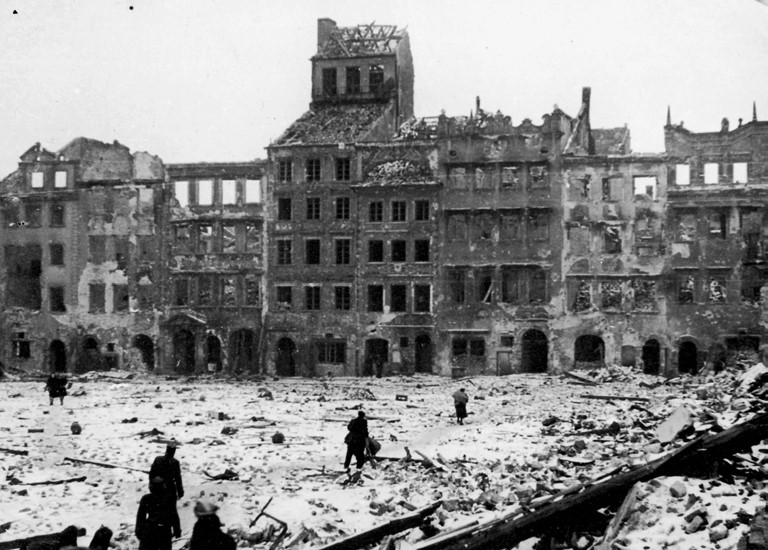
To speak today about the conservation of monuments means to once again take up a subject that is now ancient. It is a subject whose problematic has expanded considerably, beginning in the postwar years, that is, when extensive interventions, motivated by war damage, forced us to question the very criteria of conservation closely linked to the new problems of urban life. As everyone knows, the conservation of monumental buildings often degenerated into extensive stylistic reconstruction in order to recompose the forms that wartime actions had devastated or destroyed, despite the fact that such reconstructions derogated all too widely from previous aesthetic and historical cases.[2] And this happened, as we know, for reasons imposed by contingent practical necessities that could not be suppressed, as well as by influences exerted by national and patriotic traditions and popular sentiment. Obviously, however, it would not make sense to say that, in spite of everything, our experiences of culture should have imposed themselves even at the cost of denying the exceptional circumstances that also defined our present history. Thus –to cite once again an illustrious example– for reasons that transcended those of our admittedly valid theories, it happened that the face of Warsaw’s old city center was recomposed as it was before the Nazi destructions because the significance it had for the Polish nation could not be replaced and compensated for by what modern architecture would be able to provide.
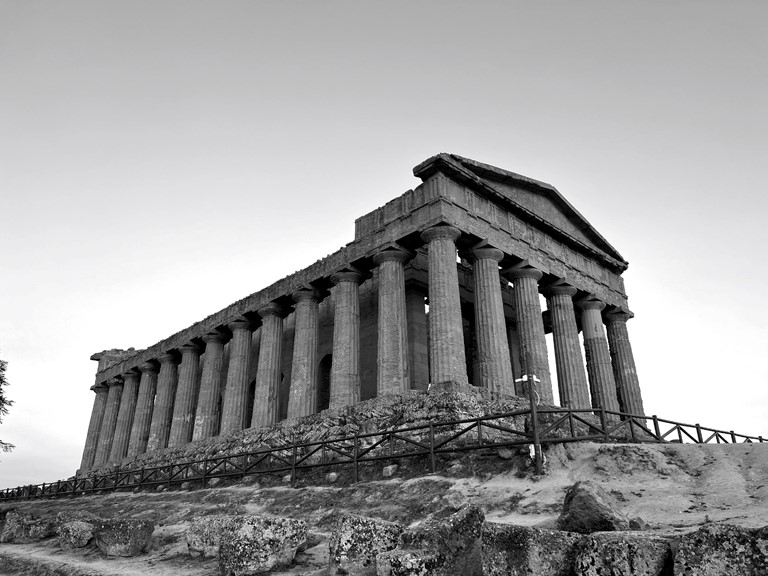
But in addition to the massive reconstructions motivated by exceptional occasions, we cannot fail to remember that, especially in the countries of northern Europe, the image of a past particularly dear to local traditions is present only because each crumbling element was progressively renewed with a new one, faithfully repeating its form. When I saw, many years ago, the cloister of Westminster, only a few sections of the walls still bore the marks of the severe decay of centuries; it is possible that today even those might have also been remade. And the same could be said of so many illustrious buildings whose artistic history, if it is to be complete, cannot hide the substantial reconstructions that were made even in the fairly distant past, so that their primitive face might continue. And for that matter, even in more favorable temperature conditions, the preservation of a more remote antiquity has motivated a whole series of successive replacements. Thus, the temple of Concord at Agrigento shows a modern history of its own, in the signs of the various restorations that have been made to it over more than two hundred years. Indeed, it may be said that for this very reason it provides a curious, if disappointing, historical record of the various methods followed to ensure the preservation of the monument while, to the layman’s eye, it seems to provide an example of exceptional survival.
Related to these remarks is the distinction between restoration and maintenance, a distinction that is purely quantitative and not qualitative, given that both aim at conservation and that cleaning dust from a painting or an engraved stone is work that demands a technique, however simple it may be. And, indeed, it will be the uninterrupted continuity of maintenance that will make the work of the restorer less compromising or substantial, since it will allow partial interventions spaced out in time and not the remaking of vast parts that long neglect has erased or made vague and uncertain.
Yet, while it is true that in many cases we have had to resign ourselves to seeing an abstract rather than a physically real vision of the primitive image, it is also true that the need for the preservation of the work of art and the document of history still continues to impose
itself with absolute rigor. And that this need continues to be felt as a prerequisite for any intervention, is confirmed by the very establishment, recently promoted by UNESCO, of an International Center for the Study of the Preservation and Restoration of Cultural Heritage. Already, the very title of this Center implies the concept of a protection that, having for its purpose the subsistence of cultural property as an indivisible whole, urges the definition and development of a new conception of the conservation of cultural property: that precisely of the meeting of general criteria and particular techniques through which the most diverse interventions can find a unified and coherent foundation. It is obvious, however, that while it is always possible to ensure the preservation of a movable object –even when it is no longer physically a participant in the present life– this is much more difficult for works of architecture, which, on the other hand, derive their sole possibility of subsistence precisely from constant participation in environmental and historical evolution.
In this sense, then, the current increase in the creation of new museums is far more often motivated by the progressive estrangement from contemporary life of the primitive tools and objects of art than by an increased and more widespread cultural need. That is, things that no longer find a place in our daily life are being saved, by transferring them, from their primitive function of use and consumption, to an atmosphere of contemplation in which they are intended to provide a testimony. And, if these represent not only their worth as works of art, but also as documents of history and custom, they become an aesthetic stimulus, in conditions expressly predisposed and, in any case, inevitably very different from the primitive ones. Thus, architecture is deprived of its furnishings; the painting, the fresco, the statue, the furniture itself move away from the palace and the church to find protection in the museum or to become the object of antiquarian trade, while the building that contained them undergoes that process of transformation, of adaptation or, even, of annihilation, which is inseparably linked to its urban destiny.
But before proceeding to consider the relationship between old and new –which defines the most topical aspects of our problem– it will be appropriate to briefly recall the modern principles of monument conservation and restoration.
Making valid reliance on the legitimate assumption of a unified vision, theories concerning architectural monuments have benefited from the most flexible and advanced experiences, already acquired in the fields of painting and sculpture.
This is why we feel today the constant need to keep in mind the data provided by the different visual arts, even if the material diversity of the intervention seems to deny the appeal to link them through a common foundation. As is well known, the orientation of modern conservation is determined by both aesthetic and historical cases, so that the whole process involved in the planning of the intervention and its practical implementation will consist in balancing and reconciling the requirements that each of the two impose on the conservator.
Regarding the greater or lesser participation of one or the other, the ancient ruin has been cited as the monument for which, exceptionally, the historical case alone dictates actions. But if we briefly call to mind some images of ruins, we find that, not infrequently, an art value is present in them, albeit in fragmentary form.
Let us recall, for example, the ruins of the Doric temples of Paestum or Agrigento and ask ourselves whether it is legitimate to say that they only have documentary value and no art value, merely because the primitive and unitary configuration no longer subsists. But, although in a different form, the same can be said for the many monuments of the medieval or modern age in which variations, mutilations and additions have made the primitive image very partial and problematic, if it ever existed. This is not to say that the ruin should and can be the object of extensive restoration of an aesthetic nature, but only to hint at the empirical vagueness into which one fatally runs as soon as one attempts to introduce categories into the immense complexity and variety of real cases. Insisting for another moment on these aspects, it must be remembered that even in the static restoration of the ruin, there intervenes a criterion of evaluation and choice whereby the addition due to consolidation or the replacement of some column drums pose problems that lead us back, inevitably and necessarily, to the aesthetic case and not only to the one that imposes respect for the integrity of the document.
It is therefore evident, from these initial statements, that the two cases operate together and simultaneously in every intervention, even if, from time to time, critical judgment assigns prevalence to one or the other.
In Italy, a recent theoretical enunciation –which I think is useful to recall here, both for its methodological contribution and its contradictions– is the one published by the Enciclopedia universale dell’arte.
It consists of two parts: the first one relating to a general enunciation and distinction of the various problems, and the second one concerning architectural conservation. The first one states, “From the historical point of view, the addition and interpolation undergone by a work of art is but a new testimony of human action and the transition of the work of art through time: in this view, the addition is not essentially different to that which is the original strain and has the same rights to be conserved. Removal, on the other hand, although it is an act also performed at a certain moment and is equally a part of its history, actually destroys a document and does not leave visible documentation of itself, and hence could lead to the destruction and, therefore obliteration of an important historical passage for the future and, in any case, to a falsification of data. Therefore, it follows from these considerations that conservation of the addition must be considered the rule, and removal the exception. This is quite the opposite of what 19th-century empiricism and the ever-returning vandals would advise for restoration.” It is important to note that, with a broader and more literary judgment, the same requirement is renewed in these words that were already expressed by the Italian Carta del Restauro, which states: “That all elements having artistic or historical value should be preserved, whichever period they may belong to, without a desire to establish unity of style or to return to the original without intervening to exclude some elements to the detriment of others; and only those features considered useless disfigurements and devoid of importance and meaning, such as the filings of windows and intercolumns of porticos, may be eliminated, but that the judgment of such related values and eliminations must in all cases have a valid justification and not rely on the personal judgment of the author of a restoration project.”
Instead, in the second part, the author of the entry Il restauro architettonico, implicitly contradicts the previous statements, assigning “to artistic value the absolute prevalence over other aspects and characteristics of the work, which must be considered only in dependence and in function of that single value.”
As can be seen, therefore, a new theory is attempted here by assigning the absolute prevalence to the aesthetic case, to be established through critical discourse, indeed the only value. Again, in order for the statement to be clearer, the author adds: “But this recognition is a critical act, a judgment based on the criterion that identifies in the artistic value, and therefore in its aspects, the degree of importance and the value itself of the work; above it is based the second task, which is to recover, through restoration and liberation, the work of art, that is, the entire complex of figurative elements that constitute the image and through which it realizes and expresses its individuality and spirituality. Every operation must be subordinate to the purpose of reinstating the expressive value of the work, since the goal to be achieved is the liberation of its true form. On the contrary, when the destructions are severe enough as to have greatly mutilated or destroyed the image, it is absolutely not possible to go back and find the monument; it cannot be reproduced, since the creative act of the artist is cannot be repeated.”
“The criteria to be adopted derive from this approach, which constitute a radical transformation and a reversal of the philological method: the need to eliminate those superimpositions and additions, even remarkable ones and having a specific linguistic and testimonial value, that could attack or spoil the architectural-figurative integrity, altering its vision.”
Here, as can be seen, the historical case is denied to such an extent, that it even takes the image that is supposed to be “saved” out of time. What, indeed, is the “liberation of its true form” if not an antihistorical statement? Moreover, to spike the misunderstanding, it speaks only of “additions, even notable and of linguistic merit, etc,” never revealing that such additions often have art value, and sometimes even outstanding value, so that the “true form” of the work, understood as that which critical judgment urges us to preserve or liberate, may even be the form from a later time and not the original one. So what, then, is this “true form”? We should recognize that in the above-mentioned statements, even the history of architecture itself is denied, in its evident reality of stratifications, variations, substitutions, additions, etc., which define the life of monuments through the centuries; a life in which the original creative personality very rarely subsists alone and whole but is critically distinguished by us in the context of other expressive values, perhaps not prevalent but also endowed with aesthetic as well as historical validity. Therefore, it is critically assessed through our care, without our being tempted by the absurd purpose of “liberating” it, except graphically, through the harmless outlines of a drawing to accompany the critical discourse.
In other words, the author fails to realize that his “liberation” fits perfectly what Viollet-leDuc said, be at least he had the merit of recognizing that the state of integrity into which the restoration operation led the monument “may never have existed.”
But that is not enough; keeping a blind eye on the complexity of the actual data and recognizing only the presence of “destructions,” “visual clutter” and “missing parts,” the author goes so far as to affirm the need for the imagination to intervene with new elements in order to restore the work to its own unity and formal continuity, taking advantage of a “free creative choice!” It is thus clear that by denying the simultaneity and dialectical coexistence of the aesthetic and historical cases lead him to enunciate another dialectical relationship: the one existing between restoration as a “critical process” and restoration as a “creative act.” But by so doing, far from proposing a new theory, the fact of going into the actual creative activity, takes away from the discourse on restoration its specificity and produces some confusion, where a distinction should have been made instead.
On the other hand, it is evident that the activity of the conservator does not end within the confines of critical, philological and constructive experience. The definition of those details that it will still be necessary to provide as a consequence of the new relationship that the intervention produces between the old and the new parts, demands a capacity for taste, even if it will simply be a matter of determining the chiaroscuro value of a stone surface or the color of a plaster; but it will be a determination constantly controlled by critical judgment and not a “free creative choice.”
Let us now speak of an entirely new requirement, even compared to a fairly recent past; that is, that of a stricter subordination of the very concept of monument conservation to the environmental context. Indeed, what best gives us the measure of our new and different behavior, related to the environmental values that define the historical and urbanistic reality of monuments, consists in the fact that we nowadays resolutely condemn the so-called “liberations” or “valorizations,” perpetrated a little everywhere until yesterday, and today still occasionally invoked. We feel a conception in the urbanistic sense of the present conservation so necessary, that we declare it impossible for a program of real care to be prepared if it is not organically provided for in the urban master plan. In this sense, I repeat, conservation, on one side, goes ahead of urban planning, while on the other the very norms of protection seek to define the particular ways in which to operate, not only in historic centers, understood as primitive and compact nuclei of ancient cities, but in those scattered elements whose effective value constitutes a heritage to be conserved. At present, this is precisely what is being fought for in Italy, namely, for or against an urban planning law that for the first time proposes regulatory criteria for the benefit of historic centers and environmental values; for the first time a valid limit is set to the free oppression that private interest has exercised and continues to exercise among us, to the detriment of cultural heritage and thus of the collective interest.
It is also equally true, however, that as soon as we come to consider the problems of monument conservation in their implications with the urban fabric, as soon as we become aware of the present need for a unified vision, in which restoration, urbanism and modern architecture would be bound together by a relationship that at no time could be allowed to be ignored, we find that our desire to conform ourselves to a historically and critically more valid conception makes our task much more complex.
The fact is that we cannot even consider the qualification of the values of the physical environment to be sufficient since, if the ancient center is easily defined by the ancient city walls –more or less recognizable in its layout even if it is no longer present– the environmental values extend from the date of their construction before the 19th-century to reach all the way back to yesterday, This means that it is to a time that is already remote for us, because it is not yet marked by that accidental congestion that some call “open urbanism” or “without form,” following a snobbish analogy, with the terms of the most recent figurative language, but in essence proposing that we accept chaos, not as a positive peculiarity, but as the inevitable destiny that our time assigns to us.
In fact, the encounter between old and new, which lies at the basis of our discourse, is not a relationship to become closer, but it is proposed as a true osmosis. And to recognize whether this is true, it is enough to recall how many buildings in the ancient centers require a work of total substitution, much more problematic than that of the restoration of a monument because it cannot be defined in a specific manner. Indeed, while for the general criteria of conservation certain norms are necessary, such as those dictated during the Athens Conference, or those foreseen in Italy by the Carta del Restauro –to which some amendments will be proposed during our sessions for the drafting of an international norm– the urbanistic encounter between old and new is susceptible to very few exhortations and positive orientations. However, the experiences made in these postwar years –alas unfortunately almost all negative– authorize us to make some suggestions.
First of all, it seems to me that the most serious damage has been produced by the excessive heights, undertaken both by replacement construction or by that which the speculation of buildings has made emerge in the green areas or on the outskirts of cities. Admitting the need for the conservation of relationships with the environment, no derogation from the average heights present in the areas of greatest interest should be allowed. And here let me remind you that for the protection of historic centers I have for many years already suggested a criterion that has found acceptance in the proposed new urban planning law in Italy. It stands to demonstrate the legitimacy of possible vertical thinning instead of horizontal thinning, which has unfortunately been followed until now, with the consequence of alienating to a considerable extent the early urban layouts. Vertical thinning –consisting in assigning, to the replacement building, lower heights than those present– while it does not reduce the number of inhabitants, given the better current use of space and the lower height of the rooms, it restores to the ancient environments the mass ratio that was present before that vertical intensification began, in many European cities, especially since the 19th century, which progressively contributed to degrading local living conditions. In this way, then, genuine environmental conservation work can be an asset to art and history values, while at the same time determining favorable conditions for healthier settlement.
However, with regard to the arguments we need to put forward, in order to better guide public opinion, I think it appropriate to recommend that the reasons concerning art should be put forward as little as possible, and that it would be necessary to insist on those concerning hygiene and public health, understood in their most modern sense, that is taking into account psychological factors that are normally neglected; it is indeed on a better common life, in any case, that both the conservation of the heritage of the past and the creation of new towns can be based, towns from which we should no longer be tempted to flee as quickly as possible.
It is hardly necessary to add that, while calls for the defense of art require a certain cultural education to be heard, those in favor of a healthier habitat can be heard and accepted by everyone.
Now, if we consider for a moment what was done for monuments and environmental values in the postwar years, we have to recognize that the countries of Eastern Europe have shown far greater solicitude, in comparison with those of the West, in preserving and caring for their cultural heritage. Those who, like me, have visited Poland, Hungary, and Czechoslovakia cannot but subscribe to this statement. Incidentally, and without mentioning the extensive conservation works –completed especially in the first two countries following the devastation of war– what is offered in them as a benefit, and I would even say as a providence in the eyes of Western visitors, is the absence of publicity, of this public calamity which, in Italy, knows no barriers and which is now the most eloquent testimony to the overpowering power of private interest to the detriment of common good.
As far as our country is concerned, it can simply be seen that if its ancient centers fall into ruins, it is because it is not those public authorities and cultural institutes whose task it would be to exercise control that decide their fate, but the large real estate institutions and those businessmen who know well the ways of corruption and the inadequacy of conservation regulations; and to those who would object to me that here I am no longer talking about conservation theory but about building abuses, which are more or less known to everyone, I would reply that if these abuses are not outlawed, we cannot seriously talk about the conservation of monuments, since the environment is not an accessory but the very life and breath of the works we want to protect.
And let us now speak of more particular circumstances which, as will be seen, will inevitably lead us back to the more general discussion. It is well known to all that we now possess the most extraordinary means of technical intervention the world has ever known. We can disengage an ancient masonry from its supporting function without it being visible; we can lighten a roof by substituting the primitive wooden structure, with agile elements of prestressed concrete or steel; frame spaces and perspective horizons by means of glass; intervene in a masonry context, formed by different elements, almost with the same delicacy and flexibility with which we intervene on the surface of a painting, etc., etc. Yet, while in some exceptional cases we do such things, the more modest and normal works of intervention –such as those consisting in the execution of a good plaster or a good layer of paint– are made difficult by the current standard of industrial production, imposed by the economy of profit and the consequent disappearance of that craftsmanship which, in times still quite recent, made possible what we might call the ordinary administration of conservation. And here one has to wonder whether, in other words, this now anachronistic craftsmanship could revive if only the unit prices –regarding the specific works related to even superficial intervention in an ancient architecture– were not the same as those that apply for current construction work. Perhaps this does not happen in other countries, however, it continues to be normal in Italy, despite the fact that the aforementioned drawback has been repeatedly denounced.
In a more general sense, current conditions register an irremediable contrast between the forms of the past and those of today. It cannot be denied that while the former always bear a handcrafted stamp, whatever the trends of taste they express, the present forms are indifferently mechanical and tend to fill the absence of surface and plastic values with the ostentation of structures, more often fake than real. The consequence is that even when socalled replacement construction introduces into the ancient fabric a modern building –even one of the same size as the primitive one– it is quite rare that this occurs without producing a substantial impoverishment of environmental values; almost always the result is similar to that of the intrusion of an inert matter into a living organism.
These problems have not been sufficiently clarified, and therefore there has been no lack of those who, precisely as a result of the aforementioned findings have affirmed the need for a clear separation between the ancient and modern environment. This is a solution that simply denies that cultural continuity without which the very conservation of architectural heritage would end up being reduced to a vain purpose, precisely because it would lack vitality and a future; without adding that the presence of scattered and important environmental values outside the ancient center stands to indicate with all evidence the absurdity of such a separation.
But the discussions –so often vainly polemical, about the meeting of the ancient and the new– bring us back to the misunderstanding that places on two opposite sides the architects who are practitioners of modern construction and those who are entrusted with the task of protecting monuments. Now, if it is true that even in today’s world nations cannot give up the aspiration to the continuity of their specific cultural qualifications, in those of ancient tradition of art and history it could be said that every architect should have the obligation to deal with the problems with which we are concerned; and that indeed from the solutions of such problems, can and must often derive the peculiarity of their production as compared with that of other countries in which the legacy of the past and the aspects of nature do not dictate a similarly peremptory or complex commitment. And this, I should repeat, without any prejudice to expressive originality, as some happily conceived works, but which are unfortunately few. In the schools of architecture themselves, training for a historical-critical culture, far from being considered an indispensable foundation for professional experience in all its directions, has so far had very little credit. On the other hand, in modern society, all aimed at the “quantification” dictated by the economics of profit, any requirement for “qualification” such as the one sought to be affirmed here, demands a difficult effort and is, therefore, very often doomed to unpopularity and lack of success. Indeed, in an attempt at easy evasion, many architects assert that, in the same way that the ancient environment appears as the result of juxtapositions and contrasts, the same can be said of that of our time, which is tantamount to denying that the question is posed today in terms quite different from those of the past, both in its particularized forms and in their operative rhythm.
Another current aspect of the misunderstanding consists in speaking of modern architecture by implying a set of positive values, when in fact the rare exceptions do not at all compensate for the boundless horror of modern construction. Instead, it is certain that a valid new architecture, understood as an expression of civilization, is only recognizable in an average number of cases.
Moreover, while on the one hand, the freelance architect turns out to be the responsible for the alienation of our heritage of art and nature, on the other hand the architect responsible for monuments continues to preach compromise –if not outright imitation– considering it as “the lesser evil” compared to the one caused by modern construction. The wrongs, which consist in a reciprocal refusal to engage in a dialogue that should be the basis for clarification and collaboration, are therefore shared. And it is significant in this sense, that while skyscrapers for dwellings, are authorized or tolerated in the vicinity of important environments and monuments, absurd restorations are still being perpetrated because of their arbitrary stylistic agenda and their denial of those just norms that recommend respect for historical stratification. Besides, a final proof of the present separation of functions and purposes is to be considered in the total absence –and I would be truly glad to be proved wrong by the facts– of the so-called militant architects at this Conference, in which organizers have nevertheless made efforts so to allow a useful dialogue to take place. It therefore seems to me that this point should be insisted upon, and that an appeal to architects of every profession for a more precise consciousness of culture can and should be one of the main purposes of our meeting.
Furthermore, continuing on this theme that is dictated by interest in everything that, being around the monument, influences or even determines its fate, one even has to wonder whether our solicitude to conserve and restore art images still corresponds to a subsisting possibility of contemplation.
One has to wonder, in other words, whether we expend our care in function of a very hypothetical future or whether it also responds to a present need. Indeed, we must recognize that even the most fleeting contemplation is made barely possible by the present urban situation; indeed everyone knows how it is far more often denied than allowed.
Already, just pausing to look at a work of architecture has become, in almost all European centers, an operation that the constant presence of vehicles now makes quite arduous; and of course, this difficulty is by no means limited to the architecture of the past; in fact, formal values are in danger of being reduced to an anachronistic aspiration even for modern architecture. And this is another aspect that, through a negative observation, brings us back to a unified vision.
So, the mentioned circumstances pose the problem of conservation of the architectural heritage in very different terms from those of the past, while conservation is –and should continue to be– the essential purpose of restoration; I say “should” because not infrequently attempts have been made to reconcile the temporary solution of traffic problems with the claimed “valorization” of monuments; and indeed not a few urban arrangements of historic centers have carried out –and still attempt to carry out– foolish demolition operations, resulting in the destruction of a stratification of great interest, without procuring any lasting advantage for traffic, but only a sure advantage to building speculation.
These seem to me to be the main problems to be discussed with architects working in modern construction, so that hypocritical evasions will no longer be possible, and our culture will derive, as is necessary, a positive increase from the examination and comparison of factual situations. And certainly, the least we will have reason to expect from a more open dialogue will be a modern qualification of architectural culture, together with a clearer definition of the activity of the conservator; an activity no longer limited to professional specialization, but necessarily extended to the ability to collaborate in a vital solution. And this, mind you, in no way contradicts the legitimate need for formal features to maintain their mark of authenticity in the juxtaposition of old and new.
But in particular –especially in the case of buildings of environmental value– the aforementioned qualification will be renewed by the fact that the current use of a building requires an intervention, especially inside, that goes far beyond pure and simple restoration, since it is a matter of making a practically valid adaptation, without which the work will cease to exist, although it will continue to be the object of protection. And, in this regard, we cannot fail to consider as unproductive –even dangerous for the very task they set themselves– the supporters of the absolute untouchability of the ancient center and environmental values; dangerous precisely because, almost as the result of a demonstration by absurdity, they must resign themselves to seeing disappear what they have not agreed to see adapted to a different existence. In this sense, naturally, psychological circumstances are added to render this already difficult issue more complex; the first one is that which allows persuasion that the truth of culture is one thing and the strategy to protect the elements of culture itself is another, perhaps negotiating, on occasion, some wise renunciation. Similarly, since we are aware of the weak participation of public authorities in the problems we care about, we frequently assume, with regard to the political and administrative authorities, a supplicating and propitiatory attitude; so that, in the end, the accomplished rescue of a monument has the air of being granted to us as a grace by those who think that their time is normally spent on much more serious and important things.
Still, and still trying to grasp, in the spirit of the times, those attitudes that suggest the terms of a new problem, it seems to me important to mention the influences –which are only apparently positive– that are exerted in our field by the cultural industry and particularly by the current relationship between the conservation of monuments and tourist activities. It seems to me that the widespread tendency of the public authorities not to disturb in the least that mental and physical laziness which, according to them, is an indispensable condition for the welfare of the working masses is worthy of consideration. There is an undeniable relationship between the sweetened stupidity of most television broadcasts and the ways in which tourist caravans are guided to the contemplation of monuments. For just as all mental effort is avoided for television, all physical effort is avoided for visits to monuments. Tourists are to be dropped off at the foot of the building they are to visit, even if this reduces or even cancels that margin liked to the environment that should instead be respected.
It should also be noted that in such programs and undertaking, what is most surprising –and even arouses a kind of admiration– is their perfect coherence within the framework of the modern consumer economy, tending precisely to eliminate any unproductive margin. The monument is no longer a historical individuality that must be protected as such, but a pure and simple object of consumption, and as a result, the very way in which it is conserved is strictly subordinate to this destination. It happens, therefore, that this ends up influencing in the worst sense the criteria of modern conservation precisely because, since aesthetic and historical demands no longer constitute the conditio sine qua non of the work of restoration, vast and undesirable reconstructions are very often perpetrated so that there is “something more to be seen” than mere ruins, and thus the consumer object better responds to its price. In this sense, it is therefore necessary to reaffirm the cultural demands of modern conservation. It is necessary to prevent, in other words, the suspension of the norms we have affirmed, and which has already happened due to the contingent necessities of postwar reconstruction, from becoming a permanent suspension or negation for the benefit of tourist “enhancement.”
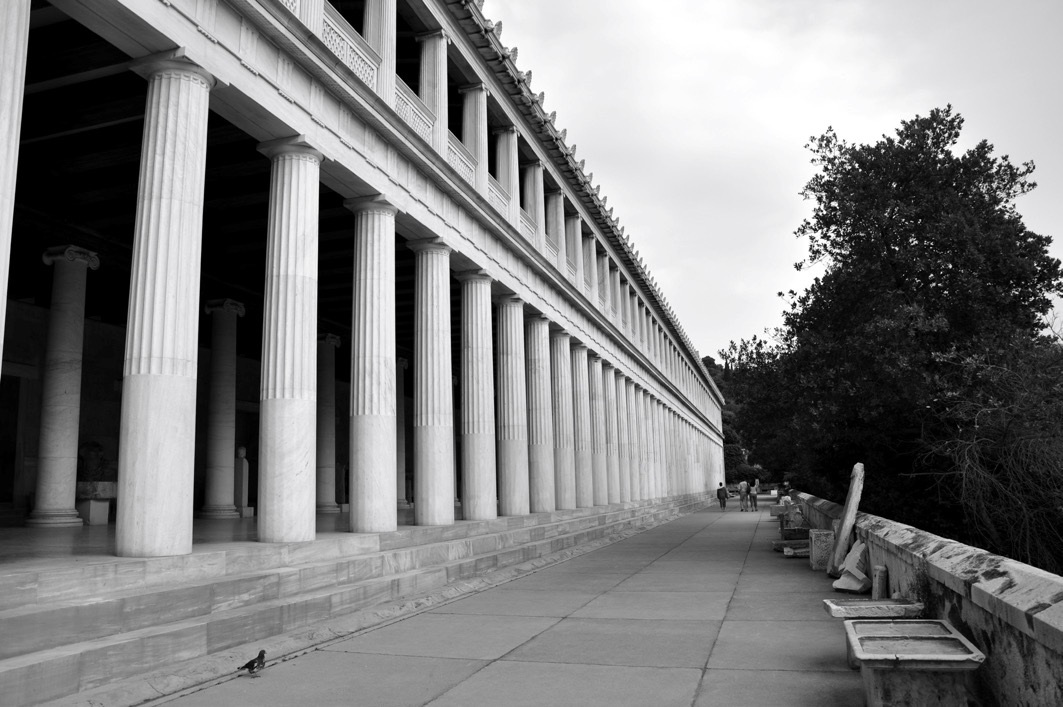
Unfortunately, numerous reconstructions and misguided restorations that have been going on for many years already in Greece and elsewhere, especially due to initiatives by the United States, provide testimonies of those interpretations. If the cold and ghostly resurrection of Stoà of Attalos, rising, new and intact, amidst the ruins of the Athenian Agora, is a legitimate thing, then it means that my discourse no longer makes sense; and, the same would have to be affirmed for that Centre created by UNESCO that I have already mentioned. In fact, from the moment that false antiquity is credited, there is no longer any need to worry about the problems of the conservation of cultural property since, as soon as such property proves to be dilapidated or is threatened with destruction, we can always remake it with every reliable approximation and verisimilitude; that is, in the same way that we replace a mechanism in poor condition with a new one.
The same applies to the basilica of Saint John of Ephesus, entirely rebuilt on the famous ruins; and equally for the very extensive reconstructions that are being perpetrated on the Athenian acropolis, always for the “edification” of the tourist now tired of seeing the same ruins, which often fail to clearly reveal enough the original structures. So here, too, it is the culture industry that imposes manipulations that are contrary to a more qualified culture, that denies those requirements of authenticity that condition the validity of any document of history; requirements that we cannot renounce since they not only express a need of our present but constitute an inescapable moral duty for the future.
I hope, in any case, that our American friends will not take it amiss and will indeed want to respond to the above remarks so that a useful clarification can be reached.
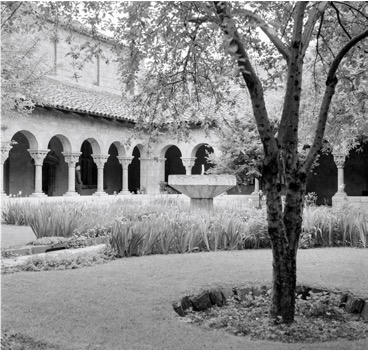
When, in America, I criticized the strange archaeological genocide composed by the Cloisters of New York, I was retorted by saying that my conception of restoration and conservation was too rigid, and that the Cloisters constituted an effective example of the European Middle Ages for so many Americans who could not allow themselves the luxury of visiting it in situ.
In conclusion, the primary reasons for our difficulties are to be found in the more general aspects of the modern crisis of civilization and culture; it is also true, however, that we should try to propose our own way, without waiting for the solution to come to us from outside. On the contrary, we should even aspire to anticipate the possible images of tomorrow without resigning ourselves to considering being “modern” as a definitive and conformist renunciation of being human individuals, in exchange for a uniform prosperity in which the “sun of the earth” is no longer present.
We do not want to conserve the monuments of the past as a rare world of images for the refuge of nostalgia, but as the living and current heritage of our present. In the same way as any modern humanistic conception, the principles of monument conservation are based on the assumption that a link of cultural and historical continuity between past and present can and should exist. And on the other hand, if in this and other fields we cease to aspire to “qualification” against the rampant “quantification,” we could no longer even speak of the subsistence of a culture.
In essence, it is a question of whether man will want to choose his own destiny, imposing himself on the instruments he has created, or whether he will resign himself to having those instruments dictate the way forward for him and conclude their own autonomous journey by marking his own demise.
INTRODUCTORY LECTURE SUMMARY
The problem of the restoration of monuments has increased greatly since the end of the war, when the vast works undertaken to repair the ravages of war often led to stylistic reconstruction which deviated excessively from former historical and aesthetic requirements. Yet, while it is true that we have had to resign ourselves to preserving only a purely conjectural image of the original appearance of many monuments, it is also true that the need to preserve works of art and historical evidence continues today to be considered as the basis for any action. Modern restoration is motivated by aesthetic and historical requirements, so that the whole process of planning and executing restoration consists in a compromise between the demands made by each. It is clear that these two requirements operate together simultaneously in every work of restoration; even when critical judgement may from time to time place greater emphasis in one of them. To give, for example, absolute priority to the aesthetic requirement is to deny the history of architecture in its still living reality of different layers, modifications, substitutions, additions, etc., which define the life of monuments throughout the centuries; a life in which original creative personality rarely survives, but is critically distinguished by us in the context of other expressive styles, which, although not more important, also have their own aesthetic as well as historical value.
*
Notes


