1. Introduction
Despite the fact that most music bachelors’ degree in Mexico are offered by universities, their curricula have not completely escaped the nineteenth-century conservatory tradition. As a consequence, their degree plans keep emphasizing musical performance and composition as the most important basis for the students’ professional formation. Unfortunately, this type of training usually favors the use of methodologies that promote the learning of music through mechanical repetition (Polanco, 2013), while providing little attention to the acquisition of resources the 21st century labor market demands from professional musicians. Some of them include having competencies in music pedagogy, music technology and cultural management (Guadarrama, 2013, 2014; Ponce de León y Lago, 2009).
Furthermore, in this context developing research competencies in students represents a true challenge. To begin with, their main concern is represented by the development and maintenance of their performance skills (Haning, 2021). Thus, the idea of carrying out research seems rather strange and the existence of this subject in the curricula is constantly questioned. Consequently, professors of this subject must appeal to every possible means to motivate and convince students regarding the importance that it will have in their professional life (Carbajal-Vaca, 2017), even though many of them may not have any interest in applying research results to solve their own career’s challenges (Bonilla Marín, 2015; Ortiz Lefort, 2010; Capistrán-Gracia, 2021).
Therefore, it is not until students graduate from their bachelor’s degree and look for options to continue improving themselves, that they notice the research competencies have tremendous value (Carbajal-Vaca, 2017). Thus, when they are admitted into a university to obtain a master's degree in some artistic area that will enable them to develop a teaching career in the university teaching system, they are faced with the challenge of carrying out research without possessing a solid academic background.
Consequently, in many cases the master’s degree has become a formative stage in which students begin to acquire academic skills, some of which should have been acquired at the undergraduate level. Of course, this also explains why in many cases graduate students show so much awkwardness delving into the core aspects of research, such as: writing a literature review, a theoretical framework or developing a research methodology (Capistrán-Gracia, 2022).
However, it was observed that many graduate students, who were also music teachers at different educational levels and contexts, felt compelled to carry out hands-on projects where they could actually take part. Therefore, when they were required to define a research problem in their area of expertise, many of them had already identified educational issues that needed to be solved, as well as pertinent hypotheses concerning the way to explain them, and were eager to do something about it. Thus, it was concluded that by departing from the situated cognition theory (Brown, Collins y Duguid, 1989) students would be able to take advantage on their experience, interests and intrinsic motivation to develop action research projects that aimed to improve music education practices (Kemmis, 1988).
Thus, this paper presents the results of three pedagogical experiences with students who not only accomplished their masters’ degrees but also made important contributions to the field of music education. The author expects the information contained in this document may inspire other graduate professors and students to explore the possibilities of this socio-critical approach to research.
2. Theoretical framework
The origins of situated cognition theory can be traced back to the writings of Lev Vygotsky, specifically, to his sociocultural theory (1986, 1988). According to him, psychological development and learning is the result of social interaction. In other words, a human being develops higher-order functions because of his/her interactions with parents, caregivers, friends, and the society in general (Marginson y Anh Dang, 2017). Based on Vygotsky’s theory, academics Brown, Collins, and Duguid (1989) developed the situated cognition theory. According to this paradigm, learning is the result of a process of enculturation in which the student becomes a member of a group or community with a specific culture of social practices. In the realm of situated cognition, students are expected to get involved in relevant learning situations, where they must solve problems in real contexts by exercising their critical thinking skills under the supervision of a more experienced tutor who teaches them strategies that can be adapted to different situations.
In this approach, learning action is followed by evaluation and deep reflection which, in turn, promotes cognitive growth. For situated cognitive theorists, knowledge is a part and a product of the activity, the context and the culture within it is developed and used. Therefore, situated cognition fosters a type of learning that promotes changes in the way in which individuals participate and understand a group activity, therefore, it is as a multidimensional process of cultural appropriation, for the learning activity involves profound thinking, affectivity in the group relations and action (Salazar Hormazábal, 2009).
On the other hand, the origins of the action research method can be traced back to the works of Lewin (1946). His ideas concerning how to solve social, economic, and political issues together with the active involvement of the community members represented a bridge that connected scientific research with social issues and philosophy. Consequently, action research implies intervening in a practical way in the resolution of situations or problems in real contexts.
There are several models of action research, all of them, to a lesser or greater degree, include the following stages: a) recognize existing needs; b) generating an action plan for improvement; c) implementing the plan; d) evaluating the results; d) deeply reflecting on them; and e) if necessary, modifying the action design as many times as necessary until the best solution or answer to the problem is found.
For example, the model proposed by Kemmis and McTaggart (1988), implies a cycle where the academic designs a plan, implements it, observes the results, evaluates and reflects on the results and, if needed, revises the plan and put it into practice again (see Figure 1). Thus, the cycle is repeated until the investigator and the participants are able to design and implement the actions that better fix the issue or situation. As Latorre (2005) explains, action research is cyclical in nature. Conducting action research may take a single cycle, but most of the time it requires several. This depends on the problem and the time available to carry out the project.
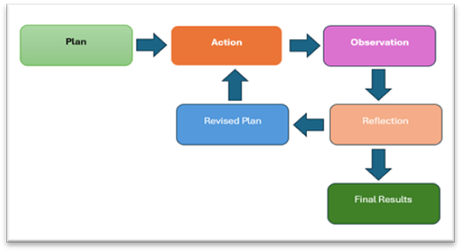 Figure 1
Action-research stages according to Kemmis y McTaggart (1988)
Own work
Figure 1
Action-research stages according to Kemmis y McTaggart (1988)
Own work
As it is shown in Figure 2, in the model of Colás (1992) the researcher must identify a need to be addressed in order to subsequently carry out a diagnosis of the situation and develop an action plan. After implementing the intervention, the researcher and the community evaluate the results achieved and reflect on the areas of opportunity in order to generate a new diagnosis and improve the action plan. When the objectives have been fully achieved, the action research project comes to an end.
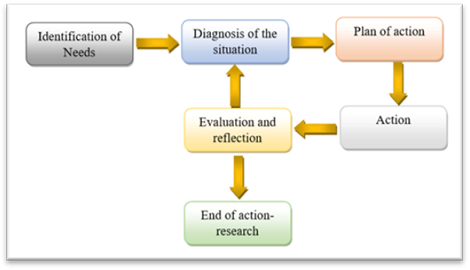 Figure 2.
Stages in the action research model by Colás (1992)
Own work
Figure 2.
Stages in the action research model by Colás (1992)
Own work
A key element in action research is the active collaboration of all participants, not only in the evaluation and reflection of results, but also in the decision making, concerning the actions that may generate a solution (Kemmis, 1988). Thus, the development of projects based on action research promotes a profound cognitive, affective, and social transformation in both the researcher and the participants involved in the intervention. Consequently, it is not a surprise that Kemmis (2009) explained:
Action research changes people's practices, their understandings of their practices, and the conditions under which they practice. It changes people's patterns of 'saying', 'doing' and 'relating' to form new patterns – new ways of life. It is a meta-practice: a practice that changes other practices (p. 463).
When applied in the field of education, action research has the goal of solving specific academic issues with the purpose of improving student learning and promoting teacher effectiveness. As explained before, throughout their experience, many graduate students have identified some kind of problem or gap in the field of music education that needs to be addressed and, in fact, are able to explain it, mention the main objective of the research project and state specific objectives. Accordantly, by directing the attention of graduate students to the weaknesses that have encountered in their professional lives, a very satisfactory middle ground is reached between their interests in teaching growth and their academic and research development. Additionally, research acquires meaning and, in many cases, even becomes a mission to be accomplished. As Phelps (1980) states: “In reality, there are innumerable significant problems in music education that need to be solved. Wouldn't it be more useful to concentrate first on those that are of immediate interest and practical value to the profession?” (p. 8).
This article presents three pedagogical experiences that show how, based on the situated cognition theory, the author was able to actively engage his graduate students in the development of meaningful action research projects that followed the model presented by Colás (1992). It is important to point out that, after analyzing the nature of the research problems, the professor and the students decided not to go back to the stage of diagnosis of situation, but to revise the plan of action instead as many times as needed (see Figure 3) until finding the right solution to the situation.
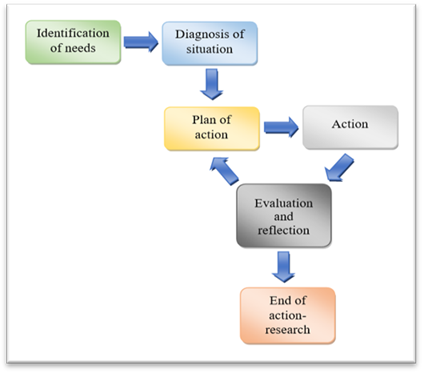 Figure 3.
Action research model by Colás (1992) modified by the author and his students
Own work.
Figure 3.
Action research model by Colás (1992) modified by the author and his students
Own work.
3. Three pedagogical experiences at a graduate level
3.1 First experience
The protagonist of the first pedagogical experience was David Reyes. He did his Master in Art degree from August 2018 to June 2020. At that time, he was a music teacher at Casa de Música, a non-formal music education program in the city of Jesús María, in Aguascalientes, México, that consisted of children and youth symphony orchestras. This project had the purpose of providing meaning to the lives of children in conditions of vulnerability, through music, and to promote the reconstruction of the social fabric.
Identification of needs
The graduate student, in his role as a researcher, observed the orchestra director and music teachers at Casa de Música used a diversity of music materials that lacked pedagogical organization and fail to gradually develop the music skills of students.
Diagnosis of the situation
In order to achieve a strict diagnosis of the situation, two studies of qualitative nature were developed. The first one consisted of a document analysis through which the planning of the orchestra rehearsals as well as the teaching materials were carefully reviewed. For the second one, were developed in-depth interviews to obtain firsthand information from the orchestra director and the music instrument teachers regarding the strengths and weaknesses they had identified in their teaching-learning processes. After analyzing the gathered data, it was concluded the program lacked a method for orchestra that helped students to develop their music skills in a systematic and progressive way. Likewise, he discovered students needed appropriate pedagogical materials that allow them to be part of a music ensemble from the very first rehearsals.
The action plan - the intervention - the evaluation of results and reflection
For this action research, it was designed a plan that consisted of creating 29 lesson plans that included 35 exercises and 12 pieces for full orchestra in progressive order of difficulty to be implemented or put into practice with a group of beginners. In order to create these materials, he established the following criteria. First, it was considered that, to be part of the orchestra, children need to develop a sense of pulse and rhythm, since these are the most basic elements of music (Pascual, 2002; Peñalver, 2013). Secondly, drawing on recent research into the neurosciences it was decided that children must develop their music skills in a playful and experiential way (De La Barrera y Donolo, 2009). Therefore, the aforementioned criteria are the main characteristics of the method and are represented by simple resources such as body percussion and beat boxing, for involvement in rhythmic ensembles can be achieved from the very first classes, without the need to use the musical instrument. Additionally, generate emotion and motivation, foster social bonds, and promote a sense of belonging to the orchestra (Capistrán-Gracia, 2020).
Finally, musical reading and writing is addressed as basic knowledge that every performer must acquire and develop in order to be part of an orchestra. Thus, the lessons and the orchestral pieces, were carefully designed so that children could get involved in ensemble work in a simple, pleasant, and organic way. Consequently, students were able to play a repertoire whose technical-musical difficulties had been addressed properly.
Furthermore, in an effort to make music a training axis to bring students closer to the use of technology (Aróstegui, 2021), it was generated pedagogical resources such as soundtracks and videos for each one of the lessons, which were implemented to promote meaningful, fun, and attractive teaching-learning processes.
The intervention consisted of 29 rehearsal sessions of two hours long each. For every teaching session, it was designed a lesson plan. After every rehearsal, the graduate student took note of any pertinent information, evaluated the rehearsal’s pedagogical and organizational outcome and reflected on the strengths and weaknesses of the new pedagogical materials. After deep and careful reflection, he made the necessary adjustments, modifications and additions in the lesson plans.
The end of the action research
At the end of the music education intervention, the master’s student finished with two sets of lesson plans: the original ones, and the ones that resulted from the modifications derived from the cycle that implied its application, evaluation and careful reflection. The main contribution to knowledge was represented by the final and carefully revised version of an Initial Method for Full Orchestra.
The reader may review David Reyes’s final paper by visiting the Universidad Autónoma de Aguascalientes repository of thesis at http://bdigital.dgse.uaa.mx:8080/xmlui/handle/11317/1949
3.2 Second experience
Diego Balderas was the protagonist of the second pedagogical experience. He did his Master in Art degree from January 2020 to December 2021. At that time, he was teaching Music History and Piano at a University in Aguascalientes, México.
Identification of needs
As a professor interested in avant-garde compositional techniques, he noticed that teachers and students did not usually integrate works of post-tonal music into the study repertoire, despite the learning impact these types of pieces may have on their academic training.
Diagnosis of the situation
With the purpose of generating a valid diagnosis of the situation, it was designed a questionnaire that consisted of open-ended questions, and Likert-type scales. The questionnaire underwent a process of content validation through expert judgement and finally, it was sent to all the students of the Music Department through Google Forms. Results revealed that the absence of a clearly recognizable melody, the lack of students’ knowledge concerning the processes of compositional construction, the absence of an easily identifiable musical form, their little acquaintance regarding the works and lives of post-tonal music composers, as well as the lack of familiarity with certain timbres and performance practices, represented some of the factors that prevented students from appreciating, assimilating, studying, and performing PTM works.
The action plan, the intervention and the evaluation of results and reflection
In order to promote the change of this situation, an action plan was developed that consisted of a workshop that was carried out during 10 weekly sessions of one and a half hours each. In every meeting were implemented a variety of teaching-learning strategies that were based on the musical expectation theory by Huron (2006), the listening processes of Western music by Meyer (1956), as well as on the meaningful learning theory by Ausubel (1980). Through this workshop 4 students majoring in music learned to appreciate the artistic value of post-tonal music, interpreted some representative pieces, and developed an authentic interest to continue learning.
After every session, the master’s student took note of any pertinent information, evaluated the pedagogical and organizational outcome of the teaching-learning activities, reflected on their strengths and areas of opportunity and made the necessary adjustments, modifications and additions to the lesson plans to make the classes more meaningful.
To evaluate the results derived from the action research, the teacher conducted focus groups and observations, and kept a field diary. The gathered information revealed this intervention significantly enriched the professional training of participants and demonstrated that it is possible to successfully fill this vacuum in their formal education.
The end of the action research
Besides the positive change in the students' perceptions concerning post-tonal music, and aside the improvement in their professional training, the master´s student designed a very detailed workshop syllabus that can be replicated/implemented by professors of other tertiary music education institutions for the benefit of their students.
The reader may review Diego Balderas’s final paper by visiting the repository of thesis of Universidad Autónoma de Aguascalientes at http://bdigital.dgse.uaa.mx:8080/xmlui/handle/11317/2465
3.3 Third Experience
The third pedagogical experience is represented by the work of Teresita Custodio. She did her Master in Art degree from January 2020 to December 2021. At that time, she was a Music Appreciation teacher at the “Manuel M. Ponce” School of Music, a public non-formal education institution that belonged to Instituto Cultural de Aguascalientes, Mexico.
Identification of needs and diagnosis of the situation
When Teresita was hired to teach the Music Appreciation class to students ages 7-12, she realized the academic program did not even have a list of contents for her to design an appropriate syllabus. In order to generate a more complete diagnosis of the situation she carried out focus groups, and in-depth individual interviews with the students, in order to know the expectations that they had concerning the subject, and the weaknesses they had detected in case they had taken this subject previously.
The action plan – the intervention – the evaluation of results and reflection
The master’s student decided to improve the teaching-learning processes of the subject, through the careful design of a subject syllabus, the comprehensive writing of lesson plans for every session as well as the thorough planning of interesting and fun music appreciation learning activities created according to the students’ cognitive level. To generate these materials, it was taken into consideration the meaningful learning theory by Ausubel (1980), as well as the existing knowledge derived from the neurosciences in the classroom (Guillén, 2014). Thus, for example, she continuously tried to connect what students already knew with the new knowledge and implemented teaching-learning activities of ludic character in order to awaken curiosity and establish a pleasant environment.
When playing, dopamine is generated, which makes the uncertainty of the game a real brain reward that facilitates the transmission of information between the hippocampus and the prefrontal cortex, thus promoting working memory. This process has no specific age to happen and helps students to improve self-esteem, creativity, well-being and socialization (De la Barrera y Donolo, 2009). Additionally, by implementing activities of ludic nature as part of educational processes, various types of emotions are awakened, which maintain curiosity and promote communication (Day y Leitch, 2001).
Throughout a semester, the master’s student implemented these materials to teach the History and Music Appreciation class to two different groups of students. In order to evaluate the intervention in a more holistic way, she gathered a thorough portfolio of evidence consisting of tests, homework assignments, essays, presentations, video recordings and photos. After analyzing data, it was concluded students had acquired an important amount of knowledge regarding music history, had developed their aural skills and were able to recognize and identify musical elements by ear, such as rhythm, pitch, texture, dynamics, harmony and timbre. Furthermore, they had also developed vital core values such as responsibility, discipline, respect, empathy and cooperation as it was demonstrated in the observations she took, as well as in the focus groups and interviews.
The end of the action research
At the end of the action research, the master’s student left an important proposal to teach the Music Appreciation class from a more practical perspective. With the help of the lesson plans and the pedagogical materials created, students will get involved in the construction of their own knowledge and will find in the classroom a space where they not only will learn topics related to the Western musical culture, but will also develop other musical and social skills.
The reader may review Teresita Custodio’s final paper by visiting the repository of thesis of Universidad Autónoma de Aguascalientes at http://bdigital.dgse.uaa.mx:8080/xmlui/handle/11317/2469
4. Discussion and conclusions
The development of the action research on behalf of the three graduate students in the context of the Master of Art degree offered by the Autonomous University of Aguascalientes, Mexico, promoted in them a meaningful learning experience in the context of the situated cognition theory (Brown, Collins y Duguid, 1989). In the three cases afore-described, the author, in his role of tutor, was able to observe and enter in his weekly records how his students demonstrated a keen and authentic interest in solving important educational issues in their area of expertise and how constantly progressed in the development of their projects.
A fundamental factor to carry out successful teaching-learning processes throughout the thesis advising sessions, was the exchange of personal experiences in the area of music education between the tutor and the tutee, as well as the constant reflection, since this allowed for the strengthening of affective ties between them, and fostered the development of a relationship as colleagues. Therefore, tutees fully understood the procedures for conducting content analysis of scientific literature to the point that they became proficient and identified themselves with the theories that supported their projects. They also showed great attitude to develop rigorous action research protocols, analyze data, review results, and draw conclusions, for they understood that the key factor to transform reality in a classroom setting depends on the careful planning, the implementation of effective teaching-learning strategies, the constant evaluation of results and the keen reflection concerning ways to improve the educational act.
The action research processes developed in a flowing manner. From the author’s perspective, there were minimal tensions between him, as a tutor, and the tutees, and they mainly consisted in their perception regarding what participants might or might not achieve during the interventions. Yet, there was always a willingness to reconcile the different approaches and come to an agreement.
Finally, students demonstrated their authentic interest in learning by actively presenting the results of their work in colloquiums and symposiums organized by the university as a way to further promote research. Additionally, their papers have not only become important contributions in the field of music education at a local and regional level, but the out coming information resulted in the publication of articles and book chapters (see list of publications in the appendix).
Finally, after the defense of their theses, the juries decided the three students must receive their master’s degrees with summa cum laude. More recently, Teresita Custodio received an honor mention in the competition for the best graduate thesis organized by the Autonomous University of Aguascalientes.
The author expects this paper will motivate professors and graduate students to use the everyday educational challenges and issues as research problems and search for their solution through action research projects. The experience will be meaningful and rewarding, and the results will contribute to an improvement in the educational practice.
References
Aróstegui, J. L. (2021). Del Benedicat Bovis al Joy to the World: economía y mímesis en un centro privado de élite. En J. L. Aróstegui, G. Rusinek, G. y Fernández-Jiménez, A. (Eds.). Escuelas musicales: Buenas prácticas docentes en centros de Primaria y Secundaria que educan a través de la música (pp. 167-194). Octaedro.
Ausubel, D. P., Novak, J. D., y Hanesian, H. (1983). Psicología educativa: un punto de vista cognoscitivo (2a. ed.). Trillas.
Balderas Chacón, D. (2023). Propuesta metodológica para el estudio e interpretación de la música post-tonal. Una investigación-acción en el Departamento de Música de la Benemérita Universidad Autónoma de Aguascalientes [Trabajo Práctico de Maestría]. Benemérita Universidad Autónoma de Aguascalientes. http://bdigital.dgse.uaa.mx:8080/xmlui/handle/11317/2465
Balderas Chacón, D. y Capistrán-Gracia, R. W. (2021). La música post-tonal. Área de oportunidad en la formación del músico académico. La Escalera-Anuario de la Facultad de Arte, 31, 57-80. https://www.ojs.arte.unicen.edu.ar/index.php/laescalera/article/view/1191
Bonilla Marín, M. (Coord.). (2015). Diagnóstico del posgrado en México: Nacional. COMEPO. https://www.google.com/url?sa=t&rct=j&q=&esrc=s&source=web&cd=&ved=2ahUKEwi7zeqXqdHxAhWGmmoFHdttB34QFnoECBoQAw&url=https%3A%2F%2Fwww.posgrado.unam.mx%2Fsitios_interes%2Fdocumentos%2Fcomepo_regiones.pdf&usg=AOvVaw3xvLZKPL4IDEFfJ080OJSO
Brown, J., Collins, A. y Duguid, P. (1989). Situated cognition and the culture of learning. Educational Researcher, 18(1), 32-42.
Capistrán-Gracia, R.W. (2017). La práctica musical efectiva. Revisión de literatura, resultados de investigación y propuesta metodológica. Recuperado de https://editorial.uaa.mx/catalogo/cac_rc_practica_musical_efectiva_9786078523092.html
Capistrán-Gracia, R.W. (2020). Educación Musical y Bienestar Psicológico en los Niños y Adolescentes en Etapa Temprana de la “Ciudad de los Niños de Aguascalientes”. ArtsEduca, 25, 105-130. http://dx.doi.org/10.6035/Artseduca.2020.25.
Capistrán-Gracia, R.W. (2021). La formación de los profesionales de la música del siglo XXI desde la perspectiva del profesorado de instrumento musical. Un enfoque internacional. Epistemus – Revista de estudios en Música, Cognición y Cultura, 9(1), 98-118. https://doi.org/10.24215/18530494e030
Capistrán Gracia, R.W. (2022). El asesor de tesis en música en los posgrados en investigación. Roles, retos, reflexiones. En I. S. Carbajal (Ed.). La musicología en la formación universitaria. Investigar para comprender (pp. 263-283). Universidad Autónoma de Aguascalientes. https://www.researchgate.net/publication/366123449_El_asesor_de_tesis_en_musica_en_los_posgrados_en_investigacion_Roles_retos_reflexiones
Capistrán Gracia, R.W. y Reyes Sosa, D. (2020). La Enseñanza Instrumental Grupal en las Orquestas Infantiles y Juveniles. Área de Oportunidad en la Formación de los Futuros Docentes de Música. Revista de Investigación y Pedagogía del Arte, 8, 1-19. Recuperado de https://publicaciones.ucuenca.edu.ec/ojs/index.php/revpos/article/view/3292/2316
Capistrán Gracia, R. W. y Reyes Sosa, D. (2020). Las orquestas infantiles y juveniles en Aguascalientes, México. Propósitos, logros, retos. En R. W. Capistrán Gracia (coordinador), Educación Musical Superior. Reflexiones, aportaciones y actualidades en investigación (pp. 31-48). UAA. https://editorial.uaa.mx/catalogo/cac_rc_educacion_musical_superior.html
Carbajal-Vaca, I. S. (2017). Educación musical superior: el desarrollo de competencias profesionales en músicos universitarios. En Memoria Electrónica del Congreso Nacional de Investigación Educativa COMIE (pp. 1-12). San Luis Potosí, México: COMIE. http://www.comie.org.mx/congreso/memoriaelectronica/v14/doc/0081.pdf
Colás, M. P. (1992). La Investigación Acción. En M. P. Colás y L. Buendía, L. (Coords.), Investigación Educativa (pp. 291-316). Alfar.
Day, C. y Leitch, R. (2001). Teachers’ and Teachers Educators’ Lives: The Role of Emotion. Teaching and Teacher Education, 17, 403-415. https://doi.org/10.1016/S0742-051X(01)00003-8
De La Barrera. M. L. y Donolo, D. (2009). Neurociencias y su importancia en contextos de aprendizaje. Revista Digital Universitaria, 10(4), 3-18.
Guillén, J. (18 de septiembre de 2014). La motivación escolar: siete etapas clave. Escuela con cerebro. https://escuelaconcerebro.wordpress.com/2014/09/18/la-motivacion-escolar-siete-etapas-clave/
Guadarrama, R. (2013). Mercado de trabajo y geografía de la música de concierto en México. Espacialidades. Revista de temas contemporáneos sobre lugares, política y cultura, 3(2), 192-216. https://www.redalyc.org/pdf/4195/419545120007.pdf
Guadarrama, R. (2014). Multiactividad e intermitencia en el empleo artístico. El caso de los músicos de concierto en México. Revista Mexicana de Sociología, 76(1), 7-36. http://www.scielo.org.mx/scielo.php?pid=S0188-25032014000100001&script=sci_abstract
Kemmis, S. y McTaggart, R. (1988). The Action Research Planner. Deakin University.
Lewin, K. (1946). Action research and minority problems. In G. W. Lewin (Ed.), Resolving social conflicts: Selected papers on group dynamics (pp. 201-216). Harper &Brothers.
Marginson, S. y Anh Dang, T. K. (2017). Vygotsky’s sociocultural theory in the context of globalization. Asia Pacific Journal of Education, 37(1), 116-129. https://doi.org/10.1080/02188791.2016.1216827
Haning, Marshall. (2021). Identity formation in music teacher education: The role of the curriculum. International Journal of Music Education, 39(1) 39-49. https://doi.org/10.1177/0255761420952215
Ortiz Lefort, V. (2010). Los procesos de formación y desarrollo de investigadores en la Universidad de Guadalajara. Una aproximación multidimensional. Universidad de Guadalajara. http://www.publicaciones.cucsh.udg.mx/pperiod/cgraduados/pdf/sin/4_Los_procesos_de_formacion_y_desarrollo_de_investigadores_en_la_Universidad_de_Guadalajara.pdf
Pascual, P. (2002). Didáctica de la Música para Primaria. Pearson Educación.
Polanco, R. (2013). La orientación académica y profesional en los Conservatorios de Música. ArtsEduca, 5, 1-7. file:///C:/Users/PC/AppData/Local/Temp/Dialnet-LaOrientacionProfesionalAplicadaALasEnsenanzasProf-6126456.pdf
Ponce de León, L. y Lago, P. (2009). Necesidades de orientación en los conservatorios profesionales de música. Revista Electrónica de Leeme, 24, 63-76. https://ojs.uv.es/index.php/LEEME/article/view/9795
Phelps, R. P. (1980). A Guide to Research in Music Education. Scarecrow Press.
Salazar Hormazábal, P. (2009). Implicaciones de la cognición distribuida y situada en el aprendizaje [Tesis de Maestría]. Universidad de Chile. https://repositorio.uchile.cl/bitstream/handle/2250/108567/fi-salazar_pa.pdf
Vygotsky, L. (1986). Pensamiento y lenguaje. La Pléyade.
Vygotsky, L. (1988). El desarrollo de los procesos psicológicos superiores. Grijalbo.