
¿Es el estado en Marruecos un estado social?
Is the State of Morocco a Social State?
Revista Tecnológica ESPOL - RTE, vol. 37, núm. 1, pp. 174-193, 2025
Escuela Superior Politécnica del Litoral
Artículos
Aprobación: 20 junio 2025
Publicación: 30 junio 2025

Resumen: La situación del desarrollo humano en Marruecos en 2025 evoca la relativa euforia que caracterizó a este país norteafricano a principios de la década de 2000. La Iniciativa Nacional para el Desarrollo Humano (INDH), lanzada en 2005 por el rey Mohammed VI, pretendía establecer una red de seguridad social para los marroquíes que se habían quedado del “crecimiento por fin en marcha”. El Informe del Cincuentenario realizó un balance de los 50 años de independencia e indicó vías para desarrollar su economía y transformar su sociedad para 2025. El informe argumentó que el país se encontraba en una encrucijada y contaba con los medios para emprender el camino de la ambición nacional compartida por todos, articulada en torno al desarrollo humano. Este artículo presenta dos definiciones de estado social y reúne un amplio panorama de datos económicos y sociales para examinar en profundidad la realidad socioeconómica de la población. El análisis compara esa realidad con las intenciones y políticas públicas declaradas por el gobierno, destaca importantes brechas en el logro de la justicia social para una gran proporción de la población. Con base en el análisis comparativo de datos, el artículo demuestra que, a pesar de la firme promoción de la inclusión y el desarrollo humano, los planes y programas gubernamentales en la práctica distan de lograr lo que proclaman. Las conclusiones identifican los factores que explican la falta de progreso hacia una sociedad más justa.
Palabras clave: Estado, justicia social, desarrollo humano, mujeres, desempleo, déficits sociales.
Abstract: The human development situation in Morocco in 2025 has evolved from the relative euphoria that characterized this North African country in the early 2000s. The National Initiative for Human Development (INDH), launched in 2005 by King Mohammed VI was intended to spread a social safety net under Moroccans left behind by "growth finally on track". The Fiftieth Anniversary Report took stock of the country's 50 years of independence since 1956 and indicated paths for developing its economy and transforming its society by 2025. The report assessed that the country was at a crossroads and had the means to embark on the path of national ambition shared by all, articulated around human development. This article reviews the social state as a framework for analyzing the subsequent discourse and practice of the social state in the Kingdom of Morocco. It presents two definitions of a social state, and draws on a wide range of economic and social data to examine in depth the socio-economic realities of the country's population. The analysis compares and contrasts those realities with the government's stated intentions and public policies to highlight significant gaps in obtaining social justice for a large proportion of the population. Based on comparative analysis of data referencing the definitional framework, the article demonstrates that, despite strong rhetoric promoting inclusion and human development, government plans and programs on the ground fall short of their proclaimed goals. The conclusions identify factors for the lack of progress towards a more socially just country and society.
Keywords: State, social justice, human development, women, unemployment, social deficits.
Introduction
The human development situation in Morocco in 2025 harkens back to the relative euphoria that characterized this North African country, located just 14 km from Europe, in the early 2000s. At the time, the National Initiative for Human Development (INDH), launched in May 2005 by King Mohammed VI, was supposed to spread a "social safety net" under the feet of Moroccans left behind by "growth finally on track". That same year, a summary document known as the "Fiftieth Anniversary Report" took stock of the country's 50 years of independence (acquired in 1956) and, above all, indicated possible paths for developing its economy and transforming its society by 2025. The report argued that the country was at a crossroads and had the means to embark resolutely on the path of a great national ambition, shared by all, and centered on human development. Now, 20 years later, despite vocal promotion of inclusion and human development, government plans and programs on the ground continue to fall short of their declared objectives.
Among Arab countries, and in the Maghreb region itself, Morocco is often portrayed as an exception, as a democracy. An economic and social democracy, with a "multi-party system", periodic local and national elections, and a parliament that has formally functioned since the early 1960s, even if it lacks significant political power and control.
However, real powers in the country are held by the King, who is neither subject to election nor politically accountable, even though he presides over the Council of Ministers - which decides the State's economic and social policies – and he is the head of the army, the head of the justice authority and the head of the National Security Council, etc. (Royaume du Maroc, Constitution of 2011, Art. 41 - 59)
Another manifestation of this "Moroccan exception" was illustrated by the form and consequences of what has been called the "Arab Spring", which was initiated and led in Morocco in early 2011 by the "February 20" movement. This movement - supported by socialist opposition parties and numerous human rights associations, as well as some associations for the unemployed - led major demonstrations in almost 150 cities, particularly in the most important ones such as the capital Rabat, Casablanca, Fez and Tangiers.
The demonstrations denounced situations of precariousness and social exclusion that had become untenable for a large part of the population across the country, in both urban and rural areas. The main demands of the demonstrators were political. These included reform of the state, independence of the judiciary, separation of politics from business and politics from religion at the head of the state - in other words, the creation of a civil state. They were also of a social nature, aiming to reduce inequalities within Moroccan society, notably with less injustice, more jobs, more schools and health care centers, more dignity, less corruption, less inequality between men and women, and so on.
In this article, we present the definition of a "social state"and review the main economic and social data in Morocco, along with their political underpinnings. Such data indicate that, while the country's leaders proclaim inclusion and human development, government programs/plans on the ground have, to date, led to nearly the opposite of what they proclaim to achieve.
Methodological note
This article examines the nature of the social state as a framework for analyzing the discourse and practice of the social state in the Kingdom of Morocco. It brings together a broad panorama of economic and social data to examine in depth the socio-economic reality of the country's population, comparing it with the official discourse of the government. The analysis compares and contrasts the reality represented by the data with the government's stated intentions and public policies, to highlight significant gaps in real efforts to promote social justice for a large proportion of the country's population. Based on this in-depth comparison, the conclusions identify the factors responsible for the lack of progress towards a more socially just country and society, as well as the situation of a long-developing country.
What is the social state?
In the following section, we briefly present two models of the social state as well as the Moroccan model.
The welfare-state model
This is a model of political and economic organization in which the State plays a central role in the protection and well-being of its citizens. In addition to the so-called regalian missions of internal and external security, such a state performs three major functions:
1. Social protection: The State guarantees social assistance and benefits (unemployment benefits, pensions, family allowances, RSA, etc.) to reduce inequalities and protect the most vulnerable, thereby guaranteeing social cohesion.
2. Access to public services: The state finances, or guarantees the financing of, and organizes essential services such as health (social security), education (public schools, universities) and essential infrastructure (roads, railroads, ports and airports, electricity, water and sanitation networks, etc.).
3. Economic regulation: the State intervenes in the economic sphere to limit market excesses, impose rules on companies (minimum wage, safety regulations, labor laws) and reduce initial inequalities in the distribution of national income through the redistribution of wealth, notably via a progressive, fair and efficient tax system.
This model developed especially after the Second World War, with states assuming greater responsibility for the process of economic development and the well-being of their citizens[1]. However, since the 1980s, many countries have reduced the role of the welfare state under the influence of so-called neo-liberal policies (notably under Prime Minister Margaret Thatcher in the UK - 1979-1990, and Ronald Reagan in the USA - 1981-1989).
The social-democratic (or universalist) state model
It is characterized by:
· A high level of social protection that covers the entire population, regardless of an individual's labour market status or family situation;
· A wide range of public and social services;
· A major demarketing effort (i.e., making non-tradable goods and services available to the population, such as water, health and education), through compensation systems (redistribution of wealth) and the setting of strict rules - in terms of wages, social protection and working conditions - for economic players;
· The aim is to achieve greater equality between citizens, so as to reduce social stratification and ensure a degree of social justice.
In reality, these two models are hardly dissociated from each other, and in any case, they converge in the sense that both aim - at a given stage of development of the liberal market economy - to ensure social cohesion, a basic immaterial factor necessary for the development of any economy. alongside the physical factors of labor, capital and natural resources.
The Moroccan model
Without referring ideologically or theoretically to either of the above two models, the social state, as supported by the liberal government that the King of Morocco has put in place from September 2021, boils down to a Government Program comprising a set of promises. The latter ''indicate the social dimension of future public policies, which can be deduced from the government's commitments to create one million net jobs over the next 5 years (between 2021 and 2026), activate comprehensive social protection, lift one million families out of the cycle of poverty and fragility, the protection and expansion of the middle class, the creation of economic and social conditions for the emergence of a middle class in the rural world, and the universalization of primary education for the benefit of all children from the age of four, with the establishment of permanent and effective governance for quality control; and the reduction of social and spatial disparities''(Akhannouch, 2021).
A review at Morocco's economic and social performance up to the year 2024 reveals the gap between the commitments made and the results achieved over the years. In other words, a fragile economy, dependent on variations in annual rainfall levels, and a precarious, highly unbalanced social sphere.
Morocco in economic figures and social conditions
Assessing the human development situation in Morocco in 2025 requires any objective observer, or researcher in the economic and social sciences, to take account of the relative euphoria that characterized this North African country in the early 2000s.
At the time, the National Initiative for Human Development (INDH), launched in May 2005 by King Mohammed VI - who came to power following the death of his father in 1999 - aimed to create a social safety net for marginalized populations, at a time when it was felt that economic growth was finally beginning to take a stable course. In the same year, a synthesis document, known as the "Human Development Report" or "Fiftieth Anniversary Report", drawn up by a host of economists, sociologists and other academics, took stock of the country's 50 years of independence (gained in 1956) and, above all, indicated possible paths for developing its economy and transforming its society by 2025.
In its foreword, the report argued that "Our country (Morocco) is at a crossroads. It now has the means to embark resolutely on the path of a great national ambition, shared by all, and built around human development. To achieve this, the national community has an ardent obligation to make coherent choices, accelerate the pace and deepen the scope of reforms, and make a definitive break with the practices and behaviors that have hitherto thwarted its development'' (Royaume du Maroc, 2005, p.31).
Morocco's economic figures: weak growth over the long term, uneven growth in the short term
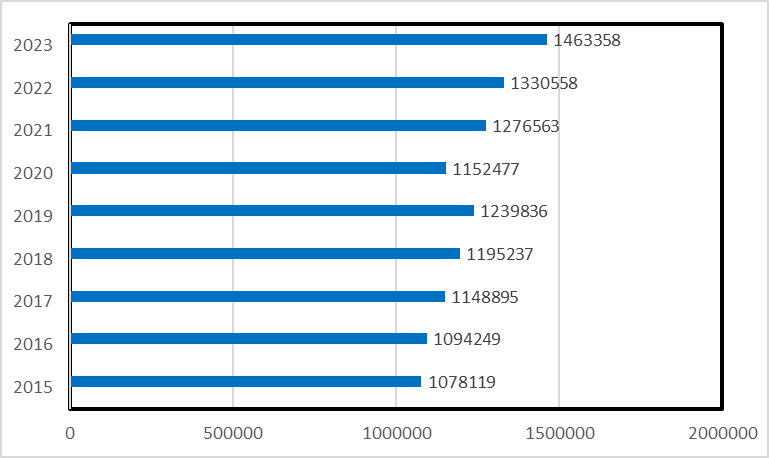
As the graph below shows, Morocco's Gross Domestic Product (GDP) - the total wealth produced by the country - is estimated to have risen by almost 36% in 8 years. In 2023, average GDP per capita will be just over 3,700 dirhams, or around 3,500 euros. This corresponds to 1/35th of the GDP per capita in Switzerland, and 1/9thof the average per capita in the European Union. However, price rises have exceeded 30% over the same period, with food price inflation of over 20% in 2022 alone (HCP, 2024). This has had a direct impact on the purchasing power of the poorest and most vulnerable sections of the population, estimated to number over 20 million.
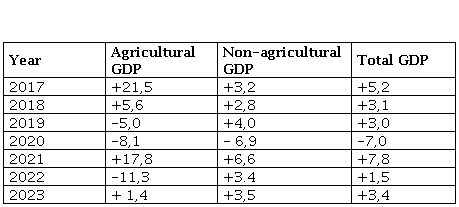
Furthermore, as shown in the table below, the annual growth rate of overall GDP remains strongly correlated with agricultural GDP. The latter remains totally dependent, year after year, on the evolution of rainfall. In other words, the evolution of the Moroccan economy's main aggregate - where agricultural value added accounts less than 13% of GDP - remains intimately linked to changes in climatic conditions. Nature, that is.
In parallel with this finding, a national survey of household incomes carried out between 2019 and March 2020 - just before the Covid 19 health crisis - highlighted a marked inequality in the distribution of per capita income, according to living environment and population category. In 2020, per capita income in rural areas represented less than 2/3 (62%) of per capita income in urban areas, while the wealthiest 20% of the population had more than half (53.3%) of national income, compared with 5.6% for the least well-off 20% (HCP, 2024).
Such magnitudes - with their continued dependence on climatic hazards, their absolute and dynamic weakness and their unbalanced structure between regions and social categories - speak volumes about the financial capacities that the Moroccan public authorities have given themselves to achieve the work of a "social state", i.e. human development.
So, broadly speaking, nothing very significant in terms of social development seems to differentiate the periods before and after 2000. Above all, Morocco, now with a population of almost 37 million (HCP, 2024), has remained under constant threat of "the occurrence of a serious external or internal crisis" (according to the same fiftieth anniversary report), as happened with the global financial crisis of 2008/2009, with the Arab Spring movements of 2011, with the Coronavirus crisis – first identified in China at the end of 2019, and began to affect North Africa on March 2, 2020, when the first case of contamination by the virus was confirmed in Morocco - or with the inflationary effects that followed the start of the Russian (and Western) military intervention in Ukraine in February 2022.
Morocco's social shortcomings: the consequences of the government's economic and political choices
Despite the economic weaknesses mentioned above, or because of them - as a kind of projection towards a dreamed-of but still unattainable future - Morocco adopted a constitutional text 15 years ago, following the "Arab Spring" protests in its cities, making social issues a cornerstone of state action.
Also, it is specified in Article 31 of the Constitution adopted on 1 July, 2011 that:
''The State, public institutions, and local authorities endeavour to mobilise all available resources to ensure that all citizens, irrespective of gender, have equitable access to the conditions necessary for the full enjoyment of their rights:
- to health care;
- to social protection, medical coverage and mutual or state-organized solidarity;
- to modern, accessible, quality education;
- to education on attachment to Moroccan identity and unchanging national constants;
- to vocational training and physical and artistic education;
- to decent housing;
- to the work and support of public authorities in the search for employment or self-employment;
- to access to public office based on merit;
- to access to water and a healthy environment;
- to sustainable development.’’
The health crisis of 2020/2021: a full-scale revelation of Morocco's social deficits
The apparent courage of such a constitutional proclamation - in which the State undertakes to do everything in its power to give the population access to the essentials of basic services and benefits, education, employment and water - will quickly come up against the wall of the country's social reality, and the contradictory nature of the policies pursued there over previous years/decades.
The closure of all land borders by the Moroccan authorities, and the concomitant suspension of air and sea transport of people, suddenly turned Morocco into a kind of island where all its inhabitants found themselves locked in, forced to live in autarky. All of a sudden, this gave rise to a widespread fear of their country's weaknesses, of its dependence on foreign countries, which had extraverted its economy and made openness to foreign markets a dogma. But it also made many citizens realize that they belong, in the final analysis, to the same human and social group, and that none of them can find - at least for a while - an escape elsewhere, whether for healthcare, study or work.
As a result, the perception of society as a whole has suddenly become different, a mixture of fear and empathy towards those living in confined conditions made extremely difficult by the state of financial and social precariousness in which they were already living before the crisis. A state covered by what looks like political propaganda through recurring tunes of "everything's fine", and in any case, "everything's better than with our neighbors". (In the Maghreb and the rest of Africa).
And it is precisely in the context of this new perception that many Moroccans have begun to understand, for example, that the informal sector is far too predominant in the country's economy, and that most of the jobs available are informal, insecure, low-skilled and low-paid. The same Moroccans have also begun to feel that the imbalances in the distribution of the wealth produced by the country are very great. Far too great to be sustained indefinitely. And, intuitively - as if scalded by the upheavals of the Arab Spring - the State perceived the danger that the strict confinement of the entire population, decided on from mid-March 2020, could result in violent movements by the poorest sections of the population, effectively unemployed and/or without sufficient income, Hence the huge deployment of security forces all over the country's main cities, where citizens also noticed the sporadic presence of army tanks, a sort of confirmation that it's not far from social injustice and deficits to violence and revolt (Lahlou et al, 2022).
The faces of social fault lines in Morocco
In 2005, a summary of the aforementioned fiftieth anniversary report stated that: "An uncompetitive economy, with a volatile and insufficient rate of growth, would lead to a worsening of unemployment at national level, with strong repercussions on poverty, vulnerability and exclusion. In urban areas, one working person in four and one graduate in three would be unemployed in 2025 if the growth rate remained at its trend level. Unemployment would continue to affect more women and young people. The informal sector would develop in response to the shortcomings of the modern sectors of the economy and as an alternative means of regulating the effects of globalization. Budgetary room for manoeuvre is likely to shrink, especially as the windfall from privatizations gradually dries up. This could have an even greater impact on government investment spending and progress in infrastructure" (Royaume du Maroc, 2005).
And in fact, for the purely economic aspect, as mentioned above, as for employment and unemployment, health, schools, migration or basic public services such as access to water, the a priori "pessimistic" predictions set out in part here have been met with short-term policies. These were (are) carried out under the supervision of the administration, broken down by sector, with no overall coherence and, above all, never subject to control.
In what follows, we briefly review relevant data relating to employment and unemployment, health, education, migration and access to water.
Employment and unemployment
As a link between economic growth and employment trends in an economy, the prevalence or otherwise of unemployment indicates both the success and failure of the policies pursued at both levels. In Morocco, both the persistence of a high unemployment rate, and even its worsening over the last period, as well as its structure by category, express a situation of failure to absorb the demand for labor expressed by the population. This is despite the fact that the activity rate (people actually employed or looking for work as a proportion of the total population) at national level is just under 43%, and that the rate for women is just over 18% (18.3%), i.e. just under one woman in five is actually employed or looking for work.
Overall, by the end of 2024, the number of unemployed people in Morocco had risen to 1.645 million (13.7% of the working population), compared with 1.549 million (12.9% of the working population) in 2023. This level of unemployment, the highest ever recorded in the country, has risen over the past seven years by almost 30%, from 10.2% in 2017 to 13.3% in 2024 (and even to 13.7% in December of the latter year – see Figure 2 below).
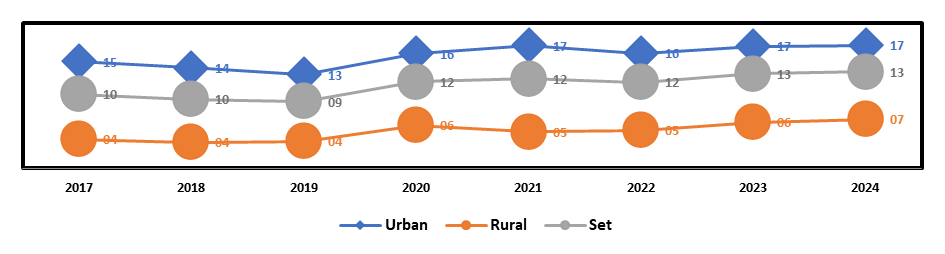
As for Figure 3 below, it shows two important facts, both of which are imbalances to the detriment of young jobseekers, as well as women. While the national average unemployment rate was 13.3%, the unemployment rate for 15-24 year-olds was almost triple that in the same year, at 36.7%.
In 2024, the female employment rate stood at almost 20% (19.4%), i.e. one woman in five. Taking into account the female activity rate, itself below 20%, this means that less than 16% of Moroccan women of all ages are actually employed.
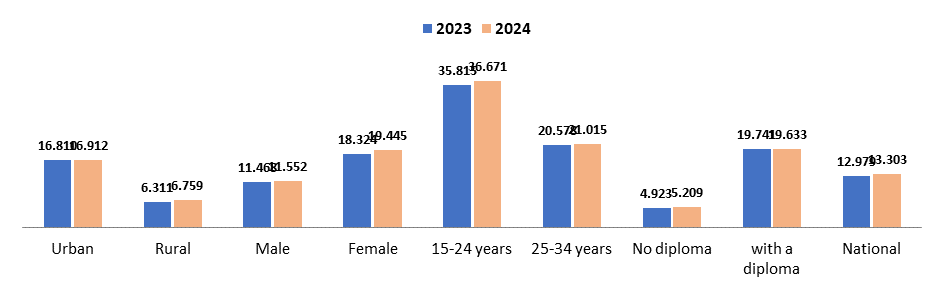
Figure 4 below shows two concomitant elements. In fact, two constants in the Moroccan labor market. These are the unemployment rates among "no diploma" holders and among holders of vocational training or higher education certificates or diplomas. In the former case, the unemployment rate, which can be described as full-employment, stands at just over 5%, while in the latter it averages over 25%, and reaches over 31% for specialized and higher technicians.
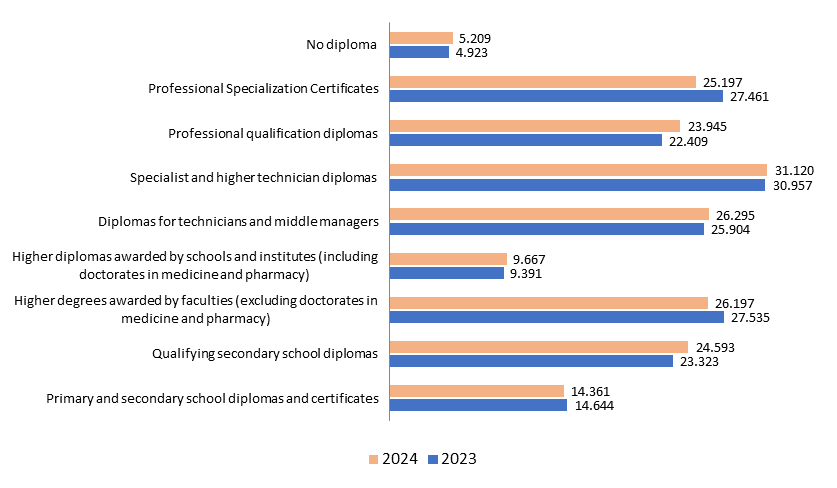
Such a configuration, while explaining the low level of labor productivity in the Moroccan economy and, incidentally, part of the slow growth in value-added generated by it, also means that the national education system is operating at a loss. This is because the education system produces unemployed people, either because the training it offers does not match the needs of the job market, or because the latter is reluctant to take up skilled jobs.[2]
This observation, fraught with consequences, leads us to the deficits in the Moroccan education system. Another social flaw in Morocco's public policies.
Morocco's education and vocational training system, the country's other millstone around its neck
The Moroccan government has made a considerable financial effort in the field of education. Until the end of the 1970s, the national education system generally fulfilled its missions. Despite the considerable deficits inherited from the colonial period - lack of financial and human resources; large numbers of young and not-so-young people left behind; linguistic problems, with a strong tug-of-war between the Spanish and French languages of the former colonists, and the local Arabic dialects and Amazigh (Berber) languages, etc. - and despite the strong demographic growth of the 1970s-1980s, it succeeded in widening Moroccans' access to education. It also provided the administration and the national economy with the managers needed to replace the foreign managers who left after independence in 1956. Moreover, for a time, education was a real channel for social mobility, opening up to the world, access to modernity and the production/strengthening of social ties" (Chakhrati & Amsidder, 2025).
However, from the early 1980s onwards, "the education system entered a long crisis, the most obvious symptoms of which are school wastage, the relapse of school leavers into illiteracy, the decline in civic sense and critical thinking, unemployment among university graduates, and the weakness of basic learning (reading, writing, arithmetic, languages, communication). Despite, and sometimes because of, a series of reforms, sometimes improvised and more often than not incomplete, the education system has become a heavy, unprofitable machine, producing graduates ill-prepared for the changes and demands of the modern economy and society. The system has ended up producing a multi-speed school, whose performance deteriorates the further you move away from the centers of major urban agglomerations" (Royaume du Maroc, 2005).
In fact, in addition to the observation made in the section above that, in the final analysis, "the less training you have in Morocco, or the less progress you make in training, the more likely you are to find a job". Two other observations are worth highlighting when discussing the failure of education policies in Morocco.
Thus, while the Moroccan government spends nearly 5% of the country's GDP (Ministry of Finance, 2024) on national education, i.e. more than the average for Arab countries or countries with similar economic development, only:
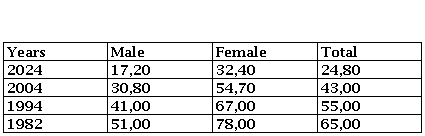
- The illiteracy rate is still high in the country. In 2023, one in three Moroccans over the age of 15 (around 34.2%) was illiterate, i.e. unable to read, write or do simple calculations, according to the Cour des Comptes annual report for 2023-2024. However, this rate represents a relatively significant - albeit very slow - reduction compared to 2004, when it stood at 47.7% (Tel Quel, 2024).
In addition, there's a strong imbalance here, with more emphasis on injustices against women.
As shown in the table below for the illiterate population aged 10 and over, the average illiteracy rate among women is almost double that of men. Even so, this rate has fallen sharply for both sexes since 1982.
- Furthermore, in 2023, the HCP recorded that almost half (48.2%) of the working population in Morocco (and 71.6% of the working population in rural areas) had a level of education equal to or lower than that of basic schooling, i.e. a level devoid of any cognitive or professional aptitude.
- According to the HCP, one in four young Moroccans aged between 15 and 24 will be NEET (Not in Education, Employment or Training) in 2022, i.e. 1.5 million people. This figure underlines the inadequacy of public strategies and policies dedicated to the socio-economic integration of this particularly sensitive and vulnerable category. Such vulnerability is linked in particular to two determining factors, the first of which is school drop-out between primary and secondary school levels. In 2022, it was estimated that an average of over 331,000 pupils left school prematurely each year, without any diploma or educational qualifications, which represents a loss of both financial resources allocated to schools and human capital. The main reasons for this are failure at school, difficulties in accessing educational establishments (lack of roads, water and heating in schools, extreme poverty among parents, especially in rural areas, etc.), as well as a significant lack of vocational training opportunities. The second is when school-leavers enter the job market, where first-time job-seekers account for nearly 6 out of every 10 unemployed.
The healthcare system: a qualitatively and quantitatively deficient system, reinforcing/prolonging regional imbalances
The number of beneficiaries of the Compulsory Health Insurance (AMO) scheme, introduced in 2021, and of the National Social Security Fund (CNSS), has reached more than 24.7 million people, according to a communication made by the Moroccan government in February 2025. This number includes 3.1 million people in the public sector, as well as more than 11 million newly insured people who are unable to pay into the health insurance system, and whose contributions have been paid by the public authorities through an annual budget of 9.5 billion dirham, or almost 900 million euros (h24 info, 2025). Such an announcement expresses the social commitment of the Moroccan authorities. It is, however, weighed down by certain highly restrictive features of the Moroccan healthcare system.
Thus, in parallel with the low per capita national income and its highly unequal distribution between different regions and social categories - as mentioned above - it should be stressed that, until recently (i.e. the year 2021, when AMO was introduced), the burden of healthcare expenditure fell largely on households.
In this sense, according to a Ministry of Health report on the subject, it appears that households' direct contribution towards covering their healthcare costs amounted to 45.6% in 2018 (Ministry of Health, 2019). Adding the same households' health insurance contributions (14.3%), their share of healthcare expenditure rises to 59.7% of their disposable income.
Excluding social security contributions, the total individual expenditure on healthcare in Morocco in 2018 was 489 US dollars. By international comparison, this represented less than half the healthcare expenditure of a Lebanese person.
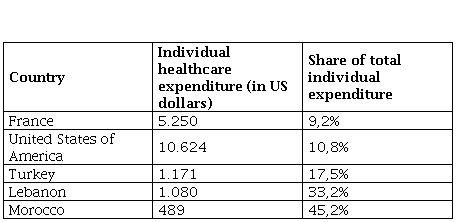
This financial situation is made even more restrictive to access to healthcare in Morocco by the low number of doctors per capita in the country. The country has just 8 doctors per 10,000 inhabitants, compared with a world average of 17.2 doctors per 10,000 inhabitants (OMS, 2022).
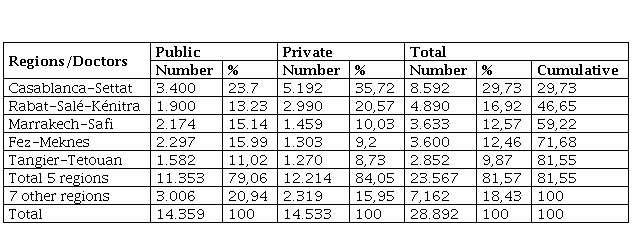
For the rest, the table above shows that, more than the relatively small number of doctors available per capita, it is the highly unbalanced geographical distribution of these doctors across the country that makes healthcare services difficult to access for a large proportion of the population. Those living in rural areas, far from the main cities, are generally the poorest. Overall, Morocco is a medical desert, extending beyond 5 regions/urban centers where more than eight out of ten doctors are based nationwide.
This situation of regional under-medicalization is further exacerbated by the fact that almost ten thousand Moroccan doctors work outside the country. This has fuelled migratory movements - including of skilled workers - making Morocco one of the most important emigration countries in the region. This phenomenon adds to the very unsocial nature of the country's public policies, as well as to the dependence of its economy, which continues to be financed to the tune of 8% by savings transfers from its citizens living abroad.
Emigration from Morocco, another facet of exclusion and the failure of social policies
From the early 1960s onwards, Morocco became a country of emigration, due to its historical ties with France and Spain, the two powers that occupied the country between 1912 and 1956. Secondly, because of the convergence between the great need for manpower expressed by certain European countries such as France (ILO, 1963) and Belgium (RTBF, 1964) - and the country's own economic and social policies. In the 1970s (Ministère du Plan, 1973), these policies had explicitly incorporated emigration as a means of limiting the pressure of job demand on the local labor market, and as a source of financing for the national economy.
Until the mid-1990s, there was no methodical monitoring of, and therefore no precise statistics on, emigration from Morocco to Europe. Until then Europe had been the main destination for Moroccan emigrants. However, according to estimates published by the OECD (OECD, 2017), the number of Moroccans born in Morocco and living abroad was around 650,000 in the 1960s, rising to around 800,000 in the following decade, before reaching just over 1.5 million in 2000 and 3 million in 2010, or almost 9% of the country's total population that year. These data reveal a very sharp acceleration in Moroccan migration from the beginning of the current century, with between 120,000 and 150,000 Moroccans leaving Morocco each year between 2000 and 2010.
For its part, the HCP, in charge of collecting statistics in Morocco, claims that there were 3.3 million Moroccans living abroad (Marocains résidant à l’étranger - MRE) in 2006, a figure that would have risen to 5.4 million by 2020, an increase of over 63% in the space of 14 years.[3]
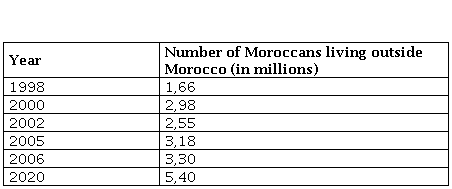
These data, as presented above, show a very sharp acceleration in Moroccan migration over the last two decades, with, in particular, the number of residence permits (corresponding to regular migration) granted to Moroccan migrants in European Union countries varying between 120,000 and 150,000 annually, since the 2000s (Eurostat, 2019).
In a survey carried out between 2018 and 2019 by the HCP (HCP, 2020), it emerged that the continued departure in numbers of Moroccans abroad over the years is due to three main reasons: 1) the search for employment and better working conditions; 2) studies and, 3) family reunification and marriage. According to the same survey, more than half of MREs (53.3%) left Morocco for economic reasons, and almost a quarter (23.4%) to pursue their studies abroad. The remainder left for social reasons (mainly family reunification and marriage) or political reasons (lack of political and/or religious freedoms, lack of respect for individual rights, etc.).
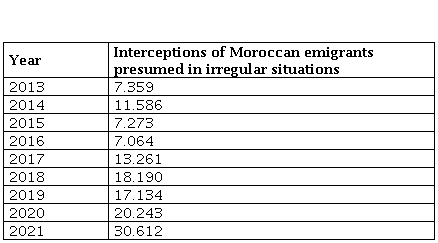
The numbers and other quotients quoted above speak for themselves when it comes to economic and social policies which, over 60 years ago, saw emigration as a temporary solution, but which ended up becoming a subject of conflict with Europe, particularly in terms of the "irregular migration" of Moroccans seeking a "better life elsewhere".
The latter remains relatively high, and even seems to have worsened with the health crisis of 2020, as shown in the table below, which shows that the number of Moroccan migrants attempting to leave Morocco irregularly increased by more than 3.5 times between 2016 and 2021.
Access to water
The ideologically and financially asocial nature of public policies in Morocco is particularly striking in the case of a basic service that is vital to the population: access to water and sanitation. In this sector, there is a complete gap between the rights proclaimed, both inside and outside the country, and what is actually applied.
Until the last decade (2010-2020), Morocco was one of only 13 countries worldwide (Water words, 2023) to have constitutionalized the right of access to water (see article 31 of the constitution, mentioned above). In the same vein, and both before and after the constitutionalization of access to water for all citizens, Moroccan lawmakers held, in the country's first water law, published in 1995, and then in a second, published in 2016, that ''water is a public good that cannot be subject to private appropriation'' (Ministry of Finance, 1995), ''nor to transaction by sale and purchase'' (Official Bulletin, 2016). Morocco also joined the community of nations when, on July 28, 2010, the United Nations General Assembly recognized "access to quality water and sanitation as a human right" (Nations Unies, 2010).
In practice, however, a completely different approach was followed, that of the State's offloading of this basic public service. In this context, the abandonment by the State of water, sanitation and electricity distribution services in Morocco took the legal form, from 1997 onwards, of "Delegated Management". Although there was no legal framework in place at the time (CESE, 2015), this was to result in the gradual transfer to private capital - in this case, to two major French groups - of the distribution of the relevant services in three of Morocco's largest urban centers, Casablanca, Rabat-Salé and Tangier-Tetouan.
Thus, in 1997, Lyonnaise des Eaux took control of the public water company (Régie Autonome de Distribution - RAD) in Casablanca; the former RAD became Lydec. In 1998, the same operation was carried out in Rabat for the benefit of Spanish and Portuguese investors, who had never before been involved in the water sector, even in their own countries.
That same year (2002), Veolia Environnement-Maroc took over management of the two water utilities in the northern cities of Tangier and Tetouan. Thus, in the space of 6 years (1997-2002), public service delegation for water (and electricity) covered 50% of the volume of water distributed - and wastewater treatment - in Moroccan cities.
Introduced for essentially economic, financial and ideological reasons, delegated management was intended to "relieve the State" of the financial and "managerial" burden associated with urban water and electricity distribution, reduce the time it takes to connect "users/customers", and facilitate and reduce collection times.
Very quickly, however, the economic and "social" principles behind the decision to use the legal mechanism of delegated management - which in effect amounts to privatization of the service - came up against the poverty of the population, especially in the outlying districts of the urban centers concerned. And the principles of consent to pay, full cost recovery and "water pays for water" were applied to all subscribers. This application was made all the more painful for the population by the fact that, at the same time, the State introduced VAT on water and sanitation in 2006 (Ministry of Finance, 2006). The opérations de branchements sociaux (costing rates, technical measures, and regulations to ensure utility service connections for all) which were intended to facilitate access to the network for the poorest, failed to deliver the expected results. In the country's economic metropolis, Casablanca, for example, 10,000 new connections per year were announced annually, but the number of new connections actually made did not exceed 1,250 between 1997 and 2007.
It's as if the discourse around the right of access to water, water as a common good, and water as a non-market good, which can be "neither bought nor sold", is aimed at international public opinion. And it is invited only to better cover the liberal bias of public policies in Morocco, which are more focused on "covering costs" and the financial profitability of the actions undertaken than on their social effects.
And, in fact, these policies - with regard to distribution services as with any other basic service - take the exact opposite direction to the official proclamations of faith. The latter appear, in the final analysis, to be no more than a cover for the true ideological foundation of the Moroccan state. That of a liberal state acting in the social sectors, or qualified as such, only to better serve the interests of private capital.
In fact, if we omit this, we wouldn't understand why the management of water and liquid sanitation and the distribution of electricity have been delegated to private capital in some of the country's major conurbations, namely Casablanca-Mohammadia/Rabat-Salé/Tanger and Tétouan. Nor do we understand why freshwater springs - community resources for centuries - have been handed over to private individuals without further ado (in 2006/2007, in the case of Aïn Sultan, in the Fès region, and in 2010, in the case of Ben S'mime, in the Ifrane region. These two springs, whose water abstraction represents a veritable spoliation of the populations who used to live on them, come on top of, for example, the more ancient transfers of the natural waters of Oulmès/Sidi Ali, in the Middle Atlas, Sidi Harazem or Aïn Fès, in the center of the country (Lahlou, 2024).
Conclusions
Morocco - a country with 3,500 km of coastline among the world's richest in fish, the world's richest phosphate reserves, the fastest train on the African continent, inexhaustible solar energy potential, one of the largest ports in the Mediterranean and a motorway network that compares favourably with many European networks, etc.... - despite all this, occupies an unenviable position when it comes to the human development indicator presented as a benchmark for social development by the UNDP.
A review of the country's 7 key social and socio-economic sectors and their situation in 2025 provides ample evidence of this, while confirming the most pessimistic projections announced by the authors of the Fiftieth Anniversary Report of 2005, referred to several times in this text.
This report also stated that ''The uncertain effectiveness of governance (could) be detrimental to the country's development if the shortcomings inherent in the public management system are not corrected: corruption, dysfunctional justice system, lack of program evaluation culture, compartmentalization and dispersion of sectoral solutions and ministerial departments, lack of planning and time management in public policies'' (Royaume du Maroc, 2005).
''The scale of deficits could be exacerbated. A financial crisis or social crises would become likely. A financial crisis, which could take the form of a deterioration in the current account of the balance of payments or an accumulation of record budget deficits, in the absence of alternative budget revenues, would place Morocco under international conditions (adjustment programs). As for social crises, they would be triggered in particular by a succession of worsening droughts, persistent and worsening unemployment, deepening inequalities, a decline in freedoms and the rise of fundamentalism. The consequences for human development are far from positive" (Royaume du Maroc, 2005).
Now, 20 years later, and since before the Covid-19 pandemic added its devastating economic and social effects to those of the drought and other crises - double-digit inflation, disruption of commodity imports, rising prices for energy and certain basic materials, etc. it is evident that the "coherent choices" referred to in 2005 have not been made. Or they have been incoherent choices, in any case economically and socially inefficient. And even when some have been made, they have not been followed by effective policies or operational projects, or they have been sidetracked by poor political and administrative governance. In many cases, they have also been undermined by a lack of oversight on the part of the authorities responsible for implementing them, or by the persistence of contingent phenomena that continue to plague Moroccan society, notably corruption and/or nepotism.
Over the years, these trends became so obvious that the Head of State was compelled to voice it himself, announcing in a speech to parliament in 2017 the failure of the "Moroccan development model" followed until then. Thus, according to him, "the last few years have revealed the inability of our development model to satisfy the growing needs of some of our citizens, and to reduce social inequalities and spatial disparities" (Maroc Diplomatique, 2017).
The Human Development Index (HDI), a summary indicator that ranks countries worldwide according to their social performance in the broadest sense, shows that Morocco has been treading water, or nearly so, since 2005. In that year, its HDI was equal to 0.631, and in 2018 it was still only 0.676 - an increase, in 13 years, of 0.045 points - and in 2022 (UNDP, 2024), the same HDI was 0.698, ranking it 120thin the world (among 193 countries), behind Palestine (111th) , over-populated Egypt (105th) or war-torn Arab countries such as Iraq, Libya or Lebanon, and many other Arab countries as poorly endowed with energy and natural resources as Jordan or Tunisia.
Such a position on the international social scene means that Morocco has not moved in the direction of the necessary changes demanded of it by some of its own human skills at the start of the current century. In 2005, these experts stated that "Morocco is at a crossroads. It is facing a historic situation of great choices and great goals, which boil down to two fundamental and contrasting options. On the one hand, the country can resolutely embark on a virtuous dynamic of renewal and development, seizing the opportunities open to it and making the reform process a permanent and structural one. On the other hand, resolving the knots of the future that stand in the way of development can be postponed indefinitely. These are the two paths that Morocco faces over the next two decades. One is regressive, lax and demobilizing, while the other is backed by a far more ambitious and proactive vision, commensurate with the strengths of the Moroccan people. The success of future generations and the consolidation of human development gains will necessarily require adherence to a proactive vision, based on overcoming the knots of the future, that of a desirable and possible Morocco'' (Royaume du Maroc, 2005).
In fact, exactly 20 years (2005-2025) after such an observation/prophesy, the "regressive path", as predicted, seems indisputable. This is as true in terms of the purely economic framework, when it comes to the single variable relating to national income, as it is in terms of the social data that are the benchmark, such as employment and unemployment, education, migration and access to certain basic public services/goods such as health, water and sanitation.
At this level, it's clear that there's a huge gap in Morocco between the political rhetoric that puts the government's "social action" at the forefront of its priorities, and the realities on the ground, as well as those supported by some of these policies. A discrepancy that a new report - published in the spring of 2021 and referred to as the New Development Model (NMD) Report - has been unable to explain or justify. The report, for its part, postponed the deadline for overcoming the crisis to the 2030s. And that with a growth projection of 6.5% annually, between 2019 and 2035 (Kingdom of Morocco, 2021). That's almost 4 points more, on average per year, than between 2005 and 2019.
There are many factual and political reasons for all this, which are difficult to analyze here, but which can be summed up in three major blocking factors, in addition to the ambivalent role of the central administration and its territorial machinery.
As highlighted by the fiftieth anniversary report, "The administrative machine has shown little concern for the poor, even though it was the only actor in human development. While it has shown itself capable of building telecommunication networks, energy infrastructures, various industrial projects, dams, ports, freeways and airports, it has nonetheless suffered from a lack of listening, dialogue, proximity, delegation of responsibility and initiative''. But this same machine has functioned under the supervision of the political system in place, and has acted in its own interest and security.
In this sense, the political institutions in place in Morocco, and the mode of governance that prevails there, have a lot to do with the findings of social deficits presented successively in this paper. These institutions and governance have not fundamentally changed since the 1960s. Even if they have modernized their means and structures, they have remained little inclined to scrutiny and questioning, even though they are at the origin and delivery of everything that is important in political, judicial, economic and social terms, etc., in the country.
Secondly, at the same time, the failure of the education system to integrate the entire school-age population, to retain it, and to train it on the basis of programs open to progress, particularly social progress, has contributed to the continued lack of emancipation of institutions. It has also allowed the continuation of blockages in terms of the nature of investment, labor productivity, the organization of production and the distribution of added value within the economy. As a result, today's economy is still on the "road to development", dependent on foreign countries, international markets and the level and annual distribution of rainfall.
This failure, combined with the persistent precariousness of a large part of the population, was at the root of violent religiosity and terrorist acts, during the years 2000 and 2010, the like of which Morocco has never experienced in its modern history (GREASE, 2018-2022).
Finally, in this synthesis, the place accorded to women in Moroccan society has made them both victims of social policies and agents of continuation of negative repercussions of these same policies and perpetuators of their negative effects. Moroccan women are the first to suffer the effects of all the social deficits mentioned in the various sections of this paper, including difficult access to school, employment and the healthcare system. Access is even more difficult in rural areas and far from major cities, where religious and social conservatism still prevails. It is also subject to an injustice that can be described as "endemic". That of access to wealth - and potentially to the means of investment - through the first form of its distribution, that of inheritance. Yet, until now, in a Morocco described as modern compared to other Arab-Muslim countries, no reform has dared to put an end to the absolute injustice of only entitling half as much property inheritance for a female heir as for a male heir. The "family code," in a reform project announced for the end of 2024 (Lemonde.fr, 2024), still only barely authorizes parents to make gifts during their lifetime to their daughters, even minors.
Agradecimientos
I express gratitude to my friends at Global Migration Policy Associates, particularly to Patrick Taran and Olga Kadysheva, who encouraged me to write this article and supported me throughout its development, translation from the original French version and finalization, making this in many respects a collective text. I extend my sincere thanks and appreciation as well to the reviewers and editors.
References
Akesbi A. (2023). Education et développement au Maroc. Editions Afrique Orient. Rabat.
Akesbi N. (2022). Maroc, une économie sous plafond de verre. Revue marocaine de sciences politiques et sociales. Rabat.
Akhannouch A. - chef du Gouvernement – (2021, November 29). La préoccupation de l'État Social est fortement présente dans les mesures que le gouvernement adoptera. https://www.cg.gov.ma/fr/node/10513
Bulletin officiel du Royaume du Maroc (2016). Loi 36-15 sur l’eau. http://www.sgg.gov.ma/Portals/0/lois/Loi_36-15_Fr.pdf?ver=2018-11-28-153115-853
Conseil économique, social et environnemental – CESE (2015). Gestion déléguée des services publics au service de l’usager. www.cese.ma
Eurostat (2019, 25 octobre). Permis de résidence pour les citoyens extracommunautaires. Le nombre de nouveaux permis de résidence délivrés par les États membres restent supérieurs à 3 millions en 2018 https://ec.europa.eu/eurostat/documents/2995521/10189090/3-25102019-AP-FR.pdf/6551054f-19d6-f3a4-0863-34806f7cfb09
GREASE, H2020 Project – European Union (2018-2022). Radicalisation, Secularism and the Governance of Religion: Bringing Together Diverse Perspectives. https://grease.eui.eu/
H24info.ma (2025, février 20). «Plus de 24,7 millions de personnes ont bénéficié de l’AMO», révèle Baitas. https://www.h24info.ma/maroc/plus-de-247-millions-de-personnes-ont-beneficie-de-lamo-revele-baitas/?utm_source=chatgpt.com
Haut commissariat au plan (2024, June 20). Evolution du niveau de vie de la population à la lumière des résultats de l’Enquête Nationale sur le Niveau de Vie des Ménages de 2022. https://www.hcp.ma/Evolution-du-niveau-de-vie-de-la-population-a-la-lumiere-des-resultats-de-l-Enquete-Nationale-sur-le-Niveau-de-Vie-des_a3900.html
Haut commissariat au plan (2024, Novembre 7). Population légale du Royaume du Maroc, septembre 2024. https://www.hcp.ma/Population-legale-du-Royaume-du-Maroc-repartie-par-regions-provinces-et-prefectures-et-communes-selon-les-resultats-du_a3974.html
Haut commissariat au plan (2024). https://www.hcp.ma/Taux-d-analphabetisme-de-la-population-agee-de-10-ans-et-plus-selon-le-sexe_a3323.html
Haut commissariat au plan (July 2020). Enquête Nationale sur la Migration Internationale 2018-2019. https://www.hcp.ma/Enquete-nationale-sur-la-migration-internationale_a3237.html
Lahlou M. (2024). La question de l’eau au Maroc: Quels enjeux nationaux et internationaux. Revue Marocaine des Sciences Politiques et Sociales. N° Mars-Avril 2024.
Lahlou M. (May 2020). Le Covid 19, ce révélateur de nos fragilités. Tribune libre. Rabat Social Studies. https://www.rssi-rabat.ma/wp-content/uploads/2020/05/Tribune-libre-RSSI-N%C2%B0%C2%B02-10.pdf
Lahlou M. (sous la direction) (2022). Mobilisation des compétences marocaines à l’étranger Un état des lieux, des recommandations‘’. ICMPD.
LeMonde.fr (2024). Au Maroc, le gouvernement propose une révision du code de la famille un peu plus favorable aux femmes. https://www.lemonde.fr/afrique/article/2024/12/25/au-maroc-le-gouvernement-propose-une-revision-du-code-de-la-famille-un-peu-plus-favorable-aux-femmes_6466557_3212.html
Maroc Diplomatique (2017). Discours du roi du 13 octobre 2017 devant le parlement marocain. https://maroc-diplomatique.net/un-nouveau-modele-de-developpement-oui-mais/
Ministère de la santé, Maroc (2019). Comptes nationaux de la santé. 2018. https://www.sante.gov.ma/Publications/Etudes_enquete/Documents/2021/CNS-2018.pdf
Ministère de la Santé, Maroc (2023). Santé en chiffres. Rabat, 2022. https://www.sante.gov.ma/Documents/2024/02/Sante%20en%20chiffre%202022%20VF1.pdf
Ministère des Finances, Maroc (1995). Loi dur l’eau, 1995. https://www.finances.gov.ma/Publication/depp/2013/loi%20n10-95%20sur%20l%20eau.pdf
Ministère des finances, Maroc (2006). Loi des Finances. https://www.finances.gov.ma/fr/vous-orientez/Pages/lf-2006.aspx
Ministère des Finances, Maroc (2024). https://www.finances.gov.ma/fr/vous-orientez/Pages/plf2024.aspx
Nations Unies (2010, Juillet 28). L’Assemblée « reconnaît » le droit à l’eau potable comme un droit fondamental et nomme Carman Lapointe du Canada Secrétaire générale adjointe au contrôle interne. https://press.un.org/fr/2010/ag10967.doc.htm
OCDE (2017). Interactions entre politiques publiques, migrations et développement au Maroc. https://www.oecd.org/content/dam/oecd/fr/publications/reports/2017/08/interactions-entre-politiques-publiques-migrations-et-developpement-au-maroc_g1g7dda0/9789264279193-fr.pdf
OCDE (2024, November 29). Etudes économiques de l’OCDE, Maroc. https://www.oecd.org/fr/publications/2024/09/oecd-economic-surveys-morocco-2024_d4786047.html
Organisation Internationale du Travail - OIT (1963). Convention de main-d'oeuvre entre la France et le Maroc du 1er juin 1963. http://www.ilo.org/dyn/natlex/natlex4.detail?p_lang=fr&p_isn=39618
Organisation mondiale de la santé (2022). Données mondiales. https://data.who.int/fr/indicators/i/CCCEBB2/217795A
Royaume du Maroc (2005). ‘’Rapport sur le développement humain, et perspectives 2025/rapport du cinquantenaire‘’. https://www.ires.ma/images/pdfs/exercices-map/Rapport-g%C3%A9n%C3%A9ral-50-ans-de-d%C3%A9veloppement-humain-au-Maroc-et-perspectives-2025-Rapport-g%C3%A9n%C3%A9ral.pdf
Royaume du Maroc (2021). Le Nouveau modèle de développement - Libérer les énergies et restaurer la confiance pour accélérer la marche vers le progrès et la prospérité pour tous. https://www.hcp.ma/attachment/2327960/
Royaume du Maroc (2011). La Constitution. http://www.sgg.gov.ma/Portals/0/constitution/constitution_2011_Fr.pdf
RTBF Actus (1964). Convention de travail belgo-marocaine. https://www.rtbf.be/info/societe/detail_17-fevrier-1964-signature-de-la-convention-de-travail-belgo-marocaine?id=8193088
Telquel.ma (2024). Un tiers des marocains de plus de 15 ans sont analphabetes. https://telquel.ma/instant-t/2024/12/17/un-tiers-des-marocains-de-plus-de-15-ans-sont-analphabetes-la-cour-des-comptes-sonne-lalarme_1909084/?utm_source=chatgpt.com
UNDP (2024), Human Development. Report 2023/2024. file:///C:/Users/21266/Downloads/hdr2023-24reporten_3_1.pdf
Zouiten M., Sadok H. (December 2018). Le phénomène de la pauvreté : exploration de certains paradigmes et indices de mesures. Revue Marocaine des Sciences Politiques et Sociales, ‘’La pauvreté au Maroc’’, N° 11, Volume XVI, Nov.-Déc. 2018.
Notas


