Introduction
The quality of training tasks is fundamental to the development of skills, physical capacities, and overall performance (Sáenz-López et al., 2005). Coaches must consider multiple interacting factors—physical, psychological, technical, and tactical—to achieve efficient and effective training outcomes (Conte et al., 2016). This study focuses on the relationship between two critical yet underexplored components: training intensity and emotional variables. Recent systematic reviews have highlighted the necessity of integrating emotional and psychological variables into models of sports performance, which would promote a more holistic and multidimensional understanding of athlete development (Laborde et al., 2016; Furley et al., 2023). Understanding this relationship is pivotal for improving the quality of training sessions (Lane et al., 2010), enhancing sports performance (Duque et al., 2020), and addressing an area that has been relatively understudied (Laborde et al., 2016). Thus, this study specifically aims to analyze how emotional intelligence (EI) and momentary emotional states relate to training intensity in youth athletes.
Despite the growing body of scientific evidence highlighting the influence of emotions on sports performance, there remains a scarcity of research specifically examining this topic (Meyer & Fletcher, 2007; Sáenz-López et al., 2020). Given the importance of effective sports training for competitive success (Reina et al., 2020), it is necessary to understand how emotional states impact athlete commitment (Wong & Law, 2002). Hence, Lane et al. (2010) suggests studying the relationships between EI and other variables in sport training and competition, such as intensity. Accordingly, this study examined the correlation between training load and emotional variables.
Emotions are the result of how individuals physically and mentally experience the interaction between their internal perceptions and their external situations. They manifest through behaviour, feelings, and physiological responses. Every behaviour or thought is intimately linked to emotions, and emotions may have positive or negative consequences on subsequent behaviours or thoughts (Bisquerra, 2020). This interaction is reciprocal, as thoughts and actions can also influence the emotional state. Hence, emotions are related in(to) every kind of physical activity, and their intensity is often heightened in sport contexts (Duque et al., 2023; Koop et al., 2021; Martinet et al., 2011). While positive emotions can enhance performance, athletic success often involves managing a co-occurrence of both positive and negative feelings. Performance is more likely to become dysfunctional when the intensity of these emotional states, whether positive or negative, exceeds an athlete’s regulatory threshold, thereby leading to negative performance outcomes (Woodman et al., 2009). While emotions are often labelled as positive or negative, it is their intensity and manageability, rather than their valence alone, that determine their impact on performance (Jones, 2003). For example, excessive excitement or anxiety can impair focus when not well regulated. This suggests that any heightened emotional state may become dysfunctional if it exceeds an athlete’s regulatory capacity, highlighting the central role of emotional regulation in performance outcomes.
Positive emotions such as confidence, a good mood, or enthusiasm have been shown to enhance performance by increasing motivation, decision-making, and concentration (Furley et al., 2023). Conversely, negative emotions such as anxiety and fear can impair performance by reducing motor coordination and attentional focus, often under conditions of perceived performance pressure (Jones, 2003). For example, Uphill et al. (2014) found that happiness was positively predictive of successful performance, while anger and embarrassment were predictors of unsuccessful actions. In addition, positive emotions, such as happiness, were correlated with improved concentration in competition and improved performance (Robyn et al., 2010). It has also been shown that empathy reduces the level of aggression in sport competition (Stanger et al., 2016). Due to situational fluctuations of mood, it would be useful for practitioners and researchers to understand how emotional states influence athletes’ intensity during sport training (Knöbel et al., 2024).
Given the inherent complexity of measuring individual emotions and well-being, self-report assessment is commonly employed (Bisquerra, 2020). The 5-item World Health Organization Well-Being Index (WHO-5) is a simple, validated questionnaire to assess feelings in the short term. It has been translated into more than 30 languages and widely used. It has also demonstrated high validity, and it has been applied in many different fields (Topp et al., 2015). This scale measures how the person has felt in the last two weeks. As this study aimed to explore emotions during one specific moment, for this reason, an adaptation and validation of this questionnaire was also conducted.
Due to the importance of emotions in sport performance, it is necessary to also examine the role of the EI. This is due to EI, as a measure, involves the ability to perceive, regulate, and manage emotions (Koop et al, 2021; Laborde et al., 2016). According to Salovey and Mayer (1990), emotional intelligence is defined as the ability to understand and manage one’s own and others’ emotions. These abilities can be classified as self-emotion appraisal, others’ emotion appraisal, use of emotion, and regulation of emotion (Wong & Law, 2002).
Self-emotion refers to an individual’s capacity to recognize, understand, and be aware of their own emotional experiences (Extremera et al., 2006). This includes having insight into why certain feelings arise internally, accurately identifying emotional awareness, and consistently recognizing one’s emotional state. It involves not only acknowledging emotions as they arise but also comprehending their underlying causes and consequences (Fernández & Cabello, 2021; Salovey & Mayer, 1990). A strong sense of self-emotion may enable athletes to better regulate their emotions, which in turn may allow them to adapt and respond more effectively to the various demands of sport or training (Jones, 2023).
Others’ emotion, or empathetic emotion understanding, refers to the ability to perceive, interpret, and comprehend the emotions of those around us (Wong & Law, 2002). Individuals who can consistently interpret their friends’ emotions from their behaviour demonstrate a high level of empathetic accuracy through observing cues such as facial expressions, body language, or tone of voice (Jospe et al., 2018). Understanding others’ emotional states is useful in team sports to both improve cooperation, communication, and cohesion and to realize rival emotions (Laborde et al., 2016).
The use of emotion is another key dimension of emotional intelligence (Mayer et al., 2000), involving the capacity to set and pursue goals with sustained effort (Wong & Law, 2002). In addition, being self-motivating and affirming one´s competence through positive self-talk reflects a proactive approach to managing emotions (Extremera et al., 2006). The use of emotion is an important aspect of emotional intelligence in sports, both competition and training (Laborde et al., 2016). In competition, these strategies include maintaining self-motivation and reinforcing competence through positive self-talk (Martinet et al., 2011). While in training, this ability is demonstrated by giving one’s best effort to improve performance and find enjoyment (Lane et al, 2010). Finally, emotion regulation involves the ability to manage and control one’s emotional experiences effectively (Mayer et al., 2000). Athletes who can manage their temper during intense situations, and handle difficulties rationally, demonstrate emotional regulation as they are adjusting their emotional responses to challenging situations in a controlled manner (Jones, 2003). Capably controlling one’s emotions means being able to quickly calm down when experiencing intense anger which is highly common in the sport context (Woodman et al., 2009).
For all these reasons, emotional intelligence plays an important role in sport training (Koop et al., 2021). These emotional attributes may influence athletes’ engagement during sporting trainings. Therefore, it would be interesting to examine the relationship between emotional variables and training intensity in sport sessions, as sports training intensity is a key factor in athletic performance (Reina et al., 2020). The relationship between training intensity and improvements in physical capacities such as endurance, strength, and speed is well documented (Michalsik et al., 2014), thereby optimizing performance. For example, high-intensity training improves aerobic performance in young athletes (Aschendor et al., 2018). In addition, aerobic endurance and strength increase after several training sessions if the intensity and load are right (Nunez et al., 2008). Furthermore, aerobic interval training enhances endurance and soccer-specific performance tests when intensity is appropriate, regardless of whether the training method is specific or general (Impellizzeri et al., 2006). However, controlling training intensity can also help minimize the risk of both overtraining and injury (Twist & Highton, 2013). Thus, it is important to investigate individual constraints that may influence training intensity in athletes.
Intensity in sports training is typically measured by internal and external loads (O'Grady et al., 2020). Internal load often has often been measured via heart rate, which reflects the body’s physiological response to training (Reina et al., 2020). On the other hand, external load quantifies the volume and intensity of training activities, such as distances covered, speeds achieved, and accelerations (Petway et al., 2020). Global Positioning System (GPS) devices are widely utilized in team sports to assist coaches in controlling intensity in training sessions (Calderón-Pellegrino et al., 2022). Understanding and managing training intensity is essential for athletes and coaches to design effective activities for both improving learning and performance (Reina et al., 2020).
The relationship between emotional intelligence and sport training has been scarcely examined, although it is increasingly recognized as a construct of great relevance in the sporting context (Meyer & Fletcher, 2007), due to its influence on success and failure in sport (Uphill et al., 2014). Taken together, recent research calls for more sophisticated models that integrate situational and dispositional emotional factors, contextual variables, and dynamic measures of training load, thus advancing our understanding of the complex interplay between emotion and performance in youth sport (e. g., Furley et al., 2023; Koop et al., 2021; Laborde et al., 2016; 0'Grady et al., 2020). In this line, the present study builds on integrative models of emotional self-regulation in sport contexts, emphasizing the interaction between affective states, physiological activation, and behavioral outcomes during training (Furley et al., 2023; Jones, 2003). Such integration provides a more comprehensive framework connecting emotional intelligence with psychophysiological responses and practical performance. Therefore, the aim of this study was to explore the role of emotional variables in youth sport training by analysing the relationship between emotional intelligence, situational emotional state, and training intensity. To this end, we adapted and validated the Psychological General Wellbeing Scale (Bech, 2004) for situational assessment in sport contexts.
Methodology
This research was structured into two studies. The first aimed to validate the adaptation of the Psychological Wellbeing Scale (Bech, 2004) to a situational context. The second study analyzed the relationship between emotional state and sport training intensity.
Participants
The sample consisted of 109 athletes, of whom 86% were male and 14% were female. A total of 79% of the participants practiced football, while 21% were involved in other sports disciplines. The mean age was 14.5 years (±1.22), with a range from 10 to 16 years. Although the sample size was sufficient for exploratory analysis, the gender distribution limited subgroup comparisons. Both the psychometric validation and the correlational analysis were conducted with the same sample of youth athletes, a common approach in exploratory research within applied sport sciences.
Instruments
To measure situational emotions, the Psychological General Wellbeing Scale (Bech, 2004) was adapted and validated. This adapted version of the WHO-5 is referred to hereafter as the HUMOR scale. First, the initial statement was modified to: “Please respond to each item by marking the value that best reflects how you feel right now”, instead of referring to the last two weeks. Additionally, the original present perfect tense was changed to the present simple. For example, “I have felt calm and relaxed” was revised to “I feel calm and relaxed”. The final questionnaire was reviewed by three experts in Sport Psychology to ensure content validity and clarity. Participants rated each item on a scale from 0 (totally disagree) to 5 (totally agree).
Please, respond to each item by marking the value that best fits how you feel right now
- 1.
I feel cheerful and in a good mood
- 2.
I feel calm and relaxed
- 3.
I feel active and vigorous
- 4.
I feel fresh and rested
- 5.
My daily life is full of things that interest me
Emotional Intelligence has been measured by Emotional Intelligence Scale (WLEIS) validated by Wong & Law (2002).There are some reasons for selecting this scale. On the one hand, it has been used in many countries through different studies. On the other hand, it has shown good reliability and adequate factor structure (Extremera et al., 2006). This questionnaire starts with this sentence “here you will find some statements about your emotions and feelings. Please read carefully each statement and indicate the extent to which you agree or disagree with that statement”. The participants rated 16 items such as “I really understand what I feel” from 1 (Not at all true) to 7 (Very true). These answers are classified in 4 dimensions: Self-emotion appraisal, Others’ emotion appraisal, Use of emotion and Regulation of emotion.
Procedure
To conduct this study, detailed information about the research was provided to parents, athletes, and sport clubs beforehand. During a training session, each athlete was given an emotional situational scale to complete prior to starting. Additionally, athletes were outfitted with a heart rate monitor and a Wimupro inertial device, which was secured to the upper back using a specialized vest. Training sessions lasted approximately 90 minutes, consisting of warm-up, technical-tactical drills, and conditioned games under standard environmental conditions (20–24°C). All sessions were supervised by the team’s regular coaches without any specific instructions related to the study. At a different time, athletes completed the EI scale. In addition, this project was approved by the Ethical Committee of Andalusia (Spain), code PRX22/00239.
Data Analysis
Study 1: Psychometric Validation of the Adapted HUMOR Scale
To examine the psychometric properties of the adapted HUMOR scale, several analyses were conducted. First, descriptive statistics (mean, standard deviation) were calculated for each item of the scale. The suitability of the data for factor analysis was assessed by calculating the Kaiser-Meyer-Olkin (KMO) measure of sampling adequacy and performing Bartlett’s test of sphericity. The measure of sampling adequacy per variable (MSA) and the determinant of the correlation matrix were also obtained.
An exploratory factor analysis (EFA) using principal components extraction was then performed to determine the factorial structure of the scale. The number of factors to retain was decided based on eigenvalues greater than one and the percentage of variance explained. The factor loadings of each item on the extracted factor were examined.
Finally, the internal consistency of the scale was evaluated using Cronbach’s alpha coefficient. Values above .60 were considered acceptable for exploratory research and short scales.
Study 2: Correlational and Predictive Analyses
The data processing and analysis for the main study objectives were carried out in five stages. First, descriptive statistics (mean, standard deviation, minimum, maximum, skewness, and kurtosis) were calculated for the emotional variables (i. e., mood, self-emotion appraisal; others’ emotion appraisal; use of emotion; emotion regulation) and physiological/training variables (player load per minute; maximum heart rate; mean heart rate). Additionally, the percentages of sex and type of sport were assessed, and the mean and dispersion of age were estimated. Outliers were then identified using the interquartile range (IQR) criterion, and observations considered outliers were subsequently removed to ensure the validity of inferential models. A clean dataset was generated for further analyses.
Following this data treatment, the Shapiro–Wilk test was applied to verify the normality distribution of the numerical variables. Since several variables did not meet the normality assumption (p < .05), non-parametric correlations and robust regression techniques were employed. Next, a Spearman correlation matrix was calculated between the emotional and physiological variables. Spearman’s rho (ρ) coefficients and p-values were reported, classifying the results according to their level of significance.
Subsequently, a multiple linear regression model was applied to predict the physical load per minute (player load) based on the emotional variables. A backward stepwise regression procedure was then conducted to construct a more parsimonious model, retaining only the significant predictors.
Finally, a K-means cluster analysis was performed after standardizing the variables. The optimal number of clusters was determined using the elbow method, based on the within-cluster sum of squares (WCSS) plot. This analysis confirmed three distinct profiles, showing significant differences in mood and player load.
All statistical analyses were conducted using Jamovi version 2.6.44. The level of statistical significance was set at p < .05 for all analyses. Preliminary checks including age and sport type as covariates did not modify the primary associations. Nevertheless, future studies should include multilevel or covariance-controlled models to improve explanatory power.
Results
Study 1. Scale Validation
An exploratory factor analysis (EFA) using the principal components method was conducted to examine the factorial structure of the HUMOR scale. Prior to the analysis, the corresponding adequacy indices were calculated: the Kaiser-Meyer-Olkin (KMO) measure of sampling adequacy, Bartlett’s test of sphericity, the measure of sampling adequacy per variable (MSA), and the determinant of the correlation matrix.
The KMO index showed a value of .726, indicating acceptable adequacy for conducting a factor analysis. Bartlett’s test of sphericity was statistically significant (χ²(10) = 70.4; p < .001), suggesting that there was sufficient correlation among the variables to proceed.
The MSA values ranged between .65 and .78, indicating sufficient strength of association between the items, while eliminating the influence of other variables. Regarding the determinant of the correlation matrix, a value of .578 was obtained, indicating the absence of severe multicollinearity.
The combined consideration of these indices indicated that conducting a factor analysis was appropriate.
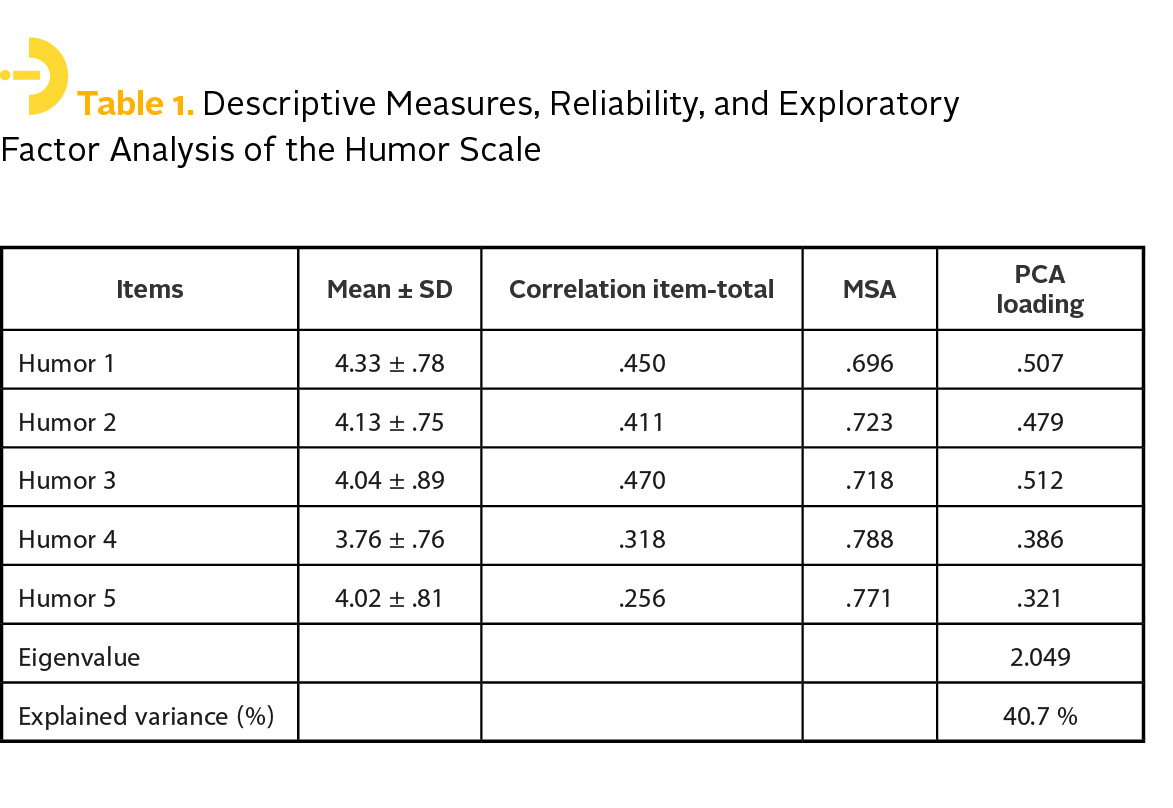
In the resulting factor analysis, a principal component eigenvalue of 2.049 and a total explained variance of 40.7% were obtained (see Table 1). All five items loaded onto a single factor, corresponding to the construct of general mood state.
Table 1.
Descriptive Measures, Reliability, and Exploratory Factor Analysis of the Humor Scale
| Items | Mean ± SD | Correlation item-total | MSA | PCAloading |
| Humor 1 | 4.33 ± .78 | .450 | .696 | .507 |
| Humor 2 | 4.13 ± .75 | .411 | .723 | .479 |
| Humor 3 | 4.04 ± .89 | .470 | .718 | .512 |
| Humor 4 | 3.76 ± .76 | .318 | .788 | .386 |
| Humor 5 | 4.02 ± .81 | .256 | .771 | .321 |
| Eigenvalue | | | | 2.049 |
| Explained variance (%) | | | | 40.7 % |
Subsequently, Cronbach’s alpha coefficient was calculated to assess the internal reliability of the scale. The value obtained was α = .625, indicating an overall acceptable consistency for a brief emotional assessment instrument (Tavakol & Dennik, 2011). According to George & Mallery (2003), in exploratory contexts and with scales comprising few items, alpha values between .60 and .70 are considered adequate.
Study 2. Emotional and Physiological Relationships
Descriptive and Correlational Statistics
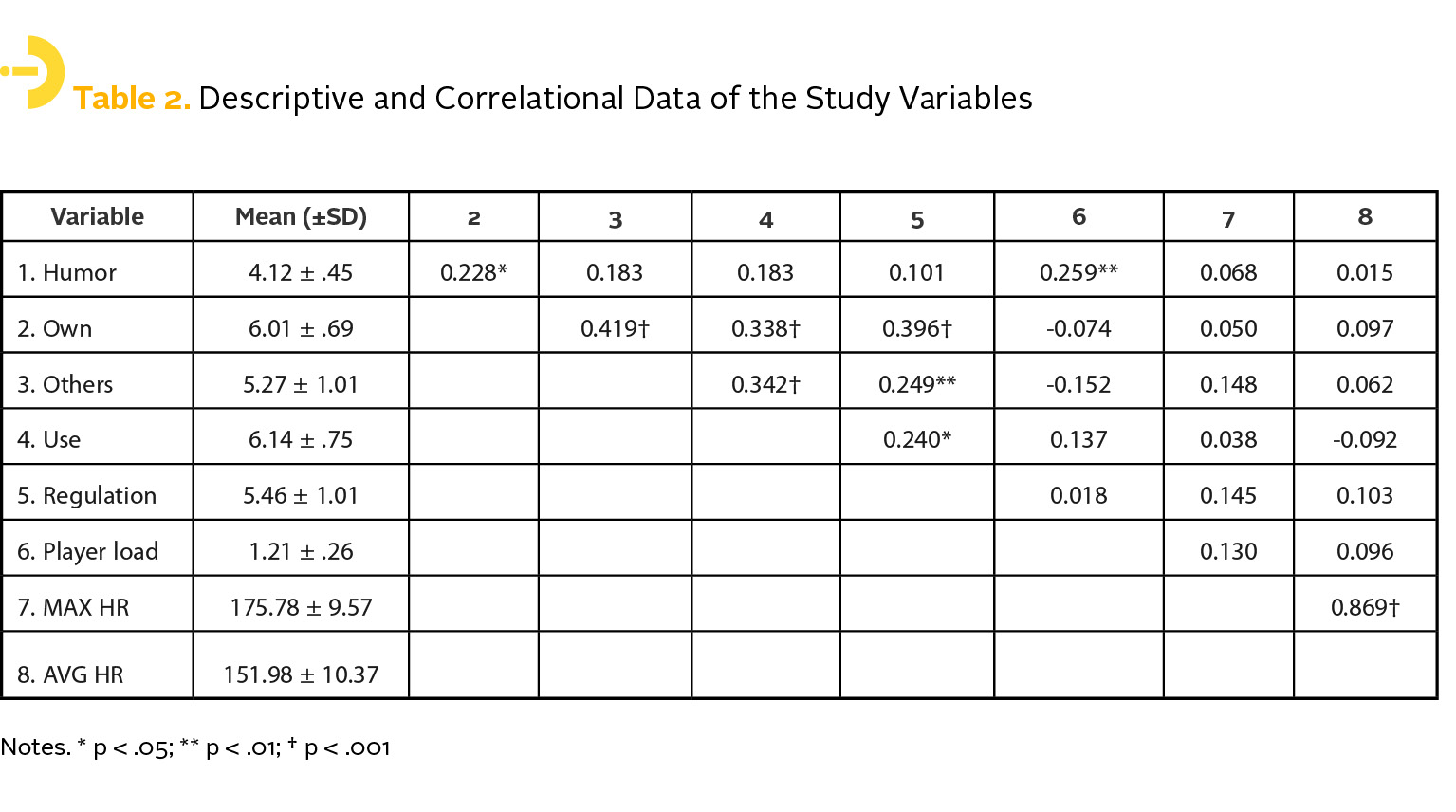
Regarding the emotional variables (Table 2), the mean score for general mood was 4.12 (± .45); own emotions had a mean of 6.01 (± .69); others’ emotions reached a mean of 5.27 (± 1.01); use of emotions was 6.14 (± .75); and emotional regulation had a mean of 5.46 (± 1.01).
As for the monitored physiological variables, the player load per minute was 1.21 (± .26), the maximum heart rate was 175.78 bpm (± 9.57), and the mean heart rate was 151.98 bpm (± 10.37).
Table 2.
Descriptive and Correlational Data of the Study Variables
 Notes. * p < .05; ** p < .01; † p < .001
| Variable | Mean (±SD) | 2 | 3 | 4 | 5 | 6 | 7 | 8 |
| 1. Humor | 4.12 ± .45 | 0.228* | 0.183 | 0.183 | 0.101 | 0.259** | 0.068 | 0.015 |
| 2. Own | 6.01 ± .69 | | 0.419† | 0.338† | 0.396† | -0.074 | 0.050 | 0.097 |
| 3. Others | 5.27 ± 1.01 | | | 0.342† | 0.249** | -0.152 | 0.148 | 0.062 |
| 4. Use | 6.14 ± .75 | | | | 0.240* | 0.137 | 0.038 | -0.092 |
| 5. Regulation | 5.46 ± 1.01 | | | | | 0.018 | 0.145 | 0.103 |
| 6. Player load | 1.21 ± .26 | | | | | | 0.130 | 0.096 |
| 7. MAX HR | 175.78 ± 9.57 | | | | | | | 0.869† |
| 8. AVG HR | 151.98 ± 10.37 | | | | | | | |
Spearman correlations were calculated to assess the relationship between emotional and physiological variables. The analyses revealed several significant correlations. General mood was positively correlated with the perception of one’s own emotions (p = .017) and with average player load per minute (p = .006). Other observed relationships, although not reaching statistical significance, included a positive association between mood and the perception of others’ emotions (p = .057), as well as with the use of emotions (p = .057), suggesting a potential trend that could be confirmed in larger samples.
Multiple Linear Regression
A multiple linear regression analysis was conducted using a backward stepwise elimination method to identify the emotional variables that best explained the recorded player load per minute. The initial model included the variables: mood, own emotions, others’ emotions, use of emotions, and emotional regulation.
After sequentially removing the non-significant predictors, the final model retained only two predictor variables: mood and others’ emotions. This model was statistically significant (F(2, 106) = 6.15, p = .003), explaining 10.4% of the variance in the recorded player load per minute (R² = .104). Specifically, mood was a positive and significant predictor (β = 0.16, p = .003), indicating that youths with a better emotional state tended to assume a higher physical load. On the other hand, the perception of others’ emotions showed a significant negative relationship (β = –0.06, p = .019), suggesting that greater attention or sensitivity to others’ emotions might be associated with a decrease in the physical demands assumed.
Cluster Analysis
A K-means cluster analysis was performed to identify athlete profiles based on their levels of mood and physical load (player load per minute). Prior to the analysis, the variables were standardized to ensure scale comparability.
The optimal number of clusters was determined using the elbow method, which indicated that three clusters were appropriate. The analysis revealed a final inertia of 96.15, suggesting adequate internal cohesion of the clusters.
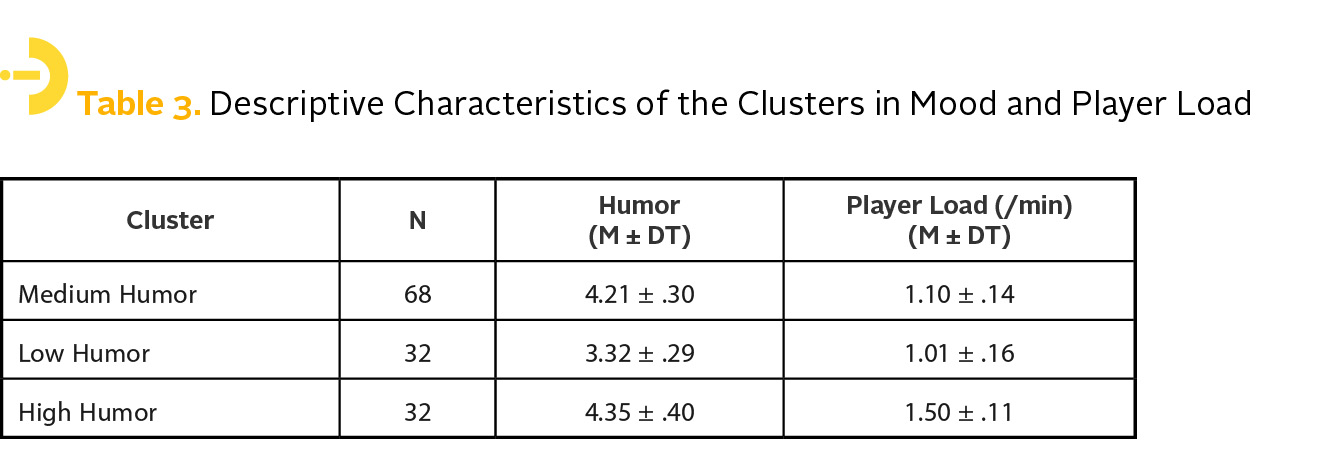
The centroids of the three clusters, on the original scale, showed substantial differences in mood and player load, with mean mood scores ranging from 3.33 to 4.35, and mean physical load scores ranging from 1.01 to 1.50 (Table 3).
Table 3.
Descriptive Characteristics of the Clusters in Mood and Player Load
| Cluster | N | Humor (M ± DT) | Player Load (/min) (M ± DT) |
| Medium Humor | 68 | 4.21 ± .30 | 1.10 ± .14 |
| Low Humor | 32 | 3.32 ± .29 | 1.01 ± .16 |
| High Humor | 32 | 4.35 ± .40 | 1.50 ± .11 |
A one-way ANOVA was conducted to test for significant differences between the clusters. The results indicated statistically significant differences both in mood (F(2, 106) = 101.28, p < .001) and in player load (F(2, 106) = 125.59, p < .001).
These results support the adequacy of the cluster analysis performed and justify the existence of three distinct profiles of adolescent athletes based on their emotional state and physiological response during activity.
Discussion
The objective of this study was to explore the impact of emotions on sports training by examining the relationship between emotional intelligence and emotional state with athletes’ training intensity. This study contributes to sport psychology by analyzing, from a situational perspective, the relationship between these emotional variables and training intensity in young athletes. This was achieved through the adaptation and validation of the Psychological General Wellbeing Scale (Bech, 2004) for immediate, contextual use in training situations. This represents a relevant methodological contribution, especially in an area where the measurement of affective states has traditionally relied on retrospective approaches that may not be sufficiently sensitive to the emotional fluctuations inherent to sport practice (Topp et al., 2015). Addressing this issue aligns with calls for holistic approaches that integrate psychological, emotional, and physiological variables to optimize both athletic performance and athlete well-being (Laborde et al., 2016; Furley et al., 2023), particularly in youth populations whose psychological and social maturation shapes their responses to training and competition.
To achieve this, the first step was to adapt and validate the Psychological General Wellbeing Scale (Bech, 2004) for a situational context. The initial statement and verb tenses were modified to shift the assessment of emotional state from the past two weeks to the present moment. The HUMOR scale demonstrated preliminary evidence of validity and reliability for its use in exploratory studies. The sampling adequacy indices and the significant result from Bartlett’s test of sphericity confirmed the suitability of the data for conducting an exploratory factor analysis. The analysis revealed a unidimensional structure, with a single factor explaining a substantial portion of the total variance (40.7%).
The internal consistency of the scale was considered acceptable as a brief scale used in exploratory contexts. These results support the use of the HUMOR scale as a valid and reliable measure of general emotional state in adolescent athlete populations. However, it is recommended that future studies expand the sample size and conduct confirmatory factor analyses to strengthen the structural validity of the scale. This methodological advance addresses the need, identified in international literature (Topp et al., 2015), for instruments sensitive to intra-session emotional fluctuations, enabling more precise assessment of affective states in real sporting contexts. In this way, the study contributes to the development of tools capable of capturing the emotional dimension in real time, which is a key aspect in contemporary sport psychology research.
The results of this study also provide evidence on the relationship between situational emotional state and various aspects related to sports performance, including training load and emotional intelligence. However, it is important to note that the relationship between subjective and objective indicators may diverge, underscoring the need for multi-method designs (O'Grady et al., 2020; Petway et al., 2020). Methodological triangulation and the use of mixed instruments are therefore warranted to achieve a more comprehensive understanding of the athlete’s emotional experience. Integrating perspectives in this way helps to overcome the limitations inherent to each method in isolation and increases the ecological validity of findings.
Our findings show a positive and significant correlation between situational emotional state and external training load (player load/min). This suggests that athletes with a more positive emotional state may perceive effort differently, thereby impacting training intensity. Similar findings have been reported by Lane et al. (2010), who found that mood influences fatigue and physical performance. These results highlight the importance of monitoring not only the physical load of athletes, but also their emotional well-being to optimize training performance and prevent overtraining. These results highlight the importance of monitoring not only the physical load of athletes, but also their emotional well-being to optimize training performance and prevent overtraining. Although emotional state was significantly associated with training intensity, the effect was modest, suggesting that emotional and physiological responses operate within a multifactorial system influenced by motivational, contextual, and interpersonal factors rather than through a direct causal link. This interpretation aligns with contemporary multivariate models proposing that emotions and performance interact dynamically through both personal and environmental mediators (Laborde et al., 2016). Thus, future research should explore possible interactions among personal, environmental factors, and the specific demands of each sport, as well as the role of prior emotional history, team culture, and processes of sport socialization.
Additionally, mood state correlated with the perception of one’s own emotions, indicating greater emotional self-awareness in positive affective states. Other relationships, such as those between mood and the perception of others’ emotions, as well as mood and emotion usage, did not reach statistical significance, although they point to a potential trend that may become significant in larger samples. Emotional self-awareness is a central dimension in current models of emotional intelligence (Laborde et al., 2016); Mayer et al., 2000); however, cross-sectional assessment may limit the ability to capture its real impact under higher demand or competitive stress. The implementation of repeated assessments or longitudinal designs would facilitate analysis of the cumulative effect of emotional intelligence on training adaptation. It is likely that the relationship between self-awareness and performance depends both on the context and on the athlete’s prior experience, which justifies exploring individual trajectories across seasons.
Multiple linear regression analysis revealed that the best model for predicting player load per minute included mood and perception of others’ emotions. While mood showed a positive association with physical load, attention to others’ emotions was negatively associated. This finding is particularly interesting, as it could be interpreted as a form of cognitive overload or interpersonal distraction that moderates physical engagement. In contexts where physical performance heavily depends on internal focus and emotional self-regulation, excessive sensitivity to the social environment may limit the intensity of the physical response (Laborde et al., 2016).
This result contributes to the debate about the ambivalent function of empathy and interpersonal sensitivity in sport: while in some contexts it favors group cohesion and functioning (Jospe et al., 2018), in situations of high individual demand it may act as a distractor, especially in team sports and with potential gender differences (Stanger et al., 2016; Knöbel et al., 2024) Investigating these moderating effects is a promising direction. Moreover, it would be relevant to analyze whether these patterns persist in more pressured competitive contexts and in individual versus team sports. This theoretical approach is especially relevant when working with adolescents, whose identity and sense of group belonging strongly influence the balance between attention to the team and personal focus.
Several practical implications for sports training and psychology can be drawn from these findings. First, coaches should consider athletes’ emotional states when planning training loads, as a positive emotional state may promote greater effort and better adaptation to training. In addition, implementing emotional regulation programs is recommended to optimize performance and improve perception of effort. Emotional competence training should address both individual self-regulation and management of interpersonal sensitivity, with attention to context, modality, and gender differences. It is essential to tailor intervention strategies to the age, experience, and psychosocial characteristics of athletes, and to systematically evaluate their short- and long-term effectiveness.
In practice, incorporating brief mood assessments before training may help coaches tailor workloads and optimize athletes’ readiness. Emotional education programs should also target emotion regulation and empathy management to balance interpersonal sensitivity and physical engagement.
Finally, emotional education for athletes could be a key tool for enhancing resilience and stress management in training and competition (Belykh, 2021). Incorporating emotional regulation strategies into training could benefit not only sports performance but also athletes’ general well-being. Future research should experimentally evaluate the effectiveness of these interventions in real sports contexts. In parallel, intervention programs should be adapted to the specific context, taking into account considering characteristics such as age, gender, competitive level, and sport discipline. Similarly, it is worth considering the possibility of involving families and the social environment in promoting emotional well-being, especially at developmental stages that are highly influenced by external support.
Overall, these results reinforce the importance of integrating psychological and emotional aspects in sports preparation, promoting a holistic approach that benefits both performance and athletes’ mental health. Progress in understanding the emotion–performance dynamic requires the development of more integrative theoretical and methodological models, as well as the execution of longitudinal, multicenter studies and the use of portable technologies for data capture in ecological settings. Finally, incorporating cultural and contextual variables and analyzing intra-session emotional trajectories represent promising avenues for future research in sport sciences.
Conclusions
The present study provides a significant contribution to the field of sport psychology by analyzing, from a situational perspective, the relationship between emotional variables and training intensity in young athletes. The adaptation and validation of the Psychological General Wellbeing Scale -Humor scale- (Bech, 2004) for immediate and contextual use in training situations represents a notable methodological innovation, especially in an area where the measurement of affective states has traditionally relied on retrospective approaches that are not sufficiently sensitive to the emotional fluctuations inherent in sport practice (Topp et al., 2015). This research pioneers the integration of momentary emotional assessment with objective load measures, opening avenues for personalized training strategies that account for athletes’ emotional states.
The findings of this research support the existence of a positive, though modest, relationship between situational emotional state and training intensity. In addition, the results highlight the ambivalent role of interpersonal sensitivity in the context of physical load, as well as the importance of emotional intelligence in athletes’ commitment.
However, the present study urges caution in interpreting the impact of emotional variables on objective performance, given the limited variance explained and the need to integrate contextual, social, and motivational factors in future explanatory models. Future studies should ensure more balanced gender representation, as this could help capture the potential divergence between self-report and objective measurements, underlining the necessity. Addressing this divergence underlines the necessity of using mixed-method approaches and data triangulation to progress towards a more robust and ecologically valid understanding of the emotion-performance relationship.
The exploratory design, small and gender-imbalanced sample, and reliance on self-reported emotional measures also constrain the generalizability of the findings. Future studies should include larger samples and adopt longitudinal, multimethod designs that integrate objective indicators of emotional responses during training.
References
Aschendorf, P. F., Zinner, C., Delextrat, A., Engelmeyer, E., & Mester, J. (2018). Effects of basketball-specific high-intensity interval training on aerobic performance and physical capacities in youth female basketball players. The Physician and Sportsmedicine, 47(1), 65-70. https://doi.org/10.1080/00913847.2018.1520054
Barreira, P., Robinson, M. A., Drust, B., Nedergaard, N., Raja Azidin, R. M. F., & Vanrenterghem, J. (2017). Mechanical Player Load™ using trunk-mounted accelerometry in football: Is it a reliable, task-and player-specific observation? Journal of Sports Sciences 35(17), 1674-1681. https://doi.org/10.1080/02640414.2016.1229015
Bech P. (2004). Measuring the dimensions of psychological general well-being by the WHO-5. QoL Newsletter, 32, 15-16.
Belykh, A. (2021). Resiliencia e inteligencia emocional: conceptos complementarios para empoderar al estudiante. Revista Internacional de Educación Emocional y Bienestar, 1(2), 125–152. https://doi.org/10.48102/rieeb.2021.1.2.18
Bisquerra, R. (2020). Emociones: instrumentos de medición y evaluación. Síntesis.
Calderón-Pellegrino, G., Gallardo, L., Garcia-Unanue, J., Felipe, J.L., Hernandez-Martin, A., Paredes-Hernández, V., Sánchez-Sánchez, J. (2022). Physical Demands during the Game and Compensatory Training Session (MD + 1) in Elite Football Players Using Global Positioning System Device. Sensors, 22, 3872. https://doi.org/10.3390/s22103872
Conte, D., Favero, T. G., Niederhausen, M., Capranica, L., & Tessitore, A. (2016). Effect of different number of players and trainingregimes on physiological and technical demands of ball-drillsin basketball. Journal of Sports Sciences, 34(8), 780-786. https://doi.org/10.1080/02640414.2015.1069384
Cuadrado, J., Chirosa, L.J., Chirosa, I.J., Martín, I., Aguilar, D. (2011). Estimación de la frecuencia cardiaca máxima individual en situaciones integradas de juego en deportes colectivos: una propuesta práctica. e-balonmano.com: Revista de Ciencias del Deporte, Journal of Sport Science, 7(2), 91-99. http://ojs.e-balonmano.com/index.php/revista/article/view/56
Duque, V., Reina, M., Mancha, D., Ibáñez, S., & Saenz-Lopez, P. (2020). Relación de la carga de entrenamiento con las emociones y el rendimiento en baloncesto formativo (Relation of training load with emotions and performance in formative basketball). Retos, revista digital. Nuevas tendencias en EF, Deporte y Recreación, 40, 164-173. https://doi.org/10.47197/retos.v1i40.82441
Duque, V. H., Yuste, J. L., Alonso, J. I., & Sáenz-López, P. (2023). Vivencia emocional en Educación Física durante la práctica de diferentes juegos deportivos. e-Motion: Revista de Educación, Motricidad e Investigación, 20, 1-12. https://doi.org/10.33776/remo.vi20.7610
Extremera, N., Fernández-Berrocal, P., & Salovey, P. (2006). Spanish version of the Mayer-Salovey-Caruso Emotional Intelligence Test (MSCEIT). Version 2.0: reliabilities, age and gender differences. Psicothema, 18, 42-48. https://www.psicothema.com/pi?pii=3274
Fernández, P., & Cabello, R. (2021). La inteligencia emocional como fundamento de la educación emocional. Revista Internacional de Educación Emocional y Bienestar, 1(1), 31–46. https://doi.org/10.48102/rieeb.2021.1.1.5
Furley, P., Laborde, S., Robazza, C., & Lane, A. (2023). Emotions in sport. En J. Schüler, M. Wegner, H. Plessner, & R. C. Eklund (eds.), Sport and exercise psychology (pp. 247-279). Springer. https://doi.org/10.1007/978-3-031-03921-8_11
George, D., & Mallery, P. (2003). SPSS for Windows Step by Step: A Simple Guide and Reference. Allyn & Bacon.
Impellizzeri, F.M., Marcora, S.M., Castagna, C., Reilly, T., Sassi, A., Iaia, F.M., Rampinini, E. (2006). Physiological and performance effects of generic versus specific aerobic training in soccer players. Int J Sports Med, 27(6):483-92. doi: 10.1055/s-2005-865839.
Jones, M. V. (2003). Controlling Emotions in Sport. The Sport Psychologist, 17(4), 471-486.
Jospe, K., Flöel, A., & Lavidor, M. (2018). The interaction between embodiment and empathy in facial expression recognition. Social Cognitive and Affective Neuroscience, 13(2), 203–215. https://doi.org/10.1093/scan/nsy005
Knöbel, S., Weinberg, H., Heilmann, F., & Lautenbach, F. (2024). The interaction between acute emotional states and executive functions in youth elite soccer players. Frontiers in Psychology, 15, 1348079. https://doi.org/10.3389/fpsyg.2024.1348079
Kopp, A., Reichert, M., & Jekauc, D. (2021). Trait and ability emotional intelligence and its impact on sports performance of athletes. Sports, 9(5), 60. https://doi.org/10.3390/sports9050060
Laborde, S., Dosseville, F., & Allen, M. S. (2016). Emotional intelligence in sport and exercise: A systematic review. Scandinavian Journal of Medicine & Science in Sports, 26(8), 862–874. https://doi.org/10.1111/sms.12510
Lane, A. M., Devonport, T. J., Soos, I., Karsai, I., Leibinger, E., Hamar, P. (2010). Emotional intelligence and emotions associated with optimal and dysfunctional athletic performance. Journal of Sports Science and Medicine, 9(3), 388–392. https://www.ncbi.nlm.nih.gov/pmc/articles/PMC3761705/
Martinet, G., Campo, M. y Ferrand, C. (2011). A descriptive study of emotional process during competition: Nature, frequency, direction, duration and cooccurrence of discrete emotions. Psychology of Sport and Exercise, 13(2), 142-151. https://doi.org/10.1016/j.psychsport.2011.10.006
Mayer, J. D., Salovey, P., & Caruso, D. R. (2000). Emotional intelligence as a set of abilities. In R. Bar-On & J. D. A. Parker (eds.), The handbook of emotional intelligence: Theory, development, assessment, and application at home, school, and in the workplace (pp. 39-56). Jossey-Bass/Wiley.
Meyer, B. B., & Fletcher, T. B. (2007). Emotional Intelligence: A Theoretical Overview and Implications for Research and Professional Practice in Sport Psychology. Journal of Applied Sport Psychology, 19(1), 1–15. https://doi.org/10.1080/10413200601102904
Michalsik, L.B., Madsen, K., Aagaard, P. (2014). Match performance and physiological capacity of female elite team handball players. Int J Sports Med, 35(7), 595-607. doi: 10.1055/s-0033-1358713
Nunez, V. M., Da Silva-Grigoletto, M. E., Castillo, E. F., Poblador, M. S., & Lancho, J. L. (2008). Effects of training exercises for the development of strength and endurance in soccer. J Strength Cond Res, 22(2), 518-524. doi:10.1519/JSC.0b013e318163468f
O’Grady, C. J., Fox, J. L., Dalbo, V. J., & Scanlan, A. T. (2020). A Systematic Review of the External and Internal Workloads Experienced During Games-Based Drills in Basketball Players. International Journal of Sports Physiology Performance 15(5), 603-616. https://doi.org/10.1123/ijspp.2019-0785
Petway, A. J., Freitas, T. T., Calleja-González, J., Medina Leal, D., &Alcaraz, P. E. (2020). Training load and match-play demands in basketball based on competition level: A systematic review. PloSone, 15(3), e0229212. https://doi.org/10.1371/journal.pone.0229212
Reina, M., García-Rubio, J., & Ibáñez, S. J. (2020). Training and Competition Load in Female Basketball: A Systematic Review. International Journal of Environmental Research Public Health 17(8), 2639. https://doi.org/10.3390/ijerph17082639
Robyn, L. V., Robyn, L. y Robert, P. (2010). Emotions in sport: Perceived effects on attention, concentration, and performance. Australian Psychologist, 45(2), 132-140. doi:10.1080/00050060903261538
Sáenz-López, P. (2020). Educar emocionando. Servicio de publicaciones de la Universidad de Huelva.
Sáenz-López, P., Duque-Ramos, V. H., Almagro-Torres, B. J., & Conde-García, C. (2020). Basketball and Emotions. A systematic review. e-balonmaano.com: Revista de Ciencias del Deporte, 16(1), 73-84. http://ojs.e-balonmano.com/index.php/revista/article/view/508
Sáenz-López, P., Ibáñez, S., Giménez, J., Sierra, A., & Sánchez, M. (2005). Multifactor characteristics in the process of development of the male expert basketball player in Spain. International Journal of Sport Psychology, 36(2), 151-171.
Salovey, P. & Mayer, J.D. (1990). Emotional intelligence. Imagination, Cognition and Personality, 9(3), 185-211. https://doi.org/10.2190/DUGG-P24E-52WK-6CDG
Stanger, N., Kavussanu, M., McIntyre, D. y Ring, C. (2016). Empathy Inhibits Aggression in Competition: The Role of Provocation, Emotion, and Gender. Journal of Sport y Exercise Psychology, 38(1), 4-14. doi: 10.1123/jsep.2014-0332
Tavakol, M., & Dennick, R. (2011). Making sense of Cronbach’s alpha. International Journal of Medical Education, 2, 53–55.
Topp, C. W., Østergaard, S. D., Søndergaard, S., & Bech, P. (2015). The WHO-5 Well-Being Index: A systematic review of the literature. Psychotherapy and Psychosomatics, 84(3), 167–176. https://doi.org/10.1159/000376585
Twist, C., & Highton, J. (2013). Monitoring fatigue and recovery in rugby league players. International Journal of Sports Physiology Performance 8(5), 467-474. https://doi.org/10.1123/ijspp.8.5.467
Uphill, M., Groom, R., y Jones, M. (2014). The influence of ingame emotions on basketball performance. European Journal of Sport Science, 14(1), 76-83. https://doi.org/10.1080/17461391.2012.729088
Wong, C.S., & Law, K.S. (2002). The effects of leader and follower emotional intelligence on performance and attitude: An exploratory study. Leadership Quarterly, 13, 243-274. https://doi.org/10.1016/S1048-9843(02)00099-1
Woodman, T., Davis, P. A., Hardy, L., Callow, N., Glasscock, I., & Yuill-Proctor, J. (2009). Emotions and sport performance: An exploration of happiness, hope, and anger. J Sport Exerc Psychol, 31(2):169-88. doi: 10.1123/jsep.31.2.169.