Introduction
Currently, the World Health Organization (WHO) is the entity in charge of managing prevention, promotion, and intervention guidelines worldwide in health. Within its policies, snakebite envenomation is reported as a tropical disease that is neglected worldwide. Snake bites affect approximately 5.4 million people in the world, causing between 81,000 and 138,000 deaths per year. Most cases are reported in Africa, Asia, and Latin America; for the latter, around 150,000 cases and the death of at least 5,000 people are estimated (WHO, 2019).
In their natural environment, venomous snakes use their venom to immobilize or kill their prey while simultaneously initiating digestion. However, it can also be employed as a defense mechanism when the snake feels in danger. In many cases, encounters with humans end in an event (Lynch, 2012). The families of snakes causing this problem and of medical interest for Colombia are the Viperidae and Elapidae families since they have species capable of injecting venom with great precision into humans, generating serious clinical symptoms of envenomation (Campbell and Lamar, 1989; Gutiérrez, 2002).
Bothropic envenomation, including in events caused by snakes of the Viperidae family, comprises bites caused by species of the genera Bothriechis, Bothrocophias, Bothrops and Porthidium, generalizing the following symptoms for these species: alteration in the coagulation cascade, myotoxicity, local reactions, mixed shock and massive capillary, pulmonary and/or mesenteric microthrombosis (Ayerbe-González and Latorre-Ledezma, 2010; Ayerbe, 2021). However, the venom of each species can show intraspecific and interspecific variability due to climatic conditions, age of the individual, feeding habits, and seasonal changes (Chippaux et al., 1991).
The genus Bothrocophias is a group separate from the genus Bothrops. For Bothrocophias, there is only one citation of the effect caused by its venom (Ayerbe, 1998). This means that clinically, whenever events caused by this species occur, the principle of cross-reactivity has resorted to polyvalent antibothropic antivenom serum, which is designed to neutralize the venom of 18 species of snakes, including Porthidium nasutum, Porthidium lansbergii, Bothriechis schlegelii, Bothrops punctatus, Bothrops asper, and Bothrops atrox, among others (Campbell & Lamar, 2004).
The species of the genus Bothrocophias previously belonged to the genus Bothrops. In 2001, the genus Bothrocophias was recognized as a separate group, explained by the division of a large group into three monophyletic groups: a predominantly North American clade (Agkistrodon, Crotalus, Sistrurus), a Central American clade (Atropoides, Bothriechis, Cerrophidion, Ophryacus, Porthidium) and a South American clade (Bothriopsis, Bothrocophias, Bothrops) (Gutberlet and Campbell, 2001). The characteristics that allow us to differentiate the species belonging to the genus Bothrocophias include small, smooth intersupraocular scales; distinctive white spots on gular and infralabial scales; and tuberculate keels on scales on the caudal portion of the back (Gutberlet and Campbell, 2001).
Bothrocophias colombianus is the Colombian toad-headed pitviper (locally known as “equis colorada.” It has an ovoviviparous embryonic development, nocturnal habits, an approximate size of 80-150 cm long, and feeds mainly on small mammals, lizards, and birds. It differs from B. campbelli in having a more reddish coloration on the body, most noticeable in juvenile snakes. Commonly, species can be found in plantations of lulo (Solanum quitoense), corn (Zea mays), banana, and yucca (Manihot esculenta) and pastures bordering the forest (Castro et al, 2005).
The venom of B. colombianus, the species of interest for this research, causes severe toxicity. A young specimen of B. colombianus caused nonoliguric acute renal failure by acute tubular necrosis, pedial artery, and colliquative mesenteric thrombosis, which required ileocecal segment resection (Ayerbe, 1998; Ayerbe-González and Latorre-Ledezma, 2010). Taking this into account, in the present work, the toxinological profile of the venom of B. colombianus was determined by calculating the LD50, myotoxic activity, and hemorrhagic, edematous, and coagulant effects.
Materials and methods
Venom
The venom was obtained from two specimens of B. colombianus (Figure 1) already in captivity at the Biomedical Research Center of the University of Cauca (CIBUC). The venom was extracted manually by inducing the animals to bite into a falcon tube. The venom was then lyophilized and stored at −20°C until use.
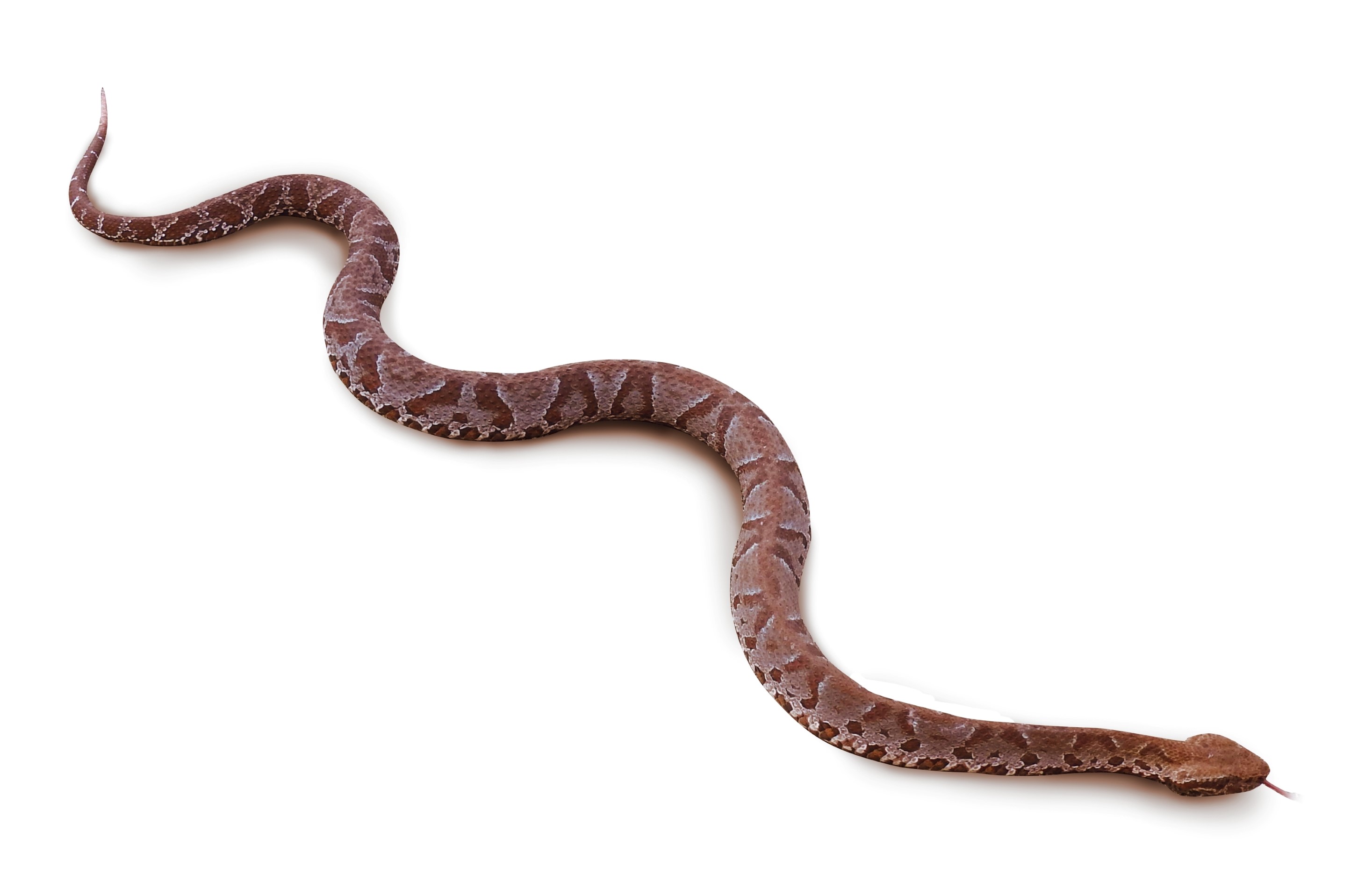 Figure 1.
B. colombianus.
Biomodels
The experiments were conducted with male and female CFW strain Mus musculus mice weighing between 16 and 20 grams (average 18 grams), provided by the CIBUC. The animals were kept in appropriate conditions with controlled temperature, humidity, and feeding.
Ethical considerations
The research was carried out under the authorization of the ethics committee of the University of Cauca, established through endorsement No. 6.1 - 1.25/34 of March 27, 2020.
Median Lethal Dose (LD50)
The LD50 was performed by intraperitoneal (i.p.) injection, with the application of 0.5 mL of solutions with different concentrations of venom (from 3.075 to 225 μg/mouse) diluted in phosphate-buffered saline (PBS). These venom concentrations were injected into groups of five mice, each weighing between 16 and 20 grams. Observations were made after 48 hours, recording how many mice died and the signs and symptoms of toxicity observed throughout the experiment (Gutiérrez et al., 1990).
Coagulant activity
This experiment was carried out with human plasma extracted from healthy volunteer donors. The blood was centrifuged at 3000 rpm for 10 min in a centrifuge, maintaining a stable temperature (17°-19°C). Subsequently, the plasma was extracted with a micropipette. For the experiment, 100 μL of venom was mixed with 200 μL of human blood plasma, and the clotting time was recorded with a stopwatch (Gutiérrez et al., 2015).
Edematogenic activity
Venom (50 μL) in varying concentrations (from 0.25 μg/mouse to 4 μg/mouse) was injected into groups of five mice (16 – 20 grams), using PBS as a diluent and 50 μL of PBS as a negative control. The doses of venom and control were administered subcutaneously (s.c.) into the footpad of the mouse's right and left hind paws, respectively. After 0.5, 1, 6, 9, 12, and 24 hours, the thickness of the two paws was measured with a caliper. The magnitude of the edema (percentage of increase in paw thickness) was estimated via the following formula: [(Thickness of the right paw/thickness of the left paws) x 100] -100 (using the values at the time of 1 hour) (Winter et al., 1962). The minimum edematous dose (MED) was determined from a dose-response analysis, defined as the dose of venom that induces 30% edema (Lomonte et al., 1993).
Local hemorrhagic activity
For the hemorrhagic activity, a range of venom concentrations was prepared (3.18 to 50.8 μg/mouse) diluted in PBS. Doses of venom (0.1 mL) were injected intradermally (i.d.) into four groups of 4 mice weighing 18 and 20 grams, and the control group was injected with 0.1 mL of PBS. The biomodels were euthanized by cervical dislocation two hours after applying the injection. To determine the area and intensity of the hemorrhagic lesion, a hemorrhagic quantification method by Jenkins et al., 2017 was used using the Inkscape v. 0.92 program. The minimum hemorrhagic dose was defined by the authors as the minimum amount of venom that produces an area of 10 mm or 50 hemorrhagic units (Jenkins et al., 2017).
Statistical analysis
In each test, dose-response graphs were constructed to calculate the minimum dose of each biological activity. These are reported with their respective standard deviations. A regression analysis was performed to determine the statistical relevance between the groups. The statistical analyses and figures were obtained in R v. 4.2.1 based on a confidence index of 95% for each of the tests.
Results and discussion
In the present work, a number of different parameters of toxicity for the venom of Bothrocophias colombianus, a pitviper endemic to the Colombian Pacific, were determined for the first time, including the LD50 and the hemorrhagic, edematous, and coagulant activities in mice. In the event of such a pitviper envenomation, these data enable medical personnel to focus on the most relevant effects and provide more rapid care to those affected.
Lethal dose 50 of Bothrocophias colombianus
The LD50 of B. colombianus in mice was found to be 199.5 μg of venom/mouse. Figure 2 shows the graph obtained from the probit análisis (where LD50 is the amount of venom that causes the death of 50% of the experimental population). The dose-response curve constructed for the calculation approximates a linear trendline, represented by a coefficient of determination of 0.85.
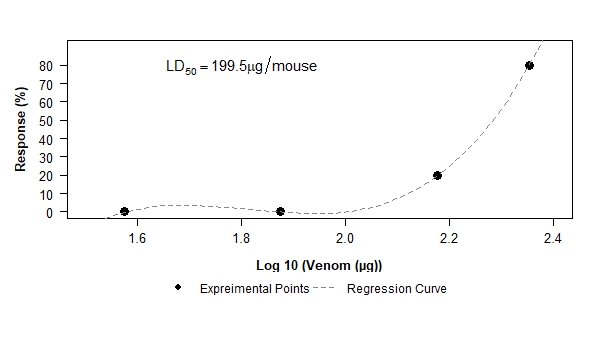 Figure 2.
LD50 of the venom of B. colombianus. The Log10 of the micrograms of venom is the abscissa, along the x-axis, and the percentage of responses is the ordinate, on the y-axis.
The venom of B. colombianus cannot be classified solely by the most relevant effect produced after a bite. Its lethality and toxicity are based on its heterogeneous chemical composition and the multiple pathophysiological actions it exerts on the body's systems (Jiménez-Porras, 1970). This protein compound is designed to exert an effective action when capturing their prey, which is why the environmental, climatic, and geographical conditions of the place in which they are distributed are factors that influence their variation compared to other species, even species belonging to the same genus (Chippaux et al., 1991).
In this case, the lethality of the B. colombianus venom (199.5 µg/mouse) is similar to B. campbelli from Ecuador (Salazar-Valenzuela et al., 2014), B. campbelli from Nariño (Sevilla-Sánchez et al., 2024), B. microphthalmus, also from Ecuador (Terán and Lomonte, 2016), two phylogenetically close species. In contrast, it has a lower potency than the venom of Bothrops asper from El Tambo, Cauca (Mora-Obando et al., 2020) and Bothrocophias myersi from the Isthmus of Pichido (Pereañez et al., 2020), both locations in the Pacific region of Colombia (Sevilla-Sánchez et al., 2024).
Within the lethality test, symptoms of toxicity such as tachypnea, prostration, and hypoactivity were recorded, symptoms generally attributed to local pain, mainly in Bothropic type events. Respiratory difficulty was also observed in prolonged periods of tachypnea, which evolved into slow-labored breathing and periods of apnea. These symptoms were also reported for B. campbelli from Nariño (Sevilla-Sánchez et al., 2024), Bothrops colombiensis, and Bothrops venezuelensis and are signs attributed to a neurological condition (Méndez A. et al, 2009). In addition to these symptoms, opisthotonus, piloerection, flaccid paralysis of the forelimbs, and ataxia were detected.
Coagulant activity
This test found that the minimum coagulant dose of B. colombianus venom was 21.02 ± 0.82 μg of venom. The dose-response curve constructed to calculate this activity approximates an exponential trendline, represented by a coefficient of determination of 0.9534 (Figure 3).
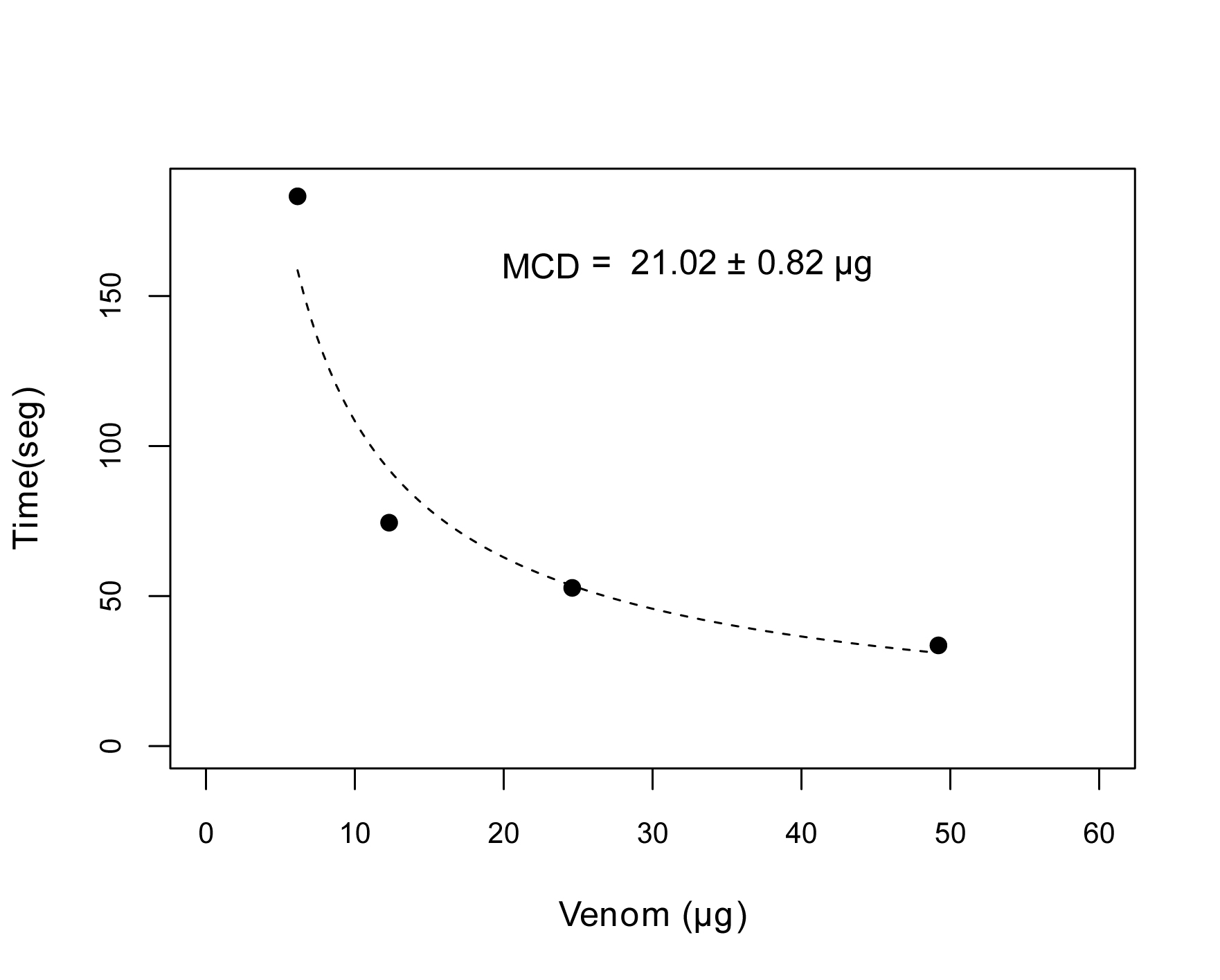 Figure 3.
Minimum coagulant dose of the venom of B. colombianus, a pitviper endemic to the Colombian Pacific. The quantity of venom is shown as the abscissa, with coagulation time as the ordinate.
Serine proteases, another component present in snake venom, can affect many parts of hemostasis, from the activation of coagulation factors to the induction of platelet aggregation (Castro et al., 2004). In the case of B. colombianus, the venom showed a weak coagulant activity, which may be related to the presence of serine proteases. However, a proteomic profile is necessary to affirm this relationship. Taking the above into account, we can consider that this venom has only a mild coagulant activity, similar to that reported for B. campbelli from Ecuador (Salazar-Valenzuela et al., 2014), and a lower coagulant activity compared to B. campbelli from Nariño (Sevilla-Sánchez et al., 2024), Bothrops asper from El Tambo (Mora-Obando et al., 2020), Cauca, B. myersi from Valle del Cauca (Pereañez et al., 2020) and Lachesis acrochorda from Colombia southwestern (Ángel-Camilo et al., 2020).
Edematogenic activity
The MED of Bothrocophias colombianus was 0.45 ± 0.15 µg of venom. The dose-response curve constructed for the calculation approximates a logarithmic trendline, represented in a coefficient of determination of 0.8885 (Figure 4).
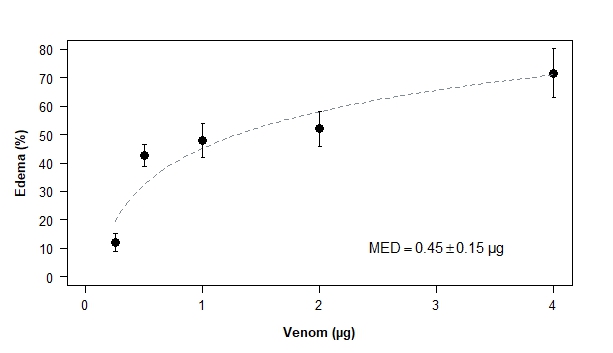 Figure 4.
The dose-response curve for determining edemantogenic activity at a time of 1 hour produced by varying doses of B. colombianus venom. Each point represents the average of 4 replicates. The abscissa is the micrograms of venom and the ordinate the percentage of edema
The maximum percentage of edema was recorded between 1 to 3 hours after inoculation with venom, with the maximum peak at 3 hours (Figure 5).
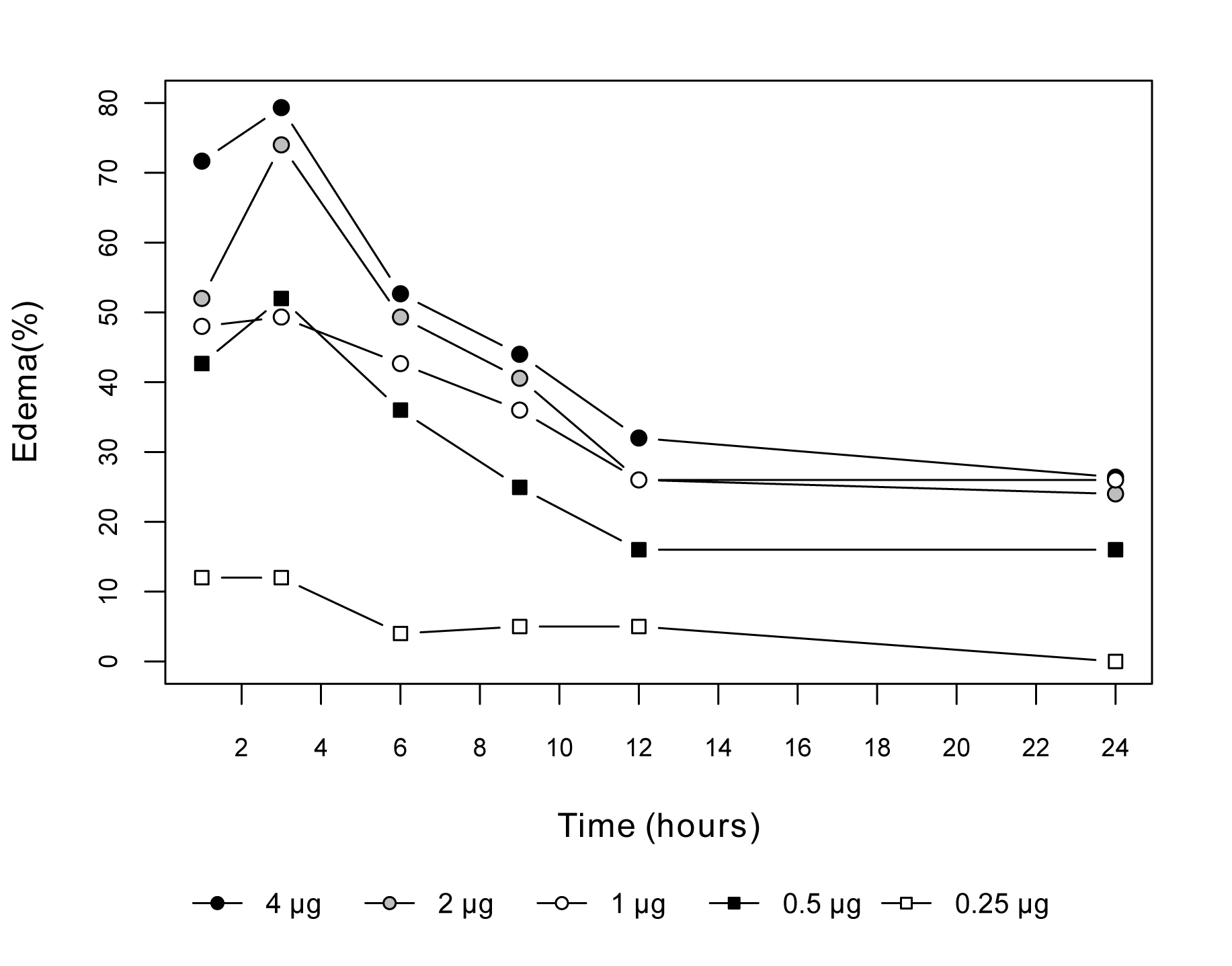 Figure 5.
Monitoring over 24 hours of the edematous activity produced by varying doses of B. colombianus venom. Each line represents a dose of venom, and each point represents the average of 4 replicates. The abscissa shows the hours elapsed and the ordinate represent the percentage of edema produced.
Edema is a characteristic of envenomation. It is defined as an effect that indicates an increase in interstitial fluid. This can be produced by deterioration in the cell membrane through the action of a peptide factor such as kinin or by the release of anaphylatoxins, histamine or other autacoids and also by the presence of phospholipase A2 enzymes (Lloret & Moreno, 1993; Martínez-Vargas, 1990).
The presence of phospholipase A2 is related to the production of edema. Phospholipase A2 allows the triggering of processes that promote damage to the cell membrane, with loss of membrane phospholipids and/or the generation of hydrolysis products such as lysophosphatides and free fatty acids, including arachidonic acid (Martínez-Vargas, 1990). Other protein factors within a venom that can induce edema are serine proteases and metalloproteinases (Pereañez et al., 2020; Salazar-Valenzuela et al., 2014).
The MED of B. colombianus is similar to those reported for Bothrops myersi from Valle del Cauca (Pereañez et al., 2020). The edematizing effect produced by the venom of B. colombianus may be related to the possible presence of phospholipase A2, metalloproteinases and serine proteases reported for B. myersi and B. campbelli respectively, species for which a rapid and strong edematizing activity was also reported (Pereañez et al., 2020; Salazar-Valenzuela et al., 2014).
Hemorrhagic activity
The minimum hemorrhagic dose produced by B. colombianus venom was found to be 1.06 ± 0.47 μg of venom. The dose-response curve constructed for the calculation again approximates a linear trendline, represented by a coefficient of determination of 0.9327 (Figure 6). The hemorrhagic lesions produced by the varying doses of venom are shown in Annex 1, along with the values of the measured area and the hemorrhagic units obtained, representing the amount of hemoglobin extravasated or leaked.
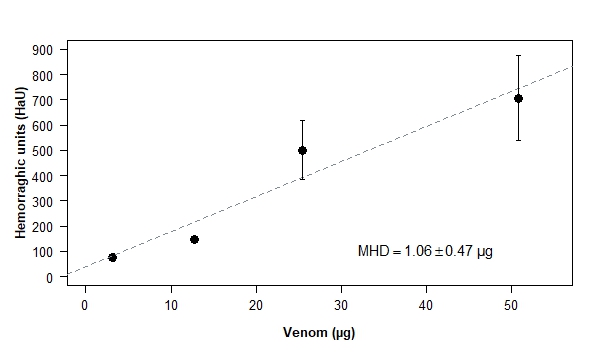 Figure 6.
Dose response curve of hemorrhagic activity produced by varying doses of venom of B. colombianus. Each point represents the measurement of four replicates. The abscissa corresponds to the micrograms of venom and the ordinate to the hemorrhagic units.
Hemorrhage is considered a frequent manifestation in the description of the main clinical characteristics of snakebite envenomations, which is consistently associated with the action of snake venom metalloproteinases (SVMPs), an abundant component in venoms (Gutiérrez & Rucavado, 2000) and that have also been reported in species of the genus Bothrocophias (Pereañez et al., 2020; Salazar-Valenzuela et al., 2014).
The hemorrhagic effect produced by the venom of B. colombianus is similar to that reported for B. asper from El Tambo, Cauca (Mora-Obando et al., 2020) and presents a more toxic effect than that reported for B. myersi from Isthmus of Pichido (Pereañez et al., 2020), B. campbelli from Nariño (Sevilla-Sánchez et al., 2024) and B. campbelli from Ecuador (Salazar-Valenzuela et al., 2014).
Conclusions
The venom of the toad-headed pitviper, Bothrocophias colombianus, is hemorrhagic, edematous, and has a mild coagulant effect. The clinical picture of envenomation caused by this species could be characterized by strong hemorrhagic, edematous alterations and slight impairments in the coagulation cascade. The LD50 of the venom of B. colombianus is considered a mild lethality similar to that reported for other species of the genus Bothrocophias. The signs of toxicity produced by the venom of B. colombianus are similar to those reported for B. campbelli from Ecuador and B. campbelli from Nariño, ensuring that, in the event of envenomation by this species, health professionals are better prepared to act and thus avoid complications for the patient.
Agradecimientos
To the Universidad del Cauca and the Museo de Historia Natural de la Universidad del Cauca for their support with the specimens. To María José Sevilla Sanchez, Andres Felipe Olaya, David Pino Velasco, Angie Camila Caicedo, and Ana Maria Bravo Valencia, for their support in the development of the experimental phase. To Henry Daza Chaves for their support in carrying graphics.
Funding: Thank you at Universidad del Cauca (501100005682) by financial support with the project “Convocatoria 2 - Jóvenes investigadores e innovadores en el departamento del Cauca”.
Authors contribution: YYMG, KAC, MLBO, SAC and JGV were responsible for the conception of the work, formal analysis, writing - original draft preparation, writing–reviewing, and editing. All authors have read and agreed to the final version of the manuscript.
Declaration of interests: The authors declare that there are no conflicts of interest.
Referencias
Angel-Camilo, K.L., Guerrero-Vargas, J.A., de Carvalho, E.F., Lima-Silva, K., de Siqueira, R.J.B., Freitas, L.B.N., de Sousa, J.A.C., Mota, M.R.L., dos Santos, A.A., Neves-Ferreira, A.G.C., Havt, A., Leal, L.K.A.M. & Magalhaes, P.J.C. 2020. Disorders on cardiovascular parameters in rats and in human blood cells caused by Lachesis acrochorda snake venom. Toxicon 184, 180–191. https://doi.org/10.1016/j.toxicon.2020.06.009
Ayerbe, S. 1998. Aspectos clínicos y epidemiológicos del accidente ofídico en el departamento delCauca, pp. 91-100. In Otero Patiño, R., Ángel Mejía, R. & García, M.E. (eds): Primer SimposioColombiano de Toxinología. Memorias, 276 pp. Editorial Ecográfica Ltda, Medellín, Antioquia(Colombia).
Ayerbe-González, S. & Latorre-Ledezma, J. P. 2010. Manual para la prevención y mejoramiento en la atención del paciente con accidente ofídico (Tercera ed).
Ayerbe, S. 2021. Serpientes, Accidentes & Soluciones. https://ayerbedocserpientes.com, Popayán, Cauca, Colombia, pp. 1-116.
Campbell, J.A. & Lamar, W.W. 1989. The Venomous Reptiles of Latin America. Cornell University Press, Ithaca, New York.
Campbell, J.A. & Lamar, W.W. 2004. The Venomous Reptiles of the Western Hemisphere. Cornell University Press, Ithaca, New York.
Castro, F., Ayerbe, S., Calderón, J. J., & Cepeda, B. 2005. Nuevo registro para Colombia de Bothrocophias campbelli y notas sobre B. colombianus y B. myersi (serpentes: Viperidae). Revista Novedades Colombianas, 8(1). https://revistas.unicauca.edu.co/index.php/novedades/article/view/1237
Castro, Zingali, R.B., Albuquerque, M.G., Pujol-Luz, M. & Rodrigues, C.R. 2004.Snake venomthrombin-like enzymes: from reptilase to now. Cell. Mol. Life Sci. 61,843–856. https://doi.org/10.1007/s00018-003-3325-z
Chippaux, J.-P., Williams, V. & White, J. 1991. Snake venom variability: methods of study, results and interpretation. Toxicon 29, 1279–1303. https://doi.org/10.1016/0041-0101(91)90116-9
Gutberlet Jr., R.L. & Campbell, J.A. 2001. Generic recognition for a neglected lineage of South American pitvipers (Squamata: Viperidae: Crotalinae), with the description of a new species from the Colombian Chocó. Am. Mus. Novit. 3316, 1–15.
Gutiérrez, J.M., Rojas Céspedes, G., Lomonte, B., Gené, J.A., Chaves Mora, F., Alvarado, J., Rojas & Umaña, E., 1990. Standardization of assays for testing the neutralizing ability of antivenoms. Toxicon 28 (10), 1127–1129.
Gutiérrez, J.M. & Rucavado, A., 2000. Snake venom metalloproteinases: their role in the pathogenesis of local tissue damage. Biochimie 82, 841–850.
Gutiérrez, J., 2002. Comprendiendo los venenos de serpientes: 50 años de investigaciones en América Latina. Revista de Biología Tropical, 2. 405
Gutiérrez, J.M., Rucavado, A., Solano, G., Lomonte, B., Herrera, M., Segura, Á., Villalta, M.,Vargas, M., Escalante, T., León Vargas, G., Escalante, T., León, G., Pazos, F. & Álvarez, C. 2015. Métodos para el estudio de actividades tóxicas de venenos de serpientes. Estrategias y Avances en el Estudio de Toxinas de Interés Para la Biomedicina. Benemérita Universidad Autónoma de Puebla, México, pp. 19–45.
Jenkins, T.P., Sánchez, A., Segura, Á., Vargas, M., Herrera, M., Stewart, T.K., León, G. & Gutiérrez, J.M. 2017. An improved technique for the assessment of venom-induced haemorrhage in a murine model. Toxicon 139, 87–93. https://doi.org/10.1016/j.toxicon.2017.10.005
Jiménez-Porras, J.M. 1970. Bioquímica, farmacología y fisiopatología de los venenos de serpientes. Rev. Univ. Costa Rica 28: 43-55
Lomonte, B, Tarkowski, A. & Hanson, L.A. 1993. Host response to Bothrops asper snake venom: analysis of edema formation, inflammatory cells, and cytokine release in a mouse model. Inflammation 17, 93–105.
Lloret, S., & Moreno, J. J. 1993. Oedema formation and degranulation of mast cells by phospholipase A2 purified from porcine pancreas and snake venoms. Toxicon, 31(8), 949–956.425 https://doi.org/10.1016/0041-0101(93)90254-G
Lynch, J. D. 2012. El contexto de las serpientes de Colombia con un análisis de las amenazas en428 contra de su conservación. Revista Académica Colombiana, XXXVI(1), 15.
Martínez-Vargas, A. Z. 1990. Química y farmacología del veneno de serpientes (1 Parte). Revista de Química, IV(1), 25–46.
Méndez, A.R.M. & Moreno, R.M.F. 2009. Dosis letal 50 del veneno de Bothrops venezuelensis y434 Bothrops Colombiensis (Serpientes, Viperidae) en ratones NMRI y BALBC. Trabajo de Grado. Escuela de Ciencias de la Salud, Departamento de Medicina Interna, Universidad de Oriente.
Mora-Obando, D., Salazar-Valenzuela, D., Pla, D., Lomonte, B., Guerrero-Vargas, J.A., Ayerbe, S.,Gibbs, H.L. & Calvete, J.J. 2020. Venom variation in Bothrops asper lineages from north-westernSouth America. J. Proteomics 229, 103945. https://doi.org/10.1016/j.jprot.2020.103945
Pereañez, J.A., Preciado, L.M., Fernández, J., Camacho, E., Lomonte, B., Castro, F., Cañas, C.A.,Galvis, C. & Castaño, S. 2020. Snake venomics, experimental toxic activities and clinical characteristics of human envenomation by Bothrocophias myersi (Serpentes: Viperidae) from Colombia. J. Proteomics 220, 103758. https://doi.org/10.1016/j.jprot.2020.103758
Salazar-Valenzuela, D., Mora-Obando, D., Fernández, M.L., Loaiza-Lange, A., Gibbs, H.L. L., & Lomonte, B., 2014. Proteomic and toxicological profiling of the venom of Bothrocophias campbelli, a pitviper species from Ecuador and Colombia. Toxicon 90, 15–25.448. https://doi.org/10.1016/j.toxicon.2014.07.012
Sevilla-Sánchez, M.J., Guerrero-Vargas, J.A., Ayerbe-González, S., Calderón-Leytón, J.J., Lomonte, B. & Mora-Obando D. 2024. Toxinological profile and histopathological alterations induced by Bothrocophias campbelli venom from Colombia. Acta Trop. 250:107094. https://doi.org/10.1016/j.actatropica.2023.107094
Terán, M. & Lomonte, B., 2016. Actividad letal de seis venenos de serpientes de importancia médica en el Ecuador. Rev. Ecuat. Med. Cienc. Biol. 37, 25–30.
WHO. 2019. Snakebite Envenoming. https://www.who.int/news-room/fact-sheets/detail/snakebite-envenoming.
Winter, C. A., Risley, E. A. & Nuss, G. W. 1962. Carrageenin-Induced Edema in Hind Paw of the Rat as an Assay for Antiinflammatory Dkugp. Proceedings of the Society for Experimental Biology and Medicine,11(3):544-547. https://doi.org/10.3181/00379727-111-27849