1. Introduction
Research on modeling in mathematics education has been advancing domestically and internationally, with emphasis on research that points out the theoretical and practical contributions of modeling to the processes of mathematics teaching and learning, at the most varied levels of education; and, more recently, to the initial and continuing education of mathematics teachers (Lopes, 2024; Lopes; Pacheco, 2023; Lopes; Reis, 2024; Menezes; Bairral, 2021; Rocha; Pinto, 2020).
Modeling in mathematics education has various conceptions/perspectives. However, it presents some similarities that converse with each other, enabling, to a greater or lesser extent, readings of the world based on the analysis of the results obtained in the modeling process (Klüber; Burak, 2008), for example, whether mathematical models of the investigated real-world problems are achieved.
Initially, much more focused on applied mathematics, a conception of mathematical modeling situated in the educational field proposed by some researchers, such as Rodney Bassanezi (2002) and Maria Salett Biembengut (Biembengut; Hein, 2003), leads/prioritizes the obtaining of mathematical models of the situations or problems modeled as the final product of the modeling process.
This concept can be somewhat difficult to use in the basic education classroom, mainly because of the “requirement” to build a mathematical model. However, other researchers, such as Dionísio Burak (2010) and Jonei Barbosa (2001), present conceptions of mathematical modeling that “do not require a mathematical model at the end of the work,” although they do not dismiss it. Instead, they focus on valuing the learning process, following a path separate from the need to build models. These conceptions are considered more accessible to basic education students, who often lack the broad mathematical knowledge necessary for the more rigorous construction of models at the end of the process.
We can also highlight a perhaps “differentiated” conception of the researcher Ademir Caldeira (Caldeira, 2009), who conceives mathematical modeling not simply as a “teaching and learning method,” but rather as a conception of mathematics education itself, probably based on his vision of modeling as a learning system in which the teaching and learning processes take place through mathematics “teaching projects.”
However, all these conceptions of modeling in mathematics education point to the need for learning –and the focus on this type of learning– with a much more significant and comprehensive spectrum, seeking to break with the Cartesian and linear form of current curricula, since the involvement of students in the search for solutions in the modeling process is much more effective than in traditional mathematics classroom procedures.
Another interesting point about modeling as a trend in research and practices in mathematics education is that, when we study and research in the process of finding solutions to a problem, we are led to reflect on what we can infer from the results found, what the possible interpretations are, what changes can be proposed, in addition to other inferences depending on the model or the situation researched – that is, we are encouraged to maintain a “critical stance” throughout the entire modeling process.
Therefore, we understand that it is essential to delve deeper into the possible approaches and different focuses of criticality in the different conceptions of modeling in mathematics education. Therefore, the objective of this article is to map theses and dissertations developed in the area of mathematics education in Brazil, focused on criticality in mathematical modeling, included in the Catalog of Theses and Dissertations of the Coordination for the Improvement of Higher Education Personnel (CAPES), as detailed below.
2. Mapping as a research methodology
It is worth highlighting that, initially, due to our objectives for the construction of this article, we decided not to carry out a state-of-the-art or state-of-knowledge type of research, but a mapping or systematic mapping type of research, since, according to Fiorentini et al. (2016), research mapping differs from the state-of-the-art of research, as it refers to the identification, location, and description of research carried out in a given time, space, and field of knowledge.
Thus, mapping is more concerned with the descriptive aspects of a field of study than with its results, according to the understanding of the researchers outlined below:
In short, we will understand the mapping of research as a systematic process of surveying and describing information about research produced in a specific field of study, covering a particular space (or place) and a specific period of time. This information concerns the physical aspects of this production (describing where, when, and how many studies were produced over the period and who the authors and participants of this production were), as well as its theoretical-methodological and thematic aspects. (Fiorentini et al., 2016, p. 18)
Furthermore, Cavalcanti (2015) contributes to the consolidation of mapping as a research methodology, pointing out possibilities of “directing” mapping towards the horizontal and vertical dimensions. According to the researcher:
The questions “how many, who, and where have already done something about it” would point to a horizontal exploratory study, focusing more on the observable relief of scientific productions, that is, on the topology of the territory. The questions on “what advances have been achieved and what problems remain open to be taken forward” would indicate a vertical study, which could be guided by what is below (that is, the work already developed – would indicate trends) and what is above (that is, the work that can be developed – would indicate perspectives) the surface of scientific literature. (Cavalcanti, 2015, p. 219)
From this perspective, we adopted a direction that combines aspects of both a horizontal mapping –such as the number of works developed, the identification of their authors, advisors, and institutions in which they were produced, among others– as well as a vertical mapping, such as the theoretical framework used, with emphasis on the modeling concepts adopted and the criticality of the approaches that were identified.
We will therefore proceed with a detailed analysis of the mapping, seeking to explain some of its systematic, horizontal, and vertical characteristics.
3. Mapping criticality in research in modeling in mathematics education
The survey that characterized our mapping was conducted through a search in the CAPES Theses and Dissertations Catalog. Initially, we inserted the following search terms: “modelagem matemática” [mathematical modeling] and “criticidade” [criticality] and found only four works. Due to the low number of works found, we suggested the following terms for a new search: “modelagem matemática” [mathematical modeling] and “crítica” [criticism], and we then found 128 works.
Next, we initiated an initial analysis of these 128 works, aiming to identify which of them specifically addressed modeling from a mathematics education perspective. Some, for example, focused on modeling in various engineering fields, such as water resources engineering, production engineering, or civil engineering, among others. This, then, became a criterion for excluding these works. We also identified which of them really focused on criticality, from some theoretical perspective, or pointed to its importance in the development of the modeling process and/or in the research conclusions (as we examined abstracts, keywords, theoretical-bibliographical references and also searched for words such as “criticality,” “criticism,” and “critical,” among others) – and this then became a criterion for inclusion of these works.
Based on this refinement, we selected a total of 50 works for detailed analysis: nine academic theses, 16 academic dissertations, and 25 professional dissertations, published between 2001 and 2022, as we will detail in a grouped manner, following criteria that initially move in a horizontal dimension and, later, in a vertical dimension.
3.1. The mapped academic PhD theses
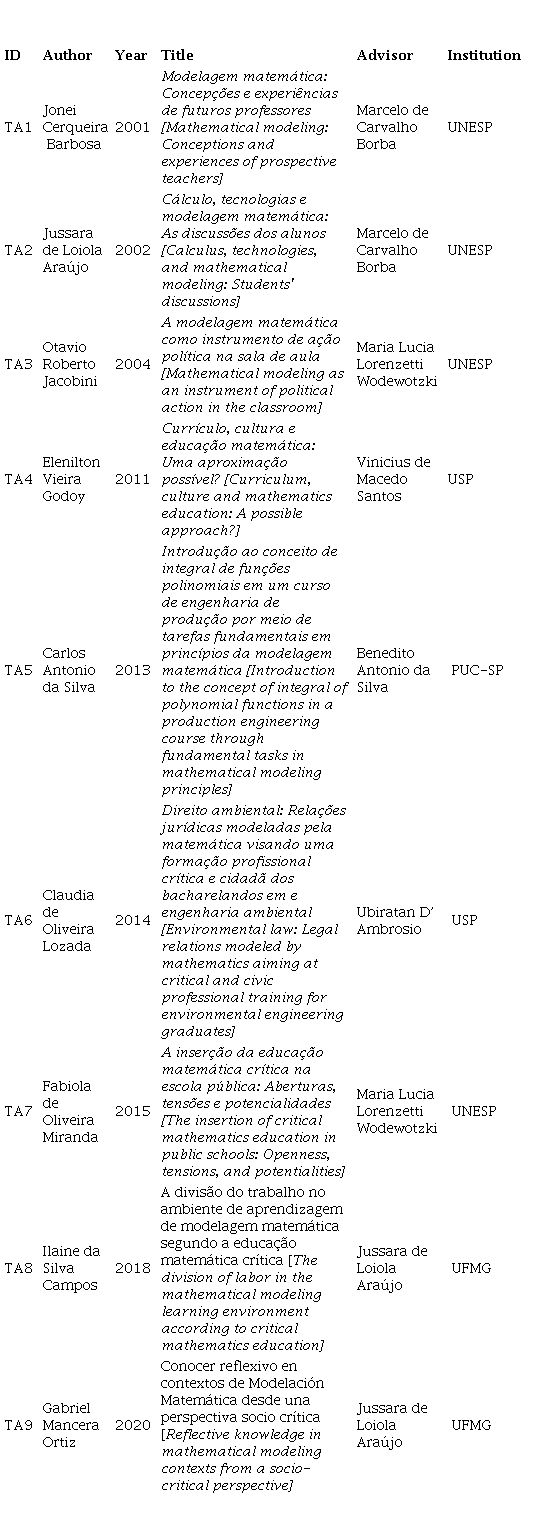
n Chart 1, we present the nine mapped academic PhD theses, chronologically, by year of defense, highlighting: identification (ID), author, year of defense, title, advisor, and institution (we use only the acronyms, as they are well-recognized higher education institutions in the academic world).
Chart 1: Selected Academic PhD Theses
 Source: Study data
| ID | Author | Year | Title | Advisor | Institution |
| TA1 | Jonei Cerqueira Barbosa | 2001 | Modelagem matemática: Concepções e experiências de futuros professores [Mathematical modeling: Conceptions and experiences of prospective teachers] | Marcelo de Carvalho Borba | UNESP |
| TA2 | Jussara de Loiola Araújo | 2002 | Cálculo, tecnologias e modelagem matemática: As discussões dos alunos [Calculus, technologies, and mathematical modeling: Students’ discussions] | Marcelo de Carvalho Borba | UNESP |
| TA3 | Otavio Roberto Jacobini | 2004 | A modelagem matemática como instrumento de ação política na sala de aula [Mathematical modeling as an instrument of political action in the classroom] | Maria Lucia Lorenzetti Wodewotzki | UNESP |
| TA4 | Elenilton Vieira Godoy | 2011 | Currículo, cultura e educação matemática: Uma aproximação possível? [Curriculum, culture and mathematics education: A possible approach?] | Vinicius de Macedo Santos | USP |
| TA5 | Carlos Antonio da Silva | 2013 | Introdução ao conceito de integral de funções polinomiais em um curso de engenharia de produção por meio de tarefas fundamentais em princípios da modelagem matemática [Introduction to the concept of integral of polynomial functions in a production engineering course through fundamental tasks in mathematical modeling principles] | Benedito Antonio da Silva | PUC-SP |
| TA6 | Claudia de Oliveira Lozada | 2014 | Direito ambiental: Relações jurídicas modeladas pela matemática visando uma formação profissional crítica e cidadã dos bacharelandos em e engenharia ambiental [Environmental law: Legal relations modeled by mathematics aiming at critical and civic professional training for environmental engineering graduates] | Ubiratan D’Ambrosio | USP |
| TA7 | Fabiola de Oliveira Miranda | 2015 | A inserção da educação matemática crítica na escola pública: Aberturas, tensões e potencialidades [The insertion of critical mathematics education in public schools: Openness, tensions, and potentialities] | Maria Lucia Lorenzetti Wodewotzki | UNESP |
| TA8 | Ilaine da Silva Campos | 2018 | A divisão do trabalho no ambiente de aprendizagem de modelagem matemática segundo a educação matemática crítica [The division of labor in the mathematical modeling learning environment according to critical mathematics education] | Jussara de Loiola Araújo | UFMG |
| TA9 | Gabriel Mancera Ortiz | 2020 | Conocer reflexivo en contextos de Modelación Matemática desde una perspectiva socio crítica [Reflective knowledge in mathematical modeling contexts from a socio-critical perspective] | Jussara de Loiola Araújo | UFMG |
| | | | | | |
We can observe that all nine mapped academic theses are concentrated in institutions located in the Southeast region: seven in São Paulo (four at UNESP, two at USP, and one at PUC-SP) and two in Minas Gerais (two at UFMG).
Among the advisors, the researchers Jussara de Loiola Araújo (two guidances), Marcelo de Carvalho Borba (two guidances), and Maria Lúcia Lorenzetti Wodewotzki (two guidances) stand out.
A special mention goes to researcher Jussara de Loiola Araújo, who, as we can see, appeared as an author in 2002 and as an advisor in 2018 and 2020, demonstrating that, in some cases, new PhDs become potential future researchers and advisors, exemplifying a cross-section of the academic cycle of scientific research in Brazil and worldwide.
3.2. The mapped academic master’s dissertations
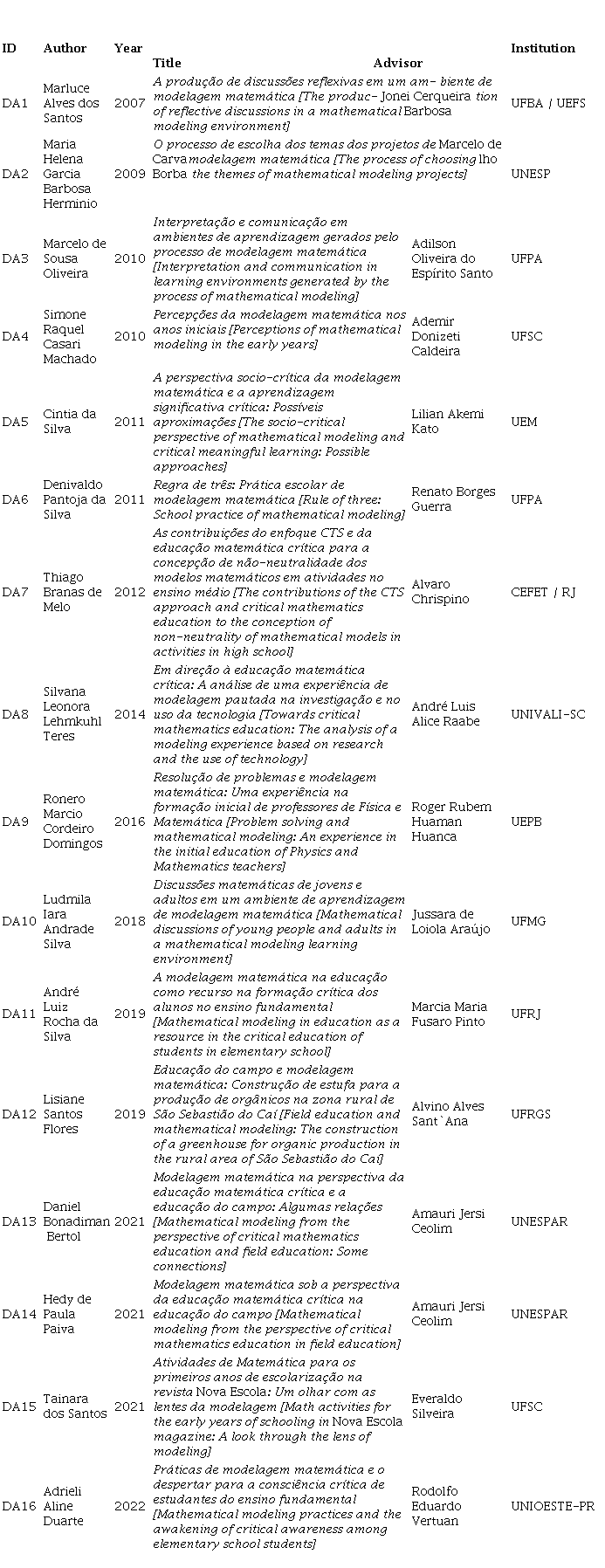
In Chart 2, we present the 16 academic master’s dissertations mapped, chronologically, by year of defense, highlighting: identification (ID), author, year of defense, title, advisor, and institution (we also use acronyms).
Chart 2: Selected Academic Master’s Dissertations
 Source: Study data
| ID | Author | Year | Title Advisor | Institution |
| DA1 | Marluce Alves dos Santos | 2007 | A produção de discussões reflexivas em um am-biente de modelagem matemática [The produc- Jonei Cerqueira tion of reflective discussions in a mathematical Barbosa modeling environment] | UFBA / UEFS |
| DA2 | Maria Helena Garcia Barbosa Herminio | 2009 | O processo de escolha dos temas dos projetos de Marcelo de Carvamodelagem matemática [The process of choosing lho Borba the themes of mathematical modeling projects] | UNESP |
| DA3 | Marcelo de Sousa Oliveira | 2010 | Interpretação e comunicação em ambientes de aprendizagem gerados pelo processo de modelagem matemática [Interpretation and communication in learning environments generated by the process of mathematical modeling] | Adilson Oliveira do Espírito Santo | UFPA |
| DA4 | Simone Raquel Casari Machado | 2010 | Percepções da modelagem matemática nos anos iniciais [Perceptions of mathematical modeling in the early years] | Ademir Donizeti Caldeira | UFSC |
| DA5 | Cintia da Silva | 2011 | A perspectiva socio-crítica da modelagem matemática e a aprendizagem significativa crítica: Possíveis aproximações [The socio-critical perspective of mathematical modeling and critical meaningful learning: Possible approaches] | Lilian Akemi Kato | UEM |
| DA6 | Denivaldo Pantoja da Silva | 2011 | Regra de três: Prática escolar de modelagem matemática [Rule of three: School practice of mathematical modeling] | Renato Borges Guerra | UFPA |
| DA7 | Thiago Branas de Melo | 2012 | As contribuições do enfoque CTS e da educação matemática crítica para a concepção de não-neutralidade dos modelos matemáticos em atividades no ensino médio [The contributions of the CTS approach and critical mathematics education to the conception of non-neutrality of mathematical models in activities in high school] | Alvaro Chrispino | CEFET / RJ |
| DA8 | Silvana Leonora Lehmkuhl Teres | 2014 | Em direção à educação matemática crítica: A análise de uma experiência de modelagem pautada na investigação e no uso da tecnologia [Towards critical mathematics education: The analysis of a modeling experience based on research and the use of technology] | André Luis Alice Raabe | UNIVALI-SC |
| DA9 | Ronero Marcio Cordeiro Domingos | 2016 | Resolução de problemas e modelagem matemática: Uma experiência na formação inicial de professores de Física e Matemática [Problem solving and mathematical modeling: An experience in the initial education of Physics and Mathematics teachers] | Roger Rubem Huaman Huanca | UEPB |
| DA10 | Ludmila Iara Andrade Silva | 2018 | Discussões matemáticas de jovens e adultos em um ambiente de aprendizagem de modelagem matemática [Mathematical discussions of young people and adults in a mathematical modeling learning environment] | Jussara de Loiola Araújo | UFMG |
| DA11 | André Luiz Rocha da Silva | 2019 | A modelagem matemática na educação como recurso na formação crítica dos alunos no ensino fundamental [Mathematical modeling in education as a resource in the critical education of students in elementary school] | Marcia Maria Fusaro Pinto | UFRJ |
| DA12 | Lisiane Santos Flores | 2019 | Educação do campo e modelagem matemática: Construção de estufa para a produção de orgânicos na zona rural de São Sebastião do Caí [Field education and mathematical modeling: The construction of a greenhouse for organic production in the rural area of São Sebastião do Caí] | Alvino Alves Sant`Ana | UFRGS |
| DA13 | Daniel Bonadiman Bertol | 2021 | Modelagem matemática na perspectiva da educação matemática crítica e a educação do campo: Algumas relações [Mathematical modeling from the perspective of critical mathematics education and field education: Some connections] | Amauri Jersi Ceolim | UNESPAR |
| DA14 | Hedy de Paula Paiva | 2021 | Modelagem matemática sob a perspectiva da educação matemática crítica na educação do campo [Mathematical modeling from the perspective of critical mathematics education in field education] | Amauri Jersi Ceolim | UNESPAR |
| DA15 | Tainara dos Santos | 2021 | Atividades de Matemática para os primeiros anos de escolarização na revista Nova Escola: Um olhar com as lentes da modelagem [Math activities for the early years of schooling in Nova Escola magazine: A look through the lens of modeling] | Everaldo Silveira | UFSC |
| DA16 | Adrieli Aline Duarte | 2022 | Práticas de modelagem matemática e o despertar para a consciência crítica de estudantes do ensino fundamental [Mathematical modeling practices and the awakening of critical awareness among elementary school students] | Rodolfo Eduardo Vertuan | UNIOESTE-PR |
| | | | | | | |
We can observe that the 16 mapped academic dissertations were developed in institutions located in almost all Brazilian regions. The works are distributed as follows: in the South Region (eight dissertations): four in Paraná (two at UNESPAR, one at UEM and one at UNIOESTE-PR), three in Santa Catarina (two at UFSC and one at UNIVALI-SC) and one in Rio Grande do Sul (one at UFRGS); in the Southeast Region (four dissertations): two in Rio de Janeiro (one at UFRJ and one at CEFET-RJ), one in São Paulo (one at UNESP) and one in Minas Gerais (one at UFMG); in the Northeast Region (two dissertations): one in Bahia (one at UFBA/UEFS) and one in Paraíba (one at UEPB); and in the North Region (two dissertations): both in Pará (two at UFPA).
Among the advisors, researchers Amauri Jersi Ceolim (two advisors), Jussara de Loiola Araújo (one advisor), Marcelo de Carvalho Borba (one advisor) stand out, who had already been highlighted as advisors of mapped theses, and Jonei Cerqueira Barbosa (one advisor), who appeared as an author in 2001 and as an advisor in 2007, validating the same observation that we had previously made, in a similar case.
A special highlight is that, unlike the mapped academic theses, developed only in institutions located in the Southeast Region –historically, the cradle of the first postgraduate programs in Brazil with mathematics education as an area of concentration or line of research–, the mapped academic dissertations reflect the expansion of such programs to practically all Brazilian regions or states.
3.3. The mapped professional master’s dissertations
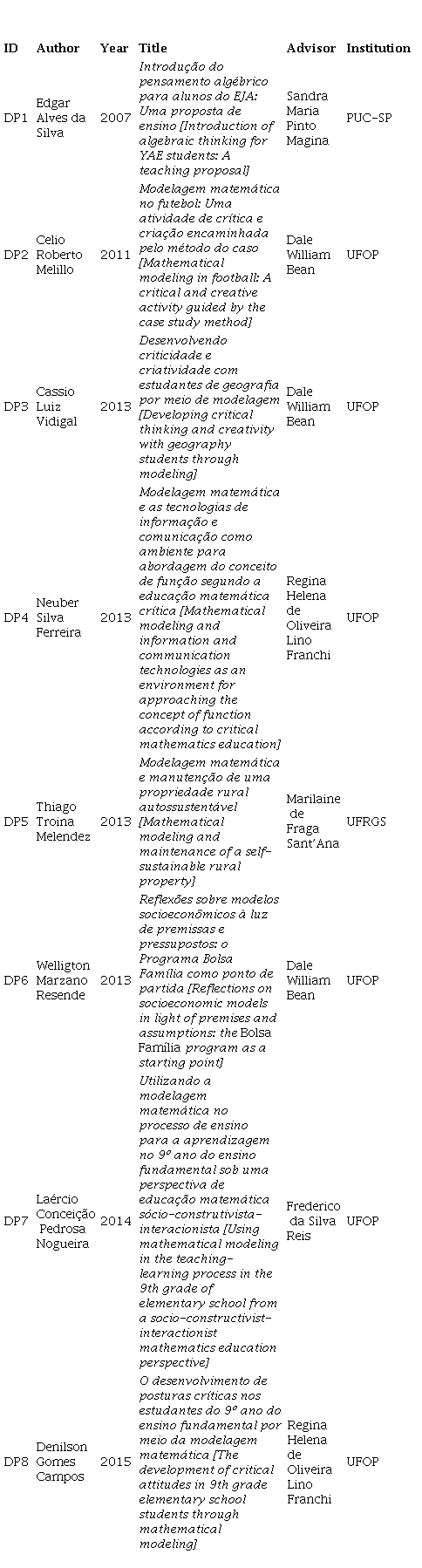
In Chart 3, we present the 25 professional master’s dissertations mapped, chronologically, by year of defense, highlighting: identification (ID), author, year of defense, title, advisor, and institution (with acronyms).
Chart 3: Selected professional master’s dissertations
| ID | Author | Year | Title | Advisor | Institution |
| DP1 | Edgar Alves da Silva | 2007 | Introdução do pensamento algébrico para alunos do EJA: Uma proposta de ensino [Introduction of algebraic thinking for YAE students: A teaching proposal] | Sandra Maria Pinto Magina | PUC-SP |
| DP2 | Celio Roberto Melillo | 2011 | Modelagem matemática no futebol: Uma atividade de crítica e criação encaminhada pelo método do caso [Mathematical modeling in football: A critical and creative activity guided by the case study method] | Dale William Bean | UFOP |
| DP3 | Cassio Luiz Vidigal | 2013 | Desenvolvendo criticidade e criatividade com estudantes de geografia por meio de modelagem [Developing critical thinking and creativity with geography students through modeling] | Dale William Bean | UFOP |
| DP4 | Neuber Silva Ferreira | 2013 | Modelagem matemática e as tecnologias de informação e comunicação como ambiente para abordagem do conceito de função segundo a educação matemática crítica [Mathematical modeling and information and communication technologies as an environment for approaching the concept of function according to critical mathematics education] | Regina Helena de Oliveira Lino Franchi | UFOP |
| DP5 | Thiago Troina Melendez | 2013 | Modelagem matemática e manutenção de uma propriedade rural autossustentável [Mathematical modeling and maintenance of a self-sustainable rural property] | Marilaine de Fraga Sant’Ana | UFRGS |
| DP6 | Welligton Marzano Resende | 2013 | Reflexões sobre modelos socioeconômicos à luz de premissas e pressupostos: o Programa Bolsa Família como ponto de partida [Reflections on socioeconomic models in light of premises and assumptions: the Bolsa Família program as a starting point] | Dale William Bean | UFOP |
| DP7 | Laércio Conceição Pedrosa Nogueira | 2014 | Utilizando a modelagem matemática no processo de ensino para a aprendizagem no 9º ano do ensino fundamental sob uma perspectiva de educação matemática sócio-construtivista-interacionista [Using mathematical modeling in the teaching-learning process in the 9th grade of elementary school from a socio-constructivist-interactionist mathematics education perspective] | Frederico da Silva Reis | UFOP |
| DP8 | Denilson Gomes Campos | 2015 | O desenvolvimento de posturas críticas nos estudantes do 9º ano do ensino fundamental por meio da modelagem matemática [The development of critical attitudes in 9th grade elementary school students through mathematical modeling] | Regina Helena de Oliveira Lino Franchi | UFOP |
| | | | | | |
 Source: Study data
| DP9 | Fernando Carvalho Grimaldi | 2015 | A modelagem matemática na merenda escolar nos anos finais do ensino fundamental [Mathematical modeling in school meals in the final years of elementary school] | Eline das Flores Victer | UNIGRANRIO |
| DP10 | Camila Maria Dias Pagung | 2016 | Construção do conceito de função em um ambiente de modelagem matemática: Estudo da renda de uma associação de reciclagem de resíduos sólidos [Construction of the concept of functions in a mathematical modeling environment: A study of the income of a solid waste recycling association] | Oscar Luiz Teixeira de Rezende | IFES |
| DP11 | Jéssica Adriane de Mello | 2016 | A modelagem matemática na perspectiva sócio-crítica: Uma experiência em um curso de costureiras [Mathematical modeling from a socio-critical perspective: An experience in a seamstress course] | Marilaine de Fraga Sant’Ana | UFRGS |
| DP12 | Joelma de Fátima Rodrigues Batista Freitas | 2016 | Modelagem matemática no ambiente virtual de aprendizagem (AVA): Entendendo as suas dimensões crítica e reflexiva a partir de um estudo de caso [Mathematical modeling in the virtual learning environment (VLE): Understanding its critical and reflective dimensions based on a case study] | Daniel Clark Orey | UFOP |
| DP13 | Jonisario Littig | 2016 | Modelagem matemática e o conhecimento reflexivo: Um estudo a partir da captação da água da chuva [Mathematical modeling and reflective knowledge: A study based on rainwater harvesting] | Luciano Lessa Lorenzoni | IFES |
| DP14 | Everton Murilo da Vitoria Olario | 2017 | O desenvolvimento de uma atividade de modelagem matemática em um ambiente virtual de aprendizagem baseado no modelo de cooperação investigativa [The development of a mathematical modeling activity in a virtual learning environment based on the investigative cooperation model] | Oscar Luiz Teixeira de Rezende | IFES |
| DP15 | Janaina Marquez | 2017 | Modelagem na educação matemática com vistas à autonomia [Modeling in mathematics education with a view to autonomy] | Marilaine de Fraga Sant’Ana | UFRGS |
| DP16 | Rogerio Braga Soares | 2018 | Modelagem matemática como um ambiente de aprendizagem para o desenvolvimento das competências em modelagem matemática de um grupo de estudantes ao transformar uma brincadeira em uma prática esportiva [Mathematical modeling as a learning environment for the development of mathematical modeling skills of a group of students by transforming a game into a sporting practice] | Daniel Clark Orey | UFOP |
| DP17 | Silvana Cocco Dalvi | 2018 | A modelagem matemática na perspectiva sócio-crítica e os registros de representação semiótica: A formação do conceito de número racional [Mathematical modeling from a socio-critical perspective and the records of semiotic representation: The formation of the concept of rational number] | Oscar Luiz Teixeira de Rezende | IFES |
| DP18 | Suzana Beatriz Kotovicz Moreira | 2018 | Educação matemática e educação ambiental crítica: Questões socioambientais analisadas por alunos da educação másica [Mathematics education and critical environmental education: Socio-environmental issues analyzed by basic rducation students] | Regina Helena Munhoz | UDESC |
| DP19 | Wasley Antonio Ronchetti | 2018 | Os registros de representação semiótica na aprendizagem das grandezas massa e comprimento por meio de uma atividade de modelagem matemática Oscar Luiz Teixeina perspectiva sócio-crítica [Semiotic representation ra de Rezende records in learning the magnitudes mass and length through a mathematical modeling activity from a socio-critical perspective] | IFES |
| DP20 | Caliane da Rocha Silva | 2019 | Matemática socio-crítica: Paulo Freire e o encontro com a modelagem matemática na educação de jovens e adultos [Socio-critical mathematics: Paulo Freire and the encounter with mathematical modeling in youth and adult education] | Érica Valéria Alves | UNEB |
| -DP21 | Edyenis Rodrigues Frango | 2019 | As contribuições de um curso de formação em modelagem matemática para o desenvolvimento de um guia formativo na perspectiva dos professores participantes [The contributions of a formative course in mathematical modeling to the development of a training guide from the perspective of participating teachers] | Marco Aurélio Kistemann Junior | UFJF |
| DP22 | Laísa Cominotti Rossim Dalvi | 2019 | Modelagem matemática como alternativa para o ensino de geometria no curso técnico em agropecuária [Mathematical modeling as an alternative for teaching geometry in the agricultural technical course] | Poliana Daré Zampirolli Pires | IFES |
| DP23 | Rafael Machado da Silva | 2019 | Atividades de modelagem matemática com estudantes em vulnerabilidade social: Uma análise à luz da educação matemática crítica [Mathematical modeling activities with socially vulnerable students: An analysis in light of critical mathematics education] | Karina Alessandra Pessoa da Silva | UTFPR |
| DP24 | Aldo Peres Campos e Lopes | 2020 | Uma experiência de modelagem matemática no en-sino remoto de equações diferenciais para cursos de Frederico da Silva engenharia [An experience of mathematical modeling Reis in the remote teaching of differential equations for engineering courses] | UFOP |
| DP25 | Sebastião Aparecido de Araújo | 2020 | Utilizando a dimensão sociocrítica da modelagem matemática no ensino de equações diferenciais para o curso de licenciatura em matemática [Using the so- Frederico da Silva cio-critical dimension of mathematical modeling in Reis the teaching of differential equations for the teaching degree in mathematics] | UFOP |
| | | | | | |
Twenty-five mapped professional dissertations were developed in institutions located in three Brazilian regions and are distributed as follows: in the Southeast Region (19 dissertations): 11 in Minas Gerais (ten at UFOP and one at UFJF), six in Espírito Santo (six at IFES), one in Rio de Janeiro (one at UNIGRANRIO) and one in São Paulo (one at PUC-SP); in the South Region (five dissertations): three in Rio Grande do Sul (three at UFRGS), one in Paraná (one at UTFPR) and one in Santa Catarina (one at UDESC); and in the Northeast Region (one dissertation) in Bahia (one at UNEB).
Among the advisors, the researchers Oscar Luiz Teixeira de Rezende (four advisors), Dale William Bean (three advisors), Frederico da Silva Reis (three advisors), Marilaine de Fraga Sant’Ana (three advisors), Daniel Clark Orey (two advisors), and Regina Helena de Oliveira Lino Franchi (two advisors) stand out.
A notable highlight is that the significant number of mapped professional dissertations reflects the expansion of postgraduate programs in the professional modality in Brazil, particularly those that have mathematics education or mathematics teaching as an area of concentration, especially in the 21st century.
4. Conceptions of modeling in mathematics education in the mapped works
Moving towards a vertical dimension in our mapping, we highlight below the leading researchers who supported or constituted the theoretical-bibliographical reference of the 50 mapped works, focusing on the modeling concepts adopted, and the criticality approaches identified.
Furthermore, from now on, we present such works categorizing them by their identification (ID) as academic theses, academic dissertations, or professional dissertations, as we understand that such categorization is more appropriate to better detail and contextualize the information explored in the mapped “observable relief of scientific productions” (Cavalcanti, 2015).
Regarding the mapped modeling concepts, we highlight the main researchers who supported or contributed to the theoretical-bibliographical reference of the 50 mapped works. We observed, however, that some works have more than one researcher in their reference; therefore, in these cases, we made a choice to associate them with that researcher or with that conception of modeling that we believe to have been preponderant in the development of the research and, mainly, in the analysis and conclusions presented at the end of the work.
Jonei Barbosa, with his socio-critical conception/perspective of modeling in mathematics education (Kaiser; Sriraman, 2006), serves as a reference for 30 of the 50 mapped works (60%) among theses and dissertations, including those that have more than one theoretical modeling framework. Considering that, among the 50 mapped works, he supervised only one academic dissertation (DA1) –which, as expected, has as its theoretical reference his own conception of modeling–, we can infer that such a conception was very well accepted in the academic community of mathematics education and widely used to theoretically and methodologically support research in modeling. Barbosa’s (2006) socio-critical conception presents modeling as a learning environment in which students are invited to investigate real-world situations through mathematics; and, although it is not guided by procedures, stages, or cycles, it does refer to modeling “cases,” remaining open for students to accept the invitation to work with modeling a real situation that interests them. Thus, epistemologically, this open and definite conception of the human sciences “invites” students to research something that interests them, which may or may not be related to mathematics, which can provide opportunities for a range of critical discussions in the classroom. The invitation is accepted with the students’ attitude of involvement, as they choose a topic, develop research and questions, and seek to undertake modeling according to the steps they understand to be necessary. Precisely because they are not required to build a model, which is not discarded, it is also possible to apply this modeling concept from basic education to higher education, as we observed during the analysis of the mapped works. In our mapping, verified that the socio-critical conception of modeling, supported by several scientific works by Jonei Barbosa, is used in works whose research was developed at all levels of education: two in the initial years of elementary school (DA16, DP19); six in the final years of elementary school (DA1, DA3, DA11, DA12, DP8, DP17); ten in high school – six in regular high school (TA9, DA13, DP4, DP13, DP15, DP16), one in technical high school (TA8) and three in high school in the YAE modality (DA10, DP1, DP20) –; two in basic education in general (TA4, TA7); one in vocational education (DP11); four in higher education – three in face-to-face courses (TA1, DA2, DA5) and one in a course in the distance learning modality (DP12) –; two in mathematics teacher education courses (DA6, DP21); one in a non-school environment (DP10); and two in the form of documentary analysis (DA14, DA15).
Another conception of modeling in mathematics education that is present in six of the 50 mapped works (12%) —including works that have more than one theoretical framework— is the conception of Dionísio Burak (Burak, 2010), who presents modeling as a teaching methodology consisting of a set of procedures aiming to construct a parallel to try to explain, mathematically, the phenomena present in the daily life of human beings, helping them to make predictions and decisions. Although he himself does not appear as the supervisor of any of these mapped works, this fact indicates that his conception is also well-received and disseminated in the academic community of mathematics education. In their conception, based on a vision that mathematics education in its nature must consider not only mathematics, but also psychology, sociology and philosophy, Burak and Klüber (2008) describe the modeling process in five stages and two principles: always start from the student’s interest; and carry out data collection, whenever possible, in the place where the interest is concentrated, highlighting that the stages, because they are not rigid, are not exactly sequential in the way they appear in their work; they must be guided by the interest of the student or group and by the needs of the teaching level, not requiring the formulation of a mathematical model. Thus, this conception of modeling in mathematics education is also epistemologically open and related to the social and human sciences, allowing its use as a reference for research developed at all levels of education. As basic education is the main stage proposed for the use of this conception, we highlight that five works were produced in this teaching stage: two in the initial years of elementary school (DA4, DA8); two in the final years of elementary School (DP7, DP9); one in regular high school (DP22); and one in higher education (DP25), whose research was developed with students of a mathematics teaching degree course.
As researcher Rodney Bassanezi is considered one of the precursors of mathematical modeling in Brazil, we already expected that his conception/educational perspective of modeling in mathematics education, coming from a realistic perspective (Kaiser; Sriraman, 2006), would not fail to appear as a theoretical-bibliographical reference, as we were able to verify in five of the 50 works (10%). Bassanezi (2002, p. 16) describes mathematical modeling as a dynamic process used to obtain and validate mathematical models, conceiving it as the “art of transforming real-world problems into mathematical problems”, aiming, then, to solve such problems and “interpret their solutions using the language of the real world”. In the modeling process based on this conception, obtaining, developing, and validating the model play a central role, which Rodney Bassanezi conceives as “a set of symbols and mathematical relationships” that, to some extent, can represent and explain the object of study. In this conception, which emphasizes the importance of applying mathematics to understand real-world phenomena, it presents a sequence of steps that must be followed in a modeling activity. It is essential to understand the procedures and processes involved, as well as the construction of the model. These steps, adapted from applied mathematics to carry out the modeling process in mathematics education, serve as a “backdrop or motivation” for learning mathematical content and, thus, aim to develop mathematical competence in the context of modeling to construct new knowledge, aiming at student learning and the formation of a critical and active individual in their social context. Due to the characteristics of this modeling conception, the mapped works are more concentrated in higher education. However, we also mapped works developed with high school students: three in higher education – two with engineering students (TA6, DP24) and one with mathematics and physics teaching degree students (DA9) –; and two in high school – one in regular high school (DA7) and one in technical high school (DP5).
Another conception of modeling in mathematics education in our mapping (verified in two of the 50 works, i.e., 4%) is exposed by Maria Salett Biembengut, also considered an important researcher in modeling, as her works are strongly influenced by her advisor, Rodney Bassanezi. In this conception, which we can also classify as the educational conception/perspective of modeling in mathematics education (Kaiser; Sriraman, 2006), Biembengut (Biembengut; Hein, 2003) conceives modeling as a strategy used to arrive at the mathematical model, also revealing the importance of obtaining the model in the modeling process with which, in this way, the objective is to teach sound academic knowledge so that people can act in the environment in which they live. One facet of this conception of modeling is to consider it as an “artistic process” because, when developing a model, a vast knowledge of mathematics is required to know how to discern which mathematical contents best adapt to the problem; and, also, a significant dose of intuition and creativity to interpret the context in which the variables are involved. Thus, since the model is seen as indispensable, the modeling process can be succinctly described in three stages: interaction, mathematization, and mathematical model, in a kind of adaptation of a process typical of natural sciences to the classroom as a teaching methodology, so that students learn mathematical content and, simultaneously, carry out research. This conception of mathematical modeling was mapped in works with research carried out not only in higher education, but also in basic education: one in higher education, with students of engineering courses (TA5); and one in elementary education (DP19).
Researcher Dale Bean, who passed away in 2016, theoretically references three of the 50 mapped works (6%), conceiving modeling as a creative conceptualization activity that refers to the modeler’s objectives, knowledge, and values (Bean, 2009). In its conception, it determines some steps in the modeling activity: interaction with the problem, adoption of premises, formulation of assumptions, creation of the model, and evaluation of the model. In the activity of modeling a problematic situation, to satisfy the needs, aspirations, and interests of the individual or a community, the individual’s interaction with the world is guided by their assumptions, values, beliefs, concepts, premises, and hypotheses, which will determine how to problematize the situation, accentuating or disregarding aspects of the situation to be studied, creating what Bean (2009) calls “isolation”. Starting from this isolation, the modeler is led to adjust an existing model, apply another, or build a new one according to the adopted premises and assumptions. From then on, the adjusted, applied, or created model is evaluated to verify whether it meets the modeler’s objectives and interests. If the model is not adequate, a new interaction with the problematic situation is resumed until the model satisfies the modeler’s objectives and interests. This conception of modeling in mathematics education is present in three mapped works – two portray research carried out in higher education, in mathematics and geography teaching degree courses (DP2, DP3); and one in high school (DP6).
Researcher Lourdes Almeida appears as the primary theoretical-bibliographical reference in two of the 50 mapped works (4%). She believes that mathematical modeling in education serves as a pedagogical alternative, where we approach a problem-situation through mathematics that is not essentially mathematical (Almeida; Brito, 2005). This approach occurs in four stages: integration, mathematization, resolution, interpretation, and validation. The production of a report to communicate the progress and results, along with convincing arguments for the modelers and others to whom the proposed model will be presented, is also highlighted as being of utmost importance. This report deals with the validity of the model achieved, which involves a set of actions such as searching for information, identifying and selecting variables, developing hypotheses, simplifying, obtaining a mathematical representation (mathematical model), solving the problem through appropriate procedures, and analyzing the solution, which involves validation, identifying its acceptability or not. In her work, Professor Lourdes focuses heavily on obtaining the model, implying that it is something essential and not dispensable, but that it can be presented in algebraic, geometric, or graphical form. This conception of modeling in mathematics education is present in two mapped works, both related to basic education: one in high school (DP14) and one that presents research with students aged 15 to 17 in a situation of social vulnerability (DP23).
Finally, we will also address two concepts that come from the researchers’ own doctoral theses and which, therefore, we mapped as theoretical references for two of the 50 mapped works (4%).
Jussara Araújo, in her doctoral thesis (TA2), presents her conception of modeling in mathematics education based on critical mathematics education and defines it as an “approach, through mathematics”, to a non-mathematical real-world problem or even to real-world situations considered non-mathematical, which the students must choose, always gathered in groups, in such a way that the questions of critical mathematics education serve as a basis for the development of work in the classroom (Araújo, 2002). The objective is to promote political education and critical participation of students and citizens in society, discussing political, economic, and environmental issues—in which mathematics serves as a technological support—and thus enable them to critically evaluate mathematics itself, mathematical models, and their use in society. In our mapping, we noted that she outlined this concept in her thesis, which was conducted within a higher education setting in a chemical engineering course.
In turn, Otávio Jacobini, in his doctoral thesis (TA3), presents his conception of mathematical modeling, which is heavily influenced by critical education and mathematics education. In his work with modeling, he considers “political possibilities as reflections” that can be identified with questions, criticisms, actions, and transformations. Such reflections may be related to the formation and maturation of students, both as academics and citizens; to investigations and discussions, mathematical or otherwise; and also, to the transformations that occur in their thinking and way of acting. He also understands the mathematical model as a “representation of some situation related to the real world” (Jacobini, 2004) – and, to obtain that representation, a mathematical language is used. In our mapping, we noted that the researcher outlined this concept in his thesis, which was carried out in higher education with students pursuing degrees in mathematics teaching and computer engineering.
5. Approaches and focuses of criticality in the mapped works
Continuing with the perspective of a vertical dimension in our mapping, we highlight below the main approaches and focuses of criticality identified in researchers who supported or constituted the theoretical-bibliographical reference of the 50 mapped works.
To achieve our goal of presenting a mapping of theses and dissertations developed in the area of mathematics education in Brazil that address criticality in mathematical modeling, we reaffirm our understanding that it is essential to delve deeper into the possible approaches and different focuses of criticality in the different conceptions of modeling in mathematics education. Therefore, we seek to do so, from now on, in the set of all mapped works, without, however, presenting them through their identification (ID) as academic theses, academic dissertations, or professional dissertations, as we understand that such categorization was more appropriate when we focused on the adopted modeling concepts. Furthermore, now that our gaze turns to the different approaches to criticality identified in the mapped works, we sought to relate these approaches to the conceptions previously presented, in general, thus justifying the lack of need to associate the mapped works with a specific conception again.
Thus, in relation to the main approaches and focuses of criticality we identified, we sought not only to highlight the main theories or authors that supported or constituted the theoretical-bibliographical references of the 50 mapped works, but also to relate criticality to the various stages of modeling, as proposed by the researchers previously presented through their conceptions. We observed, again, that some mapped works have more than one researcher listed in their reference related to the adopted modeling concepts. Furthermore, some others do not explicitly state a “theory or author” to define criticality, because in these cases, we sought to link their criticality focus to the researchers on whom they based their theoretical references.
Initially, we found that works using the modeling concepts of Jonei Barbosa, Jussara Araújo, and Otávio Jacobini typically presented the assumptions of critical mathematics education as a “theoretical basis of criticality,” which also has foundations in Paulo Freire’s critical education or critical pedagogy.
Freire’s critical education presents striking characteristics, such as critical reflection on practice, essential in the relationship between theory and practice; the critical capacity of students reinforced by the democratic educator, which leads them to construct and reconstruct knowledge, perceiving its relationship with what occurs around them, culturally, socially, and economically. For Freire (2009), teaching is not just “transferring knowledge but creating the possibilities for its production or construction”. The researcher talks about respecting the student’s autonomy and identity, about true dialogicity in a process of democratization in which both the educator and the student are important in the teaching-learning relationship, in which, in turn, both the teacher and the student have decisive and decision-making roles from planning to evaluation, for example. This also includes respect for the teacher, their dignity as a person and as a professional, both culturally and economically. The teacher has the possibility of constantly reevaluating themselves as cultural, historical, and unfinished beings, aware of their incompleteness; always seeking to improve and change reality for the benefit of humanity, not accepting determinism, but, in a rebellious way, in a more radical and critically revolutionary position, opposing it. Regarding technology, Freire (2009) states, “neither to deify nor to demonize it”, but to examine it critically and curiously. Ultimately, Freire’s critical education reveals itself to be a form of political and ideological education.
Based, but not solely, on such ideas, Skovsmose’s critical mathematics education (2008) proposes some main theses, such as: the formative power of mathematics in society is shaping and influencing decisions made based on mathematical results or models; and the use of mathematical knowledge and technological knowledge in carrying out some task or activity must be evaluated by reflective knowledge regarding the process, possibilities, and consequences of what is developed. The ideology of certainty presented in Skovsmose discusses the perfection, generality, and purity of mathematics in terms of social, political, and ideological interests. It also addresses the relevance and reliability of mathematics, criticizing the idea that it is applicable in all areas and can solve endless problems, generating the best and most reliable results. The researcher, using reflective and critical knowledge, contests, denounces, and challenges the ideology of certainty in mathematics by proposing that critical educators demonstrate that mathematical knowledge is one among many, and that, therefore, the models obtained for a given situation are not unique and can be modified. New philosophical approaches to mathematics, the incorporation of project work, and student involvement in choosing problems for modeling are among the suggested alternatives. Additionally, a critical mathematics curriculum highlights the possibilities and limits of this science, as well as the political dimension of the ideology of certainty (Lopes, 2023).
The mapped works, based on Burak’s (2010) modeling conception, follow the steps proposed by the researcher, who generally defends the importance of maintaining a critical stance throughout the entire modeling process.
Specifically, one of the steps proposed by the researcher is the critical analysis of the solutions; however, as an example, it is possible to observe in one of the mapped works (DA4) that the “critical sense” occurred in all steps. The topic researched was school meals, a topic of direct interest to students. Initially, they should work in groups to represent, through illustrations, the foods present in school meals. As exploratory research activities, students should interview nutritionists at their respective educational departments and visit the kitchen to highlight the social, political, economic, and cultural dimensions intertwined with the theme. When surveying the problems, the objective was to organize the data to give it meaning and logical sense, also in relation to the transfer of funds intended for the purchase of school meals. When solving the problems, they calculated the difference between the number of grams of the most ordinary and of the rarest ingredients in the menu. They calculated the daily amounts of protein and kilocalories required, comparing them with the data provided by the municipality’s nutritionist, to assess whether they met the specifications of the Ministry of Education. Finally, the critical analysis of the solutions took place through an exhibition in the school cafeteria. Thus, we recognize the criticality involved in all stages of the modeling process, highlighting that the planning activity led educators to put themselves in the students’ shoes, experiencing exactly the opposite side of the educational process, a process called inversion symmetry.
A similar characteristic of the criticality approach can be observed in the mapped works based on Lourdes Almeida’s modeling cycles, as criticality permeates these cycles within the modeling process.
As an example, we present a mapped work (DP 14) in which a modeling activity is planned and executed—specifically, daily water consumption habits in liters during bathing—through the virtual learning environment Moodle. During the first week of the activity, students wrote down the time spent showering for three consecutive days. They compared these times, making criticisms and considerations about what would be the ideal time spent in a shower. In the second week, they measured the amount of water used for showering and calculated the cost in reais of each shower during a specific time period, asking themselves, “How much is my shower time worth?” In the third week, they discussed and collectively created a text about water use and how to create more rational and conscious habits. We can see that, throughout the entire process, collective critical discussions permeated all the activities carried out.
In general, the mapped works that used the modeling concepts by Rodney Bassanezi and Maria Salett Biembengut highlight criticality in the learning of mathematical content and, thus, point to the importance of developing mathematical competence in the context of modeling to construct new knowledge, aiming at student learning and the formation of critical and active individuals in their social context.
As an example, we present a mapped work (DP24) that used Bassanezi’s Modeling assumptions, focusing on Biembengut’s educational perspective. It is possible to notice a substantial load of applied mathematics, precisely because research is carried out in the subject of Ordinary Differential Equations for engineering courses. We observed that the discussions held by the students and portrayed in the professor-researcher’s statements do not explicitly carry a critical interpretation. However, even though the questions and queries proposed by the professor-researcher were more mathematical and specific to the subject, he always proposed a critical analysis of the situations at the end of obtaining the models. Through such analyses, the students were able to express their reflections about what was produced, allowing the professor-researcher to develop a category of analysis related to the contribution of modeling activities to the criticality required by future engineering professionals.
Finally, the mapped works that used Dale Bean’s modeling conception presented, in a succinct manner, the focus of the development of critical thinking by John Dewey (1979), who, with his peers, founded “American pragmatism”, a philosophical perspective based on the assumption that “man is not essentially theoretical or thinking, but rather a practical being of will and action”, constructing knowledge from intelligent investigation developed in the process of experience to methodical reflection.
Dewey (1979) understood that the State should guarantee a structure that provides education for all and proposed an educational method based on reflective experience and the student’s interest in solving problems, not only those listed by teachers. Dewey (1979, p. 83) states, “Education was a reconstruction or reorganization of experience, which clarifies and increases its meaning and also our ability to direct the course of subsequent experiences”. Thus, man should think in a methodical and planned manner to know themselves and the world around them, exercising critical and reflective scientific thinking. Dewey (1979, p. 159) conceptualized thought as “the intentional effort to discover the specific relationships between something we do and the resulting consequence, so that there is continuity between them”, after all, “thinking is equivalent to patenting, to making explicit the intelligible element of our experience”, to guide, enrich, and give direction to human actions. Therefore, education should relate curriculum content to the physical environment and the sphere of social relations, expanding intelligence, initiative, and cooperation, which leads to the transformation of society into a more just and egalitarian one.
6. Final considerations
In the initial considerations of this article, we highlighted that modeling as a trend in research and practices in mathematics education is a methodology that opens space for inquiries, interpretations, and propositions, thus being fertile ground for maintaining a “critical stance” throughout the entire modeling process. From this perspective, we set out to investigate the possible approaches and different focuses of criticality in various mathematical modeling concepts in mathematics education.
The mapping presented here of theses and dissertations developed in the area of mathematics education in Brazil, and which involve modeling in mathematics education relating criticality and mathematical modeling, revealed that many researchers act as supervisors of academic research related to modeling in mathematics education, spread across several higher education institutions located in the most varied states and regions of Brazil.
Regarding the adopted modeling concepts, we concluded that the main researchers who supported or constituted the theoretical-bibliographical reference of the mapped works were Jonei Barbosa, Dionísio Burak, Rodney Bassanezi, Dale Bean, Maria Salett Biembengut, and Lourdes Almeida. However, as we observed, almost all the works incorporate, to a greater or lesser extent, the central ideas of several researchers, even as a means of enriching their references.
In relation to the main identified approaches and focuses of criticality, we conclude that the mapped works that use Jonei Barbosa’s conception, for the most part, explain their foundation in critical mathematics education proposed by Ole Skovsmose, just as those that use Dale Bean’s conception explain their foundation in the development of John Dewey’s critical thinking. The works mapped on the concepts by Dionísio Burak or Lourdes Almeida emphasize the importance of maintaining a critical stance throughout the entire modeling process; in turn, those that use the concepts by Rodney Bassanezi or Maria Salett Biembengut emphasize criticality in the learning of mathematical content, in line with their educational perspective of mathematical modeling.
Therefore, we conclude that, regardless of the conception of modeling in mathematics education adopted, the works mapped here demonstrate the existence of a direct and fundamental relationship between the notion and practice of modeling and criticality throughout the process or in stages thereof, which points to the need for further academic research that investigates the possibilities and potentialities of this relationship.
7. References
ALMEIDA, Lourdes Maria Werle de; BRITO, Dirceu dos Santos. O conceito de função em situações de Modelagem. Zetetiké, Campinas, v. 13, n. 23, p. 63-83, 2005.
ARAÚJO, Jussara de Loiola. Cálculo, tecnologias e modelagem matemática: as discussões dos alunos. 2002. 173 f. Tese (Doutorado em Educação Matemática) – Instituto de Geociências e Ciências Exatas, Universidade Estadual Paulista, Rio Claro, 2002.
BARBOSA, Jonei Cerqueira. Modelagem Matemática: concepções e experiências de futuros professores. 2001. 253 f. Tese (Doutorado em Educação Matemática) – Universidade Estadual Paulista, Rio Claro, 2001.
BARBOSA, Jonei Cerqueira. Mathematical Modelling in Classroom: a socio-critical and discursive perspective. ZDM, Cham, v. 38, n. 3, p. 293-301, 2006.
BASSANEZI, Rodney Carlos. Ensino-aprendizagem com Modelagem Matemática: uma nova estratégia. São Paulo: Contexto, 2002.
BEAN, Dale.Modelagem: uma conceituação criativa da realidade. In: ENCONTRO DE EDUCAÇÃO MATEMÁTICA DE OURO PRETO, 4., 2009, Ouro Preto. Anais [...]. Ouro Preto: UFOP, 2009. p. 90-104.
BIEMBENGUT, Maria Salett; HEIN, Nelson. Modelagem Matemática no Ensino. São Paulo: Contexto, 2003.
BURAK, Dionísio. Modelagem Matemática sob um olhar de Educação Matemática e suas implicações para a construção do conhecimento matemático em sala de aula. Revista de Modelagem na Educação Matemática, Blumenau, v. 1, n. 1, p. 10-27, 2010.
BURAK, Dionísio; KLÜBER, Tiago Emanuel. Educação Matemática: contribuições para a compreensão da sua natureza. Acta Scientiae, Canoas, v. 10, n. 2, p. 93-106, 2008.
CALDEIRA, Ademir Donizeti. Modelagem Matemática: um outro olhar. Alexandria, Florianópolis, v. 2, n. 2, p. 33-54, 2009.
CAVALCANTI, José Dilson Beserra. A noção de relação ao saber: História e Epistemologia, panorama do contexto francófono e mapeamento de sua utilização na literatura científica brasileira. 2015. 428 f. Tese (Doutorado em Ensino de Ciências) – Universidade Federal Rural de Pernambuco, Recife, 2015.
DEWEY, John. Democracia e Educação. São Paulo: Companhia Editora Nacional, 1979.
FIORENTINI, Dario; GRANDO, Regina Célia; MISKULIN, Rosana Giaretta Sguerra; CRECCI, Vanessa Moreira; LIMA, Rosana Catarina Rodrigues de; COSTA, Marina Carravero. O professor que ensina matemática como campo de estudo: concepção do projeto de pesquisa. In: FIORENTINI, Dario; PASSOS, Carmem Lúcia Brancaglion; LIMA, Rosana Catarina Rodrigues de (org.). Mapeamento da pesquisa acadêmica brasileira sobre o professor que ensina matemática: período 2001 – 2012. Campinas: UNICAMP, 2016. p. 17-41.
FREIRE, Paulo. Pedagogia da Autonomia: saberes necessários à prática educativa. São Paulo: Paz e Terra, 2009.
JACOBINI, Otávio Roberto. A modelagem matemática como instrumento de ação política na sala de aula. 2004. 225 f. Tese (Doutorado em Educação Matemática) – Instituto de Geociências e Ciências Exatas, Universidade Estadual Paulista, Rio Claro, 2004.
KAISER, Gabriele; SRIRAMAN, Bharath. A global survey of international perspectives on modelling in mathematics education. ZDM, Cham, v. 38, n. 3, p. 302-310, 2006.
KLÜBER, Tiago Emanuel; BURAK, Dionísio. Concepções de Modelagem Matemática: contribuições teóricas. Educação Matemática Pesquisa, São Paulo, v. 10, n. 1, p. 17-34, 2008.
LOPES, Aldo Peres Campos. Contrapondo a ideologia da certeza por meio do conhecimento reflexivo na Modelagem Matemática. Bolema, Rio Claro, v. 37, n. 77, p. 936-957, 2023.
LOPES, Aldo Peres Campos. Formação de professores e a Modelagem Matemática na perspectiva crítica: um panorama de teses e dissertações brasileiras. Revista Brasileira de Ensino de Ciências e Matemática, Passo Fundo, v. 6, n. 2, p. 121-149, 2024.
LOPES, Aldo Peres Campos; PACHECO, João Vítor Pena. Panorama das pesquisas brasileiras em Modelagem Matemática no Ensino Superior pela perspectiva da Educação Matemática Crítica. Alexandria, Florianópolis, v. 16, n. 2, p. 181-212, 2023.
LOPES, Aldo Peres Campos; REIS, Frederico da Silva. Teaching Modeling via Google Meet: a new perspective on Mathematics. Zetetiké, Campinas, v. 31, n. 1, p. 1-16, 2024.
MENEZES, Rhômulo Oliveira; BAIRRAL, Marcelo Almeida. Um mapeamento de pesquisas sobre atividades de Modelagem Matemática desenvolvidas de forma online. Revemop, Ouro Preto, v. 3, n. 1, p. 1-16, 2021.
ROCHA, André Luiz; PINTO, Marcia Maria Fusaro. A Modelagem Matemática na educação como recurso na formação crítica dos alunos no Ensino Fundamental. Revemop, Ouro Preto, v. 2, n. 1, p. 1-28, 2020.
SKOVSMOSE, Ole. Educação Matemática Crítica: a questão da democracia. Campinas: Papirus, 2008.
Appendix – Editorial Details