1. Introduction
Discussions about initial teacher education constitute a fertile field for research, especially in light of recent curriculum changes. Changes to the resolutions that establish the National Curriculum Guidelines [Diretrizes Curriculares Nacionais] aimed at the initial higher education training of basic education professionals have directly impacted formative courses. Since the revocation of CNE/CP Resolution N. 2/2015, there have been successive attempts to establish new guidelines, resulting in the approval of other resolutions. However, they do not offer the same benefits or quality as the 2015 resolution. CNE/CP Resolution N. 2/2019 sparked discussions in the academic sphere, generating a high rejection rate due to several inadequacies and setbacks.
According to the Ministry of Education (Brasil, 2021), the new guidelines impose a specific format for the pedagogical projects of teaching degree courses, which ultimately limits the didactic autonomy of institutions and affects the work of teacher educators. In this context, the proposal for curriculum standardization, centered on the pedagogy of competencies and instrumental knowing, has taken precedence over more reflective training on pedagogical practice.
Also in 2019, MEC Ordinance No. 2.117/2019 was approved, allowing higher education institutions in the federal education system to implement distance learning courses alongside their in-person courses, provided that at least one of their courses is recognized. This flexibility can correspond to up to 40% of the total course workload. It is essential to note that this Ordinance was not the first to enable such flexibility. The first was Ordinance No. 2.253/2001, followed by No. 4.059/2004 and No. 1.134/2016. All of these regulations allowed the flexible workload to correspond to up to 20% of the total course. Ordinance No. 1.428/2018 brought the possibility of increasing to 40%; however, the courses had to meet minimum criteria for their application.
With Ordinance No. 2.117/2019, this flexibility was maintained and expanded to all courses, except for medicine. However, for institutions to adopt this percentage of distance learning hours, courses must meet quality criteria. They must obtain a score equal to or higher than three in the following indicators, assessed in the final phase of the review: methodology, tutoring activities, virtual learning environment (VLE), and information and communication technologies (ICTs).
Understanding the repercussions that the adoption of this Ordinance brought to mathematics teachers’ initial education, from the perspective of the undergraduates, is the focus of this investigation. Therefore, the objective of this article is to analyze the development of content knowledge and the challenges faced by mathematics teaching degree students in the context of adopting MEC Ordinance No. 2.117/2019. Based on the theories on reasoning and pedagogical action proposed by Shulman (1987), this article addresses this flexibility, embracing the term blended education from Christensen, Horn, and Staker’s (2013, p. 7) perspective, “a formal education program in which a student learns, at least in part, through online teaching, with some element of student control over time, place, [...] and at least in part in a supervised physical location.”
Given the above, we present an excerpt from a master’s research developed in a postgraduate program in mathematics education, within research line 1: Training of Teachers who Teach Mathematics. The Research Ethics Committee approved the investigation under number CAAE 75558623.2.0000.5150 and Opinion 6.766.200.
To this end, this article is structured into four sections. In the first section, we present the theoretical framework, focusing on teaching knowledge and teaching modalities. Next, we describe the methodological approach embraced, after which we discuss and analyze the data. Lastly, we convey our final considerations.
2. Theoretical framework on professional teaching knowledge
In recent decades, there has been extensive discussion about teacher knowledge, taking Shulman’s (1986, 1987) assumptions as a reference. In this work, we outline aspects related to the development of this knowledge based on the training courses, considering them a privileged space where undergraduates can develop and learn to act as teachers. According to Shulman (1987, p. 4),
Their progress from students to teachers, from apprentices to novice teachers, exposes and highlights the complex bodies of knowledge and skills required for a person to perform accordingly as a teacher. The result is that error, success, and refinement—in a word, the growth of the teacher’s knowledge—are seen in high profile and in slow motion.
Among the knowledge that must be developed for teacher education, Shulman (1986, 1987) proposes a minimum essential base for teachers:
a) Content knowledge
It relates to the specific domain of the content to teach and its structure. It involves the teacher’s skills to understand what is important in the curriculum to be taught.
b) General pedagogical knowledge
It relates to all spheres involved in the teaching and learning process, including school management.
c) Knowledge of the curriculum
The teacher must understand all the programs that involve the subject taught, its structure, organization of content, and materials that can be used. Furthermore, it must comprise other subjects to value interdisciplinarity in classes.
d) Pedagogical content knowledge
It involves reformulating content in order to improve students’ understanding. This knowledge is constructed in school practice.
e) Knowledge of students and their characteristics
It involves understanding students’ prior knowledge and how they learn.
f) Knowledge of the educational context
It encompasses the entire environment that permeates the school and that, directly or indirectly, is related to teaching.
g) Knowledge of educational objectives, purposes, and values, and their historical and phi-losophical foundations.
According to the author, this knowledge has at least four main sources: research in the content subjects; the materials and environments of the institutionalized educational process; research on education, social organizations, human learning, teaching, and development, and other social and cultural phenomena that affect what teachers can do; and the wisdom of practice itself.
In initial education courses, students develop this knowledge based on these sources. In the various subjects of the mathematics teaching degree program, students mobilize these knowings, which are also put into practice through public policy programs and supervised curriculum practicum.
Furthermore, Shulman (1987) emphasizes the importance of reasoning and pedagogical action during the transition from student to teacher. As illustrated in Figure 1, this process begins with understanding the content and culminates in the generation of new understanding, involving reflection, action, and pedagogical reasoning.
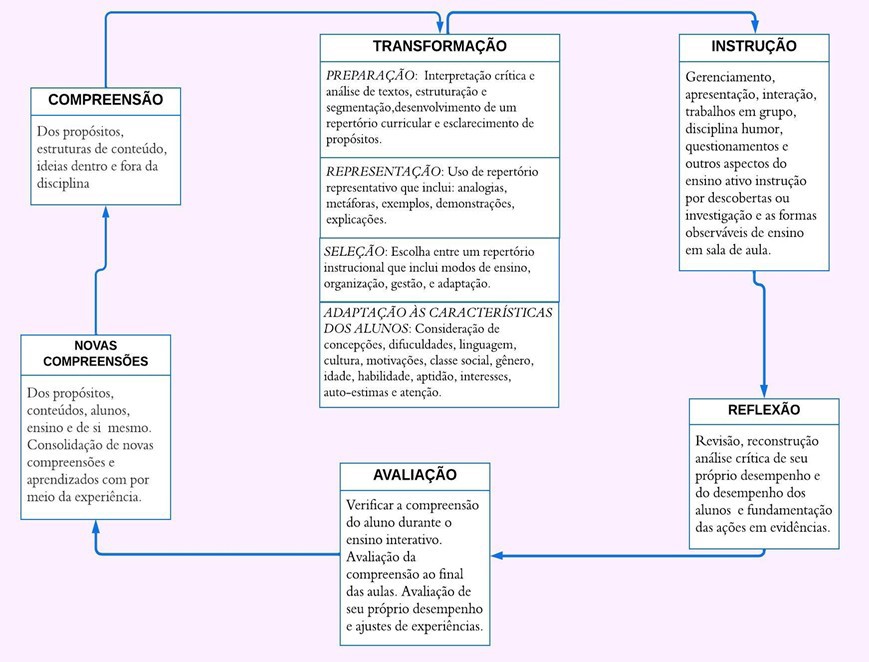 Figure 1
Model of pedagogical reasoning and action
Prepared by the authors, based on Shulman (1987).
In Shulman’s model (1987), teaching essentially involves critical understanding, which includes the exchange of ideas that teachers interpret and adapt for students’ active understanding. Shulman (1987) clarifies that new understandings do not occur instantly. It demands specific analysis and discussion strategies. Thus, our focus is on the challenges posed by MEC Ordinance No. 2.117/2019, specifically considering that prospective mathematics teachers are in the process of understanding the content, recognizing the importance of their preparation to teach, and addressing the use of technologies and related interactions.
When discussing the challenges of implementing MEC Ordinance No. 2.117/2019 in initial teacher education, it is essential to consider the educational modalities that are intertwined with this flexibility. According to Costalonga (2018), the primary characteristic of face-to-face education is the requirement for student presence in at least 75% of classes, as stipulated by the Brazilian Law of Guidelines and Bases (LDB). According to Voigt (2007), this modality stands out for the direct interaction between students and teachers, as well as among students themselves.
The school we are used to represents an educational sphere in a delimited physical location and with defined hours. Access to knowledge is closely tied to established space and time, and is characterized by face-to-face interpersonal relationships (p. 45).
On the other hand, distance learning (DL) is defined by Decree No. 9057, of December 25, 2017, as follows:
Art. 1º For the purposes of this decree, distance learning is considered the educational modality in which didactic-pedagogical mediation in the teaching and learning processes occurs with the use of information and communication means and technologies, with qualified personnel, with access policies, with compatible monitoring and evaluation, among others, and develops educational activities by students and education professionals who are in different places and times (Brasil, 2017).
The decree already outlines the main characteristics of distance learning, highlighting the use of digital information and communication technologies (DICTs), the need for qualified professionals, and the fundamental role of tutors. Furthermore, unlike face-to-face education, in distance learning, the time and space for learning are not fixed and can occur according to the students’ needs. In blended education, in turn, both modalities converge. According to Moran (2015), in this modality, there will be:
In-person [communication] with students, but also digitally, with mobile technologies, balancing interaction with each and every one. This blend of classroom and virtual environments is essential to opening the school to the world and bringing the world into the school. Another blend is to foresee more planned, organized, and formal communication processes with others, such as those that occur on social networks, where a more familiar language, greater spontaneity, and a constant flow of images, ideas, and videos prevail (p. 16).
Thus, blended education combines elements of face-to-face education, such as face-to-face interaction, with the possibilities offered by DICTs in remote teaching (Christensen; Horn; Staker, 2013; Moran, 2015). This combination seeks to enhance learning, promoting greater flexibility and student engagement.
Based on the expressed ideas, the “model of pedagogical reasoning and action” serves as a basis for analyzing MEC Ordinance No. 2.117/2019, which has repercussions on the initial education of mathematics teachers at a federal institute in Minas Gerais. The challenges faced by undergraduates at this federal institute encompass the teaching modalities discussed here, as distance learning and in-person courses already pose challenges to academic relationships. Therefore, given the proposal for blended education, the challenges that arise must be analyzed.
This framework emerged from the literature review carried out; as it is a fraction of the investigation, it is not possible to delve into it in greater depth. However, the framework presents an adherence to the investigated theme, especially regarding curriculum changes from the perspective of teaching degree students.
3. Methodology
This study employs a qualitative approach, aiming to understand and analyze data based on the experiences and perceptions of participants. According to Minayo (2009, p. 21), qualitative research:
[...] answers very particular questions. In the social sciences, [qualitative research] deals with a level of reality that cannot or should not be quantified. In other words, it works with the universe of meanings, motives, aspirations, beliefs, values, and attitudes. This set of human phenomena is understood here as part of social reality, as human beings are distinguished not only by their actions, but also by thinking about what they do and by interpreting their actions within and based on the reality experienced and shared with their peers.
The research was conducted with 17 undergraduate students from the mathematics course at a federal institute in Minas Gerais, with the objective of analyzing the development of content knowledge and the challenges faced by undergraduate students in the occasion of the adoption of MEC Ordinance No. 2.117/2019.
To ensure the anonymity and confidentiality of participants, all were identified by alphanumeric codes (L1-L17) during data collection and analysis.
Information collection was carried out in two stages. The first involved the application of a semi-structured questionnaire through Google Forms, which included questions addressing the development of undergraduate students’ knowledge, their experiences with adopting blended education, and their perceptions of curriculum changes. In this first stage, 17 undergraduate students responded to the proposed questionnaire. In the second stage, semi-structured interviews were conducted via Google Meet with four graduates who had responded to the questionnaire and agreed to participate in this stage of the investigation.
The selection of these participants followed two criteria: being enrolled in the last semesters of their teaching degree, i.e., the 7th and/or 8th semesters, and/or having participated in public policy programs to encourage teaching, such as the Institutional Teaching Initiation Grant Program (PIBID) or the Pedagogical Residency Program (PRP). Thus, partial data will be presented, referring to one of the categories analyzed during the master’s research. Thus, it is essential to note that the research in question has also yielded other emerging categories; however, for the purposes of this article, we have focused on aspects related to the challenges faced by students.
Data were analyzed using Bardin’s content analysis (1977), a systematic process divided into three main stages: pre-analysis, exploration of the material, and treatment of the results.
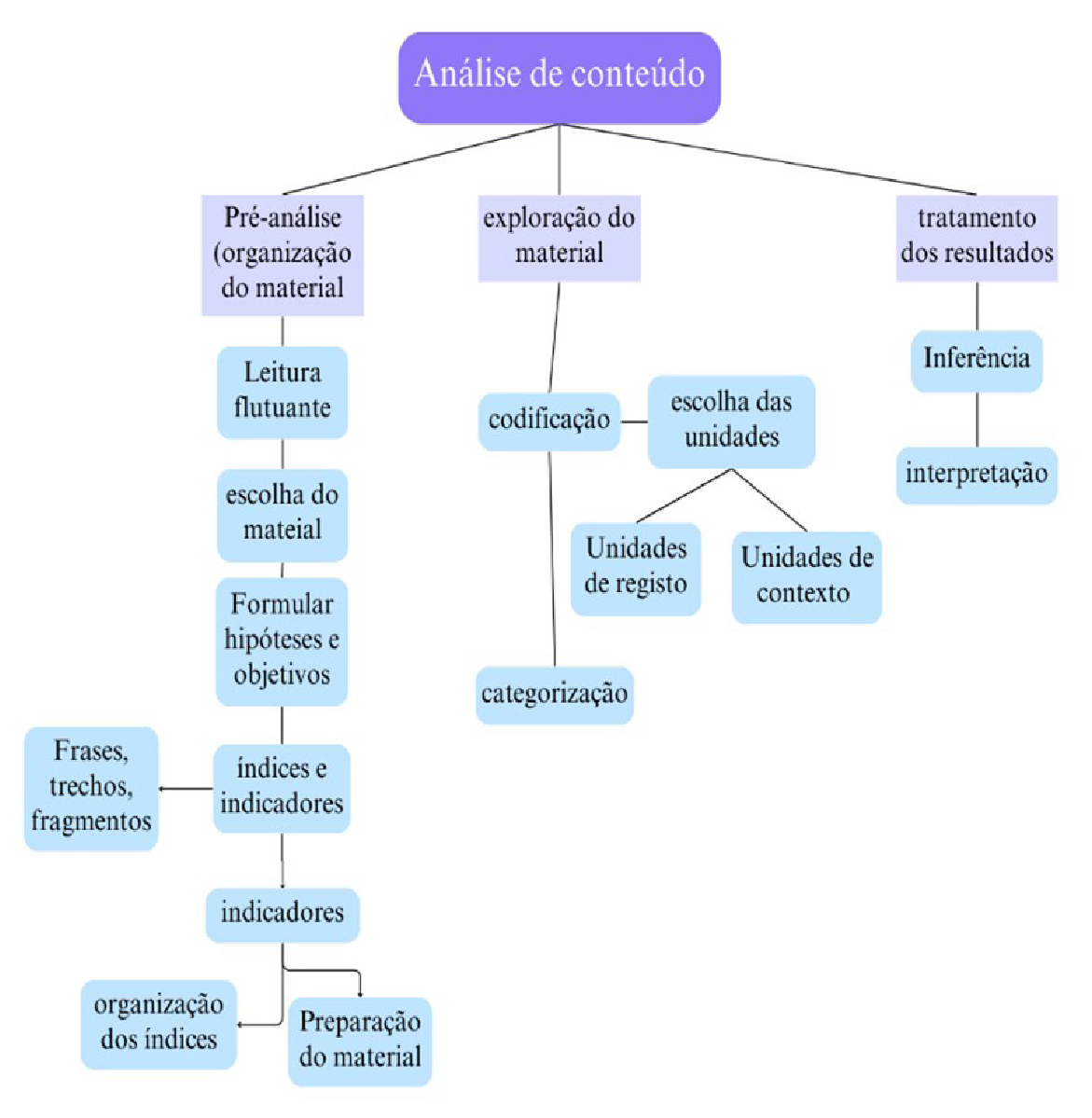 Figure 2
Stages of content analysis
Created by the authors based on Bardin (1977).
In the first phase, the data was organized and grouped into tables, facilitating the visualization of participants’ responses. During the exploration of the material, the responses were coded, so that it was possible to identify the recording units (specific responses) and context (environment, challenges, or situations that contextualize the response). In the final phase, we analyzed the data, and the emerging categories were discussed in light of Shulman’s (1987) proposal, which enabled us to understand the signs of knowledge development brought by the author and the challenges that students faced in following the Ordinance.
Therefore, we focused the analysis on these difficulties and aspects related to the development of content knowledge among undergraduates. The following section presents the analysis of these aspects.
4. Analysis of difficulties and development of content knowledge
In light of the theoretical framework, we address the main difficulties listed by the study participants and the aspects related to the development of knowledge of the specific curriculum content. Participants highlighted aspects that demonstrate that it was possible to learn the content studied during the classes offered in the distance learning modality, as can be seen in some of their answers:
L13: Yes, because most were class reviews; that is, if I didn’t understand very well, I researched it in depth, or I asked the teacher the next week, and he/she would clarify my doubts.
L2: Yes, because I have many learning difficulties, but I can learn better online than in the classroom.
L9: Yes, because they were consolidation activities and I could ask questions during class. This definitely helped a lot.
L8: Yes, because, in a way, the online classes, for the most part, were for problem-solving or some research.
The points mentioned in the reports of the participating undergraduate students refer to evidence of knowledge of the content proposed by Shulman (1986), particularly regarding the learning of mathematics content. It is essential to recognize that, in order to carry out the activities effectively, it is necessary to comprehend the content covered in the face-to-face sessions. In this context, Lopes (2019) highlights that:
The realization of the need to seek knowledge, in the sense of learning to teach, can constitute learning to the extent that the prospective teacher becomes aware of the importance of assuming training as a dynamic process, in constant re-elaboration (Lopes, 2009, p.178).
When asked about learning the content from the explanations provided by teachers, students highlighted that it was possible:
L2: Yes, but few of my teachers recorded the classes. Most teachers assigned activities for us to complete based on the lesson presented in the classroom.
L13: Most of the time, yes, because they posted recorded video classes of the content or posted readings according to the theoretical framework chosen in the classroom.
L17: Yes, because it was divided between activity and class about activities.
As can be seen, while explanations occurred during face-to-face classes, the continuation of the classes, based on the resolution of exercises, took place asynchronously. This demonstrates a sequence that allows revisiting learning that occurred in face-to-face classes, as highlighted by Christensen, Horn, and Staker (2013). Understanding the content to teach is fundamental in the pedagogical process, as Shulman (1987) emphasizes in his model of pedagogical action and reasoning.
Another important aspect that the participants highlighted is the choice of theoretical frameworks adopted. This point is crucial and should be an integral part of the entire formative process for prospective teachers. In this sense, to act effectively, it is essential that undergraduates learn to select the most relevant references to support their coursework. On this issue, the participants declare that:
L6: Yes. The importance of choosing theoretical frameworks is mainly related to their suitability and scientific relevance. Having chosen appropriate references, we can base our ideas more securely, as they are grounded in works accepted by the scientific consensus.
L13: Yes. A well-chosen theoretical framework is essential (which cannot be given up) for the construction of knowledge in a scientific and well-founded manner.
L10: Yes, it is very good to have a basis to deepen and exercise properly.
By reporting that these aspects are important not only for performance but also for continuing education, participants demonstrate their awareness of the relevance of skills such as research, information retrieval, and active participation in scientific work. Such elements represent an important stage in the teacher’s pedagogical reasoning, involving the understanding of purposes, structures, and transformation through the critical interpretation of texts.
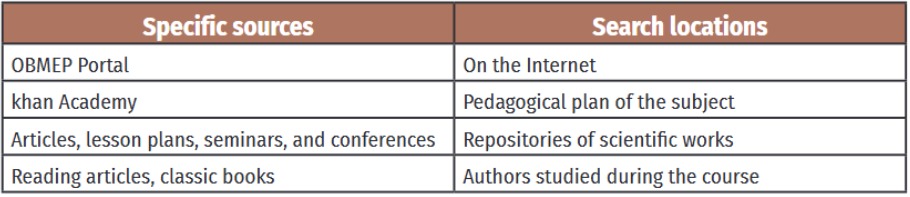
As indicated in Table 1, the main theoretical sources cited by participants are identified through Internet searches or by consulting authors studied in classroom subjects.
Chart 1
Theoretical sources
 Research data.
| Specific sources | Search locations |
| OBMEP Portal | On the Internet |
| khan Academy | Pedagogical plan of the subject |
| Articles, lesson plans, seminars, and conferences | Repositories of scientific works |
| Reading articles, classic books | Authors studied during the course |
Furthermore, according to Shulman (1986), formal academic literature on education is also a source for the construction of teacher knowledge, encompassing findings and empirical research methods in the areas of teaching, learning, and school education. Furthermore, the author states that teachers must know how to define accepted truths and explain to students why some propositions are considered valid. Regarding these aspects, the analyzed data show evidence that the participants developed skills such as those mentioned above, as reported by some of the participating students.
L17: Yes, through online classes, I learned how to argue with my students about mathematical propositions effectively. Mathematical propositions, which are statements that can be considered true or false, but never both simultaneously, form the basis of mathematical logic. They are essential for developing theorems and proofs within mathematics. During the classes, I learned the importance of formulating propositions clearly and precisely so that they can be evaluated without ambiguity. This is crucial for teaching students to understand and develop skills in mathematical logic and argumentation.
L10: Kind of. It’s not the same as in-person, but with focus, you learn what is expected.
L8: Yes, I could develop skills that enable better argumentation regarding mathematical propositions with students, thanks to online study.
In addition to the elements mentioned above, the need for autonomy is highlighted to facilitate learning in the best possible way, as well as learning about argumentation, which primarily occurred during face-to-face classes prior to the implementation of the curriculum matrix, as guided by MEC Ordinance No. 2.117/2019.
The ability to argue, as highlighted by participant L17, is essential for the teacher. Learning to develop this skill from initial education is crucial, especially considering that undergraduate studies include a practical component that features public policy programs for teacher training and supervised curriculum practicums, which immerse undergraduates in the context of basic education.
The main difficulties faced by participants are related to maintaining concentration during classes, the need for greater independence as they do not have assistance available all the time, and difficulties associated with using virtual learning environments (VLEs). Another point mentioned refers to the large number of activities to be carried out with short delivery deadlines. Finally, aspects related to the subjects’ own responsibility were mentioned, such as being more active and engaged in activities and having motivation to carry out tasks.
Participants primarily emphasized the need for greater autonomy and Internet access, which significantly influences the use of ICTs. These difficulties highlight that, for subjects taught in the distance learning modality, undergraduates need to develop autonomy and feel accountable for part of their own learning process. The emphasis on Internet access as a challenge to the learning environment is related to aspects highlighted by Gatti (2019) regarding socioeconomic inequalities in Brazil. Regarding ICTs, Martins (2016, p. 18) highlights that:
The mediation that occurs through digital resources, as well as the possibility of personalizing teaching based on students’ responses and during activities, are considered the core of the use of ICTs in classes within the blended teaching approach.
One fact that emerged is the difficulty in adapting to the pace of the two formats offered by the subject, since students face challenges both in face-to-face classes, such as remaining engaged in activities, and in distance learning classes, such as the use of virtual learning environments, with an increase in the challenges faced in the distance learning modality.
These aspects contribute to the construction of content knowledge by the teacher, particularly regarding mathematics and the importance of pedagogical reasoning. Learning about the content during undergraduate studies is relevant. Developing the ability to research and select references provides tools for understanding the central topics that should be taught, in addition to fostering the development of skills that aid in explaining and using analogies, and enabling the greater development of the analytical capacity of pre-service teachers by fostering the conscious development of autonomy.
As will be shown below, students recognize that they have more autonomy, such as being able to conduct research. However, at the same time, they demonstrate that they are aware of the need to be critical of what they find. This is because, more than students, they see themselves as future teachers, so their view of the content differs from that of other students.
The analysis of the category allowed us to better understand the challenges faced by the students who participated in this investigation. In this sense, undergraduates understand that, regardless of the structure of the subjects, they ultimately depend on the didactic perspective that will be employed.
L10: It depends, because some subjects that, even if they are not in-person, fall short. Now, other subjects are much easier because, in a way, some we find very challenging in the classroom, and by doing them remotely, we have the freedom to study more, research a little, and look up questions on Google. So, it helps. It’s not about looking for the answer, because if you look for the answer, you end up not getting anything out of it, but, for example, if you have a question that you can’t answer in person, by doing it online, you can do some research in the context to develop the answer.
Therefore, corroborating Passos (2018, p. 16), we defend that the structuring of the subject must be planned “carefully and in advance, building learning objects that are capable of supporting teaching, taking into account the physical and temporal separation between teacher and student.” Furthermore, it is essential to plan for in-person sessions that are closely aligned with remote sessions to minimize disruptions in students’ learning.
As previously analyzed, some challenges are present during the development of the subjects. In this context, greater autonomy, responsibility, and freedom stand out as key advantages, in addition to the opportunity to develop analytical thinking.
L6: Look, I believe that, as I mentioned about the issue of responsibility, we become a little more active and protagonists in that teaching when we are in distance learning, because we have this need to take the initiative ourselves, it’s the analytical issue.
L3: Critical and reflective, especially our teachers are critical, they teach us to be critical.
L3: This experience was much richer in my context. Because I teach YAE, I often use Paulo Freire, as we must base ourselves on their reality. I even had the pleasure of participating in an activity that the teacher considered an assessment. I even did several exercises where I had already spent time with them, which was 2 or 3 school terms, and as a result, I had a knowledge base of their lives on my part, because everything was discussed in the classroom. I asked individual questions, when they started reading those questions, for example: is it true that Cláudia sold gourmet popcorn in the classroom? That is a fact, I used this example in the test, especially financial mathematics, right? There was a girl who sold paprika, so I brought their reality into the classroom, not just Pedro’s grapes, I really put their reality into the classroom, but all of this with teaching from our... from our course, our teachers who introduced me to Paulo Freire in a different way, right, rich and really in a position to practice in the classroom, that’s why we really take everything we learn into the classroom.
The development of this critical sense also includes understanding that certain aspects can be improved, such as the greater incorporation of technologies. However, the fact that the participant uses examples from the students’ reality in their classes does not exemplify, or does little to corroborate, what a “Freirian” education really means. We understand that, in the prospective teachers’ education process and from the perspectives presented in their course, their interpretations and level of knowledge regarding Paulo Freire’s theory, as well as how teacher educators encourage critical thinking, are not clear.
The different realities encountered in the classroom, as highlighted by L3, are directly linked to the skills that graduates must possess when faced with the need to use different teaching strategies, as they perceive the relationship between the teacher in mediating theoretical content and the students’ reality, in a way that is relevant to them. By highlighting the adaptation of content to the realities of YAE students, participant L3 reflects what Shulman (1986) calls “pedagogical content knowledge”, which concerns understanding, anticipating difficulties, and planning interventions, according to Shulman’s (1987, p. 16) model of pedagogical reasoning and action, which “involves thinking about the key ideas in the text or lesson and identifying alternative ways of representing them to students”.
Finally, L3 makes an interesting contribution by highlighting how experiences in Youth and Adult Education (EJA) and the use of Paulo Freire in pedagogical practice helped him reflect on the importance of connecting mathematics content to students’ reality. He states: “I brought their reality into the room [...] I asked each of them individual questions.” This approach is in line with Shulman’s idea (1987, p. 15), as well as the representation and selection components, as the teacher must be able to carry out “adaptation of these representations to the general characteristics of the children to be taught, as well as [...] adaptation of the adaptations to the specific children in the classroom”. L3 believes this means bringing mathematical concepts into the context of students’ everyday lives, using concrete examples, such as selling gourmet popcorn or paprika, to make financial mathematics concepts more accessible and relevant. According to Almeida et al. (2019, p. 136), which corroborates Shulman’s ideas (1987, p. 9), it “means mastering the contents of the subject being taught and presenting it through new forms and different activities, using metaphors, exercises, examples, and demonstrations, in an attempt to lead students to learn the taught content”.
L6: The suggestion is perhaps that teachers look for varied technologies to make it more dynamic, although they already do a lot, but, for example, in remote teaching, they look for more than now in this face-to-face part, so generally when it comes to this non-face-to-face part we have, it is generally something more traditional, not that traditional is bad, right? The traditional methods also have many positive aspects, but they could be made more dynamic by exploring other tools that were more sought after in remote teaching and that may have been overlooked in recent years.
When considering a class performance, the distribution of the workload is an aspect that deserves to be highlighted, as the institution’s courses are based on credits, according to the 2023 PPC. Therefore, some courses with four credits (equivalent to four 45-minute classes) include part of the distance learning workload. In this context, the L4 undergraduate student highlights that having three classes on the same day is not always beneficial:
L4: I believe it’s a very good idea to distribute the workload, but I think that, firstly, the division should be analyzed a little better, because, for example, taking three classes on the same day can sometimes be very difficult. For example, you have three consecutive calculus classes, and you end up wanting to leave an online class to get more out of it. However, during the three classes you spend in the classroom, your performance drops.
According to the analysis of the participant’s report, the performance in the class would not be greater if the subjects were divided, with half of the workload in person and the other part online, resulting in “half a class”, according to L4. Another possibility to consider would be a 45-minute class on a single day. These situations must be examined, taking into account that, usually, the course would have all classes in person.
L10: I’m going to talk about the negative, which is what I emphasize the most. The negative thing for me is that they only send us activities to do and then not have more [...], not having a synchronous class and so on, because there are subjects that we find ver hard to follow. I’ll mention, for example, Calculus 2, because last semester we only had two in-person classes a week and the others were distance learning, and we had a lot of difficulty and couldn’t do all the activities and clear up all our doubts in person. In distance learning, we didn’t have that class with the professor; it was just activities. So, if there were a synchronous class for us to clear up doubts, study at home, have that moment for us to study at home or at least have a recorded class, it would make things much easier. Now, this issue of only having activities for us to do and register as attendance is a negative point.
L10: I think that online classes, from my point of view, would have to have support from the professors. It’s not just about saying it’s online and not having support. Some colleges I know have materials for you to do on your own, watch video lessons, do activities and, at the end, you have a meeting with the professor. But, if there was at least one class and the professor met with the class, pandemic-style, with everyone in the room, and set a good time, I think it would be very interesting.
From the participants’ perspective, suggestions for improving the dynamics of in-person and distance learning are important, as listening to their experiences is essential. In this sense, there is clarity regarding some of the difficulties associated with the use of distance learning hours. As explained in this section, the experiences reflect a formative process that promotes both technical mastery and the development of critical and reflective skills, necessary for teaching practice.
5. Final considerations
In this article, we analyze aspects related to the development of content knowledge, as proposed by Shulman (1987), considering undergraduate mathematics students from a Federal Institute in Minas Gerais and the challenges that arose with the adoption of subjects that include part of the workload carried out with distance learning methodologies.
Among the aspects observed in the development of content knowledge, evidence related to the choice of theoretical frameworks, the development of argumentation, and the learning of the proposed content is notable.
However, when addressing the challenges faced, one of the most significant difficulties reported relates to the need for student autonomy during distance learning. The blended model requires students to be able to organize themselves and develop tasks independently. Another challenge identified is related to the quality of the Internet access, which is essential for carrying out the proposed activities and tasks. Because classes include both in-person and distance learning, students need to adapt to the pace of the courses, which requires a great deal of autonomy on their part. The challenges identified for the training of mathematics teachers present several layers, especially since they are analyzed from a student’s perspective, who is maturing their perception of the needs of their profession. This perspective, despite encompassing different subjectivities throughout the process, contributed to understanding the changes that could be implemented to enrich the training.
We also note that the need for quality Internet access exposes socioeconomic inequalities. Therefore, further research is needed to investigate these aspects, particularly in the context of teaching and learning, where the issues have a significant impact on the educational process.
It should be noted that there are limitations, such as the fact that the research is conducted within a specific institution, which restricts the sample, especially since each reality is unique and each interview conducted has its value. For future research, other aspects could be explored, such as the perspective of a graduate from a mathematics teaching degree course whose curriculum matrix has been approved in consideration of MEC Ordinance No. 2.217/2019.
6. Acknowledgements
To the Coordination for the Improvement of Higher Education Personnel (Capes) for the scholarship granted for the development of master’s research within the scope of the Postgraduate Program in Mathematics Education.