

Ancient cities new building
Conversaciones…, no. 12, pp. 151-164, 2021
Instituto Nacional de Antropología e Historia
Artículos

Ancient cities new building
Original publication: Roberto Pane (1959) “Città antiche edilizia nuova”, in: Città antiche edilizia nuova, Edizioni Scientifiche Italiane, Napoli, pp. 63-94[1].
Translation by Valerie Magar
When we think of a juxtaposition between modern and ancient construction, we immediately feel many problems and questions rising within us. And this is especially true in Italy where more than in any other country in the world such a juxtaposition denounces the contrast between two ways of life: that which is manifested in the very rich stratification of our past and the new and brutal image that is being added to it. And this is being done without determining a new unity, but giving the sense of a painful, intolerable fracture everywhere. The city that approaches and overlaps the ancient appears to us as the expression of an economic impulse too strong to be able to possibly make changes and order its movements. The chaotic expansion obeys the urgings of an immediate and blind private interest, and the call for an orderly urban arrangement that saves the interests of the community is almost never heard. Indeed, in this regard, the systematic silence that greets the most enthusiastic criticism in our country should be noted; so much so that the few combatants are often urged to desist from the struggle, since there is never any response from the other side. Worthy among all, as an example, is the havoc being wreaked on the Italian landscape by a state agency under the Ministry of Public Works despite the fact that a real clamor of protest continues to be raised in Italy and beyond. But this is such a singular disgrace that it deserves a separate discourse.
Now, the aforementioned comparison leads us to pose the following dilemma: if it is true that there is an irreconcilable incompatibility between the old buildings and the new, as some writers and scholars[2] have recently been affirming; they claim, as a consequence, a clear separation between the city of yesterday and the city of today. Or is it, instead, merely a negative condition of spirit, a kind of resignation, a widespread lack of moral enthusiasm whereby we give up being masters of the tools we ourselves have created.
That it is convenient to have the new organisms arise outside the ancient centers, as new self-sufficient aggregates endowed with a certain degree of expansive elasticity, is a matter of course for any modern urban planner. But here one wants to consider the existence of the ancient center as a fact in its own right, that is, not as a passive protection that the state would have a duty to assume in the name of art and history (and which it does not actually assume), but as vital survival in relation to an actual practical reality. It seems to me that in this sense the invoked intangibility represents a perfect absurdity; indeed, precisely as a demonstration of absurdity it lends a dangerous argument to the opposite thesis, the following: since it is not possible to preserve the ancient environment unchanged because the state cannot ensure the preservation of all buildings that have an interest for art and history, it is all the better to demolish everything that presents only an environmental character and rebuild in a modern way, on the same ground, limiting preservation to buildings of exceptional importance. Now this discourse is not only the answer that all the speculators of public and private areas, the heads of state and parastatal institutions and also (let me add) almost all architects and engineers are ready to give. Nevertheless, it also reflects the real situation, namely what is rapidly being implemented, despite indignant protests and with very serious irreparable damage to a valuable asset: the choral value of historical stratification, the irreplaceable charm of the streets and squares of our ancient centers. For what is being destroyed is precisely the heritage that the most modern experience of history and art has helped to place in due prominence, namely, the rhythm determined by outdoor spaces through those forms that consistently bear the name of a particular tradition of culture and not that of such and such architect of exception. In this sense, the feeling that the old walls inspire in us is not simply romantic wishful thinking, the dreaming of a condition of life that can no longer reproduce itself; it arises instead from feeling present a coherence between life, art and craftsmanship, which seems to have been irreparably lost today. Thus, we feel the suggestion of this different world as an environmental attribute that is in the most diverse aspects and not only in some individual works; hence, the just consideration that the greater beauty of a city consists in its value as an organism even more than in its exceptional monuments, and that distinguished works are as inseparable from their environment as from their breath. The importance of such a consideration lies in its implicit recognition, far better than in the recent past, of the link between life and art, art as a condition of life itself and not as a solitary achievement that is enacted in spite of the ugliness of the surrounding world. Unfortunately, what wrongs many of us, whether architects or critics and art historians in Italy, lies precisely in our inhumane and prideful act of taking refuge in aesthetic facts while neglecting to participate in the clarification and discussion of these problems of the old and new city. The latter are of fundamental importance to our destiny as Italians because, on the one hand, they are aimed at clarifying our ties with the past and, on the other hand, at defining what still today seems very vague and obscure, expressely, in what sense and direction our participation in a common civilization of the modern world is to be understood.
The greatest charm of our old centers is in the testimony of a way of life that was both wise and naive, of a productive economy that did not exclude a margin for play, conversation and intimacy.[3] It was a poor life, provided with little wealth, but it retained a high human value, and it is not unfair to compare it with regret to the haunting megalopolis that has put so many means at our disposal but by which we have allowed ourselves to be degraded as men and which we yearn to leave as soon as respite from work makes it possible. All this (it is almost needless to say) does not mean condemnation of modern technology, which is itself a great achievement; it only means that it is not enough to satisfy us and that our supreme purpose consists in remaking ourselves masters of those means that technology places at our disposal, in such a way that they satisfy and obey our human needs, within the limits and in the places dictated by ourselves and not by occult forces that are beyond our control. And, in this regard, I like to recall here the modest and significant testimony of a great pioneer of modern architecture, Walter Gropius, who, in an article published three years ago, wrote: “For instance, when we accuse technology and science of having deranged our previous concepts of beauty and the ‘good life,’ we would do well to remember that it is not the bewildering profusion of technical mass-production machinery that is dictating the course of events but the inertia or the alertness of our brain that gives or neglects to give direction to this development.”[4]
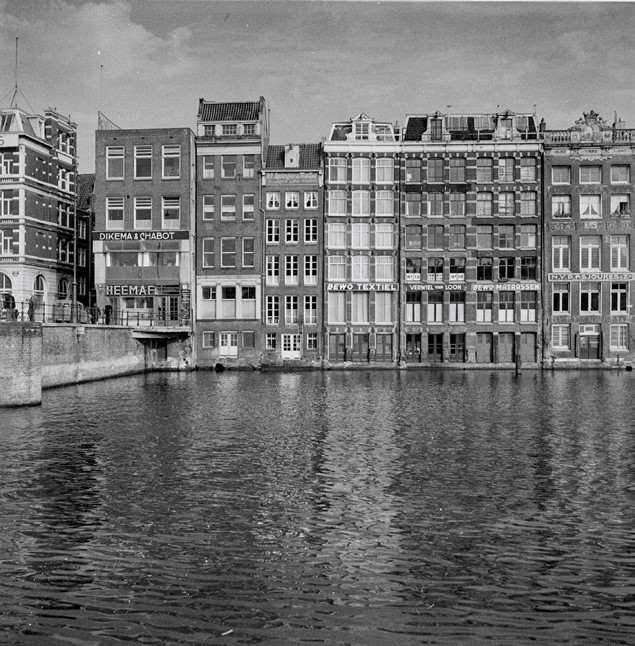
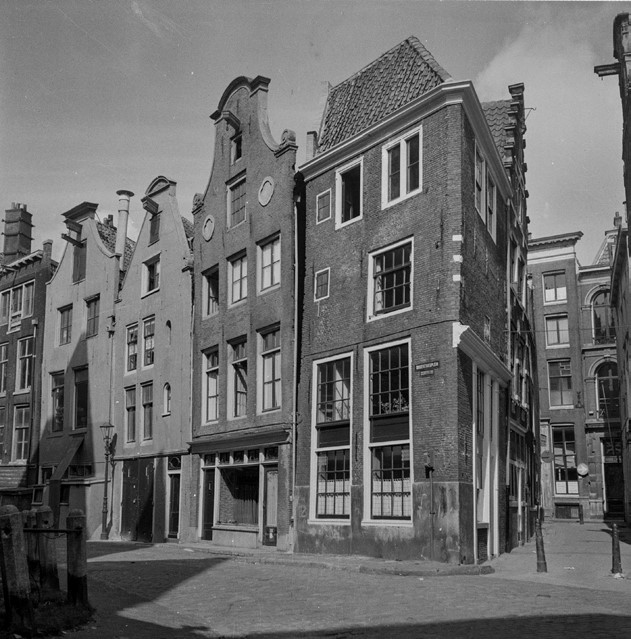
The thesis of the irreconcilable character of new and old buildings is based, in essence, on a fatalistic acceptance of the fait accompli, generalizing it as an inevitable and definitive fact for the experiences to be made tomorrow. Thus, the size of modern buildings and the use of concrete and iron, in the atrocious banality of their current forms, would be, and could not but be, the image of the affirmed irreconcilability. Here, one is wrong to forget numerous positive experiences of the juxtaposition of the new with the old; as well as Italian[5] and foreign experiences, accomplished without any renunciation of the modernity of materials and without resorting to that stylistic foppishness that still largely rages in our country and which the thesis of irreconcilability only accredits, in essence. I recall the positive cases of Amsterdam, Frankfurt and Warsaw; but what is most important to note are the extreme consequences we reach if we wish to remain consistently irreconcilable: if the new and the ancient cannot subsist together, it simply means that an unbridgeable rift has occurred between us and the past; that is, that history and tradition of culture are meaningless words and that the past can only provide us with reasons for archaeological curiosity since it no longer serves to illuminate our present. It is therefore the responsibility of those who cannot reconcile it to respond to this legitimate question: if old walls and new walls cannot subsist together, nor can those things that find in them their own inevitably coherent image.
To clarify what I have mentioned, it may help to recall the controversy that took place regarding the Wright project for the Grand Canal. I will not recount here all its episodes, but will limit myself to the extreme data. The almost universal and generous indignation aroused by the announcement that a building of a modern character would rise on the Canal, on this urban masterpiece of the past, arose, even in the fullest good faith, from the usual clichés, from the usual absence of a serious critical approach to the question. In fact, while shouting against a significant modern expression, there was silence about the horror of the false Gothic with which the Canal is largely stocked and, similarly, about the false Venetian Baroque of a house that was about to be completed at the wharf of S. Angelo, right in the midst of the raging controversy. It is already clear from this consideration that the attitude of defense at all costs, so seductive in its flavor of romantic intransigence (though practically untenable) ends up becoming reactionary in turning a blind eye to the monstrous fakes, and thus in its implicit recognition that they “do not disturb.”[6] But they do not disturb those for whom there is no difference between authentic Gothic and 20th-century Gothic; for the experts, on the other hand, the disturbance is such that it comes to the point of torture; to that sense of desperate bitterness that arises from realizing one’s own powerlessness in the presence of a world dominated by bureaucratic officialdom, the all-powerful distributor of aesthetic and moral forgeries and surrogates.
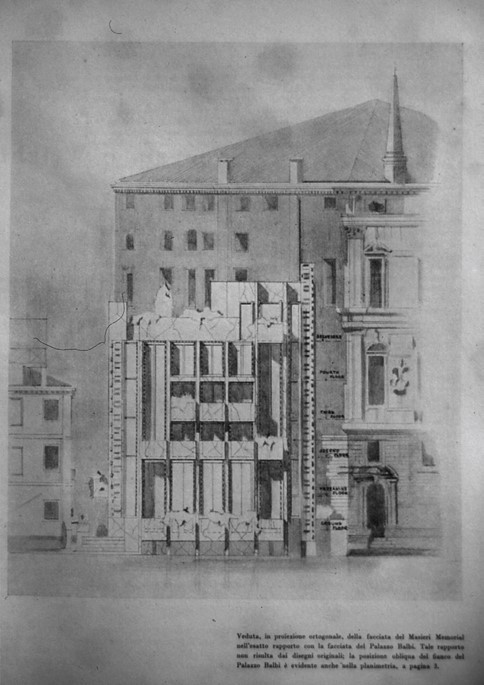
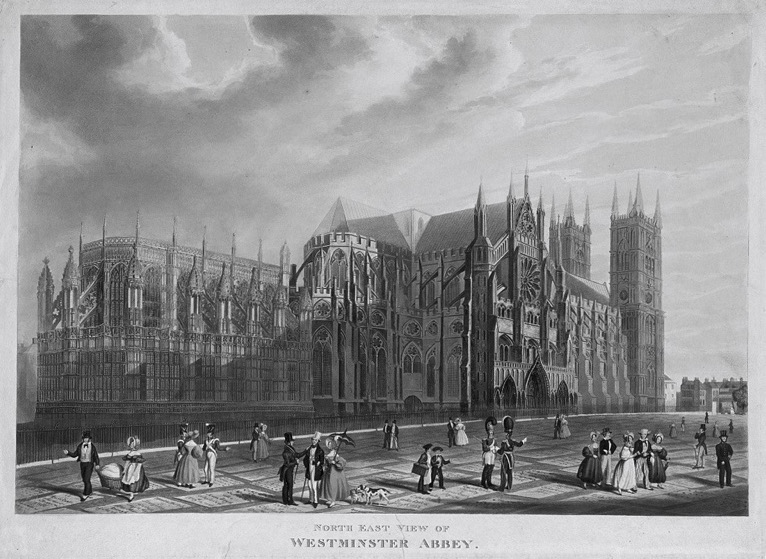
It should still be added that Wright’s design was limited to the modest dimensions of the house for which the new building was to be replaced. With this the architect recognized as something to be respected[7] the dimensional relationship of the environment and, in particular, that between the house and Palazzo Balbi on the flank; in other words, that volumetric relationship which represents the essential condition and, at the same time, the only possible one for the preservation of an ancient environment. For it is evident that, with the exception of those countries in which a particularly favorable climate makes it possible to preserve more or less intact the original chiaroscuro and chromatic values, elsewhere it happens that the replacement of the external stones, because of their progressive decay, causes only a more or less faithful simulation to be preserved of the ancient work. Take for the example of Westminster Abbey, of which not a single external stone is still that of the primitive Gothic work; and, moreover, such is the fate of architecture, the art which has no museum, or rather whose museum can only be the very environment for which it was created.[8]
But what appears frankly absurd in the thesis of intransigence is the desire, as I have mentioned, to ignore the obvious historical reality of the stratification that took place in the past, shaping, with its contrasts, the environment we wish to save, and the denial that the same can and should happen in the present. The insertion of new forms into the ancient city could not fail to take place even if the rules of protection and the strictest respect were observed. But for this to take place in the best way, it is necessary that the environment be felt as a collective work to be saved as such; that is, not as the integral preservation of a sum of particular elements, understood as the preservation of a single building, but rather as a relationship of masses and spaces that allows the substitution of an ancient building for a new one as long as it is subordinate to the aforementioned relationship.
On the other hand, the uniformity of life as a consequence of modern mechanical civilization responds to a resigned and pessimistic view of our destiny that finds no justification in the present extraordinary achievements of human ingenuity, but only in a lowering of moral tone; as if the material achievements have diminished the very value of freedom in our consciousness; and in this regard, I am reminded of an image that has been painted so many times: that of the endless theories of workers setting out, all alike, for the workshop; it is an image of yesterday, and yet today’s technology has already made it grotesque and absurd, as, moreover, have not a few prophecies of Marxism. Therefore, there is no reason to believe that a more advanced civilization should not enrich us in the best sense, and that is to allow for a greater differentiation of ways of life and customs and thus make it, not only possible, but desirable that the new city should not destroy the old one, by means of false compromises, and on the contrary be set side by side to it perpetuating its enjoyment.
But at this point it seems appropriate to include, as an example of affirmed irreconcilability, the testimony of a recent article by C. Brandi, “Processo all´architettura moderna”.[9] The author speaks of Renaissance perspective spatiality, of Baroque perspective activation, and of 19th-century “exhausted and faithful” spatiality; he traces the path of an ideal and abstract urbanism, exemplified on a series of environmental and individual masterpieces, and concludes in the assertion that the space of modern architecture “is the same lived-in space of our day for the most part without a horizon that is not enclosed by buildings, and with no other sky than the one where airplanes fly.” Moreover, although it can be said, thanks to the works of some conspicuous artists, that modern architecture exists, it “cannot be inserted into an ancient urban complex without destroying it and without self-destructing.” It seems to me that the error of this interpretation is in its being all wrapped up in an aesthetic (I was going to say aestheticizing) view very close to the pattern, and not historical; in the sense that it speaks of architecture as art, keeping silent that the city, in its fabric, is made essentially of building literature and not of architectural poetry; and here I draw the reader's attention back to the other points I have made elsewhere and to the neglected factual reality. I would add that, in replying to Brandi’s writing, Bruno Zevi rightly pointed out that here it is not a question of architectural language but of building program: “The rupture, the havoc is wrought in the drafting of the building programs and has nothing to do with the nature of architectural language.” But, at this point, it is precisely the renewed misunderstanding between architecture and construction that prompts me to recall one of my writings[10] as something that can perhaps still serve to provide clarification.
I will repeat first of all that the most current misunderstanding is produced by the use of the word architecture; a word which, for us, because of the authority exercised by an ancient tradition, continues to mean art, while in Anglo-Saxon countries it is synonymous with building; hence the proposal, already put forward by some −to substitute− in current language, the second word for the first. Moreover, parallel to the distinction made by Croce in his last Aesthetics, in which an autonomous value is recognized for literature with respect to poetry, distinguishing the poetic faculty from the literary or practical one,[11] I have proposed a distinction between the concept of architecture and that of construction. Similarly, in fact, we should identify in the former the poetic faculty in its abandonment to the universal, beyond all practical limits; in the latter, the literary faculty in its proper purpose of never losing sight of the reason that is the guide and support for practical working.
Architecture is art when it is, and hence very rarely. The immense work that is done in the world, building and writing, is not normally to be accorded any value other than that which is required and dictated by practical reasons. By this is not to be acknowledged, as has often been done, an insuperable obstacle to imagination in the complexity and urgency of practical needs, but a distinctive character that by those same needs is and wants to be defined; that does not want to conceal them but to configure them in a form, and this form cannot be the mere expression of rationality.
The distinction between poetry and architectural literature finds its best confirmation in the observation, noted above, that it is not the few outstanding monuments that create the environment of our ancient cities but the many works tending to express a particular choral value and to provide, therefore, the distinctive imprint of a civilization.
This concept in architectural literature has been favorably received by many; but it will benefit to develop further clarifications and examples.
Returning now, after these digressions and forewords, to the problem of the protection of ancient centers, it seems to me appropriate to make a general proposal that could be translated into a norm to be adopted on the national level, given and not granted, of course, that the only law that is felt to be sorely needed in Italy is first devised: a law that succeeds in enforcing legal compliance.
I summarize the proposal in a few figures which, of course, do not claim to have been formulated definitively, but only express a definite need:
I - Define the boundaries of the historic-artistic center.
II - Establish, without admitting any exceptions, that within the aforementioned boundaries neither public entities nor private individuals shall be allowed to construct buildings whose height exceeds the average height of the surrounding buildings.
It is clear that chaotic speculation would have had no reason to regard the old town as a gold mine if, in place of an old building, it could not build another one at least twice as tall.
III - Expropriate by way of public utility the private green areas included in the aforementioned center in order to prevent them from being exploited as building grounds.
The latter rule is suggested by the need to prevent the continued construction of houses in the interior of ancient islands, that is, there where the centuries-old presence of gardens and orchards compensated for the narrowness of the streets by providing, inside openings, valuable breathing space.[12]
Let us try to consider what objections might be made to these proposals. For example, one might reply that regulations concerning the size of new buildings in the old town center are already present in municipal building codes. Then it is to be answered that these, if they exist at all, are hardly ever inspired by genuine protection; this is demonstrated by the fact that they have allowed for far too many “exceptions” and “clearances;” hence the need to condition all historic-artistic centers to a single norm that responds to the national interest, indeed to that of the entire civilized world, since municipal protection has proven unable to offer a sufficient guarantee.
Moreover, an easy objection can be raised by the architect who cares more about the realization of his little skyscraper than the preservation of the environment. He may say: no aesthetics can prove that the addition of a dominant bulk constitutes’ inevitably a detriment and not a contribution intended to produce a new and harmonious overall relationship. By this, it is evident, he comes to implicitly deny the very foundation of the aforementioned protection; however, it will not suffice to remind him that the preservation of primitive relations is invoked by the best and most qualified culture; instead, it will be necessary to tell him that his skyscraper would not remain alone, but would soon have numerous and disorderly companions; so that, in the final analysis, he will have nothing left but to invoke for himself, with presumptuous unconsciousness, the right to the exception; namely, that the relationship between his personal work and the environment be recognized as definitive and unalterable. Cellini said: ”a man like Benvenuto, unique in his art, cannot be obliged to follow the law...” The latter eventuality seems to me to be anything but hypothetical or rare; and for that matter, it is precisely in the above-mentioned sense, mainly because of the absence of responsibility, which is very often ignored even by architects, that recourse to the greater authority of executive power is required here. And let it not be repeated to me that such recourse leaves time to be found and that heritage of art and culture is saved only if everyone, and especially builders and designers, assume and take to heart its defense.
This is too obvious an objection, and we might as well resign ourselves to every environment being vituperated and destroyed if we have to wait for the creation of conscious public responsibility.
One cannot, therefore, fail to go back to the major organizations for protection, the Ministry of Public Education and the one for Public Works. In this regard, Brandi’s cited article concludes with a sentence that we can licitly call amusing; he declares that there is no point in accusing the offices of artistic protection (in other words the Direzione generale delle antichità e belle arti to which he belongs) since the responsibility for the damage that afflicts us all falls on us. We, on the other hand, have reason to deplore the fact that the aforesaid offices do not show themselves at all willing to seek that cooperation which the world of culture could offer them, and that they merely acknowledge themselves insufficient to their tasks, justifying themselves with the interference of the political class and the scarcity of the means at their disposal. In reality, it is not an increase in means and authority that would substantially improve the situation, but only a different spirit to inform protection, and thus a different organization. To put it briefly, a difficult matter of town planning or conservation cannot find its best solution by evading into an office practice, but in the active participation[13] in those capacities that are most often found outside the offices. The absence of such participation ensures that the interventions of the superintendencies have, more often than not, only a negative and procedural character and barely serve to delay (if they succeed at all) the fulfillment of the worst abuses and arbitrations. Everyone has learned, for example, that an ancient building can be the subject of an overnight demolition and that the search for responsibility will yield no results because the papers will stand to show that, despite the destruction, in no way has the protection failed: the building has disappeared but the “practice” will preserve its memory.
No lesser, on the other hand, is the responsibility of the organs of the Ministry of Public Works although it appears less directly committed. And it is well known that the offices of the Civil Engineers are provided with far greater means than those of the superintendencies, and that they not infrequently intervene in matters of conservation and historic town planning without feeling the slightest commitment to a collaboration with the offices to which a specific task in this field falls. Indeed, it can be said that the relations existing between these bodies, although all equally subordinate to the service of the public affairs, are not very different from those existing between states endowed with national sovereignty.
Yet, despite the negative experiences already considered, our present practical action cannot but consist in renewing a definite appeal to the central powers. Accordingly, I invite the Istituto Nazionale di Urbanistica to examine these proposals about the defense of ancient centers and if, as I hope, it finds them legitimate, to ask the ministries concerned to put them into effect practically.
I also call the Institute’s attention, to name a few to the already mentioned and mortifying offense that continues to be done to public decorum by means of street advertising. Here at last we are not dealing with a major organizational problem but only with a major filth.
Some weekly newspapers recently reported on the decision taken by ANAS to standardize advertising by means of signs all measuring two by three meters, placed “like a milestone” a hundred meters apart. This novelty will soon be implemented in the North in order to spare motorists the fatigue produced by too much varied and repeated visual stimulation. Let it be noted that in all this, the offence to the landscape, reiterated by the promised six-squaremeter signs, is not even taken into consideration; nor, to my knowledge, has this Company whose autonomy in the face of the country’s decorum can truly be said to be exemplary, so far felt the need to respond to the accusations leveled at it from all sides, in Italy and abroad. Now, how can one hope to achieve any result in the much more arduous and problematic matters of inter-municipal and regional plans if one is not able to shall we say “check the boxes,” but not even have an answer in a matter which, moreover, dishonors us in the eyes of the world? Consider that in England, last year, there was a violent campaign at the instigation of the Architectural Review for something far more modest and which, indeed, none of us in the current times, would dare to deem intolerable, namely billboards or road signs in the open countryside, traffic lights, keep left signs, poles, power wires, etc. In short, everything tending to standardize “the entire English countryside to suburbia,” as Ian Nairn, the author of the excellent volume[14] entitled Outrage, writes. The English initiative has had the approval and encouragement of the entire press, from The Times to The Daily Mirror. But, to tell the truth, in our country, too, press participation was unanimous, and that is not why the minister of Public Works felt compelled to intervene by ordering ANAS to suspend advertising contracts and remove public ugliness; or perhaps he did not do so because the company is to such an extent autonomous that it can be said to have sovereign powers? Could not the Istituto Nazionale di Urbanistica intervene with its authority so that we might at least be given an explanation for this constant outrage?
Returning now to matters of construction, it seems to me that the aforementioned clarification about the concept of architectural literature could benefit especially in Italy where, instead of pursuing the more modest path of probity, we too often persist in pursuing fantasy.
The source of the greatest troubles in our modern construction is, in fact, what could be called the artistic equivocation. Equivocation of the recent past that survives unchanged in our present because that evolution of culture that alone could have made it possible to avoid the subsistence of the old academy, despite the revolution of material means placed at our disposal, has not taken place. In other words, the availability of new tools was not enough, nor could it have been enough, for our creative dispositions to be renewed from within as well as from without.[15]
The general tendency toward demonstrative emphasis, the purpose of achieving the highest possible visibility; in short, the lack of discretion and modesty are the most widespread and immediately recognizable characteristics of our construction; and they are, I repeat, despite appearances, unchanged characteristics. Here, for example, is the curse of plastic and chromatic gimmicks with which, exactly as in the old days, we make every effort to be noticed as the inventors of a new architecture (which we may call nuclear); and very often it has taken only one gimmick to ruin a whole street or higway that previously had its own organic layering and beauty. A fellow has painted in blue or red the overhangs of all the balconies of a many-storied house; he is sure that he has done something original since it had never been seen before. In fact, his house produces the same effect on us as our neighbor’s radio when it is running at full output while we wish we could gather or sleep in peace.
Similarly, a collection of modern houses such as can be discerned on the outskirts of any one of our cities can be compared to one of our public discussions. In fact, not even in the most qualified circles does that mutual subordination, which should enable each person to manifest his or her own point of view take place with us. There will always be some who will try to impose themselves with their own flow, with the greatest volume of their voice, and on the other side some others forced into silence through shyness, excessive scruples or insufficient prestige, despite having, perhaps, many and more useful things to say. These few considerations and comparisons would be enough to understand how, the greatest difficulties that oppose serious urban planning in Italy, are not of a technical nature; or rather, that before being such, they are of a moral and psychological nature.
Today, concrete and steel make it easy to construct building masses so highly concentrated that they implement conditions of coexistence that not even the most optimistic spirit can consider favorable to the harmonious development of new generations. The pretexts of extreme urgency and stricter economics, in a country of high population growth (our greatest and most unspoken misfortune) have led, in this postwar period, to the frustration of every healthy urban planning purpose through the accidental and chaotic exploitation of building areas; and, in this enterprise, the state and parastatal agencies have proved themselves, not infrequently, more blind and exacting than private speculators.
All this, though, it will be said, still has the flavor of vague and generic recrimination. This may be true, but the discourse will become more precise (and, dare I add, unusual) if as architects we face up to our well-determined responsibility. Are we, for example, absolutely persuaded that the dimensions assigned to the houses we design are the right ones? Is it not the case that the task imposed on us by our society is to be specialists in density and to give organized agglomerations an aesthetic appearance? Do we need to have a strong dose of presumption and cynicism to believe that this eight-, ten-, or twelve-story house, designed by us and placed to destroy an already organic environment in its relationship between factories and nature, is a positive expression of building literature (if not even poetry) and not rather something to which we have just conferred a vague imprint while its reality, in that economic and social significance that really matters, had already been arranged by others? Who can seriously believe that in that particular balcony design, detail is of such importance as to transcend the transience of fashion, and is not, instead, destined to be a cause of intimate mortification and annoyance to its author when, after just a few years, fashion will have suggested, like the sorceress Circe, new attitudes no less extrinsic and falsely persuasive?
On the other hand, the exorbitant dimensions that produce such severe human density are not an inevitable consequence of technical progress but only a limiting case of economic investment; for it is evident that the means of communication already at our disposal and the great achievements that are outlining a real revolution in our associated life new sources of energy and automation, to name a few permit a decentralization that already makes the concentration of our megalopolis feel absurd and anachronistic. Faced with the rapidity of change that modern technology suggests, we would rather need organisms of easy adaptability and transformation than giant concrete and steel phalansteries.[16]
But this is perhaps already too high a tone to comment on what is going on in Italy, where increasing housing density in the old center is far more an act “of outright criminality to the detriment of the public interest than a matter of a technical nature.” Thus, in Naples, skyscrapers are being built without first making any thinning, but only increasing, for the greater wealth of some abject speculator, the already paroxysmal traffic and unhappy coexistence.
The architect must conquer the possibility of determining, without forced obedience and inhuman constraints, the relationship between the new and the old and the creation, organically and not additionally, of a new environment. “The layout of the town,” Gropius writes again, “is usually but a dull, unimaginative conglomeration of endless strings of houses. It utterly lacks the stimulation that might have been attained from those intangibles of creative beautiful design and total conception, which give life its deepest value and for which the past has given us such magnificent examples of unity.” But this too, it will be objected, is certainly not new. There is no appeal to functionality, to outspoken organism, to living sociality that has not already been made in Italy a thousand times. This, however, does not detract from the fact that our truth continues to always be elsewhere and is reflected in a falsely aestheticizing and renunciatory construction, the image of our social and political mores, the testimony of a “know-it-all” seasoned with skeptical smiles and jokes, just as it is in the activity of every other professional field. It is enough to think of the picture that Rome offers the world today (to cite only the most glaring example) so that there is no need to add more.
Every one of us has heard admired in Italy some building complexes recently made in Scandinavian countries, in Holland or elsewhere, as things that certainly did not reveal a richly imaginative design but were nevertheless fully acceptable because of their studied and happy execution and search for a natural setting. Something similar, indeed more significant, has occurred in recent times in the direct comparison between our production at the Milan Triennials and that of some northern countries. Ours, despite sporadic inventive qualities, improvised and scattered; the foreign’s, on the other hand, thoughtful and collected. To ours, past experiences seem to have º nothing because we have always started over, while in the foreign ones, the discourse appears to have been taken up by another precedent whose teaching we have tried to treasure.
To offer in summary the image of Italian housing, one can take a look at its extreme aspects, on the one hand, the ostentatious luxury of houses of two or three million a compartment, and on the other, the shameful inadequacy of housing that we might call proletarian. In the midst of all this, a most miserable spectacle is the one offered by the prospect of council houses in which the designer, in the wake of the aforementioned aesthetic misunderstanding, has tried to make Mondrian-inspired architecture (or whoever) by juxtaposing impossible geometric planes and forcing into a dry abstract composition the most basic necessities of life. The ironic depiction of the painting can be completed by including a relative: the obscure inhabitant who moves, foreign and anonymous among these forms, noting only their early decay and not their mechanistic metaphor; a metaphor that, more or less poorly digested, provides today a tentative and ironic affinity between the remotest countries. For, among the astonishing requirements of our present time, we should record the extreme rapidity and ease with which a new figurative idea makes its way around the world and produces imitators and proselytes everywhere. Many years ago, in fact, Le Corbusier was already cursing the too many imitators of the new architecture who were in danger of ruining a Renaissance in its infancy, une Renaissance à ses débuts.
To the old stylistic rhetoric we have substituted an even more baleful one, and that is the rhetoric of mechanism. Here, we cannot fail to associate ourselves with a builder and architect endowed with genuine imagination such as Pier Luigi Nervi when he writes: “It is appropriate to denounce the danger of a constructive academicism equally if not even more harmful than the outdated decorative academicism.”[17]
Perhaps it was not sufficiently understood that a real renewal of our building industry could not consist in a technical requirement or in a different formal direction, understood in themselves as having their own autonomous destiny. Our building industry will be renewed if we architects fight as participants and become responsible for a common world in order to help change those conditions of social, political and administrative life on which our work solely depends and which we know are today not favorable to a promising development of our environment. In other words, it is necessary to commit ourselves, even at the risk of displeasing the organs of executive power, to the entities of the all-powerful state, criticizing where necessary (and God knows if it is necessary), their erroneous arrangements and procedures and suggesting new possibilities and new ways. It must be acknowledged that the greatest danger of modern society, whether dominated by the right or the left, is in the idolatry of the State, in the blind and indifferent power of massive organizations against which many enlightened men today preach the implementation of limited autonomous communities in which power is divided rather than looming from afar and from above. As Simone Weil rightly writes, the present danger is that the ancient forms of dictatorship are gradually being replaced, colossal and anonymous, by “the oppression of function.”
Now, those who believe these discourses to be alien to urbanism are themselves alien to a concrete reality and culture; and for that matter, in the name of what if not in that of a real capacity for synthesis and, therefore, of a broader and more open responsibility. Could the modern architect aspire to call himself an urbanist if his intervention, at the conclusion of others’ complex investigations and requests, should not be limited to an aesthetic apparatus that makes good taste safe, but should instead interpret and resolve the needs of a better coexistence? It is necessary, then, that he should feel even more than others the duty of full participation in social and political life, which is as much as to say the duty of a particular and responsible culture.
To those who assert that our function as architects should be limited to the technical solution of problems posed to us by others, I like to dedicate, so that it may be pondered by them, the following page by C. G. Jung: “The larger the organization, the more unavoidable is its immorality and blind stupidity. If now society in its individual representatives already automatically affirms collective qualities, it thereby rewards all mediocrity, all those who dispose themselves to vegetate comfortably and irresponsibly: it is inevitable that the individual element will be pushed aside. This process begins in the school, continues in the university and dominates wherever the state puts its hand. The smaller the social body, the more the individuality of its members is guaranteed, the greater their relative freedom and, thus, the possibility of conscious responsibility. Without freedom there can be no morality. Our admiration for large organizations vanishes if we glimpse the other aspect of the miracle, specifically the monstrous accumulation of all the primitive characters of man and the inevitable annihilation of his individuality in favor of the monster that is every large organization. A man of today, whether he corresponds more or less to the collective moral ideal, has made his heart a den of murderers, as is not difficult to prove by analysis of his unconscious, even if he is not disturbed by it at all. If he has normally fitted into his environment, even the worst taboo of his society will not disturb him, provided that the majority of his fellow citizens believe in the high morality of their social organization.”[18]
In conclusion, it seems to me that we architects need to become more precisely aware of the contemporary history of our country so that it becomes a concrete condition, and not a vague and abstract one, of our work. There is no other way to rid ourselves of the provincialism that continues to plague us despite our vitality and brilliant qualities. The works of others, those matured under a different climate and for a different society, are not things to be imitated but only to be understood as testimonies to the manifold variety in which creative freedom is configured.
What is lacking from us is not the ability to point to a few happy examples but an average production that is acceptable and worthy; for, I repeat, an achieved civilization will not be able to be demonstrated by a few works of poetry but by a widespread architectural literature that finds a place alongside that of the past.
This brief paper was presented at the national urban planning congress held in Turin in October 1956. It was my purpose to collect, in a quick summary, the arguments that most often recur in the current problem of ancient centers in order to establish some useful premise for the debates that are still taking place.
The image of the world reflected in the building is worthy of inducing architects and writers in every country to participate in the questions concerning the survival of ancient centers, and in particular those in Italy; not only because ours is a precious heritage, but because, in the forms of the new buildings and in the possibility of their coexistence with those of the past, the imprint of our own destiny is configured, in its becoming, and in an exemplary manner.
*
Notes


