1. Introduction
Since Vladimir Putin’s rise to power in 2000, the Russian Federation has undergone economic, political, and social transformations, directly impacting the country's foreign policy, as reflected in its relations with other States in the international system.
From a pragmatic stance to that of a strong, centralized state, Putin, throughout his years in power, adopted political and economic measures that reintegrated Russia into the global geopolitical chessboard.
Using a vast reserve of natural resources, mainly associated with energy, such as oil and natural gas, Russia plays a significant role in the commercial geopolitics of these commodities.
Given this Russian framework and its importance in the energy sector, the article aims to analyze the concept of natural resources and their political use by the Russian Federation.
Considering that natural resources, in geopolitical terms, meet the requirements of dominant structures in their distribution, the study will be carried out with the following guiding question: How does the Russian Federation use its energy resource as a political platform?
As for the methodology, dialectical and historical materialism will be used as a means of verifying the insertion of the logic of Russian natural resources within the context of the capitalist system.
2. The Debate of the Capitalist System and the Energy Trade of Natural Resources
The capitalist system is made up of economic cycles, characterized by surpluses and deficits throughout its historical construction. Capitalism has already gone through four main phases of capital accumulation: commercial, industrial, financial, and informational (Bolaño, 2020).
At each stage of capitalism, the system experienced “failures” in its execution, marked by economic crises that undermined its position and distribution within the international system.
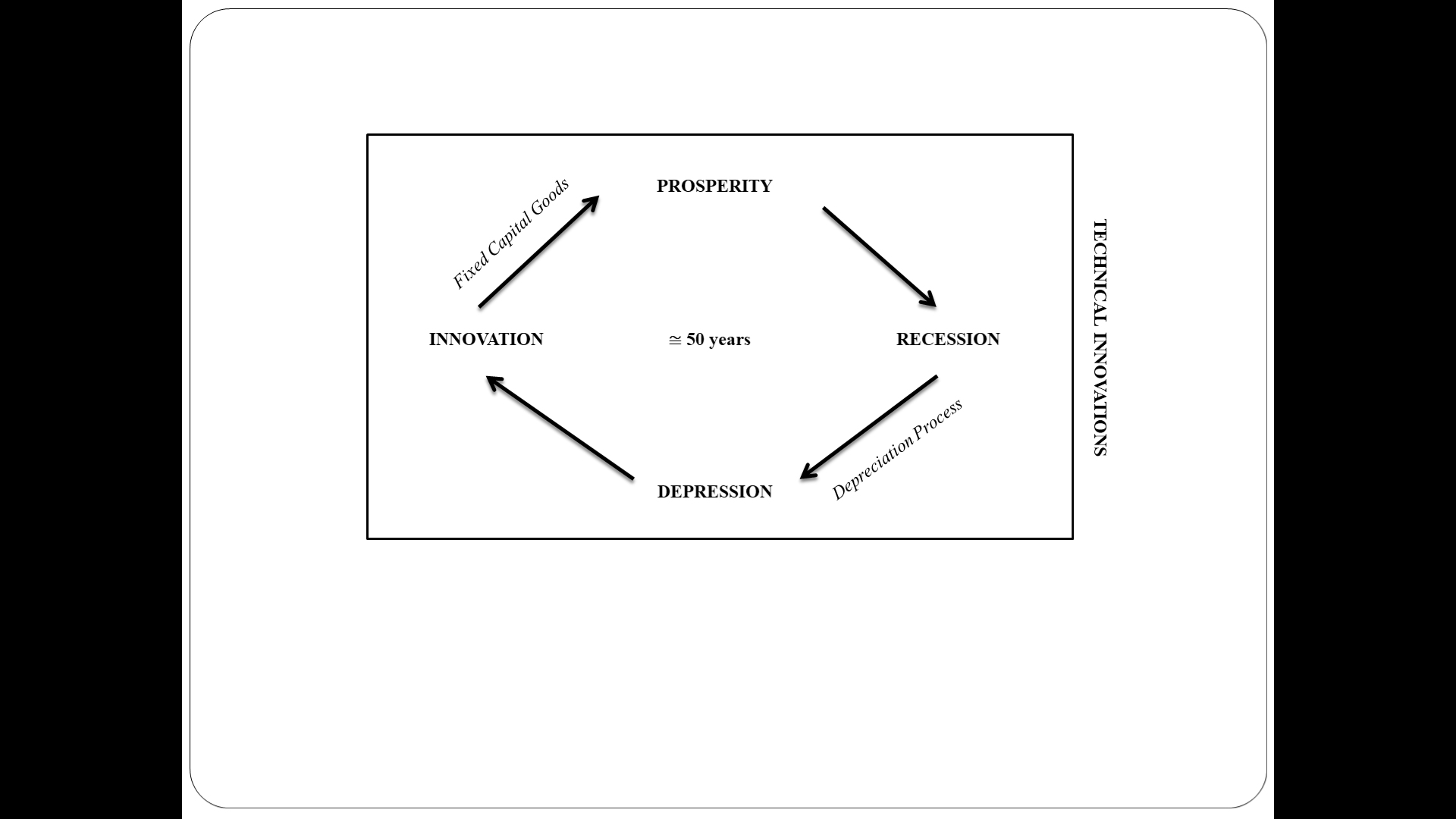
According to Kondratieff's scheme (1935), the capitalist system is flawed due to its cyclical nature, involving four main stages: prosperity, recession, depression, and innovation. All these stages are directly influenced by the process of technical innovations, which are essential to recover from system failures in times of crisis.
During both the depression phase (lowest point of the cycle) and the prosperity phase (highest point of the cycle), capitalism undergoes the process of transforming the forms of capital accumulation, while maintaining the structures that sustain it. To this end, the processes of depreciation (depreciation cycle) and fixed capital goods (prosperity cycle) follow the cycles of capital, maintaining a dialectical movement, with an execution period of approximately 50 years.
Below is a figure illustrating the cyclical flow of the capitalist system:
Therefore, due to its cyclical nature, the capitalist system presents a characteristic of ‘irreformability’. That is, it adapts during times of crisis by using new technologies, without altering its foundational structures; instead, it prolongs the process of capital accumulation.
According to István Mészáros (2011, 2012), the center of capitalism, the exploitation of surplus value, embodies the modifiable and irreformable nature of capitalism, which leads to power disputes, either through the appropriation or destruction of control over natural resources.
In this way, capitalism adapts to new economic realities by applying new research techniques and technologies in general. At the same time, its foundations do not change during capital accumulation.
From this perspective, the dialectical movement of capitalism keeps it alive, cyclical and self-sustaining, even through moments of crisis, requiring continuous adaptation to exist.
Confronted with the dialectical nature of the capitalist system, the logic of energy trade and its importance in meeting the natural resource needs of nation-states worldwide becomes evident.
Natural resource is a fundamental concept in geography (classical or critical form). In this article, the concept of natural resources will be used critically, which can be defined as follows:
(...) any element or aspect of nature that is in demand, is usable, or is being used directly or indirectly by men as a way to satisfy their physical and cultural needs, in a given time and space. (...) [Furthermore] they may also depend on geopolitical issues, especially when they are characterized as strategic, involving disputes between peoples (Venturi, 2006, p. 16)[1].
In this way, the approach to natural resources requires an understanding of geopolitics and its dynamics within the international system, involving both dominant and dominated structures— those who have energy resources and those who have the power to control them as economic assets, aiming for profit and subsequent appropriation.
Understanding global geopolitics and domination structures requires a discussion of the concept of power within this dynamic, particularly concerning the control of natural resources.
To this end, it is worth highlighting three key concepts involving power.
First, Bobbio (1998) defines power as “the ability or possibility to act, to produce effects. It can be referred to individuals and human groups as well as objects or natural phenomena” (Bobbio, 1998, p. 933). In addition, he points out that in the social sphere, power is connected with men's ability to act and to influence the behavior of others within the community (Bobbio, 1998).
When associated with the concept of man's power over nature, there is a clear distinction since “Power over man is always distinct from Power over things. And the latter is relevant in the study of social Power, insofar as it can become a resource to exercise power over a man” (Bobbio, 1998, p. 934). In this sense, domination over natural resources plays a crucial role in the accumulation of power by men.
Secondly, for Raffestin (1993), the discussion of power involves its analogy with practices of territoriality, territory, and social relations, which materialize through power relations in a given geographic space. In this way, ability is directly linked to the political traditions of a region and its appropriation, exercising possession or ownership.
Thirdly, the concept of power can also be observed by a group of countries. According to Hannah Arendt (2007), power exist only when it is exercised collectively. If not exercised this way, power can only be seen as a possibility. In this context, countries that isolate themselves do not exercise power, as there is no interaction between the dominant and the dominated within the international system.
In this context of natural resources, countries with an abundance of commodities, such as energy resources, whether for commercial export or control over production, hold power within geopolitics, which increasingly seeks control over production processes.
Countries with an abundance of energy resources have political and economic dynamics that serve their interests. This is the case with the Russian Federation.
The trade in oil and natural gas associated with the Russian Federation, whether in terms of exports or investment in infrastructure, logistics, and communication, brings up the discussion of the accumulation of power in this country in terms of its energy geopolitics.
Understanding the cyclical processes of capitalist dialectics, along with the concepts of natural resources and power, is essential for analyzing the importance of the Russian Federation in the geopolitical energy dominance process.
Given this conceptual framework, it is assumed that there is a politicization in the process of Russian energy trade involving its main economic partners.
3. The Politicization of Russian Energy Trade
The Russian Federation is currently the third-largest oil producer in the world. In addition, it is the leading supplier of energy resources to Europe and key countries in Asia, such as China, India, and other countries in Central Asia.
Since Vladimir Putin came to power in 2000, the GDP of the Russian Federation has consistently shown surpluses over the years, with brief setbacks during the 2008 financial crisis and the war in Ukraine in 2014. By 2027, Russia is expected to reach a GDP of 2.3 trillion dollars (Statista, 2023).
Below is an illustration of the leading oil producers and the Russian GDP.
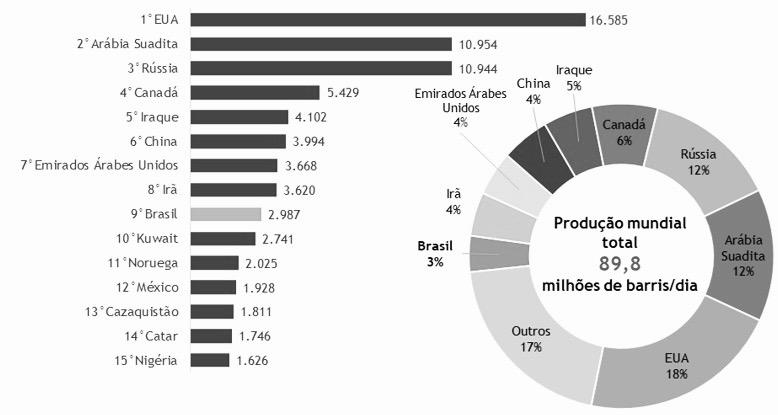 Figure 2:
Largest oil producers in 2021 (thousand barrels per day)
Source: adapted from IBP (2022)
Figure 2:
Largest oil producers in 2021 (thousand barrels per day)
Source: adapted from IBP (2022)
As shown in Figure 2, Russia accounts for 12% of total global production, tying with Saudi Arabia in absolute terms and significantly ahead of Canada (6%), which holds the fourth position.
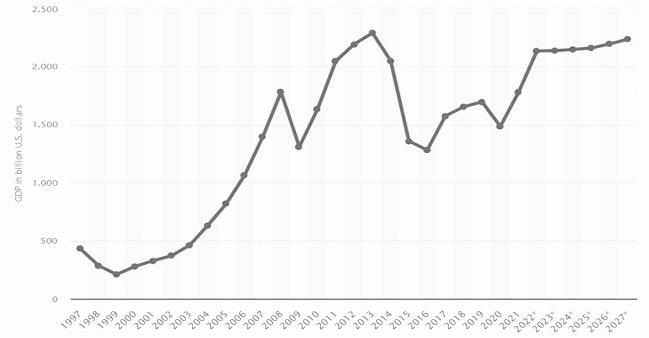 Figure 3:
Russian Gross Domestic Product (GDP) at current prices from 1997 to 2027
Source: Adapted from Statista (2023)
Figure 3:
Russian Gross Domestic Product (GDP) at current prices from 1997 to 2027
Source: Adapted from Statista (2023)
Analyzing Figure 3, Russia’s GDP has shown a consistent growth with consecutive surpluses, except for the years 2008 and 2014. This was a result of the expansion of Russian energy trade with its Asian and European trading partners. The cyclical nature of the capitalist system and its dialectic, marked by peaks of prosperity and regression are evident here (Kondratieff, 1935; Whitacker, 2015).
Russia's privileged position in the global energy resources ranking reflects a geopolitical advantage that supports the country's interests in the trade of natural gas and oil. In addition, there is interest in preserving the infrastructure and economy around this commercial dynamic.
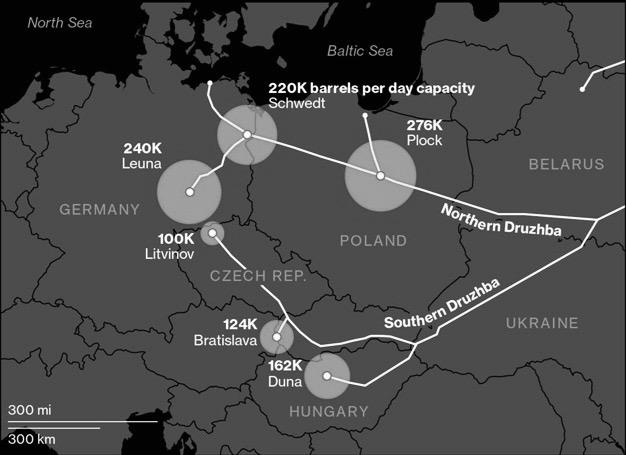 Figure 4:
Druzhba pipelines (North and South)
Source: Adapted from Bloomberg (2023); Energy Connects (2023)
Figure 4:
Druzhba pipelines (North and South)
Source: Adapted from Bloomberg (2023); Energy Connects (2023)
As shown, some European countries, including Hungary, Poland, Slovakia, Czech Republic, and Germany, exhibit a high degree of dependence on Russian oil. Specifically Germany also maintains a significant commercial relationship with Russia involving natural gas, which is discussed further below.
Generally, there is a complex gas pipeline and oil transport scheme involving Russia and the European Union. The Russian ports of Murmansk, Primorsk, and Novorossiysk (Novorussia), in the far West of Russia, are essential for maintaining this energy trade through the BPS, Druzhba (North and South), and BTC pipelines. Further details are provided below.
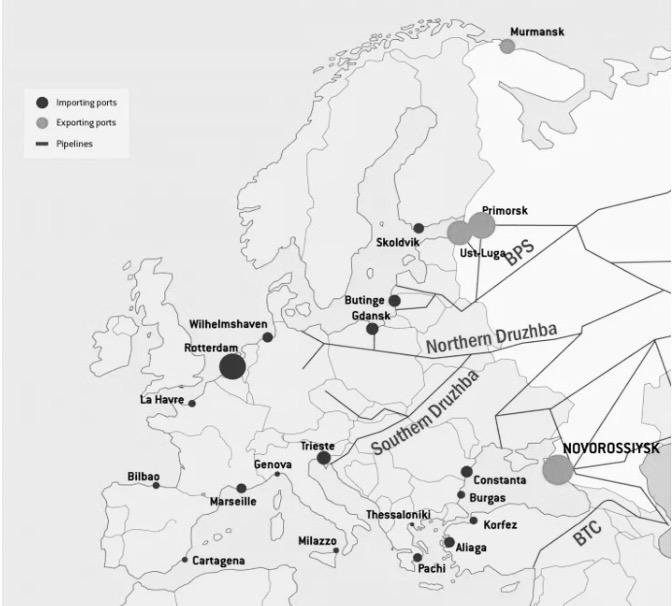 Figure 5:
European ports for oil landings from the Russian Federation
Source: Adapted from Bruegel (2023).
Figure 5:
European ports for oil landings from the Russian Federation
Source: Adapted from Bruegel (2023).
In addition, gas pipelines connect Russian ports to Germany, considered to be the largest economy in the European Union. A focused analysis of this connection is therefore essential.
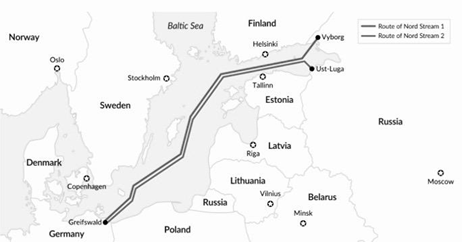 Figure 6:
Nord Stream 1 and 2
Source: adapted from Umbach (2020), GIS Report portal.
Figure 6:
Nord Stream 1 and 2
Source: adapted from Umbach (2020), GIS Report portal.
The marine terminals at Vyborg (also near Primorsk) and Ust-Luga are the main terminals linking Nord's marine pipelines stream 1 and 2 to Germany via the Baltic Sea. This infrastructure[2] is crucial for the consumption of Russian gas by Germany and, by extension, the European Union.
As an example of this trade, Germany alone imported 55.6% of its natural gas in 2020 via the Nord Stream pipeline[3]. This trend has remained consistent across the rest of Europe in absolute terms.
Table 1
Balance of the European Union's natural gas supply (2019)
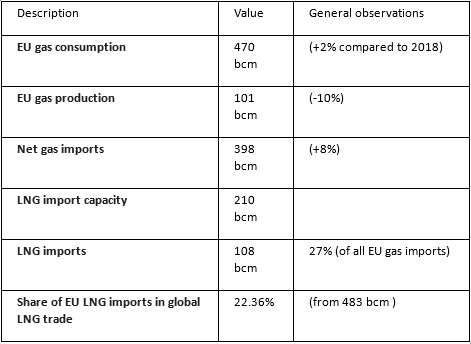 Subtitle: EU: European Union. BCM: Billion Cubic Meters. LNG: Liquefied Natural Gas. Source: Adapted from Umbach (2020), GIS Report portal.
As shown, Europe does not produce enough natural gas to meet its consumption needs. More than half of imports come from Russian trade. Excluding all Russian gas exports to Europe, the following result is observed (based on data from 2019):
Table 2:
Russian gas exports to Europe (2019)
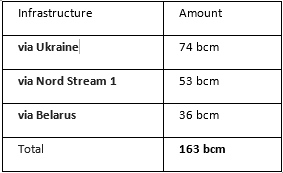 Caption: BCM: Billion Cubic Meters Source: Adapted from Umbach (2020), GIS Report portal.
In this way, Russia can leverage political bargaining on various sensitive issues within its regional geopolitics, such as the Ukrainian conflict, which reignited in 2022 and continues into 2023. Despite facing economic sanctions from the West due to its ongoing conflict with Ukraine and Europe's energy dependence, Vladimir Putin has managed to implement measures that counter a geopolitical stance more favorable to the Kremlin.
In addition, due to the significant energy trade that the Russian Federation maintains with its Asian and European partners, the country is able to implement foreign policy measures that go against its national interests, further emphasizing the economic importance the energy sector provides to Russia.
The high concentration of strategic natural resources in Russia’s oil, as well as the possession of the necessary technology for the extraction and capitalization of these energy resources, has enabled the Russian Federation to amass significant power in national geopolitics, which goes against the ideas discussed by Raffestin (1993), Bobbio (1998), and Arendt (2007) at the beginning of this study.
In this conceptual context of power and the rational use of natural resources as a means of concentrating power, the way the Russian Federation uses its energy resources as a political platform contradicts the commercial dependence that European and Asian regional authorities need to import these goods as the foundation for its key activities, whether in society, the economy, or the very dialectical movement of capital.
From the extraction of natural gas and oil to their refining and transportation, the Russian Federation holds a monopoly on these resources, profiting significantly from this crucial segment of international trade. Additionally, with the advancement of the Silk Road and the OBOR project, the partnership between Russia and China strengthens the energy market, which has long been favorable to the Kremlin (Stonis, 2022).
The main instrumentalization of Russian policy through its energy resources became more evident with the resurgence of the conflict between Russia and Ukraine in 2022. The West took an unfavorable stance on the conflict, imposing economic sanctions and political pressure on Russia that did not result in a shift in Russia’s position, either in the short or medium term regarding the Ukrainian conflict (Alwago, 2022 & Bansal, 2021).
Having already experienced similar sanctions in 2014, Russia was better prepared in 2022 for the new conflict with Ukraine, with strengthened economic, financial and political measures to withstand potential international embargoes.
Among the main characteristics, the following stand out: a) in January 2022, Russia’s foreign currency and gold reserves exceeded US$ 630 billion (making it the fourth-largest reserve in the world); b) Russia's national reserve managed to reduce its dependency on the US dollar from 40% to just 16%; c) 13% of its national reserves were held in Chinese renminbi; d) there was a decrease in Western foreign loans and investments between 2015 and 2020; e) financial relations with Eastern countries, such as China and Central Asian countries, increased; f) Russia established its own payment system, reducing dependence on Western SWIFT; g) Russia maintained and controlled its natural gas exports to the European Union (around 40%); and h) Russia joined the Chinese UnionPay network, replacing VISA and MasterCard in the country's domestic market (Alwago, 2022 & Bansal, 2021; Gricius, 2020).
Therefore, Europe, particularly Germany, needed to diversify its energy sources. For example, on average, Russian gas accounted for approximately 40% of Europe's energy consumption (International Energy Agency, 2022).
Some factors led to this high dependence on Russian gas and oil imports: a) historical dependence and territorial proximity to Europe, b) relatively competitive prices, c) lack of energy diversification in European countries, with particular attention to Germany, d) delay in the energy transition process to non-polluting or nuclear sources, e) economic interdependence, and f) consolidated infrastructure in the distribution of Russian gas and oil in Europe. (Stern, 2022).
In geopolitical terms, Russia maintains control over the distribution dynamics of natural gas and oil, despite the current European discourse on reducing dependence and boosting energy diversification.
Furthermore, the existence of Russians and pro-Russians within Ukraine, as seen in the annexation of Crimea and the accession of Eastern Ukraine in Donbass, gives Russia a geopolitical advantage, which impacts the country's energy dynamics with Europe (Tagliapietra, 2022).
4. Conclusions
Since Vladimir Putin took over the Russian Federation in 2000, the country has taken more assertive measures in its foreign policy. With a significant economic recovery and an increasingly active voice in the international system, contemporary Russia has become a key player in the major global geopolitical issues.
Due to commercial pragmatism in the country's energy sector and an increasingly centralized state policy, Russia is able to shape its geopolitics through oil and natural gas finance that goes against its national interests.
As the third-largest exporter of energy resources in the world, with the technical capabilities to facilitate the extraction, transport and commercialization of Russian commodities in Europe and Asia, the country holds a position of energy leadership that should not be overlooked.
In addition to the import dependency several countries, particularly industrialized European countries, have on Russian energy products, Russia’s strategic position in maintaining its privileged role in the regional and global energy sector is evident. At this point, the politicization of energy resources present in its contemporary geopolitics is presented in a cyclical position of capitalism closer to 'prosperity' compared to the theoretical view of Kondratieff (1935).
Russia's conflict with Ukraine, which resumed in 2022, at odds with Western industrialized countries, highlights that the Kremlin has a voice in its foreign policy, whether in terms of national and regional security, as well as in the maintenance of geopolitical spaces of interest that Russia is determined to retain.
It is important to highlight that despite the high dependence on Russian oil and natural gas in many European countries, this reliance does not extend across the entire continent. For example, France has significantly developed its nuclear energy and renewable energy sectors, accounting for approximately 67% and 13% of its energy production, respectively.
However, with the escalation of the conflict between Russia and Ukraine, the need for energy diversification in Europe has become a reality, prompting the import of natural gas and oil from other nations, such as the United States, Qatar and Algeria.
5. References
Alwago, W. O. (2022). Is the Renminbi a global currency in the making? Globalization of digital yuan. Public Finance Quarterly, 67(4), 553-566. https://doi.org/10.35551/PFQ_2022_4_5
Arendt, H. (2007). A condição humana. Forense Universitária.
Bansal, R. y Singh, S. (2021). China’s digital Yuan: An alternative to the Dollar- dominated financial system. Carnegie Endowment for International Peace. https://carnegieendowment.org/research/2021/08/chinas-digital-yuan-an-alternative-to-the-dollar-dominated-financial-system?lang=en
Bloomberg (25 de febrero de 2023). Poland says Russia stops oil flows via key Druzhba pipeline. Energy Connects. https://www.energyconnects.com/news/oil/2023/february/poland-says-russia-stops-oil-flows-via-key-druzhba-pipeline/
Bobbio, N. et al. (1998). Dicionário de Política. Editora Universidade de Brasília.
Bolaño, C. R. S. (2020). Reseña del libro Digitalized finance: Financial capitalism and informational revolution. Tecnologías de información y comunicación y capitalismo financiero: una contribución latinoamericana al estudio de un elemento clave del capitalismo del siglo XXI de Edemilson Paraná. Signo y Pensamiento, 39(77), 1-3. https://doi.org/10.11144/Javeriana.syp.39.ticc
Gricius, G. et al. (2020). Russia’s new soft power: The mir card system. Journal of Liberty and International Affairs, 6 (2), 32-44. https://doi.org/10.47305/JLIA2020032g%20
Heussaff, C. et al. (2023). Russian crude oil tracker. Bruegel. https://www.bruegel.org/dataset/russian-crude-oil-tracker
Instituto Brasileiro de Petróleo e Gás (2020). Observatório do setor: Maiores produtores de petróleo do mundo.
Kondratieff, N. D. (1935) y Stolper W. F. The long waves in economic life. The Review of Economics and Statistics, 17(6), 105-115. http://www.jstor.org/stable/1928486
Mészáros, I. (2011). O desafio e o fardo do tempo histórico: o socialismo no século XXI. Boitempo.
Mészáros, I. (2012). Para além do capital: rumo a uma teoria da transição. Boitempo.
Rafesttin, C. (1993). Por uma geografia do poder. Ática.
Statista (2023). Produto Interno Bruto (PIB) da Rússia a preços correntes de 1997 a 2027. https://www.statista.com/
Stern, J. (2022). The future of gas in Europe: The role of Russia in the European gas market. Oxford Institute for Energy Studies.
Stonis, D. et al (2022). Comparative Analysis of the Shanghai Cooperation Organisation and European Union Strategy on Central Asia: Confrontation or Cooperation? Polish Political Science Yearbook, 51(1), 69-90. https://doi.org/10.15804/ppsy202230
McWilliams, B., Tagliapetra, S. y Zachmann, G. (2025). Europe’s energy information problem. Bruegel. https://www.bruegel.org/policy-brief/europes-energy-information-problem
Umbach, F. (2020). Nord Stream 2 divide Germany’s allies. GIS Report Online. https://www.gisreportsonline.com/r/nord-stream-2/
Venturi, L. A. B. (2006). Recurso natural: a construção de um conceito. GEOUSP Espaço e Tempo, 10 (1), 09-17. https://doi.org/10.11606/issn.2179-0892.geousp.2006.74004
Whitacker, G. M. (2015). Território e poder: apropriação, uso e controle de recursos naturais e a irreformabilidade do modo de produção capitalista. Revista bibliográfica de geografía y ciencias sociales, 20, 1-29. https://www.raco.cat/index.php/Biblio3w/article/view/299553
Notes
1 Author's citation translated by the author of this article.
2 It is estimated that Nord Stream 1 cost approximately €7.4 billion, while Nord Stream 2 has already surpassed €9.5 billion.
3 Other imports came from Norway (27.8%), the Netherlands (23.4%), and other European countries to a lesser extent (2.9%) (
Umbach, 2020).
Author notes
* Máster en Relaciones Internacionales por la Universidad Estatal de Paraíba (Brasil). Profesor de Licenciatura en Geografía en la Universidad Estatal de Paraíba. Editor del Grupo de Estudios e Investigación en Asia Pacífico (GEPAP). Artículo financiado por la Fundación de Apoyo a la Investigación del Estado de Paraíba.
Additional information
Cómo citar este artículo: de Lucena, A. M. M. (2025). The energy politicization of the Russian Federation and the dialectic of the capitalist system. Relaciones Internacionales, 34(68), 207, https://doi.org/10.24215/23142766e207