Introduction
Incidents of dog attacks and bites are widely recognized as a public health issue1, especially due to the transmission of serious zoonotic diseases such as rabies2. In addition, dog bites cause significant psychological repercussions3 and entail economic costs that affect both victims’ families and the State4-7, becoming a major concern for health authorities.
Globally, rabies is estimated to cause around 59000 human deaths annually8, and approximately 99 % of cases result from bites by dogs infected with the rabies virus. Notably, free-roaming domestic dogs have been identified as the main source of transmission9,10. At the continental level, most countries have eliminated rabies from their domestic dog populations, however, in low - and middle-income countries, rabies still persists in these poorly controlled populations4,9,11. According to the Pan American Health Organization (PAHO), Bolivia is one of the few countries in the Americas where cases of canine rabies (CR) are still reported9.
In 2017, Bolivia reported 965 confirmed cases of CR and 8 cases of human rabies. These figures represent the highest number of CR cases and human rabies deaths recorded in the country over the past 10 years12-14. The department of Santa Cruz was the most affected in 2017, accounting for 658 of the 965 CR cases reported nationwide14. In the same year, at least 25000 individuals who were bitten by dogs were recorded across the country13.
Human rabies is preventable by avoiding viral exposure15,16. This can be achieved through a detailed understanding of the modifiable factors that drive its transmission, as well as the epidemiological dynamics of dog bites. To do so, high-quality data are essential to quantify the disease burden and guide prevention and control efforts16.
Within this approach, spatial analysis becomes a valuable tool for detecting changes in the patterns of endemic diseases17. Few epidemiological studies address the spatial distribution of dog aggression in the city of Santa Cruz, as well as the associated risk factors. This study aimed to identify the risk factors associated with dog aggression, the occurrence of RC cases in the city of Santa Cruz de la Sierra, and analyze their spatial distribution using georeferencing tools, in order to determine key epidemiological patterns between 2019 and 2022, contributing to the design of effective strategies for the prevention and control of zoonotic diseases.
Materials and methods
Study Area. The study was conducted from 2019 to 2022 in the city of Santa Cruz de la Sierra, located in the eastern region of Bolivia (17º 45’S, 63º 14’W) at an altitude of 416 meters above sea level (Figure 1), characterized by a sunny, semi-tropical climate. The estimated population is 2 657 762 inhabitants18, with a canine population of 39054319. The city is divided into four health networks and has a total of 65 health centers, which provide services to meet the healthcare needs of the population, including care for people who have been attacked by dogs, cats, and other animals.
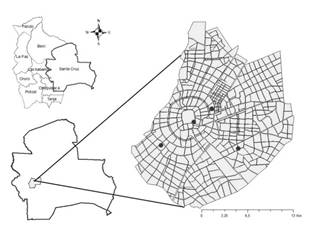 Figure 1
Map of the city of Santa Cruz de la Sierra, indicating the location of the four health centers at each point
Figure 1
Map of the city of Santa Cruz de la Sierra, indicating the location of the four health centers at each point
Study design and data collection. A retrospective cross-sectional study was carried out, gathering records of animal attacks in 2022 from four health centers: Elvira Wunderlich (part of the Central Health Network), Lazareto (part of the Northern Health Network), Preventiva Sud (part of the Eastern Health Network), and Sagrada Familia (part of the Southern Health Network) (Figure 1). The database of suspected CR cases from 2019 to 2022 was provided by the National Laboratory Unit (UNALAB) of the National Service for Agricultural Health and Food Safety (SENASAG).
Data Analysis. The analysis was based on descriptive and inferential statistics of the variables of interest, using measures of central tendency as well as bivariate frequencies and proportions. To analyze both CR cases and dog attack cases, a binary logistic regression analysis was performed with odds ratios (OR), assuming a 95 % confidence interval.
For dog attack cases, the variable of interest was the animal’s status (known vs. unknown) and potential exposure to the rabies virus. The independent variables considered were: sex (male, female), age (0-4, 5-9, 10-19, 20-64, >65 years), educational level (≤18 years, no education, primary, secondary, university), site of exposure (head/neck, upper limb, lower limb, trunk), post-exposure prophylaxis (PEP) (yes, no), circumstances of the attack (accidental, provoked, no apparent cause), first aid received (washing with soap and water, alcohol, povidone-iodine, none), time elapsed between the attack and seeking care (same day, 1-5 days, more than 6 days), completion of the vaccination schedule (yes, no, referred to another health center), receipt of anti-rabies serum (yes, no), breed of the attacking animal (mixed, characteristic of a specific breed), and vaccination status of the attacking animal (vaccinated, not vaccinated).
For the CR cases in suspected animals, the variable of interest was the laboratory test result (positive vs. negative). The independent variables were year (2019, 2020, 2021, 2022), sex (female, male), age (0-1 year, >1 year), vaccination status (vaccinated, not vaccinated), breed (mixed, characteristic of a specific breed), and number of people bitten (none, 1-6).
The significance level was set at p < 0.05 throughout the analyses. Data were analyzed using the Minitab 19® statistical software20.
Georeferencing and spatial pattern analysis. For the georeferencing analysis, the geographic coordinates listed in each case record were obtained using Google Maps® (https://www.google.com/maps/).
The point location datasets were then plotted using ArcGIS software within its ArcMap module, applying a non-parametric Kernel density analysis. A bandwidth of 0.6 km was used, calculated using the adaptive bandwidth selection method, and a grid cell size of 0.01 km².
Ethical Approval Statement. Use of the records of dog attacks on people and CR cases was authorized by the respective directorates of the four Health Networks and by UNALAB - SENASAG.
Results
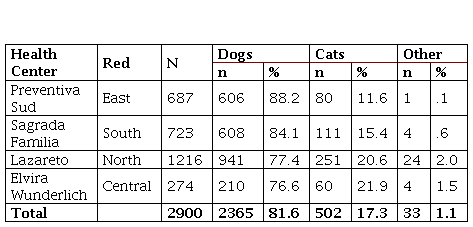
Sociodemographic characteristics of individuals attacked by dogs. During 2022, a total of 2900 bite victims were recorded across the four health centers in the city of Santa Cruz. The Lazareto Health Center reported the highest number of incidents (n = 1216). Of these, 81.6 % were caused by dogs and 1.1 % by other species, such as mice, rabbits, bats, and monkeys (Table 1).
Table 1
Recorded cases of attacks by Health Center and species
| Health Center | Red | N | Dogs | Cats | Other |
| n | % | n | % | n | % |
| Preventiva Sud | East | 687 | 606 | 88.2 | 80 | 11.6 | 1 | .1 |
| Sagrada Familia | South | 723 | 608 | 84.1 | 111 | 15.4 | 4 | .6 |
| Lazareto | North | 1216 | 941 | 77.4 | 251 | 20.6 | 24 | 2.0 |
| Elvira Wunderlich | Central | 274 | 210 | 76.6 | 60 | 21.9 | 4 | 1.5 |
| Total | | 2900 | 2365 | 81.6 | 502 | 17.3 | 33 | 1.1 |
Of the 2900 cases reported in 2022, 891 (30.7 %) were excluded because the attacks occurred outside the city’s geographic area or due to incomplete records.
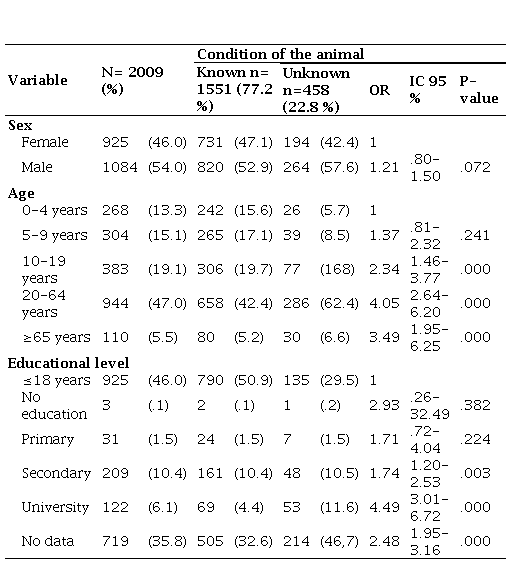
Since most attacks were caused by dogs, the variable analysis focused on this species. The cases were more frequent among males (54 %, n = 1084) than females (46 %, n = 925), with a statistically significant difference (Fisher’s exact test p = .000). The mean age of those attacked was 25.4 years (ranging from 0.6 to 91 years). Adults (20-64 years old) were the most affected group, representing 47 % of cases (n = 944) (Table 2).
Education level data for individuals over 18 years old are not collected systematically in all health centers, resulting in a substantial proportion of missing data (35.8 %). Among cases with available information, 10.4 % (n = 209) had a secondary education level.
Table 2
Characteristics of individuals attacked by dogs according to the animal’s status
| Variable | N= 2009 (%) | Condition of the animal |
| Knownn= 1551 (77.2 %) | Unknownn=458 (22.8 %) | OR | IC 95 % | P-value |
| Sex |
| Female | 925 | (46.0) | 731 | (47.1) | 194 | (42.4) | 1 | | | |
| Male | 1084 | (54.0) | 820 | (52.9) | 264 | (57.6) | 1.21 | .80-1.50 | .072 |
| Age |
| 0-4 years | 268 | (13.3) | 242 | (15.6) | 26 | (5.7) | 1 | | | |
| 5-9 years | 304 | (15.1) | 265 | (17.1) | 39 | (8.5) | 1.37 | .81-2.32 | .241 |
| 10-19 years | 383 | (19.1) | 306 | (19.7) | 77 | (168) | 2.34 | 1.46-3.77 | .000 |
| 20-64 years | 944 | (47.0) | 658 | (42.4) | 286 | (62.4) | 4.05 | 2.64-6.20 | .000 |
| ≥65 years | 110 | (5.5) | 80 | (5.2) | 30 | (6.6) | 3.49 | 1.95-6.25 | .000 |
| Educational level |
| ≤18 years | 925 | (46.0) | 790 | (50.9) | 135 | (29.5) | 1 | | | |
| No education | 3 | (.1) | 2 | (.1) | 1 | (.2) | 2.93 | .26-32.49 | .382 |
| Primary | 31 | (1.5) | 24 | (1.5) | 7 | (1.5) | 1.71 | .72-4.04 | .224 |
| Secondary | 209 | (10.4) | 161 | (10.4) | 48 | (10.5) | 1.74 | 1.20-2.53 | .003 |
| University | 122 | (6.1) | 69 | (4.4) | 53 | (11.6) | 4.49 | 3.01-6.72 | .000 |
| No data | 719 | (35.8) | 505 | (32.6) | 214 | (46,7) | 2.48 | 1.95-3.16 | .000 |
The binary logistic regression analysis indicated no statistically significant difference between the animal’s status and the sex of the attacked person. However, individuals older than 10 years (10-19, 20-64, and ≥65 years) were more likely to be attacked by an unknown dog compared to those under 4 years old (OR 2.34, 95 % CI: 1.46-3.77, OR 4.05, 95 % CI: 2.64-6.20, OR 3.49, 95 % CI: 1.95-6.25, respectively; p = .000).
A similar pattern was observed regarding academic level: higher educational levels (secondary and university) increased the likelihood that the attacker would be an unknown dog (OR 1.20, 95 % CI: 1.20-2.53, OR 4.49, 95 % CI: 3.01-6.72, p = .000, respectively), compared to those under 18 years old.
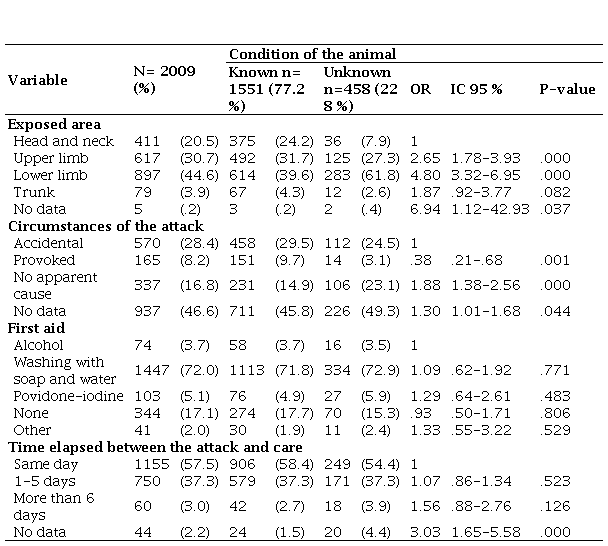
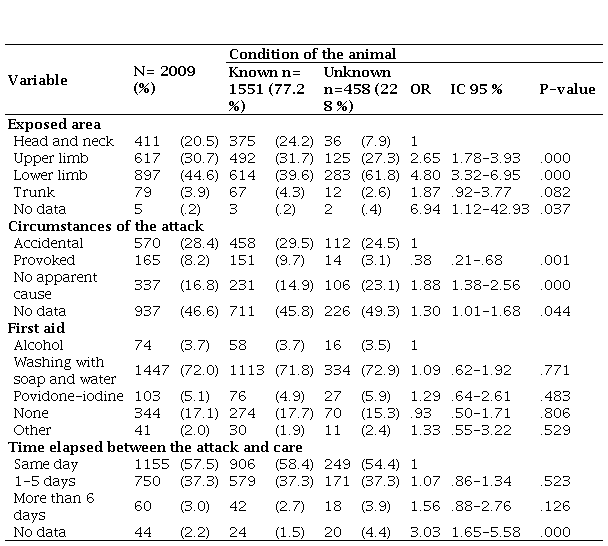
Epidemiological characteristics of dog attacks. The results show that most attacks occurred on the lower limbs (44.6 %, n = 897). Binary logistic regression analysis indicated that an unknown dog’s probability of being attacked on the lower or upper limbs (OR 4.8 and OR 2.65, respectively, p = .000) was significantly higher than suffering attacks to the head and neck.
Most attacks took place accidentally, accounting for 28.4 % of cases (n = 570). However, there was a significantly higher probability that an unknown dog would attack without apparent cause (OR 1.88, 95 % CI: 1.38-2.56, p = .000) compared to accidental attacks.
Regarding first aid, 72 % (n = 1447) of victims washed the wound with soap and water, whereas 17.1 % received no immediate medical attention.
The time elapsed between the attack and seeking care at a health center ranged from 0 to 171 days. The majority of those attacked (57.5 %, n = 1155) sought care on the same day, although 3 % waited more than six days before going to a health center (Table 3).
Table 3
Epidemiological characteristics of dog bite exposure according to the animal’s status
| Variable | N= 2009 (%) | Condition of the animal |
| Knownn= 1551 (77.2 %) | Unknownn=458 (22 8 %) | OR | IC 95 % | P-value |
| Exposed area |
| Head and neck | 411 | (20.5) | 375 | (24.2) | 36 | (7.9) | 1 | | | |
| Upper limb | 617 | (30.7) | 492 | (31.7) | 125 | (27.3) | 2.65 | 1.78-3.93 | .000 |
| Lower limb | 897 | (44.6) | 614 | (39.6) | 283 | (61.8) | 4.80 | 3.32-6.95 | .000 |
| Trunk | 79 | (3.9) | 67 | (4.3) | 12 | (2.6) | 1.87 | .92-3.77 | .082 |
| No data | 5 | (.2) | 3 | (.2) | 2 | (.4) | 6.94 | 1.12-42.93 | .037 |
| Circumstances of the attack |
| Accidental | 570 | (28.4) | 458 | (29.5) | 112 | (24.5) | 1 | | | |
| Provoked | 165 | (8.2) | 151 | (9.7) | 14 | (3.1) | .38 | .21-.68 | .001 |
| No apparent cause | 337 | (16.8) | 231 | (14.9) | 106 | (23.1) | 1.88 | 1.38-2.56 | .000 |
| No data | 937 | (46.6) | 711 | (45.8) | 226 | (49.3) | 1.30 | 1.01-1.68 | .044 |
| First aid |
| Alcohol | 74 | (3.7) | 58 | (3.7) | 16 | (3.5) | 1 | | | |
| Washing with soap and water | 1447 | (72.0) | 1113 | (71.8) | 334 | (72.9) | 1.09 | .62-1.92 | .771 |
| Povidone-iodine | 103 | (5.1) | 76 | (4.9) | 27 | (5.9) | 1.29 | .64-2.61 | .483 |
| None | 344 | (17.1) | 274 | (17.7) | 70 | (15.3) | .93 | .50-1.71 | .806 |
| Other | 41 | (2.0) | 30 | (1.9) | 11 | (2.4) | 1.33 | .55-3.22 | .529 |
| Time elapsed between the attack and care |
| Same day | 1155 | (57.5) | 906 | (58.4) | 249 | (54.4) | 1 | | | |
| 1-5 days | 750 | (37.3) | 579 | (37.3) | 171 | (37.3) | 1.07 | .86-1.34 | .523 |
| More than 6 days | 60 | (3.0) | 42 | (2.7) | 18 | (3.9) | 1.56 | .88-2.76 | .126 |
| No data | 44 | (2.2) | 24 | (1.5) | 20 | (4.4) | 3.03 | 1.65-5.58 | .000 |
The recommendation to administer PEP depends on factors such as the injury site, the animal’s status, and the patient’s vaccination history. Based on these criteria, PEP was indicated in 58.7 % (n=1180) of cases. The likelihood of administering PEP was highly significant when the animal’s status was unknown (OR 25.3, 95 % CI: 15.43-41.52, p=0.000) (Table 4).
Table 4
Characteristics of post-exposure prophylaxis
| Variable | N= 2009 (%) | Condition of the animal |
| Knownn= 1551 (77.2 %) | Unknownn=458 (22 8 %) | OR | IC 95 % | P-value |
| Exposed area |
| Head and neck | 411 | (20.5) | 375 | (24.2) | 36 | (7.9) | 1 | | | |
| Upper limb | 617 | (30.7) | 492 | (31.7) | 125 | (27.3) | 2.65 | 1.78-3.93 | .000 |
| Lower limb | 897 | (44.6) | 614 | (39.6) | 283 | (61.8) | 4.80 | 3.32-6.95 | .000 |
| Trunk | 79 | (3.9) | 67 | (4.3) | 12 | (2.6) | 1.87 | .92-3.77 | .082 |
| No data | 5 | (.2) | 3 | (.2) | 2 | (.4) | 6.94 | 1.12-42.93 | .037 |
| Circumstances of the attack |
| Accidental | 570 | (28.4) | 458 | (29.5) | 112 | (24.5) | 1 | | | |
| Provoked | 165 | (8.2) | 151 | (9.7) | 14 | (3.1) | .38 | .21-.68 | .001 |
| No apparent cause | 337 | (16.8) | 231 | (14.9) | 106 | (23.1) | 1.88 | 1.38-2.56 | .000 |
| No data | 937 | (46.6) | 711 | (45.8) | 226 | (49.3) | 1.30 | 1.01-1.68 | .044 |
| First aid |
| Alcohol | 74 | (3.7) | 58 | (3.7) | 16 | (3.5) | 1 | | | |
| Washing with soap and water | 1447 | (72.0) | 1113 | (71.8) | 334 | (72.9) | 1.09 | .62-1.92 | .771 |
| Povidone-iodine | 103 | (5.1) | 76 | (4.9) | 27 | (5.9) | 1.29 | .64-2.61 | .483 |
| None | 344 | (17.1) | 274 | (17.7) | 70 | (15.3) | .93 | .50-1.71 | .806 |
| Other | 41 | (2.0) | 30 | (1.9) | 11 | (2.4) | 1.33 | .55-3.22 | .529 |
| Time elapsed between the attack and care |
| Same day | 1155 | (57.5) | 906 | (58.4) | 249 | (54.4) | 1 | | | |
| 1-5 days | 750 | (37.3) | 579 | (37.3) | 171 | (37.3) | 1.07 | .86-1.34 | .523 |
| More than 6 days | 60 | (3.0) | 42 | (2.7) | 18 | (3.9) | 1.56 | .88-2.76 | .126 |
| No data | 44 | (2.2) | 24 | (1.5) | 20 | (4.4) | 3.03 | 1.65-5.58 | .000 |
Of the available data on PEP regimen follow-up in attacked individuals, only 55.2 % (n=295) completed their prophylactic regimen. Among the 381 patients who were advised to visit a tertiary-level health center to receive anti-rabies serum, 63.5 % (n=242) received it. No statistically significant difference was observed in the likelihood of being discharged, completing the vaccination schedule, or receiving anti-rabies serum between patients attacked by an unknown dog (Table 4).
Table 5
Characteristics of the attacking dog
| Variable | N= 2009 (%) | Condition of the animal | |
| Knownn= 1551 (77.2 %) | unknownn=458 (22.8 %) | OR | IC 95 % | P-value | |
| Race | |
| Characteristics of a specific race | 270 | (13.4) | 245 | (15.8) | 25 | (5.5) | 1 | | | | | |
| Mixed | 781 | (38.9) | 626 | (40.4) | 155 | (33.8) | 2.43 | 1.55-3.80 | .000 | | |
| No data | 958 | (47.7) | 680 | (43.8) | 278 | (60.7) | 4.01 | 2.59- 6.19 | .000 | | |
| Vaccination status of the attacking animal | |
| Not vaccinated | 388 | (19.3) | 265 | (17.1) | 123 | (26.9) | 1 | | | | | |
| Vaccinated | 691 | (34.4) | 677 | (43.6) | 14 | (3.1) | .04 | .03-.08 | .000 | | |
| No data | 930 | (46.3) | 609 | (39.3) | 321 | (70.1) | 1.14 | .88-1.46 | .325 | | |
| | | | | | | | | | | | | | |
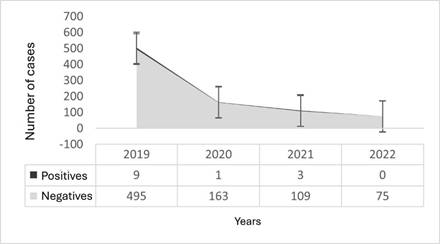 Figure 2
Temporal distribution of suspected canine rabies cases in the city of Santa Cruz from 2019 to 2022
Figure 2
Temporal distribution of suspected canine rabies cases in the city of Santa Cruz from 2019 to 2022
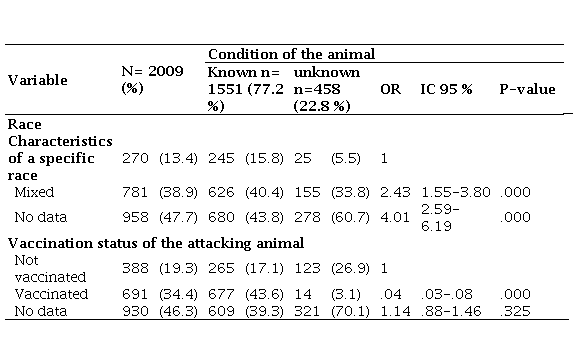
In Table 5, the characteristics of the attacking dogs are shown for the cases where information was available. Mixed-breed and vaccinated dogs were responsible for most bites (38.9 and 34.4 %, respectively). The likelihood that an unknown dog was mixed-breed was higher compared to purebred dogs (OR 2.43, 95 % CI: 1.15-3.80, p=.000), and the likelihood that an unknown dog was vaccinated was extremely low (OR 0.04, 95 % CI: 0.03-0.08, p=.000).
Risk factors associated with the occurrence of canine rabies (2019-2022). Suspected CR cases in Santa Cruz are analyzed using direct immunofluorescence (DIF) or polymerase chain reaction (PCR) and reported by the official laboratory UNALAB-SENASAG.
During the 2019-2022 period, the laboratory analyzed 876 suspected CR cases from the city of Santa Cruz. Twenty-one samples (2.4 %) were excluded because they were unsuitable for testing or in a state of decay, and therefore no result could be obtained. Of the 855 samples evaluated, 1.5 % (n=13) tested positive. The largest proportion of analyzed cases (58.9 %, n=504) and positive cases (69.2 %, n=9) was recorded in 2019, with a progressive decrease noted in subsequent years (Figure 2).
Table 6
Characteristics of suspected canine rabies cases in the city of Santa Cruz from 2019 to 2022
| Variable | N= 855 (%) | Result |
| Positiven= 13 (1.5 %) | Negativen=842 (98.5 %) | OR | IC 95 % | P-value |
| Sex |
| Female | 326 | (38.1) | 2 | (15.4) | 324 | (38.5) | 1 | | | |
| Male | 516 | (60.4) | 11 | (84.6) | 505 | (60.0) | 3.53 | .78-16.02 | .102 |
| Unknown | 13 | (1.5) | 0 | (.0) | 13 | (1.5) | .00 | - | - |
| Age |
| 0-1 year | 354 | (41.4) | 6 | (46.2) | 348 | (41.3) | 1 | | | |
| >1 years | 477 | (55.8) | 7 | (53.8) | 470 | (55.8) | .86 | .29-2.59 | .794 |
| Unknown | 24 | (2.8) | 0 | (.0) | 24 | (2.9) | .00 | - | - |
| Vaccination status |
| Vaccinated | 126 | (14.7) | 3 | (23.1) | 123 | (14.6) | 1 | | | |
| Not vaccinated | 589 | (68.9) | 8 | (61.5) | 581 | (69.0) | .56 | .15-2.16 | .403 |
| Unknown | 140 | (16.4) | 2 | (15.4) | 138 | (16.4) | 1.05 | .22-5.01 | .572 |
| Race |
| Mixed | 686 | (80.2) | 11 | (84.6) | 675 | (80.2) | 1 | | | |
| Characteristics of a breed | 168 | (19.6) | 2 | (15.4) | 166 | (19.7) | .74 | .17-3.37 | .696 |
| Unknown | 1 | (.1) | 0 | (.0) | 1 | (.1) | .00 | - | - |
| Number of people bitten |
| None | 688 | (80.5) | 7 | (53.8) | 681 | (80.9) | 1 | | | |
| 1-6 | 159 | (18.6) | 6 | (46.2) | 153 | (18.2) | 3.82 | 1.26-11.51 | .017 |
| Unknown | 8 | (.9) | 0 | (.0) | 8 | (1.0) | .00 | - | - |
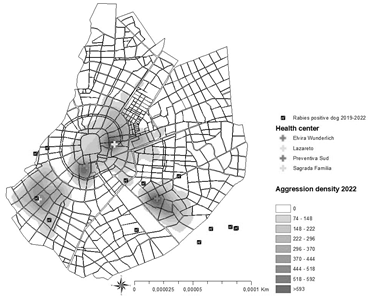 Figura 3
Densidad Kernel de agresiones de perros a personas de 4 centros de Salud y casos positivos a rabia canina
Figura 3
Densidad Kernel de agresiones de perros a personas de 4 centros de Salud y casos positivos a rabia canina
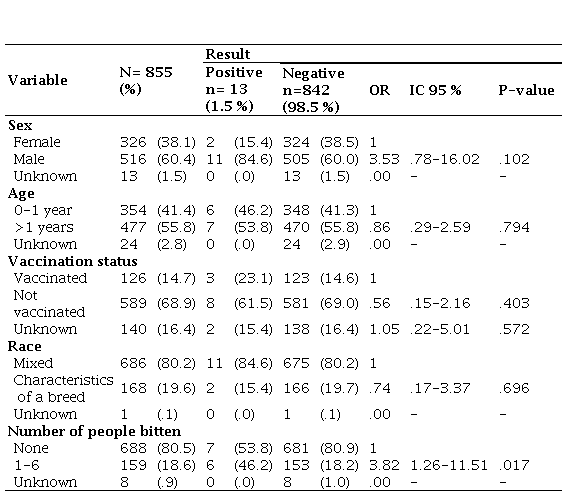
The proportion of rabies-positive dogs was higher among males (84.6 %, n=11), over 1 year old (53.8 %, n=7), unvaccinated (61.5 %, n=8), and mixed breed (84.6 %, n=11). There was no statistically significant difference in the likelihood of obtaining positive results according to the year of detection, sex, age, vaccination status, or breed of the dogs (Table 6).
Most of the suspected rabid dogs (80.5 %, n=688) were not reported to have bitten any person, and there was a statistically significant lower probability that a positive dog would not bite anyone (OR 0.26, 95 % CI: 0.09-0.79, p=.017) (Table 6).
Spatial distribution of CR cases and dog attacks. A total of 2009 dog bite cases treated in 2022 at the four health centers included in the study were geolocated. Through a Kernel density analysis (Figure 3), four hotspots were identified, coinciding with the locations of the health centers: the first in UV 20 and 21 (DM 2), corresponding to Lazareto Health Center; the second in UV 27 (DM 4), where Elvira Wunderlich Health Center is located; the third encompassing UV 148 and 160 (DM 8), the location of the Preventiva Sud Health Center; and the last hotspot in UV 126 (DM 10), corresponding to Sagrada Familia Health Center.
Figure 3 shows the location of the 13 positive CR cases reported between 2019 and 2022. No positive cases were recorded within the area bounded by the 4th ring road. Most cases were concentrated in peripheral areas, especially in the eastern part of the city of Santa Cruz, which reported 9 positive cases (DM 7 and 8).
Discussion
The findings of this research confirm that dog bites remain the main type of aggression by domestic animals in urban settings, consistent with studies conducted in Peru21 and Mexico22, which reported a predominance of canine attacks over other species. Similarly, in 2017, Aguirre-Revollo23 analyzed cases reported at the Northern University Health Center in the city of Santa Cruz, revealing a predominance of dog attacks.
The predominance of cases in males aligns with the findings of other authors15,24,25. However, the discovery of a higher number of attacks among adults (20-64 years old) contrasts with studies indicating a higher risk among children23,26. Our results suggest a more significant impact on the 20-64 age group, which could be attributed to this age range representing a larger proportion of the population in the department of Santa Cruz18. Nonetheless, when grouping all those attacked who are under 18 years old, they also represent a considerable population segment. This pattern suggests that sociocultural factors, such as household dynamics and the presence of dogs in the family setting21, as well as vulnerability, physical condition, and children’s size22,25, may influence the age distribution of attacks.
The predominance of known dogs as aggressors is consistent with what has been observed in research conducted in various endemic regions, where owned dogs21,27, often with roaming habits, can be significant rabies vectors. This point is reinforced by authors like Mshelbwala et al.16, who found that responsible pet ownership and careful monitoring of dog vaccination status significantly reduce human rabies cases following an attack. However, our study also establishes that unknown or stray dogs increase the probability of exposure, a finding that underscores the importance of dog identification programs and control of stray populations to reduce rabies transmission.
Regarding the educational level, we noted a higher proportion of adults who had finished school. This is important because a lack of education and awareness often leads to neglect in seeking care after an injury24.
In this study, most attacks occurred on the lower limbs2,23, which can be somewhat advantageous if the wound is isolated, as it allows the animal to be observed if it is known, serving as a prophylactic measure to better determine the timing of the vaccination schedule26. On the other hand, the age of the victim influences the anatomical location of the injury, since children are more likely to sustain bites to the head and neck compared to adults1,27.
Concerning the circumstances of attacks, the present study found that most bites occurred due to accidental causes, but there is a higher probability of being attacked for no apparent reason when the dog is unknown. This is because certain situations are likely to provoke aggressive behavior in dogs, such as territoriality, protection, guarding, or fear triggered by sudden noises24, which may be deemed “no apparent cause” or “accidental” by the victim, even though it might actually be provoked.
In terms of prophylaxis and treatment, we identified a significant percentage of patients who did not complete the anti-rabies vaccination schedule or did not receive anti-rabies serum when indicated. This finding is consistent with reports by Talavera et al.21 in Peru, where accessibility issues, lack of knowledge, or underestimation of risk impede the completion of prophylaxis. This suggests a need to strengthen community education about the importance of completing the vaccination schedule and seeking timely healthcare services.
In addition to PEP, psychotherapy can be essential, when warranted, to substantially reduce potential adverse effects on the health of patients who have suffered dog bites28.
The number of CR cases significantly decreased in the city of Santa Cruz over the four years studied, unlike the results reported by Pessoa Villarroel29, where the proportion of positive cases was 15 % (40/272) in 2014, 12 % (11/95) in 2015, 23 % (26/113) in 2016, and peaked at 48 % (558/1170) in 2017. Calizaya Robles30 studied rabies cases reported in 2018, finding that 9.5 % (86/907) of all suspected cases were positive.
The decrease in CR-positive cases is the result of the combined efforts of the public medical and veterinary health system, which improved vaccination campaigns with cell-culture vaccines, raised awareness of the significance of CR, and encouraged seeking medical attention in case of exposure24. It may also have been influenced by the pandemic starting in 2020, during which most of the population remained confined to their homes, reducing the likelihood of exposure for both people and their pets.
The Kernel density analysis of attacks shows that most cases clustered around each health center, which may be explained by the large proportion of known dogs as the source of attacks, as well as people generally visiting the nearest health center for treatment. The positive CR cases were concentrated in the peri-urban areas of the city, especially in the eastern zone of Santa Cruz (DM 7 and 8). This coincides with the findings of Calizaya Robles30, who identified hotspots that included DM 7, 8, and 14, as well as those of Pessoa Villarroel29, who noted a hotspot in DM 8. This finding helps identify critical areas where targeted strategies, such as mass vaccination campaigns and educational programs for vulnerable communities, can be implemented. Additionally, the absence of positive cases within the area bounded by the 4th ring road supports the hypothesis that central urban areas have better health-control levels, possibly due to the higher density of services.
Among the limitations, it is important to highlight the reliance on clinical records and potential underreporting of bites that go unreported. Furthermore, not including all health centers in the city and lacking precise data on the vaccination status of many dogs could have biased the real incidence of bites and the risk assessment for rabies. The absence of post-vaccination follow-up data for patients also limited the ability to fully assess the impact of prophylactic interventions.
These findings underscore the need to strengthen epidemiological surveillance, improve reporting systems, and promote public education on the importance of completing anti-rabies prophylaxis. Future research should incorporate longitudinal analyses and involve a wider range of health centers to bolster data representativeness, as well as delve into the socioeconomic profile of families who own dogs.
Overall, this study confirms the persistence of CR as an endemic problem in Santa Cruz de la Sierra and emphasizes the urgency of comprehensive public and veterinary health strategies that bolster vaccination campaigns and community awareness.
Cited literature
1. American Veterinary Medical Association Task Force on Canine Aggression and Human-Canine Interactions. A community approach to dog bite prevention. J Am Vet Med Assoc 2001;218(11): 1732-49. DOI: https://doi.org/10.2460/javma.2001.218.1732
2. Schneider MC, Santos-Burgoa C. Tratamiento contra la rabia humana: un poco de su historia. Rev Saúde Pública 1994;28(6):454-63. DOI: https://doi.org/10.1590/S0034-89101994000600010
3. Dhillon J, Hoopes J, Epp T. Scoping decades of dog evidence: a scoping review of dog bite-related sequelae. Can J Public Health 2019;110(3):364-75. DOI: https://doi.org/10.17269/s41997-018-0145-3
4. Shwiff S, Hampson K, Anderson A. Potential economic benefits of eliminating canine rabies. Antiviral Res 2013;98(2):352-6. DOI: https://doi.org/10.1016/j.antiviral.2013.03.004
5. Anderson A, Shwiff S, Gebhardt K, Ramírez AJ, Shwiff S, Kohler D, et al. Economic evaluation of vampire bat (Desmodus rotundus) rabies prevention in Mexico. Transbound Emerg Dis 2014;61 (2):140-6. DOI: https://doi.org/10.1111/tbed.12007
6. Narrod C, Zinsstag J, Tiongco M. A one health framework for estimating the economic costs of zoonotic diseases on society. Ecohealth 2012;9(2): 150-62. DOI: https://doi.org/10.1007/s10393-012-0747-9
7. Shope RE. Rabies-related viruses. Yale J Biol Med 1982;55(3-4):271-5.
8. Animal bites [Internet]. World Health Organization. 2024 [cited 10 August 2024]. Retrieved from: https://www.who.int/news-room/fact-sheets/detail/animal-bites
9. World Health Organization. WHO expert consultation on rabies: third report [Internet]. Italy: World Health Organization; 2018 [cited 10 August 2024]. Technical Report Series, No. 1012. Retrieved from: https://www.paho.org/en/documents/who-expert-consultation-rabies-third-report
10. World Organisation for Animal Health. Dog population management. In: World Organisation for Animal Health, editors. Terrestrial Code Online Access [Internet]. Paris: World Organisation for Animal Health; 2024. p. 1-17. Retrieved from: https://www.woah.org/en/what-we-do/standards/codes-and-manuals/terrestrial-code-online-access/?id=169&L=1&htmfile=chapitre_aw_stray_dog.htm
11. Hampson K, Coudeville L, Lembo T, Sambo M, Kieffer A, Attlan M, et al. Estimating the global burden of endemic canine rabies. PLoS Negl Trop Dis 2015;9(5):e0003786. DOI: https://doi.org/10.1371/journal.pntd.0003786
12. Un freno a la rabia canina en Bolivia [Internet]. Organización Mundial de la Salud - Organización Panamericana de la Salud. 2017 [citado 10 de agosto de 2024]. Recuperado a partir de: https://www.paho.org/es/historias/freno-rabia-canina-bolivia
13. Montaño Riveros LM. Falta de políticas y normativas más efectivas, que incidan en la erradicación de la rabia canina en Bolivia. Apthapi 2019;5(3): 1739-43
14. Unidad de Análisis de Políticas Sociales y Económicas. Dossier 2022 [Internet]. La Paz: Unidad de Análisis de Políticas Sociales y Económicas; 2023[citado 10 de agosto de 2024]. Recuperado a partir de: https://www.udape.gob.bo/datos-estadisticos
15. Thahaby N, Akand AH, Hamdani SA, Bhat AH, Hussain SA, Shiekh I, et al. Epidemiological pattern of dog bites and the occurrence of rabies in humans within Srinagar district of Kashmir Valley, India. Comp Immunol Microbiol Infect Dis 2020;73:101556. DOI: https://doi.org/10.1016/j.cimid.2020.101556
16. Mshelbwala PP, Soares Magalhães RJ, Weese JS, Ahmed NO, Rupprecht CE, Clark NJ. Modelling modifiable factors associated with the probability of human rabies deaths among self-reported victims of dog bites in Abuja, Nigeria. PLoS Negl Trop Dis 2023;17(2):e0011147. DOI: https://doi.org/10.1371/journal.pntd.0011147
17. Suzuki K, Pereira JAC, López R, Morales G, Rojas L, Mutinelli LE, et al. Descriptive spatial and spatio-temporal analysis of the 2000-2005 canine rabies endemic in Santa Cruz de la Sierra, Bolivia. Acta Trop 2007;103(3):157-62. DOI: https://doi.org/10.1016/j.actatropica.2007.06.003
18. Santa Cruz [Internet]. Instituto Nacional de Estadística. 2012 [citado 10 de agosto de 2024]. Recuperado a partir de: https://www.ine.gob.bo/index.php/santa-cruz-3/
19. Loza Vega AJ. Caracterización de la población canina y felina en Santa Cruz de la Sierra [Internet]. Santa Cruz: Universidad Autónoma Gabriel René Moreno; 2014 [citado 22 de agosto de 2024]. 58 p. Recuperado a partir de: https://es.scribd.com/document/662438609/838
20. Minitab Statistical Software [Internet]. Minitab. 2021 [cited August 11, 2024]. Retrieved from: https://www.minitab.com/en-us/products/minitab/
21. Talavera M, Gamboa B, Gonzáles J, Huanambal C, León D, Falcón N. Accidentes por mordedura de canes y conocimiento de rabia urbana en pobladores de Madre de Dios y Puno, Perú, 2014. Rev Investig Vet Perú 2018;29(3):1025-35. DOI: http://dx.doi.org/10.15381/rivep.v29i3.14837
22. Quezada-Nolasco JL, Galarde-López M, Sánchez-Zamorano LM, Serrano-Márquez JM, Arvizu-Tovar LO, Reyna-Sevilla A, et al. Spatial patterns and risk of aggression of dogs and cats in a central township of Mexico City. Acta Trop 2023;239: 106814. DOI: https://doi.org/10.1016/j.actatropica.2023.106814
23. Aguirre-Revollo D. Análisis descriptivo espacio-tiempo de agresiones de perros y gatos a personas notificadas en el Centro de Salud Universitario Norte de Santa Cruz de la Sierra, 2017 [Internet]. Santa Cruz: 2019: Universidad Evangélica Boliviana; 2019 [citado 07 de noviembre de 2023]. 15 p. Recuperado a partir de: https://www.difuciencia.com/files/original/1a196fdbdb121a659008f3aedc361599d8194e67.pdf
24. Mediouni S, Brisson M, Ravel A. Epidemiology of human exposure to rabies in Nunavik: incidence, the role of dog bites and their context, and victim profiles. BMC Public Health 2020; 20(1):584. DOI: https://doi.org/10.1186/s12889-020-08606-8
25. Holzer KJ, Vaughn MG, Murugan V. Dog bite injuries in the USA: prevalence, correlates and recent trends. Inj Prev 2019;25(3):187-90. DOI: https://doi.org/10.1136/injuryprev-2018-042890
26. Savu AN, Schoenbrunner AR, Politi R, Janis JE. Practical review of the management of animal bites. Plast Reconstr Surg Glob Open 2021;9(9): e3778. DOI: https://doi.org/10.1097/GOX.0000000000003778
27. Ponsich A, Goutard F, Sorn S, Tarantola A. A prospective study on the incidence of dog bites and management in a rural Cambodian, rabies-endemic setting. Acta Trop 2016;160:62-7. DOI: https://doi.org/10.1016/j.actatropica.2016.04.015
28. Katica M, Obradović Z, Ahmed NH, Mehmedika-Suljić E, Stanić Ž, Abdalaziz Mohamed RS, et al. Interdisciplinary aspects of possible negative effects of dogs on humans in Bosnia and Herzegovina. Med Glas (Zenica) 2020;17(2):246-51. DOI: https://doi.org/10.17392/1187-20
29. Pessoa Villarroel MR. Análisis descriptivo espacio-tiempo de rabia canina en Santa Cruz de la Sierra del 2014 al 2017 [tesis licenciatura]. [Santa Cruz de la Sierra]: Universidad Evangélica Boliviana; 2021 [citado 16 de septiembre de 2023]. Recuperado a partir de: https://www.difuciencia.com/s/ueb/item/124
30. Calizaya Robles AN. Análisis descriptivo espacio tiempo de rabia canina y felina en Santa Cruz de la Sierra, 2018 [tesis licenciatura]. [Santa Cruz de la Sierra]: Universidad Evangélica Boliviana; 2022 [citado 16 de septiembre de 2023]. Recuperado a partir de: https://www.difuciencia.com/s/ueb/item/96
Notes
Source of financing: This study is part of a postgraduate research project, but there were no sources of funding involved.
__________
Conflicts of interest: The authors declare no conflicts of interest.
___________
Acknowledgements: To the Faculty of Veterinary Medicine and Animal Science at the Gabriel René Moreno Autonomous University. To the Elvira Wunderlich, Lazareto, Preventiva Sud, and Sagrada Familia Health Centers.
__________
Authors’ contribution to the article: Gladys Carolina Herbas Pérez, project conceptualization and execution, drafting, and preparation of the original manuscript.
Alvaro Guibarra Urquieta, project conceptualization and execution.
Nestor Gomez Salvatierra, project conceptualization and execution.
Saúl Jhonny Ruiz Justiniano, project conceptualization and execution.
Ariel Jhonny Loza Vega, project execution, supervision, and final review of the document.
__________
Limitations in the research: The authors note that there were no limitations in the present research work.
__________
Access to data: The data and information from this research are present in the article.
___________
Permissions for publication: Not applicable
___________
Editor’s Note: Journal of the Selva Andina Animal Science (JSAAS). All statements expressed in this article are solely those of the authors and do not necessarily represent those of their affiliated organizations, or those of the publisher, editors, and reviewers. Any product that may be evaluated in this article, or the claim that its manufacturer may make, is not guaranteed or endorsed by the publisher.
Author notes
* Dirección de contacto: Gabriel René Moreno Autonomous University. Faculty of Veterinary Sciences. Veterinary Biostatistics. Ciudad Universitaria, Av. 26 de febrero. Phone: +591-33542014, fax: +591- 3537676. Santa Cruz, Plurinational State of Bolivia.
Ariel Jhonny Loza-Vega E-mail address: arielloza@uagrm.edu.bo
Alternative link
http://www.scielo.org.bo/scielo.php?script=sci_arttext&pid=S2311-25812025000100006&lng=es&nrm=iso&tlng=en (html)