Introduction
Modern consumers tend to prefer healthy and easy-to-prepare foods, challenging the food industry to elaborate products with high-value proteins and minor fat index, uncommon in most industrialized food options (Vessoni et al., 2019).
Among the foods with these characteristics, those from fishery resource stand out because their meat has easy digestibility, low caloric value, important content of polyunsaturated fatty acids, fat-soluble minerals and vitamins (Lunkes et al., 2018).
Fish burgers have become well known over the years, stimulating the consumption of fishery resource, and attending to the modern human requirements abovementioned. Moreover, additives can increase its nutritional value (Atayde et al., 2021), thus it could be a rising product.
The South American silver croaker (Plagioscion squamosissimus) is a promising fish for this burger production. The great commercial importance in public markets of the Amazon Region is due to its light meat with high protein content (20.6%), low lipid composition (0.5%) and good meat yield (Oliveira Filho et al., 2020).
The use of alternative flours in fish burgers, replacing the most commonly used, enlarge the consumer’s market, especially with people affected by celiac disease, and does not compromise its acceptability (Atayde et al., 2021; Caio et al., 2019).
From this perspective, banana flour stands out as a possible substitute due to its concentration of dietary fiber and pectin (prebiotic agents), phenolic acids (antioxidants that prevent intestinal cancer), high resistant starch content (maintainer of the intestinal epithelium health, especially the colon), minerals (potassium, calcium, magnesium, iron and vitamins A, B1, B2, and C), (Sarawong et al., 2014; Szeremeta et al., 2019), and it has low oil retention capacity in derivatives (Wang et al., 2012).
This study verified the effect of replacing traditional thickening flours with banana flour (Musa paradisiaca), in green maturation, for the elaboration of South American silver croaker (P. squamosissimus) fish burger, as an alternative to healthier consumption. The market potential was estimated through sensory tests and purchase intention.
Material and Methods
Sampling and transportation of raw materials: In Santarém – PA, Brazil, twenty samples of South American silver croaker (P. squamosissimus), all fresh and gutted, were acquired in Feira do Pescado (local Fishery Resource Fair). At the same time, eight samples of green banana (M. paradisiaca), in maturation level 1 according (PBMH&PIF, 2006), were acquired in Mercadão 2000 (local market).
The fishes [in isothermal boxes, among layers of ice (1:1, ice: fish)] and the bananas were transported to LEMRA of UFOPA.
Preparation of washed minced fish: Individually, the fishes were beneficiated until obtaining the fillet without skin, weighing the eviscerated fish and fillet without skin. These fillets were sanitized in chlorinated water and ground in a previously sanitized manual grinder. The minced fish was washed once, according to an adaptation of Caldas et al. (2018), due to the smooth taste and smell of P. squamosissimus meat. At final, the washed minced fish was quantified in grams and stored by freezing, for use in the fish burger formulation. The measured weights were used for yield calculation (in %).
Preparation of green banana flour (GBF): The whole bananas were washed under running water, sanitized by immersion in chlorinated water (fifteen minutes bath), and weighted. Later, they were manually peeled until obtaining the pulp, which was weighted as well.
These pulps were cut in thin slices that, after uniform disposal over aluminum paper, were dehydrated in a stove with circulating air (42 °C/ 14 hours, when hit constant weight) [(Bertolini et al., 2010), adapted, reducing the stove time].
Then, the dehydrated pulps were crushed in an electric multiprocessor (to fine granulometry, light yellow color and characteristic banana odor) and the obtained GBF was quantified in grams and packed in a plastic bag, sealed, labeled, and kept under refrigeration until preparation of fish burger. The measured weights were used to calculate the yield (in %).
Preparation of fish burgers: Four formulations were defined, being three (F2.5, F10 and F20) with different percentual concentrations (identified by the number after letter F) of GBF and one control formulation (F0, without GBF) as described in table 1. For the control, the maize starch substituted the wheat flour, so that the sensory analyses could be done by people with gluten sensitivity.
The ingredients were manually homogenized and molded between plastic bags, in 80 g portions of circular format, that were kept frozen until the sensory analysis. The total quantity of prepared portions was compared to the expected total, for calculating the unitary yield.
Table 1 – Formulations of fish burgers of South American
silver croaker (P. squamosissimus)
supplemented with green banana (M. paradisiaca) flour, elaborated for
this study.

|
Table 1 – Formulations of fish burgers of South American
silver croaker (P. squamosissimus)
supplemented with green banana (M. paradisiaca) flour, elaborated for
this study.
|
|
Ingredients
|
Formulations
|
|
F0
|
F2.5
|
F10
|
F20
|
|
Quantities of
ingredients (in g) to 1000 g of South American silver croaker (P.
squamosissimus) washed minced
|
|
Maize starch (Zea mays)
|
25
|
0
|
0
|
0
|
|
Garlic (Allium sativum)
|
15
|
15
|
15
|
15
|
|
Chives (Allium schoenoprasum)
|
15
|
15
|
15
|
15
|
|
Onion (Allium cepa)
|
30
|
30
|
30
|
30
|
|
Coriander (Coriandrum sativum)
|
15
|
15
|
15
|
15
|
|
Hydrogenated vegetable fat
|
125
|
125
|
125
|
125
|
|
Industrialized spice*
|
10
|
10
|
10
|
10
|
|
Refined and iodized salt
|
10
|
10
|
10
|
10
|
|
Green banana (Musa paradisiaca) flour, Pacovan
type
|
0
|
25
|
100
|
200
|
|
* Sazón® label,
with coriander and touch of spice.
|
The potential market by sensory analysis of fish burgers: 60 untrained judges were duly informed about the procedures for sensory evaluation before filling out the individual file. The fish burgers were fried in salt-free vegetable fat until golden color and their samples were served on disposable plates, numerically coded, all still hot and accompanied by mineral water.
In the attributes test (color, odor, flavor and texture), the five points hedonic scale according to Dutcosky (2019) was used, i.e. 1 = I disliked very much; 2 = I disliked; 3 = I neither liked, nor disliked; 4 = I liked and 5 = I liked very much, for judges express their intensity or grade impression to each attribute.
The market potential analysis by purchase intention: It was evaluated by five-point hedonic scale, with code from A to E, adapted from Dutcosky (2019), where A = I would not buy; B = I would rarely buy; C = maybe I would buy, maybe not; D = I would buy frequently and E = I would always buy.
Data analysis: The ANOVA one-way was used to infer on the judges' perception. The fish burger formulations, sensorial attributes, and purchase intention were used as factors. When the results indicated the presence of significant differences (p < 0.05), the posteriori Tukey test was used to identify the differences between means. All the analyses were done in software R 4.0.2.
Results and discussion
In general, the
fillet yield can be influenced by biological and/or human/mechanical factors (Duarte et al., 2017) and, in this study, the yield of fillets without skin
of P. squamosissimus were similar to
those obtained by Oliveira Filho et al. (2020) – 40.25% and Aguiar & Rego (2017) – 35.90%. These data are relevant and enhance this
specie`s potential for industrialization because they are similar to the yields
of tilapia fillet (Oreochromis niloticus)
– between 36.5% and 36.84%, and the tambaqui (Colossoma macropomum) – between 37.63% and 45.00% (Souza & Inhamuns,
2011; Souza & Maranhão, 2008). In the table 2 shows the biometric data and yields
obtained in this study.
Table 2 – Biometry and yield of South American silver croaker (P.
squamosissimus).

|
Table 2 – Biometry and yield of South American silver croaker (P.
squamosissimus).
|
|
Item
|
Weight (g) *
|
Total weight (g)
|
Yield (%)
|
|
Eviscerated fish
|
575.50 ± 274.87
|
11,510.08
|
100.00
|
|
Fillet
without skin
|
228.88 ± 130.12
|
4,577.55
|
38.97
|
|
Unwashed minced meat
|
-
|
4,300.00
|
** 37.36
|
|
Washed minced meat
|
-
|
4,042.02
|
** 35.12
|
|
Note: *Mean ± standard deviation, n = 20; **Related to the total
weight of the eviscerated fish.
|
On the other hand, the minced meat had a higher yield than that reported by Aguiar and Rego (2017) – 33.90%, and this may be due to water pH or temperature, or capture of fish at different periods of the hydrological cycle or life stage ( Souza & Inhamuns, 2011).
The yield of green banana, in fresh pulp (Table 3) was lower than that obtained by Jesus et al., (2004) for the Pacovan type banana and its mature hybrids – ranging from 61.52 to 65.21%. The difference compared to this study could be as a result of the displacement of water from the peel to the pulp at each stage of maturation, increasing the weight of the pulp.
Table 3 - Weights and yields of the banana (M. paradisiaca)
Pacovan type, in green maturation.

|
Table 3 - Weights and yields of the banana (M. paradisiaca)
Pacovan type, in green maturation.
|
|
Item
|
Weight (g)
|
Yield (%)
|
|
Whole banana
|
* 377.65 ± 31.34
|
100.00
|
|
Fresh pulp
|
* 221.45 ± 21.27
|
59.18
|
|
Dehydrated pulp
|
* 86.40 ± 6.24
|
23.09
|
|
Flour
|
** 82.51
|
22.05
|
|
Note: *Mean ± standard deviation; n = 8. ** Mean without standard
deviation because all the dehydrated pulps were mixed for flour prepare.
|
To obtain the dehydrated pulp, the moisture loss mean was similar to the TACO index, edited by NEPA (2011).
The GBF yield in this study was lower than that verified by Polônio et al. (2016) – 41.07%, but it is close to the indexes determined by Szeremeta et al. (2019) and Franca et al. (2020) – 25.6% and 20.92%. In this way, the GBF yield is quite variable and depends on several factors, including the pulp moisture, plant variety and age, the use of peel, among others (Franca et al., 2020).
Regarding the fish burger yields (table 4), only a few mentions are found in scientific and technical literature. Moreover, some studies do not clarify if the quantity is the total value or related to each kilogram of minced meat or formulation.
Table 4 – Yields of
different fish burger formulations from 1000 g of South American silver
croaker (Plagioscion squamosissimus)
washed minced meat.

|
Table 4 – Yields of
different fish burger formulations from 1000 g of South American silver
croaker (Plagioscion squamosissimus)
washed minced meat.
|
|
Formulation
|
Quantity
(total, in g)
|
Produced fish
burgers
(total, 80 g each)
|
|
Control
|
1245
|
15
|
|
F2.5
|
1245
|
15
|
|
F10
|
1311
|
16
|
|
F20
|
1420
|
17
|
In a smaller number, but close to that obtained by Pereira (2016) – who counted 19 units (80 g, each) per kilo of minced used in the mapará fish burger (Hypophthalmus spp.), in this research the expected absolute quantity for each formulation was reached. This quantitative difference depends on the weight of other ingredients and the precision in weighing each unit, whose importance was highlighted by Serrão & Atayde (2020), because the inaccuracies can compromise the profit of a commercial initiative.
In the sensory analysis, the inference statistical results showed significant differences among the formulations (F = 19.61; p < 0.0001) and among the attributes (color – F = 3.16 and p = 0.025; odor – F = 2.91 and p = 0.035; flavor – F = 10.12 and p < 0.0001; texture – F = 5.39 and p = 0.001). Overall, the attributes of F20 had the lowest score from the judges, being statistically different from the control formulation, while the others were statistically equal, and this suggests that the maximum limit of GBF added to the fish burger, without compromising its consumer acceptance, is 10%.
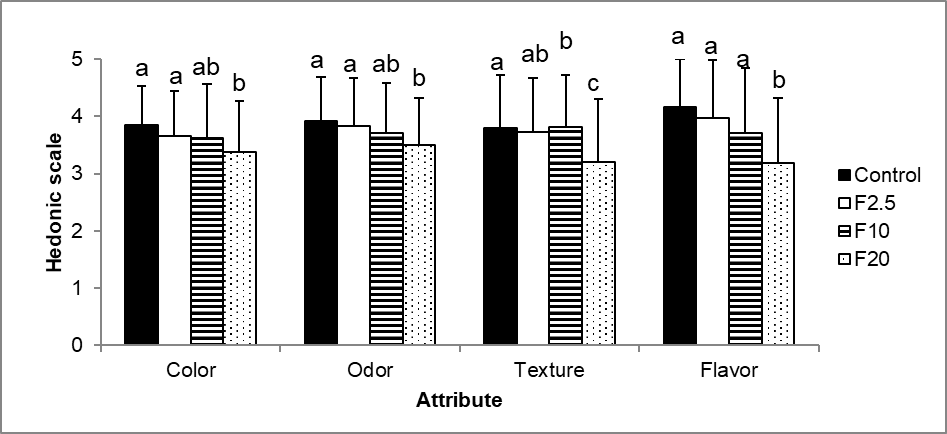 Fig. 1 – Sensory evaluation by attributes of
different formulations of South American silver croaker (P. squamosissimus)
fish burger using a five-point hedonic scale. To the same attribute, the
different letters mean significant differences among the formulations; on Tukey
test, p ≤ 0.05.
Fig. 1 – Sensory evaluation by attributes of
different formulations of South American silver croaker (P. squamosissimus)
fish burger using a five-point hedonic scale. To the same attribute, the
different letters mean significant differences among the formulations; on Tukey
test, p ≤ 0.05.
The relative rejection for F20 may be a consequence of the higher quantity of GBF, because the green banana has a typical hardness and astringency (Sarawong et al., 2014). Thus, capable of negatively influence its consistency (harder) and flavor (less pleasant) the higher the GBF index.
Lunkes et al. (2018) indicate that the texture is affected by fat quantity in a food; more insertions result in a softer product. In this study, aiming at a healthy product, the added fat (rich in saturated fatty acids) remained the same in all formulations, and in percentual values, it decreased among them, what may have compromised the evaluation of this attribute. Despite this, it is recommended to reduce this fat content because according to Vessoni et al. (2019), the high ingestion of the saturated fat increases the serum levels of total and LDL cholesterol.
The F2.5 did not differ regarding the attributes of the control formulation, and F10 only differed on flavor. Thus, among the tested formulations, that with lowest GBF insertion (equivalent to 2.5%) was the most pleasing to judges.
Torres-Oblitas et al. (2018) added the peels GBF in the puddings and observed that inclusions levels of up to 30% did not differ the acceptation compared to the control formulation. This suggests the addition of BF (banana flour) in foods depends on the characteristics of the food, due to in the fish burger a limitation with this supplementation was observed.
Considering that M. paradisiaca flour, in acceptable quantity to the consumers, can be a relevant option to increase the nutritional value of foods due to the high content of fiber, resistant starch, flavonoids and proteins (Silva et al., 2016), it is suggested that the inclusion of 2.5% of GBF in the fish burger already confers a nutritional advantage when compared to the conventional one.
As for the purchase intention, the control and F2.5 formulations presented de highest values of “I would buy frequently” and “I would always buy” and the ANOVA one-way results presented significant differences among F20 and the other formulations (F = 10.02; p < 0.0001) (Figure 2). Among test formulations, the F2.5 would be the best option to purchase and it decreases as more GBF is added.
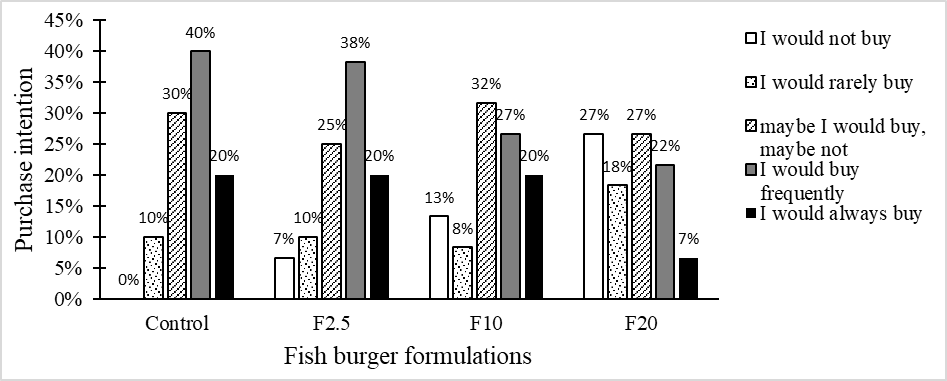 Fig. 2 - Mean
purchase intention of the South American silver croaker (P. squamosissimus)
fish burger with green banana (M. paradisiaca) flour added.
Kruskal-Wallis test, p < 0.05.
Fig. 2 - Mean
purchase intention of the South American silver croaker (P. squamosissimus)
fish burger with green banana (M. paradisiaca) flour added.
Kruskal-Wallis test, p < 0.05.
The inclusion of ingredients on fish burgers or other fish-based preparations generally presents a tolerable limit, similar at the result obtained by Guimarães et al. (2020) when prepared mapará (Hypophthalmus edentatus) fish burgers with and without pepperoni pepper, and it was reported most of the judges would buy the fish burger without this condiment.
Even not specifically testing the contents of alternative flours, Silva et al. (2016) had consumers' acceptation of Pseudupeneus maculatos fish burger using GBF and eggplant flour, separately. These findings suggest that fish derivatives enriched with natural ingredients are a good alternative to the consumer.
Conclusion
The market potential to fish burger made of South American silver croaker (P. squamosissimus) supplemented with GBF was confirmed. The yields obtained are equivalent to the findings of other researchers, that used similar products but with different origins. The addition of GBF increases the absolute quantity of fish burgers. Among formulations, the index of 2.5 % was considered more pleasant and we suggest that 10.0% is the maximum acceptable level. New studies including more intermediary indexes between 2.5 and 10% are necessary to determine which maximum addition of GBF does not negatively interfere in the consumers’ acceptation.
References
Aguiar, P. A. de O., & Rego, R. da C. (2017). Influência das lavagens nas características mercadológicas e nutricionais do quibe de pescada branca Plagioscion squamosissimus (Heckel, 1840). Universidade Federal do Oeste do Pará.
Atayde, H. M., Amorim, É. L. de, Beleza, E. S. de, Queiroz-de-Vasconcelos, E. L., & Oliveira, M. J. M. de. (2021). Efeito de farinhas espessantes na aceitabilidade do fishburguer de aruanã branco (Osteoglossum bicirrhosum). Científica, 49(2), 51. https://doi.org/10.15361/1984-5529.2021v49n2p51-57
Bertolini, A. C., Bello-Pérez, L. A., Méndez-Montealvo, G., Almeida, C. A. S., & Lajolo, F. (2010). Rheological and functional properties of flours from banana pulp and peel. Starch/Staerke, 62(6), 277–284. https://doi.org/10.1002/star.200900216
Caio, G., Volta, U., Sapone, A., Leffler, D. A., De Giorgio, R., Catassi, C., & Fasano, A. (2019). Celiac disease: A comprehensive current review. BMC Medicine, 17(1), 1–20. https://doi.org/10.1186/s12916-019-1380-z
Caldas, K. D. P. P., Santos, P. R. B., & Atayde, H. M. (2018). Patê de peixe usando resíduos da indústria pesqueira amazônica: produção e aceitação. Revista Ibero-Americana de Ciências Ambientais, 9(6), 188–198. https://doi.org/10.6008/cbpc2179-6858.2018.006.0020
Duarte, C. V., Vieira, R. P., & Gherardi, S. R. M. (2017). Fishburguers de tilapia-do-nilo (Oreochromis niloticus) com e sem adição de fumaça líquida. Revista Brasileira de Tecnologia Agroindustrial, 11(2), 2382–2396. https://doi.org/10.3895/rbta.v11n2.3145
Dutcosky, S. D. (2019). Análise Sensorial de Alimentos (5th ed.). Champagnat - Pucpress.
Franca, L. G. da, Holanda, N. V. de, Aguiar, R. A. C., Reges, B. M., Costa, F. B. da, Souza, P. A. de, Silva, Á. G. F. da, Sales, G. N. B., & Moura, C. F. H. (2020). Elaboração e caracterização de farinhas de banana verde. Research, Society and Development, 9(7), 1–13.
Guimarães, J. L., Rodrigues, F. C., Jimenez, É. A., & Amaral, M. T. (2020). Aproveitamento do mapará (Hypophthalmus edentatus Spix, 1829) para elaboração de fishburguer. In Ciência e tecnologia do pescado: uma análise pluralista (1st ed., pp. 74–86). Científica Digital.
Jesus, S. C. de, Folegatti, M. I. da S., Matsuura, F. C. A. U., & Cardoso, R. L. (2004). Caracterização física e química de frutos de diferentes genótipos de bananeira. Bragantia, 3(1), 315–323.
Lunkes, L. C., Paiva, I. M., Rubim, Fernando Marcos de Ribeiro, A. de O., & Murgas, L. D. S. (2018). Consumo de carnes e percepção dos universitários de Lavras-MG em relação a carne de peixe e seus benefícios à saúde. Arch. Latinoam. Nutr, 68(1), 295–302.
NEPA. (2011). Tabela brasileira de composição de alimentos. In NEPA - Unicamp (4. rev. e). http://www.unicamp.br/nepa/taco/
Oliveira Filho, R. do N., Dias, J. A. R., Barros, F. A. L., França, V. dos S., Fujimoto, R. Y., & Cordeiro, C. A. M. (2020). Análise da morfometria corporal, rendimento de corete e sensorial da pescada branca Plagioscion squamosissimus (Heckel, 1840). Biota Amazônia, 10(2), 25–29.
PBMH&PIF. (2006). Normas de Classificação de Banana (p. 7). CEAGESP.
Pereira, E. C. (2016). Influência das lavagens no rendimento, aceitabilidade e preço mínimo do fishburguer de mapará (Hypophthalmusspp.). Universidade Federal do Oeste do Pará.
Polônio, L. C. C., Mafei, T. D. T., & Simionato, E. M. R. S. (2016). Farinha de banana verde proveniente de três variedades brasileiras: análise bromatológica e fenólicos totais. Revista de Ciências Farmacêuticas Básica e Aplicada, 37(1), 14.
Sarawong, C., Schoenlechner, R., Sekiguchi, K., Berghofer, E., & Ng, P. K. W. (2014). Effect of extrusion cooking on the physicochemical properties, resistant starch, phenolic content and antioxidant capacities of green banana flour. Food Chemistry, 143, 33–39. https://doi.org/10.1016/j.foodchem.2013.07.081
Serrão, L. C. N., & Atayde, H. M. (2020). Hambúrguer de peixe: Transferência tecnológica e seu impacto na renda dos participantes. Revista Brasileira de Extensão Universitária, 11(1), 73–85. https://doi.org/10.36661/2358-0399.2020v11i1.11127
Silva, M. A. P., Vieira, P. H. de S., & Oliveira Filho, P. R. C. (2016). Elaboração do fishburguer de saramunete (Pseudupeneus maculatos) utilizando diferentes tipos de farinhas vegetais. Revista Brasileira de Engenharia de Pesca, 9(2), 36–51.
Souza, A. F. L. de, & Inhamuns, A. J. (2011). Análise de rendimento cárneo das principais espécies de peixes comercializadas no Estado do Amazonas, Brasil. Acta Amazonica, 41(2), 289–296. https://doi.org/10.1590/S0044-59672011000200015
Souza, M. L. de, & Maranhão, T. C. F. (2008). Rendimento de carcaça, filé e subprodutos da filetagem da tilápia do Nilo , Oreochromis niloticus (L), em função do peso corporal. Acta Scientiarum. Animal Sciences, 23(0), 897. https://doi.org/10.4025/actascianimsci.v23i0.2643
Szeremeta, J. S., Siguel, G., Amaral, J. G., Nascimento, R. F. do, & Canteri, M. H. G. (2019). Farinhas de banana: Desenvolvimento do produto e sua caracterização físico-química e funcional. Revista Tecnológica, 27(1), 1–10. https://doi.org/10.4025/revtecnol.v27i1.34002
Torres-Oblitas, K., Sancho, A. M., & Gozzi, M. S. (2018). Caracterización físico-química de harina obtenida a partir de cáscaras de banana (Musa paradisiaca) y su aceptabilidad en budines sin gluten. Ciência y Tecnología de Alimentos, 28(2), 22–29.
Vessoni, N. G., Piaia, A. F., & Bernardi, D. M. (2019). Pesquisa de consumo de carne bovina, produtos cárneos, hambúrguer e alimentos funcionais. Fag Journal of Health (Fjh), 1(4), 25–37. https://doi.org/10.35984/fjh.v1i4.88
Wang, Y., Zhang, M., & Mujumdar, A. S. (2012). Influence of green banana flour substitution for cassava starch on the nutrition, color, texture and sensory quality in two types of snacks. LWT - Food Science and Technology, 47(1), 175–182. https://doi.org/10.1016/j.lwt.2011.12.011
Abreviaturas
ANOVA: – variance analysis
GBF: – green banana flour
LDL: low-density lipids
LEMRA: - Laboratório de Ensino
Multidisciplinar em Recursos Aquáticos (Laboratory of Multidisciplinary
Teaching in Aquatic Resources)
NEPA: – Núcleo de Estudos e Pesquisas em
Alimentação (Nucleus of Studies and Research on Food) of UNICAMP – Universidade
Estadual de Campinas (State University of Campinas)
PBMH & PIF: – Programa Brasileiro para a
Modernização da Horticultura & Produção Integrada de Frutas (Brazilian
Program for Horticulture Modernization & Fruit Integrated Production)
TACO: – Tabela Brasileira de Composição de
Alimentos (Brazilian Table of Foods Composition)
UFOPA: – Universidade Federal do Oeste do Pará
(Federal University of Western Pará)
Author notes
1 Fisheries
engineer graduated at UFOPA.
2 Fisheries
Engineer graduated at UFOPA and Aquaculture Master Science at Universidade
Nilton Lins (Nilton Lins University, UNINILTONLINS) and Instituto Nacional de
Pesquisas da Amazônia (National Institute for Amazonian Research, INPA)
agreement.
3 Fisheries Engineer and M.Sc. in Aquaculture and Aquatic Tropical
Resources graduated at Universidade Federal Rural da Amazônia (Federal Rural
University of Amazônia, UFRA), and Ph.D. in Ambiental Sciences at UFOPA,
where is Professor and research themes related to Fisheries Science.
4 Fisheries Engineer and M.Sc. in Aquaculture and Aquatic Tropical
Resources graduated at Universidade Federal Rural da Amazônia (Federal Rural
University of Amazônia, UFRA), and Ph.D. in Ambiental Sciences at UFOPA,
where is Professor and research themes related to Fisheries Science.
5 Fisheries Engineer, M.Sc. in Food Science and Ph.D. in Fisheries
Science in the Tropics at Universidade Federal do Amazonas (Federal
University of Amazonas, UFAM). Currently, is Professor at UFOPA and research
themes related to Food Science and Technology.