Introduction
Throughout this proposal we wanted to immerse students into a class where the local culture in Barranquilla could be touch, feel and discover in a very playful way. Based on the results gotten in the research we noticed that students are opened to this idea and are motivated to work on the activities we are going to present them. This work has also been developed to verify the hypothesis done by Hymes (1972) regarding the acquisition of a language through the proximity with this. He says that the contact with the culture is a fundamental part of the process of achieving the skills to comprehend and manage the multiple situations carried by the learning of a second language.
We are also proving the five hypotheses raised by Krashen about the language acquisition through the culture, which are: The natural order, the acquisition/ learning hypothesis, the monitor, the input and the affective filter. Everything based on the communicative approach and the cultural awareness proposed by our mentor Magister Jairo Eduardo Soto Molina.
Soto, J. et al states that:
The accompanying intercultural competence and Intercultural
awareness are sources of great human richness for bilingualism and
intercultural studies. Both terms are discussed through perspectives on the
concept of culture and research related to culture in the classroom. The
purpose here is to give a view of some of the research on culture and foreign
language teaching and learning which may have a direct impact on the
instructional process and classroom management in bilingual and ESL settings
when we considered to include among the rest of competencies that conform the
communicative competence, the intercultural competence and the type of
awareness that we need in this type of socio-cultural context of instruction.
We concentrate on two areas: cognitive styles, cultural background, and social
interaction (2015, p.p.13-14).
We develop this work to show the teachers and students at Colegio San José Hermanitas de la Anunciación the way they can improve their speaking skills through the implementation of strategies and activities where the local culture in Barranquilla is shown as a playful and enjoyable experience that provides them an easy way to learn English.
The implications with the school are that they can improve the quality of the teachinglearning process and the way the students see this subject. We think that the activities we propose are going to be highly adopted by the teachers and they would see a great difference between their way and ours.
The main objective of this proposal was to reduce the affective filter using Barranquilla’s local culture input to improve speaking skills in 10th grade students from Colegio San José Hermanitas de la Anunciación. Besides, to expose students to the local culture while English learning-teaching process takes place to develop the speaking skills. Also, to make students produce a short promotional video about a specific aspect of local culture in Barranquilla. Moreover, to demonstrate how being motivated and attached affectively to the culture take part in the process of second language acquisition.
Sources for the new path
Learning is the process by which students take the information or what they are given as input, and make it part of themselves. That means, everything what we learn can be useful in real situations to improve the speaking skills of the chosen sample. In order to achieve these skills, students must felt a great link between the studied subject and those, putting into practice one of the most valuable hypotheses of Krashen (1985): The affective filter.
This proposal is supported on the Affective Filter (Krashen, 1985) which carry on the motivation, self-confidence and attitude, causing that the emotional states of the students have incidence such as filter allowing the entrance of the require information for the comprehension, additionally if the affective filter is lower, it will reflect outstanding levels in the acquisition and learning of a second language but if the affective filter is higher, they will have greater difficulty to acquire the second language. Krashen (1985) promotes the Affective Filter Hypothesis to stress the importance of building a classroom environment that is less threatening to anxious students. It is particularly important to reduce anxiety for learners with low proficiency and confidence.
Anxiety does not affect every academic subject. But for
language acquisition, it is very important factor… If the student is not
motivated, if self – esteem is low, if anxiety is high… if he thinks that
language class is a place where his weakness will be revealed (not a place
where he will get new input), then a block goes up. We call this block the
affective filter (1982, p, 182).
Others authors like MacIntyre and Gardner, agree with Krashen and they reaffirm that “Anxious students are likely to experience <mental block>, negative self-talk and ruminate over a poor performance which affects their ability to process information in language learning contexts” (1991:90).
According to these authors, we assert that self-confidence and motivation must be “up” and it is assumed such as one of the most significance factors to get more abilities in the students with the aim to achieve goals. Authors, such as Oxford and Nyiko, indicated that “Learners with high motivation to learn a language will likely use a variety of strategies as they found motivation was the single most important factor influencing strategy use” (1989: 293). They focused on the works of Atkinson, (1964) who propose “Motivation is in function of two mains factors: Need for Achievement and Incentive Values to Success”. The latter one is the situational aspect of Atkinson’s model in that they refer to the particular achievement task in which the individual is engaged, and McClelland, (1985) reasserts agree with this model, adding that “The need for achievement is influenced by internal drive for action (intrinsic motivation), and the pressure exerted by the expectations of others (extrinsic motivation)” (1985:824).
Nonetheless, R. C. Gardner (1985) describes motivation and attitudes “as the primary sources contributing to the success of individual language learning. Motivation can be a matter that explains why people decide to do something, how long they are willing to sustain an activity, or how hard they are going to pursue it”. Gardner classified the ability of motivation into four components: a goal, effort, want, and attitude toward acquisition activities. In this case, the concept of motivation can be grouped into two orientations of reasons: instrumental and integrative. An instrumental orientation is more self-oriented.
It can be described as when students have utilitarian reasons such as they want to pass an exam or they want to get a job. The integrative orientation refers to the individual’s willingness and interest in having social interaction with members of learner group. This orientation occurs when students wish to truly become part of the culture of the language being learned. “Both instrumental and integrative orientations lead to more proficiency, but integrative orientation motivated students to learn more” (Gardner; McIntyre, 1993).
Bringing up the words of Gardner, our proposal is oriented to be integrative because students in our sample were always trying to achieve the goals, and help their partners to understand the concepts and input provided by the instructor. Students were interested in getting involved on activities where they could share for example, the answers of a previous homework, a workshop or even the summary of a book. Teacher plays the role as a guide: a person who is following the process of each student without being too close.
Based on the affective filter hypothesis formulated by Dr. Stephen Krashen, the assessment techniques used to evaluate were implemented following his Monitor Hypothesis. Role-play, peer and group, self-assessment and presentations were the most used ways to evaluate our students. Kassim Shaaban (2001), based on the foundations provided by Krashen and other author expressed the advantages of using different ways to assess. Talking about the role plays, she said: “This informal assessment technique combines oral performance and physical activity. Children of all ages, when assessed through this technique, feel comfortable and motivated, especially when the activity lends itself to cooperative learning and is seen as a fun way of learning” (Shaaban, 2001: 10). She also adds the effectiveness of evaluating the students in peer and groups because they were able to work cooperatively with others. The self-assessment could be inappropriate at the beginning, but students will manage it under the teacher’s instructions. To make this type of evaluation possible, we videotaped student’s oral presentations for them to be able of correcting their own mistakes, not only when talking, but also when moving around the classroom, visual contact and body language. In Shaaban Kassim words: “Presentations give the teacher some insights into student's interests, work habits, and organizational abilities. Presentations cover a wide range of meaningful activities, including poetry readings, plays, role-plays, dramatizations, and interviews” (2011, p.43). That is why we used these tools to evaluate our students, because they were effective to diminish the affective filter and made them feel comfortable at the time to speak.
Elements and ways to use the local culture
Based on the observations made at Colegio San José Hermanitas de la Anunciación, we realized that student’s lack of motivation was caused by the missing connection between their lives and the content of the English class, which was more focused on the American culture. We also realized that most of the students expressed discomfort, anxiety and mental block when talking in English; this was a result of the high affective filter that did not allow them to have a better performance in the class and acquire the English language in a proper way. Soto, J. states that:
Literary culture is substantive as pathway for the spread of
various fields of culture in the community to be considered basis for
reflection on the different themes, genres, authors, and demonstrations
covering literature, basic element within the Gabriel Garcia Marquez’s thought.
Barranquilla has been distinguished as a literary center since the well-known
Barranquilla Group existed. There is an outstanding place for literature in
Barranquilla’s culture (2017, p.4).
To reduce the affective filter in the English class, we will use the local culture in Barranquilla as our main tool to improve the student’s speaking skills. Our objective is to help the students to lessen the anxiety and mental block that prevent them from speaking in English, that’s the reason why we considered the use of the local culture, as it is something they are familiar with. The main purpose of our methodology of work is to decrease the pressure students feel when speaking and, by promoting a classroom emotionally safe, give them the opportunity to overcome difficulties they had when talking in front of their peers. It is important to emphasize that Barranquilla’s local culture input is a vehicle that will take the students to the road of acquiring the English language with confidence; this means that it is the first step on the path of learning English as L2.
After being applied the test to know their English level, students were told their result and the skills they must develop or work on more than the others. Students also received personalized instructions from us about the web pages they could visit to better their weaknesses. Immediately we put into practice our plan to know the reasons why they got those low results in the test. Students accepted they were coming from Spanish teachers that have studied English as a complement course, but they never received a class from an English teacher in the last three years.
Classroom atmosphere: We were working with students in the lowest level according the humanities department. Classes in this group were very different than the grades, and the environment in this class was not the appropriated to teach or learn. It was full of discussions, mistreatment, bulling. Students in this group did not want to work; or even do their homework.
Classroom interaction: (Teacher –students) we realized that those students were not motivated in classes and they had problems at speaking and listening to the instructions of the teacher. There was not any type of respect to the teacher. The teacher was very tired of being there and she was not enjoying the pedagogical experience. She confessed us that she just wanted to continue being the Spanish teacher, that this had been the reason why she became teacher in humanities. She seemed stressed and sick. So we decided to help her. After evidencing this problem inside the classroom, we decided to work together to help the teacher with the activities based on the research we had already done and the ideas we had in mind.
Classroom interaction: (student-student) concerning to the relationship between the students, they weren’t very respectful, they didn’t listen to their partners when they were talking, when they correct their mistakes, they mocked off their partners, some of the students used to ask helpful information for the rest of the class, even if they had already understood, this was something good for the rest of the group.
Classroom activities: the activities provided by the teacher were very funny and caught the attention of the students. Sometimes those activities were not so easy and funny; nevertheless, most of the boys and girls in the classroom wanted to participate and get a grade. We noticed that the teacher used to work with online exercises she printed and write on the board, she also work on the activities proposed by the book “American on Course”. When 10th grade students were in Informatics room, the teacher took advantage of the resources provided by the school: computers, video-beam, the speakers, and with those tools, she played some songs, videos and reproduced the CD of the book. She was very recursive. The activities proposed were effective and impacted their way to understand and acquire the English as a foreign language. If these activities are based on the local culture will be more pertinent. In this respect Soto, points out: “La cultura es el determinante fundamental de los deseos y conductas de una persona. Al crecer, la persona adquiere un conjunto de valores, preferencias y conductas a través de sus familias y las instituciones sociales de su medio o contexto” (2008:102). This aspect was taken in to account in the interviews that were carried out.
To double check and verify the correct way to proceed, we are going to apply some surveys and interviews in order to get more information about what we have seen and apply some efficient activities to improve the performance of the teenagers in 10th grade.
Some possible recommendation we can make to the class could be the continuous use of the interactive materials that guarantee the focused attention of the students. We also recommend the teacher to delegate some tasks to her students, like the presentation of an easy topic.
Triangulation and data analysis
Instrument used: Interview
Sample: 5 students in 10th grade from Colegio San José Hermanitas de la Anunciación and the Master in Quality in charge of the corrections to the internal and external audits and the creation of a more integrated curriculum.
Questions asked to students in 10th grade at Colegio San José Hermanitas de la Anunciación, object of our research work:
- 1.
How do you feel when learning English? Do you like learning English? Why? (This question is based on the affective filter hypothesis of Krashen)
Some students answered that they do not feel comfortable because they are not good enough. Some others said they were learning English just because it was part of the curriculum of the school, but honestly, they prefer not to deal with something so difficult as English or Math.
- 2.
Do you feel confident when speaking in English in front of your peers? Why? (This question is based on the affective filter hypothesis of Krashen)
Most of the answers of this question were negative; students stated that they feel discouraged and very anxious when they were going to speak in public. Besides, students explained that they were afraid of rejection, ridiculization from their classmates for making a mistake, this was, according to them, causing to avoid oral presentations and activities when they had to give an oral participation.
- 3.
Do you notice when you make a mistake when talking? What actions do you take to correct yourself? (This question has to be with the monitor hypothesis of Krashen, if the students are able to follow up their own learning process)
The answers for these questions were very different from each other. Half part of the students told us they realized when making mistakes at speaking in English and most of the time they asked the teacher to correct them; on the other side, part of them do not notice their mistakes when they talk, so that make them feel uncomfortable and they prefer not to talk instead of participating. Another part of the sample said that they do notice their own mistakes and look for the pronunciation online or in books, or through listening to other advanced students with great abilities at speaking to improve their pronunciation or correct their mistakes.
- 4.
The school is accomplishing his mission at the moment to provide you with knowledge? (This questions has to do with the knowledge of the mission and vision of the school)
All the students agreed that school is accomplishing the mission and vision because the school was certified by IQ and ISO 9001 for developing an excellent curriculum and the philosophy of Mother Berenice. They are forming integral students and the quality in education is excellent. As a probe of these improvements, the school achieved the concept of
“MUY SUPERIOR” not only in English, but also in other subjects as social studies, science, and math. (This makes us feel very proud of the work done with those guys).
- 5.
Do you consider the strategies and knowledge your teacher uses and shows you in the class are enough and go with the school’s mission of offering an education’s service of quality with committed and qualified stand? (This question has to be with the confidence students have in the stand of teacher used by the school to teach them and guide them to get their goals)
Students answered in two different ways: the first one said they liked the strategies used by the teacher and they felt comfortable with the level of knowledge and professional skills teacher had. On the other hand, they moved forward the English class and said that sometimes, they feel the teachers in other subjects does not have enough activities to provide or even come to the classroom with an improvised class. Students also remarked the huge effort most of the teachers do to train them and become better teachers and more integral human beings.
- 6.
What type of activities do you enjoy doing when you are asked to talk in English? (This question looks for those activities students prefer to develop in order to be applied in our proposal. It also has to be with the acquisition/learning hypothesis of Krashen and the natural order one).
Students answered this way: We enjoy the dialogues/conversations in pairs because we can receive the feedback from the teacher, but also from our partner. We love playful activities as nursery rhymes, dramas, role-plays performances. None of them prefer the oral presentations; they said it was very difficult to explain a topic in English yet. They also said that debates are boring because most of their partners never participated due to their low English level at listening and speaking. They proposed activities where they have to move their bodies, singing karaoke, perform a chapter of a movie, book, and short stories. They said: “We want to do everything but oral presentations or debates”.
- 7.
What activities do your English teacher use to motivate you to talk and which one of those do you prefer to do? What kind of activities does your teacher do or apply in the class for you to get excellent English skills? What of the activities mentioned before you feel you are the best at? (This question looks for the grade of comfort the students feel at developing some activities in the classroom and double check in which ones he or she is the best at).
Students’ answers turned around the dialogues, performances, orally answers to teachers’ questions, dictations, parodies of TV programs, lectures, but they strength out the dialogues and role plays, they also love going to the backyard and play funny games with the English teacher. Students highlighted the funny and ludic activities proposed by teacher Luis Fernando Arroyo because they were full of competitiveness and challenged them to do their best.
- 8.
Would you feel comfortable receiving input about your local culture traditions in Barranquilla? Do you consider you have enough knowledge and information about your own culture to be in favor or against the arguments exposed by your teacher in the English class? (These questions have to be with the grade of agreement or disagreement students have based on the researchers’ proposal and the amount of preconceptions students must have in Spanish to deal with a class were the matter will turn around the local culture in Barranquilla)
The whole sample said they would be glad of being taught in English about the local culture in Barranquilla throughout the uses of input about the different topics that concern the aspect of the culture mentioned. Students also emphasized they were not pretty sure about the knowledge and information they manage about the traditions, food, music, customs, etc. in our beautiful city, Barranquilla. Some students also mentioned that sometimes teacher do not know everything about their own city, and that it’s totally normal; in that case, they said they will help the teacher and with all respect will correct him if he made a mistake. We loved one of the answers given by a student who said that her book is showing slightly some aspects of the Colombian culture, but not particularly those ones from Barranquilla.
- 9.
Have you been exposed to the use of bibliographical contents or writings, in audio or any electronic material with information in English about the most important aspects of the culture and traditions in Barranquilla within the English class? If so, what kind of content was used by your English teacher and how often did he use it to teach you in or outside the class? (This question has to be with the exposure of the students in 10th grade to input about their local culture in the L2, in this case, English as a foreign language and the period of time used it by the teacher to explain a subject).
Students honestly answered and remarked that they have not been exposed to any type of content in English nor Spanish about their own traditions, music, customs, religion or any other aspect of their culture; conversely, students told us they were little exposed to this input when they were in primary. Since those days they have never seen local aspects about Barranquilla inside the English class.
- 10.
Which lived experiences would you like to share as input or material to be used within the English class as teaching’s object? (This question is focused on the relevance of using the lived experienced of students as object to improve or redirect the teaching/learning process and receive the student’s suggestion about the possible content they would love to use and talk about).
This question was not fully understood by the students, so they did not answer it properly. We had to ask them by phone after we got the written interviews. After deeply explaining the question to the students they mentioned the following aspects: the industry, the commerce, the festivals, the carnival, the lifestyle, and the dishes in our city. But something that called our attention was one of the student’s answers concerning the lack of places where people can breathe fresh air and read a book at the same time, she also said the fast increase of bars, motels and residences to have sex in our city instead of building or repairing parks where children, young and adults could have fun. In the other hand, another student highlighted the high amounts of money they must pay to get into the museums, theaters, art galleries and other places where culture can be fully appreciated.
Resuming again, students said they will be glad to talk about the experiences lived in the airport, the jazz concerts, within the cathedral, the Amira de la Rosa’s Theater, the multiple events at Plaza de la Paz, going shopping to Paseo Bolivar, downtown, eating fish and swimming in Santa Veronica, Salgar, Playa Mendoza, Pradomar, Solinilla, enjoying a sunset in Puerto Colombia. Students also wanted to know or receive further information about the origin of the industry and commerce in Barranquilla, the reasons why she is called the Golden Door in Colombia, the origins of the aviation and the use of Magdalena’s River as the main way to transport products inside the country and the project who become our carnival the Intangible and Cultural Heritage of Humanity, a recognition given by UNESCO in Paris on November 7, 2003.
- 11.
How much importance does your English teacher give to the local culture within the English class? (This question was done to double check teacher do not pay much attention to the cultural aspects of the city they are working in and the relevance of approaching students to this kind of information).
Students sincerely answered that most of their English teacher never paid attention to using information or input about the culture in Barranquilla: Teachers never mentioned anything about their lifestyle, necessities or even our foundations. Teacher just focused their classes on the fact of teaching topics about the American culture or the English one. Some teachers even hated the idea of being asked about anything about Colombia. These situations liked us at the beginning because we were learning several things about United States and England, but then, we felt as we were losing our identity. So we started to suggest our teacher to include in their classes some information related to our wonderful and always beloved country Colombia and at the same time, our always-thriving city, Barranquilla.
- 12.
What is, in your opinion, the idea your teacher has about the English language acquisition? What aspects of your reality could be recreated for you to acquire English as a second language? (We wanted to know if the students know the personal reasons or aim proposed by their English teacher to provide the learning service and the conceptions they have about the labor done by the educator inside and outside the classroom and the possible situation lived by students and teachers that can be recreated and used as material to teach a topic in the English class).
The entire sample taken agreed the following idea: “Teachers have taught us the importance of English as a second language or basic element in the formation of the whole person because of all the advances in the various areas of knowledge and cultural dimensions”. They also added: “In my opinion, the idea that my teacher has about acquiring a second language is that it is essential for our life; since we are in a very competitive and know English society gives us an advantage over other professionals who do not handle English. At home I can gain more practice in this language, placing phrases and the names of the objects in my home, in the English language”. Students considered that will be great to receive information about the struggles young people pass through when looking for a job, deciding what to study after finishing high school, the decision to make a family or having a good relationship based on respect and confidence. Obviously these guys proposed those topics to be taken into account because they belong to a school where Mother Berenice values in all the community are highly clinging; nonetheless, they wanted to put into practice or being informed about, commerce, industry, drugs, relationships in short and long term, STDs, taxes, trades, importation and exportation, education in Barranquilla, possibilities to find a job, etc. We noticed that culture is full of several aspects we have not considered; despite of those matters, the topics already given in question number 9 completed our range of possibilities.
- 13.
What aspect of the foreign culture do you consider could be recreated within the process of language acquisition the school is proposing you? (This question has to be with the elements of the American or English culture students would like to be addressed to).
Students answered this way: “The values or aspects of the American culture which is closer to ours, are the individuality, privacy, equality, good use of time management, manners, seriousness, formality to dress, talk and walk (in the case of English people), the impetuousness, the effort and the most important, they never give up when trying to achieve their dreams”. Basically, students compared Colombian values with the American ones and they spoke their minds to let us know how important those topics are for Colombia to become in a more developed country.
- 14.
Would you like to be involved in a course where
you could simulate your cultural values mixed with those ones that belong to
the foreign culture (the American Culture) in order to be used in your language
acquisition process? (This questions is dealing with the Affective filter
Hypothesis of Krashen).
We consider it very important that students are attracted by the thematic seen within the English class and the values of both cultures have, and how both can be linked within a framework that generates affection and love in them the desire to keep learning more and more about the traditions and lifestyles of the two countries. Students thought that it will be an important procedure because it allows them to learn a lot about both countries and make comparisons at the same time while they are being taught, they also added that they are not only learning other language but also the teacher “allowed us to contextualize our own values in a foreign language, achieving a better comprehension and understanding of the situations that turn around us”.
Questions posed to subjects in the educational establishment of other areas of knowledge as sciences, math, social studies, religion, philosophy, Spanish, physical education, etc. (or administrative coordinators) of the school “Colegio San José Hermanitas de la Anunciación”
- 1.
Do you consider accurate the use of lived experiences and recreating the local reality as a strategy to teach English and the development of the communicative skills of the students in your school?
I consider it not only pertinent, but also necessary. The lived experiences make part of student’s reality and, for that reason; they help to the development of their abilities.
- 2.
Taking into account
the school’s vision, what activities do you consider could be integrated or
implemented to the curriculum, tending towards multiculturalism, and that way,
form or rise young people able to build a society that overpass the XXI century
challenges?
One proposal or key activity is the creation of a
curriculum to tend the interculturality is the Regionalization project, which
is handled since Colombia was openly divided into five regions and the insular
one. We consider this could be one of the topics students must be taught to
better understand the political and economic division of the power in Colombia.
Analysis of the Survey: Is important Using Local Culture
Input in an English Class in a low social class School in Barranquilla?
 DATA
ANALYSIS
DATA
ANALYSIS
The 58% of the students think that learning
local culture while learning English is very important and the 42% consider
that is important. This means that they are aware of the importance of learning
culture and English at the same time. According to the answers given to the
question 1, students agreed the second option with a 56% and the 44% though in
a separate course, it was an equal decision; they said that no matter the way
we used, they would be interested of getting the classes.
The 62, 5% of the students think that learning local culture while learning English is very important and the 37, 5% consider that is important. This means that they are aware of the importance of learning culture and English at the same time. They also showed reciprocity to the process of engagement with the local traditions and behaviors of their own community.
According to the results gotten in the interviews we could double-check that 56% of the students agreed to receive some type of cultural topic inside the class to improve their learning process. With cultural topic, we meant a piece of theater, a short story, a poem, an article, a song, a reading about the food, costumes, and traditions, etc. about the
Barranquilla’s Culture. We noticed that their performance in class was better than before and they were more interested in the class. Students agreed with 62.5% and 37.5% respectively, that learning local culture is important while learning English. Nobody says that it was not important.
Students were asked to level their English teacher fluency and the ability to communicate in the foreign language. The 35% of the students thought their teacher has a good English spoken level; but the 65% considered she could be much better when speaking English in classes. She (the teacher) explained that she got her degree in Foreign Language but with emphasis in Spanish, she has taught Spanish since she graduated from university. We can see here that some schools do not pay close attention to the academic background of their teachers.
Concerning the level of spoken English of the teacher, we could verify that students were aware of the lacks in pronunciation and mistakes their teacher makes when she speaks, they also let us know that sometime is confusing to understand the instructions given by the teacher. We let the teacher know this information and she felt a little embarrassed. Anyway, we told her that she has a good methodology to present the topics and the activities she proposed are very interesting.
We were
surprised for getting these results because it meant we were doing a good job.
Students were interested on our class, and wanted to share more time with us learning about their local
culture. Students also showed interest
in receiving input about their own traditions, music, food and costumes.
Even though students were not skillful at speaking in English; they argued that could not be too difficult to learn it. The 73% said that was easy to learn English, while the 27% argued was too difficult to achieve the competences to speak it properly and they argued the weakness they had in their speaking skills.
They also said that learning English is easy for them with a 73%, this shows that they are not apathetic to the subject, the other 27% did not say that is something difficult, but they wanted to understand it more quickly.
Most of the students (91%) considered that Colegio San José Hermanitas de la Anunciación has the resources to provide a good English teaching-learning process. 9% of the students said that school needed more tools and a special place to share materials and make ludic and playful activities.
Regarding the questions about if the school has the resources and proper classrooms to offer and excellent teaching-learning process for them, they said yes with a 91% versus no 9%. We ratify that students are aware of the necessity of the English language and know that the school offers an excellent service and makes easier the tech-learning process.
With 87% over
a 13%, we noticed that Colegio San José Hermanitas de la Anunciación students
wish to know more about their own local culture than the Anglophones countries.
Through the observations, we saw and checked that there were not spaces to
deeply explain and develop the whole subjects of the culture such as music,
theater, TV, radio, new in magazines and newspapers, etc.
At the end they were asked to describe the work done by Laura, Andrés and me and, 42% of the students agreed that we made an outstanding job, another 31% felt that was excellent and 16% said that was very good. When we saw the results, we were very proud of what we have already done. In the other hand, 9% of the class said that the work was nice; they added that it could be better and funnier because we were younger than their teachers were, just a 2% of them though we had done a bad job. This made us reconsider some aspects of our class, like being more dynamics when developing the activities.
Based on the information collected, we recommended that could be viable to implement:
- 1.
At least
one hour per week would be used to the analysis of poems, songs, magazines and
newspaper articles, radio emissions, etc. in a didactical way.
- 2.
To
complement what they learn in classes with an intensive course of local culture
proposed by us or by taking classes on Saturday mornings with us: Laura Pérez,
Luis Fernando Arroyo and Andrés Colón.
- 3.
Teachers
could propose more activities produced by themselves and stop using just the
book. They can also take advantages of the tools provided by the school like
computers, speakers, and video-beam to develop their classes.
- 4.
Let the
students being responsible for one or two sections of the class and not only
being passive receptors of the input given.
- 5.
Encourage
the students to organize spaces in the school where the local culture could be
shown to the students in previous grades (6th, 7th, 8th,
and 9th) through a declamation of a poem, singing a song, performing a play,
etc. to let them know how easy and versatile the English language is.
- 6.
If it is
possible, to let the students talk to a native person from United States,
England or even a Colombian one, with an outstanding English level and a high
level of knowledge about Colombia or Barranquillera culture, with whom, the
students could share ideas about the topic.
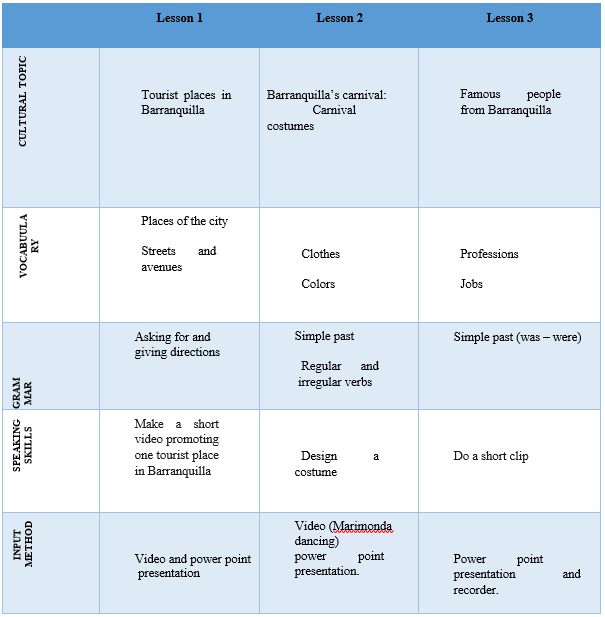 Table
1
Table of content – Topics treated within the English class
Table
1
Table of content – Topics treated within the English class
Results of the study
Focusing on the results of our
investigation, we have designed 6 worksheets that cover different topics
related to Barranquilla’s culture and also grammar, vocabulary and everyday
English. In spite of being centered in the improvement of the speaking skill,
we will also incorporate the other skills so the process of acquiring the
language is comprehensive. The development of the activities was progressive
and was worked in three different stages:
- 1.
Presentation:
The teachers introduced the topics related to Barranquilla’s culture and new
vocabulary, grammar and different expressions that belong to our customs. The
presentations were designed using the power point tool with images and videos,
for that we made use of the YouTube tool. This stage is very important because
it gives the first impression on the students about the English topic to
handle. We took special care in this part since our purpose was to make them
feel eased and eliminate the pressure of facing to something new.
- 2.
Practice:
Students practiced vocabulary and grammar topics that they were introduced to
during the presentation stage. They practiced their skills through games,
tests, conversations and participations in class. As we are interested in
reducing the affective filter, we designed and utilized games that helped them
to develop and improve their speaking skills in a safe environment were none
could be judged or mocked of for making a mistake.
- 3.
Production
and assessment: This is the final part of the activities planned in the
worksheets. In this stage we could verify the improvement of the students when
making their presentations, and moreover we could notice the results of the
strategy set out in this proposal, it is important to know how the students
have evolved since they first started these activities.
We took special attention on the evolution of the students’ speaking skills related to their affective filter, which was why we decided to do the activities progressively so we could see the impact of our strategy in our students. As it was previously exposed, the affective filter allows the flexibility because it is understood that students have their own personalities and context, which makes them see the same world from different perspectives; in other words, they have their own pace and it was important for us to respect it.
Promoting the local culture to students we focused on the cultural items they chose and as a result, the following content table shows the aspects we took into account to enhance speaking skills in the students by immersing them into the local culture using it as an excuse with the aim to reduce the affective filter.
Table 2
Schedule of the activities proposed within the English class.

| BARRANQUILLA’SCULTURE
INPUTWEEKS
|
|
WORKSHEET #1 AUGUST 9TH |
|
WORKSHEET #2 AUGUST 16TH |
|
WORKSHEET #3 AUGUST 23RD |
|
WORKSHEET #4 AUGUST 30TH |
| WORKSHEET#5 SERTEMBER 6TH |
|
WORKSHEET #6 SEPTEMBER 13TH |
The worksheets were applied in 6 weeks. Students
met with the researchers on Saturdays, 4 hours from 8 am to 12 pm, below is the
schedule of the activities implemented at the school in 2014.
Discussion
This research will have practical implications for curriculum development and redesign the PEIs. It also give possible solutions in the other skills like speaking, reading and listening, and also for vocabulary teaching. It also gives a more intrinsic and extrinsic motivation for teachers and students.
Based on the information collected, we recommended that could be viable to implement:
- 1.
At least
one hour per week would be used to the analysis of poems, songs, magazines and
newspaper articles, radio emissions, etc. in a didactical way.
- 2.
To
complement what they learn in classes with an intensive course of local culture
proposed by us or by taking classes on Saturday mornings with us: Laura Pérez,
Luis Fernando Arroyo and Andrés Colón.
- 3.
Teachers
could propose more activities produced by themselves and stop using just the
book. They can also take advantages of the tools provided by the school like
computers, speakers, and video-beam to develop their classes.
- 4.
Let the
students being responsible for one or two sections of the class and not only
being passive receptors of the input given.
- 5.
Encourage
the students to organize spaces in the school where the local culture could be
shown to the students in previous grades (6th, 7th, 8th, and 9th) through a
declamation of a poem, singing a song, performing a play, etc. to let them know
how easy and versatile the English language is.
- 6.
If it is
possible, to let the students talk to a native person from United States,
England or even a Colombian one, with an outstanding English level and a high
level of knowledge about Colombia or Barranquillera culture, with whom, the
students could share ideas about the topic.
Bibliographic References
Atkinson, J. W. (1971). An introduction to motivation. The achievement motive.Chapter.Harvard
Book List Oxford, USA.
Gardner, R. C. (1985). The attitude/motivation test battery: Technical report. University of Western Ontario.
Gardner, R. C., & MacIntyre, P. D. (1993). A student's contributions to second-language learning. Part II: Affective variables. Language teaching, 26(1), 1-11.
Gardner, R. C., & MacIntyre, P. D. (1993). On the measurement of affective variables in second language learning. Language learning, 43(2), 157-194.
Gardner, R. C., Lalonde, R. N., & Moorcroft, R. (1985). The role of attitudes and motivation in second language learning: Correlational and experimental considerations. Language learning, 35(2), 207-227.
Hymes, D. (1972). On communicative competence. sociolinguistics, 269293, 269-293.
Krashen, S. D. (1982). Principles and practice in second language acquisition. Oxford: Pergamon Press Inc.
Krashen, S. D. (1985). The input hypothesis: Issues and implications. Michigan: Longman.
MacIntyre, P. D., & Gardner, R. C. (1991). Methods and results in the study of anxiety and language learning: A review of the literature. Language learning, 41(1), 85-117.
McClelland, D. C. (1985). How motives, skills, and values determine what people do. American psychologist, 40(7), 812.
Oxford, R., & Nyikos, M. (1989). Variables affecting choice of language learning strategies by university students. The modern language journal, 73(3), 291-300.
Shaaban, K. (2001). Persistent issues in assessment of English as a foreign language. TESL reporter, 34(1), 1-11.
Shaaban, K. (2001, April). Assessment of young learners. In English Teaching Forum (Vol. 39, No. 4, pp. 16-24).
Soto Molina, Jairo Eduardo; García Burgos, Álvaro Ramón; & García Burgos, Diego Alberto, (2015). The Intercultural Competence and Intercultural Awareness. International Journal of English and LiteratureISSN(P): 2249-6912; ISSN(E): 2249-8028 Volumen 5 Número Issue 5 Páginas 103-112 Editor .TJPRC pvt. Ltd
Soto, J. E. (2008). El currículo intercultural bilingüe: La naturaleza humana integrada a su modo cultural. Bogotá: Magisterio.
Soto, Jairo Eduardo (2017). The role of literature in the formation of intercultural awareness. International Journal of English and Literature (IJEL) ISSN (E): 2249-8028 Volumen 7 Número Issue 4 Páginas 1-14 Editor TJPRC Pvt. Ltd