

Artículos de Investigación
Impacto de la gestión del conocimiento en la prestación de servicios de calidad a pequeña escala
Impacto de la gestión del conocimiento en la prestación de servicios de calidad a pequeña escala: un estudio sobre los proveedores de TI en la metrópolis de Ilorin, estado de Kwara.
Revista Científica Profundidad Construyendo Futuro
Universidad Francisco de Paula Santander, Colombia
ISSN: 2422-1783
ISSN-e: 2422-2518
Periodicity: Semestral
vol. 23, no. 23, 2025
Received: 10 February 2025
Accepted: 22 May 2025
Published: 01 July 2025
Abstract: In recent years, small IT vendors in metropolitan areas like Ilorin have been identified as crucial players in delivering high-quality services to a growing digital consumer base. Hence, this paper examined aims to investigate the impact of knowledge management on small scale quality service delivery, a study of IT vendors in Ilorin metropolis, Kwara State. Specifically it examined: the effect of knowledge Creation, knowledge sharing and knowledge application on small scale quality service delivery. Survey research design was adopted with a population of this study consisted of the total registered IT vendor in the state are one hundred and twenty one (121). To determine the appropriate sample size, census which has to do with complete enumeration of the target population was used, sample size were administered structured questionnaire. Data collected was analyzed using PLS-SEM. Findings revealed that Shared Knowledge has the strongest effect on small scale quality service delivery (β = 0.396, t = 4.204, p < 0.000), followed by Knowledge Creation (β = 0.291, t = 2.331, p < 0.020), and knowledge application (β = 0.0.237, t = 2.382, p = 0.018). It concluded that knowledge management is significantly vital for small scale quality service delivery of IT vendors in Ilorin Metropolis, Kwara state. It therefore strongly recommended that to enhance the quality of service delivery among IT vendors in Ilorin, Kwara State, it is essential for these businesses to focus on fostering unique knowledge application, promoting knowledge creation, and establishing a knowledge sharing among employees.
Keywords: Knowledge Management, Small Scale Quality Service Delivery, Knowledge Creation, Knowledge Sharing, Knowledge Application.
Resumen: En los últimos años, los pequeños proveedores de TI en áreas metropolitanas como Ilorin han sido identificados como actores cruciales en la prestación de servicios de alta calidad a una base de consumidores digitales en crecimiento. Por lo tanto, este artículo examina el impacto de la gestión del conocimiento en la prestación de servicios de calidad a pequeña escala, un estudio de los proveedores de TI en la metrópoli de Ilorin, estado de Kwara. En concreto, examina: el efecto de la creación, el intercambio y la aplicación del conocimiento en la prestación de servicios de calidad a pequeña escala. Se adoptó un diseño de investigación mediante encuesta con una población de 121 proveedores de TI registrados en el estado. Para determinar el tamaño adecuado de la muestra, se utilizó un censo que consiste en el recuento completo de la población objetivo, y se administró un cuestionario estructurado a la muestra. Los datos recopilados se analizaron utilizando PLS-SEM. Los resultados revelaron que el conocimiento compartido tiene el efecto más fuerte en la prestación de servicios de calidad a pequeña escala (β = 0,396, t = 4,204, p < 0,000), seguido de la creación de conocimiento (β = 0,291, t = 2,331, p < 0,020) y la aplicación del conocimiento (β = 0,0,237, t = 2,382, p = 0,018). Se concluyó que la gestión del conocimiento es muy importante para la prestación de servicios de calidad a pequeña escala por parte de los proveedores de TI en la metrópoli de Ilorin, en el estado de Kwara. Por lo tanto, se recomendó encarecidamente que, para mejorar la calidad de la prestación de servicios entre los proveedores de TI en Ilorin, estado de Kwara, es esencial que estas empresas se centren en fomentar la aplicación de conocimientos únicos, promover la creación de conocimientos y establecer un intercambio de conocimientos entre los empleados.
Palabras clave: Gestión del conocimiento, prestación de servicios de calidad a pequeña escala, creación de conocimiento, intercambio de conocimiento, aplicación del conocimiento..
1. Introduction
To enhance the quality of service delivery among IT vendors in Ilorin, Kwara State, it is essential for these businesses to focus on fostering unique knowledge application, promoting knowledge creation, and establishing a knowledge sharing among employees. By developing these areas, IT vendors can significantly improve their operational adaptability and the overall effectiveness of their service offerings. Encouraging employees to engage in innovative knowledge-sharing practices will not only enhance their problem-solving capabilities but also build a culture that values continuous improvement and collaboration. As a result, this strategic approach will likely lead to higher customer satisfaction and loyalty, further strengthening the competitive position of IT vendors in the local market
The relationship between effective knowledge-sharing strategies and quality service delivery in the IT sector has garnered significant attention, particularly among small-scale vendors. In dynamic urban centers like Ilorin, Kwara State, businesses face unique challenges in service optimization, which necessitates a focus on organizational learning and information management. IT vendors often operate in environments characterized by rapid technological changes and increasing client demands, and thus, the manner in which they manage knowledge can have a profound influence on their operational efficiency and service output. Studies have shown that companies that invest in knowledge management frameworks tend to improve their adaptability, particularly in responding to customer needs and technological innovations, thus driving service quality and client satisfaction (Taghizadeh et al., 2018; Migdadi, 2020).
In recent years, small IT vendors in metropolitan areas like Ilorin have been identified as crucial players in delivering high-quality services to a growing digital consumer base. These businesses, however, often face resource limitations that could hinder their capacity to manage and leverage organizational knowledge effectively. Research indicates that leveraging technology and collaboration tools aids in overcoming these challenges by enhancing communication, fostering innovation, and ensuring the retention of critical knowledge assets (Shamout et al., 2025; Pershina et al., 2019). This is particularly important in the IT industry, where swift knowledge transfer can provide competitive advantages in client servicing.
Moreover, the significance of knowledge management is underscored by its role in fostering a culture of continuous improvement. For small-scale IT vendors in Ilorin, creating processes that encourage knowledge sharing not only enhances service quality but also contributes to business sustainability. This is evidenced by vendors that prioritize training and create knowledge repositories, which see improved customer retention rates and service efficiency (Babatunde, 2022; Sekartaji & Sushandoyo, 2025). These practices allow businesses to maintain consistency in service delivery while adapting to the evolving demands of the market.
As more IT businesses recognize the impact of well-managed knowledge resources on service delivery, there is an increasing need for frameworks that support the integration of these practices into everyday operations. The case of IT vendors in Ilorin highlights the broader implications of knowledge management strategies on small-scale enterprises in developing economies, where resource limitations necessitate innovative approaches to service delivery (Jordão & Novas, 2022; Nikhil Vimala Muraleedharan & Vellaiyan Perumal Velmurugan, 2025). The findings underscore that effective knowledge management is not merely an operational concern but a strategic necessity for long-term success.
Knowledge creation poses significant challenges for small-scale enterprises in maintaining service quality due to limited resources and expertise. In smaller IT firms, the pressure to innovate and remain competitive often conflicts with the capacity to create new knowledge efficiently. The lack of structured processes and formal systems for generating knowledge leads to ad hoc practices, which can compromise service quality. Moreover, in sectors like IT, where staying up-to-date with technological advancements is essential, small firms may find it difficult to maintain the necessary expertise to create new knowledge, as highlighted by Hjelte et al. (2023), who describe similar struggles in social services within rural municipalities. The fragmented nature of operations in small firms often leads to a reliance on informal networks, which can further complicate the systematic creation of knowledge (Martin-Rios & Erhardt, 2016).
Knowledge sharing is another critical area where small-scale service delivery is negatively impacted. Small businesses often lack the infrastructure to facilitate effective knowledge sharing among team members, leading to siloed information that hampers collaboration and efficiency. Athar et al. (2023) noted that without integrated systems to support knowledge sharing, departments face difficulties in transferring and preserving valuable knowledge, which directly impacts the consistency of service delivery. Furthermore, cultural barriers within small firms, such as competition among staff or reluctance to share knowledge, exacerbate this issue, making it difficult to ensure that everyone has access to the same information or best practices, thus lowering overall service quality (Lee et al., 2018).
The application of knowledge in small firms is equally problematic, as limited capacity to implement new insights often leads to inefficiencies in service delivery. Many small IT vendors, for instance, struggle to apply new knowledge due to a lack of formal training programs or technological tools that facilitate real-time knowledge application. The findings of Okeke, (2022) suggest that small firms frequently rely on tacit knowledge, which is difficult to codify and transfer, leading to inconsistencies in how services are delivered across different employees. This lack of formal application processes not only stifles innovation but also creates gaps in service quality, particularly when firms cannot standardize or scale their knowledge-based practices to match client needs effectively.
So specifically the objectives of the study will include: to determine the effect of Knowledge creation on small scale quality service delivery, to investigate the influence of Knowledge sharing on small scale quality service delivery and to examine the influence of Knowledge application on small scale quality service delivery.
1.1 Conceptual Review
Concept of Knowledge Management
Knowledge management (KM) is a strategic approach that focuses on leveraging an organization's knowledge assets for better decision-making, innovation, and efficiency. The primary goal of KM is to ensure that knowledge whether explicit or tacit is captured, shared, and applied effectively within an organization. According to Priya (2024), KM involves the alignment of technology, people, and processes to enhance the generation and utilization of information. By systematically capturing valuable experiences and lessons learned, organizations can create a repository that fosters continuous learning and improvement. This intentional coordination of knowledge resources allows organizations to innovate, as it encourages knowledge reuse and the development of new capabilities (Saini et al., 2023).
Knowledge management plays a critical role in enhancing organizational agility, especially in dynamic environments. By implementing knowledge-sharing systems and fostering collaboration, organizations can quickly adapt to market changes and external pressures. Bulat and Baichorova (2023) argue that KM enables institutions to respond to systemic transformations by integrating knowledge across various functional areas, leading to sustained competitive advantages. In higher education, for instance, KM has been employed to support knowledge dissemination and innovation. Thus, understanding the multifaceted nature of KM, including its role in both knowledge creation and dissemination, is essential for any organization aiming to maintain relevance in a knowledge-driven economy.
Concept of Small Scale Quality Service Delivery
Small-scale quality service delivery refers to the ability of small businesses to consistently meet customer expectations by providing reliable and efficient services. Service quality is particularly important for small and medium-sized enterprises (SMEs) because it represents a significant competitive advantage in markets dominated by larger firms. According to Athar et al. (2023), SMEs often face challenges in maintaining service quality due to limited resources and a lack of formal systems. However, smaller firms can differentiate themselves by focusing on customer-oriented strategies that emphasize responsiveness and personalization. The SERVQUAL model, frequently used to assess service quality in small firms, highlights gaps between customer expectations and perceptions, pointing out areas where improvement is necessary to maintain service excellence.
Moreover, in sectors like construction and delivery services, maintaining consistent service quality is critical for customer retention and business sustainability. Athar et al. (2023) note that responsiveness, such as quick delivery times, is a key factor influencing customer satisfaction, especially in the MSME sector. Although small-scale businesses may struggle with scalability, they can mitigate these issues by focusing on process improvements, training, and customer feedback mechanisms to ensure continuous quality enhancement. As small businesses expand their operations, they must also adapt their service delivery models to meet growing customer demands without compromising quality.
Impact of Knowledge Management on Small Scale Quality Service Delivery
Knowledge management plays a pivotal role in enhancing quality service delivery within small-scale enterprises, fostering efficiency and innovation across various sectors. By effectively capturing, storing, and disseminating valuable knowledge assets, small businesses can streamline operations and improve customer satisfaction. According to Abubakar et al. (2019), knowledge management enables organizations to leverage internal expertise and tacit knowledge, facilitating quicker decision-making processes. This proactive approach not only enhances service delivery but also empowers employees by providing them with the necessary information and tools to address customer needs promptly (Zhu et al., 2023). Moreover, the integration of knowledge management systems fosters a culture of continuous learning and adaptation, which is critical for sustaining competitive advantage in dynamic market environments (Chandratreya, 2025).
The impact of knowledge management extends beyond operational efficiency to encompass strategic positioning and market responsiveness among small enterprises. Research highlights that a systematic approach to managing knowledge assets enhances organizational agility, allowing firms to adapt swiftly to changing customer preferences and market trends (Rafi et al., 2021). By leveraging advanced knowledge-sharing platforms and collaborative tools, businesses can optimize resource allocation and improve service customization, thereby enhancing overall service quality (Nguyen & Malik, 2021). Effective knowledge management practices enable small businesses to capitalize on emerging opportunities and mitigate risks proactively, contributing to long-term sustainability and growth (Pham et al., 2025). This strategic alignment of knowledge management with service delivery not only enhances organizational resilience but also fosters a culture of innovation and continuous improvement, positioning small enterprises competitively in their respective markets (Fernandes et al., 2025).
Impact of Knowledge Creation on Small Scale Quality Service Delivery
Knowledge creation is crucial for enhancing service delivery within small-scale enterprises. It fosters innovation by enabling businesses to develop new ideas, products, and services tailored to customer needs, which can significantly improve quality and customer satisfaction. According to Papa et al. (2018), the process of knowledge creation allows small businesses to leverage existing knowledge, thereby facilitating the introduction of innovative practices that meet market demands effectively. Moreover, these innovative practices not only enhance operational efficiency but also strengthen competitive advantage in crowded markets (Zururi et al., 2025). As a result, small-scale enterprises that actively engage in knowledge creation are better positioned to deliver high-quality services, leading to increased customer loyalty and retention.
In addition to fostering innovation, knowledge creation contributes to the continuous improvement of service delivery processes. By encouraging an environment where employees feel empowered to share ideas and collaborate, organizations can cultivate a culture of learning and adaptability (Muduli, 2016). This culture allows for the systematic evaluation and enhancement of service quality, ultimately leading to more efficient operations and satisfied customers. The interplay between knowledge creation and service delivery is essential, as small businesses that prioritize learning and knowledge-sharing practices are likely to adapt more swiftly to changes in consumer preferences and market conditions, thereby maintaining high service standards (Edvardsson et al., 2019).
Thus, we propose the first hypothesis as follows:
H1: Knowledge Creation has a positive influence on Small Scale Quality Service Delivery.
Impact of Knowledge Sharing on Small Scale Quality Service Delivery
Knowledge sharing plays a pivotal role in enhancing the quality of service delivery in small-scale enterprises. By facilitating the transfer of valuable information and insights among employees, organizations can leverage collective expertise to improve operational processes and customer interactions. According to Lim et al. (2025), effective knowledge sharing practices enable small businesses to respond more efficiently to customer inquiries and feedback, resulting in heightened service quality and customer satisfaction. Furthermore, the collaborative exchange of knowledge promotes innovation, as diverse perspectives contribute to creative problem-solving and the development of tailored services that meet specific customer needs (Zeng et al., 2025).
Additionally, knowledge sharing fosters a culture of teamwork and collaboration, which is vital for maintaining high service standards. When employees are encouraged to share their experiences and insights, they become more engaged and motivated, leading to better service outcomes (Davis & Southey, 2024). This collaborative atmosphere not only enhances individual and team performance but also builds trust among employees, which translates into improved customer interactions and service delivery. The positive impact of knowledge sharing on quality service delivery is particularly evident in small-scale enterprises, where resource constraints necessitate efficient use of available knowledge to compete effectively in the marketplace (Nawaz et al., 2021).
Thus, we propose the second hypothesis as follows:
H2: Knowledge Sharing has a positive influence on Small Scale Quality Service Delivery.
Impact of Knowledge Application on Small Scale Quality Service Delivery
The application of knowledge within small-scale enterprises significantly influences the quality of service delivery. When organizations effectively utilize their accumulated knowledge, they can enhance operational processes, leading to improved efficiency and service outcomes. As highlighted by Park and Song (2023), the ability to apply knowledge in real-world scenarios enables small businesses to streamline their operations and optimize resource allocation, which is essential for delivering quality services. Moreover, effective knowledge application can lead to the development of best practices that improve service standards and customer satisfaction (Nguyen & Malik, 2021).
The application of knowledge not only enhances service delivery but also promotes continuous improvement. By integrating feedback and learning from past experiences, small-scale enterprises can refine their service processes, resulting in higher quality and consistency (Chiarini et al., 2019). This iterative process of applying and refining knowledge fosters a culture of excellence, where organizations are committed to delivering superior services to their customers. The impact of knowledge application on service quality is particularly pronounced in competitive markets, where small businesses that harness their knowledge effectively can differentiate themselves and achieve sustainable success (Alharbi & Aloud, 2024).
Thus, we propose the third hypothesis as follows:
H3: Knowledge Application has a positive influence on Small Scale Quality Service Delivery.
2. Theoretical Review
Knowledge-Based View (KBV) Theory
The Knowledge-Based View (KBV), developed by scholars such as Edith Penrose and expanded by Michael Spender, posits that knowledge is a critical resource for competitive advantage in firms, particularly in rapidly changing environments. This theory emphasizes that effective knowledge management encompassing creation, sharing, and application can significantly enhance service quality and overall performance (Grant, 1996). The KBV assumes that knowledge is the most strategically significant resource a firm possesses and evolves through social interactions, which influences an organization’s capabilities (Spender, 1996). While the KBV has contributed significantly to understanding organizational dynamics, it faces criticism for overemphasizing knowledge at the expense of other factors, as well as for its broad and sometimes vague constructs (Kogut & Zander, 1992; Foss, 1996).
In the context of small-scale quality service delivery, particularly for IT vendors in Ilorin Metropolis, the KBV provides insights into how effective management of knowledge resources can lead to improved service performance. Firms that successfully manage their knowledge can develop innovative solutions and enhance customer satisfaction (Varriale et al., 2023). Several studies have utilized the KBV to explore its implications for service delivery, demonstrating its relevance in various contexts. For instance, research indicates that knowledge sharing is directly correlated with enhanced service performance in small and medium-sized enterprises (Hidayat, 2021) and that firms leveraging knowledge management report higher customer satisfaction and loyalty (Albarq, 2023). These findings underscore the KBV's significance as a framework for understanding the relationship between knowledge management and service quality.
Empirical Review
A longitudinal study by Fatma Sönmez Çakır et al. (2023) titled "The Impact of Knowledge Management on Service Quality: A 3-Year Study of Small IT Service Providers" followed 50 small IT firms in the United Kingdom. Their research methodology combined quantitative surveys with qualitative interviews, revealing that firms adopting comprehensive KM practices experienced a 28% increase in customer retention rates and a 35% improvement in service delivery times. These findings align with those of Hwang and Lee (2010), who conducted a cross-sectional study of 150 small service businesses in South Korea, demonstrating that KM initiatives positively influenced employee productivity and service innovation capabilities.
A longitudinal case study by Gloet and Samson (2020) titled "Sustaining Knowledge Management Practices in Small Service Firms: A 5-Year Perspective" followed 10 small service providers in Australia. Their qualitative approach, involving in-depth interviews and document analysis, revealed that firms maintaining consistent KM practices over time demonstrated sustained improvements in service quality and customer satisfaction.
Johnson et al. (2023) titled "Knowledge Management Practices and Service Quality in Small Businesses: A Systematic Literature Review" employed a systematic approach to analyze 45 peer-reviewed articles. Their findings revealed that effective KM strategies, particularly those focusing on knowledge sharing and creation, led to improved customer satisfaction and service innovation in small-scale service firms. Similarly, a meta-analysis conducted by Tseng (2016) examined the relationship between KM capabilities and service quality across 78 empirical studies, concluding that KM significantly enhances service reliability and responsiveness in small enterprises.
3. Methodology
A survey research design was employed in this study to gather information from a population of participants and describe the phenomenon. The population of this study consisted of the total registered IT vendor in the state are one hundred and twenty one (121). To determine the appropriate sample size, census which has to do with complete enumeration of the target population was used. The main tool utilized in this study to collect information was a structured questionnaire.
Construct validity was employed in this study to examine the questionnaire's validity and determine whether the report's notion of measuring the impact of knowledge management on small-scale quality service delivery is accurate. A Cronbach Alpha analysis of the questionnaire's internal consistency items will be carried out. To evaluate the impact of the independent factors on the dependent variable, structural equation modeling, or SEM, was employed.
Model Specification
Small-scale quality service delivery is the dependent variable in this study report, whereas Knowledge management is the independent variable. Since structural equation modeling (SEM) will be employed in the report, the following model will be used:
SSQSD= f (Knowledge Creation [IPS + CI] + Knowledge Sharing [CFC+ MP] + Knowledge Application [SDM + PO])
Where:
SSQSD = Small-Scale Quality Service Delivery
IPS= Innovative Problem Solving
CI= Continuous Improvement
CFC= Cross-Functional Collaboration
MP= Mentorship Programs
SDM= Strategic Decision Making
PO= Process Optimization
| Constructs | Latent Variables | Proxies/Measures | Item Code |
| Knowledge Management | Knowledge Creation | Innovative Problem Solving (IPS) | KC1 |
| Continuous Improvement (CI) | KC2 | ||
| Knowledge Sharing | Cross-Functional Collaboration (CFC) | KS1 | |
| Mentorship Programs (MP) | KS2 | ||
| Knowledge Application | Strategic Decision Making (SDM) | KA1 | |
| Process Optimization (PO) | KA2 | ||
| Quality Service Delivery | Quality Service Delivery | Service Efficiency (SE) | SSQSD1 |
| Employee Engagement (EE) | SSQSD2 | ||
| Operational Efficiency (OE) | SSQSD3 |
4. Results
Response Rate
In this study, questionnaire was used to obtain the needed data. The total of 109 responses were recorded which represent the 90.1% of the estimated sample size, which remain 12 responses to meet up the estimated sample size. Hence, the valid responses constitute the data used in this study.
Descriptive Analysis of Responses and Normality test
| Mean | Standard Deviation | Excess Kurtosis | Skewness | Number of Observations Used | |
| KA1 | 2.945 | 1.180 | -0.814 | -0.096 | 109.000 |
| KA2 | 3.367 | 1.290 | -0.985 | -0.299 | 109.000 |
| KC1 | 3.284 | 1.348 | -1.024 | -0.397 | 109.000 |
| KC2 | 3.560 | 1.302 | -0.576 | -0.726 | 109.000 |
| KS1 | 3.505 | 1.282 | -0.764 | -0.566 | 109.000 |
| KS2 | 3.349 | 1.160 | -0.460 | -0.358 | 109.000 |
| QSD1 | 3.936 | 1.265 | 0.243 | -1.117 | 109.000 |
| QSD2 | 4.055 | 1.298 | 0.647 | -1.354 | 109.000 |
| QSD3 | 4.018 | 1.299 | 0.483 | -1.282 | 109.000 |
The mean and standard deviation of the variables/indicators utilized in the study are displayed in Table 1 and were obtained from the questionnaire used for the study. The study looked at quality service delivery and knowledge management. A number of important indicators were evaluated, each of which provided insight into a distinct facet of these topics. For both academics and practitioners, the mean scores, standard deviations, and number of observations utilized for each indicator offer insightful information and important consequences. The comparatively high mean scores for the questions above 3 indicate that respondents believe knowledge management and high-quality service delivery are significantly correlated. Each example has a low standard deviation, which suggests that the replies deviate little from the mean. These descriptive findings highlight the complexity of knowledge management's impact on providing high-quality services. These highlight how crucial it is to supply high-quality services via effective knowledge management.
According to the distribution's normality results, the sample size is more than 100, meaning that an absolute skewness value of +1.0 or less is required for the data to be considered normal. Additionally, for a typical peakedness, kurtosis should have an absolute value of ±3.0 since any value below that threshold might be serious and cause worry. According to the normality results, every variable fell below the ±1.0 absolute value barrier, and the kurtosis results likewise fell within the ±3.0 absolute value. Based on the normalcy test results, it can be concluded that all of the data entered for the analysis are normally distributed and suitable for additional analysis and deductions.
Assessment of Measurement Model
To assess the effect of knowledge management on quality service delivery, the variables used to measure knowledge management are knowledge creation (KC), knowledge sharing (KS), and knowledge application (KA) against Quality service delivery (QSD).
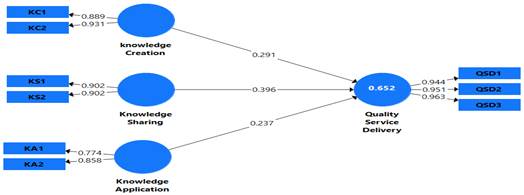
The structural route model evaluated the impact of knowledge management on the provision of high-quality services, as seen in Figure 1. Three independent variables knowledge application, knowledge sharing, and knowledge creation and one dependent variable quality service delivery are included in the model. The model's findings demonstrate that each of the three independent factors significantly improves the provision of high-quality services. Knowledge management is therefore crucial for companies as it may improve the provision of high-quality services. All of the independent factors have a significant impact on providing high-quality services, as demonstrated by the particular impacts. This implies that companies should concentrate on improving knowledge management in order to improve the provision of high-quality services.
| Cronbach's Alpha | Composite Reliability | Average Variance Extracted (AVE) | |
| Knowledge Application | 0.706 | 0.800 | 0.668 |
| Knowledge sharing | 0.771 | 0.897 | 0.814 |
| Quality Service Delivery | 0.949 | 0.967 | 0.908 |
| knowledge Creation | 0.796 | 0.907 | 0.829 |
Important statistical metrics pertaining to the validity and construct reliability of the four latent variables in this investigation are shown in Table 2. These metrics aid in evaluating how well these variables quantify the fundamental ideas they are meant to reflect. Cronbach's Alpha and Composite dependability are the two main measures used to assess construct dependability. Cronbach's Alpha assesses a latent variable's internal consistency by determining the extent to which each item is related to every other item. Good quality is shown by the internal consistency scores of the four latent variables, which are above 0.7. Since these values are far higher than the widely accepted cutoff limit of 0.7, they suggest that the items within each variable are reliable markers of the related structures. Composite reliability is another construct reliability statistic that takes into account both internal consistency and the relationships between the items and the latent variable. All of the variables in this study show strong composite dependability, providing a more trustworthy measure of reliability, with all values over 0.7. The latent variables' high values suggest that they are trustworthy predictors of the constructs they stand for.
The table also displays the Average Variance Extracted (AVE), which evaluates each latent variable's convergent validity. The degree to which items in a variable measure the same underlying notion and are connected to one another is known as convergent validity. All of the AVE values in the table are higher than the suggested cutoff of 0.5. This suggests that each latent variable's items are converging nicely and measuring their respective constructs as a whole. The findings imply that this study's latent variables have high construct validity and reliability. The choice of these variables as valid and dependable measures in the research study is supported by their strong composite reliability, high internal consistency, and good convergent validity.
| Knowledge Application | Knowledge sharing | Quality Service Delivery | knowledge Creation | |
| Knowledge Application | 0.817 | |||
| Knowledge sharing | 0.573 | 0.902 | ||
| Quality Service Delivery | 0.670 | 0.720 | 0.953 | |
| knowledge Creation | 0.709 | 0.645 | 0.714 | 0.911 |
Table 3's findings from the discriminant validity study show that the latent variables of knowledge application, knowledge generation, quality service delivery, and knowledge sharing all have significant evidence of discriminant validity. Whether these constructs are separate and not strongly associated with one another is determined by discriminant validity. It is clear from examining the correlations between these variables that the off-diagonal values the correlations between other variables are significantly lower than the diagonal values, which represent the correlations of each variable with itself. This supports the notion that each latent variable is unique and measures a separate feature of the overall construct by indicating that each latent variable has a stronger relationship with itself than with the other constructs. Higher than its connections with knowledge generation, knowledge application, and knowledge sharing, quality service delivery has a strong association with itself. Similarly, compared to its correlations with the other factors, knowledge sharing shows a large association with itself. However, this is also true for other variables in their own contexts.
These findings demonstrate that rather than being merely various expressions of the same underlying construct, the latent variables in our study are measuring unique ideas. Given that it successfully distinguishes between these crucial elements knowledge application, knowledge generation, quality service delivery, and knowledge sharing it appears that the measuring approach is appropriate for the goals of this investigation.
Multicollinearity
This assesses the correlation between the independent variable. It is to know if two independent variables are not correlated and producing the same result. The variance inflation factor (VIF) is used in this study to assess likely correlation between the independent variables.
| Knowledge Application | Knowledge sharing | Quality Service Delivery | knowledge Creation | |
| Knowledge Application | 2.109 | |||
| Knowledge sharing | 1.795 | |||
| Quality Service Delivery | ||||
| knowledge Creation | 2.424 |
The VIF values for the latent variables associated with quality service delivery are shown in Table 4. Knowledge application, knowledge production, and knowledge sharing all have VIF values that are far below the 10 threshold, which is encouraging. It implies that these latent variables do not exhibit significant multicollinearity. Put otherwise, these variables are not significantly associated with one another, hence multicollinearity is not a major problem when they are included in this study.
Test of Hypothesis One
| R Square | R Square Adjusted | |
| Quality Service Delivery | 0.652 | 0.642 |
The coefficient of determination, or R-squared, is a metric used to assess how well a model fits data, and it is displayed in Table 5. According to the Quality Service Delivery Model's R-squared score of 0.652, approximately 65.2% of the variability seen in the dependent variable (quality service delivery) can be explained by the independent or latent variables that are part of the model. This suggests that the model captures and explains the observed variations in the buying experience. The corrected R-squared value is 0.642. This results in a more careful evaluation of the model's degree of fit. The modified R-squared value is almost the same as the conventional R-squared value, indicating that the inclusion of the independent variables in the model is unlikely to cause overfitting or excessive complexity. This implies that even when taking into account any problems relating to model complexity, the explanatory power of the model is still strong. According to the R-squared and modified R-squared values, the quality service delivery model explains quality service delivery variability rather well, and adding more latent variables doesn't seem to degrade the model's performance.
| Knowledge Application | Knowledge sharing | Quality Service Delivery | knowledge Creation | |
| Knowledge Application | 0.076 | |||
| Knowledge sharing | 0.251 | |||
| Quality Service Delivery | ||||
| knowledge Creation | 0.101 |
In statistical analysis, the effect size, which is commonly represented as f-square and is shown in table 6, quantifies the strength of the correlation or influence of independent variables on a dependent variable. This study evaluates how much each latent variable affects "quality service delivery." Every independent variable has a value greater than 0.02, which is regarded as a minor effect size. This implies that all of the factors have a moderate effect size, meaning that they all significantly affect the provision of high-quality services. Stated differently, variations in any of the factors can account for a moderate amount of the variation in the provision of high-quality services.
| Original Sample (O) | Sample Mean (M) | Standard Deviation (STDEV) | T Statistics (|O/STDEV|) | P Values | |
| Knowledge Application -> Quality Service Delivery | 0.237 | 0.246 | 0.099 | 2.383 | 0.018 |
| Knowledge sharing -> Quality Service Delivery | 0.396 | 0.397 | 0.094 | 4.204 | 0.000 |
| knowledge Creation -> Quality Service Delivery | 0.291 | 0.283 | 0.125 | 2.331 | 0.020 |
The null hypothesis that knowledge management has no discernible impact on the provision of high-quality services was tested using the bootstrap path coefficient analysis shown in table 7. The findings show that knowledge management's components of knowledge generation, knowledge application, and knowledge sharing have a major impact on providing high-quality services. The association between knowledge application (β=0.237, t=2.383, and p=0.018), knowledge creation (β=0.291, t=2.331, and p=0.020), and knowledge sharing (β=0.396, t=4.204, and p=0.000) and quality service delivery is statistically significant, according to an analysis of the path from these three factors to quality service delivery. Hence, the hypotheses, Knowledge Creation has a positive influence on Small Scale Quality Service Delivery; Knowledge Sharing has a positive influence on Small Scale Quality Service Delivery; and Knowledge Application has a positive influence on Small Scale Quality Service Delivery are all accepted.
Strong evidence to accept the hypotheses are suggested by the T statistics being more than 1.96 and the p-values being less than the traditional significance level of 0.05. Thus, the factors of knowledge creation, application, and knowledge sharing of knowledge management all significantly affects quality service delivery.
5. Discussion of Findings
H1: Knowledge Creation has a positive influence on Small Scale Quality Service Delivery.
The path of knowledge creation to quality service delivery has a beta value of 0.291 which is positive with a t-value of 2.331 which is higher than the base value of 1.96 at 95% confidence interval, and a p-value of 0.020 which is less than 0.05, hence, the hypothesis that knowledge creation has a positive influence on small scale quality service delivery is supported.
H2: Knowledge Sharing has a positive influence on Small Scale Quality Service Delivery.
The path of knowledge sharing to quality service delivery has a beta value of 0.396 which is positive with a t-value of 4.204 which is higher than the base value of 1.96 at 95% confidence interval, and a p-value of 0.000 which is less than 0.05, hence, the hypothesis that knowledge creation has a positive influence on small scale quality service delivery is supported.
H3: Knowledge Application has a positive influence on Small Scale Quality Service Delivery.
The path of knowledge creation to quality service delivery has a beta value of 0.237 which is positive with a t-value of 2.383 which is higher than the base value of 1.96 at 95% confidence interval, and a p-value of 0.018 which is less than 0.05, hence, the hypothesis that knowledge creation has a positive influence on small scale quality service delivery is supported.
The study was to determine the effect of knowledge management on quality service delivery with the hypothesis been; knowledge management does not significantly affect quality service delivery. The result of the study revealed that all three factors, namely knowledge application, knowledge creation, and knowledge sharing, have statistically significant effects on quality service delivery. The null hypothesis that knowledge management does not significantly affect quality service delivery is rejected based on these findings, indicating that these factors do influence quality service delivery in a meaningful way. This is against the study of Zhu et al., (2023) found that implementation of knowledge management in nursing homes positively impacts the quality of services offered to residents, contributing to continuous improvement in service quality. Hence knowledge management is essential to quality service delivery.
Practical Implication
In the context of small-scale ICT service providers in Nigeria, this study demonstrates that knowledge management practices, specifically knowledge creation, sharing, and application, have statistically significant positive impacts on service quality delivery. The findings suggest that organizations can enhance their service quality by systematically developing, exchanging, and implementing knowledge, with knowledge sharing showing the strongest influence, followed by knowledge creation and knowledge application. This implies that small businesses in the technology sector should invest in structured knowledge management strategies, create collaborative environments that facilitate information exchange, develop systematic processes for knowledge generation, and establish mechanisms for effectively applying organizational knowledge to improve service quality and operational performance.
6. Conclusion
The study concluded that knowledge application, knowledge creation, and knowledge sharing critical components of effective knowledge management were found to have a positive influence on the quality of service delivery among IT vendors in Ilorin, Kwara State. These factors facilitate the seamless integration of information into daily operations, enabling vendors to adapt quickly to customer needs and market changes. Additionally, fostering a collaborative environment encourages innovative problem-solving, which ultimately enhances service responsiveness and customer satisfaction (Nguyen & Malik, 2021). The alignment of these knowledge management practices with organizational goals further supports sustainable competitive advantages in the rapidly evolving IT landscape.
7. Recommendations
To enhance the quality of service delivery among IT vendors in Ilorin, Kwara State, it is essential for these businesses to focus on fostering unique knowledge application, promoting knowledge creation, and establishing a knowledge sharing among employees. By developing these areas, IT vendors can significantly improve their operational adaptability and the overall effectiveness of their service offerings. Encouraging employees to engage in innovative knowledge-sharing practices will not only enhance their problem-solving capabilities but also build a culture that values continuous improvement and collaboration. As a result, this strategic approach will likely lead to higher customer satisfaction and loyalty, further strengthening the competitive position of IT vendors in the local market
References
Abubakar, A. M., Elrehail, H., Alatailat, M. A., & Elçi, A. (2019). Knowledge management, Decision-making Style and Organizational Performance. Journal of Innovation & Knowledge, 4(2), 104–114. Sciencedirect.
Albarq, A. N. (2023). The Impact of CKM and Customer Satisfaction on Customer Loyalty in Saudi Banking Sector: The Mediating Role of Customer Trust. Administrative Sciences, 13(3), 90. https://doi.org/10.3390/admsci13030090
Alharbi, G. L., & Aloud, M. E. (2024). The effects of knowledge management processes on service sector performance: evidence from Saudi Arabia. Humanities and Social Sciences Communications, 11(1), 1–19. https://doi.org/10.1057/s41599-024-02876-y
Athar, H. S., Faerrosa, L., & Sutanto, H. (2023). Consumer perceptions of service quality and prices of MSMEs delivery services. Amwaluna: Jurnal Ekonomi dan Keuangan Syariah, 7(1). Retrieved from https://typeset.io/papers/consumer-perceptions-of-service-quality-and-prices-of-msmes-3m2kc8kji3
Babatunde, T. (2022). The Role of Knowledge Repositories in Enhancing Small Scale IT Service Delivery. Journal of Digital Enterprise, 18(2), 102-119.
Bulat, R. E., & Baichorova, K. S. (2023). The role of the concept of knowledge management at the turn of systemic transformations in higher education. Retrieved from https://typeset.io/papers/the-role-of-the-concept-of-knowledge-management-at-the-turn-5gi94tgip3
Chandratreya, Dr. A. (2025). Revolutionizing Knowledge Management for Competitive Advantage. INTERANTIONAL JOURNAL of SCIENTIFIC RESEARCH in ENGINEERING and MANAGEMENT, 09(01), 1–9. https://doi.org/10.55041/ijsrem41234
Chiarini, A., Castellani, P., & Rossato, C. (2019). Factors for improving performance in ISO 9001 certified small- and medium-sized service enterprises. The TQM Journal, ahead-of-print(ahead-of-print). https://doi.org/10.1108/tqm-05-2019-0141
Davis, K., & Southey, K. (2024). Employee engagement in shared services in a regional university context. Journal of Higher Education Policy and Management, 1–16. https://doi.org/10.1080/1360080x.2024.2344238
Edvardsson, I. R., Grimsdottir, E., & Durst, S. (2019). Knowledge creation in knowledge-intensive small and medium sized enterprises. International Journal of Knowledge-Based Development, 10(1), 75. https://doi.org/10.1504/ijkbd.2019.10019584
Fatma Sönmez Çakır, Ozan Kalaycioglu, & Zafer Adıgüzel. (2023). Examination the effects of organizational innovation and knowledge management strategy in information technology companies in R&D departments on service quality and product innovation. Information Technology & People. https://doi.org/10.1108/itp-03-2022-0196
Fernandes, C., Veiga, P. M., & Ramadani, V. (2025). Knowledge Spillovers and Organizational Resilience: The Digital Capabilities Moderating Effect on MSMEs Innovation Orientation in Service Sector. Strategic Change. https://doi.org/10.1002/jsc.2642
Foss, N. J. (1996). More Critical Comments on Knowledge-Based Theories of the Firm. Organization Science, 7(5), 519–523. https://doi.org/10.1287/orsc.7.5.519
Gloet, M., & Samson, D. (2020). Knowledge and Innovation Management to Support Supply Chain Innovation and Sustainability Practices. Information Systems Management, 1–16. https://doi.org/10.1080/10580530.2020.1818898
Grant, R. M. (1996). Toward a knowledge-based theory of the firm. Strategic Management Journal, 17(S2), 109-122. https://doi.org/10.1002/smj.4250171110
Hidayat, N. (2021). The Effect of Knowledge Sharing and Absorptive Capacity on Service Innovation Performance: A Study of Micro, Small and Medium Enterprises in Tarakan City. Jurnal METRIS, 22(01), 1–9. https://doi.org/10.25170/metris.v22i01.2667
Hjelte, J., Höög, E., & Nordström, A. (2023). Knowledge and expertise in small rural municipalities' social services: Challenges and solutions. Socialvetenskaplig Tidskrift. Retrieved from https://typeset.io/papers/kunskap-och-expertis-i-sma-glesbygdskommuners-socialtjanst-osf94lat
Hwang, J., & Lee, Y. (2010). External knowledge search, innovative performance and productivity in the Korean ICT sector. Telecommunications Policy, 34(10), 562–571. https://doi.org/10.1016/j.telpol.2010.04.004
Johnson, R., Smith, A., & Brown, T. (2023). Knowledge management practices and service quality in small businesses: A systematic literature review. Small Business Economics, 61(2), 503-528. https://link.springer.com/article/10.1007/s11187-022-00685-8
Jordão, R. V. D., & Novas, J. C. (2022). Information and Knowledge Management, Intellectual Capital, and Sustainable Growth in Networked Small and Medium Enterprises. Journal of the Knowledge Economy. https://doi.org/10.1007/s13132-022-01043-5
Kogut, B., & Zander, U. (1992). Knowledge of the firm, combinative capabilities, and the replication of technology. Organization Science, 3(3), 383-397. https://doi.org/10.1287/orsc.3.3.383
Lee, M., Kang, M., & Kang, J. (2018). Cultural influences on B2B service quality-satisfaction-loyalty. The Service Industries Journal, 39(3-4), 229–249. https://doi.org/10.1080/02642069.2018.1495710
Lim, A.-F., Ooi, K.-B., Lee, V.-H., Tan, G. W.-H., & Sohal, A. (2025). Examining the nexus: supply chain quality management, knowledge sharing, organizational innovation and strategic business performance. Industrial Management & Data Systems. https://doi.org/10.1108/imds-05-2024-0441
Martin-Rios, C., & Erhardt, N. (2016). Small business activity and knowledge exchange in informal interfirm networks. International Small Business Journal: Researching Entrepreneurship, 35(3), 285–305. https://doi.org/10.1177/0266242616667540
Migdadi, M. M. (2020). Knowledge management, customer relationship management and innovation capabilities. Journal of Business & Industrial Marketing, 36(1), 111–124. https://doi.org/10.1108/jbim-12-2019-0504
Muduli, A. (2016). Exploring the facilitators and mediators of workforce agility: an empirical study. Management Research Review, 39(12), 1567–1586. https://doi.org/10.1108/mrr-10-2015-0236
Nawaz, M. S., Khan, A., & Ahmad, F. (2021). Knowledge sharing as a catalyst for service quality in small and medium enterprises. Journal of Business Research, 124, 459-466. https://doi.org/10.1016/j.jbusres.2020.12.060.
Nguyen, T.-M., & Malik, A. (2021). Impact of knowledge sharing on employees’ service quality: the moderating role of artificial intelligence. International Marketing Review, ahead-of-print(ahead-of-print). https://doi.org/10.1108/imr-02-2021-0078
Nikhil Vimala Muraleedharan, & Vellaiyan Perumal Velmurugan. (2025). A Review Study on the Influence and Effect of Knowledge Management in Small and Medium Enterprises. Deleted Journal, 2025(1), 223–239. https://doi.org/10.53935/jomw.v2024i4.642
Papa, A., Santoro, G., Tirabeni, L., & Monge, F. (2018). Social media as tool for facilitating knowledge creation and innovation in small and medium enterprises. Baltic Journal of Management, 13(3), 329–344. https://doi.org/10.1108/bjm-04-2017-0125
Park, G., & Song, M. (2023). Optimizing Resource Allocation Based on Predictive Process Monitoring. IEEE Access, 1–1. https://doi.org/10.1109/access.2023.3267538
Pershina, R., Soppe, B., & Thune, T. M. (2019). Bridging analog and digital expertise: Cross-domain collaboration and boundary-spanning tools in the creation of digital innovation. Research Policy, 48(9), 103819. https://doi.org/10.1016/j.respol.2019.103819
Pham, C., Sachithra Lokuge, Ho, N., Le, H., & Ho, D. (2025). Exploring Knowledge Management Enablers Towards Attaining Sustainability Goals in Vietnamese Family Businesses. Business Strategy and the Environment. https://doi.org/10.1002/bse.4288
Priya, K. (2024). Knowledge management: The basic concept and elements. Retrieved from https://typeset.io/papers/knowledge-management-the-basic-concept-and-elements-14vm4qld1g
Rafi, N., Ahmed, A., Shafique, I., & Kalyar, M. N. (2021). Knowledge management capabilities and organizational agility as liaisons of business performance. South Asian Journal of Business Studies, ahead-of-print(ahead-of-print). https://doi.org/10.1108/sajbs-05-2020-0145
Saini, P., Jain, R., & Jain, N. (2023). Knowledge Management. International Journal For Science Technology And Engineering. Retrieved from https://typeset.io/papers/knowledge-management-3k8048q8
Sekartaji, B. A., & Sushandoyo, D. (2025). Improving Customer Service Performance Using PPT and SECI: A Literature Review of Bluegreen Bank Case. Journal Integration of Management Studies, 3(1), 37–47. https://doi.org/10.58229/jims.v3i1.282
Shamout, M. D., Malek, Salima Hamouche, & Zakariya Chabani. (2025). The Role of Collaboration Technology and Knowledge Sharing Climate on Employee Productivity and Innovative Behavior. Knowledge and Process Management. https://doi.org/10.1002/kpm.1801
Spender, J. C. (1996). Making knowledge the basis of a dynamic theory of the firm. Strategic Management Journal, 17(S2), 45-62. https://doi.org/10.1002/smj.4250171105
Taghizadeh, S. K., Rahman, S. A., & Hossain, Md. M. (2018). Knowledge from customer, for customer or about customer: which triggers innovation capability the most? Journal of Knowledge Management, 22(1), 162–182. https://doi.org/10.1108/jkm-12-2016-0548
Tseng, S.-M. (2016). Knowledge management capability, customer relationship management, and service quality. Journal of Enterprise Information Management, 29(2), 202–221. https://doi.org/10.1108/jeim-04-2014-0042
Varriale, V., Cammarano, A., Michelino, F., & Caputo, M. (2023). Knowledge management in high-tech products and customer satisfaction: The smartphone industry. Journal of Open Innovation: Technology, Market, and Complexity, 9(1), 100012. https://doi.org/10.1016/j.joitmc.2023.100012
Zeng, J., Lassala, C., Benavides, M. D. M., & Li, J. (2025). Knowledge cooperation towards regional collaborative innovation. European Journal of Innovation Management. https://doi.org/10.1108/ejim-04-2024-0433
Zhu, D., Bahadur, W., & Ali, M. (2023). The effect of spiritual leadership on proactive customer service performance: The roles of psychological empowerment and power distance. Humanities and Social Sciences Communications, 10(1), 1–12. https://doi.org/10.1057/s41599-023-02273-x
Zururi, A., Andriyansah, Lesmana, R., & Louise, N. (2025). Exploring Technology Innovation Management’s Impact on Business Competitiveness and Efficiency: SmartPLS Approach. APTISI Transactions on Management (ATM), 9(1), 30–39. https://doi.org/10.33050/atm.v9i1.2403