

Soil Erosion, fertility and socio-economic role of exclosure land
Erosión del suelo, fertilidad y papel socioeconómico de las tierras excluidas
Journal of the Selva Andina Biosphere, vol. 9, no. 2, pp. 92-98, 2021
Selva Andina Research Society
ARTÍCULOS DE REVISIÓN
Received: 01 August 2021
Corrected: 01 September 2021
Accepted: 01 October 2021
Published: 01 November 2021

Abstract: Improper use of land could result in loss of biodiversity, soil fertility, and poverty to the people. Population growth, agricultural expansion, urbanization, the absence of alternative assets, and other biophysical factors aggravate forest land degradation. Previously, in most parts of the world different forest land reclamation approaches had been implemented. Many authors argue that the establishment of exclosure land use through providing equivalent benefit to participated local community sustainably reclamation degraded lands. Therefore, this review paper was aimed to assess the role of previously established exclosure land use for socio-economic as well as soil fertility improvement. Secondary data were used and summarized. Due to the conversion of communal grazing land to exclosure land soil fertility aspects were enhanced. The socioeconomic benefits of exclosure land to the local communities were shown inconsistence improvement across Agroecology. Therefore, further studies on how to sustainably, and equally share all benefits of exclosure land use to local communities should be studied for obtaining win-win results on the previously exclosure land uses.
Keywords: Culture, income, job opportunity, land reclamation, leadership skill, soil nutrient.
Resumen: El uso inadecuado de la tierra podría resultar en la pérdida de biodiversidad, fertilidad del suelo y pobreza para la gente. El crecimiento de la población, la expansión agrícola, la urbanización, la ausencia de activos alternativos y otros factores biofísicos agravan la degradación de las tierras forestales. Anteriormente, en la mayor parte del mundo se habían aplicado diferentes enfoques de recuperación de tierras forestales. Muchos autores argumentan que el establecimiento del uso de la tierra excluida al proporcionar un beneficio equivalente a la comunidad local participada en la recuperación sostenible de tierras degradadas. Por lo tanto, este documento de revisión tuvo como objetivo evaluar el papel del uso de la tierra de exclusión previamente establecido para la mejora socioeconómica y de la fertilidad del suelo. Se utilizaron y resumieron datos secundarios. Debido a la conversión de tierras de pastoreo comunales a tierras de exclusión, se mejoraron los aspectos de fertilidad del suelo. Los beneficios socioeconómicos de las tierras excluidas para las comunidades locales mostraron una mejora inconsistente en toda la agroecología. Por lo tanto, se deben estudiar más estudios sobre cómo compartir de manera sostenible y equitativa todos los beneficios del uso de la tierra excluida a las comunidades locales para obtener resultados beneficiosos para todos en los usos de la tierra anteriormente excluidos.
Palabras clave: Cultura, ingresos, oportunidad laboral, recuperación de tierras, capacidad de liderazgo, nutrientes del suelo.
Introduction
For millions of people around the world, forests are the vital basis of life for national economic development as well as a carbon sink that will later contribute to climate protection. In all respects the peoples of the world are dependent on either wood or other forest products. Obtaining individuals who are free from addiction to forest products is equivalent to obtaining electrons for free. The viability of restoration choices can be affected by the differences in ecological and socio-economic conditions, political and authentic settings, and level of management1. By excluding invasive species (negative factors in land restoration), land exclusion plays an important role in balancing the ecological and human foundations of life. Before establishing the exclusion, the surface/land should be scanned for pre-existing invasive alien species. Enrichment plantings should also be carried out after the introduced species have been checked for invasiveness. The establishment of restricted livestock areas or species protection support agricultural growth because they protect water catchment areas, stabilizes the local climate and the hydrological system. Community cooperation could be an essential ingredient for land restoration ventures to enhance the level of residential fulfilment and to progress its victory rate2. Nevertheless, there are socioeconomic and demographic components, which decide the level of interest in such projects. The absence of advantage from the preserved zone, level of education, and sexual orientation are among the basic variables of community interest in land reclamation. Therefore, this review paper is aimed to create awareness through providing information and documenting files on the socio-economic and soil nutrient improvement role of previously established exclosure land uses.
Development
Exclosure on soil erosion reduction and fertility improvement. In Ethiopia, inadequate agricultural practices such as cultivation on steep slopes, clearing of vegetation and overgrazing are the main factors leading to soil erosion and nutrient loss3-5. For instance, cultivation on the steep slopes in northern Ethiopia resulted in a loss of 35 tons of soil per hectare of land annually6. But today such a devastating loss of soil is being reduced by exclosures. For this reason, it was established as a form of land management with a spatial focus to improve environmental conditions and control soil erosion5,7.
The role of exclosure on soil fertility is measured through considering the availability of essential nutrient (micro and macro nutrient) for plant growth. Nitrogen (N), Phosphorus (P), Potassium (K), Sulfer (S), Calcium (Ca), Magnesum (Mg), Iron (Fe), Zinc (Zn), Manganese (Mn), Cuppor (Cu), Borun (B), Molybdenum (Mo), and Chlorine (Cl) are among the essential nutrient for plant growth8. Mekuria et al9. and Conant et al.10 reported that variation in soil type, land-use history, land cover, climate, topography and vegetation cover creates difference in the content of soil organic carbon stock of a converted grazing lands (exclosure land). Due to such variability the contributions of exclosure for soil physical and chemical properties were studied in different way by different authors.
For instance, Abay et al.11 reported that converting open grazing land into an exclosure improved most soil properties except soil pH, avP and EC. They reported that exclosure had a significantly (p <0.05) higher SOC which shows an improvement of 46.5 or 61.3 % compared to grazing land. Besides, they said that, it increases CEC, TN and avK levels significantly (p <0.05) by 16.8, 45.5 and 34 %, respectively.
Mekuria and Aynekulu12 reported that the availability of N, P and CEC is varying with the age of exclosure and soil depth. They said that prevention of grass harvesting leads to raise the available soil P and N. Damene et al.13 also recently reported that management of degraded land by converting open grazing land to exclosure land with chomo grass sowing practice significantly enhances the total available N and SOC than open grazing lands (Table 1).
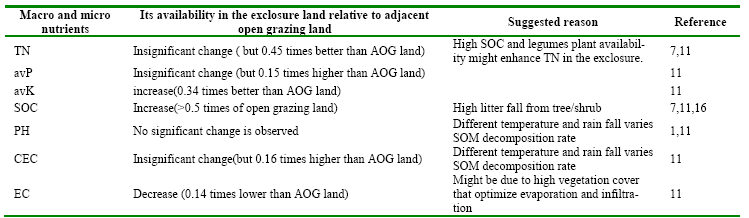
CEC= Cat ion exchange capacity, EC=electric conductivity, TN= total Nitrogen, avP=available phosphorus, avK= available Potassium, SOC=soil organic Carbon.
The presence of improved soil structure (high level of leaf litter and vegetation cover) in the exclosure land reduces the soil erosion better than open grazing land11,13.
Study done in the upper Blue Nile basin of Ethiopia shown that the use of area exclosure with trenches is a best option for soil erosion and runoff reduction14. While for soil loss reduction issue alone, use of area exclosure is suitable land management practices14. The improvement in canopy and ground cover in area exclosure with increasing age of exclosure reduces sediment associated nutrient loss through lowering raindrops and soil erosion4,12,15.
Socio-economic impact of exclosure land. In this review paper, the socio-economic role of exclosure land focus on family size, gender, income, occupations, culture, perception and attitude of the society, educational status of the society. The contribution of forests to total household income in the northern highlands and southern Ethiopia was 27 % and 34 %, respectively17,18. Although such benefits are obtained, deforestation due to population pressures in Ethiopia is severe and has a long history, particularly in the central and northern highlands19.
To avoid such problems, the rehabilitation of degraded forests and woodlands by ecological and environmental viable (area exclosure and enclosure) land management practise is currently seen as a critical issues19,20. In addition to its role in regulating ecosystem services, the exclosure has socio-economic benefits for the livelihood of the community18,21-25. For example, the preservation of tree species in the vicinity of the church boundary is considered a heritage and offers spiritual benefits to society. Their role in demarcating the affected country and expressing the culture of a society is great as the facility requires less manpower26,27. The establishment of the exclusion had negative23,25 and positive4,28, attitudes towards the local community. Accordingly, the positive attitude of the local community is crucial for the sustainability of the exclosure and future rehabilitation measures.
The economic role of exclosure can be direct or indirect. Its direct role for the local community is expressed through the provision of animal feed, bee fodder, fuel and other non-wood forest products17,21 (Table 2). A study conducted in Biyo-Kelala Area Enclosures, Ada`a District, Eastern Shewa Zone, Oromoia Region, showed that income from exclosures was approximately 3.07 % of total annual household income29. The indirect benefits of excluser have also been achieved through improving land productivity and regulating environmental services30. Studies done in the semi-arid lowlands of northern Ethiopia showed that converting communal grazing land into exclosure land over 30 years was achieved the US $ 3.071 per hectare30. The conversion of the aboveground carbon stock into the monetary value of a relatively older excuser also creates a lot of economic benefit to a community and natural environment improvement. Conservation includes the preservation, maintenance, sustainable use, restoration and improvement of the natural environment. In this regard, Exclosure helps support the sustainable use of natural resources there by generating environmental, economic and social benefits for the rural communities31. This allows the local community to alleviate poverty by extending the vegetation cover on the degraded land.
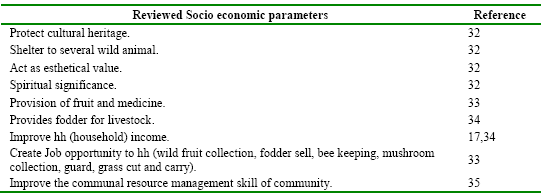
hh=household
hh=household
Conclusion
Extensive dependence of rural household on the natural resource leads to resource degradation. Equitable resource distribution among end-users is important to sustainable forest land reclamation. Medicine, fuel wood, fruit, honey, aesthetic value, cultural value and spiritual uses were some of the socioeconomic uses of exclosure land to the rural households. Participation of local community on integrated soil erosion control practice in the exclosure land use enhances soil fertility when it is governed by local bylaws. Generally, the household who got benefit form land reclamation practice more motivated to protect other similar featured lands. In doing so, communities’ attitude towards exclosure land use improves with improved ecological systems. Further studies of the use of exclosure land use on gender, education level and age group should be done and documented for end-users. In addition to this studies on the equal distribution of resource to the community should be done to reduce conflict among exclosure land user households and get benefits sustainably. Studies on enhancing the advantage of local communities, their preferred tree/shrub, grass and spice species that should be planted in the exclosure land uses is also needed.
Cited Literature
1. Munie Shiferaw AM. Effect of plantation forests on soil chemical properties, soil temperature and regeneration of woody plants: a comparative analysis [thesis dissertation]. [Brno]: Mendel University in Brno; 2013 [cited 2020 Oct 18]. Available from: https://www.academia.edu/35550541/effect_of_plantation_forests_on_soil_chemical_properties_soil_temperature_and_regeneration_of_woody_plants_a_comparative_analysis
2. Fakere AA, Ayoola HA. Socioeconomic characteristics and community participation in infrastructure provision in Akure, Nigeria. Cogent Soc Sci 2018;4:1437013. DOI: https://doi.org/10.1080/23311886.2018.1437013
3. Lemenih M, Karltun E, Olsson M. Soil organic matter dynamics after deforestation along a farm field chronosequence in southern highlands of Ethiopia. Agric Eco-syst Environ 2005;109:9-19. DOI: http://doi.org/10.1016/j.agee.2005.02.015
4. Mekuria W, Veldkamp E, Haile M, Gebrehiwot K, Muys B, Nyssen J. Effectiveness of exclosures to control soil erosion and local community perception on soil erosion in Tigray, Ethiopia. Afr J Agric Res 2009;4(4):365-77.
5. Abebe T, Hunde Feyssa D, Kissi E. Area ex-closure as a strategy to restore soil fertility status in degraded land in Southern Ethiopia. J Biol Chem Research 2014;31(1):482-94.
6. Keyzer MA, Sonneveld BGJS. The effect of soil degradation on agricultural productivity in Ethiopia: a non-parametric regional analysis. In: Heerink N, van Keulen H, Kuiper M, editors. Economic policy and sustainable land use. Switzerland: Springer Nature; 2001. p. 269-92. DOI: https://doi.org/10.1007/978-3-642-57558-7_16
7. Yimer F, Alemu G, Abdelkadir A. Soil property variations in relation to exclosure and open grazing land use types in the Central Rift Valley area of Ethiopia. Environ Syst Res 2015;4:17. DOI: https://doi.org/10.1186/s40068-015-0041-2
8. Akenga P, Salim A, Onditi A, Amir Y, Waudo W. Determination of selected micro and macronutrients in sugarcane growing soils at Kakamega North District, Kenya. J Appl Chem 2014;7(7): 34-41. DOI: https://doi.org/10.9790/5736-07713441
9. Mekuria W, Langan S, Noble A, Johnston R. Soil restoration after seven years of exclosure management in northwestern Ethiopia. Land Degrad Dev 2017;28(4):1287-97. DOI: https://doi.org/10.1002/ldr.2527
10. Conant RT, Ogle SM, Paul EA, Paustian K. Measuring and monitoring soil organic car-bon stocks in agricultural lands for climate mitigation. Front Ecol Environ 2011;9(3):169-73 DOI: https://doi.org/10.1890/090153
11. Abay K, Tewolde-Berhan S, Teka K. The effect of exclosures on restoration of soil properties in Ethiopian lowland conditions. SN Appl Sci 2020;2 :1771. DOI: https://doi.org/10.1007/s42452-020-03538-9
12. Mekuria W, Aynekulu E. Exclosure land management for restoration of the soils in degraded communal grazing lands in northern Ethiopia. Land Degrad Dev 2013;24(6):528-38. DOI: https://doi.org/10.1002/ldr.1146
13. Damene S, Bahir A, Villamor GB. The role of Chomo grass (Brachiaria humidicola) and exclosures in restoring soil organic matter, total nitrogen, and associated functions in degraded lands in Ethiopia. Reg Environ Change 2020;20:92. DOI: https://doi.org/10.1007/s10113-020-01680-z
14. Ebabu K, Tsunekawa A, Haregeweyn N, Adgo E, Meshesha DT. Aklog D, et al. Effects of land use and sustainable land management practices on runoff and soil loss in the Upper Blue Nile basin, Ethiopia. Sci Total Environ 2019;648:1462-75. DOI: https://doi.org/10.1016/j.scitotenv.2018.08.273
15. Tefera B, Sterk G. Land management, erosion problems and soil and water conservation in Fincha'a watershed, western Ethiopia. Land Use Policy 2010;27(4):1027-37. DOI: https://doi.org/10.1016/jlandusepol.2010.01.005
16. Okolo CC, Gebresamuel G, Zenebe A, Haile M, Eze PN. Accumulation of organic carbon in various soil aggregate sizes under different land use systems in a semi-arid environment. Agric Ecosyst Environ 2020;297:106924. DOI: https://doi.org/10.1016/j.agee.2020.106924
17. Mamo Bahiru K. Enclosure as a viable option for rehabilitation of degraded lands and biodiversity conservation: the case of Kallu Woreda, Southern Wello. [thesis masters]. [Etiopía]: Addis Ababa University; 2008 [cited 2020 Oct 18]. Available from: http://213.55.95.56/handle/123456789/6185
18. Babulo B, Muys B, Nega F, Tollens E, Nyssen J, Deckers J, et al. The economic contribution of forest resource use to rural livelihoods in Tigray, Northern Ethiopia. For Policy Econ 2009;11(2): 109-17. DOI: https://doi.org/10.1016/j.forpol.2008.10.007
19. Lemenih M, Kassa H. Re-greening Ethiopia: history, challenges and lessons. Forests 2014;5:1896-909. DOI: https://doi.org/10.3390/f5081896
20. Mengistu T. The role of enclosures in the recovery of woody vegetation in degraded hillsides of biyo and tiya, central and northern Ethiopia [thesis masters]. Sweden: Ethiopian MSc in Forestry Programme thesis; 2005.
21. Muys B, Gebrehiwot K, Aerts R, Haile M, Deckers J. Perspectives for the rehabilitation of dryland forests in Ethiopia. J Dry-lands 2006;1(2):217-20.
22. Tilahun M, Olschewski R, Kleinn C, Kindeya G. Economic analysis of closing degraded Bosewellia papyrifera dry forest from human intervention-a study from Tigray, Northern Ethiopia. For Policy Econ 2007;9(8):996-1005. DOI: https://doi.org/10.1016/j.forpol.2006.09.004
23. Tekalign M. The role of area exclosures for biodiversity conservation and its contribution to local livelihoods: The case of Biyo-Kelala area exclosures in Ada`a Wereda [thesis masters]. [Addis Abeba]: Addis Ab-aba University; 2010 [cited 2020 Oct 18]. Available from: http://thesisbank.jhia.ac.ke/4115/
24. Veldkamp E, Mekuria W, Tilahun M, Olschewski R. Economic valuation of land res-toration: the case of exclosures established on communal grazing lands in Tigray, Ethiopia. Land Degrad Dev 2011;22:334-44. DOI: https://doi.org/10.1002/ldr.1001
25. Mulugeta G, Achenef M. Socio-Economic challenges of area exclosure practices: A case of Gonder Zuria Woreda, Amhara Region, Ethiopia. J Nat Sci Res 2015;5(13):123-32.
26. Dudley N, Higgins-Zogib L, Mansourian S. The links between protected areas, faiths, and sacred natural sites. Conserv Biol 2009;23(3):568-77. DOI: https://doi.org/10.1111/j.1523-1739.2009.01201.x
27. Birhane E. Actual and potential contributions of enclosures to enhance biodiversity in drylands of eastern Tigray, with particular emphasis on woody plants [thesis masters]. [Sweden]: Swedish University of Agricultural Sciences; 2002.
28. Heitschmidt RK, Vermeire LT, Grings EE. Is rangeland agriculture sustainable?. J Anim Sci 2004;82(E Suppl): E138-46. DOI: https://doi.org/10.2527/2004.8213_supplE138x
29. Manaye A. Contribution of exclosures for restoration of woody species diversity and regulating ecosystem services in Ethiopia. Environment and Forest Research Center: Mekele, Ethiopia. J Nat Sci Res 2017;7(13):28-35.
30. Mekuria W. Conversion of communal grazing lands into exclosures restored soil properties in the semi-arid lowlands of Northern Ethiopia. Arid Land Res Mang 2013;27(2):153-66. DOI: https://doi.org/10.1080/15324982.2012.721858
31. Gebregziabher D, Soltani A. Exclosures in people's minds: perceptions and attitudes in the Tigray region, Ethiopia. For Policy Econ 2019;101:1-14. DOI: https://doi.org/10.1016/j.forpol.2019.01.012
32. Amin A, Zaehringer JG, Schwilch G, Koné I. People, protected areas and ecosystem services: a qualitative and quantitative analysis of local people's perception and preferences in Côte d'Ivoire. Nat Resour Forum 2015;39(2):97-109. DOI: https://doi.org/10.1111/1477-8947.12069
33. Gebregziabher D, Soltani A, Hofstad O. Equity in the distribution of values of outputs from exclosures in Tigray, Ethiopia. J Arid Environ 2017;146 :75-85. DOI: https://doi.org/10.1016/j.jaridenv.2017.07.003
34. Soltani A, Angelsen A, Eid T. Poverty, forest dependence and forest degradation links: evidence from Zagros, Iran. Environ Dev Econ 2014;19(5):607-30. DOI: https://doi.org/10.1017/S1355770X13000648
35. Ostrom E. Self-governance and forest resources. Occasional Paper [Internet]. 1999 [cited 2020 Oct 10];20:2-15. Available from: https://www.cifor.org/publications/pdf_files/OccPapers/OP-20.pdf
Notes
______
______
_______
______
______
Author notes
Alternative link
http://www.scielo.org.bo/scielo.php?script=sci_arttext&pid=S2308-38592021000200092&lng=es&nrm=iso (html)


