

A Visual Review and Bibliometric Analysis of Cloud Computing Traffic Flow Forecasting for a Digital Africa
 Sello Prince Sekwatlakwatla sek.prince@gmail.com
Vusumuzi Malele Vusi.Malele@nwu.ac.za
Sello Prince Sekwatlakwatla sek.prince@gmail.com
Vusumuzi Malele Vusi.Malele@nwu.ac.za
Latin-American Journal of Computing
Escuela Politécnica Nacional, Ecuador
ISSN: 1390-9266
ISSN-e: 1390-9134
Periodicity: Semestral
vol. 12, no. 1, 2025
Received: 30 June 2024
Accepted: 23 September 2024

Abstract: —the use of cloud computing has grown globally in recent years. When allocating resources, cloud resources and traffic flow management need to be closely watched and controlled. This paper conducted a bibliographic study based on the Scopus database and the Institute of Electrical and Electronics Engineers (IEEE) to evaluate the adoption rate of resource management and traffic flow forecasting in cloud computing in Africa. There is still uncertainty about cloud computing adoption on the African continent. It is difficult to say that 54 African countries are fully prepared to adopt cloud computing. The growth of internet connectivity and potential economic development in Africa are contributing to the rapid growth of cloud computing. This technology enables individuals, private companies and the government to access computing resources and services remotely. It has the potential to significantly impact the education, healthcare and economic sectors; however, there are challenges such as limited infrastructure and data security concerns in Africa. This study demonstrates the limitations of the implementation of cloud computing in African countries such as South Africa, Nigeria, Namibia, Botswana, Zimbabwe, Uganda, Kenya, Cameron, Egypt and Ghana. Only 18.5% of the continent is researching the implementation of cloud computing, and the lack of cloud implementation remains a persistent issue because of scarce resources. However, Africa's adoption of cloud computing can be increased through alternative solutions suggested in the study.
Keywords: Cloud Adoption, Traffic flow, and Africa.
I.Introduction
The African cloud computing market attracts foreign investors and has a penetration rate of 15% of cloud computing resources and traffic. This rate will grow significantly in the future. Cloud computing in African markets is still in its early stages with South Africa displaying the most activity. The private sector and businesses established in South Africa, such as Internet Solutions are the sources of demand. International suppliers compete with the increasing number of submarine cables connecting continents to high-speed internet. This growth is possible [1–3].
Cloud computing is becoming increasingly popular in Africa with governments and private entities alike recognizing the benefits and adopting cloud-based strategies [4]. As a result of limited and uneven cloud service delivery infrastructure development across the continent. African businesses want to adopt this technology; however, some of the African infrastructure challenges are signs of slowing down and cloud adoption remains low.
African organizations faced challenges in adopting cloud computing to reduce ICT costs, including user resistance, human factors, support and funding [5]. The use of cloud computing makes managing and maintaining ICT resources easier and more efficient. The African cloud computing market is gaining momentum due to the growing demand for digital transformation and a shift towards cloud applications across various industries and sectors [5–6].
In recent literature, African countries have been struggling to adopt this technology. They are facing challenges such as mimetic, coercive and normative. The implementation of cloud computing is hampered by doubts about the dependability of cloud service providers and a deficiency of cloud computing expertise [7]. Together with government regulations pertaining to cloud computing, cloud service providers have also come under fire for providing insufficient assistance and training [8]. A strong higher education system boosts a nation's worldwide competitiveness, economic power, social well-being and global leadership position. In this regard, African countries to increase their adoption of cloud computing a strong foundation of education in universities must be laid on the African continent about cloud computing [9-10].
The primary contribution of this paper is to identify publishing trends in 54 African countries and propose a strategy to encourage other countries to adopt cloud computing technology. The rest of this article is divided into related work, methods, results, discussion and recommendation and conclusions.
II. Related Work
There is still uncertainty about cloud computing adoption on the African continent [11]. Africa is falling behind in cloud technology adoption owing to poor broadband access and expensive infrastructure. Better bandwidth must be made available by service providers and the government in order to overcome these obstacles, which could have a significant positive impact on cloud computing in Africa [12]. Africa's health industry is rapidly becoming digital, especially in the area of medical data. By providing safe, on-site access to patient information, medical data and health apps globally. Cloud computing enables "accessibility without borders" fostering interoperability and well-informed decision-making [13].
Most countries in Africa are ignoring this benefit due to poor infrastructure and unaffordability. On the other hand, political interference is also a major blockade to the development of Africa [14]. To advance technology in Africa, cloud adoption must be encouraged and authorized by African regulators [14-15]. As African regimes become more authoritarian, residents will become increasingly disenfranchised from their leaders, resulting in political instability and bloodshed[15].This will cause internal displacement, increase external migration and impede social and economic growth. In order to resolve these problems, long-standing complaints and the cruel governance that permeates Africa must be addressed.
In contrast, African states are trying to adopt the technology. The usage of the internet in Africa has increased significantly [16]. Table 1 shows the top twelve African countries that are adopting the use of the internet. Morocco is leading the internet usage with 91.7%, followed by Libya with 89.4%, the Seychelles with 87%, followed by Tunisia with 79.6%, Botswana with 77.3%, Mauritius with 75.5%, and the internet usage in South Africa is 74.7%, followed by Gabon with 73.7 %, Algeria with 72.9%, Egypt with 72.2 %, Cabo Verde with 72.1 %, and Ghana with 69.8%, as shown in Table I. Top twelve countries internet usage% in Africa.
| 1 | Morocco | 91.7 |
| 2 | Libya | 89.4 |
| 3 | Seychelles | 87.7 |
| 4 | Tunisia | 79.6 |
| 5 | Botswana | 77.3 |
| 6 | Maurituis | 75.5 |
| 7 | South africa | 74.7 |
| 8 | Gabon | 73.7 |
| 9 | Algeria | 72.9 |
| 10 | Egypt | 72.2 |
| 11 | Cabo verde | 72.1 |
| 12 | Ghana | 69.8 |
It is difficult to say that 54 African countries are fully prepared to adopt cloud computing.
![Submarine cable network[17]](../6025466008_gf2.png)
However, the arrival of several international submarine cables on the African continent (see Figure 1), has significantly increased international bandwidth capacity, which indicates an opportunity for investors to invest in cloud computing on the continent [17].
Cloud computing will make large scale genomic data analysis and storage more scalable and affordable on the African continent as cloud computing becomes more prevalent. The privacy and security concerns regarding human data must be addressed in accordance with African regulations [18]. Kenya is creating data security and privacy regulations, including a bill that allows cloud firms to handle personal data [19].
It is also critical to address a server placement, foster cloud computing confidence, and make investments in terrestrial broadband backbone networks. Additionally, the government has declared cable damage to be an economic crime punishable by severe fines [19-20].
Improved infrastructure and pricing are driving South Africa's cloud computing service expansion, innovation may be increased by addressing regulatory issues and encouraging cloud services in e-government and education [21]. Closing legislative gaps in cybersecurity, data privacy and data can boost offshore markets, increase consumer confidence in cloud services and spur economic development [22]. It is equally significant to pass laws pertaining to data security and privacy and to develop local expertise in advanced technologies, such as cloud computing.
There is no doubt that cloud computing can reduce costs and improve services exactly what Africans need right now [23]. By lowering capital costs, enhancing service delivery, boosting transparency and assisting small and midsize enterprises (SMEs) in IT procurement. The Nigerian government's implementation of a cloud computing strategy would boost the country's economy and create employment [24].
Technology Acceptance Model (TAM): During the pandemic, educational institutions logically adopted cloud computing to enhance academic performance, despite the secondary focus was not on secure services[25]. Cloud computing adoption in Ghana was proposed using partial least squares structural equation modelling, the study reveals that institutional pressures, including mimetic, coercive and normative, account for 27% of cloud computing adoption variance, highlighting its adoption in low-adoption environments [25] .Other studies found that trust perception did not significantly impact the onboarding of cloud computing in North-Eastern Nigerian academic libraries [26].
Ghana's internet connection puts the country in a good position to progress in cloud computing, but adoption and knowledge remain poor [27]. Unlike other industries like banking, telecommunication, media and education, the industry is still in its infancy and lacks a single front and clear guidance from a unified entity. While educational societies in Sub-Saharan Africa have built their own private cloud computing infrastructure, universities are working with public cloud service providers such as Microsoft, Cisco and Amazon Web Services [27]. These universities play a critical role in the development of countries and to increase cloud computing adoption, it should be the subject in all areas of courses, no matter what career students are pursuing.
Web-based services were given a two-model modification to determine cloud computing adoption, the model increased adoption with 73% of the variance and determinants related to this adoption [28]. In Africa, Cloud service providers face reliability concerns, a lack of skills, inadequate support and government policies hindering adoption due to concerns about reliability, skills, and training [29].
Digital legacy in trade-dependent countries results in export-oriented firms investing in traditional digital assets. Large service sectors have high Cloud Computing adoption but low growth rates [30]. Implementing cloud computing in higher education faces significant challenges due to data risk, privacy, government regulation, peer pressure, data security and management factors [31]. Cloud Computing in Resource-Constrained Environments to facilitate e-Government Services in Ethiopia recommends the enhanced Framework for Cloud Computing adoption in Ethiopia's WoredaNet context [32]. There are more benefits to adopting cloud computing in Ethiopia's public sector than in private institutions [32]. Ethiopian companies find it difficult to use cloud computing because they do not trust international suppliers, mostly because they are worried about privacy and data security [33].
Ethiopia must embrace cloud computing if it wants to succeed in a digitalized, knowledge-based economy. The Ethiopian government should implement new regulations that support cloud computing and its effects on security, secrecy and protection of personal data in order to facilitate its growth. Programs for training businesses to implement cloud computing might also assist in addressing issues.
III. Methods
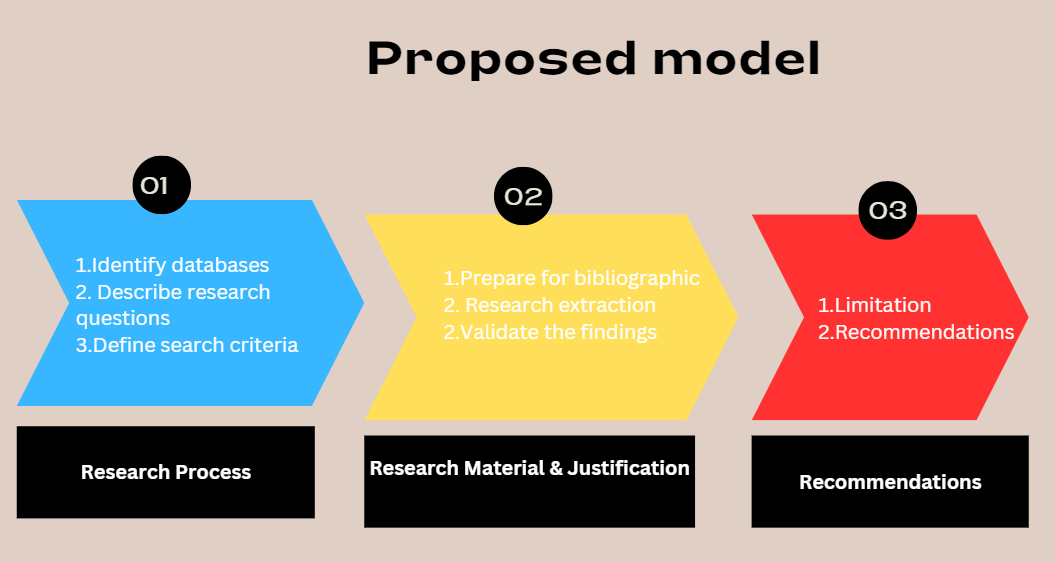
Figure 2 shows the research process and steps, which are grouped into three categories: research process, research material, justification, and recommendations.
A. Research Process
Identify databases – A literature search was conducted in two databases: the Institute of Electrical and Electronics Engineering (IEEE) and Scopus for literature related to cloud computing adoption in Africa.
Describe research questions – The research focuses on the challenges faced in Africa in implementing cloud computing, using specific research questions to guide the study.
What are cloud computing adoption challenges in Africa?
Search criteria: The search criteria explore English-written articles published between 2019 and 2023.
B. Research Material & justification
Research extraction- articles were filtered according to research question and search criteria. The data extracted was analyzed thematically.
Validate the findings-The research output was validated using two databases.
C. Dataset
This study included only English-language original articles and reviews published between January 1, 2019 and December 26, 2023, by 6213 authors and 278 sources.
IV. Results
A. Bibliometric analysis review
Using a bibliometric analysis review of the cloud computing traffic flow forecasting for Africa, the results showed that South Africa and developing countries were most cited and are contributing to the implementation of cloud computing in Africa.
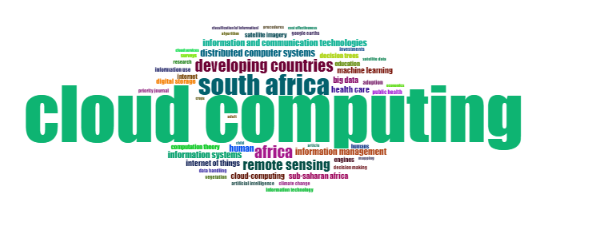
Remote sensing, distributed computer systems and information management are some of the tools and techniques highlighted in these results (see Figure 3).
B. Adoption strategy
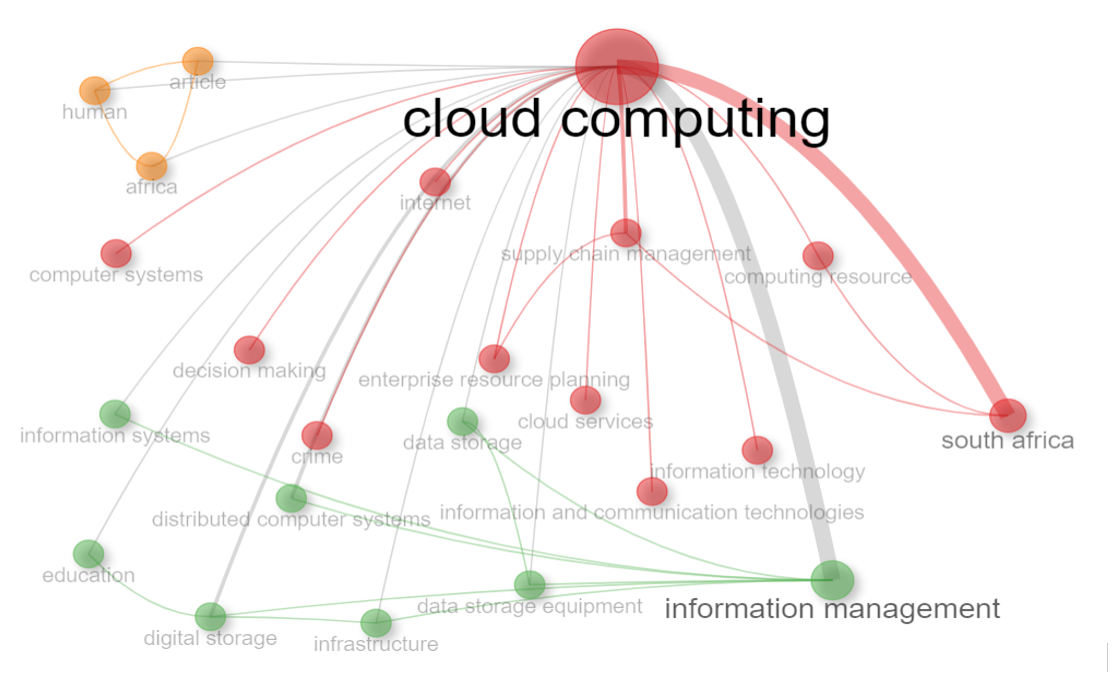
To accelerate the implementation of cloud computing in Africa, it is very critical that the continent have a stable internet connection. The resources to adopt the internet in Africa are slowly covering the African region, for example. Several international submarine cables landed on the African continent (see Figure 1).To support Africa, however Africa needs supply chain management, cloud computing resources (such as skills, etc.), enterprise resource planning and distributed computer systems also local infrastructure to support the adoption of cloud computing (see Figure 4).
C. African Corresponding author’s countries
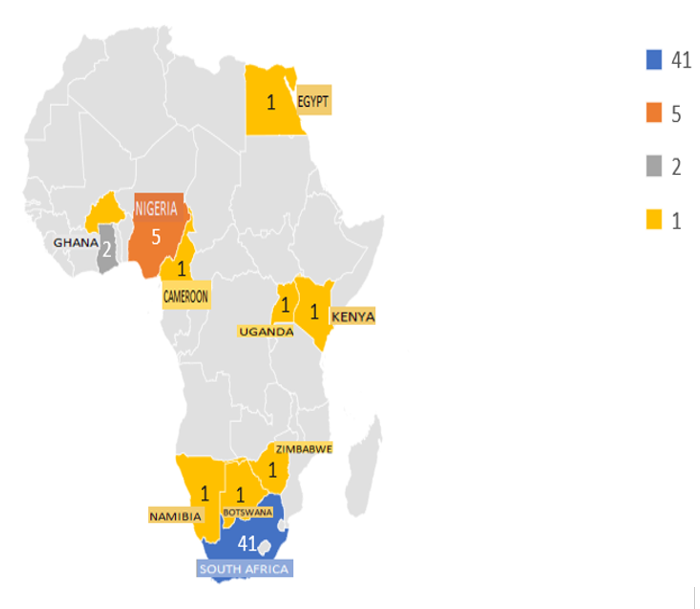
Using a bibliometric analysis review, the results indicate that there is research about the adoption of cloud computing in African countries such as South Africa, Nigeria, Namibia, Botswana, Zimbabwe, Uganda, Kenya, Cameron, Egypt, and Ghana. Only 10 countries are significantly contributing to the continent's research on the adoption of cloud computing (see figure 5).
As it can be seen in Figure 5, the most publication affiliations are from South Africa (41%), followed by Nigeria (5%), and Chana (2%). The following section investigates the top five affiliations that are publishing the most articles from three countries, which are South Africa, Nigeria, and Chana.
Table 1 shows the top five affiliations in South Africa. The University of Cape Town is leading with 20% of published documents, followed by the University of the Western Cape with 14%, the University of Pretoria with 11%, the University of Johannesburg with 10%, and the University of South Africa with 9% of cloud computing published documents.
| 1 | University of Cape Town | 20 |
| 2 | University of the Western Cape | 14 |
| 3 | University of Pretoria | 11 |
| 4 | University of Johannesburg | 10 |
| 5 | University of South Africa | 9 |
The top five affiliations in Nigeria are displayed in Table II. With 4% of cloud computing-published documents, Covenant University leads the field, followed by the Federal Ministry of Health (1%), the University of Ibadan (2%), the University of Nigeria (3%), and the University of Ilorin (3%).
| 1 | Covenant University | 4 |
| 2 | University of Ilorin | 3 |
| 3 | University of Nigeria | 3 |
| 4 | University of Ibadan | 2 |
| 5 | Federal Ministry of Health | 1 |
Table III shows the top five affiliations in Ghana. The Kwame Nkrumah University of Science & Technology is leading with 3% of published documents, followed by the University of the Cape Coast Ghana with 2%, the University of Ghana with 2%, the Ashesi University with 1%, and the Ghana Institute of Management and Public Administration with 1% of cloud computing published documents.
| 1 | Kwame Nkrumah University of Science & Technology | 3 |
| 2 | University of Cape Coast Ghana | 2 |
| 3 | University of Ghana | 2 |
| 4 | Ashesi University | 1 |
| 5 | Ghana Institute of Management and Public Administration | 1 |
D. World collaboration with Africa
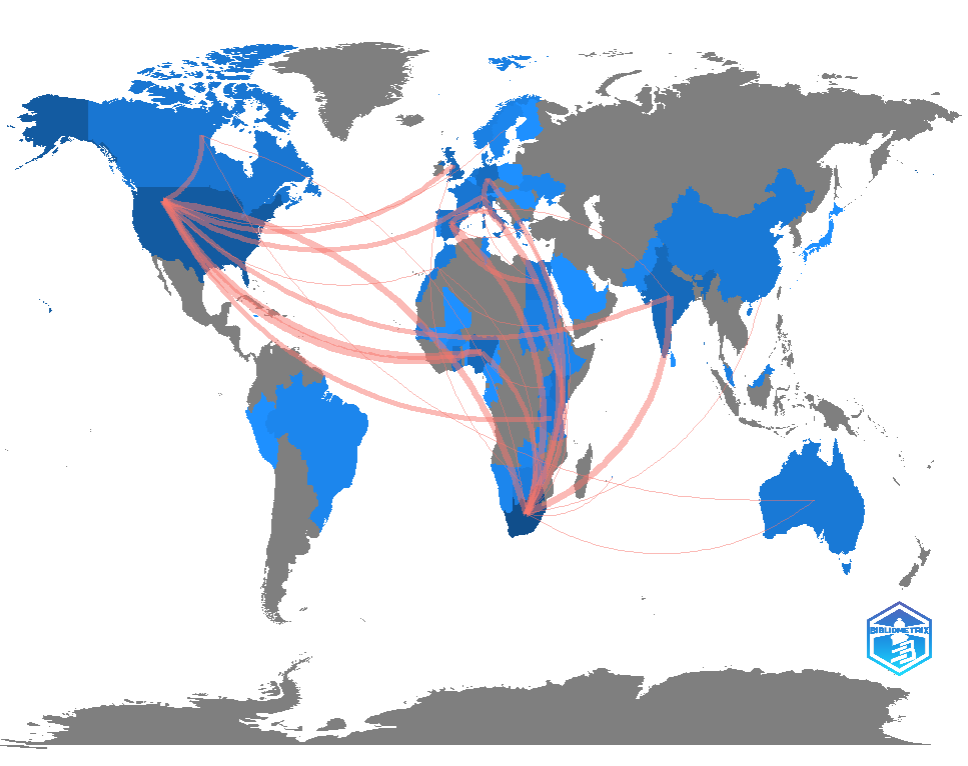
Cloud computing is being adopted by a few African countries. In this regard, there is a slow cooperation with the developing countries (see Figure 6).
V. Discussion and Recommendation
Developing countries are supporting Africa by bringing technology to the continent, for example, international submarine cables on the African continent, according to this paper. It is hard to state that 54 African countries are fully prepared to adopt cloud computing. Only 10 countries on the continent are researching the implementation of cloud computing. The first recommendation is awareness of cloud computing adoption; it would be easy to implement and carry out awareness and discussion inside higher education institutions. The African government and private sector must invest in teaching and learning about cloud computing to create the required expertise to implement cloud computing. The second recommendation is collaboration; 18.5 percent of countries must inspire and support other African countries to adopt the change and implement cloud computing. There is also a need for Africa to adopt supply chain management, cloud computing resources (such as skills, etc.), enterprise resource planning, distributed computer systems, and local infrastructure to support the onboarding of cloud computing.
VI. Conclusion
The growth of internet connectivity and potential economic development in Africa are contributing to the rapid growth of cloud computing. Cloud computing enables individuals, private companies and the government to access computing resources and services remotely. It has the potential to significantly impact the education, healthcare, and economic sectors; however, there are challenges such as limited infrastructure and data security concerns.
This paper uses a bibliometric analysis of cloud computing traffic flow forecasting for a digital Africa. There is still uncertainty about cloud computing on the African continent. It is challenging to assert that all 54 African countries are fully prepared to implement cloud computing. The results indicate that there is research about the adoption of cloud computing in African countries such as South Africa, Nigeria, Namibia, Botswana, Zimbabwe, Uganda, Kenya, Cameron, Egypt, and Ghana. Only 18.5% of the continent is researching the adoption of cloud computing.
African nations encourage and help other African countries in adopting and implementing cloud computing. They may also begin at the educational institution, where they can teach our future leaders. This will make it simpler for the emerging nations to approach other non-participating African nations later on. In order to facilitate the implementation of cloud computing, Africa must also implement supply chain management, distributed computer systems, corporate resource planning, cloud computing resources (such as talents, etc.), and local infrastructure.
Since only the IEEE Xplore and Scopus databases were used in this report, other research databases will be included in the future to broaden the scope of this investigation. Researchers in the future will be able to analyze the data using bibliometric programs such as VOSviewer and Bibexcel. The findings might not be representative of all research on a visual review and bibliometric analysis of cloud computing traffic flow forecasting for a digital Africa. To examine additional studies, future research will require a more thorough search that encompasses all papers.
References
[1] Yakubu, A.S., Kassim, A.M. & Husin, M.H. Conceptualizing hybrid model for influencing intention to adopt cloud computing in North-Eastern Nigerian academic libraries. The Journal of Academic Librarianship, Vol,49(2023). [Online]. Available: https://doi.org/10.1016/j.acalib.2023.102747
[2] Clare, M.A., Yeo, I.A., Bricheno, L., Aksenov, Y., Brown, J., Haigh, I.D., ... Carter, L.: Climate change hotspots and implications for the global subsea telecommunications network. Earth-Science Reviews, Vol ,237(2023). [Online]. Available:https://doi.org/10.1016/j.earscirev.2022.104296
[3] Jieun.H, Hyo-Jin. K, Minjung.K, Gyu., H.,K.: Mapping the intellectual structure of research on surgery with mixed reality: Bibliometric network analysis (2000–2019), Journal of Biomedical Informatics Vol 109 (2020). [Online]. Available: https://doi.org/10.1016/j.jbi.2020.103516
[4] Yakubu, A.S., Kassim, A.M. & Husin, M.H.: Conceptualizing hybrid model for influencing intention to adopt cloud computing in North-Eastern Nigerian academic libraries. The Journal of Academic Librarianship, 49(2023), [Online]. Available:https://doi.org/10.1016/j.acalib.2023.102747
[5] Dommo, A., Vondou, D.A., Philippon, N., Eastman, R., Moron, V. & Aloysius,. The ERA5's diurnal cycle of low-level clouds over Western Central Africa during June–September: Dynamic and thermodynamic processes. Atmospheric Research, Vol, 280(2022),[Online].Available:https://doi.org/10.1016/j.atmosres.2022.106426
[6] Sharma, M., Singh, A. & Daim, T.,Exploring cloud computing adoption: COVID era in academic institutions. Technological Forecasting and Social Change, Vol,193(2023),
[7] Adjei, J.K., Adams, S. & Mamattah, L.,Cloud computing adoption in Ghana; accounting for institutional factors. Technology in Society, Vol ,65(2021), [Online]. Available: https://doi.org/10.1016/j.techsoc.2021.101583
[8] Yakubu, A.S., Kassim, A.M. & Husin, M.H, Conceptualizing hybrid model for influencing intention to adopt cloud computing in North-Eastern Nigerian academic libraries. The Journal of Academic Librarianship, Vol 49(2023), [Online]. Available: https://doi.org/10.1016/j.acalib.2023.102747
[9] Tella, A., Ukwoma, S.C. & Kayode, A.I, A two models’ modification for determining cloud computing adoption for web-based services in academic libraries in Nigeria. The Journal of Academic Librarianship, Vol 46(2020) [Online]. Available https://doi.org/10.1016/j.acalib.2020.102255
[10] Njenga, K., Garg, L., Bhardwaj, A.K., Prakash, V. & Bawa, S. The cloud computing adoption in higher learning institutions in Kenya: Hindering factors and recommendations for the way forward. Telematics and Informatics, Vol,38(2019). [Online]. Available:: https://doi.org/10.1016/j.tele.2018.10.007
[11] Mohammed, K.,Juma, A., T., Challenges of Cloud Computing Adoption Model for Higher Education Level in Zanzibar (the Case Study of SUZA and ZU), Procedia Computer Science Vol,161(2019). [Online]. Available: https://doi.org/10.1016/j.procs.2019.11.215
[12] Vu, K., Hartley, K. & Kankanhalli, A. Predictors of cloud computing adoption: A cross-country study. Telematics and Informatics, Vol,52(2020). [Online]. Available: https://doi.org/10.1016/j.tele.2020.101426
[13] Hassan, A., Bhatti, S.H., Shujaat, S. & Hwang, Y. To adopt or not to adopt? The determinants of cloud computing adoption in the information technology sector. Decision Analytics Journal, vol ,5(2022), ) [Online]. Available:
[14] Kamiri, J. & Mariga, G. 2021. Research Methods in Machine Learning: A Content Analysis. International Journal of Computer and Information Technology (ISSN: 2279 – 0764) Volume 10 – Issue 2 (2021)
[15] Shuraida, S. & Titah, R. An examination of cloud computing adoption decisions: Rational choice or cognitive bias? Technology in Society, Vol ,74(2023) [Online]. Available: https://doi.org/10.1016/j.techsoc.2023.102284
[16] Gxokwe.S, Dube.T, Mazvimavi.D , Grenfell.M,Using cloud computing techniques to monitor long-term variations in ecohydrological dynamics of small seasonally-flooded wetlands in semi-arid South Africa,Journal of Hydrology,Vol ,612(2022) [Online]. Available:https://doi.org/10.1016/j.jhydrol.2022.128080
[17] Livadariu,I.,Elmokashfi A & Smaragdakis,G.Tracking submarine cables in the wild,journal of Computer Networks,vol,242(2024),[Online]. Available: https://doi.org/10.1016/j.comnet.2024.110234
[18] Veiga,A.A study on information privacy concerns and expectations of demographic groups in SouthAfrica,journal of computer law & security review,vol,47(2022).[Online]. Available:
[19] Rotich,J. Rintaugu, E & Thangu, E.,Doping knowledge, attitude, and experience of pharmacists in Kenya,journal of Performance Enhancement & Health,vol,11(2023),[Online]. Available:https://doi.org/10.1016/j.peh.2023.100261
[20] Ndung,J.,Vertinsky,I.,Onyango,J.The relationship between social media use, social media types,and job performance amongst faculty in Kenya private universities,Journal of Heliyon,vol,9(2023)
[21] Zhang,J.,Huirong,Z.,Gong,X. Government’s environmental protection expenditure in China: The role of Internet penetration,Journal of Environmental Impact Assessment Review,vol,93(2022)[Online]. Available: https://doi.org/10.1016/j.eiar.2021.106706
[22] Al-Besher,A.,Kumar,k.Use of artificial intelligence to enhance e-government services,journal of Measurement: Sensors,vol,24(2022)
[23] Somohano-Rodríguez,F.,Madrid-Guijarro,A.Do industry 4.0 technologies improve Cantabrian manufacturing smes performance? The role played by industry competition,journal fo Technology in Society, vol,70(2022)[Online]. Available:
[24] Qiao,P.,Chang,M.,Zeng,Y.The influence of digitalization on SMEs’ OFDI in emerging countries,Journal of Business Research ,vol.177 (2024),[Online].Available:https://doi.org/10.1016/j.jbusres.2024.114633
[25] Banimfreg,B.,H.A comprehensive review and conceptual framework for cloud computing adoption in bioinformatics,Journal of Healthcare Analytics,vol,3(2023),[Online].Available:https://doi.org/10.1016/j.health.2023.100190
[26] Adjei,J.,k.,Adams,S.& Mamattah,L.Cloud computing adoption in Ghana; accounting for institutional factors,journal of Technology in Society,vol,65(2021),[Online].Available.https://doi.org/10.1016/j.techsoc.2021.101583
[27] Sharma,M.,Singh,A.,Daim,T.Exploring cloud computing adoption: COVID era in academic institutions,journal of Technological Forecasting & Social Change,vol,193(2023),[Online].Available.https://doi.org/10.1016/j.techfore.2023.122613
[28] Oredo, J., Njihia, J. & Iraki, X. Institutional Pressures and Cloud Computing Adoption: The Moderating Effect of Organizational Mindfulness," 2019 IST-Africa Week Conference (IST-Africa), Nairobi, Kenya, 2019, pp. 1-9, doi: 10.23919/ISTAFRICA.2019.8764832.
[29] Hiran,K.,K.& Dadhich,M.Predicting the core determinants of cloud-edge computing adoption (CECA) for sustainable development in the higher education institutions of Africa:A high order SEM-ANN analytical approach,Journal of Technological Forecasting & Social Change,vol,199(2024).,[Online].Available.https://doi.org/10.1016/j.techfore.2023.122979
[30] Oredo, J. Personal Cloud Computing Adoption: Integrating IT Mindfulness with TAM, 2020 IST-Africa Conference (IST-Africa), Kampala, Uganda, 2020, pp. 1-8
[31] Rananga, N., & Venter, H. S. Mobile Cloud Computing Adoption Model as a Feasible Response to Countries’ Lockdown as a Result of the COVID-19 Outbreak and Beyond," 2020 IEEE Conference on e-Learning, e-Management and e-Services (IC3e), Kota Kinabalu, Malaysia, 2020, pp. 61-66, doi: 10.1109/IC3e50159.2020.9288402.
[32] Mujinga,M.,Cloud Computing Inhibitors Among Small and Medium Enterprises,2020 3rd International Conference on Intelligent Sustainable Systems (ICISS), Thoothukudi, India, 2020, pp. 1385-1391, doi: 10.1109/ICISS49785.2020.9315905
[33] Zhu,L. & Tan,L.Task offloading scheme of vehicular cloud edge computing based on Digital Twin and improved A3C,Journal of Internet of Things,vol,26(2024),[Online].Available https://doi.org/10.1016/j.iot.2024.101192
Additional information
Author Contributions: The authors acknowledge that this article was written as part of the outcomes produced while studying for a Ph.D. in computer science and information systems. After consulting with their supervisors, Ph.D. students elaborated the original draft of this work. In this study, they conceptualized the methodology, collected the data, set up the experimental platform, conducted bibliometric analysis of cloud computing traffic flow forecasting for a digital Africa, and analyzed the findings. Besides this, there are no conflicts of interest reported by any of the authors.