

Artículos de Investigación Científica y Tecnológica
IMPACT OF SPRINKLER IRRIGATION METHOD AND MINERAL FERTILIZER ON WHEAT PLANT
Impacto del método de riego por aspersión y fertilizante mineral en la planta de trigo
Revista de la Facultad de Ciencias Agropecuarias
Universidad de La Amazonia, Colombia
ISSN: 1692-9454
ISSN-e: 2539-178X
Periodicity: Semestral
vol. 15, no. 2, 2023
Received: 15 May 2023
Accepted: 30 May 2023

Abstract: Aim of the research was to know effect of the appropriate irrigation method and amount of fertilizer specified for urea fertilizer that achieves the best growth for the plant and increase its productivity while avoiding the bad impact on soil properties. The farmer believes that adding chemical fertilizers and amounts of irrigation water to field will increase production, so this is wasted and irrigation water is increased until this leads to it being one of the causes of soil salinization, which has become the most important problem. The Sprinkler irrigation showed significant differences compared to surface irrigation. The length of the spike , number of grain per spike ,1000 grains weight Number of spikes per square meter, grains weight per square meter and the harvest index, while the plant height was not significant only the study also showed that the correlation coefficient between the apparent characteristics of plants was stronger in the case of using sprinkler irrigation compared to the surface irrigation. Therefore, farmers must avoid surface irrigation because it harms the soil and increases its salinity.
Keywords: Sprinkler Sprayer, Irrigation Watering, Significant, Fertilizer, Wheat.
Resumen: El objetivo de la investigación fue conocer el efecto del método de riego adecuado y la cantidad de fertilizante especificada para el fertilizante de urea que logra el mejor crecimiento de la planta y aumenta su productividad evitando el mal impacto en las propiedades del suelo. El agricultor cree que añadiendo fertilizantes químicos y cantidades de agua de riego al campo aumentará la producción, por lo que esta se desperdicia y se aumenta el agua de riego hasta llegar a ser una de las causas de la salinización del suelo, que se ha convertido en el problema más importante. El riego por aspersión mostró diferencias significativas respecto al riego superficial. La longitud de la espiga, el número de granos por espiga, el peso de 1000 granos, el número de espigas por metro cuadrado, el peso de los granos por metro cuadrado y el índice de cosecha, mientras que la altura de la planta no fue significativa únicamente. El estudio también mostró que el coeficiente de correlación entre las características aparentes de las plantas era más fuerte en el caso del riego por aspersión en comparación con el riego superficial. Por tanto, los agricultores deben evitar el riego superficial porque daña el suelo y aumenta su salinidad.
Palabras clave: Rociador Aspersor, Riego, Importante, Fertilizante, Trigo.
INTRODUCTION
Wheat is the dominant crop in temperate countries being used for human food and live-stock feed. Its success depends partly on its adaptability and high yield potential (Shewry, 2009).
The farmer believes that adding chemical fertilizers and quantities of irrigation water to the field will increase production, so this is wasted and overloaded with irrigation water until this led to be one of the reasons for salinization of the soil, which has become the most important problem facing us, today as a specific constraint to agriculture, at the same time, irrigation water has become scarce and decreasing in nature, and the role comes on chemical fertilizers, it is a third determinant and a key factor in the development of produc-tion and productivity if that we do not add it outside the required need, for this research is directed to find a suitable urea fertilizer dose in light of the use of a specific irrigation efficiency (Sprinkler irrigation) to reach the best productivity at the lowest cost while pre-serving the soil and chemical properties physically.
Sprinkler irrigation was superior to surface irrigation because it makes the moisture per-manent in the root system and reduces the air temperature, and these results are consis-tent with what previous research has reached (Mousa, and Ulas, 2022).
The results also showed that the economic efficiency of the sprinkler irrigation farmers was better than the gravity irrigation farmers as the kind of wheat (IPA) which was using sprinkler irrigation a level of economic efficiency of 89% of total farms, while it achieved on economic efficiency of 64% in gravity (Nazzal.et al. 2010).
The length of the Spike encourages it to contain more grains, and this is what happened with sprinkler irrigation, which increases the dry weight and the yield. Also, the increase in the number of Spikes comes from an increase in the number of branches and thus an increase in the total yield and an increase in the weight of the grain (Hadi.et al. 2016).
Explained an experience in Syria was that the yield of irrigation by sprinkler was 1.78 kg|m2 wheat and for barley 1.18 kg |m2 while for surface irrigation it was 0.88 for wheat and0.60 barely (Al-Dairi., et al 2011).
MATERIALS AND METHODS
The experiment carried out on the lands of Al-Numaniya city (Mr. Habib Al-Khatib’s farm) for the agricultural season 2022-2023 within a field to grow wheat crop (Dana) with an area of 200 dunums under the linear sprinkler irrigation system, and part of the field is subject to surface irrigation , In sandy, silt soil, , the experiment was divided into two parts, one of which was under irrigation with linear sprinkling and the second half was by surface irrigation system.
The experiment ground was plowed with disks, then adjusted by the two rates, and plowed with disks again and added to it 60 kg / dunums with 15 kg / dunums of urea, the seed rate for wheat was kg / dunum
The first irrigation was given to the two parts of the experiment by spraying and surface irrigation, the germination percentage for the experiment site under sprinkler irrigation was 80% and 70% for the surface irrigation, after 50 days, the second batch of urea fertilizer was given according to the proposed quantities, for both sections of the experiment, and the field was combated with a Ventur pesticide for thin leaves and Crane Star for broad papers in quantity.
The experiment was designed with two blocks with four treatments of urea fertilizer kg / dunum and four iterations for each treatment for both sprinkler and surface irrigation (15, 10, 5, 0)
| Sprinkler irrigation | Surface irrigation | |||||||||||||
| level ofnitrogen fertilization kg/ dunum | plant length cm | Spike length cm | number of spike seeds | numberof spike in m2 | Weight 1000 g | weight of seeds in m2 | Harvest Manu-al% | plant length cm | Spike length cm | number of spike seeds | numberof spike in m2 | Weight 1000 g | weight of seeds in m2 | Harvest Manual% |
| 0 | 78.3 | 9.3 | 33 | 353 | 30 | 330 | 18.3 | 89.4 | 8.6 | 32 | 300 | 31 | 245 | 13.3 |
| 5 | 79.8 | 10.6 | 36 | 522 | 32 | 451 | 36,93 | 94.7 | 9.3 | 36 | 282 | 32 | 295 | 23.1 |
| 10 | 83.3 | 10.8 | 37 | 573 | 38 | 506 | 38.89 | 91.9 | 9.4 | 33 | 416 | 32 | 375 | 22.2 |
| 15 | 87.2 | 10.8 | 40 | 676 | 40 | 570 | 39.0 | 95.3 | 9.4 | 35 | 467 | 35 | 405 | 25.6 |
RESULTS
Plant length| cm
Surface irrigation was superior to sprinkler irrigation in terms of plant height it gave an average plant height of 92.82 cm compared to sprinkler irrigation of 82.15 cm,this result would agree with(Hussain,I.,Khan M.A. and Khan E.A., 2006)
| Dose of fertilization kg | dunum | Irrigation methodR | Average | |
| Surface irrigationr1 | SprinklerIrrigation r2 | (F) | |
| 0 | 89.4 | 78.3 | 83.85 |
| 5 | 94.7 | 79.8 | 87.25 |
| 10 | 91.9 | 83.3 | 87.6 |
| 15 | 95.3 | 87.2 | 91.25 |
| L.S.D 0.05 F * R | 1.58 | L.S.D 0.05 F= 1.29 | |
| Average R | 92. 82 | 82.15 | L.S.D 0.05 R=0.03 |
Spike length | cm
The table showed that there were significant differences in the length of the spike with the superiority of the sprinkler irrigation method over the irrigation method, where the average spike length reached 10.37 cm and 9.17 cm, respectively (i.e. a very small difference), and the least significant difference was L.S.D. 1.058. As for the interaction between the irrigation method and fertilizer doses, it was Also significantly significant, the L.S.D was 1.662
| Urea fertilizer Dose of fertilizationkg | dunum | Irrigation methodR | Average | |
| Surface irrigationr1 | SprinklerIrrigation r2 | (F) | |
| 0 | 8.6 | 9.3 | 8.95 |
| 5 | 9.3 | 10.6 | 9.95 |
| 10 | 9.4 | 10.8 | 10.1 |
| 15 | 9.4 | 10.8 | 10.1 |
| L.S.D 0.05 F* R | 1.66 | L.S.D 0.05 F =1.05 | |
| Average R | 9.1 | 10.3 | L.S.D 0.05 R =1.30 |
Number of grain per spike
The number of spike seeds, sprinkler irrigation was better ( L.S.D. 1.793), and the fertilizer interaction with irrigation was 1.601
| Dose of fertilization kg | dunum | Irrigation methodR | Average | |
| Surface irrigationr1 | SprinklerIrrigation r2 | (F) | |
| 0 | 32 | 33 | 32.5 |
| 5 | 36 | 36 | 36 |
| 10 | 33 | 37 | 35 |
| 15 | 35 | 40 | 37.5 |
| L.S.D 0.05 F * R | 1.60 | L.S.D 0.05 F =1.60 | |
| Average R | 34 | 36.5 | L.S.D 0.05 R =1.79 |
1000 grain weight / g
The weight of a thousand grains is one of the most important indicators of the yield com-ponents associated with the number and weight of the grains Sprinkler irrigation was better L.S.D 0.05 =59.66 while surface irrigation L.S.D 0.05 = 44.19, and for fertilizer interference, 62.15
(Nicou., et al 1990) Showed that the use of modern irrigation of agricultural crops will in-crease the capacity of the soil by retaining water, increasing its permeability, and reducing water by surface runoff, and this will increase production in quantity..
| Dose of fertilization kg | dunum | Irrigation methodR | Average | |
| Surface irrigationr1 | SprinklerIrrigation r2 | (F) | |
| 0 | 31 | 30 | 30.5 |
| 5 | 32 | 32 | 32 |
| 10 | 32 | 38 | 35 |
| 15 | 35 | 40 | 33.5 |
| L.S.D 0.05 F * R | 1.60 | L.S.D 0.05 F = 1.05 | |
| Average R | 32.5 | 35 | L.S.D 0.05 R =1.79 |
Number of spikes per square meter
Although there is no difference in the average number of ears between surface irrigation and sprinkler irrigation, the latter gave a significant difference, as L.S.D 0.05 =2.351
| Dose of fertilization kg | dunum) | Irrigation methodR | Average | |
| Surface irrigationr1 | SprinklerIrrigation r2 | (F) | |
| 0 | 30 | 31 | 30.5 |
| 5 | 32 | 33 | 32.5 |
| 10 | 38 | 34 | 36 |
| 15 | 40 | 36 | 38 |
| L.S.D 0.05 F * R | 1.19 | L.S.D 0.05 F=1.14 | |
| Average R | 35 | 34.25 | L.S.D 0.05 R=2.35 |
grains weight g| m2
Seed weight gm in m2, irrigation with spraying was superior to a rate of 456 compared to irrigation with irrigation of 328.7, and the L.S.D was 1374.3 and for the overlap was1434.0... meaning the productivity of wheat with irrigation with spraying was more , this consis-tent with what was found (Al-Jubouri, .et al, 2014) that the production of wheat variety Aba gave an optimal production of 1039 (kg/dunum)
| Dose of fertilization kg | dunum | Irrigation methodR | Average | |
| Surface irrigationr1 | Sprinkler Irrigationr2 | (F) | |
| 0 | 244 | 297 | 270.5 |
| 5 | 285 | 451 | 368 |
| 10 | 383 | 506 | 444.5 |
| 15 | 403 | 570 | 486.5 |
| L.S.D 0.05 F * R | 1434.0 | L.S.D 0.05 F= 1036.9 | |
| Average R | 328.7 | 456.0 | L.S.D 0.05 R=1374.3 |
% The harvest index
- In the harvest index, sprinkler irrigation was superior to surface irrigation, L.S.D. was0.524 and the difference between fertilizers was 0.467. As for the interaction between irrigation and fertilizers, there was a significant interaction with a value of 0.622.
| Dose of fertilization kg | dunum | Irrigation methodR | Average | |
| Surface irrigationr1 | SprinklerIrrigation r2 | (F) | |
| 0 | 13.3 | 18.3 | 15.8 |
| 5 | 23.1 | 36.9 | 30.0 |
| 10 | 22.2 | 38.8 | 30.5 |
| 15 | 25.6 | 39.0 | 32.3 |
| L.S.D 0.05 F * R | 0.62 | L.S.D 0.05 F =0.46 | |
| Average R | 21.0 | 33.3 | L.S.D 0.05 R =0.52 |
STATISTICAL ANALYSIS
Simple correlation coefficient
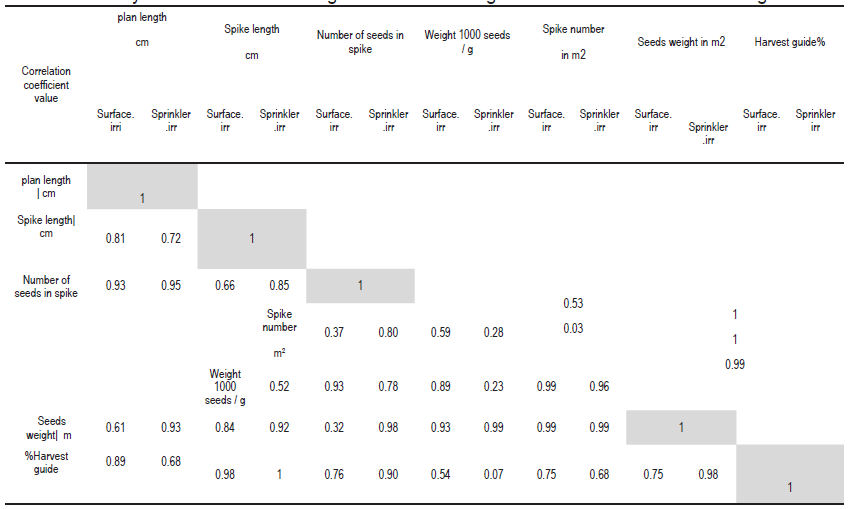
The following table shows the simple correlation coefficient between the studied charac-teristics in an experiment using two types of irrigation methods (spraying - irrigation and four levels of nitrogen fertilization (0, 5, 10, 15) kg | Acres - second batch and four levels of nitrogen fertilization (0, 5, 10, 15) kg | Acres - second batch.
The correlation coefficient showed that the relationships between the apparent character-istics of wheat plants, shown in the following table, are all positive, and the difference in their strength depends on the irrigation method and the fertilizer dose of urea. The cor-relation coefficient was highest in irrigation with spraying, and this is consistent with the significant differences that were shown.) 6- Conclusions
The study showed that increasing the levels of nitrogen fertilizer increased the average
plant height, the number of ears in m2, the weight of grains in m2, and the weight of 1000 grains - gm. The reason is attributed to increasing the efficiency of photosynthesis by increasing the manufactured materials, which had a positive effect and increased their weight. This means that nitrogen is the nutritional element. The first determinesthe production of agricultural crops.((Abdul Hadi, 2009) Nitrogen is the first nutrient fertilizer that wheat requiresIt is noted that there are significant differences between the levels of nitrogen. fertilizer, and there are also differences according to the irrigation method.
The sprinkler irrigation system gave the highest rate of grain yield characteristic compared to surface irrigation, and (this result is consistent with (Al-Arquazi 2010))Straw weight increases with increased nitrogen.Increase the number of ears by increasing the dose of nitrogen.The number of grains per spike increases with the increase in the nitrogen dose.
RECOMMENDATIONS
We recommend using the sprinkler irrigation method instead of surface irrigation to treat the water shortage because of its results in increasing production quantitatively and qualitatively
The need to use the fertilizer dose of urea15 kg / dunum because it was the best
Avoid using sprinkler irrigation in case of strong wind speeds greater than 15-20 km per/hour that hinder the regular distribution of water on the ground. also, the water used in irrigation is of high salinity.
REFERENCES
Mousa, R. A., & Ulas, A. (2022). The effect of some irrigation systems and the reduction of mineral fertilizers on soil salinity and the growth and yield of wheat crop. Journal of Agricultural, Environmental and Veterinary Sciences, 146, 146–158
Abdul Hadi, A. H. (2009). Nitrogen, phosphate, potassium and micronutrient fertilizers in Egyptian agriculture. Agriculture Research Center, Land, Water and Environment Re-search Institute, Department of Land Fertility and Plant Nutrition Research.
Alarquoise, A. L. A. (2010). The effect of different levels of urea fertilizer and superphos-phate on some components of wheat yield. Agricultural Journal of Science Diyala.
Hussain, I., Khan, M. A., & Khan, E. A. (2006). Bread wheat varieties as influenced by different nitrogen levels. Journal of Zhejiang University Science B, 7(1), 70-78.
Nazzal, H. T., Mudhahi, A. A., & Faris, H. M. F. (2010). Determining the optimal area for wheat using sprinkler irrigation. Iraqi Agricultural Sciences Journal.
Hadi, B. H., Hassan, W. A., & Khalaf, N. S. (2016). Genetic and phenotypic changes, correlation, and path analysis of bread wheat varieties. Al-Furat Journal of Agricultural Sciences, 8(4).
Al-Dairi, W., Toushan, H., Badlisi, S., & Basal, A. (2011). Study the influence of some irrigation methods on the productivity of two irrigated cereals on some physiologicalparameters in Maskane Region, Syria. League of Arab States | Arab Center for Devel-opment.
Nicou, R. B., Outtara, L., & Some, L. (1990). Effets des techniques d’économie de l’eau à la parcelle sur les cultures céréalières (sorgho, mil, maïs) au Burkina Faso. Agronomie Tropicale, 45, 43-57.
Al-Jubouri, N. N. I., & Al-Samarrai, H. T. Z. (2014). Volume economies of wheat crop using sprinkler irrigation in Salah Governorate. Tikrit University Journal of Agricultural Sci-ences, Issue 3.