

Artículos de investigación
Look At the Real World Through the Images and Talk About It
Ver el mundo real a través de las imágenes y hablar de él1
Revista de Investigaciones de la Universidad Católica de Manizales
Universidad Católica de Manizales, Colombia
ISSN: 2539-5122
ISSN-e: 0121-067X
Periodicity: Semestral
vol. 16, no. 28, 2016
Received: 31/07/2016
Accepted: 30/08/2016
Abstract: Objective: to determine what happens when musical learners use audiovisual aids for English speaking skill development. Methodology: as object study, it was taken six musical learners, who were chosen according to multiple intelligence text proposed by Gardner. For collecting data three instruments were used: interviews, video recording and journals. Findings: the results indicate that learners develop their English speaking skill when their interests, specific intelligence, and the use of the real language are evolved in the English teaching process.
Keywords: audiovisual aids, English speaking development, musical intelligence, real use of the language.
Resumen: Objetivo: determinar qué sucede cuando estudiantes de música utilizan ayudas audiovisuales para el desarrollo de habilidades en Inglés. Metodología: se tomaron seis estudiantes de música como objeto de estudio, escogidos de acuerdo con el texto de inteligencias múltiples propuesto por Gardner. Se utilizaron tres instrumentos para la recolección de información: entrevistas, grabaciones de videos y diarios. Resultados: los resultados indican que los estudiantes desarrollan su habilidad para hablar en inglés cuando sus intereses, inteligencia específica y uso real del lenguaje están involucrados en el proceso de enseñanza del inglés.
Palabras clave: ayudas audiovisuales, desarrollo del habla inglesa, inteligencia musical, uso real del lenguaje.
Introduction
When students learn a foreign language in a communicative way, they can use it in real situations (inside and outside the classroom). That is why teachers and researchers began to create new methods that aimed to the real use of the foreign language, based on communicative approaches, that allow learners to interact with others in order to develop worldviews, and be critical people within the society, as well as, understand the context they live in. According to Jack C. Richards and Theodore S. Rodger (2001): “In Germany, England, France and other parts of Europe, new approaches to language teaching were developed by individual language teaching specialists, each one with a specific method for reforming the teaching of modern languages” (p.7). Taking into account the previous ideas, these new approaches emerged with the objective of reforming classes that were focused only on grammar instruction and repetition of pieces of speech.
One of the methods originated in these approaches is the Task Based Language Teaching, in which students are given functional tasks that invite them to use the target language for non- linguistic purposes, like interacting with others in different real contexts. In second language research, tasks have been vehicles to elicit production, interaction, and processing of input, all of those aspects are supposed to foster foreign language acquisition.
Based on some observations and my pre-service teaching English practice in the context of study, I could identify that teachers use the same kind of resources and activities in the English class like textbooks and posters, board, texts translation, thus the interests and needs of most of students are overlooked. Taking into account this situation, I carried out this project, which looked for the applications of audio visual aids in relation to the most common students’ intelligence, throughout eleven workshops with the purpose of developing English speaking skills, based on the task based language teaching method.
Literature review
Communicative language approach
To start, it is important to see how language teaching in the twentieth century was characterized by changes and innovation of language teaching ideologies. Thus, new approaches to language teaching arose, such as the Communicative Language Teaching (CLT), where students started to be engaged in real communication, interaction and authentic language use. In second place, according to Brown (1994) beyond grammatical and discourse elements in communication, it is proving the nature of social, cultural and pragmatic features of language. It is exploring pedagogical means for “real life” communication in the classroom.Brown’s view is better understood on the light of Nunan’s features, cited in Brown (1994, p. 78) and listed below, which for the purpose of this project were taken into account. Those characteristics are:
a) “An emphasis on learning to communicate through interaction in the target language; b) The introduction of authentic texts into the learning situation; c) The provision of opportunities for learners to focus, not only on language but also on the learner process itself; d) An enhancement of the learners own personal experiences as important contributing elements to classroom learning; e) An attempt to link classroom language learning with language activation outside the classroom.
In this sense, the communicative language approach aims to make the communicative competence the goal of the language teaching, not only inside the classroom but also outside. Thus, Berns (1984) says:
Language is interaction; it is interpersonal activity and has a clear relationship with society. In this light, language study has to look at the use (function) of language in context, both its linguistic context (what is uttered before and after a given piece of discourse) and its social, or situational, context (who is speaking, what their social roles are, why they have come together to speak (p. 5).
In consequence, the acquisition of language takes places through the communication; it means that Communicative Language Approach brings to the classroom authentic language use, real life communication and interaction, so that, these kind of activities fit the interests of the teachers and students. According to Hyme’s view when a learner acquires the communicative competence acquires both knowledge and the ability for the language use. Moreover, the communicative competence is composed by four dimensions, which are: grammatical, strategic, discourse and sociolinguistic competence.
Task based language teaching
Task Based Language Teaching (TBLT), approach constitutes a strong version of the (CLT) because it provides a natural context for students to engage in real life tasks in which they use the language that is relevant for them. A task involves real-world processes of language use as well as pedagogic communicative activities. Thus, as tasks are almost always familiar to students, they are more likely to be engaged, which may further motivate them in their language learning.
Regarding the types of tasks, Nunan (1993) distinguishes between two kinds of tasks: Real world tasks and pedagogical tasks. Real-world tasks are designed to emphasize those skills that learners need to have, so they can function in the real world. Such tasks normally simulate authentic task behavior, and their focus is often the achievement of an end product. On the contrary, pedagogical tasks act as a bridge between the classroom and the real world in that they serve to prepare students for real-life language.
They are designed to promote the language acquisition process by taking into account a teacher’s pedagogical goal, the learner’s developmental stage and skill level, and the social contexts of the second-language learning environment. They often help learners to understand how language works and also the development of learning skills and strategies in general. In relation to the theory of learning (Richards & Rogers, 2001), identify that a task offers the input and output processing by means of feedback necessary for the language acquisition; a task activity and achievement are motivational; learning difficulty can be negotiated and fine-tuned for the pedagogical purposes.
The TBLT aims at the use of authentic materials like photographs, video selections, and other teaching resources that are not specially made for pedagogical purposes, because those materials contain authentic language and reflect real-world language use about students’interests. Prabhu (1987, as cited in Littlewood 2004) considers that students learn more effectively when their minds are focused on a task, rather than on the language they are using. When students are exposed to do the different tasks, the TBLT enables teachers to recognize if the students are developing the ability to communicate in the target language.
Audiovisual aids
Lee (2000) defines an audiovisual aid as “any device used to aid in the communication of an idea. Audiovisual aids can help a student preparing for a particular occupation. Besides they can illustrate environment and situations for language use” (p.27).That is why, the use of audiovisual materials and methods increases the effectiveness of learning by helping students to assimilate ideas in a more meaningful and interesting way.
The importance of audiovisual aids in the English teaching
The implementation of audiovisual aids in the English teaching is closed to Task Based Language Teaching, because through its application we as teachers can bring into the classroom the real world. Those visuals can help make a task or situation more authentic (Canning-Wilson, 1999). Furthermore, the audiovisual resources make the English teaching and learning more meaningful and interesting. In this sense, Mannan (2005) says: “audiovisual aids help the teacher to clarify, establish, correlate and coordinate accurate concepts, interpretations and appreciations, and enable him/her to make learning more concrete, effective, interesting, inspirational, meaningful and vivid” (p. 108).
Finally, the current studies related to the use of audiovisual aids have demonstrated that memory for visual elements tends to be better than memory for words. Similarly, Moriarty (1994) also claims that human beings develop their visual language skills before the verbal language development, that is the reason to assert that human beings before reading words they learn how to read and comprehend the world.
Types and common audiovisual aids in the English teaching
There are different kinds of audiovisual material that teachers can use according to what they pretend to achieve during the English teaching and learning process. For this project the most common audio materials used were: songs, conversations, dialogues, images, videos. Those audiovisual materials were chosen under two assumptions; firstly, because they are useful to improve the English speaking skills; secondly because these audiovisual aids work directly with musical learners.
Songs for the development of the speaking skill. There are hundreds of strategies in teaching speaking. One of them is by using English songs. English songs are amazing, authentic materials, and also good for teaching vocabulary, intonation, rhythm and pronunciation, etc.Davies (2000) asserts that: “Songs are very valuable in developing powerful access to the new language by being enjoyable, fostering confidence, and, increasing attention span and motivation to learn” (p.148). Songs provide contextualized word meaning, grammar, cultural aspects which are fun and easy for students to comprehend. They can provide valuable practice for speaking, listening and language practice inside and outside of the classroom but what is really interesting is how to motivate the development of the speaking skill, especially, in the musical learners.
Flash cards and pictures for oral composition. Wright & Haleem (1991) state that flash cards are normally used by the teacher in oral work for cueing responses to questions or in more open communicative work for stimulating conversation, storytelling, etc. Pictures can make a task or situation authentic, since, they help to identify or manipulate structures, vocabulary, functions, situations and skills. Furthermore, flash cards are useful to build up a story telling or paragraph with meaning and coherence.
CD player. Haycraft (1978) states that “Tape recorder is an indispensable classroom aid. It brings other voices into the classroom and gives the students valuable practice in listening to varieties of English different form the teacher’s” (p.32).The use of tape recorders help students to show segmental features of English a word level especially vowels and consonants sounds, stressed and unstressed syllables. It can be used in connection with other activities like dialogues, conversation, songs, etc., likewise by using a tape recorder teachers can bring into the classroom “native” speech.
Video. Haycraft (1978) asserts that video is a great tool to implement inside the classroom because it provides authentic language input, since movies and TV programs are made by native speakers, letting students have contact with real language use, which includes additional elements as idioms, facial expression, gestures, or details of the environment.
To support the previous ideas some studies carried out by Mukherjee & Roy (2003) have demonstrated that the use of visual aids to contextualized spoken speech it is a great help for students, as they can understand 30% more than without the visual support. Likewise, Canning Wilson (2000) carried out a research process in which they found that audiovisual aids are useful to comprehend the meaning of the message conveyed by the speakers thanks to the paralinguistic cues.
As well, the use of audiovisual aids are related to motivation. To explain better this idea Gilakjani (2011) identified some of the problems of EFL learners in classrooms. They include demotivation, less exposure to English language, lack of emphasis on pronunciation and the intervention of the sounds and rules of the first language. These issues were solved by bringing to the classes audio visual aids.
On the other hand, Clark & Lyons (2004) explain that in the learning process two common types of memories are involved: working memory and long-term memory. The new knowledge is keep on the working memory, which is claimed to be the center of active mental work, including the learning. When the visual and phonetic information is received then it is organized to form a cohesive idea. Finally this idea must be integrated with active prior knowledge from long term memory. It means during the cognitive development, the two memories work together in complementary way, to form what is called an updated mental model that will be stored in long-term memory; it allows the learners to express ideas and acquire new contextualized vocabulary. Taking into account the way that human beings learn by means of two memories, there is a direct connection between musical learners and long -term memory due to the fact that people who learn by using musical intelligence are characterized by a strong long-term memory.
Multiple intelligences
Gardner (1999) asserts that multiple intelligences are “the capacity to solve problems or to fashion products that are valued in one or more cultural settings” (p.57). According to the author, human beings possess all the intelligences in different degrees, however, each individual manifests varying levels of these intelligences, this fact evidences that each person has a different learning style or “cognitive profile”, so that, by applying multiple intelligences in the classroom teachers can improve education. The author recognized eight Multiple Intelligences, which are: Linguistic, Logical-Mathematical, Spatial, Bodily Kinesthetic, Musical, Interpersonal, Intrapersonal, and Naturalistic Intelligence (Gardner, 1999).
Multiple intelligences in foreign language learning
Nolen (2003) suggests that the presentation of foreign language teaching material should involve most of the intelligences due to the fact the intelligence is potentially available in each learner. In order to support the effectiveness of a multiple intelligence classroom approach, “Emig (1997) associated MIT with “magic” since it is highly advantageous for both students and teachers because they feel more competent and confident in an MI-based classroom”.
By using the multiple intelligences in the classroom, we as teachers provide a comfortable atmosphere for authentic learning based on students’ needs, interests, and abilities. The multiple intelligences are connected with the Task Based Language Teaching Method because students are exposed to use the language by means of tasks. For example, ask for students to read texts aloud and tell stories with rich gestures and expressions, or represent and important character. Encourage them to illustrate the pictures in the discourse, ask them to answer questions with the aid of real objects, ask the English group to defend ideas or have discussions on specific tasks; meanwhile, they are interacting through those activities at the same time they are learning by means of Multiple intelligences.
There are many strategies to design classes applying multiple intelligences in the English teaching process. Those strategies include “(a) collaborating with other teachers, (b) providing students with various presentation options, (c) incorporating multiple intelligences in cooperative learning groups, and (d) involving education stakeholders and guest speakers” (Educational Broadcasting Corporation, 2004a, pp. 4-5).
Teaching and learning with multiple intelligences allow teachers to bring to the classroom multiples possibilities to guide the apprehension of knowledge; what is more, it is a crucial point to follow student’s learning style. It means that teachers can plan their lessons in a wide variety of ways using music, cooperative learning, art activities, role-plays, acting from a script, among others.
Musical intelligence
According to Gardner (1999), musical intelligence is “the capacity to think in music, to be able to hear patters, recognize them, and perhaps manipulate them” (p. 17). People with this kind of intelligence have strengths in picking up sounds, remembering melodies, singing and playing instruments. They learn best when they are exposed to rhythm and music. Likewise, Gardner proposes eight music factors: discrimination of tones and sequences of tones; tonal imagery; discrimination and judgment of tonal patterns in musicality; temporal tracking; ability to recognize and maintain mentally an equal-time beat; ability to retain, on a short-term basis, images of tones, tonal patterns, and voices; and absolute pitch ability.
The musical intelligence is located in the right hemisphere of the brain, the musical intelligence’s grasp of subtlety and complexity is virtually unlimited. A musical child learn best when music is part of their daily life. Activities such as singing, listening to music, dancing, playing an instrument should be part of their everyday routine.
Additionally, the author suggests that musical intelligence is parallel in structure with the linguistic one. The musical intelligence and linguistic intelligence work together, for example rhythmic, intonation of words have long been associated with music. Music is related to dance, song, and gesture, places where speech and writing also have deep roots. “The spoken word is a form of music”. Spoken language it expressed by different rhythms and patterns, that is why to supported the instructional design purpose of helping musical learners to develop speaking skill through the use of the audiovisual aids described above.
Speaking skill
According to Harmer (2001) is “The ability to speak fluently presupposes not only knowledge of language features, but also to process information and language on a spot” (p. 28). Taking into account the previous assertion, the speaking skill goes beyond of the knowledge of the grammatical rules of any language. Moreover, learners want to manage it as soon as they can; however, it is one of the most difficult skills to get because it involves almost all the language components like grammar rules, pronunciation, listening, mastery of stress, pragmatic, etc. In this sense, Bueno, Madrid & McLaren, (2006) assert that:
Speaking is one of the most difficult skills language learners have to face. In spite of this, it has traditionally been forced into the background while we as teachers of English have spent all our classroom time trying to teach our students how to write, to read and sometimes even to listen in a L2 because grammar has a long written tradition (p. 321).
Feedback in the speaking skill
The feedback plays a significant role in communication because it is the return message. Without the return message, communication would be unidirectional and for effective communication we need at least two parties in the first place. When learners are exposed to interact with their partners or teacher, something wonderful happens, it is the time where feedback takes place. Without communication there is not feedback. This concept is a crucial point in the development of the English speaking skill, since learners and teacher can “correct” and can be corrected, it means that feedback is a reciprocal process. To explain better this idea Hattie & Timperley (2007) argue that:
Teachers or parents can provide corrective information, a peer can provide an alternative strategy, a book can provide information to clarify ideas, a parent can provide encouragement, and a learner can look up the answer to evaluate the correctness of a response. (p. 81)
So that feedback offers the learners the chance to follow not only his/her own learning process but also to contribute to his/her partners learning acquisition.
Elements of speaking
Speakers of English, specifically, where it is a foreign language, they have to know some elements related to the speaking skill in order for them to be able to speak in a range of different genres and situations. Likewise, they have to be able to use a range of conversational repair strategies. Knowing these elements, allows the speaker to stay active in typical functional exchanges. Such elements are:
Different speaking events: Thornbury & Slade (2006, pp. 13-14) suggest various dimensions of speaking events. The authors make a distinction between transactional and interpersonal functions. The first one is related to the conveying of information and facilitating the exchange of goods and services, on the other hand, the interpersonal function involves maintaining and sustaining good relationships among people.
Conversational strategies: a) Conversational rules and structure: It is related to categories of discourse, such as, conversational openings and closings; b) Survival and repair strategies: It involves asking for repetition by using formulaic expressions, repeating up to the point of conversation break down, etc.; c) Real talk: The exposure to real contexts situations; teacher leaves textbooks aside, and let students get involved in spontaneous conversations outside the classroom.
Speaking micro-skills: speaking divides into some categories, which are related to the different sub-abilities that the speaker needs to master, they are: Pronounce the distinctive sounds of a language clearly enough, so that, people can distinguish them. This includes making tonal distinctions. Use stress and rhythmic patterns, and intonation patterns of the language clearly enough so that people can understand what it is said. Use the correct forms of words. For example, changes in the tense, case, or gender. Put words together in correct word order. Use vocabulary appropriately and so forth.
Classroom speaking activities
There are a great number of classroom activities which aim to speaking skill. They let students get involved in different situations, where they can use a range of communication strategies in order to express ideas and interact with others. Some of such activities are described by Harmer (2007).
Acting from a script: teacher can ask students to act scenes from a play or to carry out dialogues written by themselves. It makes learners to get familiar with the theme and motivate them to perform stories created on their own.
Communication games: help students to talk as quickly and fluently as possible. In this category two types of games are distinguished: information gap games (those in which students exchange information in order to complete a required activity.) and television and radio games (they provide good fluency activities inside the classroom).
Discussion: it is a more formal and usually topic-centered talk. It focuses on a specific topic or purpose. Discussion involves buzz groups, instant comment and formal debates.
Concerning those activities, it was taken into account the characteristics and criteria of the acting and communication ones, that were implemented within real situations and based on musical learners needs. Such activities have the purpose of promoting interaction among students and the real use of the target language to communicate.
Research design
The research is based on a qualitative approach. According to Sandin (2003), the qualitative research is “a systematic activity guided to the comprehension of educational phenomenon and the transformation of the socio-educational sceneries” (p. 123). The type research of the project is action research, given that my purpose with its implementation was to make the diagnosis of a problem, look for information or research about the topic and aspects related to it, plan an action, implement the action, reflect on observations and apply some strategies in order to change it; those steps are proposed by Cárdenas (2000).
Population
The population selected to work was seventh graders, at Coronel Juan José Rondón high school. The course was integrated by sixteen seventh graders, 2 young girls and 14 young boys aged between 11 and 13 years old. The participants involved in the implementation of the pedagogical strategy were 6 students, who were musical learners. However, from the beginning to the end, the implementation was carried out with the whole group.
Method
Throughout the application of the pedagogical proposal, learners worked once a week during four months. I designed eleven tasks that follow the PPP theory about the steps in a lesson plan (Presentation, Practice and Production) proposed by Harmer (2001). All of them were based on the use of audiovisual aids in order to develop musical learners’ speaking skill. Moreover, they were organized in three stages. The first one, aimed at developing student’s awareness about the importance of being competent in English nowadays. The second stage aimed at promoting individual oral production; it sought that students produced basic sentences to talk about different cultures, music, singers, and retell short stories. The last one aimed to motivate students to interact, so that, they produce simple sentences, short texts and finish constructing complete oral texts with coherence, cohesion and appropriateness.
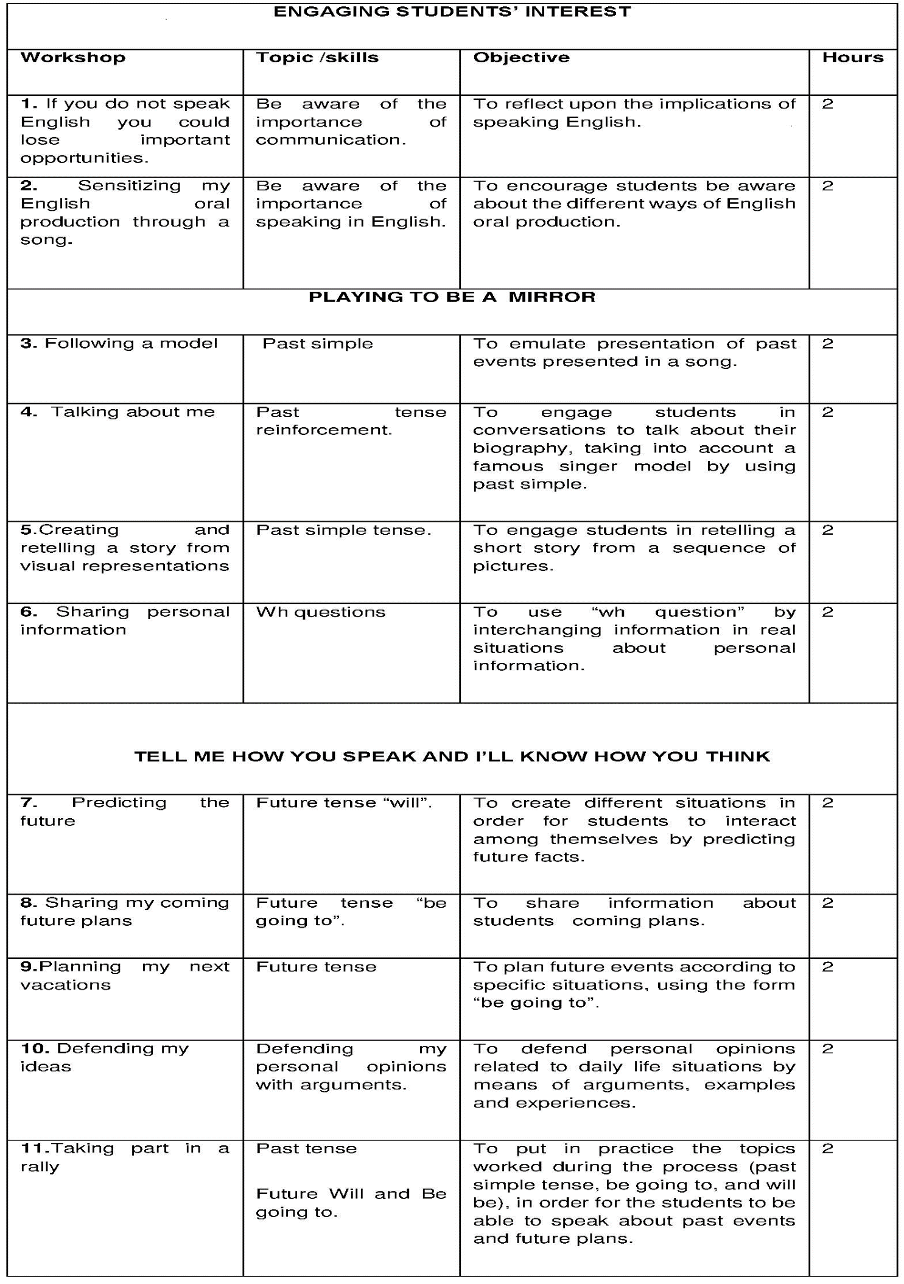
Instruments, techniques and procedures for data collection
In order to collect information the elicitation and observation techniques and their instruments: interviews, video recording and journals were used. Thus, Gubrium & Holstein (1995) establish that: “elicitation technique uncovers an articulated informant knowledge” (p. 138).
Journal: this instrument was used to report students’ behaviors during the development of the workshops. Then, I reflected upon the taken notes, principally, those aspects related to students speaking skill and their encouragement.
Interview: the interviews aimed to draw out opinions and information in relation to students. They were a mean of collecting opinions and feelings of students regarding the activities based on audiovisual aids. I interviewed six students, subjects of the study, in the middle and at the end of the proposal implementation in order to get a general view of all the process.
Video recording: it is to document what was actually done and the results that were achieved. This instrument was used to record students’ reactions and attitudes, as well as, their speaking skill behavior and features during the development of the workshops.
Data analysis
The data analysis of the project was oriented by the grounded theory created by Strauss & Corbin (2008),they assert that “it is a qualitative method that uses a systematic set of procedures to develop an inductively derived grounded theory about a phenomenon” (p. 12). In this sense, the analysis of information was based on the following range of steps, through which I explained all the process the project follows: First, in order to collect data, I used journals, interviews, and video recordings. Such instruments provided information regarding the use of audiovisual aids and speaking skill in musical students. Second, once the data collection stage finished, I identified key points, classified, coded and grouped the different aspects into similar concepts, which provided information for the project, in order to form categories and subcategories of analysis. Finally, from the classification of the information, I established categories and subcategories, taking into account similar aspects and the nature of them.
The next table shows the main category at the top, followed by the two sub-categories emerged from the data analysis that hold a dynamic relation in which they cannot be separated one from other because the two sub-categories give account of the main one.
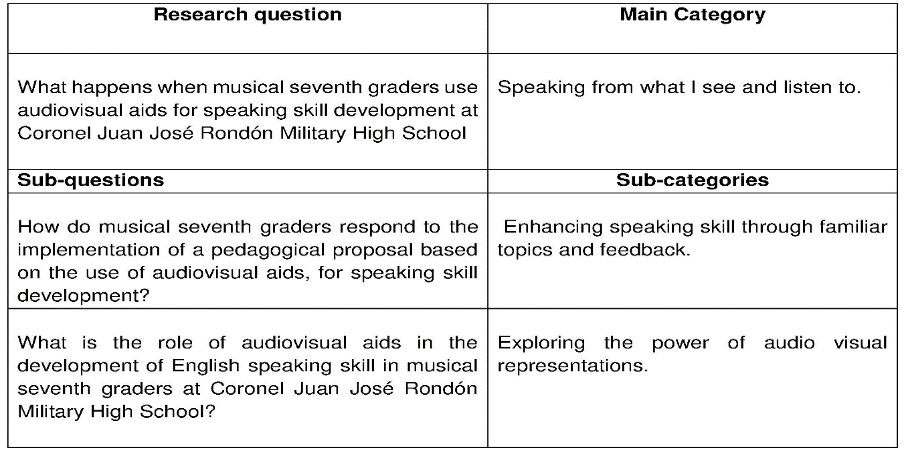
Shaping my speaking from what I see and I listen to. After grouping, organizing, reading, and analyzing the information gathered among participants through the three instruments, the core category was established as the one which responds to the main research question. This main category displays how the parts of data grouped in the two subcategories connect into a whole. The main category was metaphorically called: shaping my speaking from what I see and listen to, based on two important issues. On one hand, as it was already stated in the theoretical framework, the speaking skill is the one that all learners want to develop so quickly; however, it is one of the most difficult skills to build up, because it involves almost all components of the language. Under this assumption, developing speaking skill in a foreign language classroom results from the practice and use of the language by means of a conscious and an unconscious process everyone does according to the interaction of internal and external factors they are exposed to. On the other hand, all participants, as noticed in the next excerpts taken from one interview they responded to and the video N°2, agree that both images and oral input help them to express and use spoken language.
The posters are useful, because throughout images, we can not only express ideas, but also understand what we are learning. The videos are useful too; however, by seeing the images we learn more because we see the picture and after we can talk according to what we have seen. So that, the images can help us to understand and comprehend what we already have learned (Rodrigo).
What is mentioned above is also showed in the next example of a classroom activity about future predictions.
Junior: good morning.
Christian: good morningJunior: tell me, tell me about my future
Christian: what is your zodiac sign?
Junior: my zodiac is Sagittarius
Christian: ehhhhhh ok..you, you will have a car. (The student looks straight one of the cards provided by the teacher).
Junior: ohhh yes.
Christian: ehh, you will have eehh a house (the student selects one card and looks at it while doing the prediction)
Junior: ohhhh my God.
Christian: ehh, you will have two...you will have two babies? (The student looks the image).
Junior: yes?Christian: ehh, you will have ahhh no you will jet (instead of get) you will jet money.
Junior: ok.
The findings reported above are supported on one hand, by the research on the impact of images in learning, highlighted on Bower studies. This author states that if the person hears or reads a story, and at the same time he/she makes a mental representation of it, his/her comprehension is better, since they have a conscious and unconscious effect that makes learners internalize complex concepts in a more meaningful and faster way.
On the other hand, images are concrete forms to represent the world and for this reason, students can make associations among contents, their inner world and their previous knowledge in order for them to get a better understanding of them, due to the context that graphic representations provide for different kinds of topics.
Regarding the role of what students listen in order to shape their speaking skill, in this project was important to provide them with different types of spoken discourse in a variety of speaking situations such as interviews, daily life conversations, speaking about personal life, songs about friendship, making future plans, among others.
To sum up, , the main category “shaping my speaking from what I see and listen” emerged from the information gathered along the implementation of a pedagogical proposal based on the use of audiovisual aids in order to develop musical learners’ speaking skill. It means moving across experiences in which both the role of audiovisual materials and the students responses towards it work in a dynamic relation to make that image and oral input trigger students’ speaking.
First subcategory: enhancing speaking skill throughfamiliar topics and feedback
This subcategory emerged from the analysis of two well identified patterns: Familiar topics to set short dialogues and learning from others. The first one put in evidence how and when the students are framed in communicative situations and topics that are related to their lives, they find a reason to speak and look for means to cope with conversation. The second one showed the benefits of feedback to improve the speaking skill.
To understand what this subcategory embodies, I bore in mind the suggestions stated by Hedge (2000) in the sense that apart from producing features of pronunciation, vocabulary and structure accurately, these features should be practiced in purposeful communication and also consider interaction management.
In this sense, interaction was a powerful aid, which facilitated musical learners to understand and produce the language in an oral way for communicating with partners, helped by different audio visual aids like posters, flashcards, images, CD player, videos in which they based their own opinions and guided themselves while using English to speak and discuss controversial topics. As a result, they learned how to make short dialogues and started to perceive the communicative functions of the language.
The familiar topics pattern to set short dialogues, allowed me to see the progress the students had from one of the constrains they had to develop speaking skill before the implementation of this project, in which they, as many learners who are starting to have contact with a new language, are mostly focused on grammar aspects and rules, and they cannot experience its communicative functions.
For these reasons, throughout the development of the research proposal, students, especially those with musical intelligence, fostered their speaking skill because they were allowed to go beyond grammar rules in order to use them for referring to different topics, particularly those concerning to themselves and familiar matters to them.
In relation to this, Monsalve & Correal (2006) studied the development of students’ oral communication in English and the way in which the activities and teachers’ roles created students’ opportunities for learning. They found that oral production was possible thanks to the fact that teacher involved students in topics and activities close to their interests and needs. Likewise, by means of interactive activities students perceive and learn grammar aspects applied in contexts where they can speak with other people using the language they know, so that, they can exchange contents, ideas, opinions and English knowledge itself.
On the other hand, by referring to familiar topics, students can trigger their previous knowledge in order to have a better understanding of the new topics. Vigotsky (1992) said that if a learner can refer about any complex concept in their own words his /her intellectual coefficient will be increased. Thus the new theories that human beings are facing the need to be connected to the previous knowledge and this process is promoted by interaction which gives learners the opportunity to receive comprehensible input which aims to language learning, because such input takes place in meaningful contexts of communication where the language is used for real purposes (giving opinions, sharing experiences, etc.)
In this sense, familiar topics were worked to make students speak by activating their previous knowledge through a variety of audio visual resources which created a bridge between theory and their own likes and preferences. The aspects mentioned above are evidenced in the next sample of a video; it belongs to the workshop number seven which topic is “Predicting the future”, where students assumed different roles to tell their classmates their fortune.
Oscar: tell me about my future.
Alejo: what is your zodiac sign?
Oscar: my zodiac sign is Sagittarius
Alejo: ok... you will have a girlfriend. Ok, you will have a dog
Oscar: oh, my God !
Alejo: you will have a car red.[sic]
Oscar: thanks you.
Alejo: you’re welcome.
In the previous transcriptions it is remarkable the students’ language awareness. They set a coherent conversation by making and answering questions with their classmates and using the appropriate verbal tense according to the meanings they wanted to express. Likewise, the implications in the use of familiar topics to encourage student’s motivation and oral production were traced in the following two paragraphs of a teacher’s journal: “You can notice that learners feel motivated when they are asked to refer about their personal information and their classmates taking into account that those themes are very close to them”.
The achievements described above while the students deal with familiar topics to set short dialogues were also the ground to have a confident environment in which their speaking skill was enhanced thanks to input provided by their classmates’ speech and feedback, as can be seen in the next lines.
The other pattern of this category, learning from others is coherent with the assumption that feedback is an essential aspect in the English learning process, because it is a formative assessment. It means feedback gives teachers the chance to correct the mistakes made by their students, as well as, students have the opportunity to reflect and correct their own mistakes among themselves.
Nicol & Macfarlane (2006) suggest that “feedback serves as a form of formative assessment, designed to improve and accelerate learning”. Specifically, they describe feedback as “anything that might strengthen the students’ capacity to self-regulate their own performances” (p. 206).
Taking into account all the aspects mentioned above, feedback is a crucial point in the English learning process, specifically when students are asked to use English in oral way in order for them to interact with their partners. Regarding this point, from the Vygotskyan sociocultural view, corrective feedback occurs within a social context through which learners work collaboratively to solve linguistic problems (Nassaji & Swain, 2000).
Concerning such feedback roles, they took place throughout the implementation of whole workshops, taking into account that most of the activities were designed in order for students to interact among them. So that, when working in groups to develop the different exercises, students were listened by their classmates, in this way, they could correct the others and receive corrections from them and the teacher. For instance, in the initial stages, students made several mistakes and in the final ones they showed a significant progress, because they did not make the same mistakes anymore.
In relation to this, most students asserted that the interactive activities gave them the chance to give and receive feedback due to the fact that they could increase their knowledge when correcting and being corrected. To illustrate these findings we selected the next excerpts taken from some interviews:
Teacher: how hase your experience been with the activities carried out with your partners in the English class?
Narciso: well, I have enjoyed the activities because my classmates and me learn cooperatively, if we make a mistake among us the teacher corrects the mistake.
Teacher: in what extent the interaction with your pals have propitiated the English oral communication?
Héctor: well, the interaction has helped me when we talk about different topics in English, I mean, we interact and share, so that, we learn from the others.
Teacher: do you learn more?
Hector: yes, I learn faster, moreover we practiced the English outside the classroom, we not only learn the structures of the language, but also the function of it, so in that way is easier to learn how to speak in English.
According to the previous examples, we can notice students’ opinions in relation to the influence of interaction in their English speaking skill, in order to shape their language proficiency by correcting and being corrected by the others. Thus, this oral process is more meaningful for them than studying the language only as a set of rules and grammar aspects.
Second subcategory: exploring the power of audiovisual representations
This sub-category, intended to depict how audiovisual representations help learners to go beyond mechanic language use. This sub-category emerged from two well-identified patterns: One image is worth a thousand words, songs and videos as models of speech.
One image is worth a thousand words. Images facilitate written and oral information understanding because in this way contents are illustrated, so that, students can visualize theories in a more concrete context, by looking at a picture, learners can activate their previous knowledge in order to refer to new situations they have contact with. Regarding this assertion, Hill (1990) stated that images are used as a “stimulus for writing and discussion, as an illustration of something being read or talked about, as background to a topic and so on” (p. 15). That is why, regarding English language and teaching; pictures, posters, videos, flash cards, etc., help students to remember topics within different situations and hold up student’s speech at the moment of speaking.
Consequently, for learning meaningfully, images relate new knowledge with students’ own ideas. So that, images become supporting tools to get representations. According to Ausubel (1968), learning is comprehending, it means, English acquisition only takes place when students understand the functioning of the language itself based on their internal processes rather than external answers.
In relation to this, in the different workshops’ exercises students mainly musical learners could remember vocabulary and knowledge on topics which had to do with different areas such as music, stories, biographies, predictions, supported by images and those concerning to their own lives. When the students look at the images represented, they immediately mentioned the different components; learners not only read the stories and songs, but also they heard and talk about them using graphic representations.
On the other hand, images facilitated students to support their ideas in oral way, since they could describe them to refer to stories, experiences, giving critical opinions and so forth. In this way, they talked about different topics based on what they saw in the audiovisual materials presented such as posters, videos, flashcards, etc.
This idea is supported by some students’ opinions stated in the next samples taken from an interview, which had the purpose of knowing the perceptions of students in relation to audiovisual aids and interaction during the development of the research process.
Teacher: what is your opinion in relation to the use of audiovisual aids (images, videos, songs etc.) in the English class?
Lorenza: ok, I think images, videos, songs etc., and every material that the teacher has brought to the classroom makes the learning process easy and funny because these activities increase motivation levels.
Rodrigo: the audiovisual aids help us understand, comprehend the words and the concepts we just learned.
Another important function of images to foster students’ speaking skill was that such resources helped students to be logical in constructing their speeches. This aspect is related to coherence gives the utterance a sense in order to beunderstood by people who listen or read it, without this element it is difficult to express ideas to communicate complete meanings.
In relation to the research proposal, coherence was shaped thanks to sequences of images, which refer to stories, biographies, etc. Thus, when the students faced situations in which they had to speak in English to refer to the topics mentioned previously, the visual representations helped them to keep the coherence at the moment of producing their own speeches. They learned how to follow a logical sequence of events at the moment of telling a story, referring to someone else’s life even when talking about their own experiences with their classmates, also students have a context where they received input in an easier way, by studying the different grammar aspects in situations they know in order to communicate and associate them with their own lives and their previous knowledge as are evidenced in the next sample of a video, which belongs to the workshop number five:
Students had to retell a short daily routine using a sequence of images, so that, they could produce short speeches in order for them to retell the story using the different events showed in the images. It allowed the students build up and retell a story coherently.
Héctor: (looking at picture 1) the father of the boy woke him up.
Oscar: (picture 2) the boy took a shower in the bedroom (addressing to the audience) Look!
Angela: (picture 3) the boy got dressed to eat breakfast with your [sic] family (in this moment the teacher clarify the use of possessive adjectives taking into account the student’s mistake).
Héctor: (picture 4) He took the breakfast with her...his father. [sic] (He shows the picture to his classmates)
Teacher: guys, don’t say take breakfast you must say, “Have breakfast” ok? Repeat: have breakfast.
Students: Have breakfast!
Oscar: (picture 5) Ok, eeehh the boy went to school to study.
Angela: (picture 6) Yes, ok The boy arrived to the house to sleep (the boy pronounced arrived).
Teacher: Angela please repeat (/əˈrɑɪvd/)
Angela: (/əˈrɑɪvd/) (by this time she pronounces the word correctly).
Songs as models of speech. The second pattern identified in the data analysis emerged from the recurrent interest the students showed in the experience about music, what is coherent with the assumption that music is a crucial part of human existence.
Taking into account the previous ideas, music (specifically songs) plays an essential role in the English learning process, particularly, when learners are exposed to speak in English, because they can follow a model, repeat sounds, by means of songs they expand their vocabulary because songs have hundred new words in its lyrics, imitate the pronunciation, intonation. Likewise, singing helped to develop better hearing skills and, as a result, promoted and reinforced good articulation of words.
According to the aforementioned advantages, one the most significant ones is the acquisition of vocabulary, since, when students listen to songs they perceive a variety of words applied in real contexts, so that, their understanding increase and they have contact with the natural use of a word rather than its translation.
On the other hand, human beings are emotional and sensible creatures. So that, they need to find any kind of connection between new experiences and their own emotions, feeling and thoughts. In this sense, songs are tools which promote students learning by stimulating the emotional side of them, increasing their motivation and interest. Regarding the research proposal, it was clear that students, especially musical ones, felt motivated and learned in an easier way when they worked with songs, due to the fact that, they studied and learned different English grammar topics, by associating them with their personal skills (musical intelligence) and preferences.
Such songs’ role is showed in a sample of a video, in which students have to sing in a Karaoke exercise. Most of the groups showed enthusiasm and motivation at the moment of repeating and singing the chorus of it. They tried to imitate the natural language used in the song, as pronunciation and intonation of it according to the thoughts and feelings transmitted. Moreover, they were supported by corporal movements and exaggerated articulation, it was because they were feeling what they were singing, rather than only producing sounds.
In relation to this pattern, songs play an important role because they are used as a model to encourage pronunciation, intonation and learn new vocabulary in various contexts. Moreover, songs motivate students to learn English in a funny way, given that songs are a bridge between grammatical aspects and students’ interests and likes.
Conclusions
According to the analysis of the data collected and the categories and subcategories that were formed I can conclude that:
With this proposal, the students could develop their speaking skill, by means of interaction. Such role was enriched with the use of audiovisual resources that increased students’ understanding and oral production about a variety of contents. Based on the outcomes, audio-visual aids have great, positive effects on teaching English learners: they build vocabulary making the interaction more realistic, enjoyable and attractive. Students were self-motivated to interact with the teacher and their classmates; they increased their self-esteem, overcame certain of the difficulties such as shyness, anxiety, nervousness, which are considered negative behaviors when learners are exposed to the spoken language.
Familiar topics were useful to make students speak by activating their previous knowledge through a variety of audio visual resources, which created a bridge between theory and their own likes and preferences. Likewise, learners could connect the knowledge they have with the new knowledge, and those aspects allow them to have short dialogues, conversations and tell stories. In this way, they could correct others and receive feedback from their classmates and teacher.
Audio visual aids, for example videos, songs or any other types of materials facilitate teaching students to use their active vocabulary as these aids bring the reality. Students live the experience of the language as if they were in foreign countries in terms of how native speakers talk, express their ideas, how people deal with each other and so on. These “real” speaking contexts were possible by following task based language teaching in connection with audio visual resources.
To prepare the English classes focused on Multiple Intelligence Theory is a great opportunity to increase students’ interest in the process itself. However, when we as teachers design our classes based on the most common intelligence of a group of learners, the English learning is better than teaching by integrating all multiple intelligences. It does not mean that multiple intelligences work separately, the value is that students could learn throughout their strongest intelligence (musical intelligence) as well as improving the others.
Songs were very useful in order for students to increase their vocabulary and understand it to be used later, since songs provide a context for a variety of words and expressions based on the real use of the language. Moreover, intonation and pronunciation were encouraged in students through hearing songs due to learners imitated the articulation of sounds and the tones given by the singer to the utterances.
Finally, the English learning and teaching process is a very complex practice. Learning a foreign language implies to integrate at least three components such as student‘s interest (familiar topics), students learning styles (musical intelligence) and real use of the language (Task Based Language Teaching). The previous ideas mean that pedagogical practice is an integral process which does not work isolated, we as teachers have to take into account all the aspect that take part in the English learning process, in order to have success in the school practices.
Pedagogical implications
Teachers should guide their classes to create spaces where students exchange information by means of interaction; this aspect gives students the opportunity to receive feedback fromtheir partners and teacher, this comprehensible input makes students learn in a funnier and easier way.
Teachers can take into account the specific intelligences that students have, in order for them to design their classes according to those abilities. This fact allows the teacher to have more meaningful and enjoyable classes.
Teaching with the use of audiovisual aids is bringing to the classroom an easy way to learn English due to the fact that graphic representations help learners to associate an event, a word or new knowledge with an image.
Students need to have contact with the real use of the language by means of interactive tasks where they can talk to their classmates and perceive the language as a mean to communicate rather than as a set of complex grammar rules.
References
Ausubel. D. P. (1968). Educational psychology: a cognitive View. New York: Holt, Rinehart and Winston.
Berns, M. S. (1984). Functional approaches to language and language teaching: another look. In S. Savignon & M. S. Berns (Eds.), Initiatives incommunicative language teaching. Reading, MA: Addison-Wesley.
Brown, H.D. (1994). Teaching by principles: an interactive approach to language. New York: Longman.
Bueno, A., Madrid, D. & McLaren, N. (Eds.). (2006). TEFL in secondary education. Granada: Editorial Universidad de Granada.
Canning-Wilson, C. (1999) Role of Video in the F/SL Classroom. In S. Riley, S. Troudy & C. Coombe (Eds.), Teaching, Learning and Technology. (pp.69-76). TESOL Arabia.
Cárdenas, M. (2000). Action research by English teachers: an option to make classroom research possible. Colombian Applied Linguistics Journal, (5), 49-64.
Clark, R. & Lyons, C. (2004). Graphics for learning: proven guidelines for planning, designing, and evaluation visuals in training materials. San Francisco, CA: Pfieffer.
Davies, NL. (2000). Learning ...the beat goes on. Childhood Education, 148-153.
Educational Broadcasting Corporation. (2004a). Tapping into multiple intelligences: exploration. New York, NY: Author.
Emig, V. B, (1997). A multiple intelligences inventory. Educational Leadership, 55(1).
Gardner, H, (1999a). Intelligence reframed. Multiple intelligences for the 21st century. New York: Basic. Books.
Gilakjani, A. P. (2011). A study on the situation of pronunciation instruction in ESL/EFL classrooms. Journal of Studies in Education, 1(1).
Gubrium, J. F. & Holstein, J. A. (2001). Handbook of interview research. London, UK: Sage.
Haber, R. & Myers, B. (1982). Memory for pictograms, pictures, and words separately and all mixed. Perception, 11, 57-64.
Harmer, J. (2001). The practice of english language teaching. Edinburgh: Pearson Education Limited.
Harmer, J. (2007). English Language Teaching. England: Pearson Longman.
Hattie J. & Timperley, H. (2007). The Power of Feedback. Review of Educational Research, 77, 81-112. Retrieved of http://rer.sagepub.com/content/77/1/81. Doi: 10.3102/003465430298487
Haycraft, J. (1978). An introduction to english language teaching. The United Kingdom: Longman.
Hedge, T. (2000). Teaching and Learning in the Language Classroom. Oxford: Oxford University Press.
Hill, D. (1990). Visual impact: creative language learning through pictures. Essex: Longman Group UK Limited.
Lee, J. (2000). Tasks and communicating in language classrooms. New York: McGraw-Hill.
Littlewood, W. (2004). The task-based approach: some questions and suggestions. ELT Journal, 58(4), 319–326.
Prabu, N. (1987). Second language pedagogy: a perspective. Oxford: Oxford University Press.
Mannan, A. (2005). Modern education: audio-visual aids. New Delhi: Anmol Publications.
Monsalve, S. & Correal, A. (2006). Children’s oral communication in english class activities: an exploratory study. Profile Issues in Teachers’ Professional Development, (7), 131-146. Universidad Nacional de Colombia.
Moran, S., Kornhaber, M., & Gardner, H. (2006) (in press). How multiple intelligences theory opens up educational possibilities. Education Policy Review, 107(4), 3-11.
Moriarty, S.E. (1994). Visual communiation as a primary system. Journal of Visual Literacy, 4(2), 11-21.
Mukherjee, N. & Roy, D. (2003). A visual context-aware multimodal system for spoken language processing. Retrieved from http://www.iscaspeech.org/archive/eurospeech_2003/e03_2273.html. Doi=10.1.1.13.9729.
Nassaji, H. & Swain, M. (2000). A vygotskian perspective on corrective feedback in l2: the effect of random versus negotiated help on the learning of english articles. Language Awareness, 9(1), 34-51.
Nation, I.S.P. (1999). Learning vocabulary in another language. Victoria University of Wellington: English Language Institute Occasional Publication No. 19.
Nicol, D. & Macfarlane D. (2006) Formative assessment and self-regulated learning: a model of seven principles of good practice. Studies in Higher Education.
Nolen, J. (2003). Multiple intelligences in the classroom. Education, 124(1), 115-120.
Nunan, D. (1989/2000). Designing tasks for the communicative classroom. Beijing: People Education Press, Foreign Language Teaching and Research Press and Cambridge University Press.
Richards, J. & Rodgers, T. (2001). Approaches and methods in language teaching. (2nd Ed). Cambridge Universitypress.
Romano, H. & Colón, I. (2008). Foreign Language Acquisition and Audio-Visual Aids. Temple University.
Sandin, M. (2003). Investigación cualitativa en educación. Fundamentos y tradiciones. Barcelona: Universidad de Barcelona/Editorial McGraw-Hill.
Strauss, A. & Corbin, J. (2008). Basics of qualitative research. (3rd Ed.). Los Angeles, CA: Sage.
Vigotsky, L.S. (1992). Obras escogidas. Tomo I. Madrid: Visor.
Wright, A. & Haleem, S. (1991). Visuals for the language classroom. London: Longman.
Notes
Author notes