

Una visión al futuro: recomendaciones para el marco europeo de interoperabilidad 2017
A Vision to the Future: Recommendations for the 2017 European Interoperability Framework
 Cesar Casiano Flores cesar.casiano@kuleuven.be
Maxim Chantillon maxim.chantillon@kuleuven.be
Cesar Casiano Flores cesar.casiano@kuleuven.be
Maxim Chantillon maxim.chantillon@kuleuven.be
Revista Cubana de Transformación Digital
Unión de Informáticos de Cuba, Cuba
ISSN-e: 2708-3411
Periodicidad: Trimestral
vol. 3, núm. 2, 2021
Recepción: 27 Agosto 2021
Aprobación: 15 Septiembre 2021
Resumen: La interoperabilidad ha demostrado ser clave para la digitalización de las ad- ministraciones públicas. Puede ayudar a mejorar los servicios públicos al tiem- po que se ahorra tiempo, se reducen los costos y se aumenta la transparencia. También se ha reconocido como crucial para superar los desafíos sociales, como el cambio climático, la vivienda, la salud, la eficiencia energética y la movilidad urbana. Sin embargo, la implementación de la interoperabilidad es compleja y sensible al contexto. Con el fin de apoyar a los Estados miembros de la Unión Europea, la Comisión Europea ha estado desarrollando marcos europeos de in- teroperabilidad desde 2004. El marco europeo de interoperabilidad más recien- te data de 2017 y actualmente se está revisando. Sobre la base de la experiencia de investigación de los autores y su participación en el desarrollo de propuestas de nuevos marcos de interoperabilidad para la Comisión Europea, el objetivo de este artículo de reflexión es doble: 1) proponer cambios en la definición de interoperabilidad y adiciones tanto a las capas como a los principios del FEI de 2017 y 2) proporcionar una visión general a los académicos no europeos sobre los últimos avances en torno al marco del FEI de 2017. Una versión revisada de la definición de interoperabilidad, la adición de la co-creación como prin- cipio junto con una capa de interoperabilidad cultural y una capa transversal de Habilidades y Competencias facilitarían una alineación del marco revisado con los marcos de interoperabilidad desarrollados recientemente. Considerar estas revisiones podría ayudar a disminuir la fragmentación entre los diferen- tes esfuerzos realizados por la Comisión Europea. Finalmente, al compartir estos últimos desarrollos sobre el MIM, así como las propuestas desarrolladas con una audiencia latinoamericana, los autores pretenden apoyar el intercam- bio de experiencias entre Europa y América Latina.
Palabras clave: marco europeo de interoperabilidad, interoperabilidad cul- tural, cocreación, gobernanza multinivel, Unión Europea.
Abstract: Interoperability has proven to be key for the digitalization of public adminis- trations. It can help to improve public services while saving time, reducing costs and increasing transparency. It has also been recognized as crucial to overcome societal challenges, such as climate change, housing, health, energy efficiency and urban mobility. Yet interoperability implementation is complex and con- text sensitive. In order to support the Member States of the European Union, the European Commission has been developing European Interoperability Fra- meworks since 2004. The most recent European Interoperability Framework dates from 2017 and is currently being revised. Building upon research exper- tise of the authors and their participation in the development of proposals for new interoperability frameworks for the European Commission, the objective of this reflection article is twofold: 1) to propose changes in the definition of inte- roperability and additions to both the layers and principles of the 2017 EIF and 2) to provide an overview for non-European scholars on the latest developments around the 2017 EIF framework. A revised version of the interoperability defi- nition, the addition of co-creation as a principle together with a cultural inte- roperability layer, and a cross-cutting layer of Skills and Competencies would facilitate an alignment of the revised framework with the recently developed interoperability frameworks. Considering these revisions could help to decrease fragmentation among the different efforts conducted by the European Com- mission. Finally, by sharing these latest developments regarding the EIF as well as the developed proposals with a Latin American audience, the authors aim to support the exchange of experiences between Europe and Latin American.
Keywords: European Interoperability Framework, Cultural Interoperability, Co-Creation, Multi-level Governance, European Union.
INTRODUCTION
Interoperability has proved to be key for the digitalization of public administrations. It can help to improve public services while saving time, reducing costs, and increasing transparency. Furthermore, interoperability has been recognized as crucial to overcoming complex societal issues such as climate change, housing, health, energy efficiency and urban mobility (Chan- tillon et al., 2021b). Despite its acknowledged benefits, interoperability is however not easy to achieve and a lack of interoperability can result in suboptimal public services (Chantillon et al., 2021b). Considering its complexity and benefits, public administrations around the globe as well as international organizations have been working on the concept of interoperability and how to make use of it in order to improve the digital public services it offers (European Commission, 2004; Guijarro, 2007; Ubaldi, González-Zapata, & Piccinin Barbieri, 2020).
The European Commission in this respect developed the so-called European Interoperability Framework (EIF), which is a non-technical document that provides guidance on the concept of interoperability to public administrations and its staff. First thoughts and reflections on the inter- connectivity of the digital public services started already in the 1990s and the first version of the EIF was published in 2004, followed by a 2010 version. The most recent version was published in 2017 (ISA2, n.d.). The 2017 EIF aims to “ensure that services are accessible, not only within their national borders, but also across countries and policy areas” (European Commission, 2017b).
Acknowledging the challenges that public administrations are facing when it comes to
increasing the interoperability of digital public services, and understanding the key role that the EIF plays to support interoperability (European Union, 2021), the European Commission developed tools and frameworks around the 2017 EIF (European Commission, 2017b). One example is the proposed European Framework for Interoperability Skills and Competencies in the public sector (EFISC), which aims to support the improvement of skills and competen- cies related to interoperability in the public sector (Casiano Flores, Chantillon, et al., 2021). Another example is the proposed European Interoperability Framework for Smart Cities and Communities (EIF4SCC) which aims to provide “local administration leaders with definitions, principles, recommendations, practical use cases, and a common model to facilitate service delivery to the public across domains, cities, regions and borders” (Chantillon et al., 2021b). Furthermore, the European Commission is currently undertaking efforts to update the 2017 EIF, in order to align it with the current needs of public administrations and the most recent frameworks (European Commission, 2021). Yet, these interoperability efforts of the European Commission remain partially fragmented (Tambouris & Tarabanis, 2021).
Considering this background, the aim of this reflection article is twofold:
2. to provide an overview for non-European scholars on the latest developments around the 2017 EIF framework.
This article is divided into six sections. The next section presents the research background of this article. Section 3 provides a brief discussion on the evolution of the interoperability concept in the EIF. Section 4 describes the 2017 EIF, Section 5 presents the additions that the revised EIF could consider, and the last section reflects on the main conclusions.
RESEARCH BACKGROUND
Our proposals for the revised EIF are derived from our research expertise and participation in the “Study on the development of a European framework for interoperability skills and competencies in the public sector (EIFISC)” (Casiano Flores, Chantillon, et al., 2021), and the “Proposal for a European Interoperability Framework for Smart Cities and Communities (EI- F4SCC)” (Chantillon et al., 2021a, 2021b). Furthermore, we have been directly involved in the work of the European Commission concerning legal and organizational interoperability, via studies and the provision of expertise to the European Commission staff members (Chanti- llon & Crompvoets, 2020; Sallamo et al., 2020). Moreover, we were involved in co-creation workshops with European experts in interoperability. Finally, we are currently partners in the European Commission Horizon 2020 project named Co-creation in governance for more inclusive services for citizens and businesses (inGOV) (Casiano Flores, Rodriguez Müller, Al- brecht, Crompvoets, & Steen, 2021).
Before presenting briefly the 2017 EIF, the next section of this article will describe how the interoperability concept evolved over time in the different versions of the EIF (2004, 2010, 2017).
EVOLUTION OF THE INTEROPERABILITY CONCEPT IN THE 2004, 2010 AND 2017 EUROPEAN INTEROPERABILITY FRAMEWORK
As mentioned in the introduction, there has been two previous versions (2004 and 2010) of the current 2017 EIF. Those previous interoperability frameworks also had a specific unders- tanding of the interoperability concept and changes on the definition illustrate the evolution of the concept over the years. Table 1 presents the different interoperability definitions.
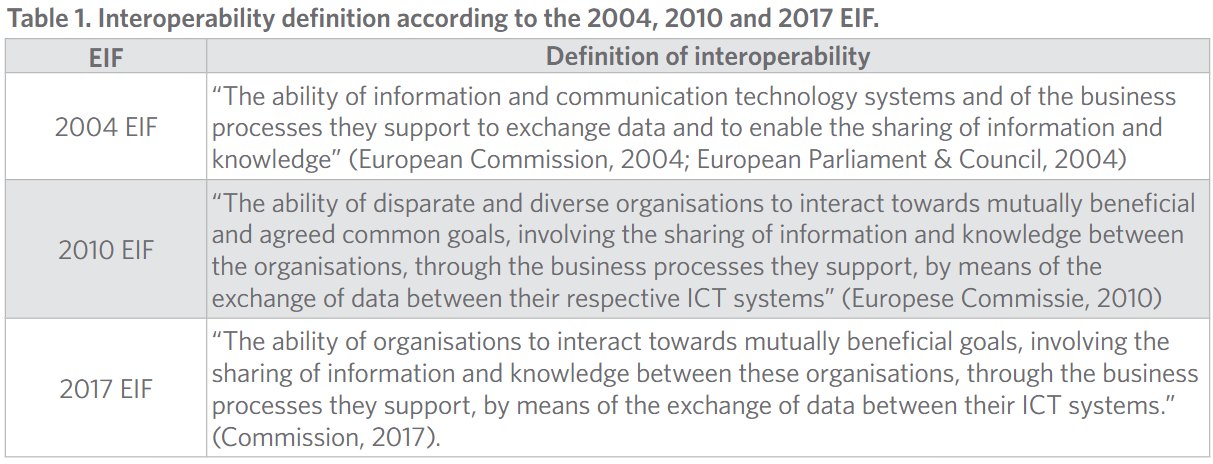
From these definitions in Table 1, we can appreciate there was an important evolution on the understanding of the concept between 2004 and 2010. However, when we compare the 2010 definition with the 2017 definition, the changes are minor. The 2004 definition was more technical via its sole focus on ICT systems. There was no reference made to the role that organizations have in the exchange of data. This reference to organizations only appeared in the 2010 definition. Furthermore, the 2004 definition did not include the idea of improving interoperability for the sake of mutually beneficial and agreed common goals. These changes demonstrate that an evolution of the concept took place in which the concept evolved from a more technical oriented sphere to an all-encompassing understanding of what interoperabi- lity is. Finally, it should be underlined that one element has remained stable over time in the definition, i.e. the focus on data, information and knowledge (Chantillon et al., 2021a).
Based on our expertise and conversations with interoperability experts, we can state that
there is an agreement that the current 2017 EIF definition of interoperability is a valid defini- tion. However, it is also a complex definition that is difficult to understand for public admi- nistration staff working on interoperability from a practical point of view. Furthermore, there are some possibilities for further reflection concerning the concept. Firstly, it is advised that the concept of interoperability is related to key European policies such as the Green Deal and other key future European objectives. The creation of this relation would provide clarity on the goals, not only for public administrator staff but to all the actors involved in interopera- bility processes. Secondly, it is advised to reflect on elements such as stakeholders’ participa- tion. Research demonstrated that participation stimulates resource pooling and joint action as it can help to reduce the cost of solutions and the decision-making process (Edelenbos & Van Meerkerk, 2016). Thirdly, technology needs to be seen as a mean and not as an objective. The current definition already reflects this point of view via its focus on organizations. Howe- ver, and in order to further intensity this view and to extent it to the level of the individual, it would be advised to provide the individual as service user, provider of data, or service (co-) creator with a more central role in the definition of interoperability. This shift could be espe- cially meaningful as it would imply a more human-centric approach to interoperability and it would lead to a more inclusive view of the actors involved in service provision.
Finally, it is recommended that a new reworked definition of interoperability also acknowle-
dges the multi-level governance character of the European Union (EU). Challenges such as cli- mate change have shown that the success in the achievement of goals depends not only on the EU Members States or cities, but it also requires the involvement of sub-national governments (Bache & Flinders, 2004; Casiano Flores, Vikolainen, & Crompvoets, 2021; Kern, 2019).
A BRIEF DESCRIPTION OF THE 2017 EIF
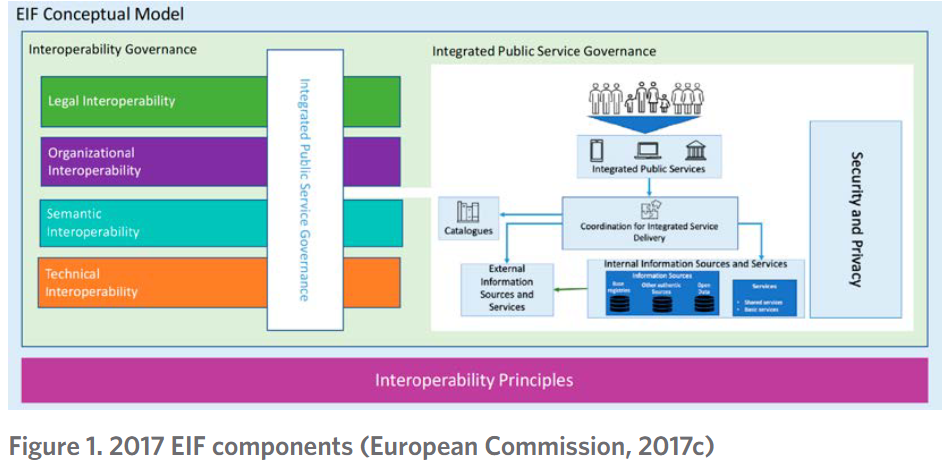
Besides the definition of interoperability, the 2017 EIF is also composed of twelve principles, six layers and a conceptual model. Those three elements together with the definition, form the heart of the 2017 EIF.
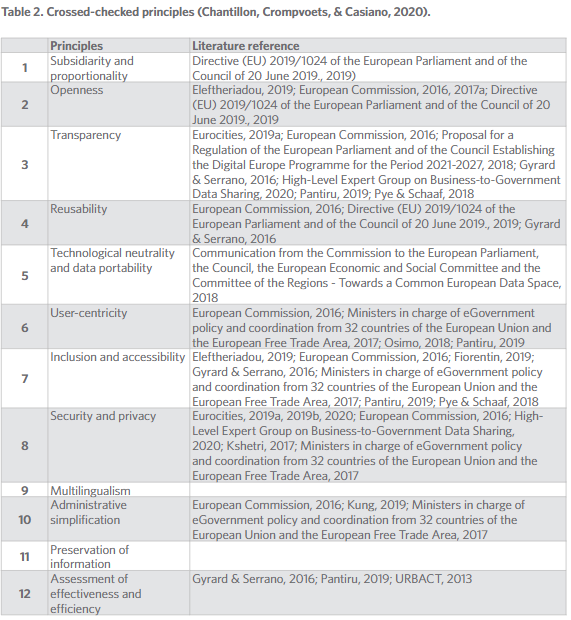
The principles, layers and conceptual model provide the public administration staff with the information required to work on interoperable digital public services. The principles aim to establish common behaviors on interoperability. The principles are the following: 1) Sub- sidiarity & Proportionality; 2) Openness; 3) Transparency; 4) Reusability; 5) Technological neutrality & data portability; 6) User-centricity; 7) inclusion and accessibility; 8) Security and privacy; 9) Multilingualism; 10) Administrative simplification; 11) Preservation of informa- tion; and 12) Assessment of effectiveness and efficiency (European Commission, 2017c).
Regarding the layers, the 2017 EIF is composed by four interoperability layers (legal in-
teroperability, organizational, semantic and technical), one cross-cutting component of the four layers (integrated public service governance) and one background layer (interoperability governance) (European Commission, 2017c). These layers are summarized below:
2. Organizational interoperability refers to the alignment of business process, responsibi- lities and expectations concerning agreed and mutually beneficial goals among different public administration organizations (European Commission, 2017c).
3. Semantic interoperability ensures that data and information are preserved in a precise format and understood in the same way when it is exchanged between different public administration organizations. (European Commission, 2017c).
4. Technical interoperability refers to the different ICT applications and technical infras- tructures that link technical systems and services (European Commission, 2017c).
5. Integrated Public Service Governance refers to a meta-level where the aforementioned layers need to be considered to (re)develop a specific service. It includes the overarching governance environment where public services are offered by the public administration. It comprises organizational structures, roles and responsibilities and the decision-ma- king process where the different stakeholders are involved. It also ensures that intero- perability can be achieved within and between individual public services. This aspect of the EIF is of crucial importance for the overall user-satisfaction (European Commission, 2017c).
6. Interoperability governance refers to the overall decisions regarding interoperability fra-
meworks, the institutional arrangement, roles and responsibilities, organizational struc- ture, policies as well as agreements to ensure and monitor interoperability at Member State and EU level (European Commission, 2017c).
The Conceptual Model for Integrated Public Services “promotes the idea of interopera- bility by design. It means that for European public services to be interoperable, they should be designed in accordance with the proposed model and with certain interoperability and reusability requirements in mind” (European Commission, 2017c). The model is a promotor of reusability which is considered a driver for interoperability. Indeed, a service that is reusa-
ble embraces the overall objective of interoperability, and the higher the interoperability of a service, the more reusable the service becomes. It recognizes that European public services should reuse existing information and services. The basic components of the model are ‘inte- grated service delivery’, a ‘no wrong door’ service delivery policy, reuse of data and services, catalogues describing reusable services and other assets, integrated public service governance and security and privacy. Figure 1 presents the different components of the 2017 EIF.
After briefly describing the 2017 EIF, the next section will present the proposed additions to that the revised version of the EIF could consider.
THE PROPOSED PRINCIPLES AND LAYERS
Recommendations for the Interoperability Principles
The twelve interoperability principles have become relevant in both EU policy documents and academic literature. To exemplify this, Table 2 below shows research and policy documents where those principles are being mentioned. As it can be seen almost all the 2017 EIF princi- ples appear also in other policy and research documents. Two principles do however appear in the 2017 EIF but not in other documents, i.e. the principles of multilingualism (principle 9) and the principle of preservation of information (principle 11). While from a European cul- tural perspective the principle of multilingualism in service delivery is considered to be im- portant, this can be different in relation to other cultural contexts. Furthermore, while other policy and research documents do not consider the preservation of information, this is never- theless an important interoperability principle as it ensures a long-term accessibility and use of information (Chantillon et al., 2017).
Despite the relevance of all those principles, we believe there is another principle that
could be considered as well. It is the principle of co-creation. Co-creation of public services is traditionally related to the concept of coproduction which means the involvement of citi- zens in the provision of public services (Voorberg, Bekkers, & Tummers, 2015). Co-creation has increased its relevance in both academia and practice, since there is a need for public
administrations to deliver better and more efficient public services, in a context of resour- ces scarcity and a decline of trust in the public sector (Rodriguez Müller, 2021). However, new approaches assign a more comprehensive and holistic definition, where a wide range of stakeholders can have a more active role in both the public service provision as well as in the definition of innovative solutions. Co-creation processes emphasize the reliance on users and external stakeholders’ knowledge and expertise to provide better or new services (Torfing, Sørensen, & Røiseland, 2019).
Based on these novel approaches we believe that the inclusion co-creation as an interope-
rability principle can provide the opportunity to overcome interoperability challenges such as integration of services and data at local level, adaptation to changing technology and interest
of stakeholders (Casiano Flores, Rodriguez Müller, et al., 2021). Furthermore, this principle can support the accessibility of services and its personalization. Although co-creation pro- cesses can also be challenging to implement, the active engagement of users in the design, delivery, and evaluation of interoperable digital public services can uncover users’ needs and behaviors in order to deliver better services (Mureddu & Osimo, 2019).
Recommendations for the Interoperability Layers
Despite the already existing layers that integrate the 2017 EIF, we believe that two new layers could be considered:
2. Skills & Competencies (introduced in the “Study on the development of a European fra- mework for interoperability skills and competencies in the public sector (EFISC)” (Ca- siano Flores, Chantillon, et al., 2021)).
Cultural interoperability in the EIF4SCC refers to “the approach taken by individuals and
organisations to take into consideration their social and cultural differences and, if applica- ble, organisational cultural differences. Interoperability can be impacted by cultural diffe- rences, as individuals and organisations can respond differently to the same interoperability challenge” (Chantillon et al., 2021b, p. 23). We consider that the EIF interoperability layers should be extended by adding this extra layer of cultural interoperability. As demonstrated in this article, the definition of interoperability has evolved from a more technically oriented concept to a wider concept, recognizing the need for cooperation among organizations. This evolution requires the incorporation of governmental and cultural factors. In a region as di- verse as Europe the understanding of this cultural diversity is crucial to favor interoperability. Furthermore, the delivery of public services can no longer be considered to be a task of public administration only, and can involve also other actors – such as businesses and societal orga- nizations (Ojo & Mellouli, 2014; Pollitt, 2013). This wide diversity also requires an alignment among actors from a cultural point of view. One can thereby think of shared public values and common goals and objectives (Chantillon, Crompvoets, & Peristeras, 2020).
Regarding Skills and Competencies, EFISCis acompetences framework thatdefines knowle- dge, skills, attitudes and values that can favor interoperability, and it can help public adminis- trators to improve their skills and competences in interoperability and digital work (Casiano Flores, Chantillon, et al., 2021). EFISC is composed of nine attitudes, four values, seventeen soft skills, six hard skills and six knowledge elements. Currently the 2017 EIF acknowledges the relevance of skills for interoperability as part of the Interoperability governance layer whi- le recognizing it as a multi-dimensional issue embedded in legal, organizational, semantic, and technical interoperability. Based on these characteristics and our experience in the deve- lopment of EFISC, we believe that a cross-cutting layer of Skills and Competences should be added. Particular attention should be paid to soft skills. Soft skills are key when considering
technological changes, as a digital transformation strongly relies on the capacity of the public administration staff (Snape, 2017). For example uncertainty about which hard skills will be needed in the future requires people who are more likely to developed them (Frankiewicz & Chamorro-Premuzic, 2020). These are people with soft skills such as adaptability and self-de- velopment (Casiano Flores, Chantillon, et al., 2021).
CONCLUSION
The objective of this reflection article was twofold: 1) to propose changes in the definition of interoperability and additions to both the layers and principles of the 2017 EIF and 2) to pro- vide an overview for non-European scholars on the latest developments around the 2017 EIF framework. Regarding the first part of the objective and based on our research experience, we believe that the concept of interoperability could be updated. Among our suggestions are the need to relate the concept of interoperability to key European policies such as the Green Deal. The concept could also consider elements such as social and stakeholders’ participation. We consider that the new concept could also more strongly acknowledge the multi-level go- vernance character of the EU as the 2017 EIF currently mainly focuses on the European and national public administrations. We also suggest that the next EIF includes co-creation as a principle in order to provide the opportunity to overcome interoperability challenges. Finally, we believe that two new interoperability layers should be added, Cultural interoperability and Skills & Competencies. While cultural interoperability could be grouped with the other four layers of legal, organizational, semantic, and technical; we propose that Skills & Competen- cies could be a cross-cutting layer.
In our opinion, the consideration of the aforementioned revisions could lead to a more
robust interoperability framework that is ready for tackling societal challenges of the 21st cen- tury and the related public service provision. The suggested additions build upon the 2017 definition of interoperability and propose a revised framework that can also be applied in a context existing of other actors than just European and national levels public administrations. Current public service provision requires the involvement of various public administration le- vels (local, regional, national, European/global) and interaction with other, non-public admi- nistration actors – such as citizens, businesses and societal organizations. Updating the 2017 EIF framework accordingly is therefore required. It is however important to highlight that the proposed revisions can also impact other elements of the framework. For example, the inclu- sion of co-creation also implies changes to the 2017 EIF Integrated Public Service Governan- ce cross-cutting layer. Therefore, we want to highlight the need to conduct future studies to examine how these elements can be properly aligned into a revised EIF.
Regarding the second part of the objective, we consider that the brief description of the
EIF together with our proposals can provide to a non-European audience, such as Latin Ame- rican scholars, a glimpse of the interoperability state of the art in the EU. In this regard, our proposals can provide insights on how the concept of interoperability and the EIF framework
can evolve based on recent developments around the 2017 EIF. However, it is important to emphasize that we do not believe that our recommendations are part of a magical recipe to overcome interoperability challenges. While we consider them as a step forward, we ack- nowledge that interoperability still faces many governance and technological challenges that are not unique to the EU context. The Latin American region is also very diverse and provi- des the opportunity to exchange experiences. This exchange of experience is not new. Various Latin American countries such as Brazil, Chile, Colombia, Mexico, and Trinidad & Tobago shared their interoperability experience for the development of interoperability framework in Latin America, taking into account the European experience (CEPAL & EUROPEAID, 2007). Furthermore, research has identified that since 2011 Argentina, Brazil, Colombia, Costa Rica, Chile, Ecuador, El Salvador, Guatemala, Mexico, Nicaragua, Panama, Peru, Uruguay, and Ve- nezuela have already assigned government units working on interoperability (Criado, Gascó, & Jiménez, 2011). Moreover, recently a guide for the implementation of digital governance and interoperability in Latin America and the Caribbean was developed (Naser, 2021). Hence, with this article, we aim to support the dialogue on interoperability between the EU and La- tin America, as the interoperability concept is becoming more and more relevant.
REFERENCES
Bache, I., & Flinders, M. (2004). Multi-Level Governance and the Study of the British State. Pu- blic Policy and Administration, 19(1), 31–51. https://doi.org/10.1177/095207670401900103
Casiano Flores, C., Chantillon, M., Tan, E., Crompvoets, J., De Groof, V., Gonzalez, I., … Sor- gi, B. (2021). Study on the development of a European framework for Study on the develo- pment of a interoperability skills and European framework for competences in the public sector interoperability skills and (EFISC). Luxembourg. Retrieved from https://op.europa. eu/en/publication-detail/-/publication/4e07a84f-abbf-11eb-927e-01aa75ed71a1
Casiano Flores, C., Rodriguez Müller, A. P., Albrecht, V., Crompvoets, J., & Steen, T. (2021). Towards the Inclusion of Co-creation in the European Interoperability Framework. In Proceedings of the 14th International Conference on Theory and Practice of Electronic Go- vernance (ICEGOV 2021). Athens: New York: ACM Press.
Casiano Flores, C., Vikolainen, V., & Crompvoets, J. (2021). Governance assessment of a blue- green infrastructure project in a small size city in Belgium. The potential of Herentals for a leapfrog to water sensitive. Cities, 117, 103331. https://doi.org/10.1016/j.cities.2021.103331
CEPAL, & EUROPEAID. (2007). Libro blanco de interoperabilidad de gobierno electrónico para América Latina y el Caribe. Retrieved from https://repositorio.cepal.org/bitstream/ handle/11362/2871/1/S2007049_es.pdf
Chantillon, M., Casiano Flores, C., Crompvoets, J., Sallano, M., Eiras Antunes, M., Garcia Ba- rron, M., … Sidique, G. (2021a). Final Study Report - Proposal for a European Interopera- bility Framework for Smart Cities and Communities(EIF4SCC). Luxembourg. https://doi. org/10.2799/085469
Chantillon, M., Casiano Flores, C., Crompvoets, J., Sallano, M., Eiras Antunes, M., Garcia Ba- rron, M., … Sidique, G. (2021b). Proposal for a European Interoperability Framework for Smart Cities and Communities (EIF4SCC). Luxembourg. https://doi.org/10.2799/816559
Chantillon, M., & Crompvoets, J. (2020). ISA2 Action 2016.23: Legal Interoperability D05.02 Study on Decentralised Agencies Survey Overview & Results. Brussels.
Chantillon, M., Crompvoets, J., & Casiano, C. (2020). D02.01 Study: Smart Cities and Com- munities Interoperability Framework: Concept, Definition(s) and Categories. Brussels.
Chantillon, M., Crompvoets, J., & Peristeras, V. (2020). Prioritizing public values in e-gover- nment policies : A document analysis. Information Polity, 25(3), 275–300. https://doi. org/10.3233/IP-190126
Chantillon, M., Simonofski, A., Tombal, T., Kruk, R., Crompvoets, J., de Terwangne, C., … Vanderose, B. (2017). FLEXPUB Public e-Service Strategy - Report WP2. FLEXPUB - Work package 2 - Baseline Measurement. Leuven.
Commission, E. (2016). Workshop Report: Supporting the implementation of eGovernment at regional and local level. Brussels.
Commission, E. (2017). New European Interoperability Framework. Promoting seamless ser- vices and data flows for European public administrations. Luxembourg. Retrieved from https://ec.europa.eu/isa2/sites/isa/files/eif_brochure_final.pdf
Commission, E. Communication from the Commission to the European Parliament, the Council, the European Economic and Social Committee and the Committee of the Re- gions - Towards a common European data space (2018). Brussels: European Commission.
Criado, J. I., Gascó, M., & Jiménez, C. E. (2011). Interoperabilidad de Gobierno electrónico en Iberoamérica. Estudio comparativo y recomendaciones de futuro. Revista Del CLAD Re- forma y Democracia, 50, 75–104.
Edelenbos, J., & Van Meerkerk, I. (2016). Normative theory. In C. Ansell & J. Torfing (Eds.), Handbook on theories of governance (pp. 402–415). Cheltenham: Edward Elgar Publishing.
Eleftheriadou, D. (2019). 100 Intelligent Cities Challenge: A strategy for cities in the 21st cen- tury. Brussels: European Commission.
Eurocities. (2019a). 74 cities have already signed the Declaration on citizens engagement.
Eurocities. (2019b). Engaging with citizens - Report on results of the “Cities4Europe - Europe for citizens” campaign and the citizens panel pilot project. Brussels. https://doi.org/10.1016/ b978-0-12-822596-7.00008-5
Eurocities. (2020). Peope-centred Artificial Intelligence (AI) in cities - Response to EU’s white paper on AI. Brussels: Eurocities.
European Commission. (2004). European Interoperability Framework for Pan-European eGo- vernment Services. Luxembourg: Office for Official Publications of the European Commu- nities.
European Commission. (2017a). eGovernment in local and regional administrations. Brussels.
European Commission. (2017b). ISA2 - Interoperability solutions for public administrations, businesses and citizens. Retrieved May 19, 2021, from https://ec.europa.eu/isa2/eif_en
European Commission. (2017c). The New European Interoperability Framework. https://doi. org/10.2799/78681
European Commission. Proposal for a Regulation of the European Parliament and of the Council establishing the Digital Europe Programme for the period 2021-2027 (2018). ht- tps://doi.org/10.1017/CBO9781107415324.004
European Commission. (2021). Interoperable digital public services – European Interoperabi- lity Framework evaluation & strategy.
European Parliament, & Council. Decision 2004/387/EC of the European Parliament and of the Council of 21 April 2004 on interoperable delivery of pan-European eGovernment services to public administrations, businesses and citizens (IDABC) (2004). Brussels: Eu- ropean Parliament / Council of Ministers of the European Union.
European Parliament, & Council of the European Union. Directive (EU) 2019/1024 of the Eu- ropean Parliament and of the Council of 20 June 2019. (2019). Brussel: European Parlia- ment / Council of the European Union.
European Union. (2021). EIF Toolbox. Retrieved May 18, 2021, from https://joinup.ec.europa. eu/collection/nifo-national-interoperability-framework-observatory/solution/eif-toolbox/ eif-toolbox
Europese Commissie. (2010). Communication from the Commission to the European Parlia- ment, the Council, the European Economic and Social Committee and the Committee of Regions ’Towards interoperability for European public services - Annex 2 (No. COM(2010) 744 final). Brussel.
Fiorentin, E. (2019). Digital Cities Challenge - The experience of Padua. European Commission.
Frankiewicz, B., & Chamorro-Premuzic, T. (2020). Developing employees Digital Transfor- mation Is About Talent, Not Technology. Harvard Business Review.
Guijarro, L. (2007). Interoperability frameworks and enterprise architectures in e-government ini- tiatives in Europe and the United States. Government Information Quarterly, 24(1), 89–101.
Gyrard, A., & Serrano, M. (2016). Connected smart cities: Interoperability with SEG 3.0 for the internet of things. Proceedings - IEEE 30th International Conference on Advanced In- formation Networking and Applications Workshops, WAINA 2016, (3), 796–802. https:// doi.org/10.1109/WAINA.2016.151
High-Level Expert Group on Business-to-Government Data Sharing. (2020). Towards a Eu- ropean strategy on business-to-government data sharing for the public interest. Brussels. https://doi.org/10.2759/406717
ISA2. (n.d.). Interoperability Storyline. Retrieved August 6, 2021, from https://ec.europa.eu/ isa2/sites/default/files/eif_leaflet_final.pdf
Kern, K. (2019). Cities as leaders in EU multilevel climate governance: embedded upscaling of local experiments in Europe. Environmental Politics, 28(1), 125–145. https://doi.org/10.10 80/09644016.2019.1521979
Kshetri, N. (2017). Cybersecurity and privacy issues facing smart cities: Challenges and policy responses.
Kung, A. (2019). Citizen centric approach to data - GDPR revisited. EIP-SCC.
Ministers in charge of eGovernment policy and coordination from 32 countries of the Euro- pean Union and the European Free Trade Area. (2017). Tallinn Declaration on eGovern- ment. Tallinn: European Union.
Mureddu, F., & Osimo, D. (2019). Co-Creation of Public Services: Why and How. COVAL. Retrieved from https://lisboncouncil.net/publications/co-creation-of-public-services-why- and-how/
Naser, A. (2021). Gobernanza digital e interoperabilidad gubernamental: una guía para su implementación. Santiago, Chile.
Ojo, A., & Mellouli, S. (2014). Deploying governance networks for societal challenges. Gover- nment Information Quarterly. https://doi.org/10.1016/j.giq.2016.04.001
Osimo, D. (2018). How Local Government Reform is Key to Europe’s Digital Success - A Six- Point Programme for eGovernment Renewal. Brussels.
Pantiru, M. C. (2019). Competencies necessary for eGovernment. Retrieved from https://www. eupan.eu/wp-content/uploads/2020/02/2019-final-REPORT-Competencies-necessary- for-eGov-PRES-RO-1.pdf
Pollitt, C. (2013). New Perspectives on Public Services - Place and Technology. Oxford: Oxford University Press.
Pye, L., & Schaaf, K. (2018). Organicity Playbook - How to launch experimentation as a servi- ce in your city.
Rodriguez Müller, A. P. (2021). Making Smart Cities “Smarter” Through ICT-Enabled Citizen Coproduction. In Handbook of Smart Cities (pp. 1–21). Cham: Springer International Pu- blishing. https://doi.org/10.1007/978-3-030-15145-4_63-1
Sallamo, M., Wauters, P., O’Neill, G., Schäfer, F., Dastis Alonso, L., Cioffi, A., … Tambouris, E. (2020). Recommendations for organising and governing integrated public services. Luxem- bourg. https://doi.org/10.2799/85943
Snape, P. (2017). Enduring Learning: Integrating C21st Soft Skills through Technology Educa- tion. Design and Technology Education, 22(3), 1–13. Retrieved from https://eric.ed.gov/?i- d=EJ1164214
Tambouris, E., & Tarabanis, K. (2021). Towards Inclusive Integrated Public Service (IPS) Co-Creation and Provision. In DG.O2021: The 22nd Annual International Conference on Digital Government Research (pp. 458–462). New York, NY, USA: ACM. https://doi. org/10.1145/3463677.3463726
Torfing, J., Sørensen, E., & Røiseland, A. (2019). Transforming the Public Sector Into an Arena for Co-Creation: Barriers, Drivers, Benefits, and Ways Forward. Administration & Society, 51(5), 795–825. https://doi.org/10.1177/0095399716680057
Ubaldi, B., González-Zapata, F., & Piccinin Barbieri, M. (2020). The OECD Digital Govern- ment Policy Framework : Six dimensions of a Digital Government. OECD Public Gover- nance Policy Papers. Paris.
URBACT. (2013). The URBACT II Local Support Group Toolkit. Saint-Denis.
Voorberg, W. H., Bekkers, V. J. J. M., & Tummers, L. G. (2015). A Systematic Review of Co-Crea- tion and Co-Production: Embarking on the social innovation journey. Public Management Review, 17(9), 1333–1357. https://doi.org/10.1080/14719037.2014.930505

