
Artigos
Ethnomathematics as a Lakatosian Research Program
Etnomatemática como um Programa de Pesquisa Lakatosiano
Etnomatemáticas como un Programa de Investigación Lakatosiano

 Lucas Junior Paixão paixaolucas48@gmail.com
Luciano de Santana Rodrigues lucianoluciano.santana1998@gmail.com
Ana Flávia Siqueira Pinto Dias anaflavia.dias56@gmail.com
Milton Rosa milton.rosa@ufop.edu.br
Revemop
Universidade Federal de Ouro Preto, Brasil
ISSN-e: 2596-0245
Periodicity: Frecuencia continua
vol. 7, 2025
Received: 22 March 2025
Accepted: 16 August 2025
Published: 19 November 2025

Abstract: This article aims to discuss how ethnomathematics develops as a Lakatosian scientific research program, that is, how it is constituted through three fundamental components: a) a hard core, formed by a set of theories and/or hypotheses considered irrefutable by researchers; b) a protective belt, surrounding the hard core and composed of a set of auxiliary hypotheses and observational methods; and c) heuristics (positives and negatives) that guide researchers in modifying the protective belt. Through comparisons, we can conclude that ethnomathematics is a Lakatosian program.
Keywords: Protective Belt, Heuristics, Hard Core, Ethnomathematics Program, Lakatosian Research Program.
Resumo: Este artigo tem como objetivo discorrer sobre como a etnomatemática se desenvolve como programa de pesquisa científico lakatosiano, ou seja, como se constitui por meio de três componentes considerados fundamentais desse programa: a) um núcleo firme, que é formado pelo conjunto de teorias e/ou hipóteses consideradas irrefutáveis pelos pesquisadores; b) um cinturão protetor, que se encontra em torno do núcleo firme e é composto pelo conjunto de hipóteses auxiliares e métodos observacionais; e c) de heurísticas (positivas e negativas) que instruem os pesquisadores a modificar o cinturão protetor. A partir de comparações, conclui-se que a etnomatemática é um programa lakatosiano.
Palavras-chave: Cinturão Protetor, Heurísticas, Núcleo Firme, Programa Etnomatemática, Programa de Pesquisa Lakatosiano.
Resumen: Este artículo tiene como objetivo discutir cómo las etnomatemáticas se desarrollan como un programa de investigación científica lakatosiano, es decir, cómo se constituye a través de tres componentes fundamentales: a) un núcleo firme, que está formado por un conjunto de teorías y/o hipótesis consideradas irrefutables por los investigadores; b) un cinturón protector, que rodea el núcleo firme y está compuesto por un conjunto de hipótesis auxiliares y métodos de observación; y c) heurísticas (positivas y negativas) que guían a los investigadores para modificar el cinturón protector. A partir de comparaciones, se concluye que las etnomatemáticas constituyen un programa lakatosiano.
Palabras clave: Cinturón Protector, Heurísticas, Núcleo Firme, Programa de Etnomatemática, Programa de Investigación Lakatosiano.
1. Introduction
Ethnomathematics, as a program, makes it possible to “seek to understand mathematical knowledge/doing throughout the history of humanity, contextualized in different interest groups, communities, peoples and nations” (D’Ambrosio, 2019a, p. 17). Thus, D’Ambrosio (2019a) argues that the Program Ethnomathematics is dynamic and continually seeks the mathematical knowledge developed by members of different cultural groups.
Rosa and Orey (2018) state that ethnomathematics can be understood as a Lakatosian scientific research program, as it constantly seeks mathematical ideas, procedures, techniques, and practices that dialogue with one another and were developed by members of different cultures. To understand the Program Ethnomathematics as a Lakatosian research program, we draw on texts by Imre Lakatos and other authors who have researched this theme.
Rosa and Orey (2018) argue that Lakatos organized scientific practice through a methodology he defended in his program, now known as the Lakatosian scientific research program. His main ideas oppose those of Karl Popper, who proposes the falsificationism theory, which holds that scientific discoveries can be proven by showing they are false rather than proving they are true.
A close example of this point of view can be observed in the way Lakatos handled mathematics, which was understood “as a static field of knowledge, proposing the heuristic of his scientific research program to understand the dynamic movement of the development of mathematical concepts” (Rosa; Orey, 2018, p. 77).
Therefore, a program to meet the specificities of the Lakatos program must include three fundamental components: the hard core, the protective belt, and the heuristics (positive and negative). In this sense, ethnomathematics can be understood as a program according to these components and, as explained by D’Ambrosio (2019b), the research program in the following sense:
[...] Lakatosian, [which] has been growing in repercussion and has been showing a valid alternative to a pedagogical action program. Ethnomathematics proposes an alternative epistemological approach associated with a broader historiography. It starts from reality and, in a natural way and through a cognitive approach with a strong cultural foundation, arrives at pedagogical action (D’Ambrosio, 2019b, p. 6).
Thus, the main objective of this article is to discuss how the Program Ethnomathematics is constituted as a Lakatosian research program. Thus, to achieve this goal, it is necessary first to discuss ethnomathematics, which will be done in the first section of this article. Next, in the second section, the Lakatos research program will be contextualized. In the third section, we will relate ethnomathematics to the Lakatosian research program and its connections.
2. Program Ethnomathematics: Definition and History
According to D’Ambrosio (1990), the etymology of the word ethnomathematics can be divided into three Greek roots: ethno, which refers to the different natural, social, cultural, and imaginary environments; mathema, which goes in the direction of explaining, knowing, learning, dealing; and tica, which comes from techne, and means techniques, arts, modes and styles.
Therefore, ethnomathematics “is the art or technique of explaining, knowing, and understanding in different cultural contexts” (D’Ambrosio, 1990, p. 5-6); that is, a theory of knowledge, which seeks to understand mathematics in a contextualized way by recognizing that members of different cultures generate and organize mathematical knowledge in different ways.
Other researchers in ethnomathematics also defend this conceptualization, proposed by D’Ambrosio (1990), including Barton (1996), Gavarrete (2015), Shirley (2015), and Pradhan (2017), whose investigations seek to understand the development of mathematical thinking in sociocultural contexts.
Before arriving at this concept in 1990, Professor Ubiratan D’Ambrosio had already studied ethnomathematics in previous decades. It was only in 1977, in a lecture at the Annual Meeting of the American Association for the Advancement of Science, in Denver, United States, that he first used the term ethnomathematics (Rosa; Orey, 2014a).
Rosa and Orey (2014a) report that several historical fragments predate ethnomathematics as we know it today, some of which are as old as the ancestral species of humans, such as the australopithecines.
Thus, for D’Ambrosio (2019a), historically, the instruments necessary for survival, such as the chipped stone, used to strip the bones of the hunts, the spears, used to hunt, and the fire, used for protection, heating, cooking, and lighting, are important instruments for the transcendence of these human beings.
These historical fragments span several centuries to the present day, when research focused on ethnomathematics is widely expanding worldwide. Rosa and Orey (2014a) point out six fundamental facts, which contributed to the development of the Program Ethnomathematics, of which we highlight the last three, from the 1980s, which consolidated ethnomathematics worldwide:
• The fourth fact highlights the “Opening lecture entitled: Sociocultural Bases of Mathematics Education, given by D’Ambrosio at ICME1 5, in Adelaide, Australia, in 1984, which, in this way, officially instituted the Program Ethnomathematics as a field of research” (Rosa; Orey, 2014a, p. 552).
• The fifth fact shows that: “In 1985, D’Ambrosio wrote his masterpiece Ethnomathematics and its Place in the History and Pedagogy of Mathematics” (Rosa; Orey, 2014a, p. 552).
• The sixth fact indicates that: “In 1985, the International Study Group on Ethnomathematics (ISGEm2) was created, which launched the Program Ethnomathematics internationally” (Rosa; Orey, 2014a, p. 552).
These facts show how the Program Ethnomathematics began its successful trajectory soon after its consolidation. In addition to the research groups, national and international events also significantly favored the expansion of ethnomathematics, among which the following stand out:
a) Brazilian Congress of Ethnomathematics (CBEm).
b) International Congress of Ethnomathematics (ICEm), sponsored by ISGEm and organized by the educational institutions that are committed to its realization.
c) Topic Study Group – Ethnomathematics (TSG-Ethnomathematics), from the International Congress on Mathematics Education (ICME) (Rosa; Orey, 2014a).
According to Rosa and Orey (2018, p. 75), the Program Ethnomathematics originated in the search for understanding “mathematical knowledge developed by members of different cultural groups, such as colonized cultures and marginalized minorities”.
Thus, research in ethnomathematics seeks to highlight the mathematical knowings and doings developed by members of different cultural groups, who value and respect the procedures, techniques, arts and ways (ticas) of solving everyday problem situations, according to their ways of understanding, explaining and understanding (matema) their own social, cultural, natural or imaginary (etno) environment (Rosa; Orey, 2018).
The Program Ethnomathematics, therefore, seeks to understand the search for knowledge by humanity, as well as proposes a living and dynamic pedagogy, which emphasizes the importance of developing a knowing/doing that can respond to environmental, social, cultural, political, and economic needs, enabling the strengthening of imagination and the enhancement of creativity (Knijnik, 1996). Thus, D’Ambrosio (2019a) considered ethnomathematics a program that aimed to maintain the original conceptualization that this trend in mathematics education is not a fully developed epistemology.
Corroborating these assertions, Rosa (2010) also argues that ethnomathematics is a program not only because it is not restricted to the study of mathematical knowledge developed by members of different cultural groups, but because it is linked to a theory of knowledge that aims to study intellectual and social organization, as well as the diffusion of knowledge in general, with the stance of a permanent search for transdisciplinary efforts.
For Rosa and Orey (2018, p. 76), “the program ethnomathematics is a theory of knowledge that incorporates the conceptions of science and mathematics of members of cultural groups who have been marginalized and excluded throughout history”. Thus, Rosa (2010) believes that the program ethnomathematics can also be considered a theory of knowledge that values and respects the mathematical ideas, knowings and doings developed locally by members of different cultures.
Faced with this discussion, a question emerges: “But why treat ethnomathematics as a program?” To answer this question, D’Ambrosio (2019a) explained that the main reason for considering ethnomathematics a program is a concern about attempts to impose an epistemology, with a final explanation.
Thus, not to conceptualize ethnomathematics as a ready, finalized, and finished field of study, D’Ambrosio (2019a) insisted on using the term program ethnomathematics in the same sense as the Lakatosian scientific research program, as it intends to understand how members of different cultures develop and use mathematical knowledge to solve problem situations related to everyday activities.
Rosa (2010) points out that this approach distances itself from traditional mathematics teaching, which often ignores, devalues, or renders invisible students’ and their communities’ mathematical knowledge. Therefore, ethnomathematics maintains the dynamics of a program that is always seeking to understand the adventures of the human species in search of survival and in search of the transcendence of knowledge.
3. Lakatosian Scientific Research Program
Imre Lipsitz (Lakatos) was a Hungarian philosopher born on November 9, 1922, in Debrecen, eastern Hungary, and deceased in London on February 2, 1974. Lakatos was the son of Jacob Marton Lipsitz (a wine merchant) and Margit Herczfeld (a beautician), and experienced his parents’ separation, being raised by his mother and grandmother (Musgrave; Pigden, 2021).
Lipsitz began his studies at the University of Debrecen in 1940 and graduated in 1944 with degrees in physics, mathematics, and philosophy. That same year, the Germans invaded Hungary, at which time about 600,000 Jews died due to the Nazi regime, including his mother and grandmother (Musgrave; Pigden, 2021).
“Earlier, in March 1944, Lipsitz himself managed to escape from Debrecen to Nagyvárad (now Oradea, Romania) with false documents under the name Molnár” (Musgrave; Pigden, 2021, p. 5). In March 1944, the Germans invaded Hungary, after which Lipsitz, along with Éva Révész, his girlfriend and subsequent wife, formed a Marxist resistance group.
According to Musgrave and Pigden (2021, p. 5), after the Soviet victory in 1944, Lipsitz returned to Debrecen and “changed his name from the German Jew Lipsitz to the Hungarian proletarian Lakatos” and moved to Budapest, where he completed his postgraduate studies at the University of Budapest.
Musgrave and Pigden (2021, p. 2) remember that Lakatos’ life has always been associated with political positioning, since “in the initial and Hungarian phase of his life, Lakatos was a Stalinist revolutionary, the leader of a communist cell”. Thus, at the end of the 1940s, he began to be considered as an individual “close to a thought police officer, with a powerful position in the Ministry of Education, evaluating university professors” (Musgrave; Pigden, 2021, p. 3).
After the war, from 1947, Lakatos worked as a senior official in the Hungarian Ministry of Education, obtaining, in the same year, a PhD from the University of Debrecen with the thesis entitled: “On the Sociology of Concept Formation in the Natural Sciences” (Musgrave; Pigden, 2021).
Imre Lakatos is considered one of the leading philosophers of the sciences in the 20th century and one of the most influential fallibilistic mathematical philosophers3, who discussed the nonexistence of absolute, final definitions or proofs that require no revision. Thus, he challenged the philosophical current of formalism4, which defined mathematics as a science of rigorous demonstrations, because without rigor, there would be no such field of knowledge (Rosa; Orey, 2018).
In this sense, Lakatos’ (1970) methodology has as its fundamental characteristic the introduction of the notion of a scientific research program, which can be conceived as a collection of theories that share common characteristics. Thus, the research program proposed by Lakatos consists of three components: the hard core, the protective belt, and the heuristics (positive and negative).
The main characteristic that defines a Lakatosian research program is its hard core, a term that serves as the basis for constructing a scientific program (Lakatos, 1970). Rosa and Orey (2018, p. 83) explain that the “hard core consists of a set of irrefutable theoretical hypotheses that scientific research programs must share”. Thus, the hard core is structured by tacit knowledge, produced and accumulated in a given scientific research program (Rosa; Orey, 2018).
Around the hard core, there is the protective belt, which, according to Rosa and Orey (2018, p. 84), “is formed by auxiliary hypotheses and/or intermediate theories that can be periodically readjusted or totally replaced to protect this core”. The protective belt protects the hard core and can be adjusted to address anomalies or refutations that arise when researchers encounter a fact incompatible with the initial theoretical predictions of the research program (Silveira, 1996). Rosa and Orey (2018, p. 84) state that:
[...] anomaly is an irregular event or an unusual phenomenon that escapes a standard law or rule, which currently accepted scientific theories cannot explain. Any situation that jeopardizes the fulfillment of the demands of the theories that make up the hard core of scientific research programs can be considered an anomaly.
Thus, to overcome these anomalies or refutations, there is a set of methodological rules, called heuristics, which consist of “a set of methodological and technical rules that are used in teaching-learning, problem solving, and the discovery of innovative and alternative methodologies” (Rosa; Orey, 2014b, p. 95).
The heuristics of the Lakatosian research programs form a conjunction between the positive heuristic, which provides the paths to be followed, and the negative heuristic, which provides the paths to be avoided (Lakatos, 1970). The positive heuristic partially guides the modifications that must be made to the protective belt to overcome the anomalies that arise, that is, “the positive heuristic consists of a partially structured set of suggestions or guesses on how to change and develop the ‘refutable variants’ of the research program, and on how to modify and sophisticate the ‘refutable‘ protective belt” (Lakatos, 1989, p. 69, our translation and emphasis in the original)5.
According to Lakatos (1970), the positive heuristic assists in anticipating and, consequently, solving problems, seeking to understand anomalies and converting them into positive evidence. Thus, Silveira (1996, p. 221) points out that “research programs have from the beginning an ‘ocean of anomalies’, the positive heuristic prevents scientists from getting confused, indicating paths that can slowly explain them and transform them into corroborations”.
This assertion points out the paths that researchers should follow (positive heuristics), which, for Rosa and Orey (2018, p. 98), are “an articulated set of recommendations on how to change and develop the refutable variants of this program and also on how to modify and sophisticate its protective belt”.
The negative heuristic, according to Lakatos (1970), is a set of auxiliary hypotheses that will predict and combat possible attacks on the hard core of the research program. In this sense, the negative heuristic prevents any anomaly from declaring the hard core as false, and with this, a protective belt is formed around this center. Therefore, the negative heuristic acts directly with the hard core of the research programs, acting as a shield to defend it from all anomalies that may arise.
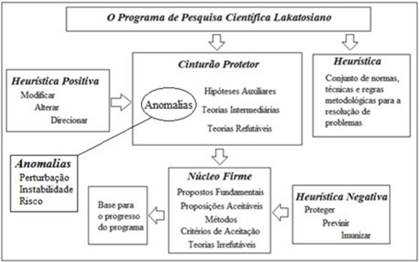
Figure 1 shows the schematic of the Lakatosian scientific research program, with its components and their main characteristics, as previously presented.
The operation of a Lakatosian scientific research program can be better understood through the scheme in Figure 2.
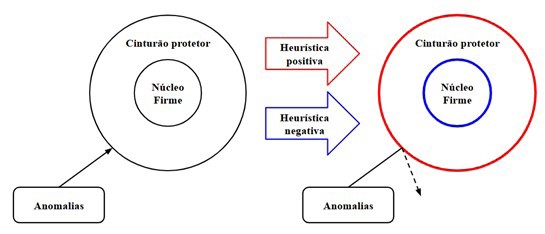
Initially, the anomalies try to reach the hard core (the theory or the set of irrefutable hypotheses of a research program), which is protected by the protective belt (hypotheses and/or auxiliary theories, and observational methods), in an attempt to refute them. In the following moment, the positive and negative heuristics strengthen the protective belt and the hard core, respectively, so that the anomalies cannot declare the hard core of the research programs to be false.
According to Lakatos (1970), a research program can be considered progressive when it succeeds, because it is led to a progressive change of the problem or as degenerative, when it fails and leads to regressive changes of the problem.
For Rosa and Orey (2018, p. 99-100), “progressive research programs absorb anomalies, generating new predictions that confirm the assumptions of the hard core”, while a “research program is degenerative when it uses its auxiliary and intermediate hypotheses to rule out the explanation of anomalies that can jeopardize its meta-theoretical assumptions, causing failures in the production of new predictions and forecasts”.
Rosa and Orey (2018) indicate that research programs, considered degenerative, present difficulties in developing alternatives to (re)compose the protective belt and, therefore, open space for possible replacements of this program by a rival. On the other hand, progressive programs are those that, after identifying and addressing anomalies, absorb them and use them as knowledge gained to strengthen the research program.
4. Ethnomathematical Program as a Lakatosian Research Program
For Rosa and Orey (2014b), the adoption of the term program ethnomathematics by D’Ambrosio (1985) is directly related to Lakatos (1970), given that his programme proposal incorporates the recognition of cultural dynamics, which is inherent to the theory of knowledge and is essential for the program ethnomathematics.
Therefore, in the methodological sense, ethnomathematics is also related to the Lakatosian research program, because, for D’Ambrosio (2019b), the methodology of this program is broad, focusing on the generation, production, organization, transmission, and diffusion of knowledge developed by members of different cultural groups, which have been accumulated throughout history and which are in permanent evolution.
Therefore, analyzing ethnomathematics as a Lakatosian research program reveals the characteristics of the three divisions that make up the Lakatosian scientific research program. For example, for Rosa and Orey (2018), the hard core of ethnomathematics is the basis of the program.
In this context, Rosa and Orey (2018, p. 92) state that “transdisciplinarity (especially with other ethno-x), transculturality, multiculturalism, diversity and cultural plurality, also being composed of the generation, organization, and diffusion of knowledge” are the components of the hard core of the program ethnomathematics, that is, the theories and/or hypotheses considered irrefutable.
For Rosa and Orey (2018), the interaction of the program ethnomathematics with other research programs strengthens it to the extent that it appropriates some theories, thus preparing for the emergence of possible anomalies. Because it is a multicultural program, there is cultural dynamism in the relationships among members of different cultural groups.
Thus, Rosa and Orey (2018, p. 93) point out that the “theories that make up the protective belt of ethnomathematics are constituted by auxiliary hypotheses that are created or discarded in order to protect the integrity of the hard core of this program” from the anomalies that can affect it.
The construction of this protective belt is strengthened by the heuristic that, for Rosa and Orey (2018, p. 95), “consists of a set of methodological and technical rules used in the teaching and learning process, in problem solving and in the discovery of innovative and alternative methodologies”.
This heuristic can be negative and, in this context, paths that researchers should avoid are identified, thereby strengthening their potential weaknesses. However, the heuristic can also be positive and, therefore, responsible for developing the research program and creating the theories that make up its protective belt. Figure 3 presents the program ethnomathematics as a Lakatosian scientific research program.
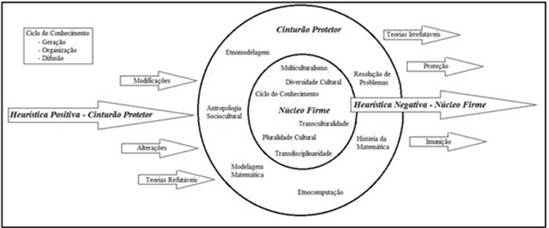
Considering the program ethnomathematics, we can surmise that, in addition to the analysis of the three main components of the Lakatosian research program, ethnomathematics is also a progressive scientific program. Rosa and Orey (2018, p. 100) indicate that ethnomathematics can become degenerative “if its theories are not able to predict new facts and phenomena, while, predicting them, it cannot corroborate them”.
However, “as the ethnomathematics program is a body of knowledge derived from quantitative and qualitative mathematical practices; such as counting, measuring, weighing, drawing lots, classifying, inferring, and modeling” (Rosa; Orey, 2018, p. 101), it is thus possible to predict anomalies and combat them through protective belt theories; therefore, in our view, the program ethnomathematics is a progressive Lakatosian scientific research program.
The progressivity of the program ethnomathematics is associated with the use of innovative theoretical bases that make up its protective belt, such as ethnomodelling (Rosa; Orey, 2010), ethnocomputing (Eglash et al., 2006), decoloniality (Walsh, 2009), sociolinguistics (Labov, 1972) and the sociocultural perspective of mathematical modelling (Rosa; Orey, 2012), which contribute so that anomalies do not reach the hard core of this program.
5. Final considerations
In this article, we seek to discuss how the program ethnomathematics is built as a Lakatosian research program and, for this, we define ethnomathematics as the various techniques, arts, ways, procedures and strategies (ticas) of explaining, understanding, teaching and dealing (matema) in different social, cultural, natural, political, economic, and imaginary contexts (etno). In addition, ethnomathematics is a dynamic program that is constantly seeking knowledge developed locally by members of different cultural groups.
We present, in dialogue with Lakatos (1989), what this philosopher defined as a Lakatosian scientific research program, which has as components a hard core where the theories and/or hypotheses considered irrefutable are found, protected by a protective belt, where the auxiliary hypotheses and heuristics are present, which, in turn, can be negative or positive, showing the paths that should, respectively, be avoided or followed by researchers, to combat possible anomalies that seek to affirm that the hard core of research programs is false.
By examining previous discussions on ethnomathematics as a research program and by associating it with the Lakatosian program, theories and/or hypotheses considered irrefutable, such as multiculturalism, transdisciplinarity, and cultural plurality, make up the hard core of ethnomathematics, which is protected by a set of auxiliary hypotheses, its protective belt, comprising pedagogical actions, ethnomodelling approaches, anthropological perspectives, and sociocultural analyses that can be adjusted in response to empirical challenges while preserving the integrity of the hard core.
In this context, the hard core of this program is supported by theoretical foundations and auxiliary theories that make up the protective belt, strengthened through positive and negative heuristics. Therefore, in this context, we conclude that ethnomathematics is a progressive Lakatosian research program. This configuration sustains a positive heuristic that guides researchers toward developing culturally situated models, dialogical methodologies, and critical analyses of mathematical practices, thereby enabling the program’s continual theoretical expansion and social relevance.
Finally, ethnomathematics, as a Lakatosian research program, seeks to investigate the relationships between mathematics and culture, considering the various forms of mathematical knowledge developed by members of different cultures. This approach aligns with the Lakatosian idea of a research program that has a hard core of ideas and hypotheses, protected by a protective belt composed of auxiliary hypotheses and positive and negative heuristics.
6. Acknowledgements
The authors thank the Federal University of Ouro Preto (UFOP), the Coordination for the Improvement of Higher Education Personnel (CAPES), and the Research Support Foundation of the State of Minas Gerais (FAPEMIG).
7. References
BARTON, Bill. Ethnomathematics: Exploring cultural diversity in mathematics. Doctorate Dissertation. University of Auckland, Auckland, 1996.
D’AMBROSIO, Ubiratan. Ethnomathematics and its place in the history and pedagogy of mathematics. For the Learning of Mathematics, v. 5, n. 1, p, 44-48, 1985.
D’AMBROSIO, Ubiratan. Etnomatemática. São Paulo: Ática, 1990.
D’AMBROSIO, Ubiratan. Etnomatemática:elo entre as tradições e a modernidade. Belo Horizonte: Autêntica, 2019a.
D’AMBROSIO, Ubiratan. Etnomatemática: um programa. Educação Matemática em Revista, v. 8, n. 1, p. 7-12, 2019b.
EGLASH, Ron; BENNETT, Audrey; O’DONNELL, Casey; JENNINGS, Sybillyn; CINTORINO, Margaret. Culturally situated designed tools: ethnocomputing from field site to classroom. American Anthropologist. v. 108, n. 2, p. 347-362, 2006.
GAVARRETE, María Elena. Etnomatemáticas de signos culturales y su incidencia en la formación de maestros. Revista Latinoamericana de Etnomatemática:Perspectivas Socioculturales de la Educación Matemática, v. 8, n. 2, p. 299-315, 2015.
KNIJNIK, Gelsa. Exclusão e Resistência: Educação Matemática e Legitimidade Cultural. Porto Alegre, RS: Artes Médicas, 1996.
Kuhn, Thomas S. The structure of scientific revolutions. 3rd Edition. Chicago, IL: University of Chicago Press, 1996.
LABOV, Willian. Sociolinguistic Patterns. Philadelphia, PA: University of Pennsylvania Press, 1972.
LAKATOS, Imre. Falsification and the methodology of scientific research programmes. In: LAKATOS; MUSGRAVE, Alan. (Eds.). Criticism and the growth of knowledge. Cambridge: Cambridge University Press, p. 191-196, 1970.
LAKATOS, Imre. La metodología de los programas de investigación científica. Madrid: Alianza, 1989.
MUSGRAVE, Alan; PIGDEN, Charles. Imre Lakatos. Stanford: The Stanford Encyclopedia of Philosophy, 2021. Disponível em: https://plato.stanford.edu/Entries/lakatos/#Life. Acesso em 12 de jun. de 2025.
PRADHAN, Jaya Bishnu. Mathematical ideas in Chundara culture: Unfolding a Nepalese teaching and learning system. In: ROSA, Milton; SHIRLEY, Lawrence; GAVARRETE, María Elena; ALANGUI, Wilfredo V. (Eds.) Ethnomathematics and its diverse approaches for mathematics education. Cham, Switzerland: Springer International Publishing, p. 125-152, 2017.
ROSA, Milton. A mixed-methods study to understand the perceptions of high school leader about English language learners (ELL): The case of mathematics. Doctorate Dissertation. College of Education. Sacramento: California State University, Sacramento, 2010.
ROSA, Milton. ISGEm is an ICMI Affiliate Organization. ISGEm Newsletter, v. 23, n. 1, p. 9-10, 2025.
ROSA, Milton; OREY, Daniel Clark. Ethnomodeling as a pedagogical tool for the ethnomathematics program. Revista Latinoamericana de Etnomatemática:Perspectivas Socioculturales de la Educación Matemática, v. 3, n. 2, p. 14- 23, 2010.
ROSA, Milton; OREY, Daniel Clark. O campo de pesquisa em etnomodelagem: as abordagens êmica, ética e dialética. Educação e Pesquisa, v. 38, n. 4, p. 865-879, 2012.
ROSA, Milton; OREY, Daniel Clark. Fragmentos históricos do programa etnomatemática. In: 6º Encontro Luso-Brasileiro de História da Matemática, 2014, Natal. Anais do 6° Encontro Luso-Brasileiro de História da Matemática. Natal: SBHMat, p. 535-558, 2014a.
ROSA, Milton; OREY, Daniel Clark. Aproximações da etnomatemática com o programa de pesquisa de Lakatos. In: 1° Encontro de Etnomatemática do Rio de Janeiro, 2014, Rio de Janeiro. Anaisdo 1° Encontro de Etnomatemática do Rio de Janeiro. Rio de Janeiro: UFF, p. 190-198, 2014b.
ROSA, Milton; OREY, Daniel Clark. Etnomatemática como um Programa de Pesquisa Científica Lakatosiano. Revista Latinoamericana de Etnomatemática:Perspectivas Socioculturales de la Educación Matemática, v. 11, n. 3, p. 74-110, 2018.
SHIRLEY, Lawrence. Mathematics of students’ culture: A goal of localized ethnomathematics. Revista Latinoamericana de Etnomatemática:Perspectivas Socioculturales de la Educación Matemática, v. 8, n. 2, p. 316-325, 2015.
SILVEIRA, Fernando Lang da. A metodologia dos programas de pesquisa: a epistemologia de Imre Lakatos. Caderno catarinense de ensino de física. Florianópolis. v. 13, n. 3, p. 219-230, 1996.
WALSH, Catherine. Interculturalidade Crítica e Pedagogia Decolonial: in-surgir, re-existir e re-viver (em português). In: CANDAU, Vera Maria (Org). Educação Intercultural na América Latina: entre concepções, tensões e propostas. Rio de Janeiro: Editora 7Letras, p. 12-42, 2009.
Appendix
Appendix – Editorial Details

Notes