1. The historical emergence of the concept of σ-algebra
The trajectory culminating in the formulation of the σ-algebra (sigma-algebra) concept represents one of the decisive moments in modern mathematics, especially in the effort to consolidate a rigorous theory of measure and probability. This development did not occur abruptly, but as a response to theoretical impasses that challenged the foundations of mathematical analysis at the end of the 19th century.
Until then, intuitive conceptions of magnitudes such as length, area, and volume predominated, adequate for simple geometric figures (Costa; Santos, 2019), but insufficient in the face of the increasing complexity of the sets studied. The absence of formal criteria for determining which sets could be measured led to the formulation of paradoxes, such as the famous Vitali set, whose existence, guaranteed by the axiom of choice, demonstrated that not all subsets of the real numbers were measurable (Cohn, 2013; Halmos, 1974; Vitali, 1905).
In this context, Henri Lebesgue, in 1902, proposed a new approach to the integration of functions, the measurement theory, which required a structure capable of ensuring consistency in measurement operations. The need to precisely define measurable sets directed to the conception of a collection of subsets with specific properties: closure under complement, countable union, and inclusion of the empty set. These characteristics would later define what came to be known as σ-algebra (Dudley, 2002; Lebesgue, 1904).
The consolidation of this concept would come a few decades later, with the work of Andrey Kolmogorov, who, in 1933, formalized probability theory as a measure defined on a σ-algebra of subsets of a sample space. This formalization not only brought rigor to probability but also enabled the development of fundamental concepts such as measurable random variables, conditional expectation, and convergence of distributions (Billingsley, 1995; Kolmogorov, 1950).
Thus, σ-algebra did not emerge as an isolated abstraction, but as a historical response to concrete challenges in mathematics, articulating itself with advances in analysis, logic, and set theory. Its development exemplifies how mathematics evolves through the tension between intuition and formalism, between concrete problems and conceptual structures that make them addressable.
Therefore, σ-algebra emerged to fill a pending conceptual gap: the precise delimitation of “measurable” sets, those for which it is possible to define a measure without contradictions.
The consolidation of the concept of σ-algebra marks a significant historical transition: the shift from intuitive representations of mathematics, based on empirical notions of length, area, and volume, to a rigorous formalism capable of supporting abstract theories and complex applications. According to Kallenberg (2021), this change not only redefined the fundamentals of analysis but also became indispensable for advancing fields such as statistics, physics, economics, data science, and artificial intelligence (AI).
In the context of AI, measurability plays a structural role. It is measurability that allows:
1) Learning from real data, since data are realizations of random variables; besides, without measurability, it is not possible to apply statistics or probability consistently (Bishop, 2006).
2) Generalization to new contexts, since the ability to predict or adapt to new situations depends on models that operate on measurable spaces (Russell; Norvig, 2020).
3) Auditability of systems, since models that operate outside the measurable framework can generate arbitrary or inconsistent results, compromising reliability (Ortega; Braun, 2013).
In emerging fields such as explainable AI (XAI), cognitive robotics, and artificial consciousness modeling, the probabilistic framework, based on σ-algebra, is used to represent uncertainty, perception, decision-making, and even internal states. Without measurable events, these representations would lose mathematical validity, becoming epistemologically weak.
The article is organized into seven interconnected sections. The second examines the use of narrative as a tool to promote mathematical abstraction. The third section presents the author’s short story, A floresta dos conjuntos [The forest of the sets]. The fourth section develops a reading of the story as a didactic metaphor, which is further explored in the fifth section through proposals for pedagogical activities. The sixth section discusses the fundamentals of the storytelling methodology and its application in the short story. Finally, the seventh section brings together the final considerations, revisiting the main contributions of the reflection.
2. Narrative as a bridge to mathematical abstraction
Understanding abstract mathematical concepts, such as the structure of a σ-algebra, can be challenging for students from diverse higher education backgrounds, especially when introduced in a formal, decontextualized manner.
This article proposes a symbolic and narrative approach to introduce the concept of σ-algebra, using the short story A floresta dos conjuntos [The forest of the sets] as a teaching resource.
The proposal is based on the connection between analytical psychology, which values the role of archetypes and symbolic imagination in the construction of consciousness (Jung, 2000; Leão et al., 2023), and the principles of mathematics education, which advocate meaningful abstraction (Borba; Villarreal, 2005; D’Ambrosio, 2005).
This connection is reinforced by contemporary studies that recognize the importance of subjectivity and the symbolic dimension in mathematics learning. Lion et al. (2023) highlight that knowledge construction processes involve internal images and narratives that give meaning to the educational experience. Brito (2011) points out that the formation of “good thinkers” depends on the integration of cognitive, affective, and symbolic aspects, emphasizing that attitudes, beliefs, and subjective experiences profoundly influence the learning of mathematical concepts.
A floresta dos conjuntos is a didactic, metaphorical, and original narrative that uses elements of literary language to introduce fundamental concepts of set theory, particularly geared toward mathematics teaching.
Even with limited resources, as Aprigio and Lübeck (2024) state, this approach contributes to making the classroom environment more welcoming and dynamic, favoring the communication of ideas and content that will be explored throughout the learning process.
For clarification purposes, the term “storytelling” can be associated with telling stories, although it goes beyond that (Vahl Bohrer; Montoito; Martins David, 2024). From this perspective, storytelling is an effective communication strategy, grounded in the art and technique of constructing and sharing narratives that spark interest, promote engagement, and foster meaningful learning.
3. A floresta dos conjuntos
In a realm beyond time, hidden among the mists of infinity, there was a living and ever-changing forest called Setaria. There lived creatures called Sets, beings formed by luminous points that danced in space. Some were simple and predictable: the Rectilinear ones, which aligned in perfect rows; and the Circulating ones, which rotated in harmony. Others, however, were chaotic: the Fractalines, which multiplied in infinite patterns; and the Vitalicans, which changed shape when observed.
Invisible forces governed the forest, and its balance depended on the understanding of its inhabitants. It was then that Lebesgue appeared, a wise traveler, known as the Guardian of the Measures. He was not just a scholar; he was an archetype of the hero, on a quest for meaning amid chaos—his mission: to discover which Sets could be understood without violating the logic of the kingdom.
Lebesgue tried to use the tools of the ancient geometers (rulers, scales, compasses), but they failed against the Fractalines and the Vitalicans. The forest demanded a new language. On his journey, he created the Codex of σ-algebra, an enchanted book that revealed which Sets could be safely studied.
The Codex established three sacred laws:
1) If a Set is known, its complement must also be known.
2) The countable union of known Sets must remain known.
3) The Whole and the Nothing must always be present.
These laws formed the σ-algebra, an invisible structure that allowed the creation of Loops of Measure, subtle threads that connected the Sets in logical communion.
Lebesgue explored the far reaches of Setaria. In the Valley of Void, he created a trivial σ-algebra, containing only the Nothing and the Whole. It was valid, but silent, like a road without a landscape. In the Complete Jungle, he tried to include all the Sets, even the wildest ones. However, in there, paradoxes arose: the Fractalines divided infinitely, the Vitalicans changed shape, and measurement became impossible.
It was then that he encountered the Paradoxical Set, a creature that appeared and disappeared, dividing itself into an infinite number of contradictory parts. He whispered to the Guardian: “Here, everything is permitted, but nothing is trustworthy. Measuring me is like trying to hold the wind in your hands.”
Disheartened, Lebesgue went to the Borelino Grove, where the Intervalines greeted him orderly and soundly. They lived in stable rows and were easy to measure. With them, he constructed his first useful σ-algebra, generated by open and predictable intervals.
Later, in Lebesgue Garden, he found the Harmonics, gentle sets obedient to the Codex. There, the Loops of Measure flourished, and the forest began to live in communion.
Lebesgue then understood that his mission was not to measure everything, but to know what could be measured without violating logic. The Fractalines and Vitalicans continued to dance on the shores of Setaria, beautiful and indomitable. The Paradoxical Set, always lurking, reminded the Guardian that not every mystery can be solved.
Lebesgue did not attempt to imprison them in the Codex. Instead, he drew a clear boundary: Sets that followed the σ-algebra code could form Loops of Measure, reveal their secrets, and live in communion. The others, though fascinating, remained off the map, respected as part of the immeasurable infinity.
Thus, the Guardian taught the wise men of the world that a true measure lies not in trying to encompass everything, but in wisely choosing what can be understood. Because not everything that exists can be measured, and there is beauty even in what remains incalculable.
4. The short story as a didactic metaphor
In the story, the character Lebesgue, inspired by the mathematician Henri Lebesgue, embodies a Jungian hero in a quest for meaning in the symbolic forest called Setaria.
The forest represents the sample space X, and the beings that inhabit it, the Sets, are subsets of X, with different degrees of complexity and measurability. The journey of the Guardian of Measure reflects the process of knowledge construction: from the attempt to measure everything (Complete Jungle) to the wisdom of recognizing the limits of logic (Lebesgue Garden).
The magical artifact created by Lebesgue, the σ-algebra Codex, represents the mathematical structure that allows for the reliable measurement of sets. Formally, a σ-algebra, denoted by Σ, over a set called X, is defined as a collection of subsets of X that satisfies the following properties (Feller, 1971):
1) X is in Σ, X ∈ Σ.
2) Closure by complement: if A ∈ Σ, then Aᶜ ∈ Σ.
3) Closing by countable union, if A₁, A₂, A₃, ... ∈ Σ, then the union A₁ ∪ A₂ ∪ A₃ ∪ ... also belongs to Σ (equivalently: if {Aᵢ} ∈ Σ for all i ∈ N, then ⋃ Aᵢ ∈ Σ.)
Notation used: belonging symbol, ∈; union symbol, ∪; complement symbol, ᶜ, and infinity symbol, ∞.
These properties are represented in the story by the rules of the Codex, which determine which Sets can form Loops of Measure, i.e., which subsets can be measured without generating contradictions.
The symbolic and Jungian interpretation of mathematical concepts and their correspondences are summarized in Chart 1.
Chart 1 - Comparative table: the metaphor of σ-algebra
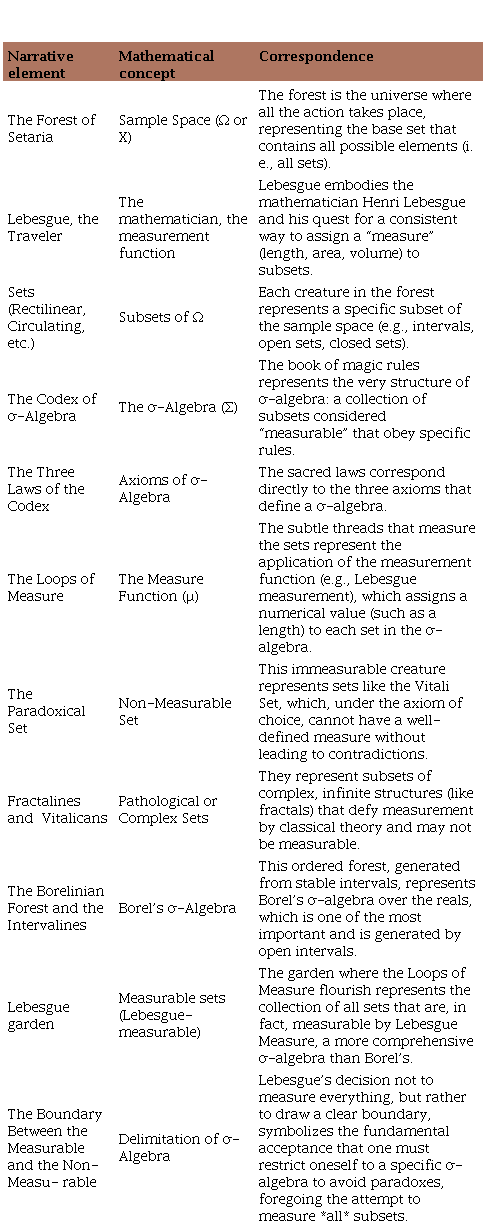 Prepared by the author
| Narrative element | Mathematical concept | Correspondence |
| The Forest of Setaria | Sample Space (Ω or X) | The forest is the universe where all the action takes place, representing the base set that contains all possible elements (i.e., all sets). |
| Lebesgue, the Traveler | The mathematician, the measurement function | Lebesgue embodies the mathematician Henri Lebesgue and his quest for a consistent way to assign a “measure” (length, area, volume) to subsets. |
| Sets (Rectilinear, Circulating, etc.) | Subsets of Ω | Each creature in the forest represents a specific subset of the sample space (e.g., intervals, open sets, closed sets). |
| The Codex of σ-Algebra | The σ-Algebra (Σ) | The book of magic rules represents the very structure of σ-algebra: a collection of subsets considered “measurable” that obey specific rules. |
| The Three Laws of the Codex | Axioms of σ-Algebra | The sacred laws correspond directly to the three axioms that define a σ-algebra. |
| The Loops of Measure | The Measure Function (μ) | The subtle threads that measure the sets represent the application of the measurement function (e.g., Lebesgue measurement), which assigns a numerical value (such as a length) to each set in the σ-algebra. |
| The Paradoxical Set | Non-Measurable Set | This immeasurable creature represents sets like the Vitali Set, which, under the axiom of choice, cannot have a well-defined measure without leading to contradictions. |
| Fractalines and Vitalicans | Pathological or Complex Sets | They represent subsets of complex, infinite structures (like fractals) that defy measurement by classical theory and may not be measurable. |
| The Borelinian Forest and the Intervalines | Borel’s σ-Algebra | This ordered forest, generated from stable intervals, represents Borel’s σ-algebra over the reals, which is one of the most important and is generated by open intervals. |
| Lebesgue garden | Measurable sets (Lebesgue-measurable) | The garden where the Loops of Measure flourish represents the collection of all sets that are, in fact, measurable by Lebesgue Measure, a more comprehensive σ-algebra than Borel’s. |
| The Boundary Between the Measurable and the Non-Measu- rable | Delimitation of σ-Algebra | Lebesgue’s decision not to measure everything, but rather to draw a clear boundary, symbolizes the fundamental acceptance that one must restrict oneself to a specific σ-algebra to avoid paradoxes, foregoing the attempt to measure *all* subsets. |
The Fractalian and Vitalican characters, with their unstable, unpredictable, and infinitely complex forms, represent the contents of the unconscious that defy Cartesian logic. They are symbolic manifestations of what Carl Gustav Jung describes as the unintegrated aspects of the psyche, archetypal forces that inhabit the collective unconscious and that, although they cannot be fully understood or measured, profoundly influence behavior, affections, and processes of inner transformation (Jung, 2000).
These entities do not follow fixed rules; they do not allow themselves to be captured by formulas, and precisely for this reason, they evoke the mystery and fascination of the unknown. They are like recurring dreams that defy interpretation, or like creative impulses that arise without warning, revealing that there is more to the human mind than what can be rationalized.
In this sense, Fractalians and Vitalicans function as living metaphors for what Jung called the transcendent function; that is, the symbolic process that integrates psychic opposites and gives rise to new meanings.
The Paradoxical Set, in turn, embodies the archetype of the shadow. In Jungian psychology, the shadow represents everything that has been excluded from consciousness: repressed traits, unaccepted desires, and internal contradictions that the ego prefers to ignore. In the story, this set is described as something that escapes because it cannot be contained by any logical structure and manifests itself in a fragmented, ambiguous way. Its existence challenges the rational system, but its presence is essential because, as Jung (2011, p. 30) warns, “assimilating the shadow, however, consists in making one’s personal darkness conscious,” an indispensable step for all self-knowledge. Recognizing the Paradoxical Set is, therefore, accepting that there are parts of reality (and of oneself) that cannot be tamed but must be respected and symbolically integrated.
In this context, the boundary drawn by Lebesgue between the measurable and the immeasurable acquires a profound symbolic value. It represents the threshold between what can be understood by reason and what remains shrouded in mystery, the exact point where the domain of consciousness ends and the territory of the unconscious begins.
This boundary is not a rigid barrier, but a transitional zone where the individual is invited to recognize the limits of their knowing and open themselves to the process of individuation. This process is the journey through which the individual becomes themselves, integrating the various aspects of their psyche and learning to live with their internal contradictions.
By preserving the logic of the forest without imposing a measure on what escapes measurement, Lebesgue adopts an ethical and symbolic stance: he recognizes that there is beauty in what cannot be quantified and that true knowledge lies not in mastering the mystery but in knowing how to live with it. This attitude can be seen as a profound pedagogical model, an invitation to the educator to teach not only formulas and theorems, but also humbleness in the face of the unknown, listening to the symbolic, and valuing what cannot be expressed in numbers.
Thus, the story becomes an allegory of the balance between reason and intuition, between science and myth, between the measurable and the ineffable.
5. Proposed teaching activities
The teaching of mathematics, especially in abstract topics such as measure theory and the construction of σ-algebras, can benefit immensely from approaches that integrate symbolic, narrative, and philosophical elements.
The proposed story, by presenting characters and settings that metaphorically represent mathematical concepts, offers a rich, sensitive, and intellectually stimulating learning experience.
The following details four pedagogical activities that explore this narrative as a starting point for teaching σ-algebra:
1) Symbolic reading and interpretation - Objective: To stimulate critical and symbolic reading, promoting the association between narrative elements and mathematical concepts of measure theory. Description: Students read the story carefully, focusing on its symbolic elements. Next, they discuss in groups the possible meanings of characters, settings, and events, relating them to mathematical concepts. Examples of symbolic correspondence include: the forest as a representation of the sample space (Ω); Fractalians and Vitalicans as unstable or complex subsets; the Paradoxical Set as a symbol of the non-measurable set; Lebesgue as a figure of the measure function and the role of the mathematician as a mediator between logic and mystery. Methodology: Based on a semiotic and interdisciplinary approach, this activity values symbolic reading as a tool for constructing meaning. It stimulates abstract thinking and the transition between literary language and mathematical language.
2) Formal Mapping - Objective: To translate the symbolic elements of the narrative into formal mathematical structures, consolidating the concepts of measure theory. Description: After the symbolic interpretation, the students construct a table that relates each narrative element to its mathematical counterpart. Example: forest - sample space, visible paths - measurable paths. Methodology: Inspired by mathematical modeling, this activity allows students to bridge the symbolic and formal worlds. It promotes cognitive organization through visual representations and conceptual relationships.
3) Construction of σ-algebra - Objective: To apply the formal concepts of measure theory to fictional situations, developing logical reasoning and abstraction. Description: Students are given a fictional set, for example: Ω = {Fractaline A, Fractaline B, Vitalican, North Path, South Path}. From this, they must construct collections of subsets that satisfy the three fundamental properties of a σ-algebra: containment of the empty set and the total set; closure under complementation; closure under countable union. Methodology: Based on active learning and problem solving, this activity encourages formal rigor, experimentation, and intellectual autonomy.
4) Philosophical Discussion - Objective: To reflect on the limits of formal logic, the nature of measurement, and the role of mystery in the construction of mathematical knowledge. Description: In a group discussion or debate, students explore questions such as: What does it mean for something to be “not measurable”? Is it possible to measure everything? What is the role of logic in the construction of knowing? Is there value in what cannot be quantified? The discussion can be enriched with excerpts from Carl Gustav Jung on the unconscious and the archetype of the shadow, as well as reflections on incompleteness in mathematics, such as Gödel’s theorems. Methodology: embedded in humanistic and philosophical education, this activity promotes critical thinking, metacognition, and interdisciplinary dialogue. It values the holistic development of the individual and the ability to reflect on their own knowing.
By integrating narrative, symbolism, formalization, and philosophical reflection, these activities propose a mathematics that thinks, feels, and imagines. This approach fosters not only the understanding of σ-algebra concepts, but also the development of an investigative, ethical, and sensitive attitude towards knowledge.
These activities promote meaningful abstraction, as argued by Skovsmose (2000), by allowing students to move between the symbolic and the formal, between imagination and logic.
6. The methodology of storytelling in mathematics education: fundamentals and application in the short story A floresta dos conjuntos [The forest of the sets]
Teacher training in mathematics demands approaches that go beyond the transmission of content and promote meaningful learning experiences. In this context, the methodology of storytelling has become established as an active pedagogical strategy, capable of integrating cognitive, affective, and symbolic aspects in the construction of mathematical knowledge (Aprigio; Lübeck, 2024).
Storytelling, as the structured use of narratives for educational purposes, promotes learning by mobilizing elements such as characters, conflicts, settings, and symbolic resolutions. This narrative structure, extensively studied by Campbell (2007) and Jung (2000), allows students to engage emotionally with concepts, develop empathy, and construct meaning from fictional experiences that mirror real dilemmas of mathematical thinking.
In the context of teacher education, the use of narratives as a teaching resource contributes to the development of pedagogical competencies focused on contextualization, interdisciplinarity, and the humanization of teaching. As Aprigio and Lübeck (2024) point out, the storytelling in mathematics education promotes holistic education by combining conceptual rigor with aesthetic sensitivity and creative imagination, essential elements for mediating complex knowings.
A floresta dos conjuntos, inspired by Henri Lebesgue’s trajectory and the construction of measurement theory, exemplifies the application of this methodology. The narrative features Lebesgue as the central character on a journey through the symbolic forest of Setaria, facing conceptual challenges represented by creatures such as the Intervalines, the Fractalines, and the Vitalicans. The construction of the σ-algebra is represented as a symbolic achievement, mediated by conflicts and discoveries that mirror the historical and logical process of mathematical formalization.
This approach allows pre-service teachers to understand not only the technical aspects of measurement theory, but also its epistemological and historical dimensions. By engaging with the narrative, the prospective teacher is invited to reflect on the limits of classical logic, the paradoxes of measurability, and the importance of abstraction in constructing mathematical models. Furthermore, the story activates Jungian archetypes that favor the integration between reason and imagination, promoting a formative experience that articulates scientific and symbolic knowings.
Therefore, the use of storytelling as a methodology in mathematics teacher training represents a powerful strategy for developing innovative, reflective, and humanized pedagogical practices (Ciríaco; Miranda; Brasil, 2024). A floresta dos conjuntos exemplifies how well-structured narratives can transform abstract content into meaningful experiences, contributing to the training of teachers capable of mediating knowledge with sensitivity, creativity, and rigor.
7. Final considerations
The proposal presented in this article seeks to connect mathematics teaching with symbolic and narrative elements, offering an alternative to the traditional formalist teaching model.
When using the short story A floresta dos conjuntos as a teaching resource, there is an expansion of the scope of meaning of mathematical concepts, especially regarding σ-algebra.
According to Skovsmose (2000), meaningful mathematical learning occurs when students are able to establish connections between the content and their subjective experiences. In this sense, the narrative allows the concept of σ-algebra, often introduced in a technical and abstract way, to be understood as a structure that organizes the measurable world, distinguishing it from what remains paradoxical or unknowable (Faustino; Passos, 2013).
Furthermore, the presence of Jungian archetypes in the construction of the story, such as the hero, the shadow, chaos, and order, fosters the emergence of profound meanings that transcend formal logic and enter the realm of imagination.
According to Leão et al. (2023) and Jung (2000), symbols serve as mediators between the unconscious and consciousness, and their presence in the educational process can favor the integral development of the subject.
From a pedagogical point of view, the proposal also aligns with D’Ambrosio’s (2005) ideas, which advocate a humanistic mathematics education capable of engaging with culture, art, and subjectivity. By allowing students to create their own mathematical narratives, the activity stimulates creativity, autonomy, and critical thinking.
Finally, it is important to emphasize that the proposal does not seek to replace formal education but to complement it with strategies that promote meaningful abstraction. The σ-algebra continues to be presented with mathematical rigor, but its introduction is done in language that respects students’ cognitive and affective limitations.
The proposal promotes the development of subjective skills, such as creativity, empathy, and respect for the limits of knowledge.
We believe this methodology can be applied to other abstract mathematical concepts, such as vector spaces, integrals, limits, and functions, provided that the principles of conceptual fidelity and symbolic coherence are respected. As Borba and Villarreal (2005) point out, mathematics teaching should be understood as a cultural practice rather than merely the transmission of techniques.
8. References
APRIGIO, Phellipe; LÜBECK, Marcos. Storytelling: uma metodologia ativa para o ensino de Matemática por meio de narrativas. Revemop, [S. l.], v. 6, p. e2024032, 11 dez. 2024. Disponível em: https:// periodicos.ufop.br/revemop/article/view/7423 Acesso em: 2 set. 2025.
BILLINGSLEY, Patrick. Probability and Measure. Toronto: Wiley, 1995.
BISHOP, Christopher Michael. Pattern Recognition and Machine Learning. Singapura: Springer, 2006.
BORBA, Marcelo Carvalho; VILLARREAL, Mônica Eugenia. Humans-with-Media and the Reorganization of Mathematical Thinking: Information and Communication Technologies, Modelling, Experimentation and Visualization. Nova York: Springer, 2005. Disponível em: https://link.springer.com/book/10.1007/ b105001 Acesso em: 24 ago. 2025.
BRITO, Marcia Regina Ferreira de. Psicologia da educação matemática: um ponto de vista. Educ. Rev., Curitiba, n. esp., p. 29-45, 2011. Disponível em: http://educa.fcc.org.br/scielo.php?script=sci_ arttext&pid=S0104-40602011000400003&lng=pt&nrm=iso Acesso em: 24 ago. 2025.
CAMPBELL, Joseph. O herói de mil faces. São Paulo: Cultrix, 2007.
CIRÍACO, Klinger Teodoro; MIRANDA, Rebeca Souza de; BRASIL, Thais. “Lúcia já vou indo ” e a Matemática também! Revemop, [S. l.], v. 6, p. e2024027, 24 nov. 2024. Disponível em: https:// periodicos.ufop.br/revemop/article/view/7413 Acesso em: 2 set. 2025.
COHN, Donald Leonard. Measure Theory. Nova York: Birkhäuser, 2013. Disponível em: https://link. springer.com/book/10.1007/978-1-4614-6956-8. Acesso em: 17 ago. 2025.
COSTA, André Pereira da; SANTOS, Marilene Rosa dos. O estudo de quadriláteros notáveis no livro didático de Matemática: um olhar para a organização matemática. Revemop, [S. l.], v. 1, n. 2, p. 229247, 1 maio 2019. Disponível em: https://periodicos.ufop.br/revemop/article/view/1758 Acesso em: 2 set. 2025.
D’AMBROSIO, Ubiratan. Educação matemática: da teoria à prática. Campinas: Papirus, 2005. Disponível em: https://books.google.com.br/ books?id=NkGnY25OShcC&printsec=frontcover#v=onepage&q&f=false Acesso em: 24 ago. 2025.
DUDLEY, Richard Mansfield. Real Analysis and Probability. Cambridge: Cambridge University Press, 2002. Disponível em: https://catdir.loc.gov/catdir/samples/cam033/2002073698.pdf Acesso em: 17 ago. 2025.
FAUSTINO, Ana Carolina; PASSOS, Carmen Lucia Brancaglion. Cenários para investigação e resolução de problemas: reflexões para possíveis caminhos. Revista Educação e Linguagem, [S. l.], v. 2, n. 3, p. 62-74, 2013. Disponível em: https://periodicos.unespar.edu.br/revistaeduclings/article/view/6362 Acesso em: 24 ago. 2025.
FELLER, William. An Introduction to Probability Theory and Its Applications. Vol. 1. New York: Wiley, 1971. Disponível em: https://books.google.com.br/books/about/An_Introduction_to_Probability_ Theory_an.html?id=mfRQAAAAMAAJ&redir_esc=y Acesso em: 24 ago. 2025.
HALMOS, Paul Richard. Measure Theory. Nova York: Springer, 1974.
JUNG, Carl Gustav. O homem e seus símbolos. Rio de Janeiro: Nova Fronteira, 2000.
JUNG, Carl Gustav. A Prática da Psicoterapia: contribuições ao problema da psicoterapia e à psicologia da transferência. 18. ed. Petrópolis: Vozes, 2011.
KALLENBERG, Olav. Foundations of Modern Probability. Nova York: Springer, 2021. Disponível em: https://link.springer.com/book/10.1007/978-3-030-61871-1#bibliographic-information Acesso em: 24 ago. 2025.
KOLMOGOROV, Andrey Nikolaevich. Foundations of the Theory of Probability. Nova York: Chelsea Publishing, 1950.
LEÃO, Weliton da Silva; BOAVENTURA FILHO, Nivaldo de Oliveira; CHERUBINO, Cíntia Nogueira; PEDROSA, Elenice Maria Fonseca Chaves. O processo de individuação segundo Carl Gustav Jung, Revista FT, [S. l.], v. 27, n. 128, 2023. Disponível em: https://revistaft.com.br/o-processo-deindividuacao-segundo-carl-gustav-jung/ Acesso em: 24 ago. 2025.
LEBESGUE, Henri Léon. Leçons sur l’intégration et la recherche des fonctions primitives. Paris: Gauthier-Villars, 1904. Disponível em: https://quod.lib.umich.edu/u/umhistmath/ ACM0062.0001.001?rgn=main;view=fulltext Acesso em: 17 ago. 2025.
ORTEGA, Pedro Andrés; BRAUN, Daniel Alexander. Thermodynamics as a theory of decision-making with information-processing costs. Proceedings of the Royal Society A, [S. l.], v. 469, p. e20120683, 2013. Disponível em: https://royalsocietypublishing.org/doi/10.1098/rspa.2012.0683. Acesso em: 30 ago. 2025.
RUSSELL, Stuart; NORVIG, Peter. Artificial Intelligence: A Modern Approach. Nova Jersey: Pearson, 2020.
SKOVSMOSE, Ole. Paisagens matemáticas: uma abordagem para o ensino da matemática. Campinas: Papirus, 2000.
VAHL BOHRER, Jordana; MONTOITO, Rafael; MARTINS DAVID, Erenita. O estudo da unidade temática de grandezas e medidas intermediado pela narrativa “As Aventuras do Pinóquio”. Revemop, [S. l.], v. 6, p. e2024028, 26 nov. 2024. Disponível em: https://periodicos.ufop.br/revemop/article/view/7372 Acesso em: 2 set. 2025.
VITALI, Giuseppe. Sul problema della misura dei gruppi di punti di una retta. Giornale di Matematiche di Battaglini, [S. l.], v. 11, p. 1-27, 1905. Disponível em: https://web.unica.it/unica/protected/417040/0/ def/ref/MAT246835/ Acesso em: 24 ago. 2025.