
Artigos
Children’s literature and mathematics: Snow White and the 7 dwarfs in activities to develop the concept of correspondence
Literatura infantil e matemática: Branca de neve e os 7 anões em atividades para desenvolver a noção de correspondência
Literatura infantil y matemáticas: Blancanieves y los 7 enanitos en actividades para desarrollar la noción de correspondencia
Revemop
Universidade Federal de Ouro Preto, Brasil
ISSN-e: 2596-0245
Periodicity: Frecuencia continua
vol. 7, 2025
Received: 07 July 2025
Accepted: 30 September 2025
Published: 15 October 2025

Abstract: This article is part of a series of studies developed by the Study Group on Narratives and Education in Postmodernity, which has been dedicated to researching the interrelationships between literature and mathematics. In this study, the authors chose to highlight children’s literature to demonstrate its potential to build the concept of correspondence in early childhood education through activities based on the reading of Snow White and the seven dwarfs. The article establishes a theoretical discussion of the concept of correspondence and suggests activities that, beyond being applicable in the classroom, aim to captivate teachers and encourage them to consider multiple possibilities for bringing storytelling closer to mathematical content, thus establishing strong links between the mother tongue and mathematical language.
Keywords: Children’s literature and mathematics, Correspondence, Storytelling, Mother tongue and mathematical language, Educational activities.
Resumo: Este artigo integra um conjunto de estudos desenvolvidos no Grupo de Estudos em Narrativas e Educação na Pós-modernidade, os quais têm se dedicado a pesquisar as inter-relações entre literatura e matemática. Nesse, os autores escolheram dar destaque à literatura infantil, traçando o objetivo de apresentar suas potencialidades para a construção do conceito de correspondência na Educação Infantil, por meio da elaboração de atividades pensadas a partir da leitura de Branca de Neve e os sete anões. O artigo estabelece uma discussão teórica sobre o conceito de correspondência e sugere atividades que, mais do que poderem ser aplicadas em sala de aula, intencionam cativar os professores para pensarem múltiplas possibilidades de aproximar a contação de histórias de conteúdos matemáticos, estabelecendo, assim, laços fortes entre a língua materna e a linguagem matemática.
Palavras-chave: Literatura infantil e matemática, Atividades de Correspondência, Contação de histórias, Língua materna e linguagem matemática, Atividades pedagógicas.
Resumen: Este artículo forma parte de un conjunto de estudios desarrollados por el Grupo de Estudios sobre Narrativas y Educación en la Posmodernidad, que se ha dedicado a investigar las interrelaciones entre la literatura y las matemáticas. En él, los autores han decidido destacar la literatura infantil, con el objetivo de presentar su potencial para la construcción del concepto de correspondencia en la educación infantil, mediante la elaboración de actividades pensadas a partir de la lectura de Blancanieves y los siete enanitos. El artículo establece una discusión teórica sobre el concepto de correspondencia y sugiere actividades que, más allá de poder ser aplicadas en el aula, pretenden cautivar a los profesores para que piensen en múltiples posibilidades de acercar la narración de cuentos a los contenidos matemáticos, estableciendo así fuertes vínculos entre la lengua materna y el lenguaje matemático.
Palabras clave: Literatura infantil y matemáticas, Correspondencia, Narración de cuentos, Lengua materna y lenguaje matemático, Actividades pedagógicas.
1. Introduction: Once upon a time, there was children’s literature
This article is part of a series of studies being developed within the Study Group on Narratives and Education in Post-Modernity (Grupo de Estudos em Narrativas e Educação na Pós-modernidade — GENEP), which investigates the possible interrelationships between literature and mathematics. These interrelationships can be applied to mathematics classes and research in mathematics education in various ways, demonstrating the plurality of appropriations available to mathematics teachers/researchers when working with a literary work. Among these possibilities — literature as a historical source (Montoito; Rios, 2019; Montoito; Silva, 2025), literature as a creation of educational products (Lanes; Cunha; Montoito, 2024), literature as a structure for the writing of articles, dissertations and theses (Montoito, 2020; Oliveira; Cunha, 2024), and literature as a means for teaching content (Bohrer; Montoito; David, 2024; Silveira; Montoito, 2024) —, this article will focus on the last group; i.e., it aims to present the potential of children’s literature for the construction of the concept of correspondence in the teaching of mathematics in early childhood education, through the elaboration of activities thought from the reading of Snow White and the seven dwarfs.
Children’s literature is very present in early childhood education classes, as this is a phase in which teachers often tell stories to their students, infusing the classroom with fantasy and playfulness. Early childhood education theorists have long discussed the “magic” of literature. We can mention, for example, Abramovich (1991), who highlights the importance of building, together with the little ones, the habit of reading, recognizing that it is indispensable that all children listen to stories, because, in this way, they will possibly become avid readers and develop more skills to have a better understanding of the world around them. Cademartori (2007, p. 71), in turn, highlights that reading, when done for children in the literacy phase,
[...] not only approaches the book as a source of knowledge and pleasure, but also plays an important role in the formation of verbal expression. The creative text has as its fundamental characteristic the surprise caused by the relationships it establishes at the level of composition and meaning. This surprise presents new connections to consciousness, opening new possibilities of expression and bringing together objects whose links were unsuspected.
The various studies carried out in our group (Bohrer, 2023; Weissheimer, 2020; Cunha, 2019) have been produced from the perspective that reading encourages the opening of new paths and, therefore,
Children can make new connections and inferences that will contribute to the analysis of mathematical structures and to problem solving. In this context, children’s literature plays a crucial role in shaping children’s worldviews, as it enables a connection between fiction and reality (Silveira; Montoito, 2024, p. 60).
Zilberman (2003, p. 49) supports this perspective, arguing that:
Fantasy is an important supplement to a child’s understanding of the world: it fills the gaps that the individual necessarily has during childhood, due to their ignorance of the real, and helps them order the new experiences the books often provide.
Not only referring to children — but obviously encompassing them in his statement — Edgar Morin, an eminent contemporary French philosopher and researcher, denominates literature as “school of life” because, in each work, “there is a deep thought about the human condition” (Morin, 2004, p. 45), and this is only one of the reasons why, according to Maria (2009), storytelling is present in human life from the earliest antiquity as an educational act that unite people. For Morin, telling stories is such a powerful and formative act of the human way of thinking that society eventually got organized through them; hence, the terms “history of science”, “history of philosophy”, “history of Brazil”, “history of the great revolutions”, etc.
Having commented, albeit briefly, on the potential of “once upon a time”, it is up to us to think about appropriations of stories that help students develop their learning in mathematics classes. In this article, we will begin with the children’s story Snow White and the seven dwarfs and present activities designed to support the development of the concept of correspondence. We must note that, with this text, our purpose is not to comment on the results of an applied activity, but rather to discuss theoretical issues and to offer the teacher some activities as an invitation to create their own using the same story or any other.
To discuss these issues, we organized the article into three parts. The first part addresses the contributions of the interrelationships between literature and mathematics to the teaching of the latter. The second concerns the importance of developing the concept of correspondence for mathematics learning. The third presents activities that tend to help develop the concept of correspondence, based on this children’s classic.
2. Interrelationships between literature and mathematics
Montoito and Dalcin (2020) highlight the importance of exploring the connections between literature and mathematics to promote learning and cognitive development. According to Montoito (2019), literature and mathematics are not isolated areas but can be interconnected, and exploring these connections can enrich learning and understanding of both.
At the heart of this article is children’s literature, which fascinates children and seizes their interest. The expression “Once upon a time...” invites the world of imagination and can capture their attention, one of the most precious assets in the classroom. Amarilha (2004) states that this enchantment comes from the fictional game of narratives and is essential for learning.
According to Farias (2006, p. 89),
When we read or hear a story, we are arrested by tunings of tension and amazement in the face of the unknown, because they provide the opportunity to cross the boundaries of the personal world through an imaginary incursion triggered by this process of cognitive activation.
Literature has the power to emotionally engage children, leading them into the world of make-believe and arousing their interest in stories. This involvement generates expectations and favors a deeper, more meaningful connection with the content worked. As Montoito and Dalcin (2020, p. 7) point out, “literature allows the expression of the imaginary and establishes a bridge between the author’s creation and the reader’s recreation, albeit not literally”, because,
[t]hrough enchantment, magic, and playfulness, children begin to understand the world and internalize concepts that will be meaningful for life. These concepts may not be immediately apparent, but they are stored in the memory until the child needs to use this knowledge (Elert; Grützmann; Redmer, 2024, p. 11).
In the early childhood education stage, as Lorenzato (2011) argues, it is essential that the child progress from concrete action to symbolic representation. This process requires the child to move from practicing to communicating and later to registering. Children’s literature, in this path, acts as an essential resource, helping the students, in a global and connected way, develop seven indispensable skills for learning mathematics: appropriating the mathematical language; communicating and recording; using the imagination; developing the ability to anticipate; mobilizing their linguistic and textual knowledge of the world; being interested; observing, analyzing, interpreting, and synthesizing (Cunha; Montoito, 2021).
Now, highlighting language, we can say that, in this context, it plays a decisive role in the construction of mathematical knowledge. For Zilberman (2003), the more linguistic mastery the child acquires, the greater their ability to interpret and understand the world around them, since language acts as a mediator between the subject and their reality. Machado (2011) complements this, stating that the mother tongue is intertwined with mathematical language, helping construct meanings. This articulation among language, mathematics, and thinking is crucial for learning, as Vygotsky (1989) underscores, stating that language drives the development of thought, as the structures of speech eventually shape the child’s cognitive structures.
Literary language, loaded with expressiveness and repertoire, as Maria (2009) points out, contributes to expanding children’s vocabulary and teaches not only what to say, but also how. This enhances communicative ability and directly influences the organization of thought, which is why early contact with books and stories is so relevant. During storytelling, children are encouraged to predict events, interpret verbal and visual elements of the narrative, and share their ideas — competencies that are also indispensable in mathematical learning, as Machado (2011) reminds us that, as mathematics does not have its own orality, it relies on the mother tongue to express itself. This interdependence strengthens the understanding and development of linguistic and mathematical skills in an integrated way, which will be widely reinforced and worked on throughout the school years, especially through texts that provide context for solving exercises or through problem solving.
Regarding the approximation between children’s literature and mathematics, Smole, Cândido, and Stancanelli (1997, p. 13) highlight that this articulation allows creating in the classroom contexts that favor students’ contact with mathematical language, something that the publications by Cunha and Montoito (2020; 2021), Arnold and Dalcin (2020), and Weissheimer and Montoito (2020), among others, clearly and inspiringly contemplate. All these publications problematize how this approach contributes to children establishing cognitive connections between their mother tongue, everyday concepts, and formal mathematical language, offering opportunities for them to express the vocabulary of mathematics through writing, drawings, or orality.
Still on the relationship between mother tongue and mathematical language, Souza and Carneiro (2015, p. 398) give a powerful statement:
Connecting children’s literature and mathematics enables the creation of teaching situations that allow exploring the relationships between mother tongue and mathematics, provides circumstances that show students the importance and usefulness of language and mathematical symbolism, and the appropriate use of these symbols and mathematical terminology, and also allows the development of mathematical communication, leading students to understand mathematical content and mathematical language.
Although, by their nature, children’s literature books aim to teach and entertain — falling within both the pedagogical and artistic fields (Coelho, 2018) —, they must be carefully selected when bridging literature and mathematics. The work must balance didactic and literary value. Arnold (2016, p. 32) reinforces that it is essential to “opt for books that, even when dealing with school content, have aesthetic, linguistic, and artistic quality, contributing to the expansion of the students’ cultural repertoire”. In other words, the presence of an educational intentionality should not nullify the literary character of the book, so the narrative must be engaging, with a thought-provoking plot that stimulates students’ imagination and curiosity, creating a favorable environment for them to seek, both in the story — be it textual or visual — and in mathematical concepts, creative solutions to problem situations.
The teacher who wants to explore this connection between children’s literature and mathematics needs to develop a sensitive, attentive gaze capable of perceiving the presence of mathematics in children’s literary texts across different aspects and possibilities.
Many books embed mathematics in the text itself; others serve to relate mathematics to other areas of the curriculum; some involve certain mathematical skills one wishes to develop, and others provide a motivation for using the teaching materials. A book may suggest numerous activities that guide students to mathematical topics and skills beyond those mentioned in the text (Smole; Cândido; Stancanelli, 1997, p. 22).
Thus, a successful connection between literature and mathematics requires that the teacher have well-defined learning objectives in both areas, language and mathematics. Only then will it be possible to adequately explore the potential of the chosen book, thereby promoting richer, more challenging, and more meaningful learning experiences for students.
3. The concept of correspondence in mathematical learning
We understand correspondence as the relationship established between two or more elements that are equivalent or associated in a logical and significant way, and it is a fundamental concept in the development of children’s mathematical thinking, as it allows them to understand initial notions of comparison, pairing, and equivalence between sets. In early childhood education, correspondence work can be explored in a playful, context-based way, helping shape essential cognitive skills such as attention, classification, ordering, and counting. By proposing situations in which the child must relate elements — such as associating objects with images, numbers with quantities, or words with figures — the educator creates opportunities for the student to establish connections between different representations of the world around them. Thus, the concept of correspondence becomes an important tool to stimulate logical-mathematical reasoning from the early years of schooling, serving as a basis for more complex learning in the years that follow.
It is worth noting that correspondence is fundamental to the:
a) Development of mathematical understanding — the concept of correspondence plays a central role in the process of building children’s mathematical understanding. By establishing relationships between elements of two sets, the child begins to perceive, in a concrete way, the equivalence between number and quantity. This experience favors the internalization of fundamental principles of mathematics, such as conservation, ordering, and cardinality, which are prerequisites for more complex operations. Thus, correspondence work contributes significantly to the child’s understanding that numbers are not just abstract symbols, but representations of quantities present in their daily lives.
b) Development of counting skill — the correct counting depends directly on understanding the correspondence one by one, that is, the notion that each object counted corresponds exactly to a number. This skill is progressively built and requires concrete experiences in which the child can manipulate, group, and compare real objects. By experiencing situations in which they need to count elements in an organized way, the child learns to control variables such as order, sequence, and totalization, which strengthens their ability to quantify and perform basic operations with greater confidence.
c) Development of the ability to solve problems — correspondence also contributes to the development of the ability to solve mathematical problems, by involving the child in situations that require logical reasoning, decision making, and strategy formulation. When working with sets of objects or numbers, the child is challenged to observe, compare, pair, and justify their choices, which stimulates cognitive flexibility and intellectual autonomy. Problems involving the distribution of elements, comparisons among groups, or associations of pairs are practical examples in which correspondence serves as a structuring axis for learning.
The development of the concept of correspondence plays a crucial role in building mathematical understanding in early childhood education. This process favors the development of skills such as counting, problem solving, and logical reasoning, which are fundamental to mathematical thinking throughout the school trajectory. When worked in an integrated, playful, and meaningful way, this concept allows children to establish relationships between numbers, quantities, objects, and sets. As a result, they expand their understanding of essential mathematical notions and develop cognitive skills indispensable to their integral formation and future learning.
4. Snow White and the seven dwarfs: some activities designed to develop the concept of correspondence
To address the concept, we suggested Snow White and the seven dwarfs, based on Vygotsky’s (1989) theory of sociocultural learning, which holds that learning occurs through social interaction and language.
Literature and mathematics can be seen as powerful tools for learning and cognitive development. The zone of proximal development, ZPD, which is the “distance” between what the child can do alone and what they can do with the help of an adult or a more experienced colleague, can be used in practice with literature and mathematics, given that the child will have the opportunity to appropriate a knowledge of mathematics with the help of an adult, from a story told.
Vygotsky (1989) emphasizes the importance of language in learning, and this is another point in favor of thinking about the use of literature to develop children’s language and understanding, associating it with mathematics to develop the language of this discipline through problem solving — in this case, problems appropriate to the age of the students whose activities this article wishes to contemplate.
In early childhood education, resolving mathematical problems in groups can foster the use of mathematical language to communicate strategies and solutions, while promoting argumentation and cooperation. Furthermore, creating stories with mathematical themes is an important pedagogical practice because it integrates mathematical concepts into the development of oral and written language while simultaneously stimulating children’s logical reasoning, creativity, and expression.
The concept of correspondence can be explored in several ways using the book Snow White and the seven dwarfs. In this article, we suggest some activities:
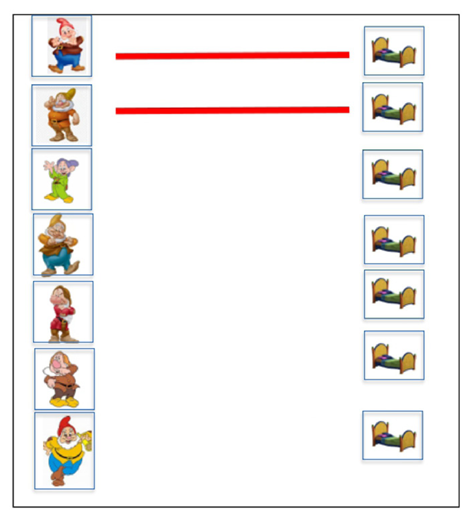
a) Correspondence between the seven dwarfs and an object — The number of dwarfs can be used to teach children the correspondence between them and objects, on the simple scale of one by one (Activity 1).
b) Correspondence between the seven dwarfs and their names – The seven dwarfs have specific names that correspond to unique characteristics or personalities, and this can be used to teach children to establish correspondence between them and textual information (a word) (Activity 2).
c) Correspondence between the seven dwarfs and their tableware – The number of dwarfs can be used to teach children about the correspondence between them and their objects, now on the scale of one to several (Activity 3).
The teacher can explore such concepts during storytelling with timely questions, or after storytelling by resuming passages and proposing activities. However, one must be careful not to disrupt the narrative thread. The storytelling moment should be absolutely pleasurable and fun, and the questions, although pedagogical, should engage the children to help them understand the narrative.
Activity 1: proposes, in a simple and very concrete way, that the students establish the correspondence between the seven dwarfs and their respective beds. The execution of the activity can take place in different ways, at the choice of the teacher, such as, for example, handing students a sheet with the following images or exposing, on a mural or on the board, the figures of the seven dwarfs and the seven beds, so that students can manipulate them by dragging them and pasting them side by side. No written statement is necessary, since the teacher will accompany the class to explain what needs to be done.
A variation of this activity that teachers could choose is to present one of the groups of “huddled” figures, without letting students know from the start that the number of dwarfs is the same as the number of beds; students would only discover this by performing the activity. This strategy is valid and aligns with the construction of the concept of correspondence, which the teacher cannot neglect, as children tend to think that scattered objects are in greater quantity than nearby objects because they occupy a larger visual region (Cunha, 2019).
It is essential to highlight that students need to manipulate the images after cutting to establish correspondence between each bed and each character. They should be encouraged to count and compare the quantities in each set, to ask whether they think there are enough beds for everyone, and to always justify their answers. Only after manipulating and making different orders with the figures should they make the correspondence of the images, that is, one bed for each character. This activity favors the development of counting, ordering, conservation, and cardinality.
Activity 2: proposes that students establish the correspondence between an object and a word, an important relationship for the student to learn to establish correspondence relationships between elements of different materialities (in this case, someone and their name). The name of each character, given that it represents his personality, serves as a concept, something that will later be more formalized when the student, for example, learns the names of planes or spatial geometric figures. No written statement is necessary, since the teacher will accompany the class to explain what is to be done.
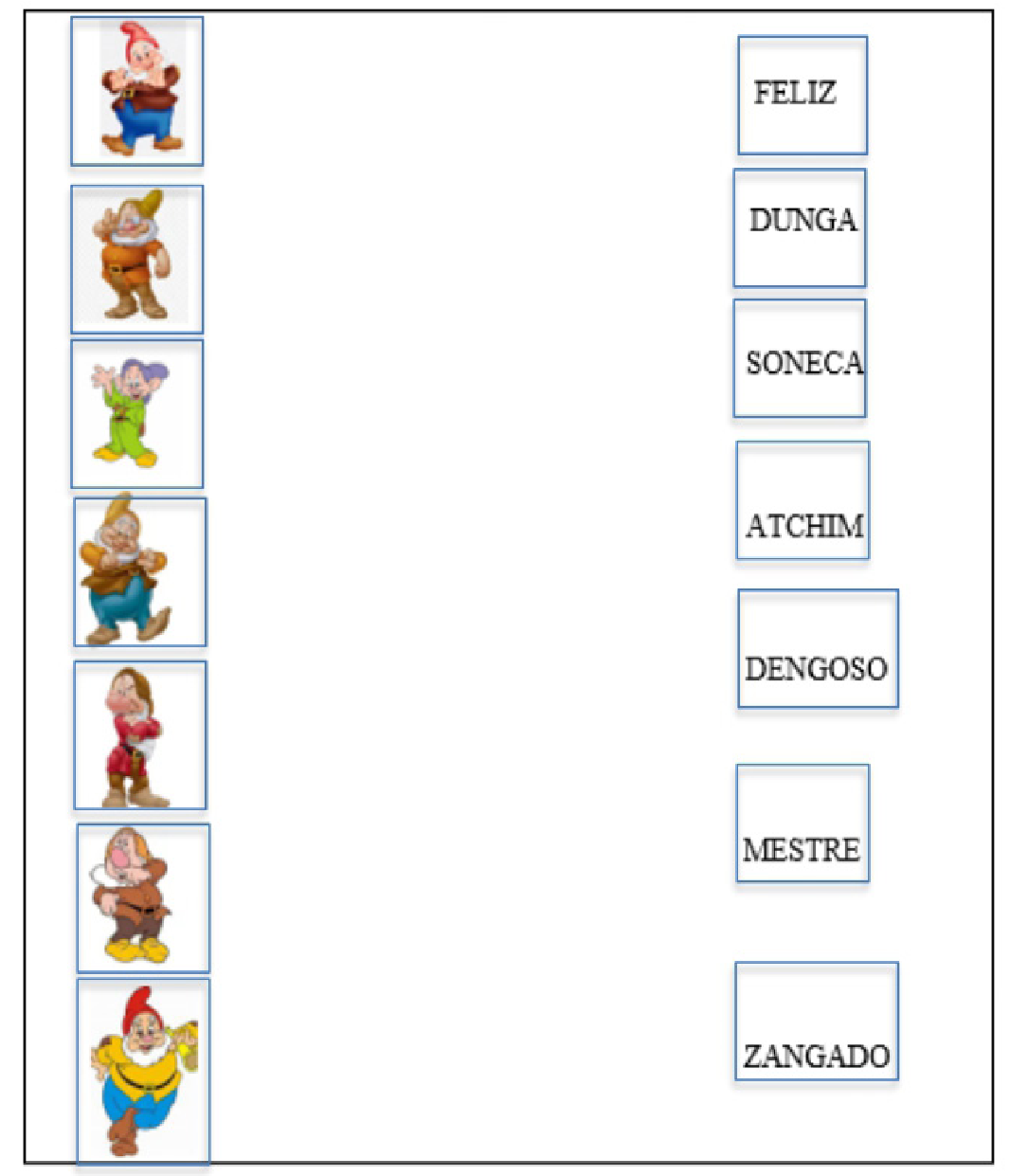
Like the previous activity, this can also be performed in more than one way, at the teacher’s choice: students can solve it in groups or go to the board, one at a time, to connect the character to his name. If the student makes a mistake, the teacher will call another, favoring interactivity and group discussion.
As in Activity 1, students must manipulate the images, count, compare, order in different ways, and finally make the correspondence. Thus, they are developing counting and concepts of correspondence, conservation, ordering, and cardinality. We must remember that we are dealing with the mental concept of correspondence, because this is the object of discussion in the article; however, in the activities, we will hardly work with a single mental concept. Usually, they are developed concomitantly, with one clarifying the other (Cunha, 2019).
Activity 3: proposes that the students establish the correspondence between the characters and the tableware each will use for dinner (plate, glass, fork, and knife). In this activity, the relationship is one (character) by four (objects), something that the student can easily realize or not, showing that they need some help from the teacher. The activity can be solved in several ways, the simplest being to “connect” each character to their set of tableware, but this can leave the sheet heavily scratched and compromise understanding. Therefore, a good suggestion is to use colors (which is why the illustration is in black and white), so students can paint each dwarf’s cap a different color, and use this same color to paint their respective dinner tableware. No written statement is necessary, since the teacher will accompany the class to explain what is to be done.
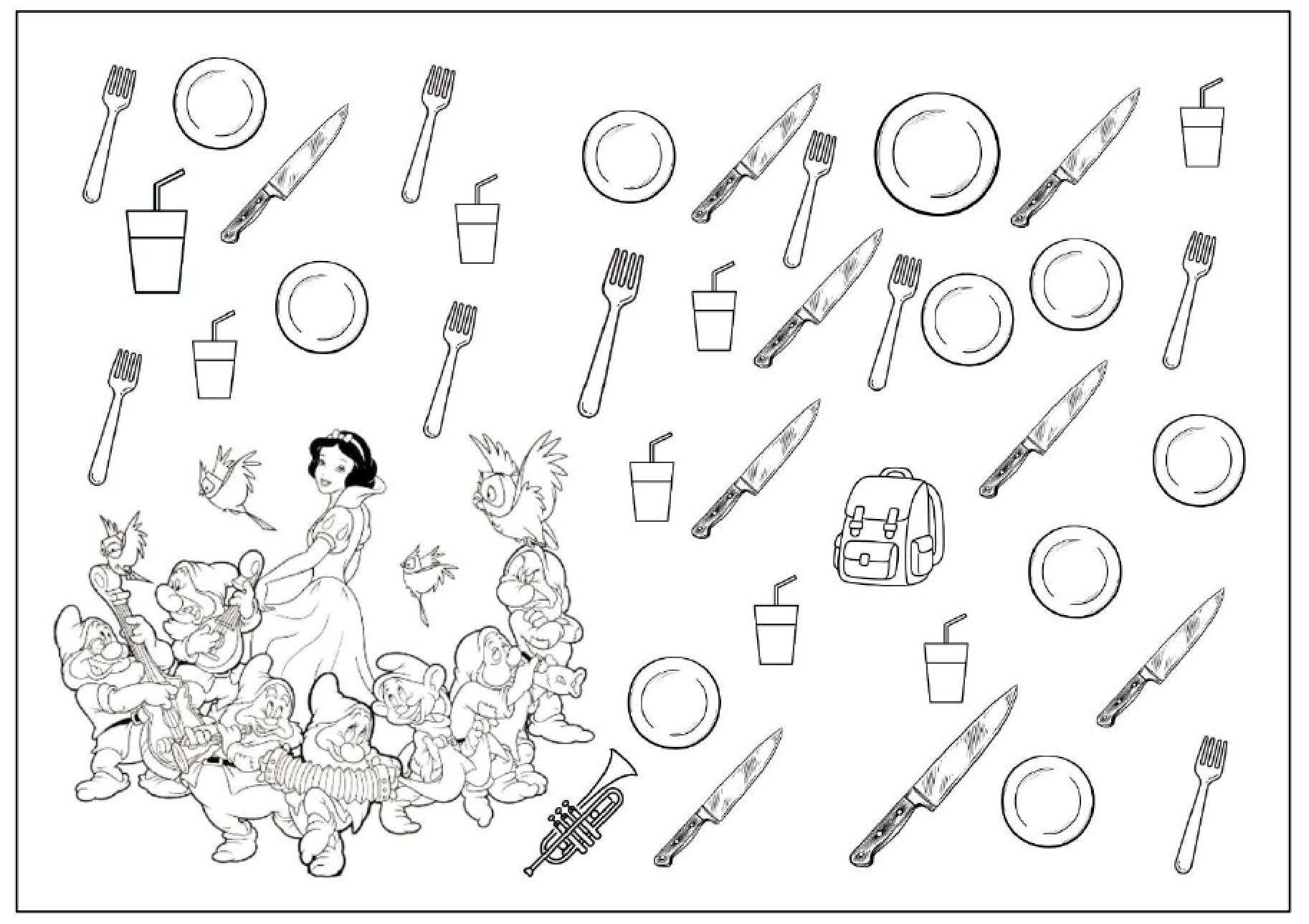
This activity is a little more complex for young children, as it does not allow object manipulation, and many are still not very skilled at counting, so they may find it challenging when the objects are disordered. They must count the characters, including Snow White, then count the tableware separately to see whether there are enough for everyone, whether any will be missing, or if any will be in excess.
In the end, the student will realize that some elements were more than enough (objects not used for dinner), which is another important piece of data for them to consider, since the concept of correspondence is not limited to exhaustively using available elements to establish a relationship. It would also be interesting to note whether the student notices that there is a set of tableware for Snow White and that it is larger than that for the dwarfs, as this is also a correspondence relationship, but one of greatness.
In this type of activity, correspondence assists in problem solving, as the student is challenged to observe, compare, and pair sets with different elements and quantities, which stimulates the creation of diverse strategies. That is why each student needs to explain their choices and compare them with their peers, as this stimulates cognitive flexibility and intellectual autonomy.
5. Final considerations
Children’s literature plays a significant role in enriching children’s vocabulary while bridging everyday and mathematical language. Through it, children are encouraged to develop curiosity and interest in the natural and social worlds, as well as to learn to identify and relate to objects, shapes, and their characteristics.
By using children’s literary works — which, although not created with specific pedagogical objectives, have significant educational potential — educators expand opportunities to develop interdisciplinary practices. In this way, these books become important resources for the teaching of mathematics and other subjects, enriching and diversifying classroom approaches.
In addition, illustrations in children’s books are important resources for children to base their interpretations of the stories and challenges presented. Therefore, it is essential that they frequently access the works used and can revisit them as needed. It is also recommended that teachers explore the mathematical elements in the narratives, such as quantity, comparison, equality, difference, and proportion. Montoito (2019) points out that there is a space where mathematics and literature meet, enabling the integration of these two fields during storytelling activities. Returning to the terminology presented by Fux (2016), Montoito (2019) points out that literature and mathematics, as areas of knowledge, have their own territories, their own places. However, there are some “in-between places” that both share — it is this type of encounter that makes it possible for the mathematics teacher (or the pedagogue, in the case of this article) to appropriate literature to use it in their class.
It is the teacher’s responsibility to create environments and situations that encourage this approach, thereby favoring richer, more engaging learning. This practice not only stimulates interest in knowledge but also contributes to the development of creativity and reinforces the use of mathematical language in real and social contexts, always in alignment with the mother tongue. This article makes it clear that there is a wide range of opportunities to connect mathematics and children’s literature, and the activities presented show that the teacher can create them from their gaze, inspiration, and creativity, with no need for them to be elaborate or complex.
In this sense, the article reaches its central objective, which was to present the potential of children’s literature for constructing the concept of correspondence in mathematics teaching in early childhood education, through the preparation of activities based on the story Snow White and the seven dwarfs.
6. References
ABRAMOVICH, Fanny. Literatura infantil: gostosuras e bobices. São Paulo: Scipione, 1997.
AMARILHA, Marly. Estão mortas as fadas? Literatura infantil e prática pedagógica. 6. ed. Petrópolis: Vozes, 2004.
ARNOLD, Denise Soares. Matemáticas presentes em livros de leitura: possibilidades para a Educação Infantil. 2016. 182 f. Dissertação (Mestrado Profissional em Ensino de Matemática) – Instituto de Matemática, Universidade Federal do Rio Grande do Sul, Porto Alegre, 2016.
ARNOLD, Denise Soares; DALCIN, Andreia. Matemática e literatura infantil: um livro, um jogo e o desafio de “desenhar” o tempo. Revista Internacional de Pesquisa em Educação Matemática. v. 10, n. 2, p. 167-181, 2020. DOI: 10.37001/ripem.v10i2.2169.
BOHRER, Jordana Vahl. As aventuras do Pinóquio no contexto do ensino de Grandezas e Medidas no 2º ano dos Anos Iniciais. 2023. 237 f. Dissertação (Mestrado em Educação) – Programa de Pósgraduação em Educação, Instituto Federal de Educação, Ciência e Tecnologia Sul-rio-grandense. Pelotas, 2023.
BOHRER, Jordana Vahl; MONTOITO, Rafael; DAVID, Erenita Martins. O estudo da unidade temática de grandezas e medidas intermediado pela narrativa “As aventuras do Pinóquio”. REVEMOP, Ouro Preto, v. 6, 2024, p. 1-19. DOI: https://doi.org/10.33532/revemop.e2024028.
CADEMARTORI, Lígia. O que é literatura infantil. Brasiliense, 2017.
COELHO, Nelly Novaes. Literatura infantil: teoria, análise, didática. 7. ed. São Paulo: Moderna, 2018.
CUNHA, Aline Vieira da. Guardados do baú da vovó: sobre Matemática, contação de histórias e a construção do conceito número. 2019. 107 f. Dissertação (Mestrado em Educação) – Programa de Pós-Graduação em Educação, Instituto Federal de Educação, Ciência e Tecnologia Sul-rio-grandense. Pelotas, 2019.
CUNHA, Aline Vieira da; MONTOITO, Rafael. A matemática dos contos de fada: a construção do conceito de correspondência a partir da contação de histórias infantis. Ciência & Educação, Bauru, v. 28, 2022. DOI: https://doi.org/10.1590/1516-731320220045.
CUNHA, Aline Vieira da; MONTOITO, Rafael. Conexões entre literatura infantil e matemática: sete categorias para um aprofundamento do tema. In: SILVA, Cristiana Barcelos da; MELLO, Roger Goullart (Orgs.). Educação em foco: contribuições para o desenvolvimento da criança na educação infantil, vol. 2. Rio de Janeiro: E-Publicar, 2021.
CUNHA, Aline Vieira da; MONTOITO, Rafael. Era uma vez... um, dois, três: estudos sobre como a literatura infantil pode auxiliar no ensino da construção do conceito de número. Educação Matemática Pesquisa. São Paulo, v. 22, n. 1, 2020, p. 160-184. DOI: http://dx.doi.org/10.23925/19833156.2020v22i1p160-184
ELERT, Cristiane Winkel; GRÜTZMANN, Thaís Philipsen; REDMER, Alice Carina Venzke. E o dente ainda doía: a literatura infantil e o ensino da matemática em uma prática no 1º ano do Ensino Fundamental. REVEMOP, Ouro Preto, v. 6, 2024, p. 1-13. DOI: https://doi.org/10.33532/revemop.e2024033.
FARIAS, Carlos Aldemir. Alfabetos da alma: histórias da tradição na escola. Porto Alegre: Sulina, 2006.
FUX, Jacques. Matemática e Literatura: Jorge Luis Borges, George Perec e o OULIPO. São Paulo: Perspectiva, 2016.
LANES, Priscila; CUNHA, Aline Vieira da; MONTOITO, Rafael. Inter-relações entre literatura e matemática: “O enigma do bichano” e o ensino de álgebra para os anos iniciais. Revista Sergipana de Matemática e Educação Matemática, n. 4, 2024, p. 131-151. DOI: https://doi.org/10.34179/revisem. v9i4.20120.
LORENZATO, Sérgio. Educação Infantil e percepção matemática. Campinas: Autores Associados, 2011.
MACHADO, Nílson José. Matemática e língua materna: análise de uma impregnação mútua. São Paulo: Cortez, 2011.
MARIA, Luzia de. O clube do livro: ser leitor − que diferença faz? São Paulo: Globo, 2009.
MONTOITO, Rafael. Às avessas: outros percursos para se pensar/discutir as inter-relações entre matemática e literatura. Revista Internacional de Pesquisa em Educação Matemática. v. 10, n. 2, 2020, p. 89-106. DOI: 10.37001/ripem.v10i2.2170.
MONTOITO, Rafael. Entrelugares: pequeno inventário inventado sobre matemática e literatura. BOLEMA, Rio Claro, v. 33, n. 64, 2019, p. 892–915. Disponível em: https://doi.org/10.1590/19804415v33n64a22. Acesso em: 2 set. 2025.
MONTOITO, Rafael; DALCIN, Andreia. Literatura e matemática em inter-relações possíveis: análises, propostas e divagações. Revista Internacional de Pesquisa em Educação Matemática, v. 10, n. 2, 2020, p. 7–13. DOI: 10.37001/ripem.v10i2.2370.
MONTOITO, Rafael; RIOS, Diogo Franco. Manchas de tinta no papel: a literatura como fonte histórica. Zetetiké, Campinas, v. 27, 2019, p. 1-18. DOI: https://doi.org/10.20396/zet.v27i0.8654788.
MONTOITO, Rafael; SILVA, Circe Mary Silva da. Lendo Shakespeare: um encontro no cruzamento entre literatura e matemática. Revista Internacional de Pesquisa em Educação Matemática, Brasília, v. 15, n. 13, 2025, p. 1-18. DOI: 10.37001/ripem.v15i3.4117
MORIN, Edgar. A cabeça bem-feita: repensar a reforma, reformar o pensamento. 9. ed. Rio de Janeiro: Bertrand Brasil, 2004.
OLIVEIRA, Adriel Gonçalves; CUNHA, Aline Vieira da. Letramento matemático a partir da obra infantil de Monteiro Lobato: reflexões e possibilidades. REVEMOP, Ouro Preto, v. 6, 2024, p. 1-18. DOI: https:// doi.org/10.33532/revemop.e2024038.
SILVEIRA, Juliana Madruga da; MONTOITO, Rafael. Letramento financeiro nos Anos Iniciais do Ensino Fundamental: a literatura infantil como uma proposta para as crianças refletirem sobre o consumo consciente. Educação Matemática Debate, Montes Claros, v. 8, n. 15, 2024, p. 1-20. DOI: https://doi. org/10.46551/emd.v8n15a11.
SMOLE, Katia Stocco; CÂNDIDO, Patrícia Terezinha; STANCANELLI, Renata. Matemática e literatura infantil. 2. ed. Belo Horizonte: Lê, 1997.
SOUZA, Ana Paula Gestoso de; CARNEIRO, Reginaldo Fernando. Um ensaio teórico sobre literatura infantil e matemática: práticas de sala de aula. Educação Matemática em Pesquisa, São Paulo, v. 17, n. 2, p. 392-418, 2015. Disponível em: https://revistas.pucsp.br/index.php/emp/article/view/17171/ pdf. Acesso em: 18 jun. 2025.
VYGOTSKY, Lev. Pensamento e linguagem. São Paulo: Martins Fontes, 1989.
WEISSHEIMER, Raquel Fensterseifer. Literatura infantil e o ensino de geometria nos anos iniciais: as aventuras (topológicas) do avião vermelho. 2020. 143 f. Dissertação (Mestrado em Educação) – Programa de Pós-graduação em Educação, Instituto Federal de Educação, Ciência e Tecnologia Sulrio-grandense. Pelotas, 2020.
WEISSHEIMER, Raquel Fensterseifer; MONTOITO, Rafael. Erico Veríssimo e Jean Piaget: da literatura infantil à construção do espaço pela criança. Vidya, v. 40, n. 2, 2020, p. 315-334. DOI: https://doi. org/10.37781/vidya.v40i2.3254.
ZILBERMAN, Regina. A literatura infantil na escola. 1. ed. São Paulo: Global, 2003.
Appendix - Editorial Details