
Do we need Statistical Education in Early Childhood Education?
Precisamos de Educação Estatística na Educação Infantil?
D¿Necesitamos Educación Estadística en Educación Infantil?
Revemop, vol. 7, pp. 1-16, 2025
Universidade Federal de Ouro Preto
Artigos
Recepción: 05 marzo 2025
Aprobación: 26 julio 2025
Publicación: 10 agosto 2025

Abstract: This article presents a theoretical essay discussing the need for statistical education in Brazilian early childhood education, considering the overexposure of students to statistical information in various media. We conjecture that children up to the age of six cannot be understood as incomplete beings who need to be prepared for future life, but rather as citizens who require cognitive development and the initiation of statistical literacy. This discussion has gained momentum since the publication of the National Common Core Curriculum and should not be limited to academia; instead, it should be brought into the classroom. In addition, we believe it is urgent to review the curricula of pedagogy and mathematics degrees, considering the precarious initial training in these areas in many Brazilian universities, as well as to expand the provision of continuing education in statistics and probability, as these sciences are rapidly evolving and require constant updating.
Keywords: Statistical Education, Childhood Education, Common National Curriculum Base, Investigative Cycle, Statistical Literacy.
Resumo: Esse artigo é um ensaio teórico no qual discutimos a necessidade da presença da educação estatística na educação infantil brasileira, considerando a superexposição dos estudantes às informações de natureza estatística nas mais diversas mídias. Conjecturamos que a criança, de até seis anos de idade, não pode ser compreendida como um ser incompleto, que deva ser preparado para a vida futura, mas sim um cidadão que precisa desenvolver-se cognitivamente e iniciar seu processo de letramento estatístico. Tal discussão ganha força a partir da publicação da Base Nacional Comum Curricular, e não deve se limitar ao meio acadêmico, mas ser levado para a sala de aula. Ademais, julgamos urgente rever os currículos das licenciaturas em pedagogia e em matemática, considerando a precária formação inicial nessa área, em grande parte das universidades brasileiras, assim como ampliar a oferta de formação continuada em estatística e probabilidade, pois tais ciências estão em franca evolução e requerem constante atualização formativa.
Palavras-chave: Educação Estatística, Educação Infantil, Base Nacional Comum Curricular, Ciclo Investigativo, Letramento Estatístico.
Resumen: Este artículo es un ensayo teórico en el que discutimos la necesidad de la Educación Estadística en la Educación Infantil brasileña, considerando la sobreexposición de los alumnos a informaciones de naturaleza estadística en los más diversos medios de comunicación. Conjeturamos que los niños de hasta seis años no pueden ser entendidos como seres incompletos que necesitan ser preparados para la vida futura, sino como ciudadanos que necesitan desarrollarse cognitivamente e iniciar el proceso de alfabetización estadística. Este debate ha cobrado fuerza desde la publicación de la Base Nacional Curricular Común, y no debe limitarse al ámbito académico, sino que debe llevarse a las aulas. Además, creemos que es urgente revisar los planes de estudio de las carreras de Pedagogía y Matemáticas, considerando la precaria formación inicial en esta área, En gran parte de las universidades brasileñas, así como ampliar la oferta de formación continua en Estadística y Probabilidad, ya que estas ciencias evolucionan rápidamente y requieren una actualización constante.
Palabras clave: Enseñanza de la Estadística, Educación Infantil, Base Nacional Curricular Común, Ciclo Investigativo, Alfabetización Estadística.
1. Introduction
Antonio Joaquim Severino (2000) states that a theoretical article is an academic production that aims to discuss, analyze, and reflect on concepts, theories, ideas, and problems of a theoretical nature, without necessarily involving empirical research or data collection. The author also emphasizes that the theoretical article is fundamental for advancing scientific knowledge, as it enables review, criticism, and the proposition of new perspectives on established or emerging themes.
This theoretical essay, based on bibliographic sources and existing theoretical references from Severino’s (2000) perspective, aims to discuss the insertion and curriculum expansion of statistical education in the context of early childhood education/literacy, seeking to answer the following question: “Do we need statistical education at preschool level?” This literacy period is when students can begin to develop their abilities to collect, organize, interpret, and compare data to obtain and support conclusions, making the most informed decisions possible for their lives with the teacher’s mediation.
Lopes (1998) suggests that work with statistics and probability in class should promote discussions and reflections to solve problem situations raised by the class or stimulated by the teacher. Stochastics teaching makes it possible to break with a linear view of the curriculum, according to Lopes (2008), due to its interdisciplinary nature. When we explore a given problem situation, we involve different mathematical concepts and establish various relationships without being limited by the content proposed for each series. By stochastics, we understand the mathematical study of random phenomena — that is, situations in which there is uncertainty about the outcome, even if we know all the initial conditions. The word comes from Greek stochastikos, meaning “relating to chance” or “skilled in fortune-telling.” Stochastics encompasses statistics, probability, and combinatorics.
Prestes (2004) observes that the pedagogue requires a theoretical framework that enables understanding of both the complexity of the educational process and the diverse areas of knowledge. In light of this issue, it is worth noting that a large proportion of early childhood education and elementary school teachers struggle to teach statistics and probability and recognize that they are not adequately prepared to work with this content in their classrooms. This previous statement is based on research by Cazorla and Santana (2010), Lopes (2008), Guimarães and Borba (2011), Coutinho and Almouloud (2012), and Silva and Cazorla (2013).
These references offer a comprehensive overview of the difficulties faced by early childhood and elementary school teachers in teaching statistics and probability, as well as strategies for overcoming these challenges. These works also highlight the importance of solid teacher education, contextualized and aligned with contemporary curriculum demands related to mathematics teaching. We emphasize that we will refer to this research later in this article, without citing it again in the text. Such difficulties are consistent with the formation of these professionals and point to the need for continuing education to contribute to the development of teaching methodologies related to teaching stochastics. Another difficulty is planning pedagogical actions guided by the Base Nacional Comum Curricular (BNCC) [National Common Curriculum Base] (BRASIL, 2018).
2. Necessary considerations on statistical education in early childhood education
Early childhood education is a fundamental phase in the literacy process; however, it is essential to recognize that literacy at this stage has distinct characteristics and differs from the formal alphabetization that occurs in the early years of elementary school. Thus, in early childhood education, the foundations of alphabetization are developed, not restricted to the systematic teaching of reading and writing, but focusing on the development of prerequisites and precursor skills that will be fundamental in the formal alphabetization process.
Based on Soares (2018), who defends the importance of integrating alphabetization (mastery of the written code) with literacy (social use of reading and writing), and Weisz (2002), who discusses the relationship between teaching and learning in alphabetization, highlighting the importance of meaningful and contextualized activities, it is at this stage that the student will develop skills to become literate.
We argue that the skills at this stage are: (i) identifying and manipulating speech sounds (rhymes, syllables, phonemes); (ii) acquiring familiarity with written language; (iii) developing oral skills by expanding vocabulary, developing the ability to express oneself orally; and (iv) improving the skills necessary for writing and understanding the functions of writing (communication, recording, and sharing ideas).
We also conjecture that in early childhood education, it is necessary to develop ideas linked to statistics and probability. Classification, conducting simple research, recording data, and disseminating information are objects of knowledge that can compose scenarios for investigation (SKOVSMOSE, 2000; KISTEMANN JR., 2022, 2024), with recreational activities providing the foundation for statistical education as early as the literacy phase. Educators such as Lopes (2003), Santos (2014), Souza (2007), Samá e Silva (2020), and Ciríaco (2020) recommend developing statistical concepts in the context of early childhood education, starting from the first literacy actions of students in the school context.
The landscapes of investigation proposed by Ole Skovsmose are learning environments that encourage students to explore, question, and reflect critically on mathematical situations, contrasting with traditional teaching based on drills. Skovsmose states that a research setting is an environment that invites students to ask questions and seek explanations. This invitation is symbolized by questions like “What happens if...?” made by the teacher, and student involvement is demonstrated by answers such as “Yes, what happens if...?”. In this way, students become involved in the process of exploration and justification, reflecting on and acting in response to the proposed situation.
Thus, understanding a database as something to be constructed and analyzed is an idea that can begin to be problematized as early as the students’ literacy phase in early childhood education. Morais (2006, p.27) says that “a statistically literate individual will be able to mobilize as much mathematical, statistical, procedural, and critical knowledge as possible, in a way that reflects such knowledge in their actions and decisions.” Lopes and Fernandes (2014, p.70) agree with Morais (2006) when they emphasize that “a citizen must be able to understand the content published in a newspaper, on television, and on the Internet, to be active and critical in our society.”
Martins and Ponte (2010) also present an important definition of statistical literacy that helps us to act more confidently in the classroom and develop statistical thinking in students who are beginning the literacy process. For them:
Statistical literacy encompasses a set of knowledge, beliefs, predispositions, mental habits, communication skills, and abilities that individuals need to deal effectively with situations involving quantitative and qualitative data that arise in life and in their professional activities. (MARTINS; PONTE; 2010, p.7)
It is necessary to emphasize what Lopes and Fernandes (2014) say about the interrelationship between literacy, reasoning, and the individual’s statistical thinking. The researchers explain that the level of statistical literacy depends on the statistical reasoning applied to decision-making in light of the available data and the resolution of problems related to statistics.
In this way, educators can discuss topics linked to students’ social and cultural daily lives, such as pets, toys, plays, and games, using both concrete and digital materials. It is also recommended at this stage of literacy to introduce landscapes that playfully explore topics related to statistics, counting, and probability, as well as characters from fairy tales, which can serve as content for student research.
The organization of the data collected in simple tables and the analysis of these materials produced by the class itself serve as a basis and initial path for the development of students’ statistical literacy. It is also possible to organize tasks that promote a research cycle, that is, that include: (i) data description, organization, and reduction of data; (ii) forms of data representation, and (iii) analysis and interpretation of the final data resulting from the statistical process.
We are living through the first quarter of the 21st century in a society that has access to numerous technologies and an abundance of statistical data, which describe various social and economic scenarios. This is an image-based society that demands statistical education for each individual to truly exercise their citizenship with critical thinking.
We remember that statistics and probability are learning environments present in the BNCC that can be problematized in early childhood education for the 21st century. This thematic unit is situated in an essential field for the student’s performance in the social context, as a multitude of information and statistical data are conveyed through various media and influence citizens’ opinions and decision-making in multiple ways.
3. Brief Theorizations on Statistical Literacy
According to Garfield (2002), statistical reasoning is how a person reasons based on statistical ideas and assigns meaning to statistical information. Campos (2007), in agreement with Garfield (2002), says that:
Reasoning statistically requires actions and interpretations of data, graphical representations, construction of tables, and understanding of concepts such as variability, distribution, chance, uncertainty, randomness, probability, sampling, and hypothesis testing, which leads to interpretations and inferences about the results (CAMPOS, 2007, p. 56).
Based on the ideas by Garfield (2002) and Campos (2007), we begin to understand how the development of statistical thinking can occur gradually, throughout the literacy of students until the end of high school, respecting the levels of experience and knowledge of students. The diversity of themes to be problematized can enrich the reading of the world through statistical, combinatorial, and probabilistic lenses, potentially leading to the development of statistical literacy in students based on critical learning with meaning in research scenarios (SKOVSMOSE, 2000; KISTEMANN JR., 2024).
For researchers Lopes and Fernandes (2014), statistical reasoning involves representing, summarizing, and carefully interpreting a set of data, establishing connections, and combining ideas related to the concepts involved. Thus, for researchers, having statistical reasoning means understanding and being able to explain statistical processes and fully interpret the results. In other words, reasoning statistically requires the student, mediated by their teacher in research scenarios, to explain procedures and situations involving statistical ideas, that is, to communicate statistically.
Given the above, teachers must prioritize the development of literacy or statistical literacy in their students from early childhood education, which will extend into elementary and secondary education or YAE. Thus, we present two definitions of literacy/statistical literacy, among others, that touch on what these two present:
a) Statistical literacy is a minimum knowledge of basic statistical concepts and procedures; the ability to understand and critically evaluate statistical results experienced in our daily lives, combined with the ability to appreciate their contributions to decision-making;
b) Statistical Literacy is the field of knowledge that includes mathematical, statistical, and contextual knowledge, in addition to procedural knowledge, that is, the individual’s skills in situations of reading, interpreting, and analyzing data. The development of statistical literacy also encompasses the critical capacity of the individual to act based on the data.
Gould (2017) updates and expands this definition, considering that the development of statistical literacy requires citizens to: (i) understand who collects data about us, why and how they collect it; (ii) know how to analyze and interpret data from random and non-random samples; (iii) understand the issues of privacy and data ownership; (iv) know how to create basic descriptive representations of data to answer questions about real-life community situations; (v) understand the importance of the origin of the data; (vi) understand how and by whom you are interested in storing the data; (vii) understand how computer representations can vary, and (viii) understand the fundamental aspects of the predictive model.
The discussion promoted by Gould (2017) deals with the discussion of emerging themes in the BNCC (BRASIL, 2018), which reflect many of our concerns regarding the dissemination of information on the Internet, highlighted by the accelerated development of digital technologies, such as the invasion of privacy, data ownership, storage, organization, and treatment, with consequences for themes such as fake news and information verification, amid the infodemic.
Given this situation, teachers who will begin working in the literacy cycle must be updated on the research that has been conducted, including proposals for activities and landscapes of alphabetization through investigation, and be aware of the recommendations in official curriculum documents.
4. Curriculum guidelines and the context of the mathematics classroom
The purpose of curriculum documents is to present guidelines so that teachers’ activity planning can contribute to the diverse literacies of students, in particular statistical literacy, which is interrelated with reasoning and the development of statistical thinking, and will mobilize skills and competencies in students to read varied scenarios involving statistical elements and make autonomous and critical decisions.
We recall that the learning of concepts related to statistics in Brazilian elementary education has its origins in the implementation of the National Curriculum Parameters (Parâmetros Curriculares Nacionais–PCN) in 1997 (BRASIL, 1997). According to Guimarães et al. (2007, 2009), the PCN emphasizes that exercising citizenship requires the ability to calculate, measure, reason, argue, and interpret statistical data, offering students a solid basis to develop an analytical stance towards statistics reported by the media, as well as critical sense to select and recognize information from reliable sources.
According to Porciúncula and Batisti (2023):
Promoting the critical and reflective development of children in relation to statistical education, starting with early childhood education, is crucial, because statistics is a science that is present in individuals’ daily lives, manifested in different spaces, with approaches to the most varied themes in our social environment. Furthermore, the BNCC suggests the possibility of incorporating statistical activities into early childhood education, enabling children to research, build simple graphs and tables, classify, compare, and develop other statistical concepts through interactions and play. (PORCIÚNCULA; BATISTI, 2023, p. 5)
In this scenario, according to the BNCC, we must promote, through school actions, comprehensive education that enables individuals to act critically and as citizens within their social context. The BNCC (BRASIL, 2018) also points out the need to develop in the literacy cycle (1st and 2nd grades of elementary school), skills and competencies focused on the notion of chance, reading tables and simple column graphs, collecting and organizing information, analyzing the idea of randomness in everyday situations, collecting, and classifying, and representing data in tables and column graphs.
We recognize that the BNCC clearly outlines the responsibility of schools to foster, through well-founded and diverse pedagogical practices, the development of student competencies in actions such as collecting, categorizing, analyzing, and interpreting data in various contexts, particularly those in which students are situated. Thus, we recall that the alphabetization cycle focused on providing opportunities for the appropriation of the writing system and reading skills in the first two years of elementary school, considering mathematical alphabetization inseparable from the process of acquiring the mother tongue (BRASIL, 2018).
Statistical education in childhood must be interrelated with learning environments that involve combinatorics and probability, knowing that the proposition of landscapes of investigation that transcend the practices of the exercise paradigm, criticized by the Danish educator Ole Skovsmose when it becomes a constant in school practice, involves much more than creating and reading graphs and tables, collecting and tabulating data; that is, learning statistics is important for making decisions in the face of so much information that the media channels deluge us with every day.
Following Lopes’ ideas (2003), we highlight that:
In the discussion about everyday life, students can be asked about events they see as certain or unlikely (“I will never see an elephant at school!” “It’s true that in June there’s a June festival!” “It’s not likely that there will be a park tomorrow, because it may rain”). Much of the fun and imagination that goes into conversations with children is predicting events and discussing possibilities in real life and fantasy (LOPES, 2003, p. 70-71).
In this way, teaching practices in the classroom can be inspired by Freirean thought to the extent that they envision that learning statistics is learning to read the world, it is building knowledge about what happens around us; it is having the ability to reflect based on random data and landscapes with variables and statistical data that describe social, political, and economic realities in a critical way, exercising the right of citizenship in the face of so much information conveyed.
The above recalls Lopes’s speech (2003, p. 74), in which she declares that “the importance of the notion of randomness is directly related to our way of understanding reality and knowledge, and it is from this conception that we will be able to make decisions.” Lopes (2003) also points out that probabilistic and statistical reasoning are important for understanding the random movement of our lives and for developing arguments after systematizing information collected and analyzed based on scientific scrutiny and assumptions.
As previously mentioned, it is still common among some educators and the general public to consider mathematics and statistics as the same thing (LOPES, 2003). In other words, they consider them to be of the same scientific nature, confusing one with the other, which results in many people still confusing statistical reasoning with mathematical reasoning. In our interpretation, this is a fact that may contribute to the lack of practices in early childhood education involving mathematical concepts, such as statistics and probability, as these relate to an area that is little emphasized in pedagogy courses (LOPES, 2003).
Therefore, according to the research cited at the beginning of this article, which guides and influences our school practice, the greater emphasis ultimately predominates in content related to the topic “Numbers and Operations.” For this reason, we aim to encourage reflection on the act of exploring mathematical language in early childhood education, extending beyond numerical, operational, and procedural issues (exercise paradigm).
In this way, the student, already in the alphabetization phase, will have the opportunity to experience situations linked to space, shapes, magnitudes and measurements, probability, combinatorics, among other themes provided for in the curriculum guidelines that govern the teaching of mathematics and statistics, and that can compose landscapes of investigation. These landscapes may constitute one of the alternatives for teachers to develop meaningful practices distinct from those marked by the exercise paradigm, which encompasses the basic principles of statistical investigation. An investigation that explores the choice of topic or problem question, collects, organizes, analyzes, and communicates data, highlights that the question or problem to be investigated must be meaningful and stimulating, and, above all, must start from real problems in their daily lives.
It is a fact that since the alphabetization phase, students build mathematical knowledge based on their lived experiences, representations, and perceptions that will help in the development of different types of thinking, including statistical thinking. From this context, the teacher can explore problem situations in landscapes of investigation, encouraging collaborative work among students distributed in groups, mediated by the classroom teacher. The mathematical approach for this age group, according to the National Curriculum Reference for Early Childhood Education [Referencial Curricular Nacional para a Educação Infantil] (RCNEI) (BRASIL, 1998), needs to be developed from a perspective that meets children’s needs and, at the same time, contributes to forming autonomous citizens capable of thinking and solving everyday problems.
Social demand led to the highlighting of notions from the field of statistics and probability as themes of the content block “Information Processing” since the National Curriculum Parameters [Parâmetros Curriculares Nacionais] (PCN) – (BRASIL, 1997) – and after 2017, in the thematic unit “Statistics and Probability” according to the National Common Curriculum Base [Base Nacional Comum Curricular] (BNCC) (BRASIL, 2018). Although the indications postulated in these curriculum guidance documents are proposed for work in classes in the initial years of elementary school (1st to 5th grade), in our country, authors such as Lopes (2003), for example, have referenced the importance of addressing such aspects also in early childhood education, since chance situations that involve adverse relationships present in events and possibilities are part of the child’s repertoire of lived experience from a very early age.
One of the obstacles we have observed through experiences in the classroom or reports from teachers who have led initiatives to develop statistical thinking in the initial literacy series is the initial education of the professional who will take over classroom management within the scope of alphabetization. According to specialized literature on the subject, the pedagogy degree holder learns “how to teach”, but does not know “what to teach” due to a lack of solid foundations concerning specific knowledge (CURI, 2004), resulting from a fragmented training process that results in not learning what to teach, much less freeing oneself from “traumas” they have suffered with the subject throughout their school careers.
This situation is not significantly different from that of pre-service teachers in various teaching degree programs. However, it has improved due to projects such as the Institutional Program for Teaching Initiation Grants [Programa Institucional de Bolsas de Iniciação à Docência] (Pibid) and the Pedagogical Residency Program [Programa de Residência Pedagógica], both projects of the Ministry of Education (MEC), which provide grants to participants, made available by CAPES (Coordination for the Improvement of Higher Education Personnel) [Coordenação de Aperfeiçoamento de Pessoal de Nível Superior] to participants, although in small numbers. To Ciríaco (2016):
This fact can be observed in the analysis of the curriculum, both of the teaching degree course in mathematics and the pedagogy course, because, just as in the first there is an exacerbated dichotomy with a focus more on specific issues, in the second, the training is centered on methodological teaching processes, that is, the “how” to teach becomes the basis of the mathematical education of pre-service teachers of early childhood education and the initial years of elementary education, not considering the elementary conceptual aspects for working with the subject in the first years of schooling. (CIRÍACO, 2016, p. 86)
5. Promoting Statistical Education in Early Childhood Education: The Investigative Cycle
We conjecture that for the development of statistical thinking, which will lead to an increase in statistical literacy and the use of statistical reasoning within the student’s literacy cycle, each teacher must engage in planning activities that contribute to the development of statistical skills and competencies. One possibility lies in the use of what Skovsmose (2000) defines as a research setting, namely, an environment that supports research work.
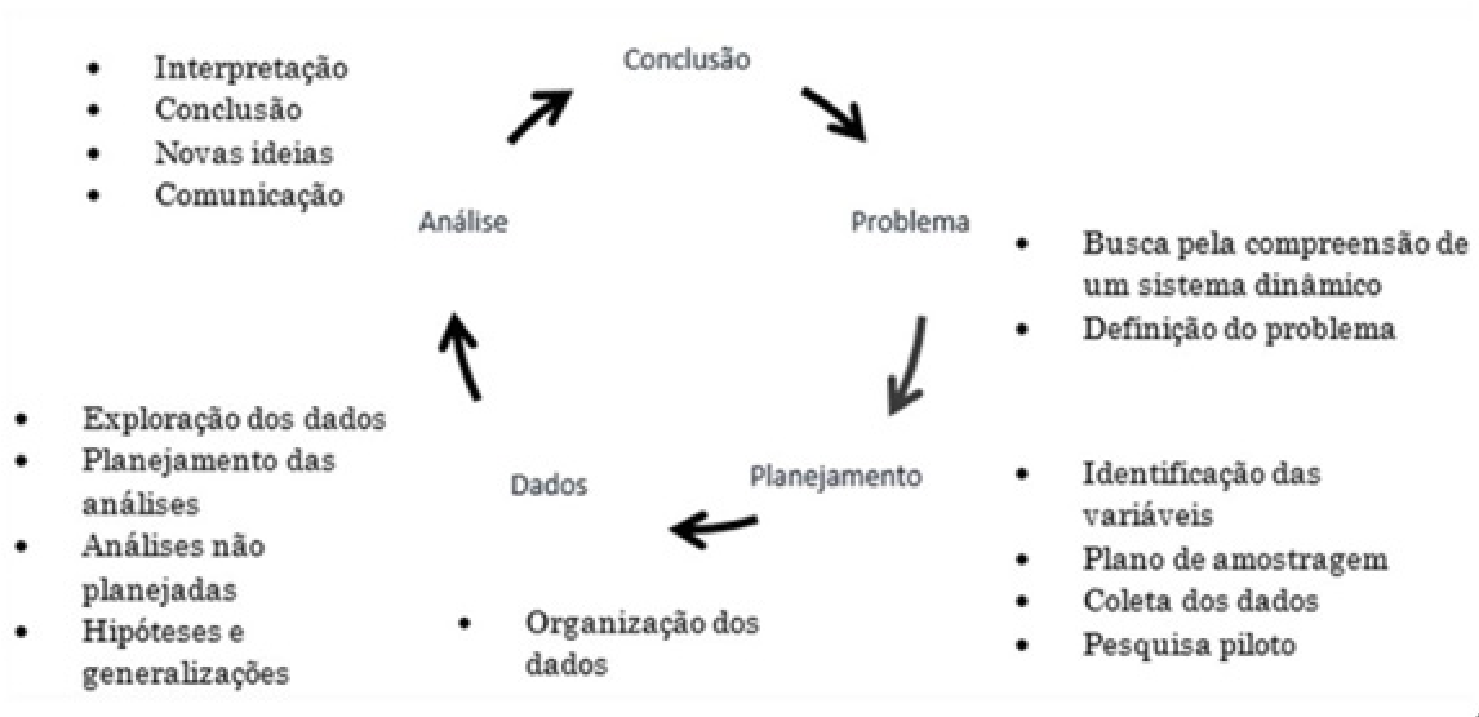
Thus, a statistical research cycle, based on landscapes of investigation, will consist of guiding the teacher’s work with data processing so that they can establish ways of organizing their practice that encourage children/adolescents to problematize themes that can promote a statistical reading of the world. The investigation, in this cycle, is divided into stages, as described in Figure 1.
The development of this investigative cycle requires an approach focused on problem-solving. By adopting this practice, the teacher will be able to educate citizens who must interpret and make decisions based on statistical information and are capable of solving everyday problems.
The initial “kick-off” of statistical research work is the definition of the “question” or “problem.” The question or problem to be investigated must be of interest to the children; they must find it meaningful. Therefore, the teacher can raise interest by asking them “what they would like to investigate,” and can help by giving suggestions such as: surveying to list the class’s pets, birthdays month by month until the end of the year, favorite characters or games, among other suggestions that may emerge from the context itself and children themselves can give.
Once the “question” has been defined, it is time to think about the best instrument for “data collection.” In the case of early childhood education, among so many alternatives, an interesting one would be to define a questionnaire with symbols and images, thus making data analysis, reading, and interpretation for this age group more comprehensible, as in the project developed by Souza (2007), in his master’s research.
From everything that has been narrated so far, we infer that to approach statistical concepts, it is necessary to have a significant contextualization that enables students, at different levels of literacy and learning, to develop critical statistical thinking.
Therefore, we defend the importance of contextualization in the learning process both in the alphabetization stage in early childhood education and other educational segments, recognizing the significance of planning landscapes of investigation according to and in harmony with students’ profiles, experiences, and maturity.
In this sense, we propose the introduction of basic notions of statistics, probability, information collection, and interpretations during the students’ alphabetization period, seeking to provide a contextualization aimed at children who are still in the youngest stages of development of the various types of thinking (mathematical, statistical, computational, variational, arithmetic, algebraic, geometric, financial, proportional, combinatorial, probabilistic) in their age group, with a more delimited direction to assist in the process of understanding statistical notions.
For further information on the different types of thoughts and their peculiarities that teachers should know to promote varied landscapes of investigation, we suggest reading the book organized by educators Gabriel Lima and Bárbara Bianchini called “O pensamento matemático e os diferentes modos de pensar que o constituem” [Mathematical thought and the different ways of thinking that constitute it] (2023).
We recall that one of the obstacles to addressing specific curriculum topics in the classroom is the lack of training among many teachers who do not have specific topics covered in their teaching degrees. Thus, regarding the teacher’s lack of knowledge, mathematics educator Celi Lopes (2012) asserts that working with statistical education in childhood during the alphabetization phase and other educational paths only has meaning if it is related to childhood’s culture.
Lopes (2012) also emphasizes the need to work with real data produced by children based on problems they encounter frequently, and each teacher must develop and adapt activities that promote the development of statistical thinking. According to Lopes (2012):
There is an urgent need to produce materials that support teaching work and to publish reports that share teaching situations involving the identification of possibilities, statistical investigation processes, and the observation of experiments, along with their respective records and analyses, enabling the integration of combinatorics, probability, and statistics. These actions will ensure that all basic education students have the right to develop stochastic reasoning. (LOPES, 2012, p. 171)
In this context, we recall that knowings from experience, as highlighted by Tardif (2007), profoundly influences the teacher’s conceptions of teaching and learning, which is why in mathematics, the versatile teacher often does not provide imaginative and creative ways of developing mathematical knowledge. It is still plausible to conclude that most teachers more frequently problematize the curriculum content with which they feel more confident, due to their experiences in their initial education in the teaching degree program or as a result of their classroom practices in everyday school life.
6. Conclusion
In this theoretical article, we seek inspiration from the question: “Do we need statistical education in early childhood education?” From the discussions, theorizing, and conjectures presented throughout the text, we conclude that statistical education must be addressed since early childhood education, as it can contribute to the development of critical thinking, analytical skills, and understanding of the world in quantitative and qualitative ways, promoting the development of statistical literacy in students.
Although statistics is often associated with more advanced levels of education, its foundations can (and should) be explored from the first school years, in a playful and contextualized manner, using varied alternative methodologies and in landscapes of investigation (SKOVSMOSE, 2000), under teacher mediation.
Pontes, Vasconcelos, Lima, and Vasconcelos (2019) confirm our conjectures as they state that:
The inclusion of statistics in the basic education curriculum was of great importance. This can be justified by the fact that citizens, from an early age, regardless of their level of education, need statistical knowledge to understand certain phenomena present in society. Thus, statistics has proven to be an area of knowledge capable of enabling the collection, analysis, and transformation of raw information into data, thereby enabling individuals to read more effectively and understand their realities. (PONTES et al., 2019, p.89)
Aligned with Gal (2002) and Lopes (2008), we also conclude that it is necessary to problematize statistical and probability themes from the initial grades in which students learn to read and write, seeking, through landscapes of investigation, to form citizens who will act in the future to combat fake news and the manipulation of multivariate data.
It is worth highlighting that following the promulgation of the BNCC (BRASIL, 2018), it is urgent to explore new contemporary transversal themes, such as financial education, tax education, sexual education, and environmental education, etc., aligned with the development of different forms of thought, including statistical thinking.
Therefore, we need landscapes of investigation and learning with statistical education themes so that students can develop their statistical literacy as they investigate topics such as: (i) notions of chance; (ii); critical reading of graphs and tables; (iii) data collection and production followed by the correct communication of these actions; (iv) ideas related to randomness in their daily lives; and (v) luck, bad luck, chance, and probability. In other words, we need statistical education to problematize such topics from an early age, respecting the experience, knowledge, and maturity of students, so that we can begin to cultivate autonomous, critical, and active citizenship in their social environment from an early age.
In line with our argument and within a landscape extremely characterized, in the 21st century, by the sharing of information and data through mobile devices and technological platforms, Pontes, Vasconcelos, Lima, and Vasconcelos (2019) assert that:
It is necessary to assess students so that they can not only attribute meaning to statistical information but also associate it with notions of probability, improbability, or intuition, by helping them develop probabilistic thinking and reasoning through an investigative process. (PONTES et al., 2019, p.91)
Thus, statistical education in early childhood education is not only possible but necessary, as it contributes to the integral development of young students, preparing them to deal with quantitative and qualitative information in a critical and reflective manner. Furthermore, it lays the foundation for learning more complex concepts in the future, becoming an essential tool for educating conscious citizens who are prepared for a society severely affected by data.
Many early childhood and elementary school teachers report facing difficulties when teaching statistics and probability; they also acknowledge that they do not feel adequately prepared to address these topics with their students. This finding is supported by studies such as those by Cazorla and Santana (2010), Lopes (2008),Guimarães and Borba (2011), Coutinho and Almouloud (2012), Silva and Cazorla (2013), and Giordano and Vilhena (2020).
Therefore, it is necessary to conduct new research not only on the difficulties and advances of early childhood education students in the field of probability and statistics, but also to investigate the difficulties faced by pedagogy degree holders who work with statistical education in this teaching segment, as well as their initial and continuing education.
Finally, we infer that in 21st-century society, teachers’ role is essential for students to have access to basic knowledge and develop scientific languages and concepts inherent to their subjects. The teacher is once again the professional who will teach students to read and write so that they can develop statistical thinking, critically, and can use it to relate it to notions of something being (im)probable, helping students to develop, from early childhood education, through an investigative cycle, statistical and probabilistic thinking and reasoning.
7. References
BRASIL. Ministério da Educação. Parâmetros Curriculares Nacionais para o Ensino Fundamental: Matemática. Secretaria de Educação Fundamental. Brasília: MEC/SEF. 1997. Disponível em: Acesso em: 2, set. 2015
BRASIL. Ministério da Educação. Secretaria Fundamental de Educação. Referencial curricular nacional para a educação infantil. Brasília. MEC/SEF, 1998.
BRASIL. Ministério da Educação. Secretaria de Educação Básica. Base Nacional Comum Curricular. Brasília: MEC/SEB, 2018.
CAMPOS, C. R.; WODEWOTZKI, M. L. L.; JACOBINI, O. R. A (2007). Literacia, o pensamento e o raciocínio estatísticos. In: Campos, C. R.; Wodewotzki, M. L. L.; Jacobini, O. R. Educação Estatística: teoria e prática em ambientes de modelagem matemática. Autêntica. Belo Horizonte.
CAZORLA, I. M., SANTANA, E. R. S. Do tratamento da informação ao letramento estatístico: reflexões sobre o ensino de estatística na Educação Básica. Revista Brasileira de Estatística, 71(229), 23-38, 2010.
CIRÍACO, K T. Professoras iniciantes e o aprender a ensinar Matemática em um grupo colaborativo. 2016. 34f. Tese (Doutorado em Educação) – Faculdade de Ciências e Tecnologia da Universidade Estadual Paulista Júlio de Mesquita Filho, FCT/UNESP. Presidente Prudente-SP. 2016. Disponível em: <https://repositorio.unesp.br/server/api/core/bitstreams/4e2a208f-e13d-486f-96699d06ed65248c/content> Acesso em: 15, ago. 2023.
CIRÍACO, K. T., SANTOS, C.A.L. Em busca de sentidos à Educação Estatística na Educação Infantil: diálogos com uma pesquisadora. Research, Society and Development, v.9, n.8, 2020.
COUTINHO, C. Q. S.; ALMOULOUD. Formação de professores para o ensino de estatística e probabilidade: um estudo com professores dos anos iniciais. Zetetiké, 20(37), 9-30, 2012.
CURI, E. Formação de professores polivalentes: uma análise de conhecimentos para ensinar Matemática e de crenças e atitudes que interferem na constituição desses conhecimentos. Tese (Doutorado em Educação Matemática) – PUC, São Paulo, 2004.
GAL, I. Adults Statistical Literacy: meanings, components, responsibilities. International Statistical Review, v. 70, n. 1, p. 1-25, 2002.
GARFIELD, J. The challenge of developing statistical reasoning. Journal of Statistics Education. v.10, n.3, 2002.
GIORDANO, C. C.; VILHENA, V. D. M. Educação Estatística e a formação de professores que ensinam Matemática no Brasil. Brazilian Journal of Development, v. 6, n. 12, p. 104137-104148, 2020. https:// www.brazilianjournals.com/ojs/index.php/BRJD/article/view/22468
GOULD, R. Data literacy is statistical literacy. Statistics Education Research Journal, v. 16, n. 1, p. 2225, 2017.
GUIMARÃES, G.; GITIRANA, V.; MARQUES, M.; CAVALCANTI, M. Abordagens didáticas no ensino de representações gráficas. In: ENCONTRO NACIONAL DE EDUCAÇÃO MATEMÁTICA (ENEM), Belo Horizonte, 2007.
GUIMARÃES, G.; GITIRANA, V., MARQUES; M.; CAVALCANTI, M. R. A Educação estatística na educação infantil e nos anos iniciais. Zetetiké, v. 17, n. 32 – jul/dez – 2009.
GUIMARÃES, G. L.; BORBA, R. E. S. R. Dificuldades de professores dos anos iniciais do Ensino Fundamental no ensino de estatística. Educação Matemática em Revista, 16(33), 4-13, 2011.
IBGE. Da educação infantil ao ensino médio-Propostas do IBGE para se trabalhar Educação Estatística. Rio de Janeiro, 2015. Disponível em: https://educa.ibge.gov.br/templates/ibge_educa/ recursos/vamoscontar_atividades.pdf. Acesso: 03 de junho de 2024.
KISTEMANN JR. M. A. 21 Anos de Cenários Para Investigação: As experiências de um educador matemático em formação continuada. In. Civiero. C.A.G.; Milani R.; Lima, A.S.; Miranda, F. O. Alçando voos com a Educação Matemática Crítica, p.86-103. Editora do Instituto Federal Catarinense, Blumenau, 2022.
KISTEMANN JR. M. A. Provocações, devaneios e o anseio de termos indivíduos alfabetizados e com letramento em diversos âmbitos no século XXI. In: Letramento matemático: desafios e possibilidades no período pós pandemia. Editora Pantanal: Nova Xavantina, 2024.
LOPES, C. A. E. (1998). A probabilidade e a Estatística no Ensino Fundamental: uma Análise Curricular. 125f. Dissertação de Mestrado em Educação. Campinas: Universidade Estadual de Campinas, 1998
LOPES, C. A. E. O conhecimento profissional dos professores e suas relações com estatística e probabilidade na educação infantil. Tese (Doutorado) – Faculdade de Educação, Universidade Estadual de Campinas, Campinas, 2003.
LOPES, C. E. O ensino de estatística e probabilidade na Educação Básica e a formação dos professores. Revista Educação e Pesquisa, 34(2), 261-280, 2008.
LOPES, P. C., FERNANDES, E. Literacia, raciocínio e pensamento estatístico com robots. Quadrante. V.23, n.2, 2014.
MARTINS, M. E. G.; PONTE, J. P. Organização e tratamento de dados. DGIDC, Lisboa, 2010
PONTES, M. M. de; VASCONCELOS, F. V.; LIMA, D. S. S. M.; VASCONCELOS, A. K. P. A temática ‘Probabilidade e Estatística’ nos anos iniciais do Ensino Fundamental a partir da promulgação da BNCC: percepções pedagógicas. Educitec, Manaus, v. 5, n. 12, dez., 2019.
PORCIÚNCULA, M., BATISTI, I. Estado do conhecimento acerca da Educação Estatística no contexto da Educação Infantil. Ensino Em Re-Vista, v.30, p. 1-28, ISSN: 1983-1730, Uberlândia, 2023.
PRESTES, L. M. A formação matemática docente para os anos iniciais do ensino fundamental: desafios e perspectivas. Revista de Ciências Humanas, V. 5, N. 5, p. 57–70, 2004.
SAMÁ, S.; SILVA, R. C. S. Probabilidade e Estatística nos anos iniciais do Ensino Fundamental a partir da BNCC. Zetetiké, v. 28, p.1–21, 2020.
SANTOS, C. E. A Educação Estatística para crianças: aprendizagens numa trajetória de pesquisa. Dissertação de mestrado, Programa de Pós-Graduação Stricto Sensu em Educação, PUC-Campinas, Campinas SP, 150, 2014.
SEVERINO, A. J. Metodologia do trabalho científico. 21. ed. São Paulo: Cortez, 2000.
SILVA, C. B.; CAZORLA, I. M. O ensino de estatística e probabilidade nos anos iniciais do Ensino Fundamental: desafios e possibilidades. Revista de Educação Matemática, 16(20), 45-58, 2013.
SKOVSMOSE, O. Cenários para investigação. Bolema, v.13, n.14, Rio Claro-SP, 2000.
SOARES, M. Alfabetização e letramento. 6. ed. São Paulo: Contexto, 2018.
SOUZA, A. C. A Educação Estatística na Infância. 2007. 209 f. Dissertação (Mestrado em Ensino de Ciências e Matemática) – Universidade Cruzeiro do Sul, São Paulo, 2007.
TARDIF, M. A profissão docente face à redução da educação à economia. Vertentes, 29, p. 11-27. São João Del-Rei, 2007.
WEISZ, T. O diálogo entre o ensino e a aprendizagem. 2. ed. São Paulo: Ática, 2002.
WILD, Chris J.; PFANNKUCH, M. Statistical thinking in empirical enquiry. International Statistical Review, v. 67, n. 3, p. 223-248, 1999.
Apéndice