
Artigos
Teachers and the curriculum from the perspective of Habermas’ theory of communicative action
Professores e o Currículo sob a perspectiva da Teoria do Agir Comunicativo de Habermas
Profesores y el currículo desde la perspectiva de la teoría de la acción comunicativa de Habermas

 Pereira Lima Soares soria.lima@ifpa.edu.br
Wagner Barbosa de Lima Palanch wagnerpalanch@gmail.com
Yara Patrícia Barral de Queiroz Guimarães yara.matematica@cefetmg.br
Revemop
Universidade Federal de Ouro Preto, Brasil
ISSN-e: 2596-0245
Periodicity: Frecuencia continua
vol. 7, 2025
Received: 16 May 2025
Published: 21 June 2025

Abstract: This article presents an excerpt from the first author’s doctoral research, focusing on the diagnostic phase of the development of the Pedagogical Project of the Course (PPC) for the mathematics teaching degree at IFPA, campus Parauapebas. The research is based on Jürgen Habermas’ theory of communicative action (2012a; 2012b), adopting an online form as a methodological instrument. The invitation to participate was sent to all members of the PPC preparation committee, comprising nine professors, one pedagogy-licensed individual, and one librarian. However, this text analyzes the reports of three collaborators. The aim is to understand whether communicative or instrumental rationality guides the process. The results indicate that it is essential to create dialogic spaces that promote interaction between the subjects involved in developing the curriculum, strengthening communicative rationality in the institutional context.
Keywords: Pedagogical Project of the Course, Teaching degree in mathematics, TCA.
Resumo: Este artigo apresenta um recorte da pesquisa de doutorado da primeira autora, focando na fase diagnóstica da elaboração do Projeto Pedagógico do Curso (PPC) de Licenciatura em Matemática do IFPA, campus Parauapebas. A investigação baseia-se na Teoria do Agir Comunicativo de Jürgen Habermas (2012a; 2012b), adotando como instrumento metodológico um formulário on-line. O convite à participação foi enviado a todos os membros da comissão de elaboração do PPC: nove docentes, um pedagogo e uma bibliotecária. Contudo, este texto analisa os relatos de três colaboradores. Busca-se compreender se o processo é orientado por uma racionalidade comunicativa ou instrumental. Os resultados indicam que é essencial criar espaços dialógicos que promovam a interação entre os sujeitos envolvidos na elaboração do currículo, fortalecendo a razão comunicativa no contexto institucional.
Palavras-chave: Projeto Pedagógico de Curso, Licenciatura em Matemática, TAC.
Resumen: Este artículo presenta un recorte de la investigación doctoral de la primera autora, centrado en la fase diagnóstica de la elaboración del Proyecto Pedagógico del Curso (PPC) de Licenciatura en Matemáticas del IFPA, campus Parauapebas. La investigación se fundamenta en la Teoría de la Acción Comunicativa de Jürgen Habermas (2012a; 2012b), utilizando como instrumento metodológico un formulario en línea. La invitación a participar fue enviada a todos los miembros de la comisión de elaboración del PPC: nueve docentes, un pedagogo y una bibliotecaria. No obstante, este texto analiza los relatos de tres colaboradores. Se busca comprender si el proceso está orientado por una racionalidad comunicativa o instrumental. Los resultados indican que es esencial crear espacios dialógicos que fomenten la interacción entre los sujetos involucrados en la elaboración del currículo, fortaleciendo la razón comunicativa en el contexto institucional.
Palabras clave: Proyecto Pedagógico de Curso, Licenciatura en Matemáticas, TAC.
1. Introduction
The Brazilian educational system has undergone relevant structural reforms over the last fifteen years. A significant example was the creation of the Institutos Federais de Educação, Ciência e Tecnologia [Federal Institutes of Education, Science, and Technology]. These educational institutions succeeded the Escolas Agrotécnicas Federais (EAF) [Federal Agricultural Schools (FAS)] and most of the Centros Federais de Educação Tecnológica (CEFETs) [Federal Centers for Technological Education (FCTEs)]. This reform was regulated through the enactment of Law 11.892 on December 29, 2008.
The creation of the Federal Institute of Education, Science, and Technology of Pará (IFPA) occurred from the merger of the former Federal Center for Technological Education of the State of Pará, the Federal Agricultural School of Castanhal, and the Federal Agricultural School of Marabá. Soon after its creation, a process of restructuring units within the predecessor institutions began, accompanied by the expansion of IFPA through the establishment of new campuses.
One of the campuses implemented during this expansion phase, the most recent, was the Parauapebas campus, which was established in 2014. The creation of this campus resulted from an agreement between the Public Prosecutor’s Office (Ministério Público) and a private company operating in the region, whereby the company assumed responsibility for constructing the physical facilities and subsequently transferred them, on a loan basis, to IFPA. From that moment on, the municipalities of Parauapebas, Canaã dos Carajás, Eldorado dos Carajás, and Água Azul do Norte began to benefit from the provision of initial and continuing professional education courses, technical courses, and undergraduate and specialization courses offered by the IFPA, Parauapebas campus.
In a continuous process of improvement, IFPA revised its Plano de Desenvolvimento Institucional (PDI) [Institutional Development Plan] in 2020 to implement a mathematics teaching degree course at the Parauapebas campus (IFPA, 2020). To make this goal viable, several actions were taken, including holding a public competition, hiring professors in the mathematics field, and establishing a committee responsible for preparing the Pedagogical Project of the Course (PPC) for the mathematics teaching degree.
This last action constitutes the first author’s research object in her doctoral thesis¹: the development of the Pedagogical Project for the Mathematics Teaching Degree Course at IFPA, Parauapebas campus. The phenomenon to be studied is the speeches of the professionals involved in this process. Our proposal aligns with the study by Baroni and Maltempi (2019), who analyzed the Pedagogical Project for the mathematics teaching degree at the Instituto Federal de São Paulo (IFSP) [Federal Institute of São Paulo], although focusing on the spaces reserved for financial education in the curriculum.
This text refers to the diagnostic phase of the doctoral research mentioned, in which it was possible to understand the initial scenario of the process of preparing the PPC for a teaching degree in mathematics through the narratives of the professionals involved, using the theory of communicative action as a theoretical and methodological reference (Habermas, 2012a; 2012b). To this end, we used Google Forms, in which participants recorded their experiences.
The invitation to participate was addressed to all members of the committee responsible for preparing the PPC for the mathematics teaching degree at IFPA, Parauapebas campus, comprising nine professors, a pedagogy licensee, and a librarian. However, this text presents the reports of the three participants.
2. Theory of Communicative Action
The theory of communicative action (Habermas, 2012a, 2012b), developed by philosopher and sociologist Jürgen Habermas, serves as the theoretical and methodological basis for analyzing and discussing the process of developing a pedagogical project for a teaching degree in mathematics. We chose this reference because of its suitability for critiquing the instrumental rationalization that has been dominating the lifeworld.
Succinctly and objectively, Jürgen Habermas is a German author and professor who has taught at several German universities. His academic formation is closely tied to the Frankfurt School, where he was supervised by Theodor Adorno.
To understand Jürgen Habermas, it is essential to begin with his conceptual categories, created to study how human relationships occur in concrete reality, considering that people’s corporal and linguistic actions position them within a social structure. The most important category presented by Habermas (2012a, 2012b) is the concept of action. In this category, the analysis begins with the subject’s social action. The fundamental categories that affect all the others are strategic action and communicative action.
It can be said that strategic action occurs when the subject of social action seeks a relationship aimed at benefiting from it, i.e., it is an action in which the subject uses communication for egocentric purposes. According to Habermas (1989),
To the extent that actors are solely oriented towards success, that is, towards the consequences of their actions, they attempt to achieve their goals by influencing, from the outside, using weapons or goods, threats or seductions, the situation or their adversaries’ decisions or motives. The coordination of actions among subjects who interact strategically depends on how egocentric gain calculations are interconnected. The degree of cooperation and stability then results from the range of interests of the participants (Habermas, 1989, p. 164-165).
Then, we can see that every strategic action has a concrete objective, which, in itself, does not constitute a problem. The situation becomes delicate when the subject resorts to spurious mechanisms, such as manipulation and deception, to achieve their goals.
On the other hand, there is communicative action, whose objective is to achieve mutual understanding. Habermas (2012a, 2012b) assumes that subjects use communication in an intelligible manner, employing quality and reliable arguments, which results in respectable norms and rules, thereby leaving no room for disagreement. Imagine two individuals who do not master speech but need to create a language as a means of protection: they will need to come together to build forms of understanding. Thus, we can affirm that it was from a communicative action that human beings created language, as it would be impossible to imagine this process arising from a strategic action.
Based on the concepts of these two categories, Habermas (2012a; 2012b) presents how social relations are thought: the subjects of action can exercise communicative action or strategic action. In a communicative scenario, each person can express their thoughts, and everyone involved in the action is free to comment or ask questions. Thus, we can infer that the search for consensus does not mean agreeing with everything but rather giving a voice to all participants — listening and being listened to. Moreover, if it is necessary to define something, let this definition occur in such a way that intentions are balanced with the collective good and not with individual success.
Another important aspect presented by Habermas (2012a; 2012b) is the idea that there are no winners or losers in a discussion. Dialogue is a win-win situation because each person learns from one another. This communication can occur in different formats, the most common being those with normative, expressive, and explanatory characteristics.
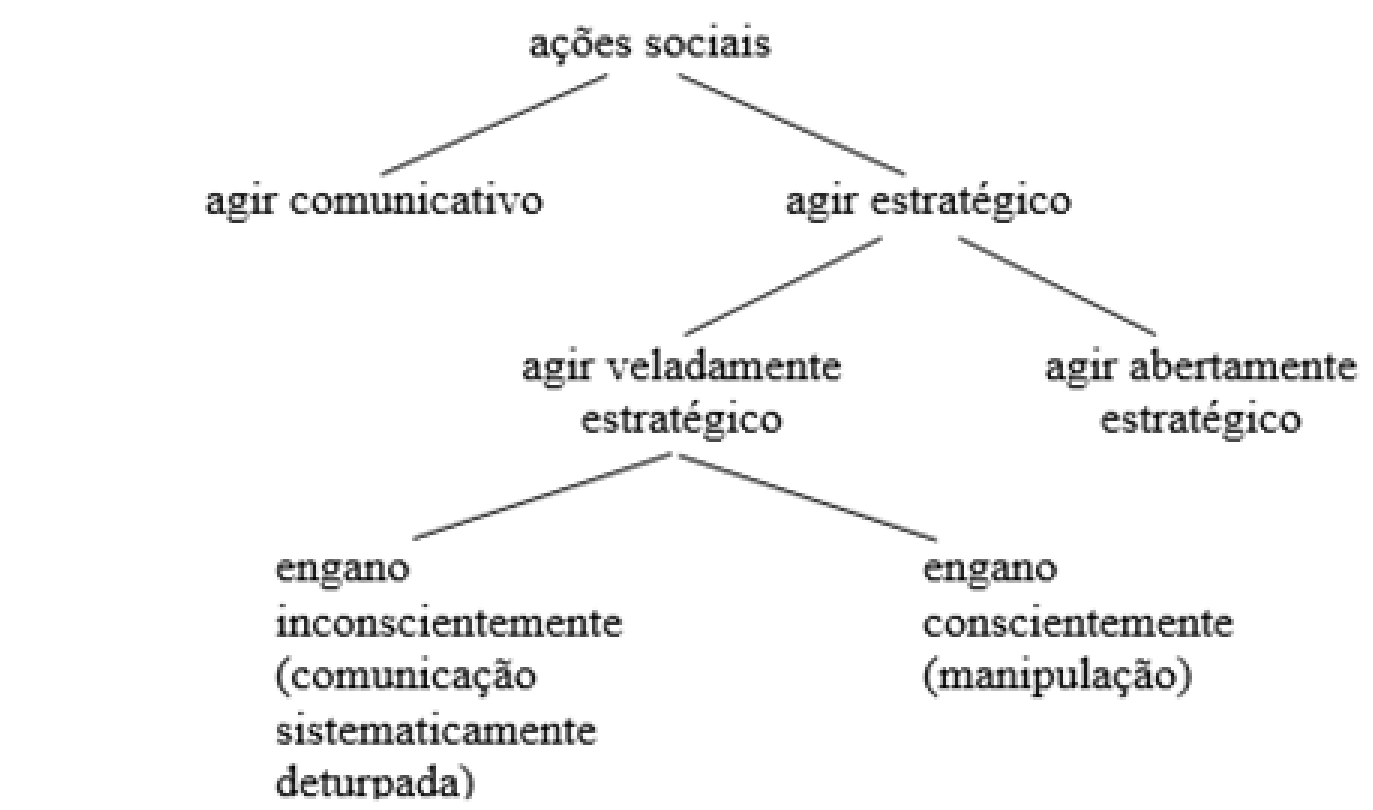
In the opposite space (see Figure 1 on the next page), subjects can engage in an openly strategic action or a covertly strategic action. In openly strategic actions, subjects make their genuine interest explicit. However, in covert strategic action, they can manipulate and/or distort communication to deceive the other, whether consciously or not.
To conclude the understanding of the theory of communicative action (TCA), in Habermas e a teoria da modernidade (Habermas and the theory of modernity), Freitag (1995) explains that TCA presents society as being formed by the intersection between the lifeworld and the system.
The theory of modernity is an integral part of Habermas’s ‘theory of communicative action.’ Alongside a concept of society that associates the subjective perspective (internal “to the lived world”) with the objective perspective (external or systemic) and the rescue of a concept of dialogical rationality, Habermas’s theory of modernity seeks to explain the genesis of modern Western society, diagnose its pathologies, and seek solutions for its suppression (Freitag, 1995, p. 139).
In the space of the lifeworld, subjects seek to understand the other, apologize when they make a mistake, try to be more proactive, change positions —as positions can be revised— and can (or should) be open to building consensus and understanding, not remaining stuck in a fixed and insurmountable perspective.
Within the system, a relationship is structured by money/currency, in which all the actions of the subjects are guided by the interests of those who control the capital turnover. Thus, social relations tend to be limited to subjects who work and live within a logic in which money, symbolic exchanges mediated by currency and life itself, are governed by these structures —and are, therefore, considered strategic.
Eldon Muhl remembers that:
Although being presented as opposed to the vital world, the systemic world has its origins linked to the world of life and remains, albeit in a parasitic way, dependent on communicative action. The systemic world is a stream of rationalization of the world of life, emerging as a mechanism to reduce the burden that weighs on communicative action in the face of the exhaustion of other social control mechanisms. As it becomes more complex, it tends to break its links with the lifeworld to replace communication through language with technical control mechanisms under the auspices of money and power, to the detriment of the other components of the lifeworld. (Muhl, 2011. p. 1039).
In Figure 2, we visualize the main concepts and categories presented in Jürgen Habermas’ theory of communicative action (2012a; 2012b), a theoretical and methodological framework adopted to analyze the discourses of professionals involved in preparing the PPC for the mathematics teaching degree at IFPA, Parauapebas campus.
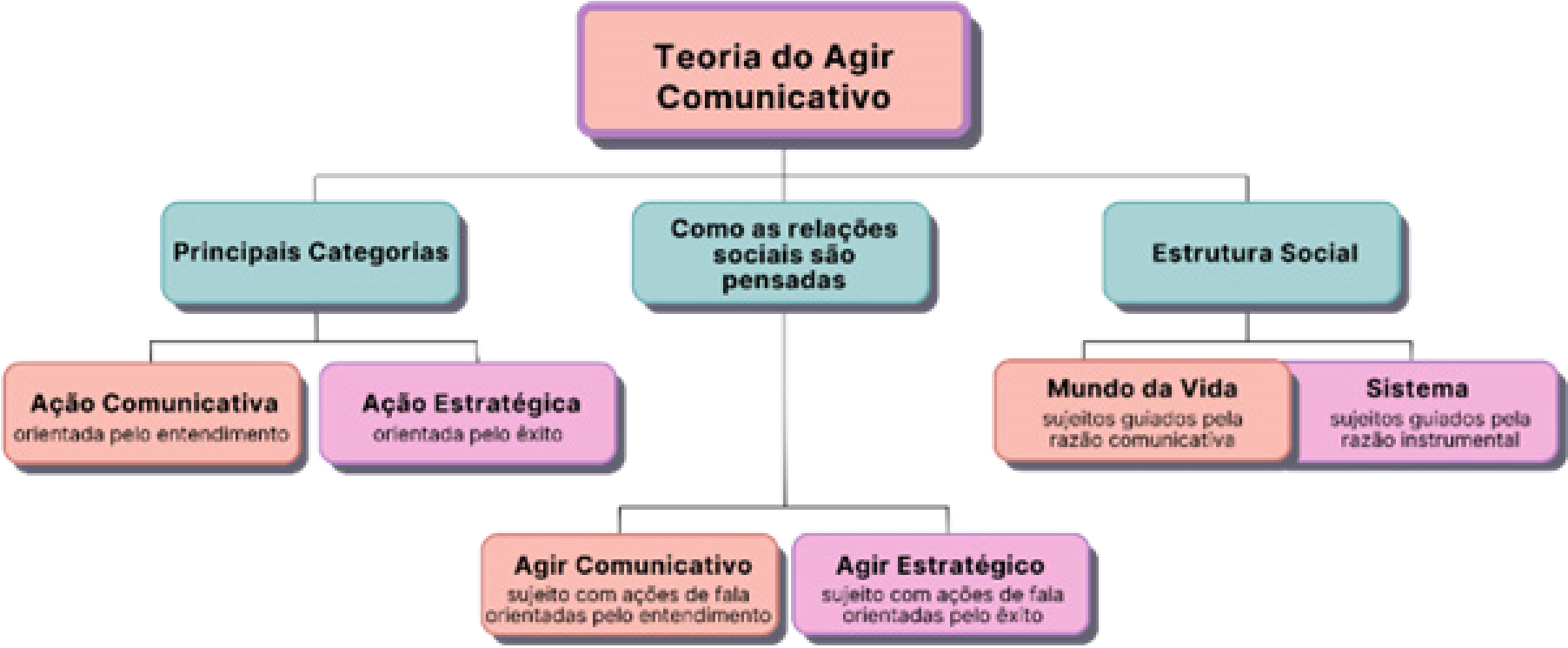
The analysis will seek to determine whether the elaboration process will be guided by instrumental rationality or whether participants will break with systemic domination, guided by communicative rationality, according to Jürgen Habermas’s perspective.
3. What the initial diagnostic questionnaire reveals
To understand the scenario of preparing the PPC for the mathematics teaching degree at IFPA, Parauapebas campus, a questionnaire was prepared to diagnose the initial phase of the drafting committee’s work, comprising five questions that reflected the experiences and thoughts of the professionals involved. Understanding that discourse is guided by rationality, the proposal is to analyze the narrative of teachers participating in the elaboration process based on their responses to the diagnostic questionnaire.
In Chart 1, we present the first question, along with the narratives and answers of the three participants.
| 1st question | What could not be missing from the PPC of the mathematics teaching degree? |
| These are the complete answers: | In general, I believe that the first step is to know or recognize the reality where the course (PPC) will be inserted. With this information in hand, study all current legislation regarding the course and adapt the target audience to the professional profile you wish to qualify. (Participant 01) State its composition and relevance and the collective nature of its construction. Rules and laws that must be observed in the preparation process. Elements and themes that will make up the document. (Participant 02) Within the curriculum proposal, the main guiding principle of the PPC is the expected profile of the graduate. (Participant 03) |
In his answer, Participant 01 raised two concerns. In the first part, he shows a more contextual concern about the course, aiming to consider the social reality that surrounds it, which allows proximity to an action guided by communicative rationality. However, immediately afterward, he expresses concerns about meeting regulatory and bureaucratic requirements. This concern suggests that the prevailing ideology among those who developed the proposal reflects an adherence to a rationality with characteristics of instrumental rationality.
The same thing happens with Participant 02. Initially, his answer aligns with communicative rationality by highlighting the importance of the collective nature in the process of preparing the PPC. However, the concern with complying with the rules and laws that govern the preparation of the document is guided by instrumental rationality.
Participant 03 is primarily concerned with the expected profile of the graduate, with communicative rationality prevailing in his answer.
In Chart 2, the participation of the academic community in the process of preparing the PPC is investigated.
| 2nd question | Does the entire academic community on campus participate in this PPC development process? |
| These are the complete answers: These are the complete answers: (continued) | To date, I am not aware of a PPC development process on my campus that has been carried out with the entire academic community. Participation occurs in an interdisciplinary manner, involving technical and administrative staff, particularly those from the pedagogical area, as well as teaching staff with a greater affinity for the subjects covered in the implemented course. I believe that the reason for the non-participation of the entire community is due to the short deadlines for preparation, which make it challenging to gather them for participation, as it requires publicity, meetings, assemblies, and discussion forums, among other things. (Participant 01) No! (Participant 02) Direct community participation does not always occur. The community participates in the initial phase of public hearings, where they demonstrate their needs and desires. However, when the process of constructing the proposal begins, it is generally directed by the staff of a commission designated following the guidelines of the Pro-Rectorate for Education. (Participant 03) |
Participant 01 states that, although the development occurred in an interdisciplinary manner, he is unaware of a process that has included the entire academic community, raising the hypothesis that the short-term nature of the situation was the determining factor. Again, based on these nuances of the narrative, initially, proximity to communicative rationality is evident when reporting that the process is conducted in an interdisciplinary manner. However, eventually, we move towards instrumental rationality as the experience narrated makes it clear that the process does not include the entire academic collective, perhaps due to the short deadline defined by management for completing the work.
Participant 02’s experience, with his direct and negative response, also aligns with a process guided by instrumental rationality.
Participant 03’s narrative recalls the institution’s external community’s involvement in the initial phase, when public hearings were held to identify the needs and desires of the region where the course would be implemented. Although the question does not directly address this fact, it is worth mentioning that the institution’s concern in bringing the external community to participate in the choice of the course to be implemented demonstrates that the process begins with characteristics of communicative rationality by setting aside time to listen to the external community before making a decision.
The following question aims to identify the behaviors a professional should possess to carry out work like this, specifically developing a pedagogical project for a course within IFPA. This is a multiple-choice question, and participants should select their answers by marking them with an “X.” There is also a blank space for them to express their opinions on the subject discussed.
On the next page, the behaviors suggested in Question 3 are presented, allowing participants to indicate their choices based on their experiences within the educational institution where they work.
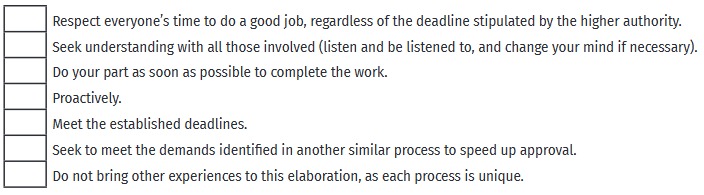
With the answers from the three participants, the Google Forms system generated a graph that represents, in percentage, each behavior indicated as essential for the professional involved in the PPC preparation process, according to the opinion and experience of each participant.
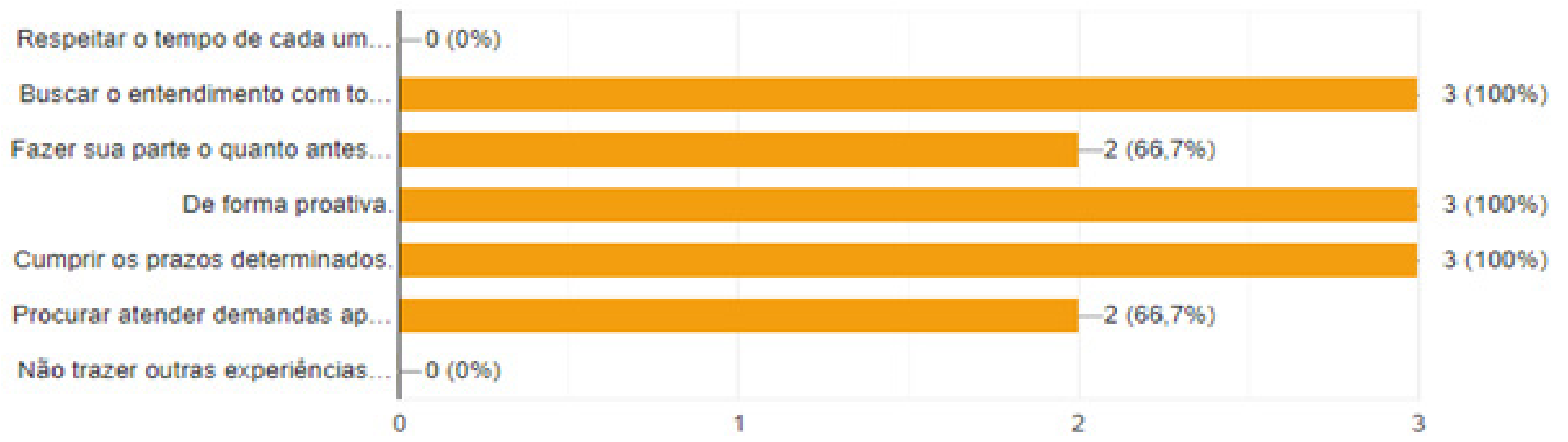
No participant indicated the first and/or last behavior as necessary for professionals in this new work of developing the PPC for the mathematics teaching degree at the Parauapebas campus. The first attitude refers to respecting each person’s timing to do a good job, regardless of the deadline stipulated by management. The latter suggests that not bringing previous experiences into a new PPC development would be ideal, under the justification that each process is unique.
At this point, it is worth highlighting that communicative rationality guides these two behaviors and was not indicated by any of the participants as necessary. However, it is essential to wait for the analysis of the participants’ narratives and opinions on the other behaviors suggested in the question so that it can determine which rationality predominated in the experiences narrated.
In the blank space for participants to express their narratives and opinions about the behaviors necessary to perform a job like the one discussed in this article, we had the following answers displayed in Chart 3.
| 3rd question | Describe your opinion(s) about the option(s) you checked. |
| These are the complete answers: | I believe that we must meet deadlines when preparing the PPC, but I know that time spent reading and discussing is fundamental to achieving a successful PPC. The latter, in fact, serves to avoid rework later. (Participant 01) To meet deadlines, it is necessary to debate, anticipate potential problems, and address issues previously identified in other similar processes. (Participant 02) When participating in a committee to prepare a course proposal, it is crucial to meet deadlines, even if they are not strict, as the proposals are analyzed by PROEN and undergo numerous modifications to meet legal requirements at both national and institutional levels. To avoid wasting time, members must be proactive and contribute seriously to the activities developed. There are many demands when deciding to open a course, including the community’s anxiety, the teaching directorate’s need for the proposal to move forward, and many others. However, we cannot let these concerns negatively influence the proposal, as a new course that opens at the institution has a significant impact on the community, and the curriculum proposal is what will support the education of professionals who will engage in the job market. (Participant 03) |
Participant 01 is concerned about meeting the deadlines set by management, but emphasizes the importance of time for reading and holding debates, which is crucial for ensuring the successful completion of the PPC preparation process. We can note that the narrated scenario oscillates between instrumental and communicative rationality.
Participant 02 narrates an experience guided by instrumental rationality, worrying only about meeting deadlines, indicating that professionals need to be attentive to address items that have already been identified as failures in similar processes.
Participant 03 is initially concerned with the bureaucratic aspects of the process, including meeting deadlines, analyzing and approving the prepared document, and ensuring compliance with institutional and national legal standards. Subsequently, it justifies the importance of meeting deadlines, considering the anxiety of the external community in receiving the course offer and, consequently, the need for new professionals to enter the job market. Once again, the narrated scenario presents characteristics that firstly approach instrumental rationality and then move toward communicative rationality.
Continuing the investigation, Question 4 seeks to identify the most significant difficulties encountered in the process of preparing and approving a PPC within the IFPA. The complete answers are presented in Chart 4.
| 4th question | What are the most significant difficulties encountered in this PPC preparation/approval process? |
| These are the complete answers: | Considering my experience with other PPCs, I can say that the very short deadlines for preparation were the main challenge. (Participant 01) Availability of time of those involved, other demands, and classes taught. (Participant 02) Think and decide together. (Participant 03) |
Participant 01 identified short deadlines as the most significant difficulty; Participant 02 highlighted the lack of time available to dedicate to preparing the PPC, considering that there are other demands and a classroom workload to be met in parallel. Participant 03 says that the biggest difficulty is thinking and deciding together.
Of the three experiences narrated, those of Participants 01 and 02 present characteristics of the systemic world, as the difficulties shown revolve around the deadlines stipulated by management and the work overload. Therefore, we could say that these experiences were guided by instrumental rationality. Although stating that thinking and deciding together was difficult, Participant 03 demonstrates that his experience was guided by communicative rationality, as there was space for collective thinking and decision-making.
Finally, Question 5 investigates whether the institution offers any training to professionals (professors and educational administrative technicians) involved in the PPC preparation process. In Chart 5, on the next page, the experiences of Participants 01, 02, and 03 are presented in full.
| 5th question | Considering the implementation phase of the PPC, do teachers/education administrative technicians participate in any training? |
| These are the complete answers: These are the complete answers: (continued) | No, but I consider it important. As it is also a matter of being familiar with the current legislation on the course and the institution offering it, the allocated time for teacher education is often not utilized, as the institution believes that the staff can resolve this through their own research and reading. Furthermore, the demands of deadlines and other requirements often make prior training unfeasible for teachers and professionals. (Participant 01) No! They are professionals qualified for such demands. (Participant 02) There are formative courses aimed at this area. However, they are restricted to coordinators and rarely occur at the institution. I personally never participated in any formative process at IFPA for this purpose, I took courses in this area on my own, at a specialization level. However, I realize that when a formative course is available for teachers in a specific area, participation is often minimal, as employees in general, especially those in technical areas, tend to lack interest in participating in them. (Participant 03) |
Participant 01 believes that receiving training is important, but states that teachers do not receive it. He then raises the hypothesis that the institution does not offer this training because it considers that the staff can meet the needs of the PPC preparation process with their own research and readings. He also adds that deadlines and other demands make prior training impossible.
Participant 02 also states that teachers do not participate in training. Despite the negative answer, he complements his response by stating that the professionals involved in the PPC preparation process are already qualified for this task.
Participant 03 recounts an experience in which the institution rarely offers continuing education, and when it does, it only includes the coordinators, not everyone involved. He notes that he independently obtained that specific training at the specialization level. He then raises the hypothesis that low adherence, primarily on the part of teachers in technical areas, makes the institution less likely to offer training more often.
From the analysis of all the narratives contained in the questionnaire, it is evident that the experiences presented are, for the most part, linked to instrumental rationality. However, it is worth noting that there are also elements linked to communicative rationality.
Given the findings, we can assume that the processes of developing the PPCs, in which Participants 01, 02, and 03 collaborated, primarily employed strategic actions, with some communicative actions, especially during collective moments.
We believe that knowing the experiences of teachers who have already worked in PPC development processes and sharing, in this article, the problems and challenges they faced can contribute, as Almeida and Miskulin (2019) did in their studies, to offering support for new curriculum developments and reformulations in the context of the mathematics teaching degree course.
4. Some considerations
As in Taveira and Peralta (2021), writing this article, which is an excerpt from a broader project, also enabled us to delve deeper into Jürgen Habermas’ theoretical-methodological framework, especially in the field of curriculum research. In this case, we investigated the process of preparing the PPC for a mathematics teaching degree to highlight how elements of instrumental and communicative rationalities are manifested in the narratives of the subjects involved. Furthermore, the analysis enabled us to elucidate some relevant methodological approaches for identifying the types of rationality present in the participants’ speeches from Jürgen Habermas’ perspective.
We trust in the power of this theoretical-methodological framework, which values actions guided by communicative rationality. To resist the domination of the lifeworld by the systemic world, as Jürgen Habermas denounces, educational institutions must guarantee the provision of spaces for interaction between professionals involved in the elaboration of pedagogical projects for courses and other members of the academic community. This collective construction is essential so that the process is not restricted to bureaucratic formality or instrumentalized strategic action, but is recognized as a moment of mutual listening, argumentation, and deliberation among educators, managers, and students.
The experience reported here reveals that, although there are signs of communicative practices in the process of preparing the PPC analyzed, instrumental rationality still prevails in the subjects’ actions. This predominance is evident, above all, in concerns about meeting deadlines, complying with institutional regulations, and the absence of effective spaces for collective participation. It is worth noting, however, that simply recognizing these limitations already constitutes an important step towards transforming this scenario, opening the way for more profound reflections on the social function of PPCs and the subjects that construct them.
Therefore, it is essential to strengthen, within the scope of institutional policies and formative processes, the understanding that the elaboration of a PPC must be permeated by communicative rationality, in which arguments are validated intersubjectively in speech contexts guided by mutual understanding. Such communicative spaces, supported by ideal conditions for speech, such as the absence of coercion, symmetry between interlocutors, and openness to dissent, favor the construction of legitimate and more democratic consensuses, which give meaning to teacher education and the public mission of educational institutions.
Finally, we hope that this work will contribute to the maturation of discussions about the processes of elaboration and reformulation of the mathematics teaching degree curriculum within the scope of IFPA and other teacher education institutions. By making visible the tensions between the types of rationality that exist in curriculum practices, the importance of communicative action is reaffirmed as a guiding principle for more critical, democratic, and coherent formative processes in the face of contemporary education’s challenges.
5. References
ALMEIDA, Amanda Larissa de; MISKULIN, Rosana Giaretta Sguerra. Aspectos matemáticos, didáticos e pedagógicos das disciplinas de conteúdo matemático na licenciatura: um olhar a partir de teses e dissertações (2001-2017). Revemop, v. 1, n. 3, p. 397-419, 1 set. 2019. DOI: 10.33532/revemop.v1n3a04
BARONI, Ana Karina Cancian; MALTEMPI, Marcus Vinícius. Os espaços da Educação Financeira na formação de professor de Matemática em uma instituição federal de São Paulo. Revemop, v. 1, n. 2, p. 248–265, 1 maio 2019. DOI: 10.33532/revemop.v1n2a5
BRASIL. Lei nº 11.892, de 29 de dezembro de 2008. Institui a Rede Federal de Educação Profissional, Científica e Tecnológica, cria os Institutos Federais de Educação, Ciência e Tecnologia, e dá outras providências. Brasília, 2008.
HABERMAS, Jürgen. Consciência moral e agir comunicativo. Tradução: Guido Antônio de Almeida. Rio de Janeiro: Tempo Brasileiro, 1989.
HABERMAS, Jürgen. Teoria do agir comunicativo 1: racionalidade da ação e racionalização social. Tradução: Paulo Astor Soethe. São Paulo: WmfMartins Fontes, 2012a.
HABERMAS, Jürgen. Teoria do agir comunicativo 2: sobre a crítica da razão funcionalista. Tradução: Paulo Astor Soethe. São Paulo: WmfMartins Fontes, 2012b.
IFPA. Instituto Federal do Pará. Relatório Comissão Local de Revisão do PDI 2019-2023 do IFPA Campus Parauapebas. Parauapebas: IFPA, 2020.
IFPA. Instituto Federal do Pará. Portaria nº 017/2021/GAB/CP DE 10 de Fevereiro de 2021. Designa a Comissão de Elaboração do Projeto Pedagógico do Curso Superior de Licenciatura em Matemática do IFPA campus Parauapebas. Parauapebas: IFPA, 2021.
FREITAG, Bárbara. HABERMAS E A TEORIA DA MODERNIDADE. Cad. CRH., Salvador, n.22. p.138-163, jan/jun,1995. Disponível em: https://periodicos.ufba.br/index.php/crh/article/ download/18781/12151/63605. Acesso em: 2 ago. 2024.
MEC. Ministério da Educação. Resolução CNE/CP n.2, de 20 de dezembro de 2019. Define as Diretrizes Curriculares Nacionais para a Formação Inicial de Professores para a Educação Básica e institui a Base Nacional Comum para a Formação Inicial de Professores da Educação Básica (BNC-Formação). Brasília: MEC, 2019.
MUHL, Eldon Henrique. Habermas e a educação: racionalidade comunicativa, diagnóstico crítico e emancipação. Campinas: Educação e Sociedade, v. 32, n. 17, p. 1035-1050, dez. 2011.
TAVEIRA, Flávio Augusto Leite; PERALTA, Deise Aparecida. Análise de documentos curriculares de Matemática inspirada na ética discursiva de Jürgen Habermas. Educação Matemática Pesquisa Revista do Programa de Estudos Pós-Graduados em Educação Matemática, São Paulo, v. 22, n. 3, p. 512–537, 2021. DOI: 10.23925/1983-3156.2020v22i3p512-537. Disponível em: https://revistas.pucsp.br/ index.php/emp/article/view/51027. Acesso em: 2 ago. 2024.
Appendix – Editorial Details
Notes