
Artigos
Mathematical practices in the manual of integrative activities:Leveling in comprehensive secondary education
Práticas Matemáticas no Manual de Atividades Integradoras: o Nivelamento no Ensino Médio em Tempo Integral
Prácticas Matemáticas en el Manual de Actividades Integradas: La Nivelación en la Educación Media de Tiempo Completo

 Ana Flávia Siqueira Pinto Dias ana.siqueira2@aluno.ufop.edu.br
André Augusto Deodato andre.deodato@ufop.edu.br
Revemop
Universidade Federal de Ouro Preto, Brasil
ISSN-e: 2596-0245
Periodicity: Frecuencia continua
vol. 7, 2025
Received: 19 November 2024
Accepted: 19 May 2025
Published: 30 May 2025

Abstract: This article analyzes the mathematical practices proposed in the mathematics leveling presented in the Manual de Atividades Integradoras [Manual of Integrative Activities] from the perspective of comprehensive education. This qualitative and documentary research was conducted between 2023 and 2024, with a focus on the manual mentioned. The study identified that the proposed document presents didactic sequences aligned with the Common National Curriculum Base and activities with open-ended answers, emphasizing the importance of diagnostic assessment, although it does not delve into the concept of assessment and its relationship with leveling, and does not explicitly articulate the intentionality of mathematical practices. As a result, the understanding and implementation of leveling in mathematics revealed a limitation. The research can help mathematics teachers reflect on and reconsider the theoretical and practical aspects of their classes.
Keywords: Mathematical practices, Mathematics leveling, Guiding documents, Full-time secondary education, Comprehensive education and/in full-time education.
Resumo: Este artigo analisou as práticas matemáticas propostas no Nivelamento em Matemática, presente no Manual de Atividades Integradoras, sob a perspectiva da Educação Integral. A pesquisa, de abordagem qualitativa e caráter documental, foi realizada entre 2023 e 2024, com foco no referido manual. Como resultado, identificou-se que o documento propõe Sequências Didáticas alinhadas à Base Nacional Comum Curricular e atividades com respostas abertas; enfatiza a importância da avaliação diagnóstica, embora sem aprofundar esse conceito de avaliação e sua relação com o Nivelamento; e não explicita a intencionalidade das práticas matemáticas. Como desdobramento, observou-se uma limitação na compreensão e na implementação do Nivelamento em Matemática. A pesquisa pode contribuir para que professores de Matemática (re)pensem aspectos teóricos e práticos de suas aulas.
Palavras-chave: Práticas Matemáticas, Nivelamento em Matemática, Documentos Orientadores, Ensino Médio em Tempo Integral, Educação Integral e(m) Tempo Integral.
Resumen: Este artículo analizó las prácticas matemáticas propuestas en la Nivelación en Matemáticas, presente en el Manual de Actividades Integradoras, bajo la perspectiva de la Educación Integral. La investigación, de enfoque cualitativo y carácter documental, fue realizada entre 2023 y 2024, centrándose en el manual referido. Como resultado, se identificó que el documento propone Secuencias Didácticas alineadas a la Base Nacional Común Curricular y actividades con respuestas abiertas; enfatiza la importancia de la evaluación diagnóstica, aunque sin profundizar este concepto de evaluación y su relación con la Nivelación; y no explicita la intencionalidad de las prácticas matemáticas. Como consecuencia, se observó una limitación en la comprensión y en la implementación de la Nivelación en Matemáticas. La investigación puede contribuir a que los profesores de Matemáticas (re)piensen aspectos teóricos y prácticos de sus clases.
Palabras clave: Prácticas Matemáticas, Nivelación en Matemáticas, Documentos Orientadores, Educación Media de Tiempo Completo, Educación Integral a Tiempo Completo.
1. Introduction
In Brazil, comprehensive education (CE) and/in full-time education (FTE), whether from a historical, political, or practical perspective, have been the subject of reflection by several researchers (Coelho, 2009; Deodato, 2017; Silva, 2018; Santos, 2023; Dias; Deodato, 2024; Deodato; Pinto, 2025). Although this is not a recent theme (Ferretti, Vianna, & Souza, 1991; Cavaliere, 2007), it remains current and pressing in the agendas of Brazilian public education. This statement is supported, for example, by the presence of CE and FTE on the agenda of the National Education Plan (Brasil, 2014),¹ as well as at the last National Education Conference (Brasil, 2024b).
That said, we highlight Cavaliere’s (2007) reflections on the extension of school time. According to the author, in the early 2000s, supporters of this expansion justified it based on various arguments, including improving school results and adapting to the new conditions of urban life, among others.
More recently, the notion of CE related to such expansion has also been the subject of weighing. Silva and Flach (2017) reflect on the hegemonic concepts of CE, put into perspective a proposal that they call the emancipatory conception, related to the notion of omnilaterality. From this perspective, “comprehensive education requires a break with the capital paradigm so that human beings are free from alienating work and can enjoy free time to develop their potential fully” (Silva; Flach, 2017, p. 732).
This omnilateral vision, as opposed to the unilateral vision, seeks the integral development of the individual. For the development of this emancipation, it is necessary not only to have an enlightened vision of the objective that one wishes to achieve, but also a historical perspective of the social structure in which this process takes place. Furthermore, in-depth knowledge of the field in which emancipation takes place is necessary. Therefore, it becomes essential to understand that this concept goes beyond the educational sphere, encompassing human emancipation in its entirety.
As can be seen from the above, the arguments in favor of extending school time and CE are diverse. Furthermore, this raises the following question: Do those who advocate for CE, in defending it, also support the same ideas? The horizon of this question compels us to a conceptual delimitation of ideas that are often treated as similar, but which reveal differences.
On the one hand, full-time education in Brazil is well defined. According to Decree N. 6.253/2007, full-time means “[...] a school day lasting seven hours or more per day, throughout the school year, including the total time that a given student spends at school or in school activities” (Brasil, 2007, p. 1). Additionally, Law N. 14.640 updates this understanding by considering as an FT student the one who:
[...] remains at school or in school activities for a period equal to or greater than 7 (seven) hours per day or 35 (thirty-five) hours per week, in 2 (two) shifts, as long as there is no overlap between shifts, throughout the school year (Brasil, 2023).
Comprehensive education (CE), on the other hand, can be understood in different ways. Among them, according to Pestana (2014), two main conceptions stand out: the socio-historical conception, which emphasizes the broad formation of the human being and the appropriation of historically accumulated and socially valued knowledge; and the contemporary conception, which, based on social policies, incorporates into the concept aspects related to the comprehensive protection of the subject.
The scenario described in the specialized literature, associated with the inconveniences pointed out in previous investigations —aimed at qualifying mathematical practices in full-time schools (Dias; Deodato, 2024; Deodato; Pinto, 2025)— or experienced by us as mathematics teachers in full-time secondary education (FTSE), highlighted relevant aspects, which, nevertheless, are little explained in the documents that the Minas Gerais Offices send to FTSE teachers class planning.
Intending to situate our perception within the horizon of research in mathematics education, we conducted a literature review using the CAPES Catalog of Theses and Dissertations. Initially, intending to establish approximations with the field in which we operate —that of mathematical education—, we used the terms ensino médio em tempo integral and educação matemática [full-time secondary education and mathematics education, respectively] as keywords in the search. Valentim (2022) was the only result, with research that deals with mathematics in an FTSE school. The author approaches comprehensive education in dialogue with the contributions of Cavaliere (2002, 2007), presenting a historical gaze into the mathematical practices of comprehensive education programs in Rio Grande do Norte.
In a second moment, still seeking a connection with mathematics, we researched the terms ensino médio em tempo integral and matemática [full-time secondary education and mathematics, respectively]. In this search, we found two more studies: the first (Sousa, 2019) addresses the perception of chemistry teachers in schools in Roraima that offer FTSE, while the second (Oliveira, 2020) constitutes a case study on mathematics and the idea of sustainability in this curriculum component, in an FTSE school. However, this last work does not discuss comprehensive education.
Thus, we observe that our concerns dialogue with those of other researchers who focus on CE and/in FTE. On the other hand, none of the works found focus on the documents sent by the Minas Gerais Offices to FTSE teachers. Hence, we identified a suitable space for conducting the research reported in this article.
Before stating our problem, it is essential to clarify to the reader that the analysis will focus on documents made available by the State Secretariat of Education of Minas Gerais (SEE/MG), especially those present on the website of the Currículo Referência de Minas Gerais (CRMG) [Minas Gerais Reference Curriculum] and in the guidance materials aimed at full-time secondary education.
Regarding secondary education, it is essential to note that the general guidelines are outlined in the Lei de Diretrizes e Bases da Educação Nacional (LDB) [Law of Guidelines and Bases of National Education] (Brasil, 1996). We also add that Federal Law N. 13.415 (Brasil, 2017), responsible for establishing the program to promote the implementation of full-time secondary education, amends several provisions of the LDB, including article 36, with the components of secondary education being organized into Formação Geral Básica (FGB) [General Basic Education (GBE)] and Itinerários Formativos (IF) [Formative Itineraries(FIs)]. Furthermore, MEC/CNE/CEB Resolution N. 3, of November 21, 2018 (Brasil, 2018a), defines comprehensive education, GBE, and FIs.
Along with the implementation of FTSE and its intention to expand secondary education, the Federal Government proposed changes through what it called the Novo Ensino Médio (NEM) [New Secondary Education (NSE)]. Following Ordinance N. 1.432 (Brasil, 2018b), responsible for establishing the references for the elaboration of the FIs and for presenting the government policy of the new secondary education, the NSE “[...] aims to meet students’ needs and expectation, strengthening their interest, engagement, and protagonism, aiming to guarantee their permanence and learning in school” (Brasil, 2018b, p. 1).
At the state level, information about the NSE is presented in SEE Resolution N. 4.908² (Minas Gerais, 2023a), which brings information about the 1st, 2nd, and 3rd grade of secondary education (K10-K12) and the curriculum matrices refer to the modalities of daytime, full-time, nighttime, full--time vocational high school, and youth and adult education (YAE).
In this scenario of CE and/in FTE, which already presents issues addressed by specialized literature and is shown to be widespread in official documents, our master’s research, already completed (Dias, 2025), is included. The purpose of the excerpt presented here is to analyze mathematical practices in the curriculum component “Nivelamento em Matemática” [Mathematics Leveling], based on the Manual de Atividades Integrativas (MAI) [Manual of Integrative Activities (MIA)] (Minas Gerais, 2023b). This objective was defined based on the following guiding question: What mathematical practices in the Leveling subject are evidenced in the MIA?
Thus, to discuss this issue and meet the set objective, we conducted documentary research (Gil, 2008) using a qualitative approach (Alves-Mazzotti & Gewandsznajder, 1998), focusing on the Manual of Integrative Activities (Minas Gerais, 2023b). Regarding this document, we must clarify that it was chosen when it was identified as the guidance for the curriculum component “Mathematics Leveling.”
That said, to communicate the research trajectory, we have organized the text as follows: after the introduction developed here, we present the concepts that theoretically underpin the research; then, we characterize the methodological aspects and contextualize the MIA, which is the main object of analysis. Next, the MIA is analyzed with special attention to the dialogue it es-tablishes with the curriculum component “Mathematics Leveling.” Finally, the article ends with a section of final considerations.
2. Theoretical framework
Concern about the mathematical practices proposed for FTSE in the state of Minas Gerais motivated us not only to access and understand the official documents prepared for this purpose, but also to develop a theoretical framework that would guide our understanding in light of specialized literature.
To begin with, we assert that the concern stated is plausible, since the capitalist logic that structures the Brazilian State has fostered a perverse duality in its educational network: on the one hand, a school focused on the production of knowledge for the most privileged classes; on the other, a school with a welfare-based and welcoming character, aimed at poor populations (Libâneo, 2012). In this context, Algebaile (2009) denounces what he calls enlargements for less. For the researcher, the Brazilian State’s actions aimed at education often turn out to be managing rather than combating poverty. Therefore, not every expansion (of access and time, among others) necessarily translates into actual progress.
For example, in recent work, we identified in the Planos de Estudos Tutorados [Tutored Study Plans] launched by Minas Gerais what seemed to us enlargements for less in the context of mathematical practices in a full-time school. We noticed that the material indicated by the State for mathematics teaching in full-time schools during the COVID-19 pandemic revealed a focus on skills, which fostered a rigidity in teaching,
[...] or even the excess of these skills, to the detriment of offering the basics, ends up extolling a search for minimums. In this sense, schools (especially full-time schools), if not losing, have hindered the opportunity to aim at the horizon of comprehensive education, in the citizenship formation of each student (Dias; Deodato, 2024, p. 20)
Therefore, following Deodato (2017), we argue that a State that does not commit to a school focused on the production and sharing of knowledge fails to ensure the conditions for students to develop their emancipation processes.
Still in this direction, the look we cast at the documents produced to guide the management of this capitalist, Brazilian school, especially in secondary education, is explained by the understanding we assume that the desire for an emancipatory education can be linked to the demand for planning (a project) concerned with the integration of school practices. After all, we agree with Gomes, Cardoso, and Sousa (2024, p. 18), when stating that the presence of integrative practices is revealed to be “[...] of utmost importance in this search to overcome both educational duality and fragmentation in student education because the dual form of education harms the student’s comprehensive development [...]”.
In continuation, we clarify that, as per Vilela (2009), we understand mathematical practices as referring to: “[…] every intentional and organized action or set of physical-affective-intellectual actions carried out in a specific time and space by a group of individuals.” Furthermore, such actions, valued by some social segments, “acquire a certain stability and are performed with a somewhat regularity” (Michael, 2003, p. 27 apud Vilela, 2009, p. 192).
Additionally, we resort to Miguel et al. (2004, p. 82) to highlight not only that we understand mathematical practices “as social activities carried out by a group of individuals who produce knowledge,” but also that, as the author does, we recognize that they are not limited “to the set of knowledge produced by these individuals in their activities.” In short, following Miguel et al. (2004), we understand that in practice, four main aspects are perceived: the human community or group of people; the actions these people perform in a specific space and time; the guiding purposes of such actions; and the knowledge produced by such a community.
In continuation, our focus is directed towards the mathematical practices produced within the context of an omnilateral formation in CE and/in FTE. Regarding this expression, we initially emphasize that, like Santos (2023), we have identified a politically intentional misunderstanding in the presentation of certain terms related to the concepts of full-time and comprehensive education. To avoid confusion, we clarify that, as indicated in the introduction to this article, the concept of FTE school is defined and standardized (Brasil, 2007; Brasil, 2023), whereas CE is polysemous. This polysemy is addressed in Coelho (2009), who historicizes the concept mentioned above.
Furthermore, it is worth noting that another significant historical context for understanding the development of the concept of CE is the tripartite division inherited from the French Revolution. About that, Pestana (2014, p. 29) states that “[...] the conservative, liberal and socialist matrices, constituting diverse political-social bases, defended, regarding education, a more precise definition for comprehensive education, embodied in this ideal of the comprehensive formation of man [...]”. Among these three, given our epistemological positioning, we highlight aspects of the socialist matrix. In it, marked mainly by Marx’s constructs (Pestana, 2014), a view of the complete human being was advocated, a multidimensional formation, committed to omnilaterality. Regarding such an idea, Roman (2010) elucidates:
Education must focus on the fulfillment of the human being in his omnilaterality. In other words, according to this concept formulated by Marx, the human being must be fully developed in their potential, through an educational process that takes into account scientific, political, and aesthetic formation (Romão, 2010, pp. 33-34).
Thus, given the education in school institutions, we mobilize the expression omnilateral formation in CE and/in FTE to refer to a worldview committed to an education focused on the collective, rather than individual emancipation of students. Furthermore, through this conception, we refer to the desire to organize a school space in FT that, through mathematical practices, favors the development of students’ strengths.
In summary, to analyze mathematical practices in the curricular component “ Mathematics Leveling” based on the Manual of Integrative Activities, we are theoretically based on the historical-critical tradition, notably in authors committed to the development of mathematical practices (Deodato; Pinto, 2025) in full-time schools guided by the horizon of comprehensive education aimed at emancipation (Santos, 2023).
3. Methodological aspects
To achieve the proposed objective, we conducted research within the qualitative paradigm. In the research, we were more interested in providing a careful description of the production and analysis of the empirical material than in seeking definitive results. In this direction, we therefore agree with Alves-Mazzotti and Gewandsznajder (1998), who present the main characteristics of investigations associated with this paradigm.
In particular, we turn to one type of document: documentary research, which, according to Gil (2008, p. 51), “[...] uses materials that have not yet received analytical treatment.” In the present case, this means that we highlight an original document, the Manual of Integrative Activities (Minas Gerais, 2023b). That is, we base our interpretations on the theoretical framework adopted, rather than focusing on readings already produced by other researchers about the document.
Furthermore, the selection process for the analyzed document proceeded as follows: we searched for an educational institution in the city where we reside, located in the Inconfidentes region of Minas Gerais, that had joined the FTSE. The selected school is linked to the state network of Minas Gerais and serves students in the middle and high school.
When contacting the institution, the director informed us that a curriculum component characteristic of FTSE was offered there: “Mathematics”. Using this information, we look for the teacher responsible for the subject. Talking with the teacher, we were informed that to develop the work with “Mathematics Leveling” teachers were “forced” to use didactic sequences (DSs) present in a document that brought specific recommendations for this component. Such sequences were included in the MIA (Minas Gerais, 2023b).
Thus, we chose “Mathematics Leveling” as the object of analysis, both because it is described in the MIA and because it is effectively practiced in the school investigated.
3.1. The Manual of Integrative Activities in the documentary context of full-time secondary education
The MIA is linked to the FTSE, which, in turn, is part of the new secondary education. Regarding NSE, at the state level, official information was, and continues to be, published on the Currículo Referência de Minas Gerais [Reference Curriculum] website. More specifically, these guidelines are found in the NSE tab and can be accessed in four tabs. Regarding these tabs, for this article, we will discuss the first, Documentos Orientadores [Guiding Documents], and the fourth, Educação Integral [Comprehensive Education]. The choice is justified because the first presents conceptual descriptions and regulatory frameworks in force in Minas Gerais, and the fourth contains the document that will be the object of our analysis.
In the Guiding Documents tab, seven links are available, which, when accessed, direct the user to files deposited in the Google Drive. The first of the seven links, whose title is “SEE Resolution N. 4777 – New High School Curriculum Matrices – 1st and 2nd grade of high school and 1st, 2nd, and 3rd period of high school YAE starting in 2023”, presents SEE Resolution N. 4.908 (Minas Gerais, 2023a). Regarding this latest resolution, it is an updated version. In the link in question, in addition to the document with the resolution (in PDF), there are, in separate attachments (in XLS), different curriculum matrices (elementary and secondary education). The first article of the document states that “[...] The resolution defines the curriculum matrices that will be adopted by the schools of the state network of Minas Gerais, in 2024, at the different levels and modalities of education” (Minas Gerais, 2023a).
The resolution is then subdivided into five sections, called Títulos [titles]: i) Elementary Education, ii) Secondary Education, iii) Comprehensive Education, iv) Teaching Modalities, and v) Extracurricular Activities in Secondary Education. These Titles, in turn, are organized into chapters, articles, and paragraphs. As MIA is linked to the FTSE, we will briefly discuss Titles ii and iii.
Article 9 of the first chapter of the title deals with secondary education. It states that the “[...] curriculum matrices of the 1st, 2nd, and 3rd grades of secondary education are organized into two inseparable parts” (Minas Gerais, 2023a, p. 1), namely: General Basic Education (GBE), which is organized into the four areas of knowledge available in the National Common Curriculum Base (BNCC), and the diversified part of the curriculum, called Formative Itineraries.
Regarding GBE subjects, all modalities have the same class hours relating to the BNCC areas. Furthermore, regarding the IFs, we noticed an organization by curriculum units.
In the title that presents CE, three distinct types of secondary education are identified, namely: i) Full-Time, composed of nine weekly class modules; ii) Full-Time Vocational; iii) Full-Time, composed of seven weekly class modules. Although curriculum differences are noticeable (Chart 1), it is clear that all of them require the presence of Life Project and Elective and Integrative Activities, the latter being a specific unit within the FTSE curriculum.
| FTSE–9 weekly class modules | FTSE – Vocational | FTSE–7 weekly class modules |
| Life Project | Life Project | Life Project |
| Electives | Electives | Electives |
| Integrative Activities | Integrative Activities | Integrative Activities |
| Preparing for the World of Work | Technical and Professional Education – Preparing for Work and Entrepreneurship–Basic | Preparing for the World of Work |
| Deepening in Areas of Knowledge | Technical and Professional Education– Specific Technical Education | Deepening in areas of knowledge |
| Deepening in the Optional Knowledge Area | Deepening in the Optional Knowledge Area |
In the same folder of Resolution SEE N. 4.908, an appendix of curriculum matrices is also available, editable in a format supported by spreadsheet software. In this appendix, among other information, the workload is broken down by modality, taking into account the number of class modules. Based on this appendix and with a focus on the curriculum components of the Integrative Activities, we highlight the existence of some differences regarding the components offered in each of the FTSE modalities (Table 2).
| Curriculum components | Weekly classes–FTSE9 weekly modules/ classes | Weekly classes– FTSE Vocational | Weekly classes–FTSE 7 modules/weekly class | ||||||
| 1st grade | 2nd grade | 3rd grade | 1st grade | 2nd grade | 3rd grade | 1st grade | 2nd grade | 3rd grade | |
| Portuguese Language Leveling | 2 | 2 | 2 | 2 | - | - | 1 | - | - |
| Mathematics Leveling | 2 | 2 | 2 | 2 | - | - | 1 | - | - |
| Experimental Practices | 2 | 2 | 2 | 2 | 2 | - | 1 | 1 | 1 |
| Guided Studies I | 4 | 4 | 4 | 3 | 3 | 3 | 1 | 2 | 2 |
| Learning Laboratory | 2 | 2 | 2 | 1 | 1 | - | 1 | 2 | 2 |
Returning our attention to the existing topics on the official CRMG website³, in addition to Resolution N. 4.908 (Minas Gerais, 2023a), a second link called Diretrizes, manuais e portfólios NEM 2022-23 [2022-23 NSE Guidelines, Manuals, and Portfolios] (Minas Gerais, 2023c). There are four do-cuments in this topic: i) Guidelines for choosing formative itineraries for the 2nd and 3rd grades of daytime secondary education and FTSE; ii) 2024 Guiding document –secondary education coordina-tion; iii) Student handbook–deepening in the areas of knowledge; and iv) Portfolio for the 2nd and 3rd grades of secondary education. In general, the first document presents guidelines on how the formative itineraries work; the second presents specific guidelines for the school professional who takes on the role of NSE coordinator; and the third is a student manual, through which information is presented to students on how the NSE works and on the IFs.
Following that, the IF guidelines are presented, still on the same topic. In the document (Minas Gerais, 2023c), choices (nine in total) for the school are characterized, referring to the possibilities for further study. These possibilities are linked to one, two, or all four areas of knowledge. However, it is essential to note that the selection of these components is closely tied to the number of classes offered by the school. For a school with only one class, only one in-depth course is available for the 2nd year, and another for the 3rd year. This quantity increases proportionally to the number of classes (two classes are equivalent to two in-depth courses, three classes are equivalent to three in-depth courses, and so on), reaching a maximum of twelve in-depth courses.
The options and details of the organizations for in-depth studies can be found in the fourth and final document of the Guidelines, Manuals, and Portfolios tab, where all the possibilities for choosing and combining in-depth studies across the four areas of knowledge are organized.
The third topic of the Guiding Documents tab is called Cadernos de Aprofundamento nas Áreas do Conhecimento [Notebooks for Deepening Knowledge Areas]. Within this topic, there are three folders: i) 1st year daytime; ii) 2nd and 3rd years daytime; iii) Nighttime. It is imperative to emphasize that the files (in PDF) of these notebooks appear with the title either Aprofundamento nas Áreas do Conhecimento [Deepening of Knowledge Areas] or Plano de Curso [Course Plan]. However, the label on the mentioned files refers to them as Cadernos Pedagógicos [Pedagogical Notebooks].
After that, we highlight that in the fourth of the seven topics related to the Documentos Orientadores (Guiding Documents) tab, titled Catálogo de Eletivas (Electives Catalog) (Minas Gerais, 2024), are the guidelines regarding elective subjects. It is worth noting that when accessing this link with this catalog, the site directs the user to a space in which there is not only a folder whose title is Eletiva Educação Financeira [Elective Financial Education], but also two files, called Catálogo de Eletivas de 2024 (2024 Electives Catalog), one of them in PDF format and the other in DOCX format.
Next, the fifth topic of the Guiding Documents is called Novo Ensino Médio – Mundo do Trabalho [New Secondary School – The World of Work]. In it, the link directs the user to a pedagogical notebook called Preparação Para o Mundo do Trabalho (Preparing for the World of Work), which refers to the curriculum unit of the formative itinerary of the same name.
We add that, accordingly, topic six presents guidelines for the subject Projeto de Vida [Life Project]. In this case, the access link leads to a space where there is: i) a pedagogical notebook related to this subject; ii) three folders, 1st year, 2nd year, and 3rd year, containing the folders of the 1st and 2nd years, four notebooks directed to the teacher (related to the 1st, 2nd, 3rd, and 4th academic quarters) and the 3rd-year folder, a general notebook, also directed to the teacher.
Finally, in Topic 7 of the Guiding Documents, five files are available for Youth and Adult Education. One of them effectively deals with YAE and presents a pedagogical notebook for IFs. One highlight is that three of these documents are repeated. They are titled “Guiding Document for the Coordination of Secondary Education” and present general considerations. Furthermore, Resolution SEE No. 4.908 (Minas Gerais, 2023a) also appears repeatedly in PDF format.
Thus, within the scope of this documentary context, specifically in the CE tab, the “Manual de Operacionalização das Atividades Integradoras” [Operationalization Manual for Integrative Activities] is presented. This manual will, therefore, be the object of our analysis in a more systematic way.
4. Mathematics Leveling in the Manual of Integrative Activities
In the last of the four tabs on the website mentioned above, entitled Educação Integral [Comprehensive Education], a link directs the user to a document called Ensino Médio em Tempo Integral – EMTI Manual das Atividades Integradoras (MAI) [Full-Time Secondary Education – FTSE Manual of Integrative Activities (MIA)].
We highlight that the MIA recommended by the Minas Gerais Secretariat in 2024 is still the one prepared in 2023. Disconnections are perceived between the guidelines and SEE Resolution 4.908, dated September 12, 2023 (Minas Gerais, 2023a). For example, the resolution presents five integrative disciplines in the scope of the text: Portuguese Language Leveling, Mathematics Leveling, Experimental Practices, Guided Studies, and Learning Laboratory; while the MIA proposes guidelines for six: Tutoring, Experimental Practices, Guided Studies, Research and Intervention, Portuguese Language Leveling, and Mathematics Leveling.
On the one hand, although the MIA offers guidelines for working with the Tutoring component, following SEE Resolution 4.908, it is no longer recommended. On the other hand, although the Learning Laboratory is included in the resolution (Minas Gerais, 2023a), the MIA does not offer guidance for its implementation.
Regarding the subjects called Leveling, three of the forty-three pages of the MIA present considerations and, conceptually, this is how we ponder “But after all, what does leveling mean? It is not reinforcement. It is not support. It’s not catch-up. It’s not acceleration. It is not deepening” (Minas Gerais, 2023b, p. 37). This excerpt from the document reveals a construction of the concept of leveling by opposition, i.e., it affirms what it is not. Furthermore, it is also suggested that this subject be understood by construction, i.e., Leveling is explained by what it is:
Leveling is a pedagogical action that enables all students to develop or consolidate the skills considered structuring in Portuguese language and mathematics, which are articulated with other areas of knowledge, allowing students to develop the competencies inherent to the ongoing series (Minas Gerais, 2023b, p. 37, our emphasis).
From the above, leveling is linked to the concept of a full-time school (Brasil, 2007; 2023), as it is intended for all students. We also recognize that this curriculum component demonstrates a specific pedagogical intentionality, since it serves as a space for students to develop or consolidate a group of structuring skills. Furthermore, the text suggests that there is an ideal time for this purpose, since such skills would be necessary for the development of “competencies inherent to the current grade” (Minas Gerais, 2023b, p. 37). Furthermore, such skills would have an interdisciplinary character, since, although they are related to the Portuguese language and mathematics, they would be “articulated with other areas of knowledge” (Minas Gerais, 2023b, p. 37). In short, we can recognize the leveling designed for full-time schools, but we ask ourselves: in the service of what type of comprehensive education? Libâneo (2012, 2014) asserts that Brazilian education reveals a perverse dualism (knowledge school for the rich; sheltering school for the poor). Furthermore, Gomes, Cardoso, and Sousa (2024, p. 5) also state that “[...] historically, education has shown to be increasingly dual” and, thus, “[...] serving only the interests of the dominant capitalist society.” Thus, based on the question raised, we began to consider leveling defined both by what it is and what it is not in MIA.
The methodology proposed in the document for both Portuguese and mathematics work is based on didactic sequences. Furthermore, the MIA not only presents models of “[...] DSs already developed that teachers can use” (Minas Gerais, 2023b, p. 38), but also supports the understanding assumed for these DSs in two references (Zabala, 1998; Dolz; Noverraz; Schneuwly, 2004).
The MIA also provides guidelines for the effective implementation of DSs in schools. It indicates, as the first premise, that school managers are aware of the monitoring of the DS application process and are also aware of their correct development and application. This premise, in our interpretation, reveals a binary view of what is expected from leveling, after all, if there is a correct development, nothing is more reasonable than to suggest the existence of an incorrect one. Furthermore, it raises some questions: What is the purpose of this monitoring? Would it guarantee the collective of students full development, an omnilateral education (Silva; Flach, 2017), or would it be to guarantee a “minimum” of necessary education (Libâneo, 2012), in the logic of harm reduction, for students to enter the world of work in the capitalist system?
In the horizon of these issues, following Fochesato (2022, p. 1114-1115), we assume the school “[...] as a mechanism for accessing culture and knowledge historically produced by humanity”; additionally, we understand that an emancipatory CE requires a teaching proposal that not only resists the market logic, centered “[...] on the training of cheap and alienated labor,” but also a proposal whose position confronts “[...] pedagogical reductionism, the emptying of scientific knowledge in the school space.”
However, it is possible to put the following question into perspective: would assigning the monitoring task to managers reflect an intention to foster the autonomy of school units in the development of pedagogical actions, or would it constitute a “cheaper” way for the State to ensure the functioning of leveling (and FTSE)?
Although it may seem impossible to us to provide a definitive answer to this question, we believe it prompts reflection on the educational management method that Brazil has adopted, particularly since the early 1990s. In 1990, on the occasion of the World Declaration on Education for All, developing countries (including Brazil), to guarantee access to foreign capital from international agencies (including the World Bank), “[...] assumed the commitment to guarantee quality basic education for all people (children, youth, and adults) (Flach, 2015, p. 742)”. In practice, this foreign capital led these countries to organize their educational structures, placing them at the service of productive restructuring. In other words, education began to be thought of, first and foremost, as an instrument for economic development. Thus, what has been noted since then in Brazil is that, often, some achievements in education —for example, universal access and the extension of school time— have occurred “[…] without the appropriate counterpart of internal improvements in the educational system, such as curriculum, teacher education, assessment, etc.” (Flach, 2015, p. 743).
That said, in continuity, the document also highlights the importance of Portuguese and mathematics teachers beginning work with DSs based on a diagnostic assessment, observing the structuring skills necessary for the development of students in the respective curriculum components during high school. At this point, it is worth noting that the MIA does not define what it considers a diagnostic evaluation.
It should be noted, however, that item six of the MIA (Minas Gerais, 2023b, p. 40) contains a general explanation for the assessments of integrative activities. This item states that the assessments “are not for students to advance grade” (therefore, they do not cause student retention), and it is argued that the assessments should be “procedural” and “continuous.”
We consider, on the one hand, that the lack of precision in the document for the desired diagnostic assessment could be mitigated if there were a mention of its epistemological foundation, as is evident, for example, regarding the DSs. On the other hand, the broad idea, whether intentional or not, opens space for consideration: What will be diagnosed when producing an assessment? What to do with the results of this diagnosis?
If the answers to these questions lead to an individualizing process, we believe that they will collide with the idea of omnilateral formation. By this, we mean that an assessment that maps out discrepancies in a group of students can be used to (re)think curricula, (re)think teaching methods and, thus, help the group of students involved to access socially valued and historically accumulated school knowledge. However, if designed to point out individual gaps, to label those who know (and those who don’t), to discriminate against those who have not achieved the minimum, this assessment, to the detriment of serving emancipation, proves to be in the service of maintaining inequalities. However, it can be used to amplify the blame placed on those who are already victims of systemic failures.
Furthermore, the document advises that, based on the results of the diagnostic assessment, one of two paths should be followed: either teachers select, from a collection already made available by SEE/MG, the most appropriate didactic sequences for each grade, or they construct DSs adapted to the specificities of their school contexts.
In this regard, it is worth highlighting that the concept of DSs, although supported by specialized literature (Zabala, 1998; Dolz; Noverraz; Schneuwly, 2004), reveals, in our understanding, to be generic. However, considering the collection of DS models already produced by SEE/MG, we can see that this generic understanding, albeit in part, is revealed therein. To substantiate this statement, we highlight one of these DSs, specifically the one entitled “Números e Álgebra: Conceito de função; função do 1° grau” [Numbers and Algebra: Concept of function; 1st degree function], in the version intended for teachers. This didactic sequence is organized in a PDF file and has thirteen pages. On its cover, three skills that guide the activities presented are indicated. Of these, one is referred to as a focus skill, and the other two are related skills. One highlight is that these skills are identical, in terms of code and text, to those specified by the BNCC for the Mathematics subject at GBE.
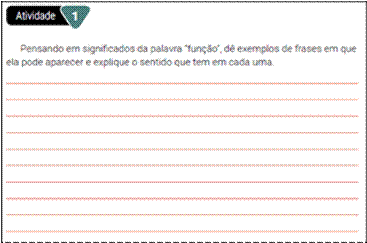
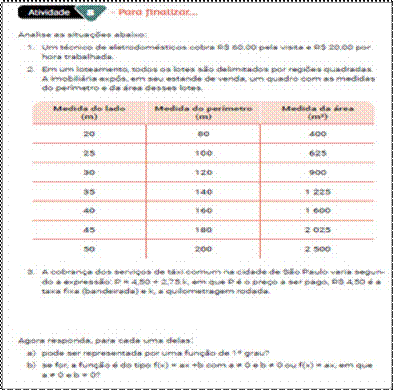
Based on these skills derived from the BNCC, the document proposes eight activities, two of which are characterized below as examples (Figures 1 and 2).
Regarding activities, most are organized around open-ended questions. The exception is item c of activity three. In this item, the following question is proposed: “Let’s C be the cost of the class and t class time. A possible sentence that describes this relationship could be:”, followed by three alternatives “( ) C = 60 + t, ( ) C = 60. t, ( ) C = 60 : t” (Minas Gerais, 2023d, p. 14). There are also activities involving graphs, filling in tables, and Venn diagrams. Chart 3 below summarizes what is covered.
| Activity | What is being discussed? |
| Activity 1 | Students’ prior knowledge of the meaning of the word “Function” in an essay question. |
| Activity 2 | Dependence of quantities in question that involves a problem situation and a table with values as a basis for the response. |
| Activity 3 | Dependence of quantities, analytical expression of the first-degree function, domain, codomain, image, and concept of function in a problem situation, followed not only by a table indicating two quantities and open questions related to the situation, but also by an item involving the Venn diagram. |
| Activity 4 | Concept of function in a problem situation, followed by a chart indicating two quantities. To this end, open questions related to the situation are presented. The intention is for the student to decide whether the situation describes (or does not) a function. After making a decision, fill in the necessary information, including domain, image, and function elements. |
| Activity 5 | Construction of a graph of a first-degree function (b=0), marking and interpreting points of the function on the Cartesian axis. To this end, a question is presented involving a table with numerical values and an indication of quantities, followed by auxiliary questions for constructing a graph. |
| Activity 6 | Construction of a graph of a first-degree function (b ≠ 0), marking and interpreting points of the function on the Cartesian axis. To this end, a question is presented involving a chart with numerical values and an indication of quantities, followed by auxiliary questions that help construct a graph. |
| Activity 7 | Analysis of a function and construction of a graph from its analytical expression. To this end, a question is presented involving the exploration of a function given its analytical expression. |
| Activity 8 | Analysis of functions based on problem situations. To this end, situations are presented, accompanied by tables containing numerical values, followed by questions about these situations. |
Furthermore, after activities four and nine, images are presented, respectively, accompanied by texts that address: i) definition of function, domain, codomain, and image (in addition to a numerical example in the Venn diagram to illustrate these concepts); and ii) definition of function, first-degree function, graph of first-degree function, information on the relationship of the coefficient b with the origin.
Therefore, in the MIA, the characteristics of the DSs in Mathematics Leveling reveal aspects that bring them closer to the concept of mathematical practices by Miguel et al. (2004). We refer to the fact that the proposed activities are directed to a specific time, full-time education, oriented to a specific space — that of the curriculum component (Mathematics Leveling) — and aimed at a clearly defined audience, that of FTSE students. However, as they are guided by skills considered structuring, including those taken from the BNCC, these practices reveal a type of knowledge valued by a segment of society. Regarding this appreciation, as Passos and Nacarato (2018, p. 125) point out, we acknowledge that it is shaped by disputes between “business groups and educational associations and universities, with a clear advantage for the former [...]”.
Regarding the activities of the DSs within the scope of these mathematical practices, we recognize in them an attempt to reveal one of the concepts of SD announced in the MIA. We refer to the proposal by Zabala (1998) because we identify a set of activities, among which one may (or may not) perceive articulation with one another and which may eventually allow the student to reflect on the content, develop hypotheses, [...].
In our understanding, both the articulation of activities and the space for reflection can occur depending on how the SEE collaborates with the autonomous management of activities in schools. Regarding the conduct of activities in the DSs, it is clear in the text boxes entitled Orientação ao Professor [Teacher Guidelines]. In them, general instructions are sometimes provided to teachers about what is expected from the activity, and sometimes models of expected responses are shared.
It is essential to clarify that, in our understanding, this type of guidance reveals more by what it fails to present than by what it makes explicit. The question is: on the one hand, it seems noticeable that the guidance highlights a particular understanding of DS assumed by the state schools network. On the other hand, considering that this is a curriculum component created in the context of FTE, and assuming our defense for a CE committed to omnilateral education, we understand that, at the heart of these guidelines, there is a lack of an explicit position regarding reason for being of this type of activity.
We believe this positioning is fundamental, because, as Fochesato (2022, p. 1118) argues, if the objective is to promote a CE committed to omnilateral education, “[...] the content must permeate all possibilities of its approach in a way that allows the student to understand its purpose based on its contextualization with the social and historical reality.”
Given the above, and in line with Gomes, Cardoso, and Sousa (2024, p. 7), we understand that an omnilateral education “[...] must be capable of developing in students skills and competencies that go beyond the mastery of specific concepts of each subject and point to the development of the capacity for critical, collaborative thinking, effective communication and intellectual autonomy.”
In this sense, given the announced objective —analyzing mathematical practices in the curriculum component Mathematics Leveling based on the Manual of Integrative Activities— and using the understanding of mathematical practices, as proposed by Miguel et al. (2004), the empirical material produced becomes, in a certain way, new knowledge. The analysis of leveling in the MIA highlighted aspects such as the methodologies used in the DSs, the focus on developing mathematical skills as provided in the BNCC, and the absence of a clear explanation of which CE conception guides this logic of teaching mathematics. Based on this, we understand that this material can constitute a relevant support for mathematics teachers to (re)think the practices constructed within the scope of Mathematics Leveling.
In short, we understand that the evidence from the analysis reveals the need for FTSE schools to focus not on promoting fragmented practices, centered on harm reduction at an individual level, but rather on collectively overcoming inequalities, through the prediction and organization of integrated practices.
5. Final considerations
In this article, an extension of a master’s degree research project, the objective established was to analyze mathematical practices in the curriculum component Mathematics Leveling, based on the Manual of Integrative Activities. To this end, we drew on specialized literature to construct the notion of mathematical practices, mobilizing this concept in the context of debates on comprehensive and/in full-time education. We also reflect on the shrinking processes and on the duality historically recognized in Brazil between the school of reception and the school of knowledge, within the context of a State that, instead of addressing poverty, chooses to manage it, often with the assistance of educational institutions. Finally, we emphasize the importance of exploring alternatives to this scenario through comprehensive education committed to the concept of omnilaterality.
Therefore, we developed a research study in which we chose the Manual of Integrative Activities as the focus of our analysis. Specifically, within the scope of this document, we focus on understanding mathematical practices in the Leveling curriculum component. We highlight that the choice of this document was due to the documentary context produced by the State of Minas Gerais, to implement full-time secondary education within the scope of the new secondary education system. In particular, it was also related to aspects of the reality experienced by a school in the location where the researchers reside.
This choice, therefore, on the one hand, measures the scope of the results of this article, which can to help mathematics teachers in the State of Minas Gerais (re)think theoretical and practical aspects (methodologies, assessment, articulation with CE) of their classes, both in the general scope (GBE) and in Mathematics Leveling (FIs). On the other hand, it reveals the interpretative character of limited generality, thus approaching the qualitative paradigm of the research reported in this article.
From the analytical processes, results emerged, among which we highlight that, in general, the context assessed revealed the presence of discrepancies (and out-of-date information) between what is presented in Resolution 4.908 and in the documents made available on the official website of the Minas Gerais Reference Curriculum. In particular, the mathematical practices of leveling show that there is a method that the State expects teachers to use: didactic sequences. There is also evidence of the expectation that the use of diagnostic assessments will be prioritized over typically summative assessments. Nevertheless, we observed the proposal of activities centered on skills clearly linked to the BNCC.
Furthermore, it seemed to us that the mathematical practices in leveling are at the service of the GBE mathematics curriculum component and the formation of a standard student, equipped with skills considered structuring. Given this, a provocation that seems pertinent to us, based on the literature: would these skills be structuring or minimal? Structuring, in the sense of promoting an emancipatory and comprehensive education for each student? Or would they be minimum, designed to guarantee precarious and prolonged care for the daughters and sons of workers, so that their guardians can stay at work for longer?
Despite the impossibility of a definitive answer, such questions allow us to put into perspective which model of comprehensive education has been promoted in secondary education by the public schools network of the state of Minas Gerais. In this sense, we point out as contributions of the research reported in this article the fact that, through it, it was possible to demonstrate, in general, the existence of a pedagogical intentionality in the Leveling component, created on the occasion of the FTSE, aimed at mitigating damages perceived in the part-time school.
More specifically, the research revealed, on the one hand, the indication of methodological work distinct from the traditional model. On the other hand, if this new approach, based on didactic sequences, is configured as a methodological alternative, the same cannot be said about the logic that supports it. It is noticeable that there is a conception of mathematics teaching centered on the development of skills (typical of the BNCC) and, at the same time, there is a notable move away from a proposal for omnilateral education —the one that starts from the singular potentials of the subjects— in favor of a fragmented, uniformizing education, aimed at the constitution of a standard student.
Furthermore, as a guideline for future studies, we highlight the relevance of contrasting the interpretation presented here with the perspectives of teachers who use the document in their daily school routine, of managers who monitor its implementation in schools, and, especially, of the agents who participated in its preparation. In our understanding, these different voices can enrich and tension the analysis developed in this research.
Therefore, we affirm that the analysis of mathematical practices revealed in the Manual of Integrative Activities —the document that presents the curriculum component Mathematics Leveling— highlights fundamental aspects of teaching the subject, as conceived in the context of comprehensive and/in full-time education.
7. References
ALGEBAILE, Eveline. Escola pública e pobreza no Brasil: a ampliação para menos. Rio de Janeiro: Lamparina, Faperj, 2009.
ALVES-MAZZOTTI, Alda Judith; GEWANDSZNAJDER, Fernando. O método nas Ciências Naturais e Sociais. São Paulo: Pioneira, 1998.
BRASIL. Lei nº 9.394, de 20 de dezembro de 1996. Estabelece as diretrizes e bases da educação nacional. Diário Oficial da União, Brasília, 23 dez. 1996.
BRASIL. Decreto n.º 6.253, de 13 de novembro de 2007. Diário Oficial da União, Brasília, DF, 2007.
BRASIL. Ministério da Educação. Plano Nacional de Educação 2014-2024 – PNE. Brasília, 2014. 86p.
BRASIL. Ministro de Estado da Educação. Lei n.º 13.415, de 16 de fevereiro de 2017. Brasília, 2017.
BRASIL. Ministro de Estado da Educação. Resolução MEC/CNE/CEB nº 3, de 21 de novembro de 2018. Brasília, DF: 2018a.
BRASIL. Ministério da Educação. Portaria n.º 1.432/18, de 08 de novembro de 2018. Brasília, DF: 2018b.
BRASIL. Ministro de Estado da Educação. Lei nº 14.640, de 31 de julho de 2023. Brasília, 2017. Disponível em: http://www.planalto.gov.br/ccivil_03/_ato2023-2026/2023/lei/L14640.htm. 2023. Acesso em 03 mar. 2025.
BRASIL. Ministério da Educação. Lei que institui o Programa Escola em Tempo Integral. Brasília, DF: 2023.
BRASIL. Ministério da Educação. Lei que prorroga a vigência do PNE 2014-2024. Brasília, DF: 2024a.
BRASIL. Documento referência. Conferência Nacional de Educação (CONAE). Decreto-Lei nº 11.697/23. 2024b.
CAVALIERE, Ana Maria. Tempo de escola e qualidade na educação pública. Educação & Sociedade, v. 28, p. 1015-1035, 2007.
COELHO, Lígia Martha Coimbra da Costa. História (s) da educação integral. Em Aberto, Brasília, v. 21, n. 80, p. 83-96, 2009.
DEODATO, André Augusto. Articulação entre disciplinas de uma escola de tempo integral: reverberações de um “Grupo de Trabalho Diferenciado (GTD)” nas aulas de Matemática. 2017. 209p. Tese (Doutorado em Educação) – Faculdade de Educação, Universidade Federal de Minas Gerais, Belo Horizonte, 2017.
DEODATO, André Augusto; PINTO, Márcia Maria Fusaro. Uma Revisão Sistemática sobre Práticas Matemáticas na Educação Integral e(m) Tempo Integral. Boletim de Educação Matemática, v. 39, p. 1-26, 2025.
DIAS, Ana Flavia Siqueira Pinto. Dos documentos orientadores ao nivelamento: práticas matemáticas no contexto de uma escola de ensino médio em tempo integral. 2025. 196 f. Dissertação (Mestrado em Educação Matemática) – Instituto de Ciências Exatas e Biológicas, Universidade Federal de Ouro Preto, Ouro Preto, 2025.
DIAS, Ana Flávia Siqueira Pinto; DEODATO, André Augusto. O Ensino de Matemática no Horizonte da Educação Integral: reflexões sobre os planos de estudo tutorados de Minas Gerais. Revista Sergipana de Matemática e Educação Matemática, v. 9, p. 39-60, 2024.
DOLZ, Joaquim; NOVERRAZ, Michèle; SCHNEUWLY, Bernard. Sequências didáticas para o oral e a escrita: apresentação de um procedimento. In SCHNEUWLY, Bernard; DOLZ, Joaquim e col. Gêneros orais e escritos na escola. Tradução de Roxane Rojo e Glaís Sales Cordeiro (Org.). Campinas-SP: Mercado das Letras, 2004, p. 95-128.
FERRETTI, Celso João; VIANNA, Cláudia Pereira; SOUZA, Denise Trento Rebello de. Escola pública em tempo integral: o PROFIC na rede estadual de São Paulo. Cadernos de Pesquisa, n. 76, p. 5-17, 1991.
FLACH, Simone de Fátima. Ensino fundamental no Brasil: previsões legais e ações governamentais para a ampliação do atendimento, da duração e do tempo escolar. Ensaio: Avaliação e Políticas Públicas em Educação, v. 23, n. 88, p. 739–762, jul. 2015.
FOCHESATO, Patrícia Gonçalves. Currículo integrado: a interdisciplinaridade como eixo norteador frente à formação Omnilateral do aluno. Studies in Education Sciences, v. 3, n. 3, p. 1107-1123, 2022.
GIL, Antônio Carlos. Métodos e técnicas de pesquisa social. 6. ed. Editora Atlas SA, 2008.
GOMES, Edmar Ferreira; CARDOSO, Flávio Manoel Coelho Borges; SOUSA, Marcos de Moraes. Formação Omnilateral: contribuições das áreas de matemática e ciências da natureza no ensino médio integrado. Práticas Educativas, Memórias e Oralidades: Revista do PEMO, v. 6, e12783, 2024.
LIBÂNEO, José Carlos. O dualismo perverso da escola pública brasileira: escola do conhecimento para os ricos, escola do acolhimento social para os pobres. Educação e Pesquisa, São Paulo, v. 38, n.1, p. 13-28, 2012.
LIBÂNEO, José Carlos. Escola de tempo integral em questão: lugar de acolhimento social ou de ensinoaprendizagem? In: BARRA, V. M. (Org.). Educação: ensino, espaço e tempo na escola de tempo integral. 1. ed. Goiânia: CEGRAF, 2014.
MIGUEL, Antonio et al. A educação matemática: breve histórico, ações implementadas e questões sobre sua disciplinarização. Revista Brasileira de Educação, p. 70-93, 2004.
MINAS GERAIS. Secretaria de Estado da Educação. Diretrizes para implementação de Itinerários Formativos. Belo Horizonte, 2023c.
MINAS GERAIS. Secretaria Estadual de Educação. Resolução SEE n.º 4.908, de 11 de setembro de 2023a. Belo Horizonte, MG: 2023a.
MINAS GERAIS. Secretaria Estadual de Educação. Ensino Médio em Tempo Integral: EMTI Manual das Atividades Integradoras. Belo Horizonte, MG: 2023b.
MINAS GERAIS. Secretaria Estadual de Educação. Sequência Didática do professor: números e Álgebra–conceito de função; função do 1° grau. Belo Horizonte, MG: 2023d.
MINAS GERAIS. Secretaria Estadual de Educação. Catálogo de Eletivas 2024. Belo Horizonte, MG: 2024.
MINAS GERAIS. Secretaria Estadual de Educação. Diretrizes para Escolha dos Itinerários Formativos para o 2º e 3º anos do Ensino Médio Diurno e EMTI. Belo Horizonte, MG: 2024a.
OLIVEIRA, Vanesca Almeida de. A sustentabilidade no ensino da Matemática: um estudo de caso em uma escola de Ensino Médio em Tempo Integral localizada em Acarape/CE. 2020. 103p. Dissertação (Mestrado em Sociobiodiversidade e Tecnologias Sustentáveis). 2020.
PASSOS, Cármen Lúcia Brancaglion; NACARATO, Adair Mendes. Trajetória e perspectivas para o ensino de Matemática nos anos iniciais. Estudos Avançados, v. 32, n. 94, p. 119-135, 2018.
PESTANA, S. F. P. Afinal, o que é educação integral. Revista Contemporânea de Educação, v. 9, n. 17, p. 24-34, 2014.
ROMÃO, José Eustáquio. O Ensino Médio e a omnilateralidade: Educação Profissional no século XXI. Eccos Revista Científica, v. 12, n. 1, p. 27-49, 2010.
SANTOS, C. C. F. Educação (em tempo) integral? Uma análise do Programa de fomento às escolas de Ensino Médio de tempo integral (EMTI) frente às políticas de ensino de tempo integral da rede estadual da Bahia (2017-2022). 2023. 230p. Tese (Doutorado em Educação) – Universidade Federal da Bahia, Bahia, 2023.
SILVA, Karen Cristina Jensen Ruppel da; FLACH, Simone de Fátima. Educação Integral: em defesa de uma concepção emancipatória. Revista Educativa-Revista de Educação, v. 20, n. 3, p. 717-737, 2017.
SILVA, Bruno Adriano Rodrigues da. A concepção empresarial da educação integral e (m) tempo integral. Educação & Realidade, v. 43, p. 1613-1632, 2018.
SOUSA, Joselma Soares. Ensino Médio em Tempo Integral: a percepção dos professores de Química das escolas estaduais de Roraima. Mestrado Profissional em Ensino de Ciências. Universidade Estadual de Roraima, Boa Vista. 2019.
VALENTIM, Maria Betânia. Práticas matemáticas em escolas de tempo integral de “Ensino Médio” no RN (1978-2019): permanências e alterações. Mestrado Profissional em Ensino de Ciências Naturais e Matemática. Universidade Federal do Rio Grande do Norte, Natal. 2022.
VILELA, Denise Silva. Práticas matemáticas: contribuições sócio-filosóficas para a Educação Matemática. Zetetiké, v. 17, n. 1, 2009.
ZABALA, Antoni. A prática educativa: como ensinar. Porto Alegre: ArtMed, 1998.
Appendix
Appendix – Editorial Details
Notes
No. 4777 – New Secondary Education Curriculum Matrices – 1st and 2nd grades of secondary school and 1st, 2nd, and 3rd periods of YAE High School starting in 2023]. However, when accessing the document, we found that there was an update to the regulations, corresponding to SEE Resolution No. 4.908, of September 11, 2023.