1. Introduction
The COVID-19 pandemic, which began in early 2020, imposed a new scenario for education, resulting in the closure of many schools and the adoption of remote classes. MEC Ordinance N. 343 of March 17, 2020, authorized the replacement of in-person classes with digital means during the pandemic, forcing teachers to quickly adapt to the use of digital technologies (DTs). In this context, Rocha et al.’s (2020) research revealed that 88% of the teachers interviewed were instructed to use some form of digital technology (DT) in online classes, although 77.2% had not been prepared for this during their undergraduate degree.
Among the transformations in education, according to Vilela, Pinto, and Conti (2024), digital technologies (DTs) began to be incorporated as pedagogical tools. Therefore, it is essential to provide resources and stimuli that incorporate new educational methods and approaches inside and outside the school environment. The issue of using digital games in mathematics teaching arises as an alternative to engage students, especially in a remote teaching context.
Often associated with memorization and formal teaching methods, mathematics can be transformed through the use of digital games, which contribute to the development of cognitive and logical skills, as noted by Brito (2020) and Grando (2000). In this scenario, educational games have been defended as important allies in learning mathematical concepts, being able to generate greater interest and interaction on the part of students (Silva, 2020; Neto; Fonseca, 2013).
This work has the general objective of investigating the perceptions of a group of in-service and pre-service teachers regarding the use of educational mathematics games, based on their participation in the extension course “Teaching Elementary School Mathematics Through Free Online Games,” offered by the Federal University of Espírito Santo (UFES) in 2020, in a remote mode. The specific objectives include examining students’ opinions on the pedagogical potential of the games presented and identifying the difficulties encountered in applying these games in the classroom.
The motivation for this study stems from the need to understand how games can be effectively used in teaching mathematics during a pandemic and how to overcome the challenges educators face when integrating digital technologies into the teaching process. The research is particularly relevant for its potential to contribute to teachers’ continuing education and the improvement of pedagogical practices through the use of educational technologies.
The methodology adopted was a qualitative approach with content analysis to investigate participants’ answers to the activities proposed in the course. The analysis aims to understand students’ conceptions about educational games, identify the perceived limitations, and explore the pedagogical possibilities that games offer for mathematics teaching.
Therefore, the research is justified by the contribution it can make to the debate about integrating digital and physical games in mathematics teaching, especially in the context of remote teaching, and by the importance of promoting teacher education that prepares educators for the effective use of these technological tools.
2. Theoretical Foundation
This study focuses on the conceptions of in-service and pre-service teachers regarding the use of educational games in mathematics teaching, employing Bardin’s content analysis (CA) (2011) to analyze participants’ responses.
Bardin (2011, p. 48) defines content analysis (CA) as:
A set of communication analysis techniques aimed at obtaining indicators (quantitative or not) for the procedures and objectives of describing the content of messages that allow the inference of knowledge related to the conditions of production/reception (inferred variables) of those messages.
In other words, it is the science of interpreting something, in a controlled way, and the interpreting part is called inferring.
According to Bardin (2011), CA has the following objectives:
a) overcoming uncertainty. This means that a researcher who analyzes their work without any theoretical basis, only according to common sense, may have their vision not shared by other people, but with CA, they can be sure that the research carried out can be generalized.
b) the enrichment of reading, because in CA, it is necessary to read and reread the text being analyzed, which brings enrichment since, when reading, the reader gains an understanding, and when reading again, they will gain another understanding. Careful reading increases productivity and relevance.
The CA field is broad, as any communication (verbal and non-verbal) can be subjected to its techniques, such as newspaper articles, questionnaires, books, a page from a book, magazines, transcription, etc. As Henry and Moscovici (1998, apud Bardin 2011, p. 39) say, “We exclude from the application scope of content analysis everything that is not properly linguistic, such as films, pictorial representations, behaviors (considered ‘symbolic’), etc.”
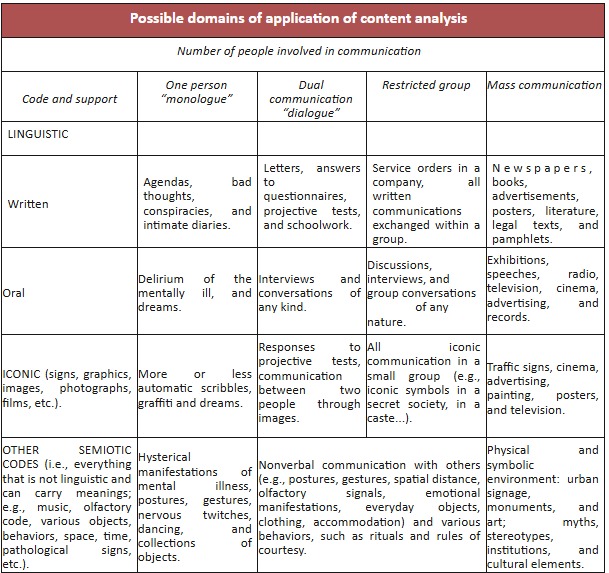
The complexity of the CA can vary, as it depends on the number of people involved in the communication, the code, and the message support, among others. Thus, the procedures used to analyze communication depend on the object of analysis. Therefore, Chart 1 presents the possible domains of application of CA.
Chart 1 – Possible domains of application of content analysis
 Bardin (2011, p. 40)
| Possible domains of application of content analysis |
| Number of people involved in communication |
| Code and support | One person “monologue” | Dual communication “dialogue” | Restricted group | Mass communication |
| LINGUISTIC | | | | |
| Written | Agendas, bad thoughts, conspiracies, and intimate diaries. | Letters, answers to questionnaires, projective tests, and schoolwork. | Service orders in a company, all written communications exchanged within a group. | N e w s p a p e r s , books, advertisements, posters, literature, legal texts, and pamphlets. |
| Oral | Delirium of the mentally ill, and dreams. | Interviews and conversations of any kind. | Discussions, interviews, and group conversations of any nature. | Exhibitions, speeches, radio, television, cinema, advertising, and records. |
| ICONIC (signs, graphics, images, photographs, films, etc.). | More or less automatic scribbles, graffiti and dreams. | Responses to projective tests, communication between two people through images. | All iconic communication in a small group (e.g., iconic symbols in a secret society, in a caste...). | Traffic signs, cinema, advertising, painting, posters, and television. |
| OTHER SEMIOTIC CODES (i.e., everything that is not linguistic and can carry meanings; e.g., music, olfactory code, various objects, behaviors, space, time, pathological signs, etc.). | Hysterical manifestations of mental illness, postures, gestures, nervous twitches, dancing, and collections of objects. | Nonverbal communication with others (e.g., postures, gestures, spatial distance, olfactory signals, emotional manifestations, everyday objects, clothing, accommodation) and various behaviors, such as rituals and rules of courtesy. | Physical and symbolic environment: urban signage, monuments, and art; myths, stereotypes, institutions, and cultural elements. |
In our case, we applied CA to a restricted group through writing, as we sought to analyze their responses in the activities proposed in an extension course taught to a group of in-service and pre-service teachers.
Below, we present the method for processing raw data, as described by Bardin (2011), which we employed in this work. We first began by organizing our material, followed by its exploration, to define the recording units, and finally categorizing them.
2.1. Pre-Analysis
• Floating reading: A quick reading approach to familiarize oneself with the collected data, allowing the analyst to capture initial impressions.
• Selection of documents: The selection of the material to be analyzed, based on rules such as exhaustiveness, representativeness, homogeneity, and relevance.
• Formulation of hypotheses and objectives: Definition of the hypotheses and research objectives, which can be adjusted during the analysis.
• Reference of indexes and preparation of indicators: Identification of words or themes in the material and the frequency with which they appear (indicators).
• Material preparation: Organizing and structuring data prior to formal analysis, such as transcribing interviews.
2.2. The Coding
Here the material is more thorougly analyzed:
• Context units and recording units: Identification of significant sections and definition of smaller units for analysis.
• Enumeration of units: Counting elements such as the presence or absence of certain themes, the frequency of appearances, or the direction of the elements (positive, negative, neutral).
• Enumeration types: Presence, weighted frequency, direction, order and (co)occurrence are analyzed to understand the meaning of the elements within the content.
2.3. Categorization
Recording units are grouped into categories based on common characteristics, using semantic, syntactic, or lexical criteria. Categorization helps simplify raw data for easier analysis.
2.4. Techniques
The most outstanding content analysis technique is categorial analysis, but other approaches, such as evaluation analysis and propositional discourse analysis, are also mentioned.
• Evaluation analysis: Evaluates attitudes towards the objects of discourse, considering the direction and intensity of the opinion.
• Propositional discourse analysis (PDA): Focuses on the meaning of statements and the structure of argumentative discourse.
2.5. The Inference
Inference is the intermediate step between data description and interpretation, allowing the analyst to make logical deductions from the analyzed data.
Through the pre-analysis, coding, and categorization stages, CA provides an in-depth understanding of the object of study, ensuring that the categories are pertinent and consistent, thus contributing to a clear and well-founded analysis.
Several studies have shown that games can be effective pedagogical tools in teaching mathematics, as they promote a more playful, motivating, and meaningful learning environment (Grando, 2000; Kishimoto, 2011). By including games in educational practices, the teacher encourages the development of logical reasoning, problem solving, and student autonomy.
According to Lorenzato (2006), games in the school context allow the construction of mathematical knowledge through experimentation and social interaction, essential aspects for learning. Furthermore, the use of educational games contributes to learning through trial and error, offering students the opportunity to test strategies, reflect on their results, and reformulate actions, which aligns with the principles of active learning.
In the context of teacher education, discussing and experiencing the use of games is essential for both in-service and pre-service teachers to understand the pedagogical possibilities of this approach and apply it critically in the classroom.
3. Methodological Path
The study analyzes the conceptions of in-service and pre-service teachers regarding the use of educational mathematics games, using Bardin’s content analysis (2011). The research adopts a qualitative approach, focusing on understanding participants’ perceptions of the effectiveness and challenges associated with these games in mathematics teaching.
The extension course “Teaching Elementary School Mathematics Through Free Online Games” was offered remotely, with 38 participants, including teachers and students, from October to November 2020. During the course, participants watched videos and carried out activities using educational games, covering topics such as percentages, fractions, geometry, and mathematical operations. This research has not been submitted to the Ethics Committee because it was a final project for the mathematics degree at the Federal University of Espírito Santo (UFES), and as such, there was no requirement for submission.
Data analysis followed the steps of content analysis: pre-analysis (initial reading of data), exploration (definition of recording and meaning units), categorization (grouping responses into categories with common characteristics), and interpretation. The categories were created based on students’ responses, and the analysis sought to identify how games can contribute to the mathematics teaching-learning process.
The data were organized into tables and synthesized into categories for a final interpretation, with the aim of understanding the participants’ conceptions regarding the use of educational games in mathematics teaching.
This study emphasizes the significance of educating in-service and pre-service teachers on the application of games in mathematics teaching. The extension course, held remotely with 38 participants, covered both digital and physical games through videos, practical analyses, and reflective activities. Data were obtained via forms and records of interactions and analyzed based on Bardin’s content analysis (2011).
4. Results and discussions
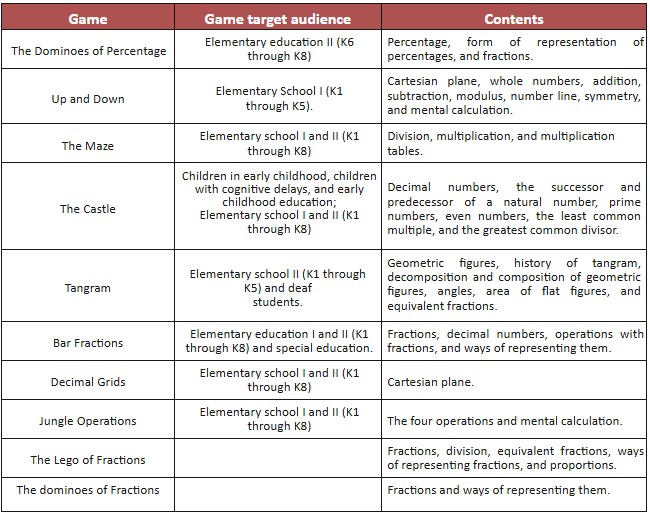
The analysis of the participants’ responses revealed two main categories: (1) the conception of the insertion of games in the teaching and learning processes of mathematics, and (2) the conception of the negative points of games. The discussions presented here seek to synthesize the results, reflecting on the pedagogical implications and future perspectives for the use of games in mathematics teaching. Below, we present in Chart 2 the contents and audience to which the games are intended.
Chart 2 – Contents that can be worked on and the target audience for the games.
 Authors of the work
| Game | Game target audience | Contents |
| The Dominoes of Percentage | Elementary education II (K6 through K8) | Percentage, form of representation of percentages, and fractions. |
| Up and Down | Elementary School I (K1 through K5). | Cartesian plane, whole numbers, addition, subtraction, modulus, number line, symmetry, and mental calculation. |
| The Maze | Elementary school I and II (K1 through K8) | Division, multiplication, and multiplication tables. |
| The Castle | Children in early childhood, children with cognitive delays, and early childhood education; Elementary school I and II (K1 through K8) | Decimal numbers, the successor and predecessor of a natural number, prime numbers, even numbers, the least common multiple, and the greatest common divisor. |
| Tangram | Elementary school II (K1 through K5) and deaf students. | Geometric figures, history of tangram, decomposition and composition of geometric figures, angles, area of flat figures, and equivalent fractions. |
| Bar Fractions | Elementary education I and II (K1 through K8) and special education. | Fractions, decimal numbers, operations with fractions, and ways of representing them. |
| Decimal Grids | Elementary school I and II (K1 through K8) | Cartesian plane. |
| Jungle Operations | Elementary school I and II (K1 through K8) | The four operations and mental calculation. |
| The Lego of Fractions | | Fractions, division, equivalent fractions, ways of representing fractions, and proportions. |
| The dominoes of Fractions | | Fractions and ways of representing them. |
4.1. Category 1: Conception about the insertion of games in teaching and learning processes
According to Macedo (2000), children with learning difficulties tend to stop fearing knowledge when this experience is made pleasurable. In our study, we noticed that for course participants, students are motivated to learn mathematics when activities with games are proposed in the classroom, as explained by C21: “Students feel more stimulated to understand the mathematical content covered by the game.”
Furthermore, we found that, according to the students, the engaging approach to the content in recreational activities, which differs from the traditional method, can help demystify the idea that mathematics is difficult and incomprehensible. C7’s report on the game “Up and down” reinforces this conception:
Many skills can be developed through this game, but primarily it would change the view that most students have of the mathematics at stake, making them more open to learning the content without preconceived notions (Student 7).
According to Grando (2000, p. 29), “through competition students’ needs are established to develop strategies to win the game.” In our work, we found that students believe that competition encourages students to use their knowledge to win, as shown in C10’s report about “The Dominoes of Fractions”:
Because it is a competitive game, it awakens students’ interest in seeking strategies to win, and consequently, they are better prepared to devise strategies to solve problems in general, as they activate their logical reasoning while playing (Student 10).
Participants pointed out the attractiveness of games as motivators. For C12, C11, and C9, the fact that the games “The Dominoes of Fractions,” “The Lego of Fractions,” and “Up and down” resemble already familiar toys arouses students’ interest and encourages them to participate in the class. C3 and C11 highlighted that the colors present in the games “The Lego of Fractions” and “The Castle” can attract students’ attention.
Furthermore, we analyzed that, according to the students, the fun way in which the content is approached in recreational activities, as opposed to traditional methods, can demystify the idea that mathematics is difficult and incomprehensible. C7’s report on the game “Up and down” reinforces this conception.
Grando (2000, p.29) states, “Competition establishes students’ need to develop strategies to win the game.” In our work, we found that students believe that competition encourages students to use their knowledge to win, as shown in C10’s report about “The Dominoes of Fractions”:
Participants pointed out the attractiveness of games as motivators. C12, C11, and C9 stated that the games “The Dominoes of Fractions,” “The Lego of Fractions,” and “Up and Down” resemble familiar toys, which sparks students’ interest in participating in the class. C3 and C11 highlighted that the colors present in the games “The Lego of Fractions” and “The Castle” can attract students’ attention.
4.2. Category 2: Conception about the negative points of games
According to students’ responses, we detected some negative points in the games. These negative points included the rules of the games, the allocated time for each game, the attractiveness, the materials used to make the toys (in the case of physical games), the lack of access to the Internet and mobile devices, and the fact that some websites were not in Portuguese (in the case of virtual games).
Macedo (2000) states that when proposing an activity with games, the teacher must reserve an adequate space and time so that students can play several rounds. According to the author, the act of playing, combined with the educator’s mediation, promotes learning since it demonstrates procedures that must be maintained and modified according to the results of each play.
Therefore, we believe that introducing a game that requires a significant amount of time in the classroom or assigning a very short deadline for completing the educational activity would not yield satisfactory results. C4’s report shows the student’s dissatisfaction with the length of the game “The Dominoes of Percentages”:
As the game progresses, it becomes interesting, and class time becomes the unpleasant part, as students complain that the class is over. I use dominoes a lot with the theme of percentages and other themes in the classroom, and I realize that time is the negative point when working with percentage dominoes in the classroom (Student 4).
Student C16 is dissatisfied with the lack of competitiveness of “The Dominoes of Fractions.”
As previously mentioned, the game only needs a more competitive aspect, as this is what sharpens students’ interest in participating in educational games. These are usually games they are unfamiliar with, so we need something that will capture their attention. Because it is a simple game, it is easy to understand. However, it would be more fun if it were worked in levels (Student 16).
Although the course participants praised the materials used for the physical games because they were easy to make, C7 highlighted that the material is degradable; thus, if students do not handle it carefully, it can be easily damaged: “One negative point is that the material is degradable (but this could easily be solved with laminating), students may not want to be careful with the materials, and that’s it.”
Regarding virtual games, participants reported discomfort in handling the sites. It would be difficult for them to apply the games to children who have never had contact with software and computers. Furthermore, another difficulty they mentioned was the fact that some websites were in English.
Studies such as those by Hoffmann, Barbosa, and Martins (2016) found that digital games can be a tool for teaching and learning. However, our research has shown that students do not perceive ICTs as a facilitating instrument in mathematics classes due to the lack of infrastructure. In their opinion, the digital games presented have teaching potential; however, as they require a computer and Internet access, they ultimately become a disadvantage.
Therefore, the main difficulties encountered in relation to virtual games were the fact that schools do not have computers for everyone and the need for an Internet connection, as not all students have access to one at home.
Macedo (2000) states that when proposing an activity with games, the teacher must reserve an adequate space and time so that students can play several rounds. Playing, combined with the educator’s mediation, encourages learning, as it shows procedures that must be maintained or modified according to the results of each turn.
4.3. Category 3: Conception about the practicality of games
We found that students believe that games can bring benefits to teaching and learning. However, as we saw in Category 2, course participants believe that using virtual games in math classes is unfeasible, as the school and students do not have the resources to carry out the activities successfully.
On the other hand, participants enjoyed the physical games. Twenty-four recording units praised their simplicity and ease of production. For example, we cite C15’s report on the “Dominoes of Percentages” game: “It is a very simple game that requires few materials to make, allowing students to build it on their own.”
Therefore, we believe that it is easier for teachers to use concrete games, as they are more practical and do not require teachers to master ICT. Furthermore, because they are simple and easy to understand, explaining their rules does not take up much of the class time, unlike the virtual games covered in the course.
Another practicality described was the ease of transporting some games, as noted in the reports of the C7 students: “[...] easy displacement (it is not a heavy game to carry around)”; C3 also observed: “The games Up and Down, Lego of Fractions, and Dominoes of Fractions are fun and can be easily transported; they are also easy to explain.”
Regarding virtual games, participants praised the fact that some games can be built in the event of an Internet outage. C4’s speech about the “Castle” notes this fact: “If there are no computers at school, students can build the game.”
4.4. Category 4: Conception that games can be worked in another way
Videos shown in the extension course “Teaching Elementary School Mathematics Through Free Online Games” aimed to explain how to play each game and how to use them to teach mathematics. However, in our analysis, we realized that some participants had different ideas about how to implement playful activities in the classroom. Thus, the games mentioned were: Lego of Fractions, Up and Down, Tangram, Castle, Maze, Bar Fractions, Jungle Operations, and Decimal Grid.
C1 thinks “Lego of Fractions” and “Up and Down” should be played with small groups of students, so that there is not too much chit-chat and the students’ concentration increases. C8 reports that he would apply the games with small groups to work on interaction and prevent students from getting tired.
C4 states that he has already used “Tangram” in his classes. He typically tells the legend of its origin first, then explores the characteristics of the piece, its decomposition, and composition of flat figures, in addition to working with interdisciplinary approaches, inviting colleagues from other disciplines. C11 has a slightly different idea about the rules of the game. According to him, the teacher must display the figures on the board and track the time for the groups to assemble them.
For C8, another way of working with the “Castle” game is by asking students to form a line. The teacher would then ask what the successor and predecessor of a number are, and if a student got it wrong, they would move to the end of the line. However, if they got it right, they would move forward. Regarding the “Maze” game, C8 explains that he would work with the same rules mentioned in the video, but would let the opponent choose the numbers. According to C11, it would be interesting to hold a tournament, making small groups using the “Maze”. According to the student, this way of working would provide a relaxed class and require students’ attention.
Two reports on digital games reveal that creating games is another way to utilize them in the classroom, as they require Internet access to be played. According to C7, the game “Bar fractions” could be adapted for use with other materials. C9 believes that the game “Decimal grid” can be played in class, using graph paper. Finally, C9 states that the game “Jungle Operations” should include problem situations involving the four operations.
Based on the discussions developed throughout this work, we observed that, although the focus was on the use of digital games as a resource for teaching mathematics in elementary school, it is pertinent to highlight that the extension course “Teaching Elementary Education Mathematics Through Free Online Games” raised reflections on the use of physical games.
During the course, students had contact with various types of games, carried out analyses of digital proposals accessible online, and, at times, created physical games, thereby expanding the range of pedagogical possibilities explored. The activities took place interactively, with moments of experimentation, creation, and evaluation of resources, allowing participants to share their perceptions through forums, questionnaires, and discussion groups.
To collect and analyze the data, we used instruments such as digital forms, class records, and notes from group discussions, which enabled us to identify the formative contributions of the course. Thus, at the end of this section, we highlight the importance of considering both digital and physical games in the educational context, recognizing the wealth of approaches that can emerge from combining different languages and materials in mathematics teaching.
5. Final Considerations
This study investigated the conceptions of in-service and pre-service teachers regarding the use of educational games in mathematics teaching, highlighting the potential and difficulties associated with their application in the classroom. The analysis of participants’ responses, using the techniques proposed by Bardin (2011), allowed opinions to be organized into categories, enabling a deeper understanding of the beliefs and pedagogical practices involved in playful activities.
The results show that participants believe in the potential of educational games to promote students’ interest in mathematics. According to the students, recreational activities encourage them to develop problem-solving strategies, increase their self-confidence, and stimulate reflection on the content. Furthermore, games encourage interaction and collective work, with students helping each other, which strengthens learning and the construction of collaborative knowledge.
However, we identified difficulties related to the use of games, especially virtual ones. The lack of technological resources, such as computers and Internet access, was highlighted as a significant barrier, in addition to the limited time available for implementing the games in the classroom. Despite this, physical games were seen as more accessible because students can make them themselves, which facilitates their implementation.
Although the study met the proposed objectives, one limitation was not evaluating the impacts of the extension course on the participants, which could have provided a more detailed analysis of the evolution of their conceptions throughout the course. Therefore, we suggest that future research adopt a pre- and post-test approach to verify changes in the conceptions of in-service and pre-service teachers on the use of educational games in mathematics teaching.
This work contributed to the understanding of teachers’ perceptions of the possibilities and challenges of using games in teaching, providing insights for improving pedagogical practices and developing formative content that can be applied in other teacher education courses. The research also points to the importance of continuing to investigate the impact of using educational games as a pedagogical tool, promoting innovation and reflection in mathematics teaching.