1. Introduction
This work is developed from the perspective of the teacher education research line of the Postgraduate Program in Mathematics Education (Programa de Pós-Graduação em Educação Matemática–PPGEDMAT) of the Federal University of Ouro Preto (UFOP), aiming to investigate the repercussions of Pibid in the initial education of mathematics teachers in East Timor. The study focuses on Timorese teachers who graduated from the natural sciences and mathematics course offered by the University of International Integration of Afro-Brazilian Lusophony (Universidade da Integração Internacional da Lusofonia Afro-Brasileira–Unilab)4, participants of the Institutional Teaching Initiation Grant Program (Programa Institucional de Bolsa de Iniciação à Docência–Pibid).
The Pibid is considered a focal point of public educational policies aimed at teacher education, according to Souza, Macêdo, and Crisóstomo (2023). Silva and Morellati (2016, p. 2) highlight that:
[...] The Ministry of Education implemented programs to contribute to the quality of initial teacher education. One of these programs is the Institutional Teaching Initiation Grant Program (Programa Institucional de Bolsa de Iniciação à Docência–PIBID) of CAPES. One of the objectives of this program is to improve the quality of academic activities aimed at initial teacher education in teaching degree courses at higher education institutions by inserting preservice teachers into the daily lives of public schools under the guidance of a university professor and supervision of a professional from the school, integrating higher education and basic education.
Alves, Martins, and Leite (2021, p. 1599) point out that the program “provides scholarship holders with unique experiences of recognizing the school from a new perspective, no longer as a student, but as a teacher.” They add: “An early contact with their work environment helps scholarship holders acquire new knowledge of teaching, also providing them opportunities to create from classroom situations.
Santos and Alves (2022) consider that Pibid changed the initial teacher education model, as it provides preservice teachers with the opportunity to enhance their knowledge of the school context and, above all, the use of active methodology in the teaching and learning process and the articulation between theory and practice.
Taking into account the experiences, perceptions, knowledge, and autonomy developed by preservice teachers in Pibid, which can enable understanding of the teacher education process, this study aims to analyze the perceptions of Timorese teachers, graduates of the natural sciences and mathematics course at Unilab, about the role of Pibid in its initial formative processes.
Therefore, after this introduction, the text turns to understanding the context of teacher education in East Timor, then addresses Pibid from the point of view of mathematics teacher education, the methodology chosen to develop it, and the analyses resulting from the questionnaires of Timorese graduates, to understand the perceptions of these participants of their experiences in Pibid. Finally, we make some considerations.
2. Teacher education in East Timor
This topic discusses teacher education in the Timorese context throughout the colonial period of Portugal (1514-1975), the Indonesian invasion (1975-1999), and the post-independence period. Jerónimo (2011) says that, in general, East Timor received little investment for its development before its independence, which reverberated in the educational sphere.
Ribeiro (2015) says that during the Portuguese colonial period (1512-1975), education in East Timor went through challenging times. While the Portuguese authorities prioritized resources management and exploitation, which considerably limited investment in education and teacher education, Catholic missionaries established schools as the main source of formal education, focusing on catechesis and literacy in Portuguese (Ribeiro, 2015). However, although there are records of educational processes promoted during Portuguese colonization, Ribeiro (2015) highlights that there were few schools, and only a small portion of the population had access to them. Teachers’ formative process mostly covered only the basics, excluding pedagogical education (Ribeiro, 2015).
In 1975, Indonesia invaded Timorese territory, ending the Portuguese colonial regime and changing the landscape. Under Indonesian rule (1975–1999), there was a change in the educational context, with a strategy of cultural exchange being implemented. The Portuguese language was eliminated, and Indonesian (Malay) was established as the official language, according to Santos (2014). Under such rule, Portuguese educational institutions were closed, and Indonesian teachers were sent to East Timor to reinforce the occupation.
During the Indonesian invasion, the number of public schools grew. However, education served the interests of the government, with a curriculum that discredited Timorese culture and Timorese teachers. Those who persisted in the education system had to adjust to the new Indonesian curriculum, often without the support or adequate education to teach using the Malay language (Santos, 2014).
An international intervention led by the United Nations (UN) resulted in the end of the Indonesian invasion and the proposal for people’s consultation. In 1999, East Timor was declared independent.
According to Silveira, Pedra, and Oliveira (2022), the educational system underwent a significant restructuring after independence. In this context, in 2000, the National University Timor Lorosa’e (Universidade Nacional Timor Lorosa’e–UNTL), the country’s first higher education institution, was founded to fill the gaps left by the private institutions Universitas Timor-Timur (UNTIM) and Politeknik Díli, which were unified in the colonialist period.
Ribeiro (2015) indicates that to make up for the lack of qualified teachers, East Timor had to overcome the challenge of restructuring its education system, reintroducing Portuguese as one of the official languages alongside Tetum, and implementing teacher education programs. Indeed, the Constitution of the Democratic Republic of East Timor, approved on March 22, 2002, defines in Article 59 that it is the State’s responsibility “to create a public system of universal, compulsory and, to the extent possible, free basic education” (Timor-Leste, 2011).
In its preamble, Law N. 14/2008, Law of Education Guidelines (Lei Bases da Educação–LBE) makes explicit the intention of the Constitution of East Timor to guarantee that:
[...] All citizens have the right to equal opportunities for education and professional training, access to the highest levels of education, scientific research, and artistic creation, in addition to the right to cultural enjoyment and creation, as well as the duty to preserve, defend, and enhance cultural heritage (Timor-Leste, 2008, p. 2641).
By establishing the organization of the Timorese education system, the LBE indicates legal means to guarantee access to education for all nationals. In its organization, the first article establishes that “it is the State’s responsibility to ensure the availability of teachers with adequate qualified education and other human resources, as well as the necessary infrastructure and financial resources to guarantee quality education” (Timor-Leste, 2008, p. 2641).
The LBE proposes initial and continuing education as the main modalities within the scope of teacher education. Initial education “provides basic scientific and pedagogical information, methods and techniques, as well as personal and social education appropriate to the exercise of the function” (Timor-Leste, 2008, p. 2656). Continuing education was indicated by the LBE as a way of complementing and updating initial education “from a perspective of permanent education, sufficiently diversified” (Timor-Leste, 2008, p. 2656), to foster the development of the knowledge and competencies of those professionals.
As diagnosed in the Strategic Plan for Education 2011-2030, “during the years that followed the independence of Timor-Leste, efforts to provide access to education were focused mainly on basic education” (Timor-Leste, 2011, p. 33), with a significant increase in the number of 1st and 2nd-cycle schools, teachers, and enrolled students. Belo (2010) highlights that, between 2000 and 2005, although there had been important progress in the educational field, there was still a significant percentage of unqualified Timorese teachers in service.
The Strategic Plan for Education 2011-2030 (Timor-Leste, 2011) also diagnosed that there was a need to improve the quality of teacher education, as it was problematic and insufficient, which had repercussions on education as a whole, hence the urgency to reform the education system, as also stated by Belo (2010).
With support from countries such as Portugal and Brazil, “the Timorese government invested heavily in teacher education, especially in the continuing education of teachers who began to practice the profession in the new State without sometimes having adequate training” (Jerónimo, 2011, p. 26). Only with the LBE, which came into force in October 2008, did East Timor begin to regularize its education system, including teacher education.
Guterres (2011) highlights that one of the priorities of the Ministry of Education of Timor-Leste focuses on the qualification of human resources, which would aim to promote means of implementing, monitoring, and following up on the curriculum. Silva (2011) understands that one of the greatest needs in the Timorese context is the shortage of human resources with adequate qualifications for high-quality teaching work and highlights the importance of international cooperation in this regard.
International cooperation, highlighted by Belo (2010), was seen as an effort by East Timor, resulting in educational policies, with the presence of Brazilian and Portuguese teacher-educators at the National Center for Continuing Teacher Education (Centro Nacional de Formação Contínua de Professores), relevant to training in-service primary and secondary education teachers in the country.
Belo (2010, p. 101) mentions that East Timor has encouraged its teachers to complete their formative processes in partner countries (Brazil and Portugal), offering them the opportunity to pursue master’s degrees, doctorates, as well as “improvement in the Portuguese language, universal culture, sciences, and knowledge about societies.”
Jesus (2016) notes that Brazil’s collaboration to foster integration with the communities of Portuguese-speaking countries (CPLP), particularly in Africa and Asia, East Timor, has favored the development of partnerships, among them, the cooperation between UNTL and Unilab, in 2011, driven by bilateral alliances between Brazil and East Timor, an initiative of academic and technical cooperation between nations, which provided for an effort for Brazilian professors to assist in the training of UNTL professors and the exchange of Timorese students to enter undergraduate courses in Brazil, as a way of expanding higher education in the Asian country.
Jesus (2016) asserts that this collaboration has been strengthened over the years, with an increase in the number of Timorese students graduating from Unilab in various areas of knowledge, such as exact sciences, agronomy, nursing, and public administration. Still in force, this policy is not restricted to education alone. It also includes strengthening cultural and linguistic ties since, upon entering Unilab, many Timorese students need support learning Portuguese, given that their previous education had been mainly in Malay and Tetum. Initiatives that have contributed to developing human capital in East Timor (Jesus, 2016).
In this context, the research problem that gave rise to this study emerges: the repercussions of Pibid on the education process of mathematics teachers in East Timor. As Jesus (2016) points out, many Unilab graduates return to East Timor and take on prominent positions in educational institutions and the government. In short, this cooperation has provided access to quality higher education and encouraged the creation of networks between the two Portuguese-speaking countries.
3. Pibid and mathematics teachers’ education
As mentioned in the introduction, studies by Silva and Morellati (2016), Alves, Martins, and Leite (2021), and Santos and Alves (2022) explain the contributions of Pibid in teacher education. In this section, we discuss these contributions to mathematics teachers’ education.
Benites (2013), in a study using communities of practice as a reference, points to Pibid in the initial education of mathematics teachers as a possibility for participatory, reflective, collaborative, resignifying, and shared learning education. According to the author, this experience presents positive points, such as mutual engagement, participation, and sociability, among other concepts close to those defined as relevant in communities of practice. Ultimately, “teacher education through Pibid, in communities of practice, is a possible path, as it can provide shared learning scenarios” (Benites, 2013, p. 168).
Rodrigues (2016) defines the implementation of Pibid as a formative space, as it allows undergraduates to enter the school environment and experience pedagogical practices relevant to the development of teaching learning. The implementation of Pibid contributed positively to the formative processes of prospective mathematics teachers. Pibid is configured as a space that “considers teaching learning in a collective, collaborative, horizontal, and shared manner between teacher educators and co-educators from both formative spaces (university and school)” (Rodrigues, 2016, p. 400).
Like Rodrigues (2016), Tinti and Manrique (2019), when investigating Pibid from the point of view of the insertion of prospective mathematics teachers in the school environment, conceived the program as a formative space, which has the school as a place for learning to teach. As part of their research, “through this official agreement, prospective teachers could experience a period that we understand as pre-teaching, in which it was possible to project themselves into a future teaching profession, experiencing its dilemmas and challenges” (Tinti; Manrique, 2019, p. 348).
Pires and Moraes (2014) point out that this interaction between prospective teachers and the school reality would be one of the main advantages of the activities developed in Pibid. Trevisan et al. (2016, p. 11) state that “the exchange of experiences between the PIBID student and the supervising teacher is important for both professionals, who qualify themselves by sharing the issues arising from the teaching and learning process at school.” When thinking about teaching, these authors conceived Pibid as a reflective field in the classroom context.
According to Souza and Almouloud (2019, p. 599) about teaching knowledge, this cooperation between the university and school shows that “the experiences in the classroom and the experiences provided by Pibid contributed to the growth of Pibid students, in different areas, both in intellectual and affective and social growth.” For these authors, in the context of initial education for mathematics teachers, Pibid finds another meaning, “the confrontation of overcoming the gap between the spaces of education and professional practice in initial education” (Souza; Almouloud, 2019, p. 600).
Costa and Silva (2024) see the practice made possible by programs of the nature of Pibid as fundamental in the dynamics that constitute the professional identity of teachers and explain that “the program not only provides significant practical experiences but also challenges scholarship holders to reflect on their role as educators and agents of social transformation” (Costa; Silva, 2024, p. 17).
In short, given the discussions emerging from the literature, it is possible to highlight the relevance of implementing Pibid in the process of the education of mathematics teachers, as this movement mobilizes: a possible path in communities of practice, a formative space where the school environment becomes a place for learning to teach, a reflective field in the context of the classroom; a means to mitigate the distance between the formative spaces and professional teaching practice, and a possibility of developing teachers’ professional identity. In the following section, we explain the methodological contributions and procedures of the research.
4. Methodology
This study adopts a qualitative approach to analyze and interpret information from a group of Timorese subjects who participated in the Pibid of mathematics in a given context since subjectivity is one of the main aspects of this type of research (Flick, 2009). This approach seeks to gather data, ideas, constructions, and opinions based on a research problem. However, the exploratory and investigative nature of this work aims, as an objective, to familiarize oneself with a subject that is still little known (Gil, 2008).
In line with Creswell’s (2010) recommendations, considering ethics to be fundamental in research, and with the belief that it is necessary to maintain participants’ rights throughout the investigation to guarantee their engagement, the Free and Informed Consent Form was sent, so that participants could understand the role of the research and guarantee the confidentiality of their identities.
The instruments to collect data and formulate conclusions were structured questionnaires with semi-open questions made available via WhatsApp. Although they can be used for different purposes, here they focused on four blocks: in the first, we sought to collect the participant’s general data; in the second, the reflections focused on the teaching degree in natural sciences and mathematics at Unilab; in the third, the aim was to learn about his experience with Pibid; finally, in the fourth block, the focus was on teacher education in East Timor.
From the perspective of Lüdke and André (1986), questionnaires are intentional documents addressed to people to obtain information about them. They represent one of the fundamental instruments for collecting data in qualitative research in education, being one of the main working techniques in almost all types of research used in social sciences. Therefore, the role of questionnaires stands out, given the skills required to carry them out.
The interaction that permeates questionnaires, more than in other research instruments, in which there is a hierarchical relationship between researcher and participants, allows respondents to discuss the topic, especially in semi-structured questionnaires. Thus, questionnaires allow subjects to be free to answer freely about their points of view, producing a wealth of data, filled with words that reveal the respondents’ perspectives (Bogdan; Biklen, 1994).
To select the subjects of this research, we used the following criteria: identify, among the scholarship holders, Timorese graduates who joined the Pibid Exatas subproject – Unilab/Redenção, former students of the teaching degree in natural sciences and mathematics who have been in the program since its implementation, which took place between 2015 and 2017. This is because, throughout the program, other scholarship holders were included.
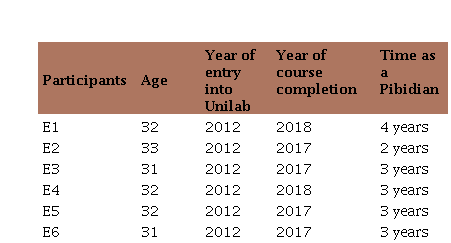
As the objective of this research is to investigate the perception of Timorese graduates of the actions developed during Pibid, experienced in the formative process of mathematics teachers in East Timor, those scholarship holders who experienced these actions from the beginning would be better able to reflect and report on this experience. Therefore, six scholarship holders who presented this characteristic participated in the research (E1 through E6). The questionnaires were designed to understand the formative and personal trajectory of the graduates and, in particular, to raise participants’ perceptions of the actions developed in Pibid. Chart 1 presents some characteristics of these participants.
Chart 1
Characteristics of participants
 Research data (2024)
| Participants | Age | Year of entry into Unilab | Year of course completion | Time as a Pibidian |
| E1 | 32 | 2012 | 2018 | 4 years |
| E2 | 33 | 2012 | 2017 | 2 years |
| E3 | 31 | 2012 | 2017 | 3 years |
| E4 | 32 | 2012 | 2018 | 3 years |
| E5 | 32 | 2012 | 2017 | 3 years |
| E6 | 31 | 2012 | 2017 | 3 years |
After the data reading and organization processes, based on Bardin (2016), they were categorized into the following analysis categories: i) challenges faced and contributions of Pibid to initial education and ii) Pibid and the development of political commitment.
5. Analysis
In order to respond to our central objective, that is, to investigate the repercussions of Pibid on the initial education of mathematics teachers in East Timor, we chose to structure the analysis using the categories that emerged in the data organization process.
5.1. Challenges faced and contributions of Pibid to initial education
The first repercussion highlighted concerns the opportunity that the Pibid Exatas – Unilab/ Redenção offered to the Timorese to understand the Brazilian school reality. This movement is in line with Freire’s perspective on education, understood as authentic help, that is:
[...] one in whose practice those involved help each other, growing together in the common effort to understand the reality they seek to transform. Only in such a practice, in which those who help and those who are helped help each other simultaneously, does the act of helping not become distorted into domination of the one who helps over the one who is helped. (Freire, 1978, p. 15)
By giving the Timorese people the opportunity to be part of the school routine and understand its structure and the entire Brazilian school culture, they were invited to establish relationships and comparisons with the schools in their country of origin, as three of the graduates who participated in the study reported:
The differences between Brazilian and Timorese schools are quite significant, especially regarding the quality of education, teaching methodology, and available technology. Brazilian schools generally have a more advanced quality of education, with modern teaching methodologies and more developed technologies. On the other hand, schools in East Timor are still in the development phase, facing challenges such as the lack of textbooks, laboratories, computer rooms, and other essential resources. In Brazil, most teachers pass rigorous public examinations, guaranteeing a high level of qualification. In turn, many teachers in East Timor have only completed secondary education and stand out for their mastery of the content; however, they lack higher education and more in-depth pedagogical education. This reflects a significant disparity in the quality of education between the two countries. (E1)
The undergraduate experience in Brazil was marked by an advanced learning system, a wide variety of content and teaching methods, and significant cultural differences from the Timorese experience. These differences may have contributed to a unique and enriching learning experience during my undergraduate studies. (E2)
I had the opportunity to learn about the reality of Brazilian schools through Pibid. The interaction environment between Brazilian and international students was very close during my graduation at Unilab. Furthermore, Brazilian schools have well-structured curricula, classrooms, computer labs, adequate sanitary facilities, libraries, and leisure spaces. (E4)
This movement of immersion in everyday school life resonated also in the development of teaching practice, as evidenced by the testimony of all graduates participating in the study:
At Pibid, I had the opportunity to get involved in several activities that contributed significantly to my qualification as an educator; the main activities were observing classes, planning activities, developing lesson plans with Pibidian colleagues, and creating teaching materials and pedagogical resources to support teaching. (E1)
The experience in the Pibid program is an important initiative for the education of prospective teachers, as it offers practical opportunities for scholarship holders to carry out a series of activities, such as workshops, preparation of lesson plans, and participation in community events. (E2)
The experience with Pibid was unique and represented a valuable opportunity. During my participation in the program, I could engage in various activities, including math workshops, Black Awareness Day celebrations, and the creation of lesson plans, among others. (E3)
The experience was very enriching, I worked mainly with students and teachers, helping to develop curricula and educational materials that were relevant to the reality of East Timor. In addition to these experiences, it was considered one of the specific needs of education that could contribute to the country. (E4)
The experience with Pibid was a good experience that I had in the program during the course, so at that time, some activities were developed such as school diagnosis, analysis of textbooks, analysis of teacher profiles, carrying out the activity on Black Awareness Day, the celebration of East Timor’s Independence Day, and a mathematics workshop at Unilab. (E5)
It was a wonderful experience. We developed many activities within the partner schools, such as presenting the workshop at the Padre Antônio Crisóstomo school with students. I didn’t have much difficulty, as we have coordinators and supervisors who help us with many other activities. (E6)
This repercussion aligns with one of the principles of Pibid, that is, to promote a “contextualized practice regarding emerging themes in the country’s social, educational, and cultural scenario” (Brasil, 2024, p. 33). However, the speech of the graduates goes against what Imbernón (2011, p. 43) points out when he states that:
The initial education teachers usually receive does not provide sufficient preparation to apply a new methodology or theoretically developed methods in classroom practice. Furthermore, there is no information on how to develop, implement, and evaluate change processes.
The data converge with the results of the studies by Rodrigues (2016, p. 274-275), especially in the defense that “PIBID is a policy to improve the initial education of mathematics teachers, as it provides experience in the future field of activity, with the support of more experienced teachers,” given that the Pibid structure favors the immersion of prospective teachers in the school environment to contribute to their education through monitoring by two teacher educators, one from the school and the other from the university.
Thus, the data revealed a third Pibid Exatas – Unilab/Redenção repercussion in the professional insertion and induction processes. Generally, the first is related to entering the career, and the second is a process with the support of more experienced teachers (mentors, for example). However, these concepts apply to the context of continuing teacher education. It turns out that, with experiences such as Pibid, it has been possible for these processes to occur concomitantly with initial education. For example, This has been a challenge for Brazilian researchers when seeking theoretical lenses to help understand the experiences that emerge from Pibid (Tinti, 2012).
When analyzing the data, it was possible to reveal the importance of educators both in developing the actions planned in the project and the education process of the PIBID students:
One of Pibid’s most valuable contributions was the possibility for scholarship holders to assist teachers in their daily activities, helping them create lesson plans, prepare educational materials, and conduct practical activities. (E1)
The weekly meetings were essential to this interaction, where supervisors, coordinators, and Pibidians met to discuss objectives, plan activities, and share individual experiences. (E3)
The Pibid structure favors unique support for prospective teachers because, as Fiorentini (2008, p. 49) rightly argues,
[...] if we want to qualify teachers capable of producing and advancing curriculum knowledge and transforming school practice/culture, then they need to acquire initial education that provides them with a solid theoretical-scientific basis related to their field of activity and that this is developed and supported by reflection and research on practice. This requires a relatively long period of study and development of a practice of professional socialization and initiation into teaching, accompanied by a lot of reflection and research, with the guidance or supervision of quality educators-researchers.
The reports from graduates E1 and E3 show that the monitoring of the two educators (from the school and the university) was fundamental to developing the actions in the school environment, hence the relevance of the partnership between university and school (Foerste, 2005) for the success of Pibid.
This partnership between students and teachers not only reduces teachers’ workload but also allows an exchange of experiences and knowledge that enriches the school environment. (E1)
My interaction with the school students was extremely rewarding, largely due to the activities carried out within the Pibid program. The proximity between students, supervisors, area coordinators, and Pibidians facilitated adaptation to the school environment. (E3)
Furthermore, the experience provided by Pibid Exatas – Unilab/Redenção based on the Brazilian school reality made it possible for Timorese graduates to understand and reflect on the possible professional challenges faced by teachers in East Timor:
[...] I realized many differences between Brazilian and East Timorese schools, highlighting a few. In Brazil, students have freedom, and a good relationship between teacher and students is one of the most important factors for learning; the language used in the classroom is the only language: “Portuguese”; there is a library and sufficient references so that students can learn more and other facilities such as water and bathrooms in schools.
In East Timor, students do not have much freedom, that is, they are afraid of teachers; the language used in the classroom is not only “Portuguese,” but there are other languages such as Tetum and even local dialects to explain subjects; many schools do not have libraries and facilities such as water and bathrooms installed. (E6)
Brazilian schools have sufficient resources, such as well-structured curricula, libraries, restrooms, computer rooms, and leisure areas. Compared to Timorese schools, which are still under construction due to the challenges faced by the country, especially in education, this situation makes education in East Timor crucial, which implies that the government must prioritize education as a primary sector in the country’s development. (E3)
To understand the comparisons made by the participants, it is worth remembering the historical context of East Timor. After a long struggle, the country’s independence was officially declared on May 20, 2002. Before that, East Timor was Portugal’s colony until 1975, when it declared its independence, but was soon invaded and annexed by Indonesia. East Timor’s education system underwent profound transformations during the Indonesian occupation, which lasted from 1975 to 1999. Indonesia implemented an educational model that sought cultural assimilation, imposing Bahasa Indonesia as the official language, while devaluing the country’s native languages, such as Tetum and Portuguese. After the 1999 independence referendum, which resulted in the choice of autonomy, the country faced a violent wave of destruction, with approximately 90% of educational infrastructure being devastated, including schools. This scenario left the education system in ruins, posing significant challenges in rebuilding and developing the education sector in a newly independent nation.
Given the above and considering that the study participants joined Unilab in 2012, it is understandable that participation in Pibid was marked by difficulties with the Portuguese language and adapting to a different cultural reality.
[...] I faced some difficulties along my journey, especially adapting to Portuguese culture and language. (E1)
Portuguese was one of the languages I learned in Brazil since, during my time of study, the course was taught in Malay; this is a linguistic transition that presents challenges such as adapting to a new language of instruction and the need to communicate effectively in Portuguese. (E2)
Although participants recognize the difficulties with the Portuguese language, the data made it possible to infer that the actions promoted by Unilab, aligned with the participation of the Timorese in Pibid Exatas – Unilab/Redenção, contributed to their development of the four basic language skills (listening, speaking, reading, and writing).
[...] My difficulty was learning the Portuguese language because, although it is considered the official language of the country, most people do not speak Portuguese; and Portuguese is also considered to be a subject that I learned at school. (E4)
[...] During this period, I faced some difficulties, especially in adapting to the Portuguese language, understanding the teaching-learning process, and integrating into the school environment. However, over the course of the semester, I gradually overcame these challenges and improved my command of the language and my understanding of how to teach and learn. (E5)
My journey in the natural sciences and mathematics teaching degree at Unilab seems to have been full of challenges and opportunities for growth as I dealt with the initial difficulty of the language and persevered to improve my language skills over time. (E3)
These results reiterate the importance of cultural dynamics for members of different cultures (Brazil/East Timor). D’Ambrosio (2009, p. 4) states: “Like an organism, cultures are in permanent transformation. This transformation is subject to very complex dynamics and constitutes one of the most intriguing themes in the modern historiography of science.” Therefore, it is important to recognize the effects of this cultural dynamic.
D’Ambrosio (2009, p. 13-14) also highlights the importance of “identifying and understanding the emergence and evolution of behaviors and knowledge, reflecting the diversity of human experiences and the dynamics of the encounter of various modes and styles of behavior and knowledge. In this cultural dynamism, members of different cultures identify and decode the behaviors, knowings, practices, and local knowledge acquired from generation to generation, accumulating and disseminating them among members of their own culture and other cultural groups. At the same time, contact with academic knowledge helps them to establish relationships and comparisons between these two types of knowledge (Rosa, 2010).
D’Ambrosio (2005, p. 104) believes that:
[...] communication between generations and the encounter of groups with different cultures create a cultural dynamic, and we cannot think of a static culture as frozen in time and space. This dynamic is slow, and what we perceive in the mutual exposure of cultures is cultural subordination and, sometimes, even the destruction of one of the cultures in conflict or multicultural coexistence.
We should also consider that cultural dynamism is a: “dynamic of interaction that is always present in the encounter of individuals [which] means that one cannot speak precisely of cultures, final or stagnant. Cultures are constantly transforming, obeying what we call cultural dynamics” (D’Ambrosio, 2001, p. 19).
As we continue to analyze the difficulties reported, beyond those of a linguistic nature, two participants also reported:
[...] Moreover, the difficulties faced during the program were challenging but also contributed to my personal and professional growth, such as the language, adaptation to the school routine, time management, and the reality of the classrooms. (E1)
One of the main challenges throughout the program may be adapting to the school environment, especially for scholarship holders who are still familiarizing themselves with the school context and the teacher’s role. (E2)
When analyzing the data, it became clear that participation in Pibid impacted the sense of professional agency of Timorese graduates. For Lasky (2005, p. 900), the agency “is always mediated by the interaction between the individual (attributes and inclinations) and the tools and structures of a social configuration.” In other words, in Pibid Exatas – Unilab/Redenção, this social configuration can be understood as subprojects’ structuring.
[...] The learnings that stood out to me, both in the academic aspect and in the development of personal and professional skills, reflect a holistic and comprehensive learning experience; however always working as a team, solving problems, and thinking critically are essential skills that will certainly help you in your career as an educator. (E3)
[...] In this sense, the difficulties faced were often overcome by the collaboration and determination of the educational community in working together with colleagues and supervisors to face the challenges. This experience not only taught me a lot about pedagogy and cultural adaptation in education, but also provided me with a valuable perspective on the complexities and opportunities for positive impact through education in development contexts. (E4)
As Cyrino (2017, p. 706) states, in interaction with the environment, the (prospective) teacher “exerts influence, makes choices, takes decisions that affect their work and reveal their professional and ethical commitment through their ideas, motivations, interests, and objectives.”
5.2. Pibid and the development of political commitment
When considering the historical context of East Timor and the experiences provided to study participants by the natural sciences and mathematics course at Unilab, in particular, by the subproject developed within the scope of Pibid Exatas – Unilab/Redenção, we can highlight the desire to contribute to the education of East Timor based on the education obtained in Brazil.
I am confident that the education and experiences I gained at Unilab have equipped me to play a significant role in education in East Timor. (E1)
[...] Upon entering the course, the expectations were clear: to complete my studies and return to my country with a degree in Brazil. I intend to use the knowledge acquired during my education to contribute to the educational development at my home community. (E5)
[...] I had a lot of opportunities to learn so much in social life, as a student, and as a foreigner and, in a way, you can say that I matured in Brazil, and I want to help my country. (E6)
Thus, we show that participation in Pibid impacted participants’ development of political commitment. Cyrino (2017) argues that teaching presupposes a commitment to those directly involved in the educational context and the external community. It presupposes a “social responsibility that involves moral, political, emotional, and knowledge dimensions. It is a commitment to action and transformation” (Cyrino, 2017, p. 706). This commitment represents the responsibility of educators to promote inclusive, critical, and transformative mathematical education, aiming at the formation of engaged citizens who are aware of their role in society.
6. Final considerations
This article aimed to investigate the repercussions of Pibid on the initial education of mathematics teachers in East Timor. As the study participants were graduates of the natural sciences and mathematics course at Unilab and of a subproject developed within the scope of Pibid, we sought to present briefly the historical trajectory of this recent democracy. Given that the independence of this country was officially declared only on May 20, 2002, after a long period of struggle. Education is among the country’s outstanding challenges, given the need, after the destruction caused by the independence conflict, to rebuild the school system with limited infrastructure, a shortage of qualified teachers, and challenges in implementing a language policy for the educational system.
Through a cooperation agreement between Portuguese-speaking countries, study participants came to Brazil to study at Unilab, where they were welcome to engage in projects such as Pibid. Beyond the financial aid that helped them to remain at university and in Brazil, the data analyzed indicated that participation in the program had a different impact on the initial education of Timorese graduates. In general terms, the repercussions evidenced by participation in Pibid were: a) it offered the East Timorese students the opportunity to get to know the Brazilian school reality up close; b) it favored the development of teaching practice; c) it contributed to the processes of professional insertion and induction, experienced concomitantly with initial education; d) it allowed understanding and reflection on the possible professional challenges faced by teachers in East Timor; e) it enabled the development of the four basic linguistic skills; f) it mobilized the sense of professional agency; and g) it developed political commitment.
The results highlighted the importance of Pibid for the education of Brazilian teachers and those from other countries, such as East Timor. This study also showed that the formative experiences provided by Pibid, aligned with political commitment and a sense of professional agency, can contribute to improving the quality of basic education in East Timor by strengthening the education of prospective teachers through cultural dynamism.
7. ACKNOWLEDGMENTS
To the Coordination for the Improvement of Higher Education Personnel (Capes) for the promotion and financial support for completing the master’s research that made this article possible.
8. Bibliographic references
ALVES, F. C.; MARTINS, E. S.; LEITE, M. C.S. R. O PIBID e a aprendizagem do fazer docente em tempos de pandemia. Revista Ibero-Americana de Estudos em Educação, p. 1586-1603, 2021.
BARDIN, L. Análise de conteúdo. São Paulo: Edições 70, 2016.
BELO, J. C. A formação de professores de matemática no Timor-Leste à luz da Etnomatemática. 205 f. 2010. Dissertação (Mestrado em Educação)–Universidade Federal de Goiás, Goiânia, 2010.
BENITES, V. C. Formação de professores de matemática: dimensões presentes na relação PIBID e Comunidade de Prática. 247 f. 2013. Dissertação (Mestrado em Educação Matemática)–Universidade Estadual Paulista, Rio Claro (SP), 2013.
BOGDAN, R.; BIKLEN, S. Investigação Qualitativa em Educação – uma introdução à teoria e aos métodos. Porto: Porto Editora, 1994.
BRASIL. CAPES. Portaria n.º 90, de 25 de março de 2024. Dispõe sobre o regulamento do Programa Institucional de Bolsa de Iniciação à Docência–PIBID. Diário Oficial da União: seção 1, Brasília, DF, 26 mar. 2024. Disponível em: https://cad.capes.gov.br/ato-administrativo-detalhar?idAtoAdmElastic =14542#anchor Acesso em: 08.jan.2025.
COSTA, V. M. M.; SILVA, S. C. O Pibid e a construção da identidade profissional dos futuros professores de matemática. Revista Cearense de Educação Matemática, v. 3, n. 8, p. 1-20, 2024.
CRESWELL, J. W. Projeto de pesquisa: métodos qualitativo, quantitativo e misto. Tradução Magda Lopes. 3. ed. Porto Alegre: Artemed, 2010.
CYRINO, M. C. C. T. Identidade profissional de (futuros) professores que ensinam Matemática. Perspectivas da Educação Matemática, Mato Grosso do Sul, v. 10, p. 699-712, 2017.
D’AMBROSIO, U. Etnomatemática: elo entre as tradições e a modernidade. Belo Horizonte (MG): Autêntica, 2001.
D’AMBROSIO, U. Sociedade, cultura, matemática e o seu ensino. Educação e Pesquisa, v. 31, n. 1, p. 99-120, 2005.
D’AMBROSIO, U. A dinâmica cultural no encontro do Velho e do Novo Mundo. Eäjournal, v. 1 n. 1, p. 1-29, 2009.
FIORENTINI, D. A pesquisa e as práticas de formação de professores de matemática em face das políticas públicas no Brasil. Bolema, Rio Claro: UNESP, ano 21, n. 29, 2008. p. 43-70.
FLICK, U. Introdução à pesquisa qualitativa. 3. ed. Porto Alegre: Artmed, 2009.
FOERSTE, E. Parceria na formação de professores. 1. ed. São Paulo: Cortez, 2005.
FREIRE, P. Cartas à Guiné- Bissau: registro de uma experiência em processo. Rio de Janeiro: Paz e Terra, 1978.
GIL, A. C. Como elaborar projetos de pesquisa. 5. ed. São Paulo: Atlas, 2008.
GUTERRES, M. F. L. Choque de realidade dos professores principiantes em Díli (Timor-Leste): um estudo. 121 f. 2011. Dissertação (Mestrado em Ciências da Educação) -Universidade de Lisboa, Lisboa, 2011.
IMBERNON, F. Formação docente e profissional: formar- se para a mudança e a incerteza. Tradução Silvana Cobucci Leite. 9. ed. São Paulo (SP): Cortez, 2011, 128 p.
JERÓNIMO, A. C. Formação contínua de professores do ensino não superior em Timor-Leste. 156 f. 2011. Dissertação (estrado em Ciências da Educação)–Universidade de Aveiro, Aveiro, 2011.
JESUS, P. S. Cooperação bilateral Timor Leste e Brasil na educação superior: trajetória, realidade e perspectivas da parceria entre ministério da educação, UNTL e UNILAB. 2016. 70 f. Trabalho de Conclusão de Curso. Graduação em Administração Pública. Universidade da Integração Internacional da Lusofonia Afro-brasileira, Redenção (CE), 2016.
LASKY, S. A sociocultural approach to understanding teacher identity, agency and professional vulnerability in a context of secondary school reform. Teaching and Teacher Education, v. 21, n. 8, p. 899-916, 2005
LÜDKE, M.; ANDRÉ, M.E.D.A. Pesquisa em Educação: abordagens qualitativas. São Paulo: Editora Pedagógica e Universitária, 1986.
PIRES, C. D. O.; MORAES, E. C. Contribuição do PIBID para a formação do docente: percepção de bolsistas de iniciação à docência do subprojeto de Ciências Biológicas da UFSC. Revista da SBEnBio (Associação Brasileira de Ensino de Biologia), n. 7, p. 1201-1210, 2014.
RIBEIRO, I. C. Educação e formação de professores no Timor-Leste (2000-2012). Dissertação (Mestrado em Educação)–Universidade Federal de Santa Catarina, Florianópolis, 2015.
RODRIGUES, M. U. Potencialidades do PIBID como espaço formativo para professores de matemática no Brasil. 540 f. 2016. Tese (Doutorado em Educação Matemática)–Universidade Estadual Paulista. Rio Claro (SP), 2016.
ROSA, M. A mixed-methods study to understand the perceptions of high school leaders about English Language Learners (ELL) students: the case of mathematics. Doctorate Dissertation. College of Education. Sacramento, CA: California State University, Sacramento–CSUS, 2010.
SANTOS, F. A. Formação de professores no contexto da (re)introdução da Língua portuguesa em Timor-Leste: da polêmica às ações táticas. 2014. 113 f. Dissertação (Mestrado em Letras)– Universidade Federal do Pará, Belém (PA), 2014.
SANTOS, L. M. M.; ALVES, M. A. Pesquisa e reflexão sobre a formação e a prática docente: uma percepção dos egressos do PIBID/Matemática. REnCIMa. v. 13, n. 5, p. 1-20, 2022.
SILVA, G. B.; MORELLATI, M. R. M. Análise de produções acadêmicas sobre as contribuições do PIBID na formação inicial do professor de matemática. In: ENCONTRO NACIONAL DE EDUCAÇÃO MATEMÁTICA, 12, Anais [...], p. 1-8, 2016.
SILVA, S. A. Dos dilemas à esperança: os desafios para a formação e atuação dos professores de Timor-Leste. Dissertação (Mestrado em Educação) -. Universidade Metodista de São Paulo, São Paulo (SP), 2011.
SILVEIRA, L. R. S.; PEDRA, L.A.; OLIVEIRA, T. S. Dois timores: a educação superior antes e depois da Untl e a emergência do ensino de língua portuguesa. EntreLetras, v. 13, n. 1, p. 510-533, 2022.
SOUZA, J. N.; MACÊDO, J. A.; CRISÓSTOMO, E. Contribuições do PIBID na formação do professor de Matemática: estado do conhecimento de 2010-2020. Revista de Ensino de Ciências e Matemática, v. 14, n. 1, p. 1-25, 2023.
SOUZA, M. A. S.; ALMOULOUD, S. A. Contribuições do PIBID na formação inicial do professor de matemática: saberes da docência. Educação Matemática Pesquisa Revista do Programa de Estudos Pós-Graduados em Educação Matemática, v. 21, n. 5, 2019. DOI: 10.23925/1983-3156.2019v21i5p589-603.
TIMOR LESTE. Constituição da República Democrática de Timor-Leste. Díli, 2002.
TIMOR-LESTE. Lei de Bases da Educação. Jornal da República. Díli, 2008.
TIMOR-LESTE. Plano Estratégico da Educação 2011-2030. Díli, 2011.
TINTI, D. S. PIBID: um estudo sobre suas contribuições para o processo formativo de alunos de licenciatura em matemática da PUC-SP. 2012. 146 f. Dissertação (Mestrado em Educação)–Pontifícia Universidade Católica de São Paulo, São Paulo, 2012.
TINTI, D. S.; MANRIQUE, A. L. PIBID: Inserción de futuros profesores de matemáticas en el entorno escolar con vistas a minimizar el choque con la realidad. Linhas Críticas, v. 25, p. 333-349, 2019.
TREVISAN, D.; BERNARDI, L.T. M. S.; CECCO, B. L.; MENEZES. D. Pibid e a formação do professor de matemática: experiências de inovação e interdisciplinaridade. In: ENCONTRO NACIONAL DE EDUCAÇÃO MATEMÁTICA,12, Anais [...], p. 1- 12, 2016.
Appendix – Editorial Details
Notes
4 The University of International Integration of Afro-Brazilian Lusophony (Universidade da Integração Internacional da Lusofonia Afro-Brasileira) is a Brazilian federal public higher education institution based in the city of Redenção, in Ceará. Redenção was chosen because it was the first city to abolish slavery in Brazil, according to some historians.