1. Introduction
Discussions on the professional identity (PI) of teachers who teach mathematics (TTM) have intensified among master’s degrees and doctoral research in teaching and education areas. According to Cyrino (2017), these studies focus on: “the relationships between identities and field experiences during initial education; the links between identities and the learning of specific mathematical topics; and how prospective mathematics teachers represent their professional identity” (Cyrino, 2017, p. 701). We understand, as several authors in this investigative field (Losano; Fiorentini, 2018; Garcia, 2014; Losano; Fiorentini; Villarreal, 2018; Lutovac, Kaasila, 2011), that research that covers the PI of TTMs constitutes theoretical-investigative possibilities whose potential is capable of engaging the reflection and discussion of cultural, professional, political, and social aspects of prospective TTMs.
From this perspective, it is worth sharing the characterization proposed by Cyrino (2017, p. 704), in which the TTMs’ PI can be understood as a movement “that occurs given a set of beliefs and conceptions interconnected with self-knowledge and knowledge of their profession, associated with autonomy (vulnerability and sense of agency) and political commitment.” Based on the discussions problematized by De Paula and Cyrino (2018) and Garcia (2014), we understand that in the context of this characterization of TTM’s PI, working conditions –closely impacted by public policies for TTM education (initial and continuing)– are elements that foster these reflections.
From this understanding arises the intention of this research: to map, describe, and systematize 2006, 2015, 2019, and 2020 National Curriculum Guidelines (Diretrizes Curriculares Nacionais–DCN) for initial teacher education to identify discussions that contain elements of the PI of the TTMs: (i) Resolution CNE/CP 01/2006³ (Brasil, 2006); (ii) Resolution CNE/CP 02/20154(Brasil, 2015); (iii) Resolution CNE/CP 02/2019 establishing the Common National Base for the Initial Education of Basic Education Teachers (BNC-Formação) (Brasil, 2019b); and (iv) Resolution CNE/CP 01/2020 establishing the Common National Base for Continuing Education of Basic Education Teachers (BNC-Formação Continuada) (Brasil, 2020).
We agree with Taveira and Peralta (2020, p. 516) when they state that “curriculum policies exist in the entire educational system and always focus on curriculum reform movements (and/ or educational/educational reforms) as they dictate the intended and proposed path in those reforms” (Taveira; Peralta, 2020, p. 516). As curriculum policies are drivers of educational reforms, we consider it crucial to investigate the presence of aspects that discuss the TTMs’ PI in those documents. As Gellert, Espinoza, and Barbé (2013, p. 543) assert, “In times of reform, it is essentially the identity of teachers that is at stake,” highlighting the importance of studying those movements.
In this sense, this article aims to build an understanding of how aspects related to the TTMs’ PI are presented in those resolutions. To this end, the problematizing question of this article is: What are the possible spaces for discussions focusing on professional identity in the National Curriculum Guidelines (DCNs) for initial and continuing teacher education?
That said, this article is organized into five sections. The first section presents the path the author took that led to the research proposal. The second debates the theme of TTMS’ PI based on Cyrino’s (2018) characterization, outlines a very brief current scenario of public policies involved in the field of teacher education, and presents Ginzburg’s (1989) evidential paradigm as an investigative criterion. The third contextualizes problematizations of the DCNs, which are articulated in the fourth section to demarcate approximations, distancing, and/or silences regarding the elements that characterize the TTMs’ PI. Finally, the fifth section shares points that other researchers interested in this topic may address in the future.
2. Connections between the current Brazilian scenario, the characterization of TTMs’ PI proposed by Cyrino (2016), and Ginzburg’s (1989) evidential paradigm in research design
The current Brazilian scenario has been a cause for concern for several educational researchers. Since the impeachment that removed President Dilma Rousseff (2014-2016), through Michel Temer’s (2016-2018) government and Jair Bolsonaro’s (2018-2022) troubled administration, Brazil has been rapidly plunging into a wave of strengthening reactionary thinking, marked by neoliberal policies that weaken a series of constitutional rights (Lavoura; Alves; Santos Junior, 2020; Portelinha, 2021; Morais; Johann; Malanchen, 2023). In this event, neoliberal practices were successful, and, abruptly, during Michel Temer’s government, social policies suffered a decisive blow: Constitutional Amendment 95 (EC 95) established 20 years (counting from 2017) of severe budgetary restrictions that practically made investments in several areas impossible, including education and health (Portelinha, 2021). Furthermore, in that context, in 2017, Law n. 13.415/17 enforced the Secondary Education Reform5, bringing to light the neo-technicism with emphasis on the deepening of inequalities in basic education, while Law n. 13.467/17 enforced the Labor Reform, stripping away several working-class vested rights. During Jair Messias Bolsonaro’s (2019-2022) government, the wave of attacks from his predecessor continued. An example is the approval of Constitutional Amendment n. 1036, changing the social security criteria for granting retirement to workers and extending the retirement by contribution and age. It also included gradual transition criteria to be implemented until 2033 for citizens close to retirement.
In that reformist context, major educational changes were implemented, an escalation that made isonomy impossible, ignoring it and denying adequate scope for public consultations: reformists did not listen to students, school communities, teachers, and researchers in the educational field and civil society. Such actions contributed to the outbreak of tensions in political and academic circles. It is precisely in this context of silenced debates and dialogues, with the compromise of the guarantee of contradiction, that the National Common Curriculum Base (Base Nacional Comum Curricular–BNCC) (Brasil, 2017) and, subsequently, Resolutions CNE/CP 02/2019, which instituted the BNC-Formação (Brasil, 2019b) and CNE/CP 01/2020, which defined the BNC-Formação Continuada (Brasil, 2020), aligned, conditionally, a gigantic space of the workload of initial teacher education exclusively with compliance with the BNCC (Lavoura; Alves; Santos Junior, 2020; Oliveira; Jesus, 2020; Taveira; Peralta; 2020; Gollo Junior; Campos, 2021, Mascarenhas; Franco, 2021; Nogueira; Borges, 2021).
We understand that the reform process and its tensions and concerns directly affect the teaching professional practice. The changes outlined by the BNCC (the BNC-Formação [Education] and the BNC-Formação Continuada [Continuing Education) challenge teachers’ autonomy. Since these aspects directly intertwine with the characterization of TTMs’ PI, which is shared (Cyrino, 2017), it is worth investigating how the elements that make up this characterization are presented in the Resolutions (Brasil, 2006, 2015, 2019a, 2019b, 2020).
To this end, we read those normative documents in full (Brasil, 2006, 2015, 2019a, 2019b, 2020) in light of Ginzburg’s (1989) evidential paradigm. For the author, the evidential paradigm is an interpretative method centered on marginal residues, allowing the researcher to illuminate the object/phenomenon under study. In this trajectory, the investigator can find evidence that is not immediately noticeable through inferential and relational reasoning between the clues. It enables the construction of conjectures and the revelation of essential elements for the investigative process. The evidential paradigm has been used as a methodological perspective in several investigations in education (Pimentel; Montenegro, 2007; Baptista, 2015; Aguiar; Ferreira, 2021) and mathematics education (Passos et al., 2006; Santos; Costa, 2020; Leandro; Passos, 2021), closely related to teacher education.
3. A brief contextualization of the DCNs and TTMs’ education
As the objective is to identify signs of TTMs’ PI in the DCNs (Brasil, 2006, 2015, 2019a, 2019b, 2020), it is fundamental to contextualize some elements related to the constitution of those regulations. Several researchers have questioned the implementation processes of the DCNs, as well as some points they considered advances and/or setbacks to contextualize these updates. Chronologically, we present a brief contextualization of these DCNs. Those studies bring discussions on the historical context of the implementation of Resolution CNE/CP n. 1 of 15/5/2006, which establishes the DCNs for teaching degree courses in pedagogy.
Discussions on the construction of a curriculum guideline for teaching degree courses in pedagogy precede both the Law of Guidelines and Bases of Education (Lei de Diretrizes e Bases da Educação–LDB/1996) and Resolution CNE/CP n. 1, of 15/5/2006. After the LDB/1996 enactment, the Ministry of Education (MEC) overlooked a pedagogy curriculum guideline for some time.
In March 2005, the National Education Council (Conselho Nacional de Educação–CNE) published a draft resolution for curriculum guidelines for the teaching degree in pedagogy, breaking such institutional silence. However, the initial proposal encountered resistance from education professionals and the academic community, who, working together through various entities, compiled criticisms in the form of a manifesto signed by ANFOPE, ANPEd, and CEDES and sent to the CNE. Scheibe (2007) presents the discussions involved in this document and, among some considerations, explains that such draft:
(i) was a reductionist proposal of educators’ aspirations for the pedagogy course and, thus, it contrasts with educators’ aspirations for the pedagogy DCNs;
(ii) disregarded pedagogy courses as a space for research in the field of education;
(iii) discarded contributions from guidelines prepared by those education entities;
(iv) deepened instrumental perspectives by defining competencies for educating teachers working in early childhood education and in the initial grades of elementary education (currently called initial years); and
(v) devalued education for teaching by proposing a degree aimed at research after the teaching degree, “aiming at deepening scientific education,” reducing pedagogy to teaching the initial grades of elementary education or early childhood education, ignoring research and the search for knowledge as a basis.
After demonstrations by organized communities, some changes were made to the draft text. With representatives from ANFOPE, CEDES, and FORUMDIR, the new text was discussed and approved at the Plenary Council of the National Education Council on December 13, 2005. Thus, Resolution CNE/CP 01/2006 (Brasil, 2006) was published on May 15, 2006. However, even amid uncertainties and tensions arising from academic entities, the text of these DCNs maintained a strong neoliberal tendency that had been inherited from Fernando Henrique Cardoso’s (1995-2002) government.
Nine years after the approval of Resolution CNE/CP 01/2006 (Brasil, 2006), Resolution CNE/ CP 02/2015 was enacted (Brasil, 2015). In this context, Dourado (2015) points out that discussions regarding Resolution CNE/CP 02/2015 (Brasil, 2015) took place surrounded by several debates within the scope of the National Education Council7.
Throughout the trajectory traced by the Bicameral Commission for Teacher Education] (Comissão Bicameral de Formação de Professores), the work produced there resulted in a draft submitted for public discussions, culminating in its approval in 2015 (Brasil, 2015). In its transitional provisions, Resolution CNE/CP 02/2015 (Brasil, 2015) set a two-year deadline for its implementation; however, this deadline was extended. The resolution was revoked with the implementation of BNC-Formação (Brasil, 2019b) without its effective implementation occurring nationally, as highlighted by Zaidan et al. (2021).
In general terms, Metzner and Drigo (2021) point out advances in Resolution CNE/CP 02/2015, among which it is relevant to highlight:
(i) the demarcation of the minimum workload of 3,200 hours for initial teacher education courses and the definition of who the professionals in the teaching staff are;
(ii) the articulation between theory and practice in the context of education;
(iii) the use of information and communication technologies (ICT) to improve pedagogical practice;
(iv) the appreciation and recognition of national diversity;
(iv) the inseparability between initial education and continuing education, which demarcates, in a broad context, the formative institution, the school space, and the teaching-research-extension triad;
(v) definition of three types of initial education courses (teaching degree, pedagogical education for non-licensed, and second teaching degree courses).
We understand that by paying attention to those points articulated with the proposal to organize teaching degrees through centers8, Resolution CNE/CP 02/2015 highlights concerns about actions and potential public policies for professional development. In turn, Resolutions CNE/CP 02/2019 (Brasil, 2019b) and CNE/CP 01/2020 (Brasil, 2020) separate initial education and continuing education, which has become the target of several criticisms.
For example, Fichter Filho, Oliveira, and Coelho (2021) point out that these two resolutions had been discussed in less time than those used until the implementation of their predecessors. The authors point out that, although relations with national educational sectors were mentioned, the silence of representative entities of the Brazilian educational field effectively involved in the process was unprecedented compared to the discussion processes of previous DCNs.
For Costa, Matos, and Caetano (2021), as well as Resolution CNE/CP 02/2019 (Brasil, 2019b), Resolution CNE/CP 01/2020 (Brasil, 2020) was also reduced to the mere role of ensuring the implementation of the BNCC (Brasil, 2017), devaluing the teacher as an individual capable of intervening in the environment and producing knowledge and, consequently, jeopardizing autonomy and the teaching profession by treating continuing education in a technical way.
We understand that the haste of the discussion process with the community and the explicit demarcation of the intentions of aligning undergraduate courses with the specificities of the BNCC (Brasil, 2017) are strong indications (Ginzburg, 1989) of the rush of the then-government in power to revoke Resolution CNE/CP 02/2015 (Brasil, 2015).
For several researchers in the educational field, the BNC-Formação and BNC-Educação Continuada aim to ensure that teachers are educated to apply the BNCC in basic education, considering teachers as uncritical beings, emphasizing technicality, and treating teaching practices in a reductionist way (Portelinha, 2021; Rodrigues; Pereira; Mohr, 2021; Cruz; Almeida, 2022; Souto Maior; Borges, 2022; Pinheiro; Fávero, 2022; Steinbach; Martins, 2022; Ximenes; Melo, 2022; Morais; Johann; Malanchen, 2023).
In an open letter entitled “Contra a descaracterização da Formação de Professores – Nota das entidades nacionais em defesa da Res. 02/2015” [Against the mischaracterization of teacher education – note from national entities in defense of Res. 02/2015], the Association of Postgraduate Studies and Research in Education (Associação de Pós-graduação e Pesquisa em Educação–ANPEd) and several other organized civil society entities repudiated the reforms that were being implemented in higher education, qualifying them as an act of dismantling and disqualifying teacher education in Brazil (ANPEd, 2019). Several class entities signed this manifesto. In summary, this letter points out that Resolution CNE/CP 02/2019 (Brasil, 2019b):
(i) fragments the relationship between initial and continuing education;
(ii) places practical knowledge above theoretical knowledge, a fact that undermines autonomy and the teaching profession;
(iii) signals a technical, pedagogical perspective with a meritocratic approach, attributing to teachers the responsibility (for failures or successes) in the search for continuing education actions;
(iv) neglects the potential of education as a collaborative critical space and
(v) disregards school institutions and education systems as formative spaces.
From this perspective, Resolutions CNE/CP 02/2019 (Brasil, 2019b) and CNE/CP 01/2020 (Brasil, 2020) ignore practices and actions built in the university-school relationship within the scope of Brazilian educational research. Indeed, in this context, national research on teacher education and its considerations are silenced, with neoliberal formative approaches standing out, a fact that is representative of the diversity of entities linked to the private sphere that defend their implementations (Freitas, 2014, 2016).
4. TTMs’ PI in the context of the curriculum guidelines: analysis of the evidence found
When looking at Resolutions CNE/CP 01/2006, 02/2015, 02/2019, and 01/2020, we looked for evidence of discussions related to the characterization of TTMs’ PI proposed by Cyrino (2018). Except for the element characterizing the TTMs’ PI beliefs and conceptions interconnected with TTMs’ self-knowledge by recognizing their idiosyncrasies, we went on searching for discussions that, perhaps, could reveal the other elements characterizing the TTMs’ PI as per Cyrino (2018), present in the DCN (Brasil, 2006, 2015, 2019b, 2020).
Discussions associated with elements characterizing the TTMs’ PI in the DCNs can mobilize it, depending on how they are implemented. Thus, we move towards finding, in these documents, signs of potential problematizations regarding the (i) knowledge and expectations of prospective TTMs regarding the profession, (ii) vulnerability and sense of agency, and (iii) political commitment. Below, we highlight how the evidence of these elements characterizing TTMs’ PI is presented.
The characterizing element of knowledge and expectations of TTMs regarding the profession is closely linked to prospective teachers’ beliefs and conceptions. Upon entering the teaching degree course, prospective TTMs have diverse expectations regarding their activities and the challenges associated with their professional practice. Although prospective TTMs may have doubts regarding their expectations, we must consider their experiences and social conception regarding the teaching practice since the teaching career is one of the few in which the individual has ideas about professional practice even before beginning their initial education. Whether as a basic education student or during initial education, prospective teachers, through contact with other professionals, can observe specificities (of an individual and/or professional nature), potentially contributing to the construction of their beliefs and self-knowledge regarding the profession.
Thus, as they are included in discussions, the experiences lived by TTMs in the initial and continuing education process should enable prospective TTMs to signify and transform their conceptions about the exercise of the profession. To this end, discussions within the formative scope can be considered: (i) future expectations regarding professional practice; (ii) the meaning of being a teacher; (iii) teaching in the area and the knowledge necessary for teaching, encompassing cultural aspects and personal views (De Paula; Cyrino, 2018, 2020a, 2020b).
The characterizing element vulnerability and sense of agency interrelates problematizations that involve teaching experiences not exclusively related to the school context.
Specifically about emotions associated with teacher education processes, we understand that they can trigger insecurities (situations of helplessness, frustration, impotence, or anxiety, for example) or challenging situations that do not necessarily involve the teacher’s weaknesses (Lasky, 2005; Cyrino, 2017; Oliveira; Cyrino, 2011; De Paula; Cyrino, 2018).
In this sense, as Oliveira and Cyrino (2011, p. 112) point out,
Not the vulnerability that weakens, makes people susceptible, and paralyzes (not trying to make the pre-service teacher “fragile”) but the vulnerability that allows us to suspend our certainties and convictions for a few moments, more or less long and more or less frequent. The one that makes us question ourselves. Also, vulnerability in the sense of exposing ourselves to others and, as such, being able to become ‘targets of criticism, of contestation.’
Considering that teaching activities are public, agency emerges, among other elements, from teachers’ social interactions when making choices, influencing (and being influenced by) the environment with actions that affect their professional activities, thus manifesting traits of their professional commitment (Cyrino, 2017; De Paula; Cyrino, 2018). Agency can be understood as the combination of “individual efforts, available resources, and contextual and structural ‘factors’” (Oliveira; Cyrino, 2011, p. 115).
The characterizing element political commitment, just as an amalgam –the cause and, at the same time, a consequence of the articulation between vulnerability and the sense of agency– has, among its intentions, the incessant search for ethics, equity, and social justice, through actions resulting from the professional teaching practice. Thus, political commitment can emerge in situations of insurrection in the face of situations (or interactions) of vulnerability, in which the agency supports these events (of the most adverse natures) requiring a position from the TTMs.
In this sense, political commitment encompasses a struggle for a society that, in addition to isonomy, recognizes the principles of equity, ethics, and social morality. As stated by De Paula and Cyrino (2018), the movement to establish TTMs’ PI “occurs in a field of ideological and political struggles, in which elements of social, cultural, and political contexts involving the issue of otherness must be problematized” (De Paula; Cyrino, 2018, p. 10). This movement, especially in a reformist context, is central because the manner in which these reformist actions are developed not only changes what teachers do; it changes who they are (De Paula; Cyrino, 2018).
We share De Paula and Cyrino’s (2020a) reflections when indicating complexity, dynamism, temporality, and experientiality as relevant aspects of the TTMs’ PI. This demarcates and is coherent when understood as a movement. This fact reinforces the relevance of identifying the constituent elements of TTMs’ PI in the DCNs, as listed in the chart below. As Cyrino (2017, p. 702) states, “[...] PI, just like identity, is continually formed and transformed regarding how we are represented or questioned in the cultural systems that surround us”; the impacts arising from official documents are representative of this transformation. To delimit points of attention as a contribution to the foreseen intentions when researching the DCNs, Chart 1 below summarizes the possibilities for discussions/reflective themes that potentially problematize the TTMs’ PI that could emerge from the prescriptive presence in the guidelines.
Chart 1
Discussions on TTMs’PI found in the DCNs
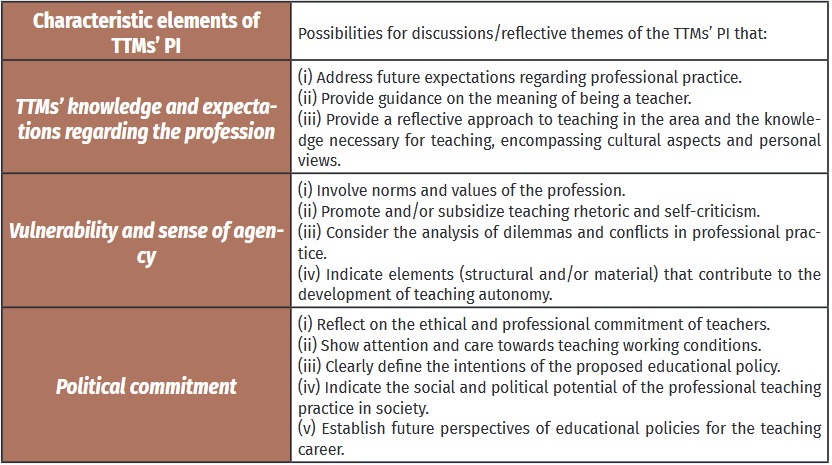 Prepared by the authors.
| Characteristic elements of TTMs’ PI | Possibilities for discussions/reflective themes of the TTMs’ PI that: |
| TTMs’ knowledge and expectations regarding the profession | (i) Address future expectations regarding professional practice. (ii) Provide guidance on the meaning of being a teacher. (iii) Provide a reflective approach to teaching in the area and the knowledge necessary for teaching, encompassing cultural aspects and personal views. |
| Vulnerability and sense of agency | (i) Involve norms and values of the profession. (ii) Promote and/or subsidize teaching rhetoric and self-criticism. (iii) Consider the analysis of dilemmas and conflicts in professional practice. (iv) Indicate elements (structural and/or material) that contribute to the development of teaching autonomy. |
| Political commitment | (i) Reflect on the ethical and professional commitment of teachers. (ii) Show attention and care towards teaching working conditions. (iii) Clearly define the intentions of the proposed educational policy.(iv) Indicate the social and political potential of the professional teaching practice in society. (v) Establish future perspectives of educational policies for the teaching career. |
The possibilities for discussions/reflective themes of the TTMs’ PI presented in Chart 1 emerged from the understanding obtained through its characterization, as outlined by Cyrino (2018). The DCNs studied in this context, except for the guidelines for the teaching degree in pedagogy (Brasil, 2006), define directions for teacher education in general, without tracing specificities by area of knowledge.
Therefore, in this analysis, the indication of general aspects that should permeate initial and continuing education is interesting, as it signals the problematization of cultural, ethical, social, and political dimensions that should have space in all teaching degree courses, including the teaching degree in mathematics. This struggle is encompassed by research in mathematics education, which aims to seek an ethical, equitable, and socially just society.
The characterizing elements highlighted in Chart 1 are not mutually exclusive; on the contrary, they interact closely with each other. The proposed grouping lists possibilities for discussion that are considered to have the potential to collaborate with discussions regarding the TTMs’ PI based on the characterization adopted here (Cyrino, 2018) and that, perhaps, it would be possible to find evidence of presence/intentionality in the DCNs in question (Brasil, 2006, 2015, 2019b, 2020).
5. Approaches, distancing, and/or silences related to the elements characterizing the TTMs’ PI in 2006, 2015, 2019, and 2020 DCNs
In the study of the DCNs (Brasil, 2006, 2015, 2019b, 2020), we directed our efforts toward searching for evidence of discussions on the TTMs’ PI in these documents. In this context, as De Paula and Cyrino (2020a, 2021) point out, we considered complexity, dynamism, temporality, and experientiality as characterizing aspects of the TTMs’ PI movement.
The characterization of complexity proposed by the authors associates the term with the multiplicity of factors that come together in the movement to constitute the TTMs’ PI, among which social, cultural, personal, contextual, psychological, and political factors can be listed. Regarding dynamism, De Paula and Cyrino (2020a) point out the inconclusive nature that constantly reverberates in the professional, personal, and inter-relational movements of TTMS’ initial and continuing education. As proposed by De Paula (2018, p. 142), temporality is tied to ephemerality:
The processes are temporal, contingent on space-time environments, transcending the scenarios traditionally associated with teacher education (initial education and the rare moments of continuing education): it occurs in all contexts in which the TTM is inserted as a person. The professor is a temporal subject.
The professor connects to his/her practices, actions, and the dynamic nature of their transformations, consequently making the TTMs’ PI constitution temporal. Finally, experientiality is linked to the dialogical concept of the action of experiencing, i.e., as De Paula and Cyrino (2018) state, it is an intrinsic movement of the TTMs with themselves and others in the different contexts and spaces they are inserted.
It follows, therefore, that the characterizing aspects proposed by De Paula and Cyrino (2018, 2020a) (complexity, dynamism, temporality, and experientiality) are inseparable aspects of the characterization of the TTMs’ PI. These aspects are articulated with the proposed characterizing elements since the knowledge and expectations of TTMs regarding the profession, vulnerability and sense of agency, and political commitment have a complex nature when amalgamated in the broad process of constitution of the TTMs’ PI; dynamic because it is in a constant process of changes driven by the experiences experienced by the TTMs in their trajectory, a trajectory that occurs temporally.
Analyzing Resolution CNE/CP 01/2006, searching for evidence of discussions on the characterizing element knowledge and expectations of prospective TTMs regarding the profession, we identified excerpts that succinctly define (i) the objectives, (ii) the applicability and the area of activity of professionals in the field of pedagogy9, and (iii) inherent aspects of the recognition of cultural diversity. There is also a brief mention of “the education of teachers for schools in the remnants of quilombos or which are characterized by receiving populations of specific ethnicities and cultures” (Brasil, 2006, p. 3). This document identified no representative evidence of vulnerability and sense of agency. The text explicitly shows that there is attention to theoretical education in the proposals for formative activities within the scope of the pedagogy degree. The articulation between formative spaces is present, although not very expressive. Finally, regarding political commitment, the intention to carefully problematize teaching working conditions was not identified. Aspects of the valorization of the profession and/or incentive programs for continuing education were also silenced, reducing the focus to strictly addressing expectations regarding the ethical values of the profession and the social and political potential of the teaching profession in society.
In the organization of the eight chapters of Resolution CNE/CP 02/2015,10which aggregate 24 articles, there are signs of discussions potentially aligned with the points of interest of the present study. Regarding knowledge and expectations of prospective TTMs regarding the profession, when addressing expectations regarding the initial and continuing education of teachers in their professional practice, the resolution outlines principles and foundations that: (i) explain an understanding of the meaning of teaching; (ii) recognize the complexity involved in teaching, providing a reflective approach to teaching; (iii) address initial and continuing education in an articulated manner, as part of the practices necessary for professional development; (iv) recognize the school –the locus of professional teaching practice– as a formative space; (v) reference the importance of theoretical and practical aspects in formative processes; and (vi) establish the inseparability of the entities that make up the teaching-research-extension triad.
Regarding vulnerability and sense of agency, we found evidence of a potential to problematize this characterizing element, as in the occasions in which Resolution CNE/CP 02/2015: (i) defends the promotion of actions that develop collective work; (ii) advocates the diversity of experiences in cultural, scientific and technological environments in the context of teacher education; and (iii) demarcates the need for a structure capable of facilitating the development of pedagogical, didactic-pedagogical and specific knowledge articulated with the experience and practice of teachers working in basic education and their knowledge about the school. We understand that by recognizing the formative aspects of the school context and the experiences and practices of its characters within the scope of teacher education, institutional dialogue is not restricted to the bureaucratic
ties of the university-school partnership but rather fosters closer personal relationships between all those involved in the formative process (university professors, teachers working in basic education and prospective TTMs in initial education). Education is seen as a shared commitment.
Regarding the characterizing element of political commitment, the resolution presents, in the section “Dos Profissionais do Magistério e Sua Valorização” [Of Teaching Professionals and Their Appreciation], topics closely related to addressing and problematizing specific aspects of the professional teaching practice such as the career plan, salary, working conditions, and formative actions. Also noteworthy are: (i) the indication of perspectives for educational policies for teaching careers aligned with the National Education Plan; (ii) the discussions that reveal understanding regarding the ethical and professional commitment of teaching; and (iii) the recognition and demarcation of the social and political potential of the professional exercise of teaching in society.
Although Resolutions CNE/CP 02/2019 and CNE/CP 01/2020 bring the formative perspective disjointedly, the treatment of issues related to the three characterizing elements we listed is aligned. Beyond its nine chapters¹¹, which aggregate 30 articles, Resolution CNE/CP 02/2019, when outlining the BNC-Formação, revokes CNE/CP 02/2015 and establishes a structure based on general and specific competencies and skills. About specific skills, the document highlights three fundamental dimensions, said to be interdependent and without hierarchies, namely: (i) professional knowledge; (ii) professional practice; and (iii) professional engagement¹².
The link between BNC-Formação and BNCC is explicit from the sole paragraph of Article 1 (when referencing it as an instrument for the implementation of BNCC) to Article 29 (when conditioning changes when there is a review of BNCC). This perspective considerably restricts discussions on the characterizing element knowledge and expectations of TTMs regading the profession.
Thus, we consider that BNC-Formação and BNC-Formação continuada mark off the separation between initial and continuing education, in contrast to CNE/CP 02/2015, which discusses initial and continuing education articulated with the valorization of the exercise of teaching in a single document. In this sense, potential problematizations, in the face of understanding the meaning of being a teacher, give way to perspectives in which instrumentalization is central. As a result, the possibilities for discussions/reflective themes indicated in Chart 1 for the characterizing element vulnerability and sense of agency are minimized.
The silencing of a space aimed at demarcating the appreciation of teachers, such as the chapter “Dos Profissionais do Magistério e Sua Valorização” [Of Teaching Professionals and Their Appreciation] in Resolution CNE/CP 02/2015 is representative of the spaces that reflect on the ethical, social, political, and professional commitments present in Resolution CNE/CP 02/2019.
6. Final considerations
This article, through the problematizing question: What is the space for potential discussions regarding professional identity in the National Curriculum Guidelines for the initial and continuing education of TTMs?, was based on the reading of the four DCNs (Brasil, 2006, 2015, 2019b, 2020), in the search for signs of approximations, distancing and/or silences regarding the elements that characterize the TTMs’ PI, present in the characterization proposed by Cyrino (2017, 2018).
Based on this characterization, we move towards the perspective of finding potential clues for the discussion on (i) the knowledge and expectations of prospective TTMs regarding the profession, (ii) vulnerability and sense of agency, and (iii) political commitment.
As a result of the search for such evidence, a silence on important points was observed between Resolution CNE/CP 02/2015 (which reveals potential concerns aligned with the PI theme) and Resolution CNE/CP 02/2019. Of the DCNs studied, the demarcation of intentions in discussing teacher appreciation present in Resolution CNE/CP 02/2015 is a notable factor.
As a study that is part of research developed in a professional master’s degree, it is important to highlight the relevance and challenges of investigating this topic. We understand that the elements characterizing the TTMs’ PI listed by Cyrino (2018) can be expanded due to their specificities and the scope of the teaching exercise. This proposition corroborates this study to expand the theoretical lens of research that discusses the TTMs’ PI in professional master’s degree courses to encourage these discussions in the formative spaces in the school contexts of in-service basic education TTMs.
While we were finalizing the investigation, MEC, through the National Education Council (Conselho Nacional de Educação–CNE), published Resolution CNE/CP n. 4/2024, providing for the National Curriculum Guidelines for initial higher education aimed at basic school teaching professionals. From this perspective, one research possibility is to reflect on the similarities and/or differences between the ideas outlined in the current guideline and its predecessors regarding the TTMs’ PI.
7. References
AGUIAR, Thiago Borges de; FERREIRA, Luciana Haddad. Paradigma Indiciário: abordagem narrativa de investigação no contexto da formação docente. Educar em Revista, Curitiba, v. 37, p. 1-22, abr. 2021. Disponível em: https://revistas.ufpr.br/educar/article/view/74451. Acesso em: 10 jul. 2023.
ASSOCIAÇÃO NACIONAL DE PÓS-GRADUAÇÃO E PESQUISA EM EDUCAÇÃO. Contra a descaracterização da Formação de Professores - Nota das entidades nacionais em defesa da Res. 02 /2015. Caxambu: ANPEd, 2019.
BAPTISTA, Lívia Márcia Tiba Rádis. Paradigma indiciário: contribuições para a investigação da construção das identidades de futuros professores de línguas. Signótica, Goiânia, v. 27, n. 2, p. 565582, 2015. Disponível em: https://revistas.ufg.br/sig/article/view/35551. Acesso em: 26 nov. 2022.
BRASIL. Conselho Nacional de Educação. Conselho Pleno. Resolução CNE/CP nº 1, de 15 de maio de 2006. Institui Diretrizes Curriculares Nacionais para o Curso de Graduação em Pedagogia, licenciatura. Brasília, DF: CNE, 2006.
BRASIL. Conselho Nacional de Educação. Conselho Pleno. Resolução CNE/CP nº 02, de 01 de julho de 2015. Define as Diretrizes Curriculares Nacionais para a formação inicial em nível superior (cursos de licenciatura, cursos de formação pedagógica para graduados e cursos de segunda licenciatura) e para a formação continuada. Brasília, DF: CNE, 2015.
BRASIL. Conselho Nacional de Educação. Conselho Pleno. Resolução CNE/CP nº 2, de 22 de dezembro de 2017. Institui e orienta a implantação da Base Nacional Comum Curricular. Brasília: MEC/SEB. 2017. Brasília, DF: CNE, 2017.
BRASIL. Conselho Nacional de Educação. Conselho Pleno. Resolução CNE/CP nº 01, de 02 de julho de 2019. Altera o Art. 22 da Resolução CNE/CP nº 2, de 1º de julho de 2015, que define as Diretrizes Curriculares Nacionais para a formação inicial em nível superior (cursos de licenciatura, cursos de formação pedagógica para graduados e cursos de segunda licenciatura) e para a formação continuada. Brasília, DF: CNE, 2019a.
BRASIL. Conselho Nacional de Educação. Conselho Pleno. Resolução CNE/CP nº 02, de 20 de dezembro de 2019. Define as Diretrizes Curriculares Nacionais para a Formação Inicial de Professores para a Educação Básica e institui a Base Nacional Comum para a Formação Inicial de Professores da Educação Básica (BNC-Formação). Brasília, DF: CNE, 2019b.
BRASIL. Conselho Nacional de Educação. Conselho Pleno. Resolução CNE/CP nº 01/2020, de 27 de outubro de 2020. Dispõe sobre as Diretrizes Curriculares Nacionais para a Formação Continuada de Professores da Educação Básica e institui a Base Nacional Comum para a Formação Continuada de Professores da Educação Básica (BNC-Formação Continuada). Brasília, DF: CNE, 2020.
COSTA, Eliane Miranda; MATOS, Cleide Carvalho de; CAETANO, Viviane Nunes da Silva. Formação e Trabalho Docente: intencionalidades da BNC-Formação Continuada. Currículo sem Fronteiras, v. 21, n. 3, p. 1188-1207, dez. 2021. Disponível em: https://www.curriculosemfronteiras.org/vol21iss3articles/ costa-matos-caetano.pdf. Acesso em: 06 set. 2022.
CRUZ, Andreia Gomes da; ALMEIDA, Adriana de. A BNCC e BNC – Formação como indutora do apagamento da formação docente. Olhar de Professor, Ponta Grossa, v. 25, p. 1-22, 2022. DOI: 10.5212/ OlharProfr.v.25.20518.055.
CYRINO, Márcia Cristina de Costa Trindade. Mathematics teachers’ professional identity development in communities of practice: Reifications of proportional reasoning teaching. Bolema, Rio Claro-SP, v. 30, n. 54, p. 165-187, April 2016.
CYRINO, Márcia Cristina de Costa Trindade. Identidade Profissional de (futuros) Professores que Ensinam Matemática. Perspectivas da Educação Matemática, Campo Grande, MS, v. 10, n. 24, p. 699712, 2017.
CYRINO, Márcia Cristina de Costa Trindade. Grupo de estudo e pesquisa e o movimento de constituição da identidade profissional de professores que ensinam matemática e de investigadores. REnCiMa, São Paulo, v. 9, n. 6, p. 1-17, 2018.
DE PAULA, Enio Freire. Identidade Profissional de Professores que Ensinam Matemática: indicativo de pesquisas, elementos e ações para elaboração de uma proposta investigativa. 2018. 227 f. Tese (Doutorado em Ensino de Ciências e Educação Matemática) – Universidade Estadual de Londrina, Londrina, 2018. Disponível em: https://pos.uel.br/pecem/wp-content/uploads/2021/08/PAULAEnio-Freire-de.pdf Acesso em: 12 jun. 2021.
DE PAULA, Enio Freire; CYRINO, Márcia Cristina de Costa Trindade. Aspectos a serem considerados em investigações a respeito do movimento de constituição da Identidade Profissional de professores que ensinam matemática. Educação (UFSM), Santa Maria, RS, v. 45, p. 1-29, 2020a. DOI:10.5902/1984644434406.
DE PAULA, Enio Freire; CYRINO, Márcia Cristina de Costa Trindade. Identidade profissional de professores que ensinam matemática: Elementos e ações para a construção de uma proposta para futuras investigações. Pro-Posições, Campinas, v. 32, p. 1-25, 2021. DOI: 10.1590/1980-6248-2018-0109.
DE PAULA, Enio Freire; CYRINO, Márcia Cristina de Costa Trindade. O compromisso político como elemento constitutivo da Identidade Profissional de professores que ensinam matemática. In: DE PAULA, E. F.; CYRINO, M. C. C. T (org.). Identidade profissional de professores que ensinam matemática em contextos de formação. São Paulo: Pimenta Cultural, 2020b, p. 15-36.
DE PAULA, Enio Freire; CYRINO, Márcia Cristina de Costa Trindade. Polos e Epistemológicos Presentes em Pesquisas Brasileiras Sobre Identidade Profissional de Professores que Ensinam Matemática. Imagens da Educação, Maringá, v. 8, n. 2, p. 1-23, 2018. DOI:10.4025/imagenseduc.v8i2.42751.
DOURADO, Luiz Fernandes. Diretrizes curriculares nacionais para a formação inicial e continuada dos profissionais do magistério da educação básica: concepções e desafios. Educação & Sociedade, Campinas, v. 36, n. 131, p. 299-324, abr./jun. 2015. DOI:10.1590/ES0101-73302015151909
FICHTER FILHO, Gustavo Adolf; OLIVEIRA, Breynner Ricardo de; COELHO, Jianne Inês Fialho. A trajetória das Diretrizes Curriculares Nacionais para a formação docente no Brasil: uma análise dos textos oficiais. Revista Ibero-Americana de Estudos em Educação, Araraquara, v. 16, n. esp.1, p. 940-956, 2021. DOI: 10.21723/riaee.v16iEsp.1.14930
FREITAS, Luiz Carlos de. Os reformadores empresariais da educação e a disputa pelo controle do processo pedagógico na escola. Educação & Sociedade, Campinas, v. 35, n. 129, p. 1085-1114, out./ dez. 2014.
FREITAS, Luiz Carlos de. Três teses sobre as reformas empresariais na educação: perdendo a ingenuidade. Cadernos Cedes, Campinas, v. 36, n. 99, p. 137-153, maio/ago. 2016.
GARCIA, Tânia Marli Rocha. Identidade Profissional de Professores de Matemática em uma Comunidade de Prática. 2014. 164 f. Tese (Doutorado em Ensino de Ciências e Educação Matemática) – Universidade Estadual de Londrina, Londrina, 2014.
GELLERT, Uwe.; ESPINOZA, Lorena.; BARBÉ, Joaquim. Being a mathematics teacher in times of reform. ZDM Mathematics Education, n. 45, p. 535-545, 2013.
GINZBURG, Carlo. Mitos emblemas e sinais: Morfologia e História. São Paulo: Cia das Letras, 1989.
GOLLO JUNIOR, Ronaldo Antônio; CAMPOS, Elisabete Ferreira Esteves. Uma leitura freireana sobre a BNC-Formação: a persistência no erro epistemológico do bancarismo. Educação & Linguagem, São Paulo, v. 24, n. 2, p. 219-244, 2021.
LASKY, Sue. A sociocultural approach to understanding teacher identity, agency and professional vulnerability in a context of secondary school reform. Teaching and Teacher Education, v. 21, issue 8, p. 899-916, nov. 2005.
LAVOURA, Tiago Nicola; ALVES, Melina Silva; SANTOS JUNIOR, Cláudio de Lira. Política de Formação de Professores e a Destruição das Forças Produtivas: BNC-Formação em Debate. Práxis Educacional, Vitória da Conquista, v. 16, n. 37, p. 553-577, 2020. Disponível em: https://periodicos2.uesb.br/index. php/praxis/article/view/6405/4720. Acesso em: 09 jul. 2023.
LEANDRO, Everaldo Gomes; PASSOS, Cármen Lúcia Brancaglion. O paradigma indiciário para análise de narrativas. Educar em Revista, Curitiba, v. 37, p. 1-28, 2021. Disponível em: https://www.scielo. br/j/er/a/hk9sxtYY6BCfcHxwYm3Q8zB/?format=pdf&lang=pt. Acesso em: 10 jan. 2023.
LOSANO, Letícia.; FIORENTINI, Dario. A constituição identitária de professores de matemática no contexto de mestrados profissionais. Educação em Revista, Belo Horizonte, v. 34, p. 1-26, 2018.
LOSANO, Letícia.; FIORENTINI, Dario.; VILLARREAL, Monica. The development of a mathematics teacher’s professional identity during her first year teaching. Journal of Mathematics Teacher Education, v. 21, p. 287-315, 2018. DOI: 10.1007/s10857-017-9364-4.
LUTOVAC, Sonja; KAASILA, Raimo. Beginning a pre-service teacher’s mathematical identity work through narrative rehabilitation and bibliotherapy. Teaching in Higher Education, v. 16, n. 2, p. 225-236, 2011.
MASCARENHAS, Aline Daiane Nunes; FRANCO, Maria Amélia Santoro. O Esvaziamento da didática e da pedagogia na (nova) BNC de formação inicial de professor da educação básica. E-Curriculum, São Paulo, v. 19, n. 3, p. 1014-1035, jul./set. 2021. Disponível em: https://revistas.pucsp.br/index.php/ curriculum/article/view/52423/37765. Acesso em: 10 jun. 2023.
METZNER, Andreia Cristina; DRIGO, Alexandre Janotta. Avanços e retrocessos em relação às DCN para formação de professores. E-Curriculum, São Paulo, v. 19, n. 3, p. 988-1013, jul./set. 2021. Disponível em: https://revistas.pucsp.br/index.php/curriculum/article/view/48101.Acesso em: 10 jun. 2023.
MORAIS, Georgyanna Andréa Silva; JOHANN, Rafaela Cristina; MALANCHEN, Júlia. Educação para o desenvolvimento econômico: A BNC-formação como controle dos processos formativos de professores. Debates em Educação, Maceió, v. 15, n. 37, p. 1-17, 2023. DOI: 10.28998/21756600.2023v1 5n37pe15001.
NOGUEIRA, Adrinelly Lemes; BORGES, Maria Célia. A BNC-Formação e a Formação Continuada de professores. RPGE - Revista on line de Política e Gestão Educacional, Araraquara, v. 25, n. 1, p. 188204, jan./abr. 2021. DOI: 10.22633/rpge.v25i1.13875.
OLIVEIRA, Helia; CYRINO, Márcia Cristina de Costa Trindade. A formação inicial de professores de Matemática em Portugal e no Brasil: narrativas de vulnerabilidade e agência. Interacções, v. 7, n. 18, p. 104-130, 2011.
OLIVEIRA, Verônica Borges de; JESUS, Ana Paula de. Fazendo a “racionalidade” tremer: notas disruptivas acerca da BNC-Formação. Série-Estudos, Campo Grande, MS, v. 25, n. 55, p. 31-50, set./ dez. 2020. DOI: 10.20435/serie-estudos.v0i0.1494.
PASSOS, Cármen Lúcia Brancaglion et al. Desenvolvimento profissional do professor que ensina Matemática: Uma meta-análise de estudos brasileiros. Quadrante, [S. l.], v. 15, n.1&2, p. 193–219, 2006. DOI: 10.48489/quadrante.22800.
PIMENTEL, Edna Furukawa; MONTENEGRO, Zilda Maria Coelho. Aproximações do paradigma indiciário com o pensamento Freiriano: uma construção possível? Práxis Educacional, Vitória da Conquista, v. 3, n. 3, p. 181-194, 2007. Disponível em: https://periodicos2.uesb.br/index.php/praxis/article/ view/537. Acesso em: 12 maio 2023.
PINHEIRO, Ana Paula; FÁVERO, Altair Alberto. Um olhar reflexivo sobre a Base Nacional Comum de Formação-BNC-Formação. Olhar de Professor, Ponta Grossa, v. 25, p. 1-20, 2022. DOI:10.5212/ OlharProfr.v.25.20828.069.
PORTELINHA, Ângela Maria Silveira. As DCN/2019 para a formação de professores: tensões e perspectivas para o curso de Pedagogia. Práxis Educacional, Vitória da Conquista, v. 17, n. 46, p. 1-21, 2021.DOI: 10.22481/praxisedu.v17i46.8925
RODRIGUES, Larissa Zancan; PEREIRA, Beatriz; MOHR, Adriana. Recentes imposições à formação de professores e seus falsos pretextos: as BNC formação inicial e continuada para controle e padronização da docência. Revista Brasileira de Pesquisa em Educação em Ciências, Rio de Janeiro, v. 21, p. 1-39, 2021. DOI: 10.28976/1984-2686rbpec2021u12771315
SANTOS, Patrícia Ferreira dos; COSTA, Váldina Gonçalves da. Paradigma indiciário: contribuições para a pesquisa em Educação Matemática. EDUCA - Revista Multidisciplinar em Educação, [S. l.], v. 7, n. 17, p. 1298–1314, 2020. DOI: 10.26568/2359-2087.2020.4858.
SCHEIBE, Leda. Diretrizes curriculares para o curso de pedagogia: trajetória longa e inconclusa. Cadernos de Pesquisa, São Paulo, v. 37, n. 130, p. 43-62, jan. 2007.
SOUTO MAIOR, Rita de Cássia; BORGES, Lorena Araújo de Oliveira. A BNC Formação de Professores da Educação Básica: discursos envolventes sobre a formação docente em textos oficiais. Entretextos, Londrina, v. 22, n. 3, p. 1-24, 2022. DOI: 10.5433/1519-5392.2022v22n3p01-24.
STEINBACH, Greicy; MARTINS, Rosa Elisabete Militz Wypyczynski. BNC-Formação e as implicações para a formação de professores/as. Revista Polyphonía, Goiânia, v. 33, n. 1, p. 106-123, 2022. DOI: 10.5216/rp.v33i1.74597.
TAVEIRA, Flávio Augusto Leite; PERALTA, Deise Aparecida. Análise de documentos curriculares de Matemática inspirada na ética discursiva de Jürgen Habermas. Educação Matemática Pesquisa, São Paulo, v. 22, n. 3, p. 512-537, 2020. DOI: 10.23925/1983-3156.2020v22i3p512-537
XIMENES, Priscilla de Andrade Silva; MELO, Geovana Ferreira. BNC - Formação de Professores: da completa subordinação das políticas educacionais à BNCC ao caminho da resistência propositiva. Revista Brasileira de Estudos Pedagógicos, Brasília, v. 103, n. 265, p. 739-763, set. 2022. DOI: 10.24109/2176-6681.rbep.103i265.5112.
ZAIDAN, Samira et al (org.). A Licenciatura em Matemática no Brasil em 2019: análises dos projetos dos cursos que se adequaram à Resolução CNE/CP 02/2015. Brasília: SBEM, 2021.
Notes
³ Diretrizes Curriculares Nacionais para o curso de licenciatura em pedagogia [National Curriculum Guidelines for the teaching degree in pedagogy].
4 It defines the National Curriculum Guidelines (DCNs) for initial higher education (teaching degree courses, pedagogical education courses for graduates, and second teaching degree courses) and continuing education.
5 Initially called “Medida Provisória do Novo Ensino Médio” [Provisional Measure for the New Secondary Education] (MPV 746/2016, on September 22, 2016), it was approved in the Federal Senate on February 8, 2017, in the form of Conversion Bill (PLV) 34/2016, and sanctioned by the President of the Republic on February 16 of the same year.
6 The Labor Reform, which became effective on November 11, 2017, changed significant sections of the Consolidation of Labor Laws, altering the Social Security system, especially in relation to working hours and the payment of wages, vacations, and overtime.
7 Historically (since the 1990s), such discussions in the educational sphere have taken place in an articulated manner. We highlight the emergence of the Bicameral Commission for Teacher Education, created by the National Education Council (Conselho Nacional de Educação–CNE) to discuss teacher education in its complexity. The collegiate composition of the Bicameral Commission for Teacher Education (Comissão Bicameral de Formação de Professores) was made up of advisors from the Higher Education Chamber and Basic Education Chamber (Câmara de Educação Superior and Câmara de Educação Básica), with periodic renewals of its members (recompositions in 2004, 2007, 2008, 2009, 2012, 2014).
8 (i) Center for general education studies and the studies of specific and interdisciplinary areas and the educational field, its foundations and methodologies, and the various educational realities; (ii) Center for in-depth and diversified studies of the areas of professional activity, including specific and pedagogical content, prioritized by the pedagogical project of the institutions; and (iii) Center for integrative studies for curriculum enrichment.
9 On this occasion, the document mentions aspects of teaching work and expectations regarding the principles expected from prospective teachers in the exercise of their profession.
10 The eight chapters are: (i) General Provisions; (ii) Education of Professional Teachers for Basic Education: National Common Core; (iii) Of the Graduates from Initial and Continuing Education; (iv) Initial Education of Basic Education Teachers at Higher Education; (v) Initial Education of Basic Education Teachers; (vi) Continuing Education of Professional Teachers at Higher Education: Structure and Curriculum; (vii) Teaching Professionals and their Appreciation; and (viii) Transitional Provisions.
¹¹ The chapters are: (i) Of the Object; (ii) The Fundamentals and Policy of Teacher Education; (iii) The Curriculum Organization of Higher Education Courses for Teacher Education; (iv) Teaching Degree Courses; (v) Education in the Second Teaching Degree; (vi) Pedagogical Education for Graduates; (vii) Education for Pedagogical and Management Activities; (viii) Internal and External Assessment Process, and (ix) Transitional and Final Provisions.
¹² Immediately after the ten general competencies, 12 specific competencies are presented, equally distributed among the three dimensions.