Abstract: From a critical point of view, tourism activity in the parishes of Catacocha, Casanga and Yamana is limited only to natural attractions and cultural manifestations, leaving aside the vernacular architecture of the heritage houses as a possible tourism resource. In this context, the research aims to identify vernacular architecture as a resource for tourism. The methodology used was based on criteria of selection, purification, screening and properties of the houses, these criteria with qualitative and quantitative approaches; in addition the survey was used to determine the effective demand for tourism development. The results of the research showed that the owners are willing to venture into tourism-related activities based on the use of vernacular architecture. It is concluded that the research is strategic for the local authorities to take initiatives in the promotion and dissemination of this heritage, which is extensive in the territory, to generate that the owners empower themselves of the great architectural wealth they possess and venture into tourism.
Keywords: Traditional architecture, vernacular architecture¸ cultural tourism, cultural identity.
Resumen: Desde una mirada crítica la actividad turística en las parroquias de Catacocha, Casanga y Yamana se ve limitada solo a los atractivos naturales y manifestaciones culturales, dejando de lado la arquitectura vernácula de las casas patrimoniales como posible recurso turístico. En este contexto la investigación tiene como objetivo identificar la arquitectura vernácula como recurso para el turismo. La metodología utilizada se basó en criterios de selección, depuración, tamización y propiedades de las viviendas, estos criterios con enfoques cualitativos y cuantitativos; además se utilizó la encuesta para determinar la demanda efectiva para el desarrollo del turismo. Los resultados de la investigación demostraron que los propietarios están dispuestos a incursionar en actividades relacionadas al turismo a partir de la utilización de la arquitectura vernácula. Se concluye que la investigación es estratégica para que las autoridades locales tomen las iniciativas en la promoción y difusión de este patrimonio que es extenso en el territorio, generar que los propietarios se empoderen de la gran riqueza arquitectónica que poseen e incursionen en el turismo. wealth they possess and venture into tourism.
Palabras clave: Arquitectura tradicional, arquitectura vernácula¸ turismo cultural, identidad cultural.
Vernacular architecture as a resource for tourism
La arquitectura vernácula como recurso para el turismo
Received: 09 January 2021
Accepted: 13 June 2021

This work is licensed under Creative Commons Attribution-NonCommercial-NoDerivs 4.0 International.
Vernacular architecture is considered an important manifestation of culture that is born from the result of the natural environment where human beings inhabit. To expand on this idea of the natural environment Navarrete et al. (2018, p.2) explains that "architecture is rational and the product of social and cultural connections that have led to the construction of building customs and traditions".
In Latin America, the challenge of preserving heritage housing is increasing in the face of weak economies, the size of built parks, real estate pressures, unenforced or even non-existent heritage regulations, discontinuities in conservation practices and socio-environmental problems, among others. The challenge merits renewed reflections involving progressive preservation actions through dynamic relationships between state entities and/or interested non-governmental entities, together with the users of the properties (Marina & Woolfson, 2016). While it is true that heritage houses as architecture can also be considered as a tourist attraction as pointed out by (Zamudio, 2013) "the architecture of heritage houses understood as a tourist attraction is that which tourists wish to visit for its historical importance, beauty, originality", which in turn contributes to the preservation of the identity of each community, contributing at the same time to the development of cultural tourism in the area. In this context, the architecture that motivates tourists to visit the buildings is vernacular architecture, which are construction techniques, designs and materials typical of a locality, giving it a high cultural value.
It is worth mentioning that the essence of the term vernacular refers to the definition of the three elements that make up a prototype: the occupation system of the plot, the construction system and the type of building, and, finally, the facade as an urban contribution. All the architectures produced until the 18th century from this point of view are vernacular, both public civil architecture and religious architecture, as well as private civil architecture for residential or mixed use (Navarro et al. 2018).
Ecuador is a multicultural and diverse country because of its cultures, traditions, ways of life, ancestral heritage reflected in colonial and modern architectural expressions, which are present in almost all the Ecuadorian territory, which contribute to the conservation of the identity of each of the 18 indigenous nationalities and the 14 peoples that make up the broad network of cultural ethnicities. At present these expressions have gradually shown a social and cultural change, which has caused an insensitive urban transformation of demolishing or making changes in the structures of the buildings with traditional architecture for new urbanistic currents.
The Canton Paltas is one of the oldest cantons of the Province of Loja, Chaos (2015) in the (GADC Paltas, 2015, p. 3), where the urban parish Catacocha still preserves the traditional architecture of the heritage houses which contributed for the cantonal head Catacocha to be declared on May 25, 1994 as Cultural Heritage of the Nation, but many of them are forgotten and neglected, among the factors that cause the constant loss of these buildings is the industrialization that cause the displacement of the rural community, trades are lost, materials are transformed and traditional construction techniques disappear. Another factor is the lack of knowledge of vernacular architecture and the term cultural tourism, the lack of appreciation of these buildings by the locality and the importance they have in preserving the identity of a given territory. Perhaps the desire to move away from a humble past and the attractions of new lifestyles have motivated a part of the population to reject traditional housing and construction techniques, which they consider obsolete incapable of reflecting the modern standards intended by the new society (Diez, Martí, & Suárez, 2016, p.34).
For Núñez (2012) this context was important to develop an inventory of the vernacular architecture of the area adjacent to the research project "Sustainable Development of the Binational Technical Training Center Zapotepamba of the National University of Loja through integrated landscape management". The research questions that were determined were to develop a general inventory of the heritage houses of the Catacocha, Casanga and Yamana communities that are adjacent to the territory of the research project, so that by knowing this inventory, tourism strategies can be developed so that the owners can enter the tourism activity. In addition, the profile of the tourist that will demand the strategies to be implemented in the territory and give value to this constructive system that is present in the territory was determined.
Based on the objective of knowing the vernacular architecture for the development of tourism was important, because a large part of the owners of the heritage houses with vernacular architecture are aware that the misuse of the facilities of the houses have not allowed them to have extra income, therefore, it is concluded that the results of the research will serve for the authorities to take initiatives to encourage the owners to venture into tourism as well as to make the appropriate dissemination to obtain a tourist flow of vernacular architecture.
As explained in Sanchez et al, the study focuses on a research project of professionals belonging to the National University of Loja and external researchers from different careers, with the theme: Sustainable Development of the Binational Technical Training Center Zapotepamba of the National University of Loja through integrated landscape management. This research aims to contribute to the sustainable development of the Binational Technical Training Center Zapotepamba through the integrated management of landscapes (2021, p. 5).
In this context, the present investigation has the purpose of diagnosing the vernacular architecture of the parishes Catacocha, Casanga, Yamana, with the objective of identifying the architecture as a tourist resource.
Through the collaboration of the National Institute of Cultural Heritage of Ecuador (INPC) and the department of "planning and strategic development" of the cantonal GAD Paltas, the baseline of the vernacular architecture of the parishes Catacocha, Casanga and Yamana was obtained. In addition, from the review of books, papers and research works, the information was analyzed analytically and synthetically for the research work.
After obtaining the list of heritage houses, it was found that there is a large number of registered properties, so criteria were established for their selection:
Purification and selection criteria: during this selection process, the heritage houses located in the peripheral zone of each area corresponding to the parishes of Catacocha, Yamana and Casanga were eliminated. Among the reasons considered were: low traffic levels, distance to complementary tourism services such as ATMs, transportation cooperatives, supermarkets, emergency services, police units, etc. Therefore, the downtown area was the most appropriate, since in addition to having a higher demand circulation, it has the facilities for access to complementary services, nearby tourist attractions, access roads in good condition, cleanliness and harmony in the streets.
Screening criterion: criterion that allowed to know in a general way the predisposition of the owners to support the research, the situation of existence of the houses, and the state of conservation of the same.
Criteria for housing properties: Finally, according to the aforementioned criteria, a list of heritage houses in each area corresponding to the parishes of Catacocha, Yamana and Casanga was obtained, which through the field visit were found to comply with the following parameters: state of conservation, formal typology, original condition, historical relevance.
During the field work, the data collection forms were applied, which were adapted according to the tourist attraction inventory forms of the Ministry of Tourism (MINTUR) and the real estate inventory forms of the Ecuadorian Heritage Institute (INPC). These cards adapted based on the two methodologies were validated by professionals with knowledge in cultural heritage and tourism.
On the other hand, an interview was conducted with each of the owners of the selected vernacular houses in each parish, in order to find out about their interest in entering into possible business ventures for the development of tourism.
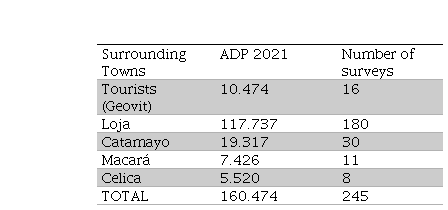
Finally, in order to know the interest of the effective demand, the sample of tourist arrivals to the canton of Paltas was taken according to the Geovit database of the Ministry of Tourism, for which based on the 2017 and 2018 data, they were projected to 2021. In order to survey a large part of the demand, the entries of the cantons of Loja, Catamayo, Macará and Celica were taken as a reference, for which they were projected to 2021 based on information from the INEC 2010 Census. The EAPs of each canton were calculated since they are the closest to the area where the project is located.
Next, the surveys were determined for each population, as shown in Table 1.
Surveys by population
INEC (2010).
To calculate the sample size, the finite population formula was used with a margin of error of 0.06 and a confidence level of 94% equivalent to 1,898 considering the difficult current conditions due to the Covid pandemic, which also made it difficult to travel easily to the different sites in person, so it was decided to apply online:
Where:
N = population size
Z = confidence level (1.898) 94%.
P = probability of success, or expected proportion (0.50)
Q = probability of failure (0.50)
D = precision (Maximum admissible error in terms of proportion). (0.06)
According to the official record of the inventory cards, it was found that in the urban parish of Catacocha there are about 117 houses registered, 39 in the rural parish of Yamana, however, in the parish of Casanga there is still no inventory record, so after the visit to the parish council it was found that there is indeed no record of the traditional houses of the site.
Officially they are not registered by any entity, so we requested the support of the parish GAD of Casanga in charge of Mr. Fabián Campoverde, president of the parish board, which determined the necessary information about this type of houses with vernacular architecture. Fabian Campoverde, president of the board, which determined the necessary information about this type of housing with vernacular architecture, for example that they are mostly concentrated in the various rural neighborhoods of the parish Casanga, also reported that most of these houses have been remodeled and overthrown to build current models, Despite this, it was possible to identify and determine the location of some traditional houses with vernacular characteristics closer to the central area of the site, being these the oldest and best known, obtaining a provisional list of them, to then proceed with the selection under the following criteria: criteria of depuration and selection, criteria of sieving and criteria of properties of the house.
Purification and selection criteria:
Based on the delimitation of the heritage houses and considering the first selection criterion called "purification and selection of heritage houses" which consisted of selecting the sections of streets closest to the central area of each site considering that they are close to complementary tourist services, easy access, cleanliness and harmony in their streets, as opposed to the peripheral area that does not fully meet these characteristics determined in the first selection criterion; Therefore, in the urban parish of Catacocha, 6 sections of streets corresponding to 55 heritage houses were identified, which are shown in the following map:
Similarly, in the Yamana rural parish, when applying the first criterion, we obtained the houses located in the central area corresponding to the busiest streets, such as 14 de febrero and 20 de julio, corresponding to a single central section, leaving a total of 24 houses in the first instance:
In the Casanga parish, according to the first criterion "purification and selection" and through the field visit and recognition of the houses with traditional vernacular characteristics, 8 architectural houses were selected, located in the central area of the parish, which are shown in the following map.
Screening criteria:
For the second classification criterion called "screening of heritage houses" in the parishes of Catacocha, Yamana and Casanga, a field visit and survey of the houses was carried out to obtain a more detailed classification, confirming their existence, the willingness of the owners to support the research, and their general state of conservation, with the following results
C. Homeownership criteria:
Summary description of selected heritage homes

authors based on field work.
Regarding the tourist use that the owners of the heritage houses would like to offer, 45% say they would like to install a restaurant service, while 36% prefer cafeterias offering typical local food, 14% consider that the spaces could be adapted to offer lodging services, and 5% say it would be interesting to place a handicrafts shop in their house. However, 80% of those interviewed do not have the economic resources to strengthen their property, while 20% say that they do have the necessary resources to carry out this type of project.
Market segmentation of effective demand
Through the results of the surveys, three market segments were identified, determined by the age of the visitors, where common interests, tourism preferences and similar characteristics of each segment are detailed for Loja, Catamayo, Celica and Macará, in order to subsequently identify a tourist profile for the development of cultural tourism in the CBFTZ's area of influence.
Segment 1: visitors from 18 to 30 years old:
In this segment, there are preferences for natural tourism, although there are also cultural and gastronomic tourism activities, such as visits to museums, monuments, churches and sites of cultural interest, as well as tasting the typical local cuisine. Among the tourism services in heritage houses that they would like to make use of are mainly lodging and handicraft stores.
They prefer to visit with family and friends for a short stay of 1 to 2 days, especially on holidays and long weekends. In addition, they would like to do other tourist activities related to tourist routes and visits to natural waterfalls.
Visitors prefer to travel by public transportation, although they also point to their own vehicle as another option, and this segment would be willing to pay an average of $0.50 to $13 for tourist services in heritage homes.
Among the promotional media through which they would like to be informed about tourism products, social networks stand out, and they also point to tour operators or travel agencies as the most appropriate intermediary for the contracting of tourism services.
This segment of tourists resides in Loja, Catamayo, Macará and Celica, with those from the city of Loja being the largest group, mostly women with an academic level of students and professionals, and with incomes ranging from $0 to $200, most of the visitors are single.
Segment 2: visitors from 31 to 42 years old:
Segment of tourists who enjoy natural and cultural tourism when visiting a site, with natural environments being the most preferred, followed by activities such as visiting museums, monuments, churches, sites of cultural interest, gastronomy and architecture of urban centers.
The main tourist services in heritage houses that they would use are lodging and restaurants, which they would preferably visit accompanied by their families. The time to visit would be during vacations and cantonal festivities, with a short stay of 1 to 2 days, using their own vehicle for transportation to the destination.
The average expenditure they would use in tourist services ranges from $0.50 to $18, making the contract through web pages, as for the promotional means by which they would like to be informed about the services are in first place social networks followed by web pages.
Among the tourist activities they would like to do are visiting waterfalls and tasting the local gastronomy.
Tourists in this segment are mostly male, married, professional and self-employed, with incomes ranging from $401 to $600.
Segment 3: visitors 43 to 55 and up:
Finally, in this last segment of tourists, it was found that they prefer to do natural and cultural tourism, being natural sites, gastronomy, monuments and places of interest what they most like to see when they go sightseeing.
Tourists would like to receive lodging services and handicraft stores in heritage houses, visiting them during vacations and long weekends, mainly accompanied by their families and partners, for a short stay of 1 to 2 days.
To make the visit they would use their own vehicle, also the expenditure for tourist services varies between $2 to $13 dollars, they like to be informed in promotional media such as social networks and websites. On the other hand, the most appropriate intermediary for the contract of these services according to this segment would be tour operators and travel agencies.
The preferred tourist activities for this segment of visitors are visits to waterfalls and gastronomic tasting, although there are also visits to Shiriculapo and the local tourist routes.
This segment is mostly female, married, professional and with incomes ranging from $401 to $600.
Through the diagnosis of the vernacular architecture of the heritage houses, it became evident that the inventory record currently registered is outdated since many of the houses no longer exist or have been remodeled in their entirety, losing their formal typology and originality. In addition to losing the built system, the loss of the cultural identity of the new generations can be evidenced because some of the construction systems have been inherited and have been subject to change by their new owners.
It is evident that local authorities in the area of tourism are lacking in administration and planning, due to the lack of policies that regulate the conservation of existing heritage houses. The implementation of tourism services in heritage houses such as restoration, lodging, and handicraft stores will be the strategies that will help the territory to take the initiative to strengthen the built system of the heritage houses with vernacular characteristics. In addition, it was observed that the cultural planning has led to the devaluation of the cultural identity in the territory of Cantón Paltas.
Surveys by population
INEC (2010).
Summary description of selected heritage homes
authors based on field work.