Resumen: La presente investigación tuvo como objetivo general determinar la relación entre participación ciudadana y presupuesto participativo para una gobernanza efectiva para los gobiernos locales en el Perú, el tipo de investigación fue aplicada, de nivel descriptiva correlacional, enfoque cuantitativo. El diseño no experimental con corte transversal, se empleó una población muestral de 50 funcionarios que desempeñan labores en procesos y ejecución del presupuesto participativo y área ciudadanía, se hizo estudios en los distritos y provincias del Perú. La técnica empleada para recolectar información fue encuesta, se utilizó escala de Likert y los instrumentos de recolección de datos fueron 16 items, las variables fueron validados con juicios de expertos, determinado su confiablidad con Alfa de Cronbach. Se usó la prueba de Rho Spearman para contrastación de hipótesis. Según los hallazgos se llegaron a la conclusión general que existe relación entre las variables participación ciudadana y presupuesto participativo. Los resultados muestran un coeficiente de correlación moderada de Rho de Spearman = 0.517 y p = 0.000<0.01, entre las variables, lo cual indica que a mayor participación ciudadana mejor se desarrollan los procesos del presupuesto participativo. Se afirma que existe una relación positiva y significativa entre la participación ciudadana y presupuesto participativo.
Palabras clave: Participación ciudadana, control transparencia.
Abstract: The general objective of this research was to determine the relationship between citizen participation and participatory budgeting for effective governance for local governments in Peru, the type of research was applied, descriptive level correlational, quantitative approach. The non-experimental design with a cross section, a sample population of 50 officials who perform tasks in processes and execution of the participatory budget and citizenship area was used, studies were carried out in the districts and provinces of Peru. The technique used to collect information was a survey, a Likert scale was used and the data collection instruments were 16 items, the variables were validated with expert judgments, their reliability determined with Cronbach's Alpha. The Rho Spearman test was used for hypothesis testing. According to the findings, the general conclusion was reached that there is a relationship between the variable's citizen participation and participatory budgeting. The results show a moderate correlation coefficient of Spearman's Rho = 0.517 and p = 0.000 <0.01, among the variables, which indicates that the greater the citizen participation, the better the participatory budgeting processes develop. It is stated that there is a positive and significant relationship between citizen participation and participatory budgeting.
Keywords: Citizen participation, transparency control.
Citizen participation and participatory budgeting for effective governance for local governments in Peru
Recepción: 24 Mayo 2020
Aprobación: 07 Noviembre 2020

Esta obra está bajo una Licencia Creative Commons Atribución-NoComercial-CompartirIgual 4.0 Internacional.
Currently, the position regarding citizen participation has undergone a possible alteration and there is a worldwide consensus that participation is a process that contributes to improving the quality of the democratic system. Citizen participation reinforces solidarity and the sense of the common good, since citizens have the option of participating with direct influence in the areas of public administration and become responsible not only for deciding for their individual benefit, but also for the welfare of the community.
Citizen participation in many municipalities is seen as an obstacle and not as a strength by some mayors; in fact, few mayors really have a participatory vocation and promote these mechanisms. There are often voices that express their discomfort with participatory budgeting and consider that citizens are not prepared to debate plans and projects. There are public officials who consider that citizen participation is not very useful and do not yet assume that the new public management cannot be conceived apart from the citizens.
Álvarez (2004), citizen participation is a collective action that unfolds and originates simultaneously in the social and state spheres. He emphasizes that it is not an exclusive action of a social organization; neither is it an action given on the margins or outside the contours of the state, nor is it an exercise limited by the contours of the social or state sphere that originates it. Citizen participation is a type of collective action through which the citizenry takes part in the construction, evaluation, management and development of public affairs, regardless of the modalities (institutional-autonomous) through which it takes place. In addition, it points out the set of activities and initiatives that civilians deploy, affecting the public space from within and outside the parties". (p. 50).
"Ziccardi (1998) states that citizen participation is "a process by means of which the inhabitants of cities intervene in public activities with the objective of representing their particular interests", on the other hand he points out that citizens become involved in the elaboration, decision and execution of public matters that affect them, concern them or, simply, are of their interest. Understood in this way, it could be stated that it refers to a particular type of interaction between individuals and the state, to a concrete relationship between the state and society, in which the character of the public is put into play and constructed" (pp.32, p. 88). (pp.32, p. 88).
"Velasquez et al. (2003), citizen participation is a concept used to designate a set of social processes and practices of very diverse nature. At certain times, it has led to a rather ambiguous analytical use. Richness, because the multiplicity of notions through which it has been enunciated has made it possible to delimit, with increasing precision, the actors, spaces and variables involved, as well as the characteristics related to the definition of this type of participatory processes. It specifies that "Citizen participation is to oversee compliance with previous agreements and rulings, as well as the performance of the political authority." (p. 57, 60).
"Colino et al (2003) local governments are institutional spaces naturally open to participation and power sharing, we can say that citizen participation at the local level generates positive effects, in at least three key areas such as: economic, social and political".
"Borja (2000), citizen participation is regularly associated at a macro level and at a micro level. At the first level, the benefits of this collective action are highlighted in the conformation of the democratic ideal that opens the state, as socialization of politics, in an institutionalized and/or autonomous context that gives margin to the progress of democratic governance, or as a dynamic that gives way to the active and dynamic participation of citizens that allows the modernization of public management, the satisfaction of collective needs, the inclusion of marginal sectors, of ideological pluralism and the displacement of representative democracy by substantive democracy" (p.66).
Avendaño (2006) the institutional form par excellence of participation is born with the formation of political parties. Citizens have a mechanism to express their political preferences, but it is revealed that it is a participation in delegation, since their vote is cast by citizens, but the representative is the one who assumes actions and responsibilities. "The parties are defined as the expression of society, which in turn entails a continuous relationship with the institutions of the State and local entities" (p. 9).
"Citizen participation is based on the rights enshrined in the Political Constitution of Peru (1993) which establish: Equality in the enjoyment of political rights, the right to participate in public affairs, to elect and be elected, to make petitions, complaints, to organize, demonstrate and mobilize in accordance with the law and to join political parties (see Title I, Chapter I; Article 1,2; Chapter II, Article 10, 16; Chapter III, Article 30,31,32,35, 38; Chapter IV, Article 39, 40. Title II; Chapter I, Article 44,45 and Title III, Chapter I, Article 61."
"Alcántara (2001) governance can be understood as the situation in which a set of favorable conditions for government action concur, which are located in its contour or are intrinsic to it. "Governance depends on governance, on the level of maturity in an organized society and its capacity to assume shared responsibilities in the implementation of decisions and in the art of governing correctly." (p. 95).
Participation of civil society organizations
"In the political constitution of Peru, Title I. Of the person and society, chapter I. Fundamental rights of the person, stipulates to participate individually or in association, in the political, economic, social and cultural life of the nation. Citizens have, according to law, the rights of election, removal or revocation of authorities, legislative initiative and referendum". (Art.2, Inc.19)."
"Pizarro (2003) participation is a central element of democracy, understood as the possibility of accentuating the dignity of man, of exercising his freedom to the full. That is to say, that each individual is a free agent to decide his conduct and to contribute to formulate the goals of the action of the group and of the society to which he belongs.
"Ziccardi (1998), citizen participation is the key to transform the local space into a public space and contribute to create conditions to consolidate democratic governance, citizen participation, unlike other forms of participation, political, community, refers specifically to the inhabitants of cities to intervene in public activities representing particular interests not individual, exercised primarily in the field of daily life and local space, which is where there is greater proximity between authorities and citizens".
Urquijo (2007) points out that the participatory budget is elaborated through a process of consultation with the communities to reach an agreement or consensus on what should be the priorities of the municipality's investment spending, which gives us to understand that the budget should include all the representatives, in this case the community development council - COCODES. Thus, the participatory budget becomes a mechanism that contributes to determine the destination of part of the public resources of the municipality.
Díaz (2002) indicates that the participatory budget is basically a system of budget formulation and follow-up through which the population determines where investments will be made, what are the priorities, works and actions to be developed by the government. It is, from another point of view, a valuable budget planning tool.
Claros (2009) points out that the participatory budget is the management mechanism through which, with a participatory approach, the municipality incorporates the organized population so that, in a concerted manner, it determines the allocation of part of the institutional budget to the execution of projects and works of community or neighborhood interest. To this end, the entity must determine the amount destined to the participatory budget process, but without neglecting its own obligations, such as operating and functioning expenses and those corresponding to the attention of local public services".
Díaz (2002) indicates that participatory budget execution is basically a system of budget formulation and follow-up through which the population determines where investments will be made, what are the priorities, works and actions to be developed by the government. From another point of view, it is a valuable budget planning tool". (p. 52).
"Miranda et al. (2003), states; that a strategy that intends to transform the background of the relations between governors and governed must start from an integral vision of reality, recognize social contradictions and collective identities, combine forms of direct and representative representation and open clear channels and mechanisms for decision making".
"Ackerman (2005) the term accountability, which attempts to translate in a limited way the Anglo-Saxon term accountability, is related to the possibility or ability to have access to information about a specific unit of analysis, official or employee, institution, government. From the point of view of public management, this definition is clearly insufficient, since it lacks a minimum criterion regarding exposure and access to information, which is in practice what makes it possible to establish the relationship with the improvement of public sector performance. From this perspective, the challenge is to find a definition that establishes a relationship between the availability of information and its use for the equitable, rational, efficient, effective and transparent allocation of public resources, which strengthens State-civil society relations"". (p.68).
Araujo, et al, (2000) participatory budgeting is a management mechanism that allows the inclusion of citizens in public investment decision-making. It is both a political and technical process. "It tends to be modified depending on the level of political maturity of the actors, the characteristics of the territory, the level of consolidation of the institutions, among others. By means of this management tool, the citizenry is brought closer to the city government."" (p.70).
"Amuvall (2004) the mechanisms of planning and concertation for participatory budgeting, in the most concrete sense are materialized in the full development of the same preparatory and concertation phases, as a form of direct, clear and true sensitization towards the population, but taking into account some of the sub-parts of the mentioned phases" such as preparation, communication, sensitization and convocation.
"Gallicchio (2006) states that governance calls for institutional strengthening of weak governments, governance is based on the idea that such institutional capacity already exists and points out that what is needed is to involve factors and subjects external to the government, since institutions are not sufficient to guarantee managerial capacity. What it proposes, ultimately, is to govern through networks rather than hierarchies; to lead through influence rather than the exercise of authority; to relate rather than to command".
Panchana (2020) indicates in his review that the Political Constitution (2008), Art. 95, citizens, individually or collectively, participate as protagonists in decision making, related to public affairs. Art. 204, the people are the principal and first controller of public power. The Organic Law of Citizen Participation (LOPC) generates scenarios for social control and accountability, and establishes that Citizen Participation Mechanisms are useful to evaluate public management.
Panchana (2020) agrees with the contribution of Fuenmayor (2004) in the Latin American context, it is observed that the Organization of American States, as well as the United Nations Organization, establishes that every citizen has the right to access to public information, including the freedom to seek, receive, exercised orally, in writing or in any artistic form and using the procedure. Also in the Latin American sphere is the Inter-American Democratic Charter of the General Assembly of the Organization of American States, generated between July 30 and 31, 2002, which establishes, in its Article 4.º, the transparency of government activities, probity and accountability of governments in public management. (p.12)
Panchana (2020) on public information agrees with the analysis of Fuenmayor (2004), Public Information, both central and decentralized, as well as any organ, entity or institution that exercises public functions or executes public budgets, has the obligation to provide the information contained in documents, writings, photographs, recordings, magnetic or digital support, or in any other format and that has been created or obtained by it, or that is in its possession and under its control. (p. 27)
For his part, he points out that transparency and accountability are, directly or indirectly, immersed in the governance process. The basic core of this governance is access to information. Governance represents the exercise of power with the objective of directing and regulating public activities for the benefit of the public interest. Since it implies the creation of institutions and processes that lead citizens to elaborate and implement community policies in a collective and democratic manner, governance represents the exercise of power with the objective of directing and regulating public activities for the benefit of the public interest.
Prieto et.al (2019) argues in their journal that for education to effectively fulfill its function in the context of a Social State of Law, it must be understood that true democracy in education comes from inclusive education and that this is par excellence the scenario of consolidation of an authentic social justice. It must develop public policies aimed at taking the concept of inclusive education to its ultimate consequences, so that school institutions consolidate a true recognition of diversity, and not a simple coverage of disability. (p.312)
In order to understand the concept of the Social State of Law, it is first necessary to explain the meaning of fundamental rights. Fundamental rights are understood as those juridical-political tools with which the population can confront the possible arbitrariness of the State or third parties, thus guaranteeing protection for the full development of their human condition. Fundamental rights mean a political conquest by humanity, against anyone who, in the exercise of power, wishes to violate the human condition.
The Social State of Law is, then, an expression of the development of democracy, corresponding to the historical development of a certain political doctrine (liberalism), which shapes democracy and the modern State on the basis of the theory of social justice. (p.313)
Likewise, it indicates that the development of citizen participation and social control, did not begin with the Political Constitution, but it is in this Magna Carta where the legal framework is established, setting as a transversal axis the rights to participate and to carry out social control (National Assembly, 2015), with these scopes the supreme positive legal norm that governs the organization of Ecuador was written and approved.
Therefore, this paper aims to demonstrate citizen participation and participatory budgeting for effective governance for local governments in Peru, with a series of existing problems. The questions posed were: What is the relationship between citizen participation and participatory budgeting for effective governance in local governments in Peru? The results of this research focus directly on officials of district and provincial municipalities in Peru, who contribute to the participatory budget processes, with a study of the reality based on citizen participation, and therefore focused on the objectives, hypothesis testing and operationalization of the variables.
The present research is based on the hypothetical deductive method, this method allows the pursuit of new knowledge, starting from other established knowledge that is progressively subjected to deductions.
Guillen (2015) explains that this method has a high value due to its heuristic character, since it can advance and corroborate new hypotheses, and make new knowledge known, this method gives a systematic, integrating and coherent character to the set of principles, laws, which establish an entire scientific theory".
Rosales (1988) regarding the method used, this was "the hypothetico-deductive method, which is the procedure or path followed by the research to make its activity a scientific practice, referring to the certain methods that can be applied in the teaching-learning process"" (p. 49), argues that:
"After the application of the deductive or inductive methods, the hypothetical-deductive method arises as a more perfect instrument than the previous ones, which tries to gather in synthesis the most positive characteristics of them. In it, and through an inductive process, a hypothesis is formulated, from which assumptions and implications are derived and through whose contrast with reality it will be attempted to verify the initial hypothesis. (1988, p.49)
In this study, inferential statistics and applied research have been used, since the aim is to improve the situation of citizen participation and the participatory budget of the provincial and district municipalities of Peru. In order to solve the problem.
Vara (2015), applied research is practical, since its results are immediately used in the solution of problems of reality. Applied research usually identifies the problem situation and seeks, within the possible solutions, the one that may be the most appropriate for the specific context. In addition, it proposes management programs, innovation and new models". (p. 235)
The research was of non-experimental design, since the variables under study were not manipulated. According to Hernández, et al. (2010), refers to: "studies that are conducted without deliberate manipulation of variables and in which only phenomena are observed in their natural environment and then analyzed". (p.149)
He argues that "non-experimental design is to observe phenomena as they occur in their natural context, and then analyze them".
A sample population of 50 civil servants working in participatory budget processes and execution and in the area of citizenship was studied in the districts and provinces of Peru.
Finally, it is a quantitative approach, the technique used to collect information was a survey, a Likert scale was used and the data collection instruments were 16 items, the variables were validated with expert judgments, their reliability was determined with Cronbach's Alpha and the Rho Spearman test was used.
For this study, inferential statistics were applied and hypothesis tests were performed with a significance level of p <05 to reject the null hypothesis, according to the objectives. The inferential statistical procedures, in which Spearman's Rho statistic was used to determine the degree of correlation between the study variables (Guillen, 2015) and their corresponding deductions for the scientific research on citizen participation and participatory budgeting in district and provincial municipalities in Peru. The correlations between the variables, dimensions based on the general and specific hypothesis were taken into account. Considering the scale values to measure the results.
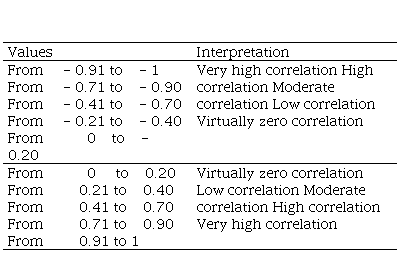
According to Bisquerra (2009), he indicated the following scale of values and interpretations of Spearman's Rho, and also refers that Spearman's Rho coefficient can vary from -1.00 to + 1.00, giving the following scheme.
Table 1. Scale values
Inferential statistical result - hypothesis testing
Table 2. Correlation between citizen participation and participatory budgeting
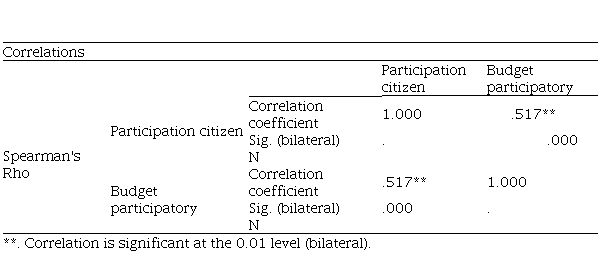
Correlation is significant at the 0.01 level (bilateral).
Table 2 shows, according to the results of the statistical analysis, that there is a moderate positive relationship (rs = 0.517) between citizen participation and the participatory budget, and the probability value (p = 0.000) is less than the critical value ( = 0.01), therefore the null hypothesis is rejected and the alternative hypothesis is accepted, which states that citizen participation has a moderate relationship with the participatory budget in the district and provincial municipalities of Peru. Therefore, it is concluded that, with a risk of 1% and 99% reliability, citizen participation has a positive and significant relationship with the participatory budget in the district and provincial municipalities of Peru.
Specific hypothesis 1:
Significance level: α = 0.05
Statistic: Non-parametric Spearman's Rho
Table 3. Correlation between citizen participation and budget execution
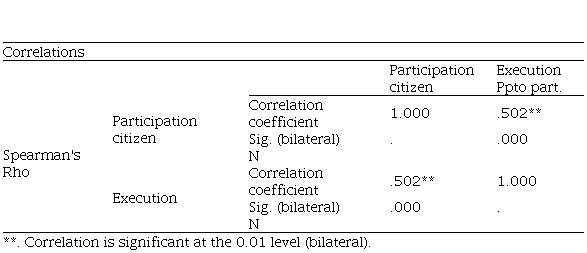
Correlation is significant at the 0.01 level (bilateral).
Specific hypothesis 2:
Significance level: α = 0.05
Statistic: Non-parametric Spearman's Rh
Specific hypothesis 2:
Significance level: α = 0.05
Statistic: Non-parametric Spearman's Rho
Table 3 shows, according to the results of the statistical analysis, that there is a moderate positive relationship (rs = 0.502) between citizen participation and budget execution, and the probability value (p = 0.000) is less than the critical value ( = 0.01), therefore the null hypothesis is rejected and the alternative hypothesis is accepted, which states that citizen participation has a moderate relationship with participatory budget execution in the district and provincial municipalities of Peru. Therefore, it is concluded that, with a risk of 1% and 99% reliability, citizen participation has a positive and significant relationship with budget execution in district and provincial municipalities in Peru.
Specific hypothesis 2:
Significance level: α = 0.05
Statistic: Non-parametric Spearman's Rho
Table 4. Correlation between citizen participation and accountability mechanisms
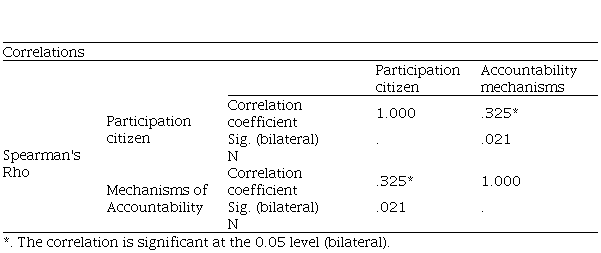
The correlation is significant at the 0.05 level (bilateral)
Table 5 shows, according to the results of the statistical analysis, that there is a low positive relationship (rs = 0.325) between citizen participation and accountability mechanisms, and the probability value (p = 0.021) is less than the critical value ( = 0.05), therefore the null hypothesis is rejected and the alternative hypothesis is accepted, which states that citizen participation has a low relationship with accountability mechanisms of the participatory budget in district and provincial municipalities in Peru. Therefore, it is concluded that, for a risk of 5 % and 95 % reliability, citizen participation has a positive and significant relationship with accountability mechanisms in district and provincial municipalities in Peru.
Specific hypothesis 3:
Significance level: α = 0.05
Statistic: Non-parametric Spearman's Rho
Table 5. Correlation between citizen participation and planning and consensus-building mechanisms
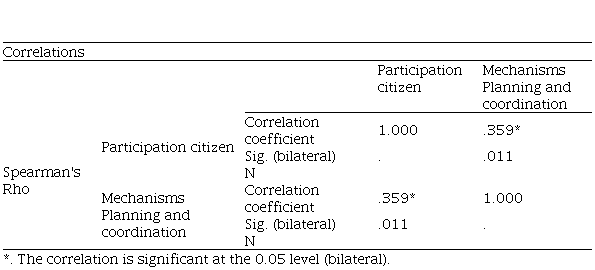
The correlation is significant at the 0.05 level (bilateral).
Table 5 shows, according to the results of the statistical analysis, that there is a low positive relationship (rs = 0.359) between citizen participation and the planning and consultation mechanisms, and the probability value (p = 0.011) is less than the critical value ( = 0.05), therefore the null hypothesis is rejected and the alternative hypothesis is accepted, which states that citizen participation has a low relationship with the participatory budget planning and consultation mechanisms in the district and provincial municipalities of Peru. Therefore, it is concluded that, with a risk of 5% and 95% reliability, citizen participation has a positive and significant relationship with the planning and coordination mechanism in the district and provincial municipalities of Peru.
Specific hypothesis 4:
Significance level: α = 0.05
Statistic: Non-parametric Spearman's Rho
Table 6. Correlation between citizen participation and the results of the participatory budget execution.
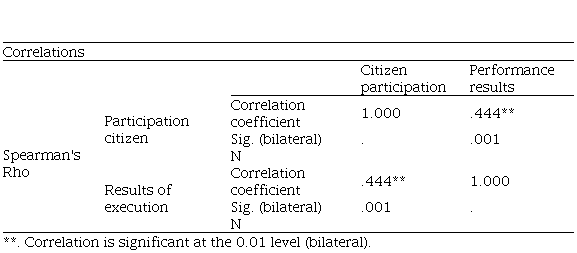
Correlation is significant at the 0.01 level (bilateral).
Table 5 shows, according to the results of the statistical analysis, that there is a low positive relationship (rs = 0.444) between citizen participation and execution results, and the probability value (p = 0.001) is less than the critical value ( = 0.01), therefore the null hypothesis is rejected and the alternative hypothesis is accepted, which states that citizen participation has a low relationship with the results of participatory budget execution in the district and provincial municipalities of Peru. Therefore, it is concluded that, with a risk of 1% and 99% reliability, citizen participation has a positive and significant relationship with the results of execution and agreement in the district and provincial municipalities of Peru.
The research obtained descriptive values between the variables citizen participation and participatory budget in the district and provincial municipalities of Peru, according to the general objective it is observed that there is a deficient level, finding a percentage of 78% regarding citizen participation and a low level of 72% regarding the participatory budget (table 17 and 22) and according to the testing of the general hypothesis it is observed that there is a positive and significant relationship between the variables (table 24), These findings are contrasted with the studies conducted by Francés (2006) in which he concluded that citizen participation favors social trust by 67%; in this respect, the more citizens participate and become aware of their role, the better the adequate use of participatory budgets will be. The methodology used was basic research, descriptive level. Non-experimental open design, receptive to the inclusion and conjunction of techniques of diverse nature, with a qualitative and quantitative approach, using a population and sample of 56. The technique used is survey, data collection. Likewise, the findings found by Niemeyer (2006) in research on the correlation of the development of citizen participation in the processes of social control of municipal management in the district of Comas, in which he concluded that there is distrust among the population, indicated in a large percentage as the attitude towards transparency and viability of the processes; this would be a result of the governmental experience that has been lived.
1.
2.
According to the specific objective 1, a low level is observed with a percentage of 62% for the participatory budget execution dimension (table 18) and according to the specific hypothesis test 1, it is observed that there is a positive and significant relationship between citizen participation and participatory budget execution in the district municipalities of the Huari province - Ancash Region (table 25), In this regard, in the research conducted by Velásquez (2013) in the thesis "Analysis of citizen participation in the participatory budget in the Cojitambo Parish in the period 2010-2012" in which he concludes that there is an impact of citizen participation in the implementation of the participatory budget in improving the quality of life of the population.
According to specific objective 2, a low level is observed, with a percentage of 64% for the accountability mechanisms dimension of the participatory budget (table 19) and according to the specific hypothesis test 2, it is observed that there is a positive and significant relationship between citizen participation and the execution of the participatory budget in district and provincial municipalities in Peru (table 26), in this regard in the research conducted in the thesis "Strategy for citizen empowerment and participation in the control of public management" in which they have as results the low participation as an effect due to lack of training of the population to participate, and the lack of confidence in the control of financial resources in the implementation of projects. Where 74% affirms that it is possible to contribute with the empowerment of citizen participation for the control of public management.
According to specific objective 3, a low level is observed, with a percentage of 60% for the participatory budget planning and coordination mechanisms dimension (Table 20) and according to the specific hypothesis test 3, it is observed that there is a positive and significant relationship between citizen participation and the execution of the participatory budget in district and provincial municipalities in Peru (Table 27), In this regard, in his thesis "Citizen participation and local administration" shows the importance of citizen participation and therefore makes use of the planning of new technologies as an impulse for participation, and environmental motivations as a reason for participation, likewise, it is necessary to encourage citizen participation in the participatory budget to increase the credibility of citizens in their authorities.
According to the specific objective 4, a low level is observed with a percentage of 58% regarding the dimension results of participatory budget implementation (table 21) and according to the specific hypothesis test 4, it is observed that there is a positive and significant relationship between citizen participation and participatory budget implementation in district and provincial municipalities in Peru (table 28), in this regard in the thesis "The participatory budget and the quality of management of public resources in district municipalities in the Ayacucho Region, period 2009-2013" concluded that participatory budgets imply an adaptation to the reality where it is applied and has the participation of civil society organizations, higher percentage indicate that it does contribute to the good management of public resources, transparency, and equitable allocation of resources, these results of the implementation of participatory budgeting is very important in the management of public resources. Likewise, with his thesis "The participatory budget based on results as an instrument for decision making in the allocation and execution of the investment budget of the district municipality of Casa Grande, 2012" in which he concluded that there is a good conduct of the participatory budget based on results and that it has been improved successively in each new process.
In general, it can be affirmed that the general research objective was achieved, and the general hypothesis was proved. It was found that there is a significant correlation between the citizen participation of the citizens of the province and the participatory budget processes of the local governments.
It was determined that there is a moderate and positive correlation with a correlation value of Spearman's Rho = 0.517 and p = 0.000<0.01, between the variables citizen participation and participatory budget in the district and provincial municipalities of Peru. This indicates that the greater the citizen participation, the better the participatory budget processes are developed.
It was determined that there is a moderate and positive correlation with a correlation value of Spearman's Rho = 0.502 and p = 0.000<0.01 between citizen participation and the execution of the participatory budget in the district and provincial municipalities of Peru. This indicates that the greater the citizen participation, the better the execution of the participatory budget.
It was determined that there is a moderate and positive correlation with a correlation value of Spearman's Rho = 0.325 and p = 0.021<0.05 between citizen participation and accountability mechanisms in district and provincial municipalities in Peru. This indicates that the greater the citizen participation, the better the accountability mechanisms of the participatory budget work.
It was determined that there is a moderate and positive correlation with a correlation value of Spearman's Rho = 0.359 and p = 0.011<0.05 between citizen participation and participatory budget planning and coordination mechanisms in district and provincial municipalities in Peru. This indicates that the greater the citizen participation, the better the participatory budget planning and coordination mechanisms work.
It was determined that there is a moderate and positive correlation with a correlation value of Spearman's Rho = 0.444 and p = 0.01<0.01 between citizen participation and the results of participatory budget execution in district and provincial municipalities in Peru. This indicates that the greater the citizen participation, the better the results of participatory budget execution.
Table 1. Scale values
Inferential statistical result - hypothesis testing
Table 2. Correlation between citizen participation and participatory budgeting
Correlation is significant at the 0.01 level (bilateral).
Table 3. Correlation between citizen participation and budget execution
Correlation is significant at the 0.01 level (bilateral).
Table 4. Correlation between citizen participation and accountability mechanisms
The correlation is significant at the 0.05 level (bilateral)
Table 5. Correlation between citizen participation and planning and consensus-building mechanisms
The correlation is significant at the 0.05 level (bilateral).
Table 6. Correlation between citizen participation and the results of the participatory budget execution.
Correlation is significant at the 0.01 level (bilateral).