2025
122
19122024
25112025
 Gabriel Willian da Costa Brito biel987.gc@gmall.com
Universidade Federal do Amapá, Brasil
Arialdo Martins da Silveira Júnior arialdomartins@gmail.com
Universidade Federal do Amapá, Brasil
Abstract: Automotive washing services, while small businesses that contribute to local development, must operate with environmental responsibility and management. This study assessed the situation of these businesses in the central region of Macapá, the capital of Amapá State, discussing potential environmental impacts due to the lack of local oversight and management of this activity. For this purpose, businesses were mapped within the study area, followed by the in-person administration of a semi-structured questionnaire to owners as a data collection method. Results indicate that these establishments are strategically located throughout the city center. The absence of waste storage tanks is a significant concern, indicating inadequate environmental control of this economic activity. Few establishments show a commitment to sustainability, opting for more eco-friendly and/or sustainable products. Additionally, high-water consumption was observed compared to average values in larger urban centers. Considering these findings, it is imperative for public management and regulatory agencies to intensify inspections, considering the structure and operation of these establishments to mitigate the impacts of inadequate management. Raising awareness among business owners about the importance of adopting sustainable practices in their operations is also essential. Although maintaining these establishments is important for the city's economy, they must be managed responsibly and sustainably to prevent serious harm to the natural and urban environment.
Keywords: Environmental impact,Car washing,Environmental Management.
Resumo: Os serviços de lavagem automotiva, embora sejam empreendimentos de pequeno porte que contribuem para o desenvolvimento local, devem operar com responsabilidade e gestão ambiental. Este trabalho avaliou a situação destes empreendimentos na região central de Macapá, capital do Estado do Amapá, discutindo os possíveis impactos ambientais decorrentes da falta de fiscalização e gestão local dessa atividade. Para isso, os empreendimentos foram mapeados na área de estudo, seguido da aplicação in loco de um formulário semiestruturado aos proprietários, como método de coleta de dados. Os resultados mostram que estes estabelecimentos estão estrategicamente localizados em quase todos os pontos da área central da cidade. A ausência de tanques de armazenamento de resíduos representa uma preocupação significativa, revelando a carência de controle ambiental sobre essa atividade econômica. Poucos estabelecimentos demonstram preocupação com a sustentabilidade, optando por produtos mais ecológicos e/ou sustentáveis. Além disso, foi identificado um elevado consumo de água em comparação aos valores médios em grandes centros urbanos. Diante desse cenário, é imperativo que a gestão pública e os órgãos reguladores intensifiquem a fiscalização, levando em conta a estrutura e o funcionamento destes estabelecimentos na capital, a fim de mitigar os impactos causados pela falta de gestão adequada. Também é crucial sensibilizar os proprietários sobre a importância de adotar práticas sustentáveis na operação de seus negócios. Embora a manutenção desses estabelecimentos seja importante para a economia da cidade, é fundamental que eles sejam geridos de forma responsável e sustentável, para evitar danos graves ao ambiente natural e urbano
Palavras-chave: Impacto ambiental, Lava a jato, Gestão Ambiental.
Resumen: Los servicios de lavado automotriz, aunque son pequeños negocios que contribuyen al desarrollo local, deben operar con responsabilidad y gestión ambiental. Este estudio evaluó la situación de estos establecimientos en la región central de Macapá, capital del estado de Amapá, analizando los posibles impactos ambientales derivados de la falta de supervisión y gestión local de esta actividad. Para ello, se realizó el mapeo de los negocios en el área de estudio, seguido de la aplicación presencial de un cuestionario semiestructurado a los propietarios como método de recolección de datos. Los resultados indican que estos establecimientos están estratégicamente distribuidos por el centro de la ciudad. La ausencia de tanques de almacenamiento de residuos es un factor preocupante, lo que evidencia un control ambiental insuficiente de esta actividad económica. Pocos establecimientos muestran compromiso con la sostenibilidad, optando por productos más ecológicos y/o sostenibles. Además, se observó un alto consumo de agua en comparación con los valores promedio de grandes centros urbanos. Considerando estos hallazgos, es imprescindible que la gestión pública y los organismos reguladores intensifiquen las inspecciones, teniendo en cuenta la estructura y el funcionamiento de estos establecimientos para mitigar los impactos de una gestión inadecuada. También es esencial concienciar a los propietarios sobre la importancia de adoptar prácticas sostenibles en sus operaciones. Aunque el mantenimiento de estos establecimientos es importante para la economía de la ciudad, deben ser gestionados de manera responsable y sostenible para evitar daños graves al entorno natural y urbano.
Palabras clave: Impacto ambiental, Lavado automotriz, Gestión ambiental.
Survey of automotive washing services and identification of potential urban environmental impacts in the central region of Macapá–AP
Levantamento dos serviços de lavagem automotiva e identificação de potenciais impactos ambientais urbanos na região central de Macapá–AP
Levantamiento de servicios de lavado automotriz e identificación de potenciales impactos ambientales urbanos en la región central de Macapá–AP
Gabriel Willian da Costa Brito biel987.gc@gmall.com
Arialdo Martins da Silveira Júnior arialdomartins@gmail.com
Received: 19 December 2024
Accepted: 25 November 2025

Since the 1970s, environmental issues have been widely discussed on a global scale (Piga; Mansano, 2015; Pott; Estrela, 2017; Alonso, 2018). Environmental preservation and conservation have become central concerns for modern societies, as unregulated urban expansion and various economic activities have significantly contributed to increasing pollution of air, water, and soil, as well as biodiversity loss. These challenges represent some of the most pressing environmental issues in the contemporary world.
In this context, automotive washing services, commonly referred to as car washes, although typically small businesses that contribute to local development by positively impacting the economy, employment, and income distribution (Asevedo; Jerônimo, 2012), must also operate with environmental responsibility and ethics. The lack of proper wastewater management – often containing pollutants such as soot, gasoline, and grease – can result in contamination of both surface water and groundwater sources (Zaneti et al., 2012; Monney et al., 2020; Rai et al., 2020).
According to Brazil’s National Water and Basic Sanitation Agency (ANA) (2023), washing a car with a hose can consume up to 600 liters of water per vehicle, whereas dry washing methods use an average of only 400 ml, or 0.4 liters, which represents merely 0.06% of the water used in a conventional wash. In Brazil, approximately 32,700 car wash facilities collectively consume 3.7 million m³ of water monthly – an amount comparable to the monthly water consumption of a city with 600,000 inhabitants (Leão et al., 2010), closely matching the population of Macapá, the capital of Amapá State.
The high level of water consumption, combined with the contaminant residues generated by conventional washing, such as oils and greases, presents an urgent environmental concern. Frequently, these residues are disposed of directly onto the ground without any treatment, which can lead to contamination of both groundwater and soil. Additionally, many of these establishments operate without the required environmental licensing, which complicates monitoring and enforcement by regulatory authorities.
Resolution 362/2005 of the National Environment Council (CONAMA) specifies that improper disposal of lubricating oils, whether directly or indirectly on the ground, generates hazardous waste that poses a significant risk to human health. As a result, effluents mixed with water used in automotive washes contaminate groundwater, exerting detrimental effects on the environment. These contaminants can also reach surface water bodies, degrading their quality, harming aquatic ecosystems, and restricting water use for domestic, industrial, agricultural, and recreational purposes (Rai et al., 2020).
The Brazilian Institute of Geography and Statistics (IBGE, 2022) reports that over the past fourteen years, the number of vehicles in Macapá has surged, increasing from 94,233 in 2010 to 179,547 in 2022. This represents a growth rate exceeding 90%. As a result, there has been a higher demand for vehicle washing services. However, there is currently a lack of reliable data or published indicators on car wash operations in Macapá, creating challenges in generating accurate environmental assessments and projections for this activity in the state capital.
Given this, the present study seeks to address the following question: what are the potential environmental impacts of car wash operations in downtown Macapá, Amapá? To explore this, a survey of these establishments was conducted in central Macapá, aiming to assess the potential environmental risks associated with their activities and to propose solutions to mitigate their impacts.
The study area is the Central neighborhood of Macapá, the capital of Amapá State, where a significant concentration of automotive washing businesses is located within the city's urban core.
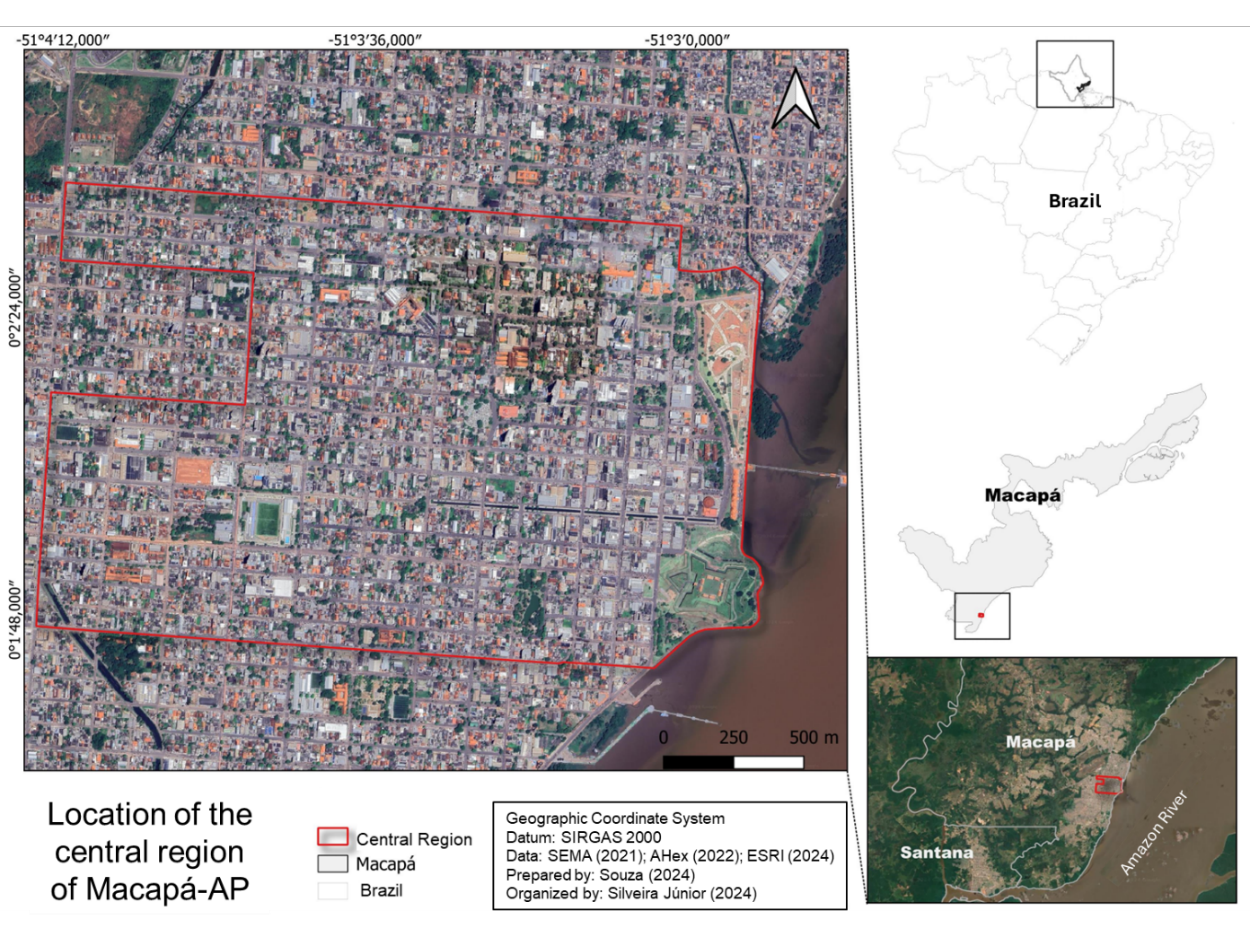
According to the Brazilian Institute of Geography and Statistics (IBGE, 2022), the population of Macapá, the capital of Amapá, was 442,933 in 2022, with a per capita GDP of R$ 22,880 recorded in 2020. The most recent Municipal Human Development Index (MHDI), from 2010, was 0.736. Regarding basic infrastructure, data from 2010 revealed that 51.2% of households had access to adequate sewage services, 66.7% of the city had tree canopy coverage, and 25.7% was adequately urbanized. In the National Sanitation Information System (SNIS) ranking, Macapá ranked 3,756th in 2020, with only 26.8% of the population having access to a sewage collection and treatment network (IBGE, 2010).
The central region of Macapá, which had 17,798 inhabitants in 2010 (IBGE, 2010), is one of the best-served areas in terms of sanitation infrastructure, especially sewage services (Viegas et al., 2021). This region is undergoing urban verticalization, marked by the construction of high-rise buildings and rising land prices. Additionally, the area contains a diversified commercial network and intense vehicle flow, factors that favor the establishment of automotive washing services. This urban development has been accompanied by the expansion of public and private services, including car washes, to meet the needs of the growing population (Silva, 2017).
Car washes (n=11) in the central region of Macapá were mapped over a two-week period through active searches and on-site visits. The selection criterion included all establishments that offered vehicle washing services within the predefined geographical limits of the central neighborhood, regardless of size, legal status, or operational structure. The area was divided into blocks to facilitate the identification of businesses, which were strategically located along busy avenues, often near schools and gas stations.
For data collection, semi-structured questionnaires were administered to car wash owners who agreed to participate in the study. The instrument was composed of six (n=6) guiding questions both open, allowing the collection of quantitative and qualitative information. The questionnaire covered the following topics:
a) General Business Information, including name, address, owner, operational period, installation date, and licensing status.
b) Water Balance, detailing the source of water supply and daily consumption.
c) Products Used, with a focus on chemical products such as lubricating oils, degreasers, and descaling agents.
d) Effluent Disposal, identifying the structures used for effluent and wastewater collection.
In addition to the questionnaire, direct observations were made at each establishment to verify the physical infrastructure, presence of containment systems, drainage structures, and waste storage areas. Field notes and photographic records were also included as complementary data sources.
The questionnaire design was based on the Terms of Reference provided by the State Government of Tocantins for environmental car wash projects, following the guidelines of the State Council for the Environment (COEMA) Resolution No. 007/2005. This approach was adopted due to the lack of specific regulations and guidelines for car wash operations in Macapá.
During the visits, business owners were informed about the research objectives and invited to sign a Free and Informed Consent Form (FICF), in compliance with Brazilian guidelines for research involving human participants, as outlined in the National Health Council (CNS) Resolutions No. 466/12 and 510/16.
The data collected through the semi-structured questionnaire were organized into an Excel matrix to calculate the mean, standard deviation, and confidence interval for quantitative variables, such as the operating period and water balance. The criteria for inclusion of variables in the analysis followed completeness of responses and data consistency checks.
Qualitative data were analyzed using descriptive methods. Responses were grouped into thematic categories, such as environmental practices, operational characteristics, and infrastructure conditions, and then interpreted to identify recurring patterns and potential environmental impacts associated with car wash activities.
In the central region of Macapá, Amapá, eleven (n=11) automotive washing establishments were identified; however, only six (n=6) agreed to participate in the study. The reluctance of the other establishments may be attributed to concerns that data collection could expose instances of non-compliance or deficiencies in meeting regulatory standards required for proper operation. For analytical purposes, the collected data were organized as presented in Table 1.
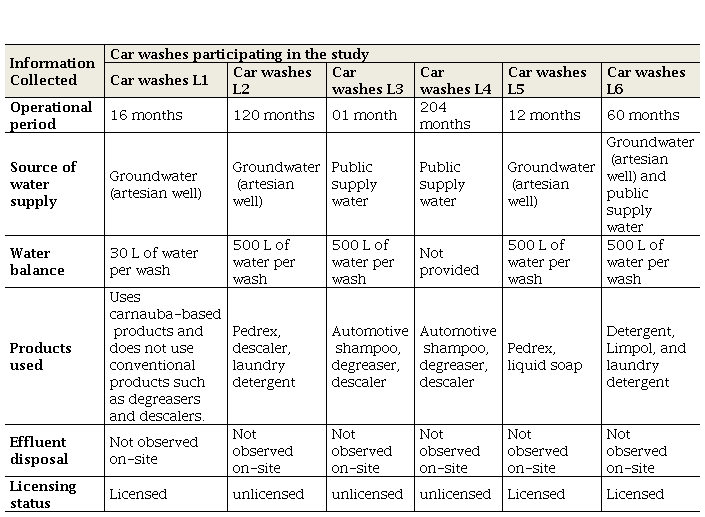
The data indicate that car washes in the central area of Macapá have been operating for periods ranging from 1 month to 17 years, with an average operating time of 5.7 years. Older establishments tend to maintain a loyal customer base, attracted by service quality or good customer relations; however, the length of operation does not necessarily correlate with improved environmental practices or regulatory compliance. For instance, L1, in operation for only 16 months, possessed an operating license at the time of the survey, while L4, despite being in operation for 17 years, lacked the required environmental license, functioning in violation of legal standards.
Only 50% of the surveyed establishments held proper licenses, highlighting a lack of commitment among some owners to comply with environmental regulations. This finding suggests that numerous car washes, both within and beyond the study area, may be operating without authorization or failing to meet the environmental standards established by regulatory bodies, such as the Municipal Environment Secretariat of Macapá, responsible for licensing these businesses.
It is important to note that in Macapá, there are no specific laws or procedures for licensing automotive washing activities. Currently, the licensing process applies criteria designed for other socioeconomic activities with potential local impact. However, this generalized approach may fail to address critical factors, and the unique environmental impacts associated with car washing operations.
Compliance with legal requirements is essential for the responsible operation of activities that pose potential environmental risks (Asevedo; Jerônimo, 2012; Costa; Albuquerque, 2021). Environmental licensing plays a critical role in the effective management of such enterprises by assessing potential environmental impacts and establishing conditions to mitigate them (Brazil, 1981; Shiavo; Bussinguer, 2020). The absence of licensing signifies non-compliance with legal standards, exposing both the environment and business owners to considerable risks.
In this context, it is crucial for licensing bodies to conduct continuous monitoring of these activities to identify instances of non-compliance and ensure adherence to environmental standards. Rigorous enforcement, combined with the adoption of sustainable business practices, promotes benefits for both entrepreneurs and the environment (Santos; Silva, 2013).
The lack of specific guidelines for car wash operations in the State of Amapá exacerbates this issue, creating an unregulated environment where many establishments operate without licenses or adequate oversight. These conditions can result in illegal practices, such as improper waste disposal. Furthermore, unlicensed establishments may lower operational costs by ignoring environmental standards, placing compliant businesses at a competitive disadvantage.
It is therefore imperative for local authorities to develop specific regulations for car washes, addressing critical aspects such as waste treatment, chemical usage, water management, and licensing requirements. Additionally, the implementation of effective enforcement mechanisms, coupled with educational initiatives to raise awareness among business owners about the importance of regulatory compliance, is essential to fostering sustainable and legally compliant practices.
Operating without a license can result in fines, particularly in cases involving illegal waste disposal and groundwater contamination (Kazembeigi et al., 2023). Penalties vary according to the severity of the violation and may include civil and criminal liability for individuals and businesses, as outlined in Law No. 9,605/98 (Brazil, 1998).
The data indicate that four out of the six car washes surveyed (66%) use groundwater, while the remaining 34% rely on water supplied by the local utility. This reliance on water availability highlights its critical importance, especially in areas with limited access to public supply systems.
The unregulated use of well water can deplete aquifers, contributing to groundwater scarcity (Jasechko et al., 2024). Furthermore, CONAMA Resolution No. 396/2007 requires environmental licensing for well drilling, irrespective of depth or purpose – an obligation that some establishments utilizing this resource fail to meet.
On the other hand, the use of treated water from the local utility can lead to unnecessary waste of a valuable resource and increased operational costs. Establishing partnerships between car washes and local utilities, including incentives for adopting environmental best practices, could serve as a viable solution. Similarly, the implementation of water treatment and reuse systems (Leão et al., 2010) offers significant potential. Additionally, businesses can adopt water conservation measures, such as installing low-flow fixtures on taps and using high-pressure hoses, to minimize waste, regardless of the water source.
Regarding water consumption, data indicate that each car wash uses between 30 and 500 liters of water per vehicle, with an average of 400 liters. L1, which uses only 30 liters per wash, stands out for its low consumption due to the use of a water meter system that limits usage, demonstrating a commitment to sustainable resource management. In contrast, other establishments report significantly higher consumption, suggesting a lack of control measures and limited attention to water conservation.
Adopting environmentally responsible technologies and practices can provide business owners with a competitive advantage while significantly contributing to natural resource conservation. For example, water capture and reuse systems can drastically reduce consumption, minimizing the impact on local water sources (Souza Filho; Vieira, 2018; Moura et al., 2020). This approach is particularly viable in Macapá, which experiences two distinct rainfall periods: a rainy season with a maximum of 407.2 mm/month and a less rainy season with 35.5 mm/month (Tavares, 2014). Rainfall is widely recognized as the most significant climatological variable in tropical regions (Amanajas; Braga, 2012). Additionally, installing filtration systems to prevent soil and water contamination by oils and chemicals is essential to meet environmental requirements and avoid fines and penalties (Dorigan; Tessaro, 2010).
Consumer awareness also plays a key role in this process. Increasingly, consumers seek services aligned with sustainability practices (Vanalle; Santos, 2014), which directly influences their choice of car wash. Transparent communication about environmental commitments and obtaining certifications can enhance public perception, differentiating businesses and encouraging sustainable behavior among service providers and consumers.
In terms of chemical usage, all surveyed car washes employ some form of cleaning product, with 83% using automotive shampoos, degreasers, and descaling agents. Improper use of these products can lead to soil pollution and groundwater contamination, particularly when waste is not disposed of properly (Araújo et al., 2017). Only one establishment (L1) uses carnauba-based products [Copernicia prunifera (Miller) H. E. Moore], avoiding conventional degreasers and descaling agents, which indicates an environmentally conscious market strategy. However, even this establishment lacks waste storage tanks, allowing waste to reach the ground.
This scenario underscores the urgent need to standardize the use of biodegradable and environmentally friendly products in car washes. Public policies promoting sustainable alternatives, such as carnauba-based or other natural compounds, could significantly reduce the environmental impact of these activities (Rodrigues et al., 2016). Moreover, oversight and technical guidance from environmental agencies are essential to ensure that establishments understand and correctly implement these practices, thereby preventing irreversible harm to natural resources (Sousa et al., 2018).
Another critical area for improvement is the implementation of wastewater treatment systems in car wash establishments. The absence of waste storage tanks, as observed in L1, is a recurring issue that can result in soil and groundwater contamination. To mitigate these risks, car washes must install appropriate waste treatment and disposal systems, ensuring that chemicals are adequately filtered and treated before being released into the environment (Rosa et al., 2011). These measures, combined with awareness campaigns and training programs, can significantly enhance environmental management in the sector, benefiting both business owners and the local community.
CONAMA Resolution 430/2011 establishes standards for effluent discharge into the soil, and non-compliance with these standards can have severe environmental consequences (Rai et al., 2020). None of the surveyed establishments have adequate waste management systems, posing substantial risks to public health and the environment.
Inadequate waste management practices in car washes, as defined by Federal Law No. 12,305/2010, may result in environmental sanctions, including fines and even business closures. The lack of effective oversight by public authorities, particularly SEMAM, perpetuates these issues.
Considering this scenario, stricter enforcement policies and the creation of incentives for establishments to comply with environmental regulations are essential. The absence of proper waste management systems, such as oil and water separators, in car washes can severely impact soil and groundwater quality. Therefore, effective intervention by regulatory bodies, such as SEMAM, is critical to ensure compliance with the standards set by CONAMA Resolution 430/2011, thereby minimizing environmental risks associated with these activities.
Additionally, raising awareness among car wash owners about the benefits of investing in effluent treatment technologies is essential. Compliance with Federal Law No. 12,305/2010, which establishes the National Solid Waste Policy, can help prevent legal sanctions and provide long-term economic benefits by reducing operational costs and improving the establishment’s public image. Adopting environmentally responsible practices not only mitigates environmental risks but also offers a competitive advantage in a market increasingly focused on sustainability.
In summary, the operation of car washes in the central region of Macapá without adequate regulation poses significant environmental risks, including excessive use of potable water, improper disposal of chemical effluents, and inadequate solid waste management. Stricter enforcement measures and the adoption of sustainable practices are essential to mitigate these impacts.
The analysis of data on automotive washing activities in the central region of Macapá-AP highlights significant environmental impacts, including high potable water consumption, the release of chemical effluents, and waste generation. However, practical solutions can mitigate these effects and promote the sustainability of this activity.
A key measure is reducing potable water consumption through the implementation of rainwater harvesting and reuse systems. Additionally, installing effluent treatment systems, such as oil-water separators and biological filters, is essential to protect soil and water bodies. Proper waste management, including selective collection and environmentally appropriate disposal, must also be prioritized.
Other recommended practices include the use of biodegradable chemicals that are less harmful to the environment and the installation of improved ventilation systems to minimize the dispersion of atmospheric pollutants. Support from the municipal government of Macapá, through financial incentives and technical guidance, could further encourage the adoption of these sustainable measures.
The Conduct Adjustment Agreement (TAC) represents an important mechanism for ensuring compliance with environmental laws, holding car wash owners accountable for adhering to regulatory standards. Additionally, training employees and raising customer awareness about the responsible use of natural resources are valuable initiatives to support the successful implementation of these practices.
In conclusion, adopting sustainable practices is essential not only for environmental preservation but also for enhancing the market image and competitiveness of these establishments. These efforts contribute to a more responsible and ecologically sustainable future for the sector.