

Akademos
Filming the Thickness of Care Ecotones: An Exploratory Tool in the Making
Filmar la espesura de los ecotonos del cuidado: una herramienta exploratoria en proceso
post(s)
Universidad San Francisco de Quito, Ecuador
ISSN: 1390-9797
ISSN-e: 2631-2670
Periodicity: Anual
vol. 13, 2026
Received: 15 December 2025
Accepted: 03 June 2026
Corresponding author: geraldine.deneuville@uclouvain.be
Abstract: This research proposes film as an exploratory tool to grasp the thickness of relational moments shaping the hybrid waste management system in Mexico City’s Metropolitan Zone. In this ecosystem of porous boundaries, continuity relies on interactions, adjustments, and care practices. Film becomes an adapted medium to reveal and render these ecotones and the system’s fragility.
Keywords: ecotone, care, waste collectors, hybrid waste management system, film.
Resumen: Esta investigación propone el cine como herramienta exploratoria para captar la espesura de los momentos relacionales que configuran el sistema híbrido de gestión de residuos en la Zona Metropolitana de la Ciudad de México. En este ecosistema de límites porosos, la continuidad depende de interacciones, ajustes y prácticas de cuidado. El cine se convierte en un medio adaptado para revelar estos ecotonos y la fragilidad del sistema.
Palabras clave: ecotono, cuidado, recicladores, sistema híbrido de gestión de residuos, cine.
One territory, multiple ecosystems
I have never managed to choose between my two field sites: La Condesa, an affluent and secure neighbourhood of Mexico City, and the “Neza 3” garbage dump site in Nezahualcóyotl, a territory saturated with waste and long left to self-organization. What initially appeared as two incomparable political, social, and spatial contexts became the entry point to my research.
When I began drawing the collection system, I first traced lines representing administrative boundaries, official routes,“formal” itineraries on one side and “infor-mal” ones on the other. I believed a map would be enough to represent the sys-tem. But in the field, these lines turned out to be thicker and more entangled than expected: the border blurred. The stable system I thought I was mapping revealed itself to be, following Catalina Ortiz (Berger & Bertschi 2024), an embodied, moving knowledge, traversed by affects, situated practices and daily negotiations. The di-chotomy between “formal” and “informal,” central at the beginning of my research, had subsequently become obsolete.
The works of Castillo Berthier (1990), Bernache Pérez (2006), and González Déctor(2017) initially structured my analysis and allowed me to deepen my understanding of the complexity of waste collection systems in Mexico, particularly the practices of pepena,1 a form of work that structures entire communities of waste collectors.
However, what I observed in the field was not two separate systems but a complex entanglement of situated ecosystems: groups of waste collectors2 (sweepers, volun-teers, piones, truck drivers, carretoneros, pepenadores, leaders...) whose practices are never purely formal or informal, but hybrid, constantly interacting, adjusting, and responding to one another. Each one, individually or collectively, constitutes a micro-system with its own function, operating according to specific temporalities, rules, tacit agreements, and daily tactics to sustain collection. Together, they form a living system whose boundaries are mobile, porous, and continually redefined.
The field taught me that it is not the categories of collectors that structure col-lection, but the interactions between them. When two microsystems meet, some-thing happens: cooperation, tension, conflict, negotiation. These unpredictable and discontinuous interactions, either brief or prolonged, are relational moments. They reconfigure the ecosystem and reveal the thickness of the relationship. In them, one observes discreet gestures, mutual attentions, silent agreements that would not exist without this situated encounter.
These are precisely the forms of care that María Puig de la Bellacasa (2017) defines as a “material and political work that allows precarious worlds to hold together”. Another important perspective is that of Helena Hirata (2021), who enriches this view by highlighting the notion of power relations that care generates. Here care appears as a fundamental element of the system: it repairs, adapts, supports, and keeps the microsystems together. Yet it circulates asymmetrically among collec-tors according to their status, access to resources, and the vulnerabilities they face. Without care, the system could harden, fragment, or collapse. This asymmetry in power relations makes the notion of care difficult to analyse through classical ana-lytical tools. Studying waste collection thus becomes the study not of the structure itself, but of the relational thickness through which care circulates, care whose inten-sity determines the cohesion or fragmentation of the collection ecosystem.
Care ecotones
When two microsystems meet, they do not overlap: they intertwine, rub, adjust. From this exchange a “care ecotone” emerges. It is not a fixed place but a relational mo-ment, “un espace temps” where activity around waste, a coveted common resource, thickens and reconfigures relations between collectors.
An ecotone appears each time a situated interaction arises and impacts collection: when the guard at Neza 3 controls or lets collectors pass; when a barrenderoempties his barrels into the truck and exchanges with the team; when a carretoneromust leave his street to avoid conflict with the municipal truck. These relational moments have a thickness in which silent, variable, often invisible practices circulate: care. Essential to the system’s durability, care enables protection, danger prevention, survival within an unequal system, resource or information sharing, conflict avoidance or mitigation. Where care circulates, the ecosystem holds together; when it withdraws, the encoun-ter becomes friction, vulnerability, or rupture.
Studying these ecotones, rather than the waste-management system as a whole, requires a method able to grasp unpredictable, thick, fragmented moments. It means choosing an artistic approach which, as Balkema and Slager (2004) argue, expands modes of knowledge rather than categorizing them. This is where the documentary film becomes a meaningful tool: made withcollectors and not about them, it can reveal inequalities of care, document practices threatened by con-straining contexts; describe situated ecotones without freezing them. Film renders visible the forms of care produced in the thickness of ecotones (gestures, atten-tions, tactics, words), everything that writing, photography, or mapping cannot capture without fixing.
Fragments3
Film is used here to capture care practices in waste collection. Its purpose is not to ex-plain or solve vulnerabilities, but to render visible gestures, attentions, tactics, words, and invisible practices that sustain the collection ecosystem, everything erased by clas-sical analytical tools. The narration of these fragments results from a weaving together of notes, maps, observations, photographs, situated memories, and a methodological intuition: that film might, better than writing or mapping, render visible the shifting forms of care perceived in ecotones.
The three fragments below, drawn from a wide selection of rushes recorded in the field, describe field scenes in different contexts. Each constitutes an ecotone: a relational moment where care appears with varying intensity depending on the hu-man interaction, the moment, and the place. Each rests on three selection criteria: the diversity of situations and territories (1); the capacity of each fragment to reveal a distinct form of care and the power relation it generates (2); their cinematographic potential, understood as their capacity to render visible what writing alone cannot fully convey (3).
Their articulation in the ongoing documentary film does not follow a linear narra-tive logic: the editing aims to bring out relational intensities, placing contrasting situa-tions in tension where care circulates differently according to context.
Fragment 1 - The entrance: a silent ecotone of Care (figures 1-4)
The bordo de Xochiacaseparates the Neza 3 dump from the rest of Nezahualcóyotl. On weekdays, the entrance is monitored and closed to outsiders; on Sundays, it opens to the football players and spectators who occupy the neighboring fields. During my first visits, in 2011, the entrance was an open threshold; saying we were coming to see the leader was enough to gain access to the site.
Today, the municipality seeks to reclaim control over a space long self-organized by URBYNA, the collectors’ association: a sign forbids entry, a guard controls workers’ access, a barrier blocks passage at closing time. This formerly open edge has become porous: access now depends on formal exchanges and tacit agreements between those who manage these infrastructures.
Without official authorization, it is difficult for me to cross the zone without being stopped by the guard. My entry now rests on a situated agreement with the group leader, Celestino, who authorizes my access to carry out my fieldwork. But nothing is guaranteed: it is a negotiated, fragile access that depends on my relationship with the group and on the context of the moment. Inside, as at the entrance, the municipality and the collectors coexist under tension, each seeking to preserve their own interests and workspace. Rules exist, but their application remains fluctuating.
The entrance is a neuralgic point of the system. Keeping the dump site open de-pends on countless tacit negotiations and micro-gestures between municipal workers and collectors, mainly the carretoneros and pepenadores who work inside Neza 3. Without the leaders’ continuous pressure on the administration, without mutual aid among collectors to keep the dump functioning, without the cordiality maintained with the guards and municipal trucks, the entrance would likely be closed.
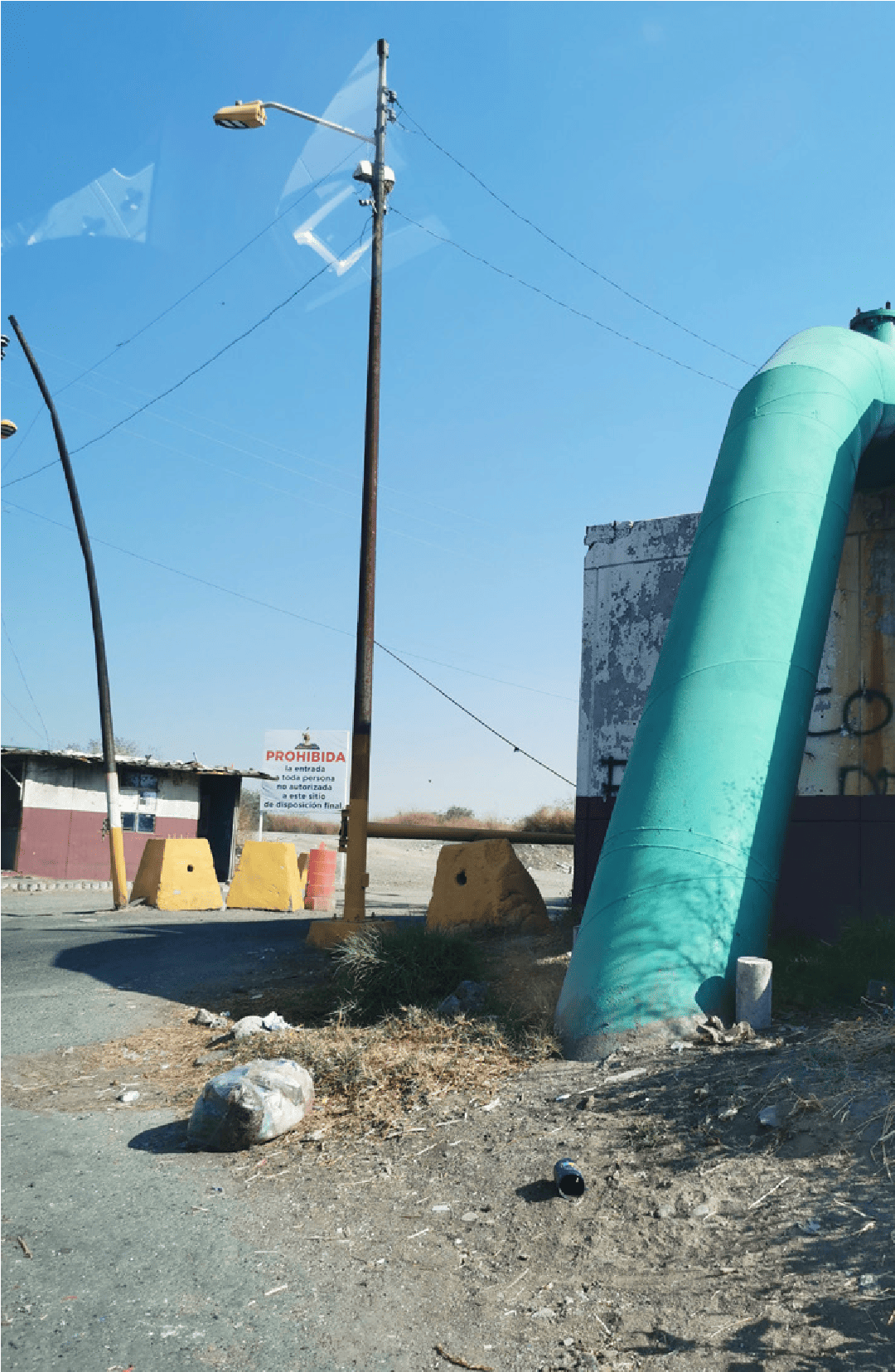
Figure 1. The “Prohibida” sign indicates that the entrance is closed to outsiders; it is partially hidden by the guard shelter and the lampposts that mark the entrance to the landfill. The framing is wide, it shows no human presence, only the infrastructures that control passage: concrete bollards, a rising barrier, a guard shelter, a sign that states the rule of access: be an authorized person: but how? It does not say. The waste soundscape can be heard but not seen. The entrance to Neza 3 materializes the care ecotone as a zone of power: a physical boundary where implicit rules are tacitly negotiated.
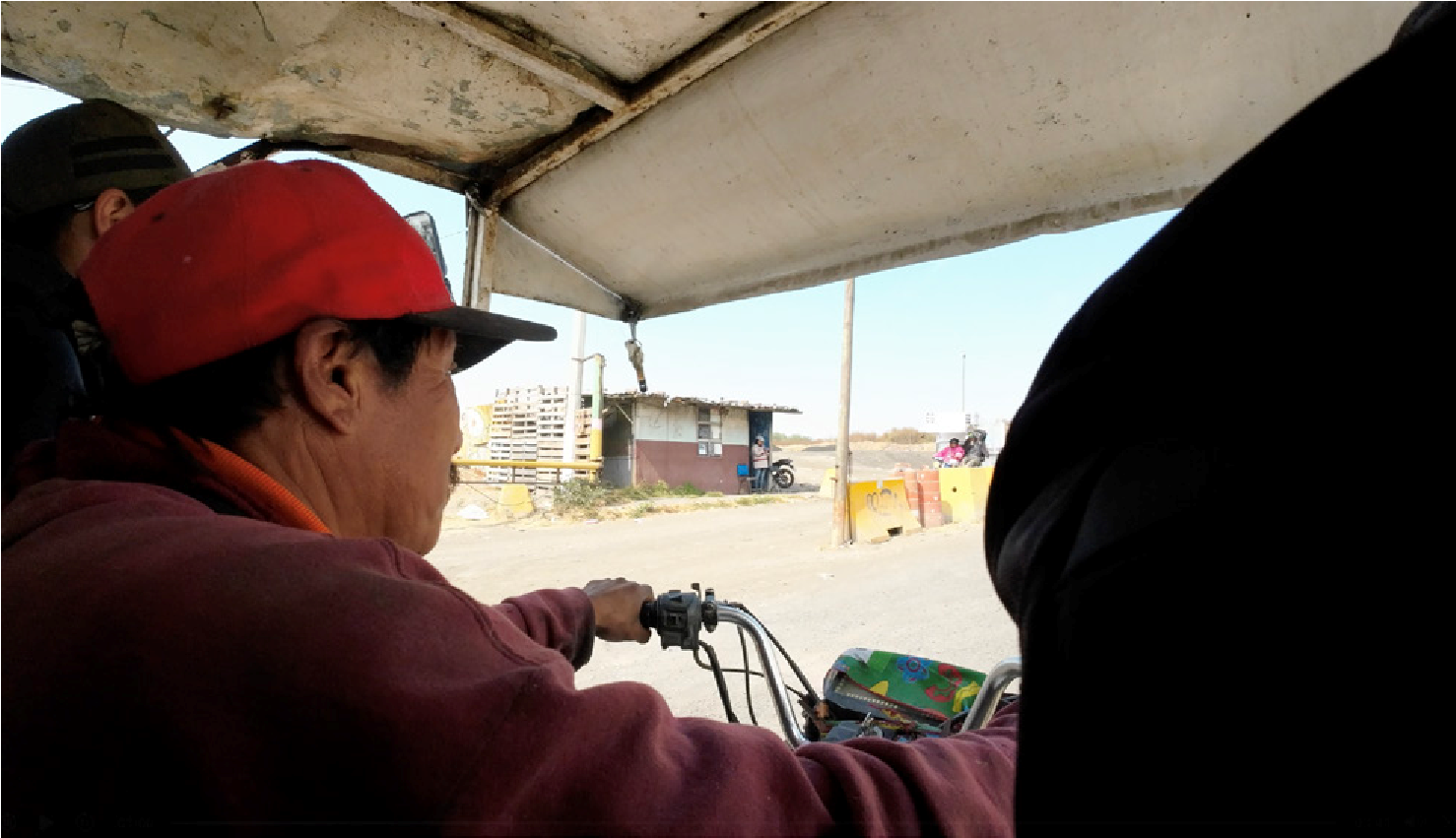
Figure 2. The shot shows Cirilio from inside the moto-cart, placing the viewer in the collector’s position: we cross the entrance with him, we see what he sees. Cirilio drives and looks straight ahead. The guard is posted at the entrance and watches from the corner of his eye, but Cirilio avoids his gaze. This immersive framing reveals a form of strategic care: making no waves, staying discreet, crossing quickly to protect his load.
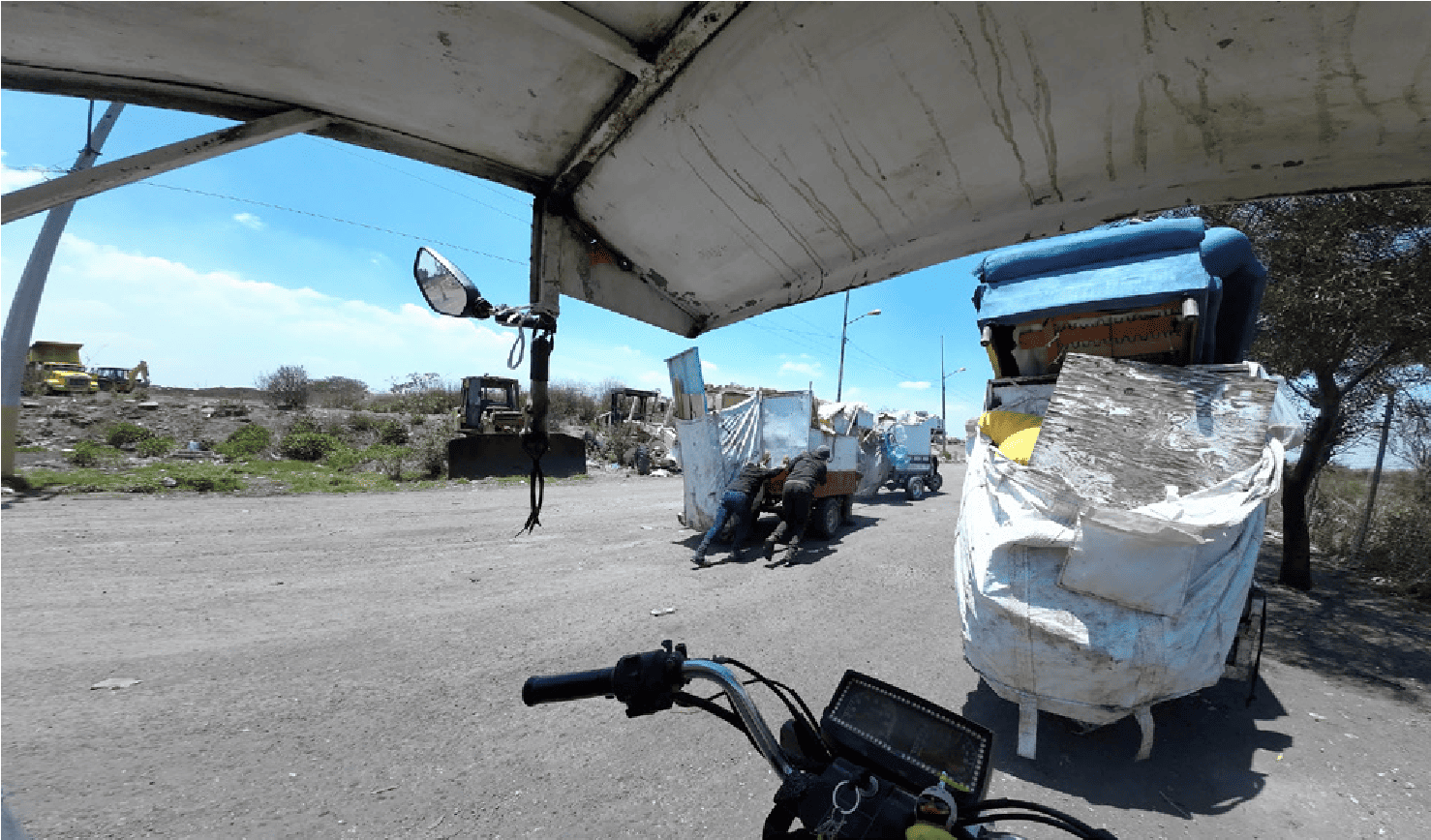
Figure 3. The wide angle from the handlebars of the moto-cart shows an everyday scene behind the entrance barrier: two collectors, among them Ana, pushing a moto-trailer. They are at the centre, surrounded by other moto-carts loaded with waste. The camera keeps its distance but films the scene unfolding: solidarity among collectors. It captures this spontaneous, collective, and immediate movement, without staging.
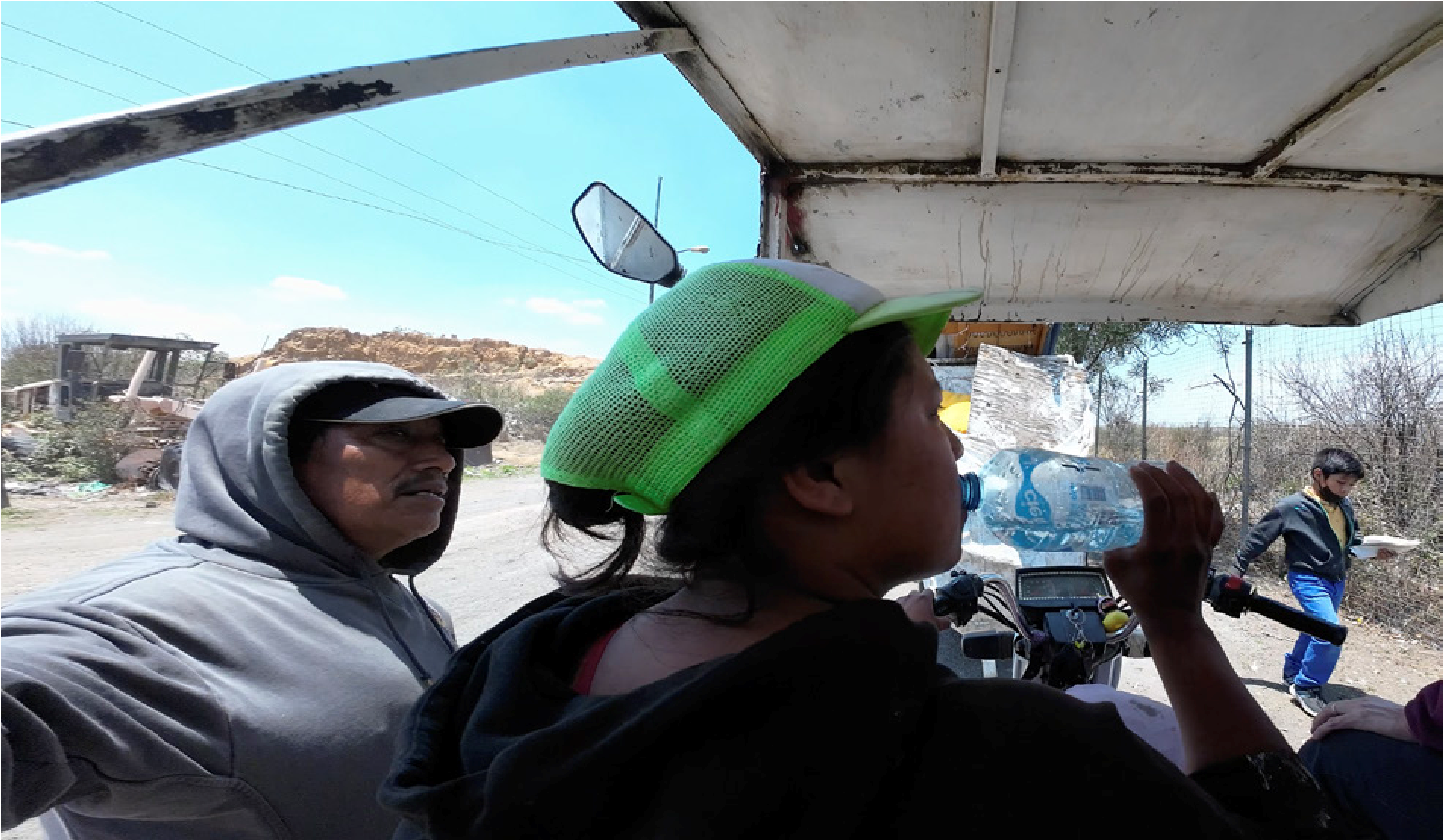
Figure 4. The framing is again intimate. It shows the interior of the vehicle and focuses on Ana’s face as she drinks water offered to her in thanks for her help, while her father, tired from the effort, waits for his daughter to drink before hydrating himself. Off-frame, a glimpse of the landfill and its edge can be perceived to the right; heat and distant sounds are sensed. Care, understood as a moment of kindness and sharing, is rendered visible through the tightening of this scene
Fragment 2 - Ana: Care in the gestures (figures 5-10)
After twenty minutes of driving from the dumpsite, we arrive at calle 10, Ana’s col-lection zone. She turns off the moto-cart, steps off, opens the back, and climbs inside. Within minutes, she has carefully arranged her space: unfolding the barcinas4, fasten-ing bags to the side panels, dividing the rear of the cart: organic waste on one side, inorganic on the other. Ana organizes the moto-cart to make her work easier, faster, and less physically demanding.
Often, collectors work as a pair. While Ana sorts the waste inside the motor-cart, her father crosses the street ringing the campana, shouting “basuraaa”, picking up bins, watching for passing cars, ensuring their safety. Ana remains silent, focused on her work, exhausted by the heat, her body strained by the effort. “Es duro...Pero comemos”, she says simply.
Her collection zone was assigned by her leader; she did not choose it. Each carretonero has a zone, with a margin of autonomy, but remains under constant informal oversight. They work with flexible hours, follow tacit rules, depend on the leader’s support, and ad-just according to shifting alliances within the group. To protect her collection, Ana must arrive before the municipal truck, report pirate collectors,5 save fuel, follow her leader’s directives, sell her materials at the best price, and adapt to the dump’s operating hours. Her presence, both in the street and at the landfill, remains constantly negotiated.
These negotiations take the form of subtle exchanges: waiting for someone, warning and being warned of danger, repairing the cart, sharing fuel, signalling the municipal truck. These are Ana’s ecotones: relational moments where a hybrid form of care circulates, made of simple but necessary gestures for surviving within an unequal system
In my notes and photos, care appears fragmented, detached from its context when I write: Ana’s father buys water on hot days; Ana gives her shoelace to fix the cart’s wheel; a collector comes to lend a hand to help repair the moto-trailer: a resident offers a snack in exchange for collection; a hand gesture warns of a speeding car; a neighbour signals the presence of a pirate truck within the neighborhood; a moment of tension makes her sick; daily rhythms shift to face unforeseen events. Yet these exchanges are not isolated: they form a continuous thread.
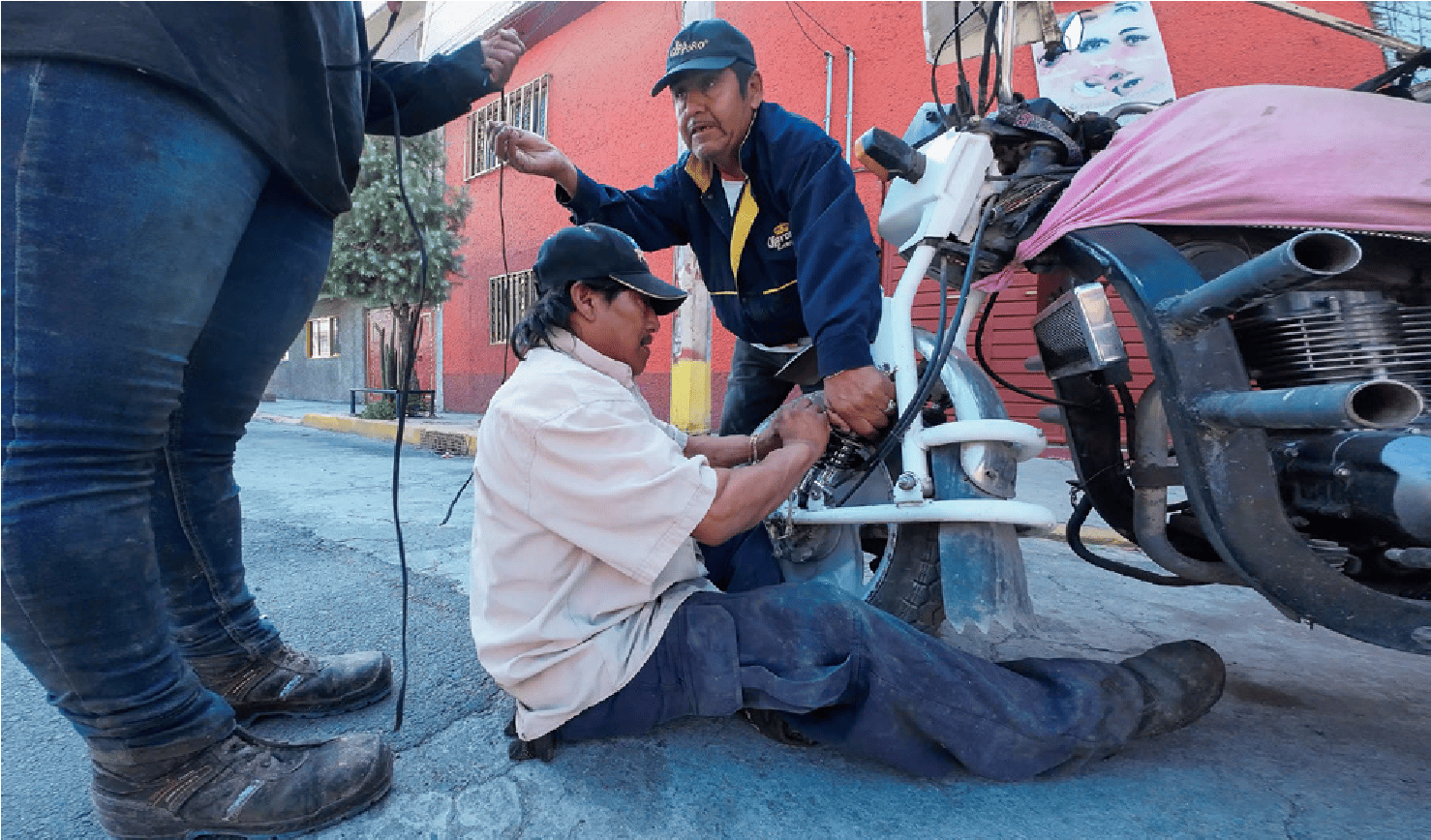
Figure 5. Ana gives her shoelace to a collector who has come to help Cirilio repair the front wheel of the motor-cart. Without tools, without time, without money, he improvises an immediate solution. This improvised repair gesture is a form of material care: keeping their working tool alive and functional so that collection can continue.
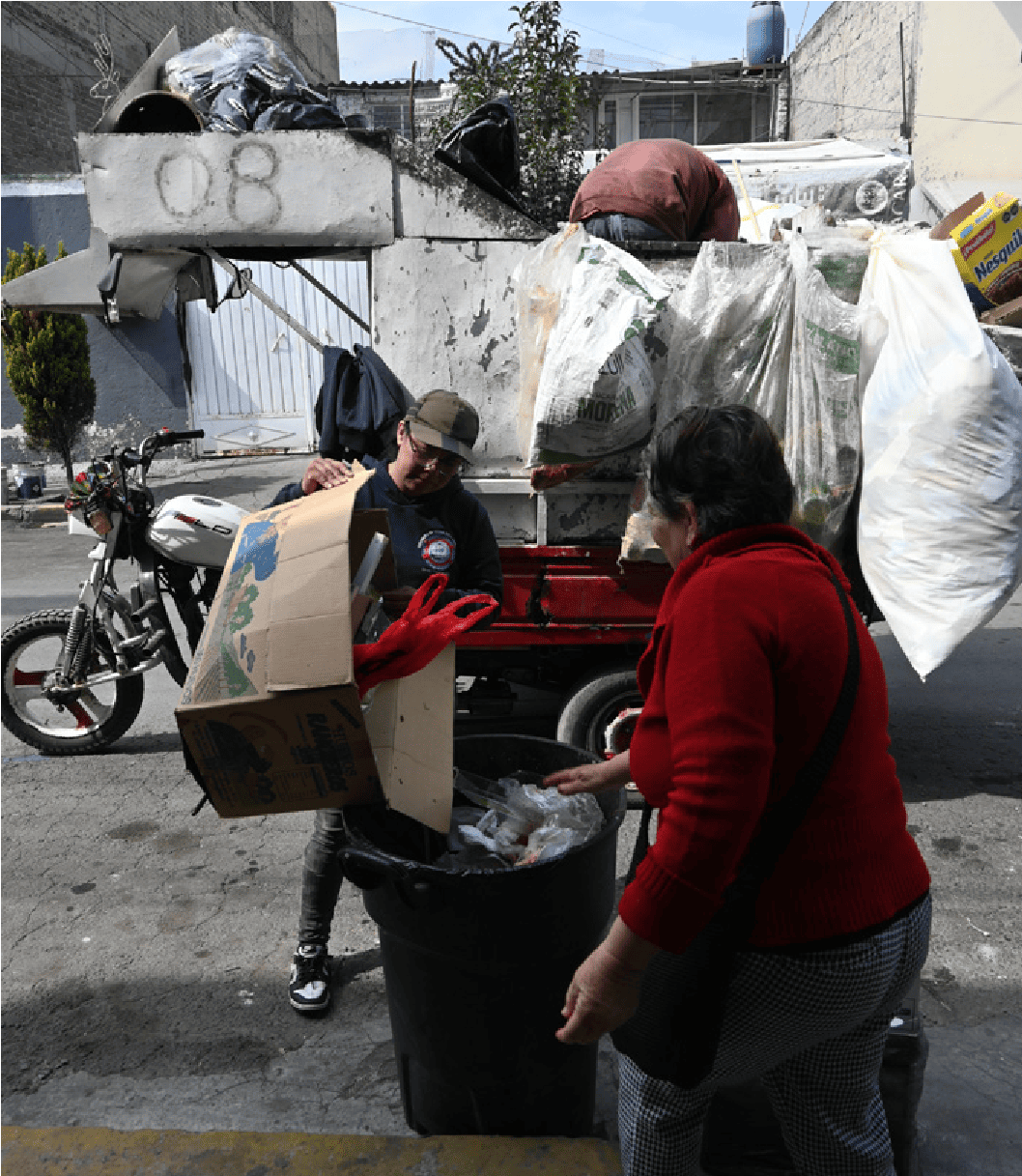
Figure 6. Ana and Cirilio work as a pair: one sorts and stores valuable materials in the barcinas, while the other greets residents and collects their waste. This tacit division of roles, never formalized but organic, reveals how care organizes work in a balanced way, according to each person’s strength and energy. It also shows how a sound signals a presence and how a simple greeting can generate a tip.
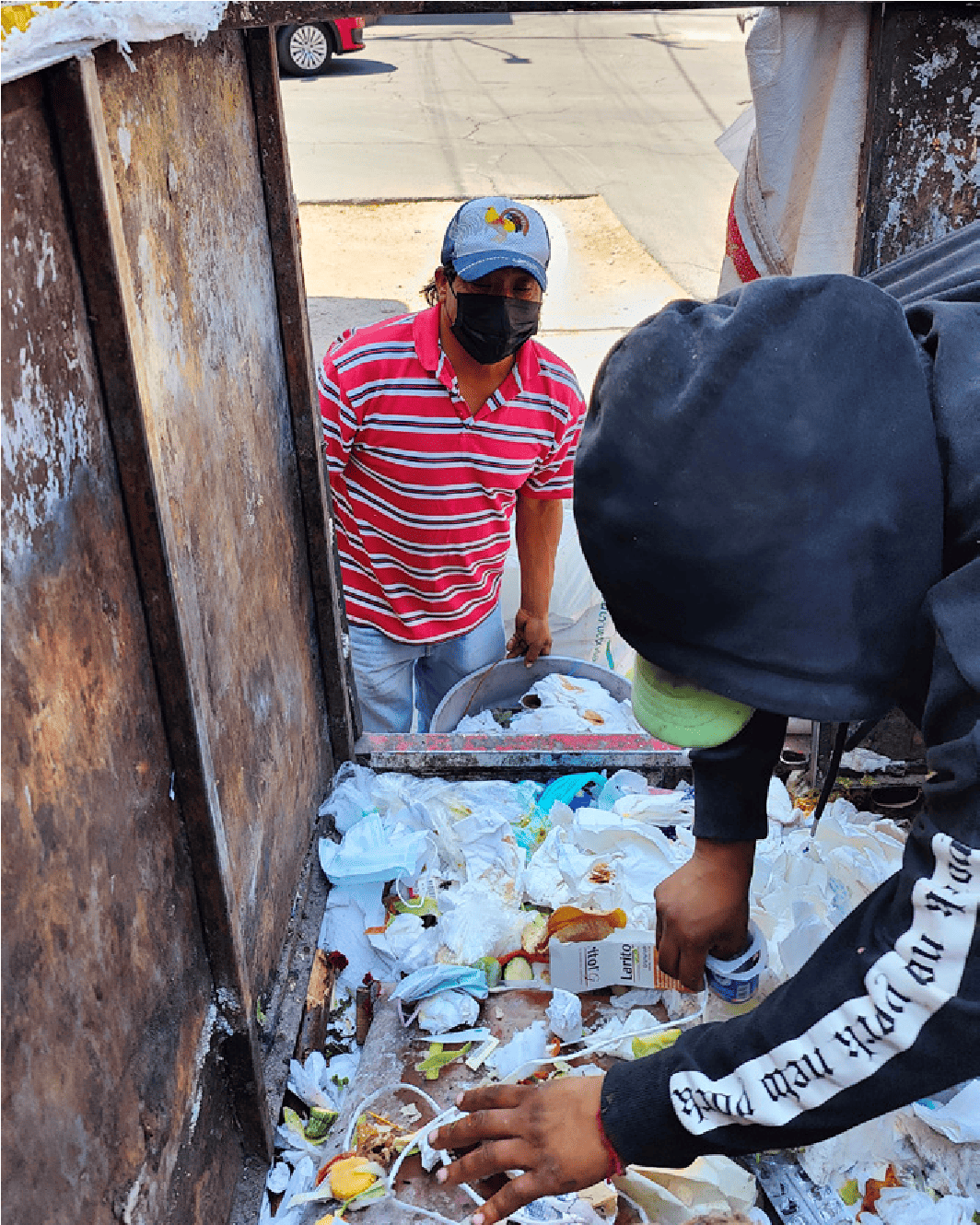
Figure 7.Ana sorts organic and inorganic waste with her bare hands inside the motor-cart. Her hood and cap protect her from the sun, but her hands are unprotected. This sorting gesture, meticulous and repetitive, is a necessary and a preventive form of care to avoid conflicts at the entrance of the landfill. These invisible and physically demanding gestures reveal a bodily dimension that writing and image alone cannot render visible.
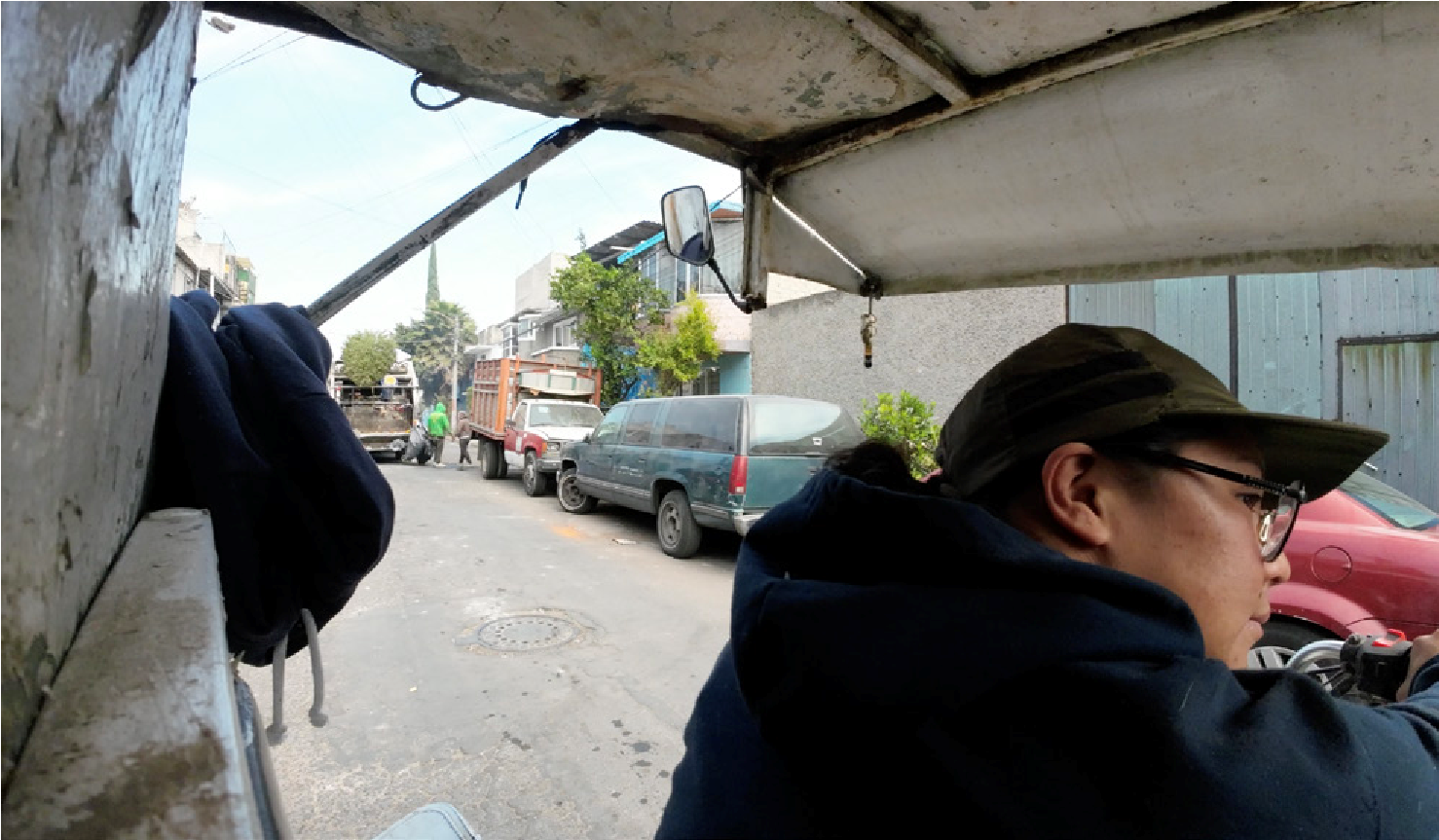
Figure 8. The municipal truck did not honk to signal its presence. When Ana sees it, she quickly turns around to give way in the street. This discreet withdrawal is a form of strategic care: avoiding confrontation and conflict in order to preserve access to the territory and maintain the fragile balance of understanding between trucks and informal waste pickers.
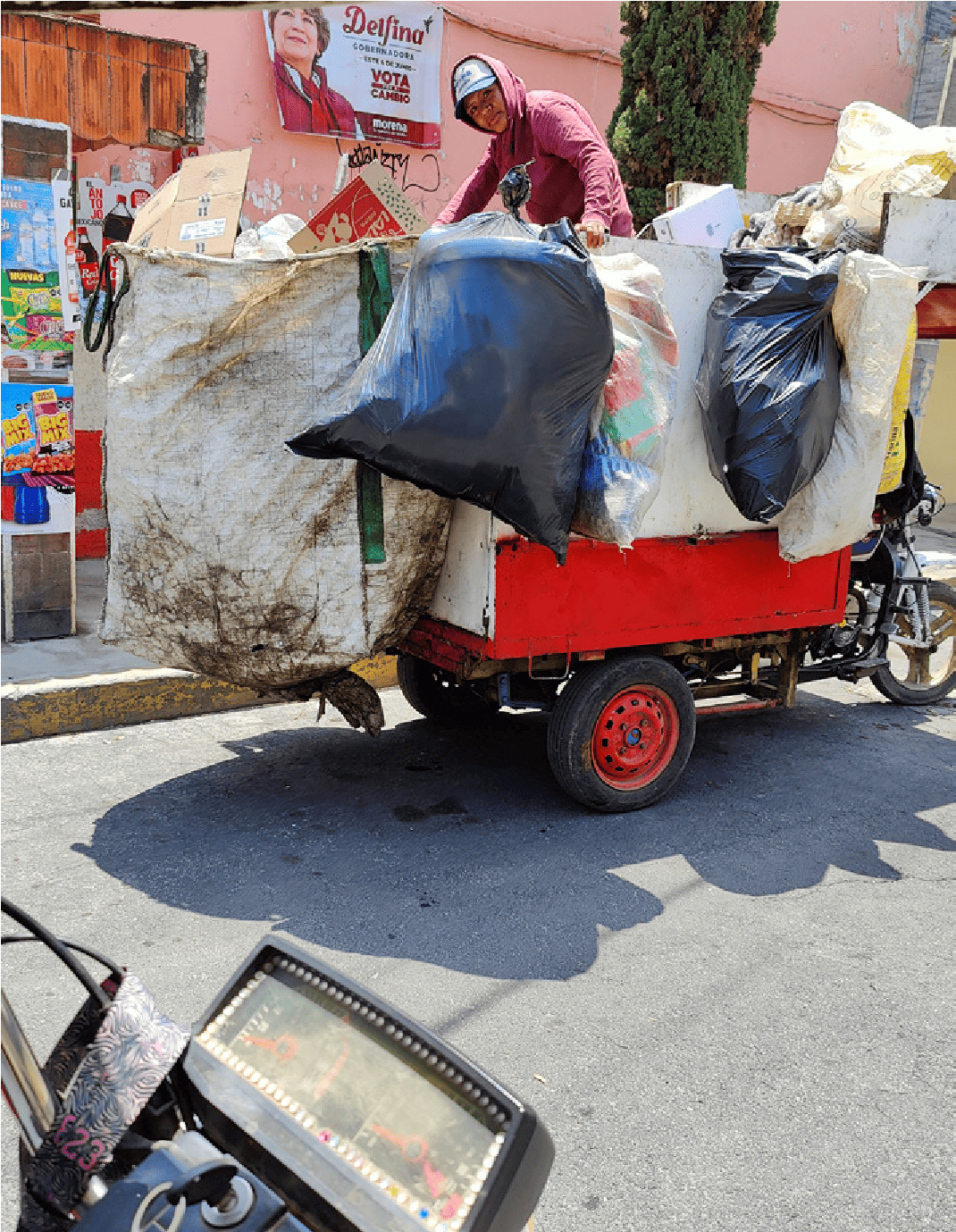
Figure 9. Ana discovers a so-called pirate collector in her sector. She calmly asks him to leave and takes a photo of him to alert her leader. This gesture reveals how care also protects the invisible boundaries of the territory: signaling without anger, protecting in order to survive.
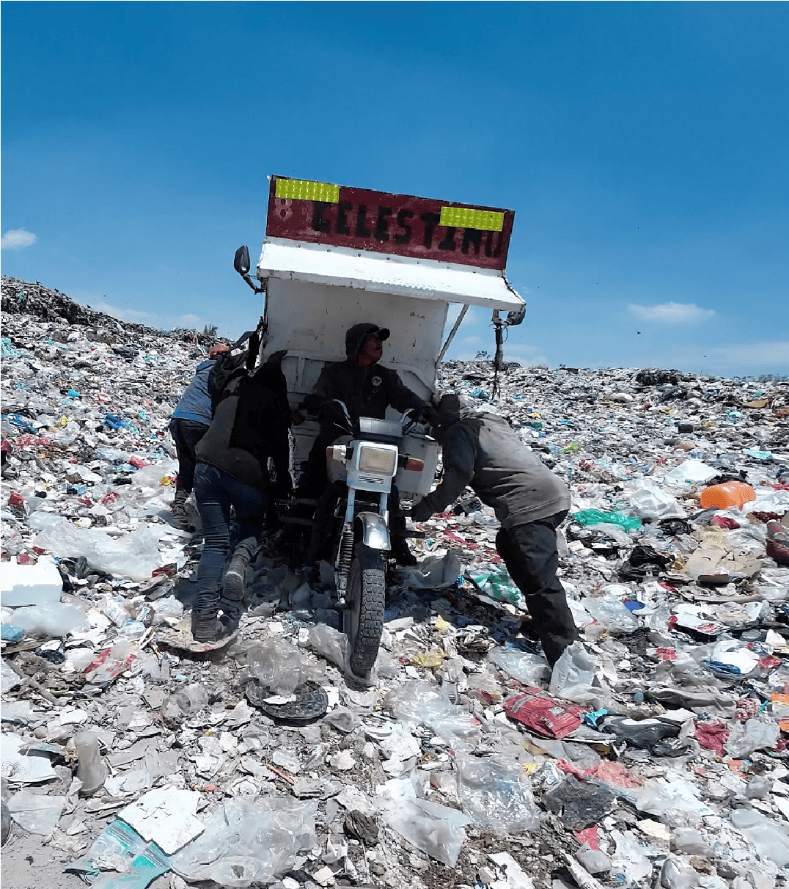
Figure 10. At the landfill, pepenadores help Ana mount and then unload her motor-cart. This spontaneous mechanical support between waste collectors, unpaid, shows that care extends into the dumpside, that it continues until the end of collection, and forms a continuous solidarity that allows each person to have a role, an income, and a place in space.
Fragment 3 - Truck 916 and Javier: a form of Solidarity of Care (figures 11-15)
Javier is an official sweeper of Sector 9 in La Condesa. Forty-five years old, with many years in the job, he knows the system’s mechanics, its opportunities and its limits. Impassive, leaning against his cart, he smokes as he waits for the arrival of truck 916, essential for emptying his barrels and maintaining his route. Suddenly, the engine’s rumble is heard, the truck appears at the corner of Avenida Sonora.
Miguel, the driver, parks in his usual spot, and the voluntarios6 leap off the back: one rings the metal bell, the campana, another runs to collect an apartment build-ing’s containers, the others stay to gather waste and sort valuable materials. Residents arrive with their bins, sometimes tipping, sometimes with specific requests that only Miguel, the truck’s leader, can address.
Javier relies primarily on the truck 916. When Miguel is absent or the truck breaks down, Javier improvises: calling other trucks, negotiating a place, renegotiating condi-tions. But with Miguel and his team, the ecotone is fluid: every day Javier empties his barrels, complains about delays, exchanges friendly insults, contests when tacit agreements change, helps colleagues, warns when a car approaches too fast, assists residents carrying their bins, and sometimes joins the improvised communal meal. At the end of the service, he sweeps the area, then returns to the depot or sells his valu-able materials. Other sweepers in the sector live similar rhythms.
This official service operates as a hybrid system. What I observe among sweepers, trucks, volunteers, piones, residents, and sector chiefs is that each one adapts and con-tributes, each in their own way, to sustaining collection. Schedules shift, routes change depending on urgencies, breakdowns or absences require reorganizing the day, access to water and toilets is precarious, and each worker develops their own tactics to meet basic needs. The sale of recovered materials funds Javier’s extras, pays volunteers and piones, supports truck maintenance, and covers part of medical costs in case of accidents.
In this orderly-looking official landscape, each encounter becomes an ecotone: resource exchanges, information sharing, agreements with sector chiefs, service adjustments, all are subtle forms of care, signs of solidarity among hybrid collectors. When it circulates, care keeps the service functional; when it withdraws, it fragments microsystems, weakens relational ties, and renders the entire ecosystem vulnerable.
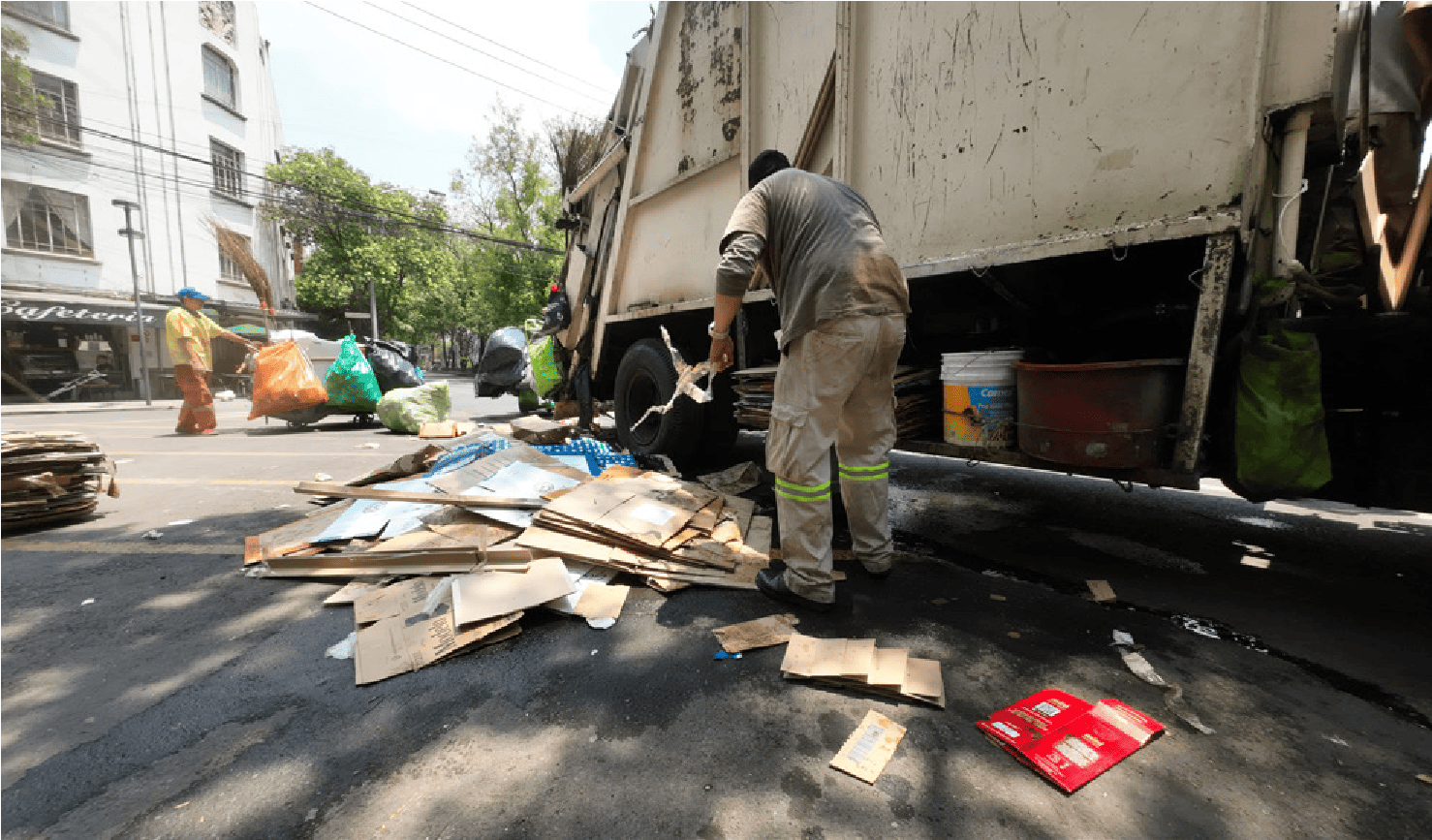
Figure 11. Javier empties his barrels into the bin of truck 916. This daily tacit agreement works because he gives a helping hand in exchange for depositing his organic waste and garbage: it is the most visible form of care among formal collectors, a mutual assistance and discreet validation that allows each party to benefit without ever truly formalizing it.
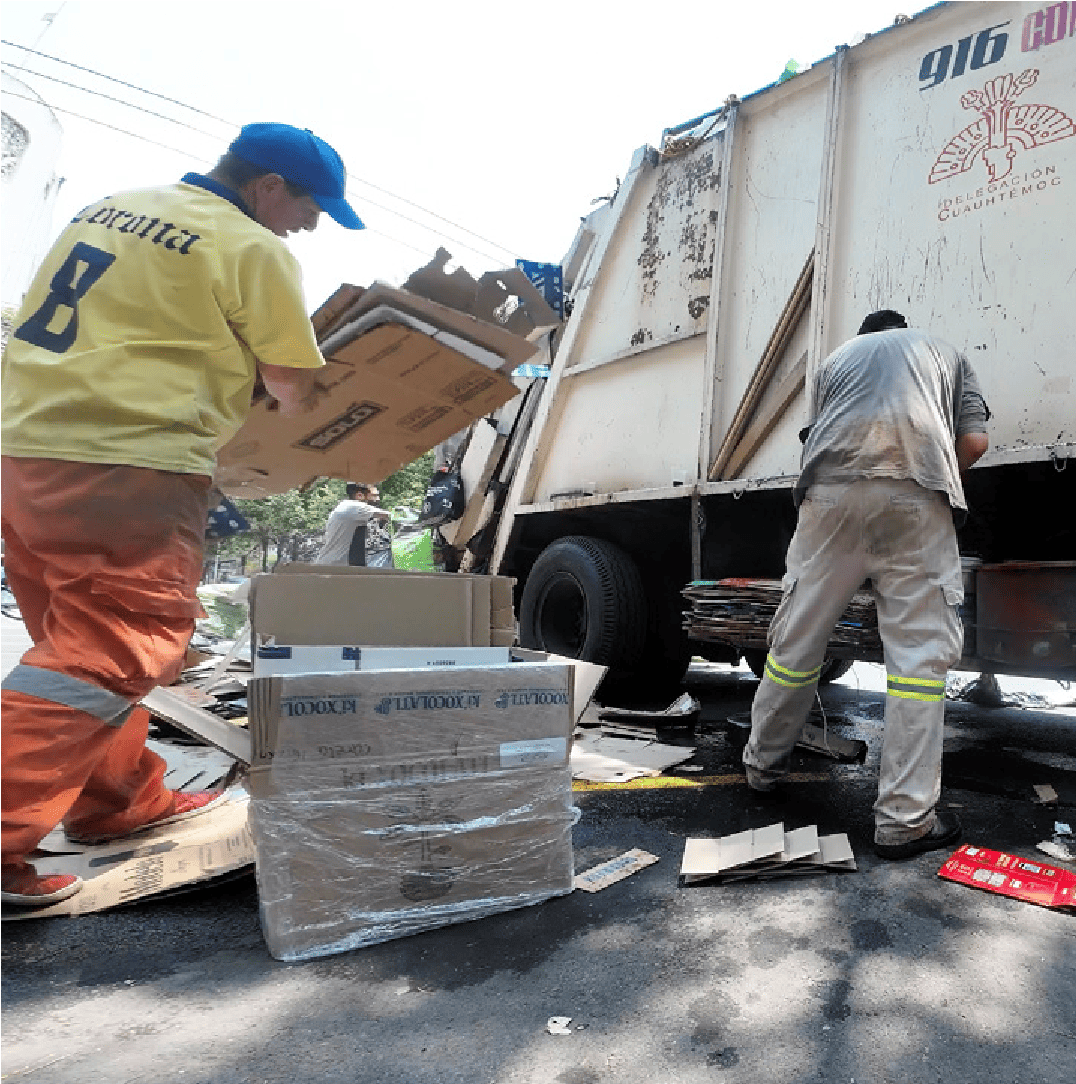
Figure 12. Javier, in a yellow T-shirt, helps the crew of truck 916 sort and fold cardboard. Without this unpaid help, he would not be able to empty his barrels or collect additional waste to generate extra income. This gesture reveals how the care devoted to maintaining good relations with the driver and the truck team conditions access to additional economic resources.
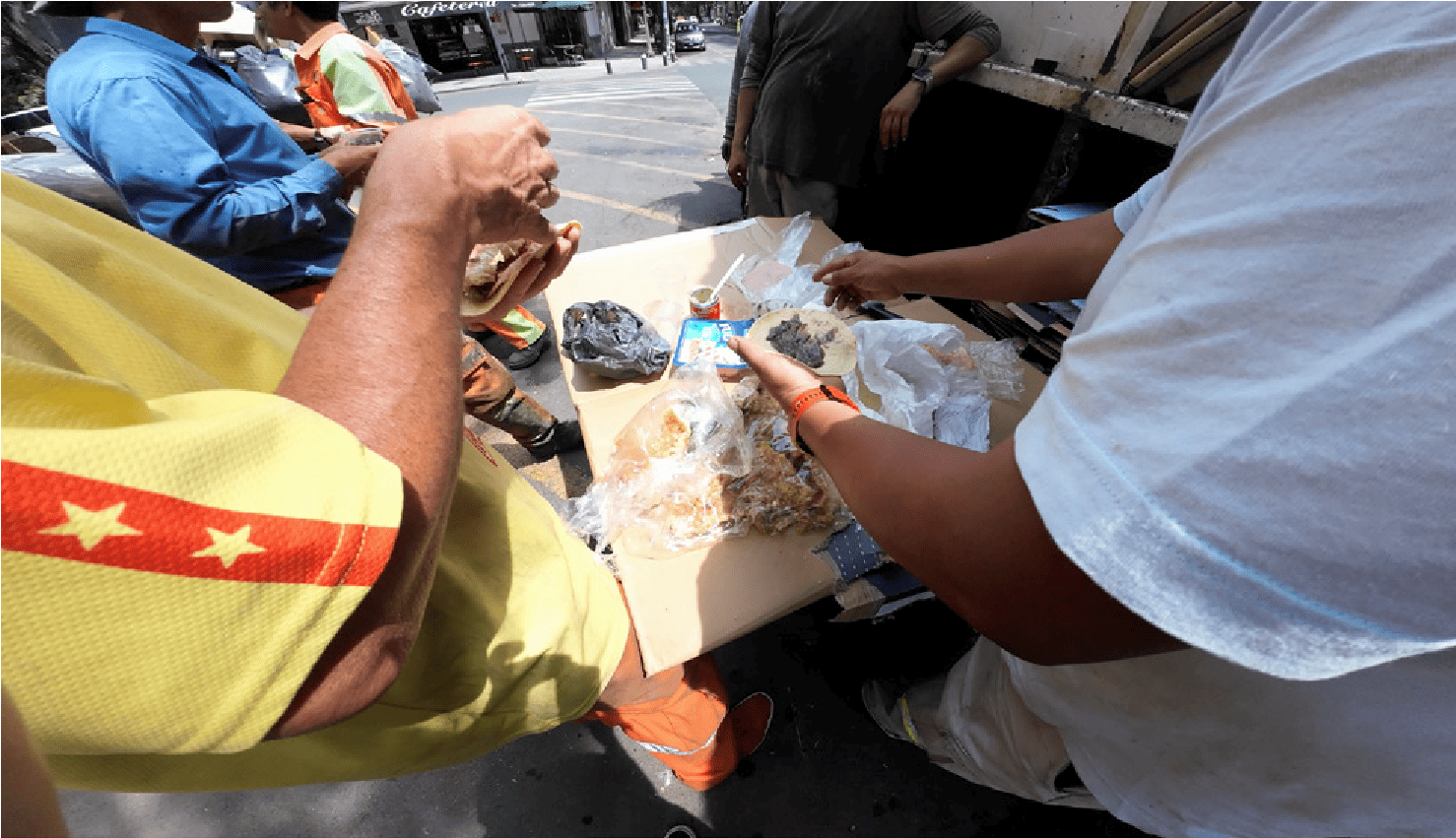
Figure 13. After work, Javier shares a meal with the truck team. This informal and relaxed moment is not a break; it is an ecotone of care: a space-time where human bonds are strengthened, where news and advice about the sector are exchanged, where each party gathers insights to adjust their collection practices.
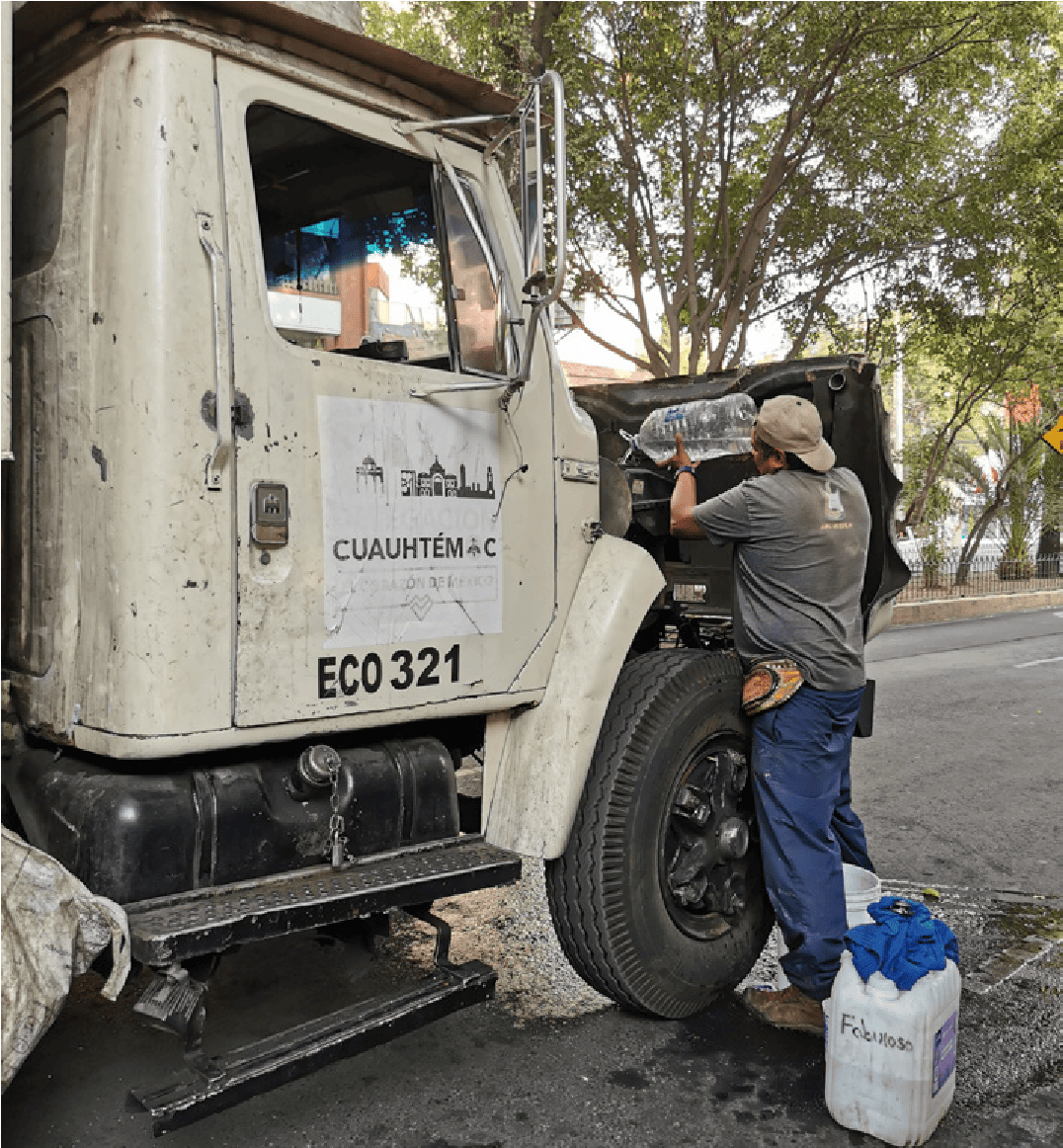
Figure 14. The engine overheated again; it is old and there is no money to repair it. So the collectors adapt and go into the street to fetch water to cool it down. This collective emergency gesture reveals how material care keeps the working tool alive. Without it, the entire chain stops: no truck, no collection, and therefore no income.
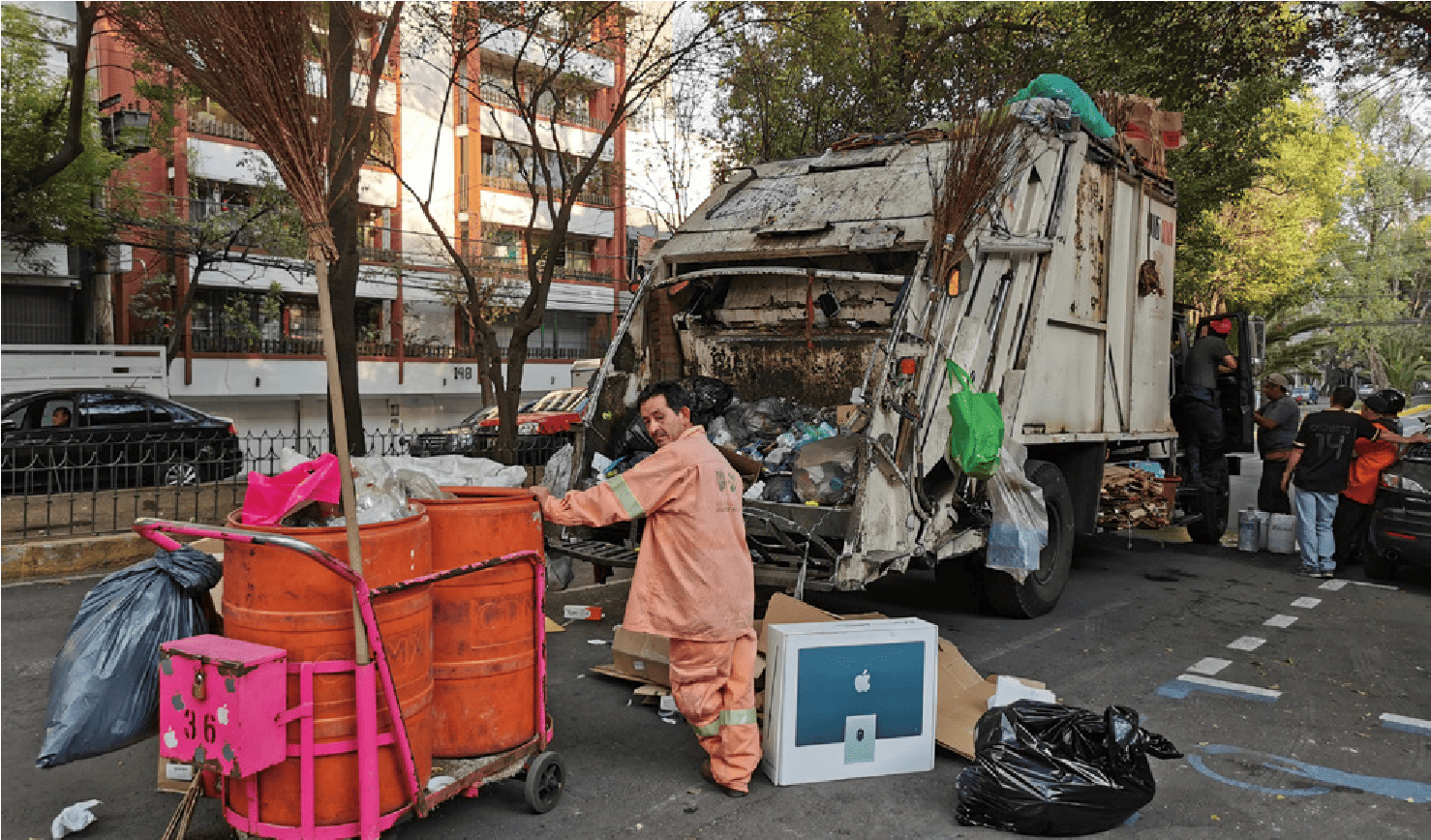
Figure 15. When the truck breaks down, collection is blocked. Street sweepers are at a standstill, garbage piles up on the sidewalks, and tension rises between citizens angry about the disorder and sector leaders calling for patience. This image reveals what happens when care withdraws: the system fractures, tension increases, discomfort becomes visible, and everyday order is disrupted, it becomes dirty, noisy, and suddenly intrusive.
The camera as a tool that reveals the continuum of care
Using a camera in the field gradually imposed itself as an obvious choice. Not as a new tool meant to illustrate forms of care, but as a pretext to remain alongside collectors for longer periods and to grasp what writing, photography, or mapping could not make visible: the thickness of ecotones.
The camera changed the rhythm of the research: slower, more continuous, more attentive. It shifted my posture from observer to situated researcher. This shift re-quired time, listening, care, and a regular presence on the field during both ordinary moments and moments of daily tension. My position as a white European woman, educated but speaking simple Spanish, curious but not threatening, facilitated my step-by-step integration with different collectors.
It was only once trust was established, after being questioned, vetted, then accept-ed, recognized, and finally integrated into their daily life and struggles, that I was able to use the camera without interfering with our exchanges. It then became a partner, a co-presence, rather than an intrusive device. It justified my long and continuous presence in the field while also being perceived as an attractive tool by collectors, as it gave value and visibility to their work. Filming, and then sharing the videos with them, fostered rich exchanges, making their stories more accessible and more easily diffused outward. The images were not extracted from their context: they circulated between us, raw, imperfect, revealing at once my hesitant videographic practice and the depth of their ecotones: intense, complex, subtle.
Filming also asked me to take a position. A film is not neutral; it is a form of com-mitment to the community that opened its world to me. My commitment rests on a tacit pact, on mutual trust, and on the responsibility to take and to give back without altering the integrity of what was shared. This is what allowed me to film sincere and truthful scenes of the collectors’ daily life, scenes that I hope to return to them in a form they can make their own.
Through sound and image, the camera made visible without fragmenting the thick-ness of shifting moments: relational exchanges, Ana’s precise gestures, the tacit agree-ments between Javier and Miguel, the tensions and silent negotiations at the entrance of Neza 3, the voices rising and softening, the bodily signals reflecting solidarity or an-nouncing conflict. This weaving of micro moments (short or long) reveals the “material and political work” (María Puig de la Bellacasa, 2017) through which collectors keep the ecosystem alive together.
Film gives depth to forms of care: it shows them as a continuous relational flow rather than isolated gestures. It becomes a political tool that reveals what is usually invisible; an archival tool that preserves endangered practices; a tool of transmis-sion that shares situated knowledge, a knowledge that can remain authentic only through movement.
Conclusion
This ongoing research explores film as a tool capable of making visible, through the prism of care, the thickness of relational moments that structure the waste collection system in the Metropolitan Zone of Mexico City. It does not claim to offer solutions or propose a model; it seeks rather to open an artistic mode of inquiry, slower, longer, more attentive to the human exchanges that keep this system alive..
In the Metropolitan Area of Mexico City, waste collection has taken the form of a dynamic and porous system, shaped partly by insufficient infrastructure and the absence of an adapted legal framework. It has been built through exchanges, nego-tiations, daily adjustments, discreet mutual aid, and tacit agreements. The system is neither formal nor informal; it is hybrid. Any attempt to apply normative tools or to privatize the waste collection service without understanding it as a living ecosystem would risk weakening it further rather than strengthening it.
the ecosystem in its own language: a living language in which care is not a moral value but a material, political, and asymmetrical practice. This asymmetry reveals the actors of the system who have the space, or not, to repair and maintain the struc-ture, and those who, on the contrary, benefit from this balance kept alive through care without reciprocity, thereby weakening the system as a whole.
To work with film is to choose to see things from a different perspective. It means accepting that what keeps this system alive is not legislation, often experienced as a weakening force, but the circulation of care that sustains the entire chain of collection. It resides in discreet, minimal, often invisible gestures: those that repair, protect, warn, adjust, and hold together what might otherwise break apart.
This exploratory research aims to open new methodological paths for researchers working on hybrid urban systems. The proposition of film as a situated analytical tool could be applied to any ecosystem whose balance rests on relational practices and invisi-ble power relations. Several conditions are nonetheless necessary for its implementation: a long and continuous presence in the field allowing the establishment of trust with the actors (1); a posture of co-presence rather than distant observer (2); a particular atten-tion to soundscapes, discreet gestures and silences of these situated systems (3). The use of documentary film proposed here is not a fixed model but an invitation to experiment with other more visual and continuous mediums for describing care ecotones.
Finally, if film becomes a tool capable of producing a fine-grained reading of a system that operates through relationships rather than regulations, then new forms of action become possible; actions grounded in interactions, in ecotones, in the places where ex-changes are negotiated and where the waste system is built and repaired; actions where care already exists, protects, and keeps the system alive, and where it is absent, it must be supported rather than where the administration arbitrarily decides to intervene. post(s)
References
Balkema, A. W., & Slager, H. (Eds.). (2004). Artistic research. Rodopi.
Berger, L., & Bertschi, D. (Eds.). (2024). Researching otherwise: Pluriversal methodologies for landscape and urban studies (N. Bathla & C. Ortiz, co-Eds.). gta Verlag.
Bernache Pérez, G. (2006). Cuando la basura nos alcanza: el impacto de la degradación ambiental. CIESAS.
Castillo Berthier, H. F. (1990). La sociedad de la basura: caciquismo urbano en la Ciudad de México. UNAM, Instituto de Investigaciones Sociales.
González Déctor, M. C. (2017). Entre basura y realidades sociales: la pepena urbana y la recolección informal de residuos en Orizaba, Veracruz. Universidad Veracruzana.
Hirata, H. (2021). Le care, théories et pratiques. La Dispute.
Puig de la Bellacasa, M. (2017). Matters of care: Speculative ethics in more than human worlds. University of Minnesota Press.
Notes
Pepena: It is the informal sorting and recovery of valuable materials, practised primarily at landfill sites or directly within collection trucks.
Barrendero: street sweeper responsible for cleaning leaves and wastes within public streets and squares.
Pepenador: informal waste picker specialized in sorting recyclable materials from wastes in landfield or public space: in this context, refers to workers in the Neza 3 dumpsite who collect recyclables from truck deliveries or assist carretoneros in emptying their moto-benne.
Piones: assistants who help the truck driver collect and sort waste; they are paid and officially recogni-zed by the government.
Author notes
geraldine.deneuville@uclouvain.be