PRIMER REGISTRO DE Capucina patula (WALKER, 1871) (BLATTODEA: BLABERIDAE: ZETOBORINAE) PARA PANAMÁ; UNA NUEVA UBICACIÓN PARA COMPRENDER SU DISTRIBUCIÓN
FIRST RECORD OF Capucina patula (WALKER, 1871) (BLATTODEA: BLABERIDAE: ZETOBORINAE) FOR PANAMA; A NEW LOCATION TO COMPRISE YOUR DISTRIBUTION
Recepción: 10 Marzo 2017
Aprobación: 30 Mayo 2017

Esta obra está bajo una Licencia Creative Commons Atribución-NoComercial-CompartirIgual 4.0 Internacional.
Capucina Saussure, 1893 is a monotypic genus of cockroaches of the subfamily Zetoborinae, its only representative Capucina patula (Walker, 1871), described with type locality in Chontales, Nicaragua [=Zetobora patula Walker, 1871: 8 (D♂(sic) ♀)]
[=Capucina cucullata Saussure, 1893: 67 (♀) junior synonym Sensu Princis, 1958: 70, same type material] [=Capucinus cucullatus(sic) Saussure & Zehntner, 1893: 102; Lam. VI, Fig. 13 mistake].
Capucina patula is distinctive for the delicate structure, greatly flattened form and very broad tegmina and a brown coloration with a white macula on the anterior edge of the pronotum. Its size is about 30 mm of body length (Hebard, 1921a: 147) and in having the pronotum and tegmina covered with a velvety pilosity (Saussure & Zehntner, 1893) (Fig. 1).
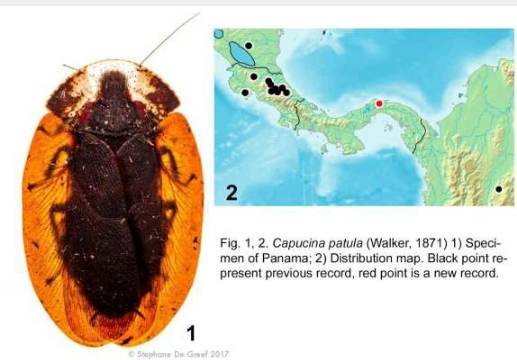
Fig. 1, 2.
Capucina patula (Walker, 1871) 1) Specimen of Panama; 2) Distribution map. Black point represent previous record, red point is a new record.
Roth in 1970 placing this genus within the Phortioecini tribe (vs McKittrick, 1964 in Panchlorinae, Princis 1960 in Laxtinae) for their affinities and male genitalia (see Roth, 1970). Capucina patula has discontinuous records in Nicaragua, Costa Rica and Colombia, without records in Panamanian territory previously (Princis. 1963: 158; Roth, 1970: 224, 233).
With a record for Colombia, Muzo, Boyacá (Apolinar 1937; Hebard, 1921 it was thought that this species was in Panamanian territory, without confirming so far.
On 12 January 2017 the co-author Stéphane De Greef found a single specimen of cockroach on the forest floor during a night walk around the Field Station of Cocobolo Nature Reserve (9.2925°N 79.2056°W) in the Mamoni Valley, Chepo District, Panama Province, Panama. Unable to identify the species, he photographed the specimen the next day on a field studio with backlight white background and posted the resulting image on iNaturalist and various Facebook groups to seek identification by other entomologists. On 10 September 2017, three extremely flat nymphs of cockroaches were found under the peeling bark of a dead tree at another site in the secondary rainforest about one kilometre north of the previous location. The nymphs were recorded on video but were not collected on that occasion, but were regularly seen under the same loose bark over the following months.
Previous records (localities amended): Nicaragua, Prov. Depto. Chontales (LT) (Maes, 1992a: 23; Saussure & Zehntner, 1893: 102; Walker, 1871: 8). Costa Rica, Prov. Alajuela, Loc. Las Delicias, Santa Clara; Prov. Cartago, Loc. Turrialba, Juan Viñas; Prov. Heredia, La Virgen, Parque Nacional Braulio Carrillo; Prov. San José, Loc. San José; Rio Virilla; Prov. Guanacaste, Loc. Tillarán (Biolley, 1900: 48;Fisk, 1971: 441; Rehn, 1903: 286). Colombia, Depto. Boyaca, Mpio. Muzo (Apolinar
1937: 135; Hebard, 1921a: 147).
NOTE: The record of Salazar 2001: 43; Fig 3 is doubtful, because the illustration of the pronto presented it does not correspond to Capucina, is more like Lanxoblatta frater Hebard, 1933 from Colombia (ver Hebard, 1933: 23; Lam. II, fig.5), the work
Hebard, 1933 is omitted in Salazar 2001.
New record: 1♀ of Panamá, Prov. Panamá, Distr. Chepo, Valle Mamoni, Reserva Natural Cocobolo (Cocobolo Nature Reserve) (9.2925°N 79.2056°W, 220m); 12
/Jan./2017; Stéphane De Greef (Fig. 1 Stéphane De Greef). Stored in Ethanol 90% in the field station of Cocobolo Nature Reserve (Fig. 1)
Biogeography: The monotypic genus Capucina Saussure, 1893 have a distribution within the provinces of the Caribbean subregion: East of Central America, West of the Isthmus of Panama (This paper), Amazonia, Choco-Magdalena and Norandina (Vélez et al., 2006) (Fig. 2).
Fig. 1, 2.
Capucina patula (Walker, 1871) 1) Specimen of Panama; 2) Distribution map. Black point represent previous record, red point is a new record.