

Ciências Florestais
INOCULATION BY DIFFERENT PRODUCTS BASED ON Azospirillum brasilense IN THE WHEAT CULTURE
Revista Ciência Agrícola
Universidade Federal de Alagoas, Brasil
ISSN: 0103-8699
ISSN-e: 2447-3383
Periodicity: Cuatrimestral
vol. 20, no. 1, 2022
Published: 29 April 2022
Corresponding author: ecco.martios@pucpr.br
Abstract: The aim of this study was to analyze the effect of inoculation of products based on Azospirillum brasiliensis in wheat seeds, evaluating production components of this culture. The experiment was carried out in a randomized block design, containing 5 treatments, with 4 replicates each. Treatments consisted of three commercial products: Masterfix gramíneas, Gelfix gramíneas and Nitro 1000, at dosage of 100 mL for each 50 kg of seeds. Nitro 1000 was used in the presence and absence of N application to evaluate the performance of bacteria in promoting root development, in addition to control treatment. The variables evaluated were: plant height (cm), stem diameter (mm), ear size (cm), ear diameter (mm), number of spikelets, hectoliter weight (PH) and yield (kg ha-1). Data obtained were submitted to the Tukey test at 5% significance, where significant response was observed in the following variables: plant height, stem diameter, number of spikelets, and yield. The number of spikelets produced per spike was a determining factor interfering with productivity, in which treatment with no base fertilization and topdressing obtained the lowest number of spikelets and, thus, lower productivity. Therefore, nitrogen fertilization was essential to increase production, regardless of association with inoculants used in this work.
Keywords: Diazotrophic bacteria, Nitrogen, Triticum aestivum..
Resumo: Objetivou-se com o presente estudo, analisar o efeito da inoculação de produtos à base de Azospirillum brasiliensis em sementes de trigo, avaliando componentes de produção desta cultura. O experimento foi conduzido em delineamento em blocos casualizados, contendo 5 tratamentos, em 4 repetições cada. Os tratamentos consistiram na utilização de três produtos comerciais: Masterfix gramíneas, Gelfix gramíneas e Nitro 1000, na dosagem de 100 mL para cada 50 kg de sementes. O Nitro 1000 foi utilizado na presença e ausência da aplicação de N, para avaliar o desempenho das bactérias na promoção do desenvolvimento radicular, além do tratamento testemunha. As variáveis avaliadas foram: altura da planta (cm), diâmetro do colmo (mm), tamanho da espiga (cm), diâmetro da espiga (mm), número de espiguetas, peso do hectolitro (PH) e produtividade (kg ha-1). Os dados obtidos foram submetidos ao teste de Tukey a 5% de significância, onde houve resposta significativa nas variáveis; altura de planta, diâmetro do colmo, número de espiguetas, e produtividade. O número de espiguetas produzidos por espiga, foi determinante para interferir na produtividade, em que o tratamento onde não foi realizado a adubação de base e cobertura obteve o menor número de espiguetas e, assim em menor produtividade. Portanto, a adubação nitrogenada foi essencial para proporcionar em acréscimos de produção, independentemente da associação com os inoculantes utilizados neste trabalho.
Palavras-chave: Bactérias diazotróficas, Nitrogênio, Triticum aestivum.
INTRODUCTION
New technologies need to be used in order to increase the national wheat production, reduce production cost and increase grain yield, such as increase in hectoliter weight (PH) through improved cultivars, resistance to lodging, lower ear germination, use of different forms of fertilization, seed inoculation, among other practices (Camponogara et al., 2015).
Several inputs have been recently developed in the national market for wheat cultivation, highlighting fertilizers with new formulations and products containing plant growth promotion microorganisms and/or substances. However, technicians and farmers still have doubts about the agronomic efficiency of these substances due to the scarcity of information on their efficiency (Silva and Pires, 2017), requiring further studies in different environments.
Fertilization with synthetic fertilizers is the most common practice for supplying nitrogen (N) to agricultural crops. According to Sangoi et al. (2015), nitrogen fertilizers are subject to losses due to erosion, leaching, volatilization and denitrification, as less than half of N applied to the soil is absorbed by crops, which is a major concern regarding the pollution of water resources and the atmosphere.
Among alternatives in the search for sustainable wheat production systems aiming at reducing application and increasing the N use efficiency, the use of bacteria capable of promoting biological N fixation (BNF) stands out (Sangoi et al., 2015). According to Reis and Teixeira (2005), these microorganisms, called diazotrophs, reduce atmospheric N (N.) into ammonia (NH..) by breaking the triple N bond by the action of the nitrogenase enzyme, with high ATP consumption. Ammonia is rapidly converted into ammonium (NH..), being assimilated by the plant cell in the form of glutamine.
The bacterium Azospirillum brasilense has the greatest potential to reduce the use of nitrogen fertilizers in poaceae, with inoculants marketed in Brazil containing this bacterium (Mumbach et al., 2017). This microorganism can provide several stimuli for plant growth, which, in addition to BNF and consequently in the photosynthetic activity, provides increase in the production of plant hormones such as auxins, gibberellins and cytokinins, phosphate solubilization and greater root development (Kazi et al., 2016).
The species Azospirillum spp. is an associative bacterium (Hungria, 2011), facultative endophytic beneficial to plants. When they grow inside the plant, they can increase the activity of the nitrate reductase enzyme as they colonize the rhizosphere and stimulate root growth, improving the absorption of water and nutrients, leaving plants with greater vigor (Hungria, 2011).
Poaceae have fasciculated root system, with advantages over the pivoting system of fabaceae in terms of extracting water and nutrients from the soil and for better photosynthetic efficiency (Quadros et al., 2014). In addition to fixing N, it provides greater phosphorus solubilization, production of growth-promoting hormones and stimulates root metabolism, helping plant development (Freitas et al., 2019).
There is evidence that in poaceae, inoculation with N-fixing bacteria of the genus Azospirillum does not completely replace the nitrogen fertilizer; however, it provided a significant increase in the size and diameter of primary and secondary roots, thus indicating a change in the root system, providing increase in the contact surface for the absorption of water and nutrients for the plant (Mendes et al., 2010).
The performance of diazotrophic bacteria is influenced by the N dose applied as reported by Sangoi et al. (2015), which depends on the level of management adopted by the farmer and the N amounts invested in the crop. Thus, it is important to understand this interaction for the adoption of the correct strategy in the choice of the inoculant, as well as the adoption of N dose that optimizes the performance of bacteria and the crop for different management investment situations. The variation of responses due to different managements, whether in the field or in controlled environments, may limit the efficiency of this inoculant.
The hypothesis of this work is that inoculation with Azospirillum brasiliensis strains in wheat seeds can promote an increase in grain yield in relation to uninoculated plants. Good BNF is the result of good commercial products and good inoculation management, providing savings in the application of chemical fertilizer and productivity gains due to the activity of these bacteria.
The inoculation of non-leguminous plants can supply, at least in part, the N needs of crops, allowing, in certain cases, to reduce the doses of the nutrient applied in topdressing. However, the agronomic feasibility of this practice still needs to be better evaluated. Therefore, in order to present a viable alternative and economic gain to the farmer, the aim was to analyze the effect of seed inoculation using products based on Azospirillum brasiliensis and base fertilization + topdressing, verifying the effect on the wheat production components.
MATERIAL AND METHODS
This study was carried out in the 2015 harvest in the municipality of Vera Cruz do Oeste – PR, located at coordinates 25° 04' 17.30'' S, 53° 53' 38.99'' W, at average altitude of 615 m a.s.l., with climate classified, according to Koppen, as humid subtropical with average annual temperature of 20oC.
The soil in the experimental area has clayey texture (type 3) of medium to high fertility, classified as dystroferric Red Latosol (Embrapa, 2018), with history of no tillage and crop succession.
Chemical analysis was carried out by means of soil sampling in the 0-20 cm depth layer 45 days before sowing, and the analysis proceeded according to methodology of Raij et al. (2001), presenting the following results: pH (CaCl2) 6.0; 4.96 cmoldm-3 of H++ Al3+; 8.42 cmolcdm-3 of Ca2+; 2.92 cmolcdm-3 of Mg2+; 0.59 cmolc/dm-3 of K+; 16.20 mg dm-3 of P (Mehlich 1); 46.44 g kg-1 MO and 70.63% base saturation.
According to the analysis, soil correction by means of liming was not necessary. The crop fertilization recommendation, according to production expectation of 3000 kg ha-1 of grains, was 367 kg ha-1 of the 10-20-10 NPK compound, and the rest of the crop fertilization was carried out by topdressing N applications using 60 kg ha-1. The nitrogen source used was urea with urease inhibitor (45% of N), with cast application 30 days after plant emergence, at the beginning of tillering.
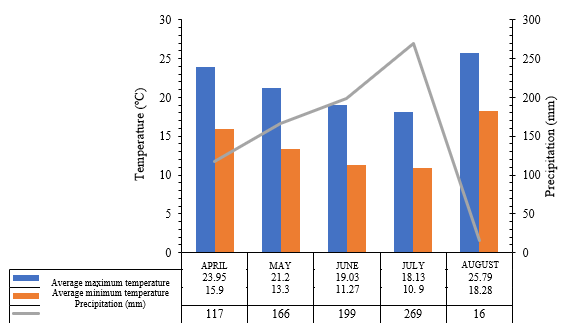
Precipitation data and average air temperatures were obtained from the meteorological station of Coopavel Vera Cruz do Oeste – PR (Figure 1).
The experimental design used was in randomized blocks (RBD), using five treatments with four replicates. Treatments evaluated were: T1 - (control) treatment without inoculation, with base fertilization and topdressing (367 kg ha-1 of 10-20-10 NPK compound); T2 – treatment with inoculation (NITRO 1000®), without base fertilization and topdressing; T3 – inoculation treatment (GELFIX GRAMINEAS®) with base fertilization and topdressing; T4 – treatment with inoculation (MASTERFIX GRAMINEAS®) with base fertilization and topdressing; T5 - inoculation treatment (NITRO 1000®) with base fertilization and topdressing.
Inoculation with Azospirillum spp. strains was performed at the time of sowing, using 100 mL of inoculant measured in volumetric pipette and mixed in 50 mL of water, held inside a plastic tray for 1 kg of seed.
Each test product has differences in composition. Nitro 1000 has Azospirillum brasilense, AbV5 and AbV6 strains, at concentration of 2.0 x 10⁸ viable cells per mL, in addition to vitamins, mineral salts, carbon source, water, thickener, preservative and PVP (aqueous) stabilizer, see leaflet inside. Masterfix gramíneas has the same strains and concentration as the previous product; however, without the other components. Gelfix gramíneas, on the other hand, presents another strain (BR11005 (SP245)), different from the other test products.
The wheat cultivar used was CD 150, with early cycle of 114 days on average, with medium/high fertility requirements. It has moderate susceptibility to diseases such as leaf spot (Stagonospora nodorum), powdery mildew (Blumeria graminis f.sp. tritici) and leaf rust (Puccinia triticina); however, it has susceptibility to Fusarium head blight (Gibberella zeae).
Sowing was carried out on April 11, 2015 in a pre-dry area, where soybean crop had been previously cultivated. The experimental units were implanted in a mechanized way under no tillage system with seeder composed of 15 wheat lines with spacing between them of 0.17 m, depth of 0.04 m, distributing 60 seeds per linear meter, with length of 5.0 m each plot, totaling 12.75 m2 each plot, and 383 m² of experimental area.
Weed control was manually performed by pulling out at the beginning of tillering. Pest control was carried out 40 days after sowing (elongation-booting), using chemical insecticides such as Beta-cyfluthrin at dose of 500 mL ha-¹ to control leaf aphids (Schizaphis graminum). Two fungicide applications were also carried out (Epoxiconazole + Cresoxim-methyl) at dose of 600 mL ha-¹, with spray volume of 200 L ha-¹ in the booting phase and the other application after 15 days, with the aid of manual backpack sprayer with capacity of 20 L (VULCAN-LXVP20L) with fan-type nozzle.
Harvest was manually carried out on August 14, 2015, where grains had moisture content of approximately 12%, mowing plants that were in the center of each plot, removing two lateral lines and one meter from each end. Soon after harvest, threshing was carried out with the aid of a stationary motorized threshing machine, and later the mass of grains of each plot were measured on a precision scale in order to obtain productivity after conversion into kg ha-1. To obtain hectoliter weight, automatic portable equipment for determination in 10 seconds (Nilema-litre) was used.
Plant height and ear length in centimeters (cm) were measured with the aid of a tape measure, evaluating ten plants from each plot measuring from the stem to the apex of the ear for plant height and ear size from the basal area to the apex. Stem diameter was evaluated using a caliper measuring at the basal part of the plant, while ear diameter was measured in the middle part of the ear. In addition to these measurements, the number of spikelets per ear was also counted, also collecting 10 plants in each plot.
The results of production variables were tabulated and submitted to analysis of variance as a function of the 5% significance level by the F test, and qualitative means were compared by the Tukey test at 5% probability, using the SISVAR 5.4 software (Ferreira, 2011).
RESULTS AND DISCUSSION
Plant height (AP) and stem diameter (DC) presented significant results (p>0.05), where the other variables presented in table 1, showed no significant effect by the F test at p>0.05.
| Treatments | AP | DC | CE | DE | |
| (cm) | (mm) | (cm) | (mm) | ||
| Control | 63.55 bc | 3.55 c | 7.30 | 6.55 | |
| Nitro1000-Ad | 60.70 c | 5.25 ab | 7.02 | 6.72 | |
| Gelfix | 72.75 ab | 4.77 b | 7.27 | 6.55 | |
| Masterfix | 72.47 ab | 5.82 a | 7.25 | 6.47 | |
| Nitro1000+Ad | 74.02 a | 5.67 a | 7.40 | 6.70 | |
| Overall average | |||||
| 68.70 | 5.01 | 7.25 | 6.60 | ||
| F value | |||||
| Treatments | 8.14* | 30.62* | 0.718 ns | 0,176ns | |
| CV (%) | 6.24 | 6.60 | 4.50 | 7.68 | |
Treatment with Nitro1000 inoculation plus base fertilization and topdressing provided higher AP, corroborating Sala et al. (2007), who, working with crop cultivated with endophytic diazotrophic bacteria, also observed increase in plant height, and attributed the effects to the production of growth phytohormones produced by the bacteria, thus promoting better cell division and expansion, such as stem elongation and, consequently, the height of larger plants.
The phytohormone responsible for this result is cytokinin, which is found in large amounts in the region of root apices. Cytokinin is directly related to cell division, and experiments carried out with tobacco showed that this hormone, together with auxin, produced several small and undifferentiated cells with meristematic characteristics.
Auxins, on the other hand, promote growth by elongation, mainly by increasing the extension capacity of the cell wall. According to the acid growth hypothesis, one of the important actions of auxin is to induce cells to transport protons to the cell wall, which in short, cause its loosening and elongation (Taiz et al., 2017).
Zagonel et al. (2002), Espindula et al. (2010) and Pietro-Souza et al. (2013) related the height of wheat plants with the increase in the N doses applied; however, they emphasize the possibility that this effect is not advantageous, given the possibility of plant lodging or damping-off. Partially corroborating the results of these authors, it is possible to affirm the direct action of N fertilization, because where the fertilizer was not applied, lower AP was observed. However, the control treatment, where wheat seeds were not inoculated but received fertilization, also showed lower AP compared to treatment inoculated with Nitro 1000 and nitrogen fertilization, allowing to affirm that the association of Nitro 1000 inoculation plus recommended fertilization, can interfere negatively, allowing greater risks of crop lodging.
For variable stem diameter (DC), it was possible to verify the importance of inoculation with AbV5 and AbV6 A. brasilense strains, different from treatment where it was not inoculated. In addition to this result, it is possible to observe that these strains may be more efficient when associated with fertilization, as for the BR11005 strain (SP245) of the Gelfix product (Table 1).
The larger stem diameter is directly related to increase in production, as it acts in the storage of soluble solids that can be used to allow greater differentiation of spikelets and contribute to the formation of grains in the post-anthesis filling period, especially if any stress comes to compromising the rate of production and translocation of photoassimilates during the grain filling phase (Dartora et al., 2013).
Therefore, the use of inoculants can be an excellent parameter for higher yields, since it actively acts on the assimilation and mainly dry matter accumulation, in which stem reserves are essential to maintain adequate yield levels (Pietro-Souza et al., 2013). Greater availability of assimilates (reserves) may represent greater number of spikelets during their differentiation in the period between double ridge and terminal spikelet (Stages 5 and 6, according to the Feekes phenological scale, modified by Large (1954)). Close to anthesis, it may represent more fertile flowers and, consequently, grains in greater number and size, because after anthesis, phototasimylates are directed to the production of ears (Fioreze, 2011).
The increments observed in the stem basal diameter of inoculated plants may be associated with the production of phytohormones by bacteria, such as auxins, gibberellins and cytokinins (Dartora et al., 2013). According to Dalla Santa et al. (2004), this growth-promoting effect is remarkable since these microorganisms stimulate the density and length of root hairs, as well as the rate of appearance of lateral roots, causing increase in the root contact surface, which enhances the use of water and nutrients available in the soil (Correa et al., 2008).
There was no significant effect of treatments on variables ear length (CE) and ear diameter (DE) (Table 1). Few authors have evaluated these variables in the wheat crop; however, it was believed that there could be an increase in ear diameter due to increase in the PH variable, in which N application together with inoculation would provide greater filling of spikelets. However, it was observed that there was no significant effect on both variables (Tables 1).
Rodrigues et al. (2014) reported that when in deficient amounts of N, plants invest energy in grain mass. In satisfactory amounts of N, plants direct photoassimilates to the length of reproductive structures, indicating that N will not be used to complement grain mass, but for the growth and elongation of vegetative structures, which may explain why in this work, no difference in CE and DE was observed.
It is evident that only inoculation by microorganisms in seeds is not capable of causing increases in a certain production component. Even though there was no change in the CE and DE values in this work, Mumbach et al. (2017) verified that in treatments where N was applied in the implantation of the corn crop and in topdressing, higher CE and DE values were observed in relation to treatments that only received A. brasilense inoculation, thus evidencing the fundamental importance of nitrogen fertilization.
According to Rodrigues et al. (2014), the production of photoassimilates probably did not differ in the different N doses applied because under conditions of low amounts of available N, plants invest in grain mass and, in adequate amounts, they are directed to the increase in number and length of reproductive structures, which corroborates this research, since fertilization was adequate in the wheat cultivation and in previous managements, it was assumed that N was not translocated to increase grain mass.
Table 2 shows significant differences for variables number of spikelets (NE) and productivity (PROD), with no statistical differences for variable hectoliter weight (PH). It was observed that only in Nitro1000 treatment without base fertilization and topdressing, NE was inferior to the other treatments, including control where N was applied. This result clearly shows the need and importance of nitrogen fertilizers in the wheat crop and that its productive development is limited in its absence.
| Treatments | NE | PH | PROD |
| (kg ha-¹) | |||
| Control | 14.65 a | 77.5 | 1993.8275 a |
| Nitro 1000 - Ad | 12.42 b | 78.25 | 1366.2533 b |
| Gelfix | 15.67 a | 78.00 | 2049.3825 a |
| Masterfix | 15.12 a | 78.25 | 2203.7025 a |
| Nitro 1000 + Ad | 15.82 a | 78.00 | 2006.1725 a |
| Overall average | |||
| 14.74 | 78 | 1917.2835 | |
| F value | |||
| Inoculation | 15.66* | 0.48 ns | 16.298* |
| CV (%) | 4.71 | 1.13 | 7.82 |
The stimulus provided by nitrogen fertilization in the development of the plant as a whole is due to the fact that N is closely linked to the plant growth process, participating in the constitution of proteins, enzymes, coenzymes, nucleic acids, phytochromes, photosynthetic pigments, etc. (Dartora et al., 2013). In addition, N favors the growth of the root system, providing the plant with conditions for greater absorption of water and nutrients (Mendes et al., 2010). Thus, plant growth is favored and, consequently, there is increase in the photosynthetically active area of the plant and the synthesis of photoassimilates, which are translocated to grains (Dartora et al., 2013), providing increase in productivity.
According to Rodrigues et al. (2014), the absence of N imposes a limitation on the wheat crop productivity, since soil in adequate amounts of N can determine the number of fertile tillers, where non-fertile tillers will act as sources, favoring leaf development and stem elongation, allowing greater light and solar radiation interception, resulting in greater differentiation of spikelets on the ear and, thus, higher yields, thus explaining the reduced values observed in wheat that received Nitro 1000 without N fertilization.
Lemos (2011) compared inoculation with and without N application in wheat and reported that diazotrophic bacteria are not able to supply all the plant's needs, requiring N complementation. Also, according to the author, the highest yields were measured in plants that received doses of inoculants and N fertilization, characterizing the need for nitrogen fertilization complementation when using inoculants with diazotrophic bacteria.
N provided by the biological fixation process is less prone to leaching and volatilization as it is used in situ, thus, the biological process is a low-cost, clean and sustainable alternative for N supply in commercial agriculture (Mendes et al., 2010). Photosynthesis products are released by the plant, being absorbed by the bacteria that inhabit the rhizosphere. Bacteria fix nitrogen and transfer NH4+ to plants.
According to the result obtained for NE, similarity was observed for productivity, where NE was what contributed to the quantitative variable. However, wheat grain yields were lower than expected, considering the productive potential of the cultivar used, which may have occurred due to the high rainfall that occurred in this period (Figure 1).
During the entire crop cycle, rainfall was relatively high, and temperatures varied until the arrival of winter, after which it remained somewhat constant in July, and rose again in August at the stage of physiological maturation of the wheat crop. It is believed that these conditions favored greater vegetative development at the expense of the formation of spikelets and grains, a fact also observed by Mumbach et al. (2017), who evaluated N application and inoculation in the wheat culture. In addition, the occurrence of diseases during the grain filling period, mainly FHB (Gibberella zeae) and wheat blast (Pyricularia grisea), led to reduction in the average production in all treatments.
Inoculation with the Masterfix strains represented increase of 9.52% in productivity compared to control treatment; however, it did not differ from this treatment. Pereira et al. (2017) obtained increases in productivity with the use of inoculation in wheat, increasing yield when using Masterfix gramíneas. A result similar to that found by Nunes et al. (2015), where wheat productivity increased by 10% when compared to uninoculated plants.
Rodrigues et al. (2014) did not obtain gains in wheat yield with inoculation, attributing this result to competition for space and nutrients among various soil microorganisms, where even the action by diazotrophic bacteria present in the soil was not enough to promote productivity gains, a result similar to the current work.
As observed in this study, others studies indicate that in wheat plants, inoculation does not replace nitrogen fertilizer; however, it can promote better assimilation and use of available N, as it promotes greater development of root hairs, a positive result of inoculation mainly under water stress conditions where larger root system enables greater soil exploration and greater water absorption by plants (Sala et al., 2005). It is also noteworthy that the only difference between treatments evaluated in this work was in relation to inoculation without fertilization, allowing inferring that whenever inoculation is carried out, fertilization should not be excluded.
There was no significant response for hectoliter weight (PH), where possibly the excess water in the period comprised between 60 and 10 days of harvest (heading and maturation) has affected the crop quality by stimulating the alpha amylose enzyme. As can be observed in Figure 1, the sum of rainfall negatively affected the quality characteristics of wheat, varying the predominance of this influence according to the period evaluated.
Therefore, significant response was observed in the number of spikelets and in productivity, when inoculation was associated with nitrogen fertilization at the base and in topdressing, and only the use of Azospirillum brasiliense inoculation without nitrogen fertilization is not recommended. Regarding ncommercial products based on Azospirillum brasiliense, there was no statistical difference between them, presenting the same quality.
REFERENCES
Camponogara, A.; Gallio, E.; Borba, W. F. de; Georgin, J. O atual contexto da produção de trigo no Rio Grande do Sul. Revista eletrônica em gestão, educação e tecnologia ambiental,2015, 19, 2, 246-25.
Correa, O. S.; Romero, A. M.; Soria, M. A.; De Estrada, M. Azospirillum brasilense-plant genotype interactions modify tomato response to bacterial diseases, and root and foliar microbial communities.2008. In: Cassán, F. D.; Garcia de Salamone, I. (Ed.) Azospirillum spp.: cell physiology, plant interactions and agronomic research in Argentina. Argentina: Asociación Argentina de Microbiologia, 87-95.
Dalla Santa, O. R.; Fernández, R.; Michelena, G.; Ronzelli Jr., P.; Soccol, C. R. Azospirillum sp. Inoculation in wheat, barley and oats seeds in greenhouse experiments. Brazilian Archives of Biology and Technology, 2004, 47, 843-849.
Dartora, J.; Guimarães, V. F.; Marini, D.; Sander, G. Adubação nitrogenada associada à inoculação com Azospirillum brasilense . Herbaspirillum seropedicae na cultura do milho. Revista Brasileira de Engenharia Agrícola e Ambiental, 2013, 17, 10, 1023–1029.
Embrapa - Empresa Brasileira de Pesquisa Agropecuária – Sistema Brasileiro de Classificação de Solos. 2018, 5. ed., rev. e ampl. − Brasília, DF: Embrapa.
Espindula, M. C.; Rocha, V. S.; Souza, L. T.; Souza, M. A.; Grossi, J. A. S. Efeitos de reguladores de crescimento na elongação do colmo de trigo. Acta Scientiarum Agronomy, 2010, 32, 1, 109-116.
Ferreira, D.F. SISVAR: a computer statistical analysis system. Ciência a Agrotecnologia, 2011, 35, 6, 1039- 1042.
Fioreze, S. L. Comportamento produtivo do trigo em função dadensidade de semeadura e da aplicação dereguladores vegetais. 2011, Dissertação (Mestrado em Agronomia) - Faculdade de Ciências Agronômicas da Unesp - Campus de Botucatu, Botucatu - SP.
Freitas, P. V. D. X. de; Tomazello, D. A.; Ismar, M. G.; Braw, T. T.; Romualdo, A. F.; Maciel, A. A. L. P.; Firmino, A. E.; Silva Neto, C. de M. e; França, A. F. de S. Produção de gramíneas forrageiras inoculadas com Azospirillum brasilense associada à adubação nitrogenada. Revista Científica Rural, 2019, 21, 2, 31-46.
Hungria, M. Inoculação com Azospirillum brasilense: inovação em rendimento a baixo custo. Embrapa Soja, Londrina 2011. In: BergamaschI, H. Coord. Agrometeorologia aplicada à irrigação. Porto Alegre: Editora da Universidade /UFRGS, 1992. Cap.1:p.25-32.
Kazi, N.; Deaker, R.; Wilson, N.; Muhammad, K.; Trethowan, R. The response of wheat genotypes to inoculation with Azospirillum brasilense in the field. Field Crops Research, 2016, 196, 368-378.
Large, E. C. Growth stage in cereals: illustration of the Feekes scale. Plant Pathology,1954, 3, 128-129.
Lemos, J. M. Resposta de cultivares de trigo à inoculação em sementes com Azospirillum brasilense, e à adubação nitrogenada em cobertura.2011. 63. Dissertação (Mestrado em Agronomia) - Universidade Estadual do Oeste do Paraná, Marechal Cândido Rondon.
Mendes, I. de C.; Dos Reis Junior, F. B.; Da Cunha, M. H. 20 perguntas e respostas sobre fixação biológica de nitrogênio.2010, Planaltina, DF: Embrapa Cerrados, Documentos, 281, 2010, 19.
Mumbach, G. L.; Kotowski, I. E.; Schneider, F. J. A.; Mallmann, M. S.; Bonfada, E. B.; Portela, V. O.; Bonfada, E. B.; Kaiser, D. R. Resposta da inoculação com Azospirillum brasilense nas culturas de trigo e de milho safrinha. Revista scientia agraria, 2017, 18, 2, 97-103.
Nunes, P. H. M. P.; Aquino, L. A.; Santos, L. P. D. dos; Xavier, F. O.; Dezordi, L. R.; Assunção, N. S. Produtividade do trigo irrigado submetido à aplicação de nitrogênio e à inoculação com Azospirillum brasilense. Revista Brasileira de Ciência do Solo, 2015, 39, 174-182.
Pereira, L. C.; Piana, S. C.; Braccini, A. L.; Garcia, M. M.; Ferri, G. C.; Felber, P. H.; Dametto, I. B. Rendimento do trigo (Triticum aestivum) em resposta a diferentes modos de inoculação com Azospirillum brasilense. Revista de Ciências Agrárias, 2017, 40, 1, 105-113.
Pietro-Souza, W.; Bonfim-Silva, E. M.; Schlichting, A. F.; Silva, M. C. Desenvolvimento inicial de trigo sob doses de nitrogênio em Latossolo Vermelho de Cerrado. Revista Brasileira de Engenharia Agrícola e Ambiental, 2013, 17, 6, 575–580.
Quadros, P. D. de; Roesch, L. F. W.; Silva, P. R. F. da; Vieira, V. M.; Roehrs, D. D.; Camargo, F. A. de O. Desempenho agronômico a campo de híbridos de milho inoculados com Azospirillum. Revista Ceres, 2014, 61, 2, 209-218.
Raij, B. V.; Andrade, J. C.; Cantarella, H.; Quaggio, J. A. Análise química para avaliação da fertilidade de solos. Campinas: Instituto Agronômico, 2001. 285.
Reis, V. M.; Teixeira, K. R. S. Fixação biológica do nitrogênio – Estado da arte. In: Aquino, A. M.; Assis, R. L. editores. Processos biológicos no sistema solo-planta: ferramentas para uma agricultura sustentável. Brasília: Embrapa Informação Tecnológica; 2005. 368.
Rodrigues, L. F. O. S.; Guimarães, V. F.; Silva, M. B.; Pinto Junior, A.; Klein, J.; Costa, A. C. P. R. Características agronômicas do trigo em função de Azospirillum brasilense, ácidos húmicos e nitrogênio em casa de vegetação. Revista Brasileira Engenharia Agrícola e Ambiental, 2014, 18, 1, 18-31.
Sala, V. M. R.; Freitas, S. dos S.; Donzeli, V. P.; Freitas, J. G.; Gallo, P. B.; Silveira, A. P. D. da. Ocorrência e efeito de bactérias diazotróficas em genótipos de trigo. Revista Brasileira de Ciência do Solo, 2005, 29, 345-352.
Sala, V. M. R.; Cardoso, E. J. B. N.; Freitas, J. G.; Silveira, A. P. D. Resposta de genótipos de trigo à inoculação de bactérias diazotróficas em condições de campo. Pesquisa Agropecuária Brasileira, 2007, 42, 6, 833-842.
Sangoi, L.; Silva, L. M. M. da; Mota, M.R.; Panison, F.; Schmitt, A.; Souza, N. M. de; Giordani, W.; Schenatto, D. E. Desempenho agronômico do milho em razão do tratamento de sementes com Azospirillum sp. e da aplicação de doses de nitrogênio mineral. Revista Brasileira de Ciência do Solo, 2015, 39, 1141-1150.
Silva, S. R.; Pires, J. L. F. Resposta do trigo BRS Guamirim à aplicação de Azospirillum, nitrogênio e substâncias promotoras do crescimento. Revista Ciência Agronômica, 2017, 48, 4, 631-638.
Taiz, L.; Zeiger, E.; Moller, I.; Murphy, A. Fisiologia e desenvolvimento vegetal.2017, 6.ed. Porto Alegre: Artmed, 888.
Zagonel, J.; Venancio, W.S.; Kunz, R. P.; Tanamati, H. Doses de nitrogênio e densidades de plantas com e sem um regulador de crescimento afetando o trigo, cultivar OR-1. Ciência Rural, 2002, 32, 1, 25-29.
Author notes
ecco.martios@pucpr.br