INTRODUCTION
In Brazil, there are about 2.16 million hectares cultivated with coffee (arabica and canephora), of which 14.8% (319.72 thousand hectares) are crops in the formation stage and 1.84 million hectares, about 85.2% are crops in full production (Conab, 2019).
Weeds are one of the main factors in reducing the productivity of agricultural crops, which can lead to losses of around 15% in grain production, in addition to harboring pests and diseases (Silva et al., 2018). Among weeds, sourgrass (Digitaria insularis L.) is an herbaceous and perennial plant highly competitive with the crop, which is difficult to control due to its large number of seeds and has high dissemination power and high germination power. Melo et al. (2019) highlights the importance of managing this species at the beginning of the commercial culture development in order not to interfere with productivity.
Glyphosate is a post-emergence herbicide, belonging to the chemical group of substituted glycines, has systemic and non-selective action. It has broad spectrum of action, which enables excellent control of mono- and dicotyledonous weeds with annual or perennial cycles (Maria et al., 2018). It acts as a potent inhibitor of the activity of 5-enolpyruvylshikimate-3-phosphate synthase (EPSPS), which is a catalyst for one of the synthesis reactions of aromatic amino acids such as tyrosine, tryptophan and phenylalanine (Yamada and Abdalla, 2007).
Herbicide Clethodin is recommended in post-emergence, being systemic and belonging to the cyclohexanedione chemical group. It is effective in controlling several annual and perennial grasses common in crops such as soybeans, cotton, sugar beet and maize. This herbicide interferes with fatty acid biosynthesis through inhibition of the enzyme acetyl coenzyme-A carboxylase (ACCase) (Radwan, 2012).
Áy et al. (2012) highlight that Glufosinate ammonium salt is herbicide with broad spectrum of action, not being characterized as non-selective of total and fast action that acts in the mechanism of inhibition of glutamine synthetase, being used in more than 50 countries.
Sourgrass has shown resistance to some active principles of herbicides, and the associated use with adjuvants and application technology can contribute to improving the efficiency of herbicides (Caixeta et al., 2019).
Sourgrass has shown resistance to some active ingredients of herbicides, and the associated use with adjuvants and application technologies can contribute to the control of this species.
Vegetable oil-based adjuvants have some functions when added to spray solutions, such as spreading, improving absorption, minimizing the degradation of active ingredients, reducing surface tension and improving penetration through the cuticle (Mendonça et al., 2007).
Thus, the aim of this research was to verify the efficiency of different herbicides associated with vegetable oil in the control of sourgrass between rows of coffee crops.
MATERIAL AND
METHODS
The experiment was carried out from July to October 2019 at ‘Sítio da Lage’, located in the Inhamal district, municipality of Campestre, southern state of Minas Gerais, located at geographic coordinates: Latitude 21º 42' 40'' S, Longitude 46º 14' 47" W and altitude 1076 m a.s.l. According to the Köppen classification, the climate of the region is tropical mesothermal type (1936).
The soil at the research implantation site is classified as Oxisol (Santos et al., 2006) with clayey texture, and soil sampling is carried out at the research implantation site for chemical analysis of fertility according to methodology proposed by Teixeira et al. (2017), and the results of analyses are presented in Table 1.
Table 1.
Chemical analysis of soil at 0-20 cm in depth.
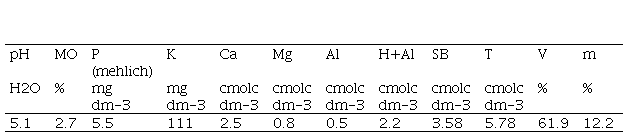
| pH | MO | P (mehlich) | K | Ca | Mg | Al | H+Al | SB | T | V | m |
| H2O | % | mg dm-3 | mg dm-3 | cmolc dm-3 | cmolc dm-3 | cmolc dm-3 | cmolc dm-3 | cmolc dm-3 | cmolc dm-3 | % | % |
| 5.1 | 2.7 | 5.5 | 111 | 2.5 | 0.8 | 0.5 | 2.2 | 3.58 | 5.78 | 61.9 | 12.2 |
The average temperature recorded during the experiment was 25.6 ºC and air humidity around 65% (Inmet, 2019). In the month of June, the average temperature was 17.8°C with rainfall of 5.28 mm, July 14.7°C and 28 mm, August 17.1°C and 25 mm, September 21.3°C and 113.6 mm and October 21.8 °C and 31.4 mm, according to data from the Cooxupé online meteorological station. The ‘Catuaí Vermelho IAC 144’ coffee variety was used, with spacing of 3.5 m x 1 m, plant stand of 2,857 plants ha-1 with approximately 3 years, where plots consisted of 1m² between the rows of coffee trees, containing average frequency of 20 sourgrass plants per plot with average height of 80 cm.
The chosen design was randomized block (RBD), consisting of 7 treatments with 4 replicates, totaling 28 experimental plots in a 3 x 2 + 1 factorial scheme, 3 herbicides, ROUNDUP® Glyphosate (445 g/L), SELECT® Clethodin (120 g/L) and FASCINATE® Glufosinate ammonium salt (200 g/L) and 2 (with and without vegetable oil 930 g L-1), plus control treatment without herbicide.
Herbicides were applied using manual costal sprayer (500 Kpa), with Teejet 110 02 tip, where the equivalent of 200 L/ha-1 of solution were applied.
The evaluation of the sourgrass (Digitaria insularis L.) control percentage was performed visually, where 0% is no death and 100% complete plant death (Silva et al., 2004), with evaluations performed 7, 14 and 21 days after application (DAA).
Plagiotropic branches were also marked in the middle third of plants, 6 branches per plant in 4 coffee plants on each row where plots were located, evaluating the number of internodes developed at 90 DAA (Alfonsi, 2008).
Phytotoxicity evaluation was carried out at 30 DAA, following the EWRC scale (where 1 is no damage and 9, total loss), observing the lower leaves of plagiotropic branches of coffee plants (Werlang et al., 2002).
Data obtained were submitted to statistical analysis using the SISVAR® Version 5.6 software (Ferreira, 2014), and significant differences between treatments being determined by the F test, with means compared by the Scott-Knott test at 5% probability level.
RESULTS AND
DISCUSSION
The results referring to the effect of herbicides are shown in Table 2, where the average sourgrass (Digitaria insularis L.) death percentages in evaluations carried out at 7,14 and 21 days after herbicide application are described.
Table 2.
Sourgrass (Digitaria insularis L.) control percentages at 7, 14 and 21 DAA
of herbicides.
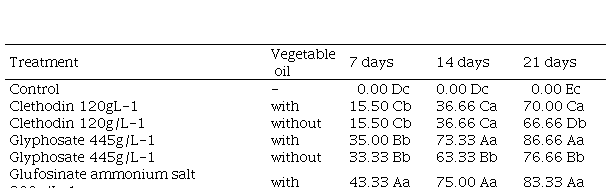 Means followed by uppercase letter in column and lowercase letter in row do not differ by the Scott-Knott test at 5% probability.
| Treatment | Vegetable oil | 7 days | 14 days | 21 days |
| Control | - | 0.00 Dc | 0.00 Dc | 0.00 Ec |
| Clethodin 120gL-1 | with | 15.50 Cb | 36.66 Ca | 70.00 Ca |
| Clethodin 120g/L-1 | without | 15.50 Cb | 36.66 Ca | 66.66 Db |
| Glyphosate 445g/L-1 | with | 35.00 Bb | 73.33 Aa | 86.66 Aa |
| Glyphosate 445g/L-1 | without | 33.33 Bb | 63.33 Bb | 76.66 Bb |
| Glufosinate ammonium salt 200g/L-1 | with | 43.33 Aa | 75.00 Aa | 83.33 Aa |
| Glufosinate ammonium salt 200g/L-1 | without | 38.33 Bb | 63.33 Bb | 70.00 Cb |
The results obtained demonstrate that at 7 DAA of herbicides, the treatment that presented the best result was glufosinate ammonium salt 200g/L-1, being enhanced by the use of vegetable oil. All herbicides had statistical differences compared to control treatment. The other herbicides had no statistical difference regarding the use or not of vegetable oil.
This condition is understood by the rapid effect (7 DDA) of herbicide glufosinate ammonium salt, acting on the inhibition of Glutamine synthase (GS), which promotes rapid accumulation of ammonia in cells, causing toxicity, reducing amino acids biosynthesis and affecting the flow of electrons and consequently photosynthesis.
At 14 DAA, herbicides that showed the best results were glufosinate ammonium salt 200g/L-1 and glyphosate 445g/L-1, being also enhanced by the use of vegetable oil. All herbicides had statistical differences compared to control treatment.
At 21 DAA, herbicides glufosinate ammonium salt 200g/L-1 and glyphosate 445g/L-1 were also those that showed the best results, being enhanced by the use of vegetable oil. These results are very similar to those found by Salvalaggio et al. (2018), who observed better effect of these herbicides associated with oil-based adjuvants.
All herbicides had statistical differences in relation to control treatment and the effects were enhanced when associated with vegetable oil, with statistical differences.
Melo (2011) evaluated the chemical control of glyphosate-resistant sourgrass (Digitaria insularis L.) in citrus orchards, and the results with the use of herbicide glufosinate ammonium at 600 g i.a. ha-1 showed no good control, as it reached the end of the experiment with control level very similar to glyphosate treatment at 1440 g i.a. ha-1.
When testing different mixtures to control sourgrass (Digitaria insularis L.), Osipe et al. (2014) concluded that mixtures of latifolicide herbicides with graminicides can reduce control provided by the graminicide applied alone to sourgrass (Digitaria insularis L.), and among tested graminicides, Clethodim showed the best results in the control of sourgrass (Digitaria insularis L.).
Salvalaggio et al. (2018), in a study carried out on the spreading and surface tension of droplets of solutions with herbicides and adjuvants in Digitaria insularis L. leaves, reported results that show the efficiency of using adjuvants added to herbicides in the spray solution, since these act to reduce the droplet surface tension, which can provide greater product efficiency.
Regarding the number of internodes developed at 90 DAA of herbicides, results are shown in Table 3.
Table 3.
Average number of internodes developed at 90 DAA.
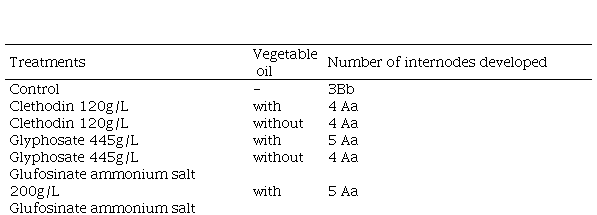 Means followed by uppercase letter in the column and lowercase letter in row do not differ by the Scott-Knott test at 5% probability.
| Treatments | Vegetable oil | Number of internodes developed |
| Control | - | 3Bb |
| Clethodin 120g/L | with | 4 Aa |
| Clethodin 120g/L | without | 4 Aa |
| Glyphosate 445g/L | with | 5 Aa |
| Glyphosate 445g/L | without | 4 Aa |
| Glufosinate ammonium salt 200g/L | with | 5 Aa |
| Glufosinate ammonium salt 200g/L | without | 4 Aa |
Table 3 shows the statistical difference between treatments in relation to the number of internodes developed, thus highlighting the importance of correct weed management between rows of coffee trees, as there was lower plant development in plots in relation to control, where no herbicide was used. Regarding phytotoxicity, lower leaves of plagiotropic branches with signs of intoxication caused by the use of herbicides were not observed, corroborating the results of Silva (2016), who observed that coffee plants submitted to chemical control of weeds with glyphosate and glyphosate + indaziflam did not show phytotoxicity that could compromise the development of internodes on the plagiotropic branches of coffee trees, being affected by the lack of weed control, which resulted in lower number of internodes.
Thus, it could be concluded that the use of glufosinate ammonium salt 200g/L-1 and glyphosate 445g/L-1 associated with vegetable oil 930 g/L-1 at dose of 0.5% of solution, were the best treatments among those used in the control of sourgrass (Digitaria insularis L.) in coffee crops and did not result in phytotoxicity in relation to the growth of plagiotropic branches.
Acknowledgments
To the Coordination for the Improvement of Higher Education Personnel (CAPES) - Financial Code 001. To the Foundation for Research Support of the State of Minas Gerais (FAPEMIG), and to the Center for the Study of Coffee Growing CESEP, Machado - MG.
REFERENCES
Alfonsi, E. L. Uso de índices fenológicos em modelos de previsão de produtividade do cafeeiro. 2008. 104 f. Tese (Doutorado em Fitotecnia) – Escola Superior de Agricultura Luiz de Queiroz, Piracicaba, 2008.
Áy, Z.; Mihály, R.; Cserháti, M.; Kótai, É.; Pauk, J. The Effect of High Concentrations of Glufosinate Ammonium on the Yield Components of Transgenic Spring Wheat (Triticum aestivum L.) Constitutively Expressing the bar Gene. Scientific World Journal, 2012, 1-9.
Caixeta, J.P.L; Franco Júnior, K.S.; Brigante, G.P.; Dias, M.S. Efeito de adjuvante associado a herbicidas no controle de Digitaria insularis L. Revista Brasileira de Herbicidas, 2019, 8, 4, 1-6. doi: https://doi.org/10.7824/rbh.v18i4.672
Companhia Nacional de Abastecimento (Conab). Acompanhamento da safra brasileira de café: safra 2019: segundo levantamento, maio 2019. Brasília, 2019, 5, 2, 1-61.
Ferreira, D. F. Sisvar: um guia dos seus procedimentos de comparações múltiplas Bootstrap. Ciência e Agrotecnologia, 2014, 38, 2, 109-112.
Instituto Nacional de Meteorologia (INMET). Disponível em:< http://www.inmet.gov.br/ portal/index.php?r=bdmep/bdmep>. Access on 12 Dez. 2019.
Köppen, W. Das geographische system der klimate. In: Köppen, W.; Geiger, R. (Eds): Handbuch der klimatologie. Berlin: Gebrüder Bornträger, 1936, Banda 1, Parte C, 1-44
Maria, M.A.; Lange, L.C.; Castro, S.R.; Soares, A.C.; Meyer, S.T. Avaliação da concentração de efeito do glifosato para controle de Eichhornia crassipes e Salvinia sp. Eng. Sanit. Ambient., 2018, 23, 5, 881-889.
Melo, M.S.C.; Rocha, L.J.F.N.; Brunharo, C.A.C.G.; Nicolai, M.; Tornisiello, V.L.; Nissen, S.J.; Christoffoleti, P.J. Sourgrass resistance mechanism to the herbicide glyphosate. Planta Daninha, 2019, 37, 1-12.
Melo, M.S.C. Alternativas de controle, acúmulo de chiquimato e curva de crescimento de capim-amargoso (Digitaria insularis) suscetível e resistente ao glyphosate. Dissertação (Mestrado) – Escola Superior de Agricultura “Luiz de Queiroz”, 2011, 1-73.
Mendonça, C.G.; Raetano, C.G.; Mendonça, C.G. Tensão superficial estática de soluções aquosas com óleos minerais e vegetais utilizados na agricultura. Engenharia Agrícola, 2007, 27, 16-23. doi: https://doi.org/10.1590/S0100-69162007000200003
Osipe, J.B.; Adega, F.S.; Osipe. R.; Alves, A.J.; Bento, D.C.; Rossi, E.; Panziera, A.C.; Salles Junior, A.J. Controle de capim-amargoso com diferentes misturas. CONGRESSO BRASILEIRO DA CIÊNCIA DAS PLANTAS DANINHAS, 2014, 1-29.
Radwan, D.E.M. Salicylic acid induced alleviation of oxidative stress caused by Clethodin in maize (Zeamays L.) leaves. Pesticide Biochemistry and Physiology, 2012, 102, 82–188.
Salvalaggio, A.C.; Costa, N.V.; Cazzo, V.N.; Junior, E.C. Espalhamento e tensão superficial de gotas de soluções com herbicidas e adjuvantes em folhas de Digitaria insularis. Revista de Agricultura Neotropical, 2018, 5, 3, 60-64.
Santos, H.G.; Jacomine, P.K.T; Angels, L.H.C.; Oliveira, V.A.; Oliveira, J.B.; Rabbit, M.R.; Lumbreras, J.F.; Wedge, T.J.F. Brazilian Soil Classification System, 2006, 2th ed.
Silva, D.A.; Albuquerque, J.A.A.; Rocha, P.R.R.; Medeiros, R.D.; Finoto, E.L.; Menezes, H.S.M. Caracterização de plantas daninhas em área rotacionada de milho e feijão-caupi em plantio direto. Scientia Agropecuária, 2018, 9, 1, 7-15.
Silva, W.; Vilela, D.; Cobucci, T.; Heinemann, A.B.; Reis, F.A.; Pereira, A.V.;
Ferreira, R.P. Avaliação da eficiência
de herbicidas no controle
de plantas daninhas em alfafa. Ciência. Agrotecnologia, 2004, 28, 4,
729 – 735.
Silva, W. C. Desempenho dos herbicidas indaziflam e glifosato na cultura
do café Conilon. 2016. 60 p. Dissertação (Mestrado em Produção Vegetal) – Universidade Estadual do Norte
Fluminense Darcy Ribeiro, Campos dos Goytacazes, Rio
de Janeiro, 2016.
Teixeira, P.C.; Donagemma, G.K.; Fontana, A.; Teixeira, W.G. Manual de Métodos de Análise de Solo. Embrapa Solos-Livro técnico (INFOTECA-E), 2017, 3 ed, 474p.
Werlang, R.C.; Ferreira, L.R.; Silva, A.A. da. Efeito da aplicação sequencial de glyphosate no controle
de commelina benghalensis
e commelina diffusa na cultura do cafeeiro. Revista Brasileira de Herbicidas, 2002, 3, 1, 1-6.
Yamada, T.; Abdalla,
S.R.S. Informações recentes
para otimização da produção agrícola, 2007, 1, 117, 1-28.
Author notes
kleso.junior@yahoo.com.br