

ARTÍCULOS DE INVESTIGACIÓN
Bibliometrics of undergraduate theses from the Faculty of Veterinary Medicine and Zootechnics at the National University of Altiplano, Puno, from 2017 to 2024. An indicator of intellectual production in the age of digital technology
Bibliometría de tesis de pregrado de la Facultad de Medicina Veterinaria y Zootecnia de la Universidad Nacional del Altiplano, Puno del 2017 - 2024. Un indicador en la producción intelectual en los tiempos de la tecnología digital
 Manrique-Quispe, Yan Pierr
Condori-Carbajal, Julio
Dueñas-Chayña, Edwin Amadeus
Rodríguez-Huanca, Francisco Halley
Pérez-Durand, Manuel Guido
Manrique-Quispe, Yan Pierr
Condori-Carbajal, Julio
Dueñas-Chayña, Edwin Amadeus
Rodríguez-Huanca, Francisco Halley
Pérez-Durand, Manuel Guido
Journal of the Selva Andina Animal Science
Selva Andina Research Society, Bolivia
ISSN: 2311-3766
ISSN-e: 2311-2581
Periodicity: Bianual
vol. 12, no. 2, 2025
Received: 01 May 2025
Corrected: 01 August 2025
Accepted: 01 September 2025
Published: 01 October 2025

Abstract: In the biomedical sciences, bibliometrics has been applied as a means of qualitative-quantitative evaluation of scientific documents, to investigate their dynamics and trends. Therefore, the objective was to analyze the bibliometrics of supported undergraduate theses between 2017 and 2024. A descriptive, observational and retrospective study of the undergraduate theses of the Faculty of Veterinary Medicine and Zootechnics of Puno from 2017 to 2024 was carried out, collecting data on year of support, gender of the thesis, species under study, area of knowledge, discipline, and number of theses per supervisor. There was a predominance of male thesis students (65%) compared to female (35%). It was observed that the most studied species were the South American camelids with 125 studies in alpacas, 6 parallel studies in alpacas and llamas, 21 only in llamas and 1 in vicuñas; cattle with 91 theses. The area of greatest research was animal production (54 % of the theses published) and its main discipline was animal reproduction with 67 studies, followed by the area of animal health with 25 %. There were 4 professors who supervised more than 25 theses and a notable increase in post-pandemic theses by 2024. This translates into a greater tendency of male thesis students with greater emphasis on theses dedicated to South American camelids within the area of animal production, with the discipline in animal reproduction by the largest number of specialist professors in this area who have dedicated a large part of their effort to the direction of the largest number of theses.
Keywords: Publication, research, scientometrics, scientific production.
Resumen: En las ciencias biomédicas se viene aplicando la bibliometría como medio de evaluación cuali-cuantitativo de los documentos científicos, para indagar su dinámica y tendencias. Por ello se tuvo como objetivo, analizar la bibliometría de tesis sustentadas de pregrado entre 2017 a 2024. Se realizó un estudio descriptivo, observacional y retrospectivo de las tesis de pregrado de la Facultad de Medicina Veterinaria y Zootecnia de Puno del 2017 al 2024, recopilando datos de año de sustentación, genero del tesista, especie en estudio, área de conocimiento, disciplina, y numero de tesis por director. Se tuvo predominio de tesistas masculinos (65 %) en comparación femeninos (35 %). Se observó que la especie más estudiada fueron los camélidos sudamericanos con 125 estudios en alpacas, 6 estudios en paralelo en alpacas y llamas, 21 solo en llamas y 1 en vicuñas; los bovinos con 91 tesis. El área de mayor investigación fue producción animal 54 % de las tesis publicadas y su mayor disciplina fue la reproducción animal con 67 estudios, seguida del área de salud animal con 25 %. Se tuvo 4 docentes que dirigieron más de 25 tesis y un incremento notorio de tesis post pandemia para el 2024. Esto se traduce en una mayor tendencia de tesistas masculinos con mayor énfasis en tesis dedicadas a los camélidos sudamericanos dentro del área de producción animal, con la disciplina en reproducción animal por el mayor número de docentes especialistas en esta área quienes han dedicado gran parte de su esfuerzo a la dirección del mayor número de tesis.
Palabras clave: Cienciometría, investigación, producción científica, publicación.
Introduction
The university thesis is research with defined parameters, it is executed as an indication of the completion of undergraduate or postgraduate studies, to obtain a university degree or degree1, being the first step to get involved in scientific research, which should not only be supported, but also published in indexed scientific journals, in order to increase the scientific production of the university community. thus, the thesis in Veterinary Medicine has great potential in publication, since the thesis published in scientific journals could be evaluated by experts for its validation and improvement in its dissemination, however, a university thesis when evaluated by university professors has certain deficiencies, which in many cases are not perceived, either due to haste or little interest in its evaluation, and who in many cases are not researchers, much less experts in the subject2. For this reason, in order to make scientific production visible, bibliometrics is the tool that makes it indispensable and necessary, since it measures through persistent indicators the visibility, downloads, number of visits and citations, essential in its institutional evaluation.
Bibliometrics is applied as a means to quantitatively evaluate scientific documents such as the thesis, and investigates their dynamics and trends, being easier nowadays, since science has been digitized3, allowing the diversification of research to be evaluated4, helping to determine weaknesses and strengths in research, propose strategies, and improve the increase in publications5. Bibliometric indicators help to discern formative research activity, identify weaknesses and strengths that are the basis for proposing strategies that increase both the quantity and quality of publications6, and are also a mechanism for assessing the scientific evolution of an academic institution, its researchers and journals4,7, thus bibliometric analysis, it helps us to evaluate the quality of research in the Faculty of Veterinary Medicine and Zootechnics (FMVZ), which would provide the authorities with concrete data to strengthen priority areas and lines of research and, ultimately, make informed decisions that benefit the development of research and improve the quality of education8.
Research, as well as bibliometrics in Peru, was limited9,10; however, the implementation of University Law 30220 marked the turning point by establishing research as a purpose of the university, increasing research, since it is considered one of the purposes of the university; this law recognizes the publication of scientific articles as fundamental, for professional training and knowledge innovation11,12, in addition to being considered the function of university teachers in response to the needs of society13. Thanks to the personal efforts of researchers, complemented by the framework of this law, the publication of research in the country's universities has achieved a sustained increase8.
Bibliometric analysis in veterinary schools in Peru is a subject that has been little studied6,14. For this reason, bibliometrics is crucial to quantify and make visible the contribution of theses published by the FMVZ14. For this reason, the objective of the study was to analyze the bibliometrics of undergraduate theses between 2017 and 2024 of the FMVZ.
Materials and methods
The study was descriptive, observational and retrospective14, through bibliometric analysis, considering the database of the Institutional Repository of the National University of the Altiplano of Puno, in the Undergraduate thesis section and in the subcommunity of biomedical sciences, the professional school of Veterinary Medicine and Zootechnics was considered between the period 2017 - 2024.
Information. Data collection was done as suggested3. First, the collection of supported digital theses was recovered from the website of the institutional repository of the National University of the Altiplano of Puno, in the FMVZ section. Second, the metadata of the theses was carried out manually in a new database considering year of support, gender of the thesis, species under study, area of knowledge, discipline, number of theses per supervisor. Third, the quantitative analysis of the data was done. Fourth, the data was visualized in figures and tables reflecting the trends and results in such a way that it looks friendly to the reader. Fifth, the interpretation of the results was carried out.
Data processing. The data was taken to a Microsoft® Office Excel sheet. The data were presented in tables and figures with absolute and relative frequencies. The statistical analysis was descriptive (averages, sum, frequencies) and bar graph. All analyses were performed in Jamovi 2.3.21.
Results
Figure 1, percentage frequency of undergraduate theses published during the period 2017 - 2024 according to the gender of the thesis students. A predominance of male thesis students is observed, who represent 65 % of the total, compared to 35 % corresponding to female thesis students.

The most studied species were the South American camelids, distributed in 125 studies on alpacas, 6 studies carried out in the same research on alpacas and llamas, 21 studies only on llamas and 1 study on vicuñas, which represents 40 % of the undergraduate theses, followed by studies on cattle with 91 documents and sheep with 42 papers. In a second order of frequency, 27 studies were recorded in small animals (guinea pigs and rabbits) and 21 in canines. The rest of the species represented a smaller proportion within the sample analyzed.
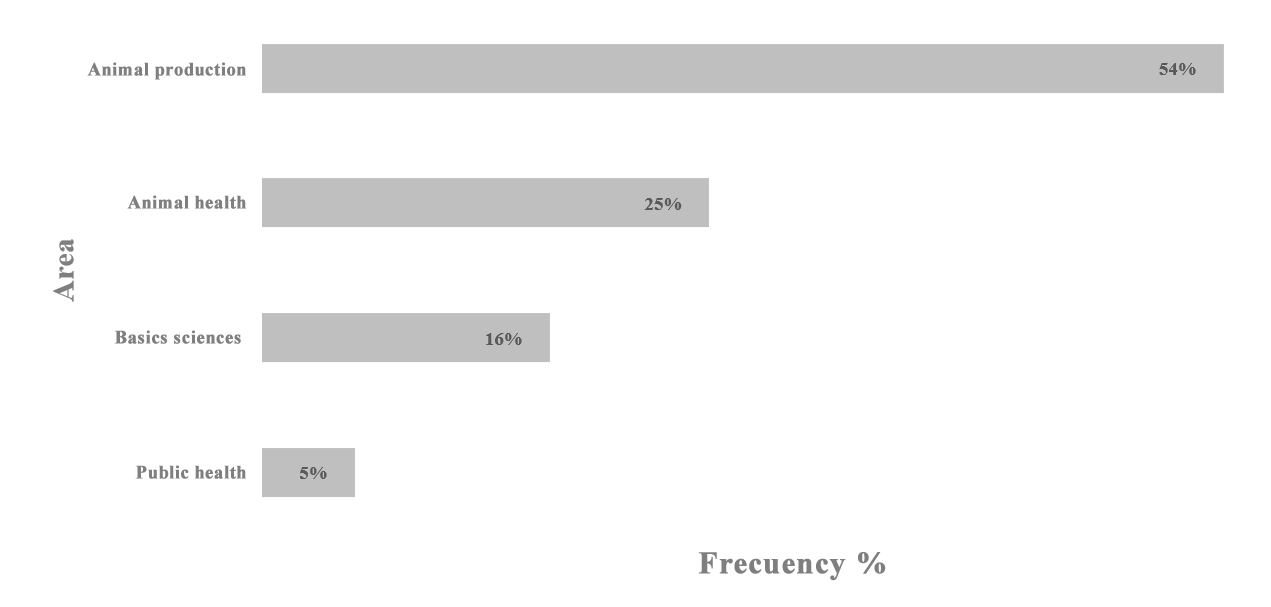
4 main areas were identified, which are Animal Health, Animal Production, Basic Sciences and Public Health, each of them with their respective disciplines as can be seen in Table 2 and Figure 2, it is noted that the area of Animal Health represents 25 % of the total and within it the most representative discipline was Virology with 24 theses. the area of Animal Production represents the highest percentage with 54 % and its largest discipline is Animal Reproduction with 67 studies; in the area of Basic Sciences there is a proportion of 16 % and within it the most outstanding discipline is Animal Physiology with 18 theses and finally in Public Health with 5 % there is the discipline of greatest relevance to Public Health itself with 13 theses and Zoonosis with 7 theses.
| Species | Years | Total | |||||||
| 2017 | 2018 | 2019 | 2020 | 2021 | 2022 | 2023 | 2024 | ||
| Small animals | 3 | 1 | 5 | 1 | 4 | 5 | 1 | 7 | 27 |
| Ovine | 11 | 5 | 3 | 0 | 2 | 6 | 4 | 11 | 42 |
| Bovine | 16 | 25 | 16 | 6 | 15 | 4 | 3 | 6 | 91 |
| Alpaca | 35 | 16 | 6 | 10 | 4 | 16 | 12 | 26 | 125 |
| Canine | 5 | 1 | 4 | 1 | 0 | 0 | 4 | 6 | 21 |
| Poultry | 3 | 2 | 3 | 1 | 1 | 1 | 1 | 6 | 18 |
| Fishes | 0 | 0 | 0 | 0 | 0 | 0 | 1 | 2 | 3 |
| Porcine | 1 | 0 | 1 | 0 | 0 | 0 | 0 | 0 | 2 |
| Wild | 0 | 0 | 1 | 1 | 0 | 0 | 0 | 0 | 2 |
| Llama | 6 | 1 | 0 | 0 | 1 | 6 | 0 | 7 | 21 |
| Human | 3 | 2 | 0 | 1 | 0 | 6 | 0 | 0 | 12 |
| Alpaca and llama | 5 | 1 | 0 | 0 | 0 | 0 | 0 | 0 | 6 |
| Equine | 0 | 0 | 0 | 0 | 1 | 1 | 0 | 2 | 4 |
| Feline | 0 | 1 | 0 | 0 | 0 | 0 | 0 | 0 | 1 |
| Vicuñas | 0 | 0 | 0 | 0 | 0 | 0 | 0 | 1 | 1 |
| Other | 0 | 0 | 1 | 2 | 2 | 1 | 0 | 0 | 6 |
| Total | 88 | 55 | 40 | 23 | 30 | 46 | 26 | 74 | 382 |
The directors (Table 3) who had a thesis published during the period 2017 - 2024 were 8; directors who conducted between 2 and 5 theses were 21; 13 directors were identified with 6 to 14 theses supervised; those professors who supervised between 15 and 25 theses were number 5 and finally those professors who conducted more than 25 theses were four.
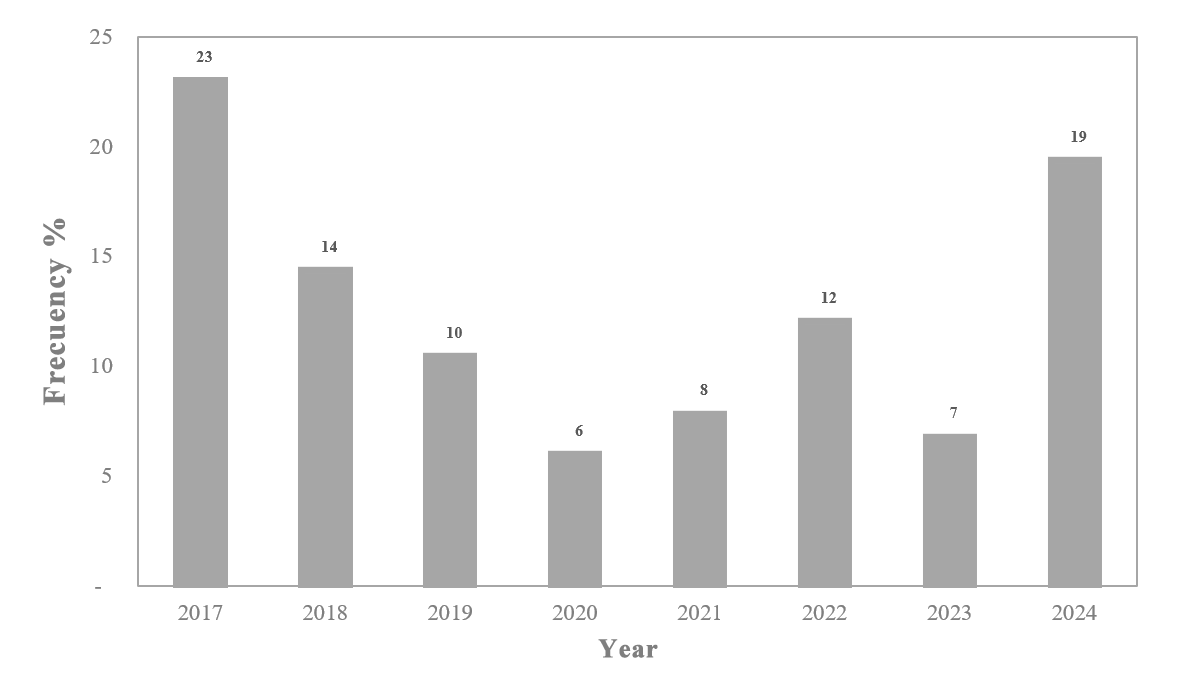
Figure 3, percentage frequency of undergraduate theses published during the period 2017 - 2024, observing a reduction in works published for the years 2018 to 2021, the lowest production of studies for the year 2020; however, the last year analyzed (2024) had a significant increase compared to the previous year, which represents 19 % of the total production.
Discussion
Regarding the gender of the thesis students, there was a similar trend to the report5. The representation of women in research has been growing, especially due to inclusion policies, so we hope that this gap will be reduced5, as it is evident in the number of female entrants to the Faculty in recent years, being up to 50 % in both genders, despite the fact that there is currently a disparity, it is expected that in the future the proportion of theses according to gender will be similar or higher for the female gender15 as has been happening in other areas of the academic world16 as reported2 with 52.2 % of female thesis students and likewise, in the Faculty of Medicine of the Universidad Nacional Mayor de San Marcos10.
| Area and discipline | Years | Total | % | |||||||
| 2017 | 2018 | 2019 | 2020 | 2021 | 2022 | 2023 | 2024 | |||
| Animal health | ||||||||||
| Parasitology | 0 | 3 | 4 | 0 | 1 | 0 | 5 | 10 | 23 | |
| Epidemiology | 3 | 7 | 1 | 0 | 0 | 0 | 0 | 0 | 11 | |
| Virology | 2 | 11 | 8 | 2 | 1 | 0 | 0 | 0 | 24 | |
| Bacteriology | 2 | 3 | 0 | 0 | 0 | 1 | 1 | 0 | 7 | |
| Animal Immunology | 4 | 0 | 0 | 0 | 0 | 0 | 0 | 1 | 5 | |
| Veterinary Pathology | 0 | 0 | 0 | 0 | 0 | 1 | 0 | 1 | 2 | |
| Animal health | 3 | 1 | 2 | 3 | 4 | 1 | 0 | 0 | 14 | |
| Clinical Pathology | 3 | 1 | 0 | 0 | 0 | 3 | 0 | 3 | 10 | |
| Total | 17 | 26 | 15 | 5 | 6 | 6 | 6 | 15 | 96 | 25 |
| Animal production | ||||||||||
| Animal reproduction | 23 | 7 | 1 | 6 | 2 | 12 | 4 | 12 | 67 | |
| Animal nutrition | 14 | 9 | 10 | 1 | 0 | 0 | 2 | 2 | 38 | |
| Animal production | 5 | 0 | 1 | 3 | 7 | 1 | 7 | 7 | 31 | |
| Poultry Production | 1 | 0 | 0 | 0 | 0 | 0 | 0 | 1 | 2 | |
| Production of small animals | 0 | 0 | 0 | 1 | 4 | 4 | 0 | 1 | 10 | |
| Flame Production | 0 | 0 | 0 | 0 | 1 | 1 | 0 | 0 | 2 | |
| Animal Feed | 0 | 0 | 0 | 0 | 4 | 2 | 0 | 5 | 11 | |
| Alpaca Production | 5 | 6 | 0 | 4 | 3 | 11 | 0 | 16 | 45 | |
| Total | 48 | 22 | 12 | 15 | 21 | 31 | 13 | 44 | 206 | 54 |
| Basic Sciences | ||||||||||
| Pharmacology | 6 | 0 | 0 | 0 | 0 | 0 | 0 | 3 | 9 | |
| Animal physiology | 7 | 3 | 3 | 1 | 1 | 1 | 2 | 0 | 18 | |
| Anatomy | 1 | 1 | 0 | 0 | 0 | 1 | 2 | 2 | 7 | |
| Genetics and animal breeding | 2 | 0 | 4 | 0 | 0 | 3 | 2 | 2 | 13 | |
| Embryology | 0 | 0 | 1 | 0 | 0 | 0 | 0 | 0 | 1 | |
| Biochemistry | 1 | 0 | 0 | 0 | 1 | 0 | 0 | 2 | 4 | |
| Histology | 1 | 0 | 2 | 0 | 0 | 0 | 0 | 0 | 3 | |
| Microbiology | 0 | 0 | 3 | 0 | 0 | 0 | 0 | 0 | 3 | |
| Anesthesiology | 2 | 0 | 0 | 0 | 0 | 0 | 0 | 0 | 2 | |
| Total | 20 | 4 | 13 | 1 | 2 | 5 | 6 | 9 | 60 | 16 |
| Public health | ||||||||||
| Public health | 1 | 0 | 0 | 2 | 1 | 3 | 0 | 6 | 13 | |
| Zoonosis | 2 | 3 | 0 | 0 | 0 | 1 | 1 | 0 | 7 | |
| Total | 3 | 3 | 0 | 2 | 1 | 4 | 1 | 6 | 20 | 5 |
| Total | 88 | 55 | 40 | 23 | 30 | 46 | 26 | 74 | 382 | 100 |
Table 1 shows the distribution of the number of theses according to species, with a total of 382 theses, which indicates the importance of Veterinary Sciences in research8, considering it one of the main thematic areas of research at the National University of the Altiplano, therefore, we consider that the support and collaboration of policies on the part of the university should be generated in this area5.
Table 1, the FMVZ has research potential in South American camelids, because the Puno region is the area with the largest population of camelids in Peru, on the other hand, the University has experimental centers such as the Experimental Center (EC) La Raya, EC Chuquibambilla and EC Carolina, where Huacaya and Suri alpacas are concentrated. K'ara and Chaku llamas providing access facilities for research, in addition the tendencies of this species under study were due to the interest of the student and the economic activity from which they come, as well as the specialties of the teachers17. The second most important species to be studied are cattle with 91 studies, due to the fact that the Puno region has livestock basins dedicated exclusively to cattle production, facilitating their study similar to what has been reported17,18.
Our bibliometrics differ from other universities that do not have South American camelids, such as the case of the report14 of the Universidad Mayor de San Marcos, prioritizing canines and cattle, and also in the case of the Faculty of Veterinary Medicine of the Universidad Peruana Cayetano Heredia, where domestic and wild animals were prioritized6.
| Thesis number by supervisor | Directors (n) |
| 1 | 8 |
| 2 a 5 | 21 |
| 6 a 14 | 13 |
| 15 a 25 | 5 |
| >25 | 4 |
In the case of areas and disciplines of study, our data are consistent with the report5, which mentions that the area of animal health and the sub-area of animal production is relevant in veterinary sciences, and likewise17 with respect to the greater number of theses in the area of animal production due to the breadth of the field of study and the interest of thesis students in livestock production systems. In our case, the largest number of theses published was in the discipline of animal reproduction, which is due to a greater number of research professors who predominate in this discipline. The above should not detract from the other areas of research, on the contrary, their development should be encouraged. Other veterinary schools also prioritize animal production6, but this differs from other schools dedicated to animal health14 or public health19.
The number of theses supervised by a supervisor is similar in proportion to what was reported17, with 4 professors directing more than 25 theses, it could be due to the fact that the professors are more empathetic with the students, as well as the level of research of the students that generate confidence in the direction of the theses14 since it is a commitment of the university professor, dedicating one's entire life to the increase of knowledge with the fundamental requirement of updating and mastering knowledge within their field13 since teachers with deficient scientific preparation could harm the research stages and generate inconsistencies between scientific research and the development of the thesis or generate irrelevant research1 hence it is necessary, that within the curricular plan of the career, research professors are designated to research courses8 since they are evaluated for their scientific production and registered in the National Scientific, Technological and Technological Innovation Registry (RENACYT)20.
Figure 3, the drop in the first years of evaluation in publications was due to the restrictive measures generated by COVID-19 in university education, bringing with it problems of adaptation to a virtual scheme, on the other hand, publications increased since 2022, which is related to the state's response to guarantee the continuity of educational services and the lifting of the restrictive measures of COVID-19 towards blended and blended education. face-to-face21. Finally, the increase in support in 2024 shows the need for the legal exercise of the profession6 since Law No. 31151 in its articles 290, 363, 364 establishes penalties for the exercise of the profession without a professional degree. In addition, another factor that contributed to the increase in theses published in 2024 could be the facilities and opportunities for research in veterinary sciences2. From all of the above, it can be deduced from the analysis of bibliometrics, I report a greater tendency of male thesis students, dedicating the greatest research effort to South American camelids, which is evidenced by the strategic role of the FMVZ in scientific production; this high specialization in South American camelids responds to the productive needs of the highland region that strengthens the value chain of this species. In addition, their EC are a source of biological material available for the development of animal production and within it the discipline of animal reproduction by the largest number of specialist teachers in this area who have been able to dedicate a large part of their effort to the direction of the largest number of theses.
Cited literature
1. Guzmán M, Chanvergo H, Guzmán B. Análisis científico y bibliométrico de las tesis de Enfermería con la Investigación Científica Universidad Nacional Santiago Antúnez de Mayolo. Rcv Aporte Santiaguino 2009;2(2).313-9. DOI: https://doi.org/10.32911/as.2009.v2.n2.411
2. Castro-Rodríguez Y, Hinojosa-Añorga M, Torres-Robles G, Roca-Sacramento C, Rojas-Ortega R. Tesis sustentadas y publicadas por estudiantes de las ciencias de la salud en Perú. EDUMECENTRO 2020;12(1):15-29.
3. Michan L, Muñoz-Velasco I. Scientometrics for the medical sciences: Definitions, applications and perspectives. Inv Ed Méd 2013;2(6):100-6. DOI: https://doi.org/10.1016/S2007-5057(13)72694-2
4. Hurtado Valenzuela AM, Sedamano Ballesteros MA, Saavedra Jaramillo de Sedamano MJ, Valenzuela Tarazona M. Diseños de las tesis de posgrado de educación: un análisis bibliométrico. Apunt Univ 2023;13(2):142-54. DOI: https://doi.org/10.17162/au.v13i2.1439
5. González TM, Salgado-Arroyo LC. Análisis bibliométrico de los artículos científicos publicados en Medicina Veterinaria y Zootecnia en Colombia 2010-2019. Rev MVZ Córdoba 2020;25(3): e2114. DOI: https://doi.org/10.21897/rmvz.2114
6. Llalla Vidal T, Mendoza Torres G, Falcón Pérez N. Evaluación bibliométrica de la investigación formativa en la Facultad de Medicina Veterinaria y Zootecnia de la Universidad Peruana Cayetano Heredia en el periodo 2012-2017. Salud Tecnol Vet 2018;6(1):9. DOI: https://doi.org/10.20453/stv.v6i1.3373
7. De La Ossa VJ, Montes-Vergara D, González-Tous M, Salgado-Arroyo LC. Análisis bibliométrico de la Revista Colombiana de Ciencia Animal - RECIA 2009-2018. Indicadores de producción. Rev Colombiana Cienc Anim RECIA 2019;11(1):724. DOI: https://doi.org/10.24188/recia.v11.n1.2019.724
8. Estrada Araoz EG, Yabar-Miranda PS, Roque-Huanca EO, Achata-Cortez CA, Jinez-García EL, Guillen-Sosa N, et al. Análisis bibliométrico de la producción científica de las Universidades del Suroriente Peruano en la Base de Datos Scopus. J Law Sust Develop 2023;11(7):e1282. DOI: https://doi.org/10.55908/sdgs.v11i7.1282
9. Urbizagástegui-Alvarado R. La bibliometría en el Perú. Letras (Lima) 2014;85(122):247-70. DOI: https://doi.org/10.30920/letras.85.122.8
10. Pacheco-Romero J, Huerta D, Galarza C, Ramos-Castillo J. Producción científica de los Institutos y Centro de Investigación de la Facultad de Medicina de la Universidad Nacional Mayor de San Marcos. An Fac Med 2012;73(2):147-51.
11. De La Ossa VJ, Pérez CA, Patiño PR, Montes VD. La investigación formativa como una necesidad en el pregrado. Rev Colombiana Cienc Anim RECIA 2012;4(1):1-3. DOI: https://doi.org/10.24188/recia.v4.n1.2012.250
12. Ley 30.220/2014 [en línea]. Lima: Ministerio de Educación del Perú; 2014 [citado 20 de febrero 2025]. Disponible en: https://siteal.iiep.unesco.org/bdnp/532/ley-302202014-ley-universitaria
13. Parra C. Apuntes sobre la investigación formativa. Educ Educ 2009;7:57-77.
14. San Martín HF, Pacheco MJ. Análisis bibliométrico de las tesis de pregrado de la Facultad de Medicina Veterinaria de la Universidad Nacional Mayor de San Marcos en el periodo 2001-2006. Rev Investig Vet Perú 2008;19(1):82-92. DOI: https://doi.org/10.15381/rivep.v19i1.1267
15. Lundine J, Bourgeault IL, Clark J, Heidari S, Balabanova D. The gendered system of academic publishing. Lancet 2018;391(10132):1754-6. DOI: https://doi.org/10.1016/S0140-6736(18)30950-4. PMID: 29739551.
16. Vidal Cabo C, Aleixandre-Benavent R, Valderrama-Zurián JC. Evolution of doctoral theses in Documentation, Automated Documentation and Bibliometrics in Spain: A gender stud. Rev Esp Doc Cient 2024;47(1):e379. DOI: https://doi.org/10.3989/redc.2024.1.1455
17. Contreras W, Benites RM., Calle F, Gómez-Quispe OE. Bibliometría y caracterización de las tesis de pregrado de la Facultad de Medicina Veterinaria y Zootecnia de la Universidad Nacional Micaela Bastidas de Apurímac, Perú. Rev Investig Vet Perú 2020;31(4):e19038. DOI: https://dx.doi.org/10.15381/rivep.v31i4.19038
18. González MR, Ríos R, Mattar S. Análisis bibliográfico de los artículos publicados en Medicina Veterinaria y Zootecnia en Colombia, 2000-2009. Rev UDCA Act Div Cient 2011;14(1):63-9. DOI: https://doi.org/10.31910/rudca.v14.n1.2011.758
19. Gómez-Quispe O, Benites RM, Contreras W, Ibañez V. Tesis desarrolladas, tiempo de realización y publicación como artículos científicos en una Facultad de Medicina Veterinaria y Zootecnia de Perú. Rev Investig Vet Perú 2022;33(4):e23345. DOI: https://doi.org/10.15381/rivep.v33i4.23345
20. III Informe Bienal sobre la Realidad Universitaria en el Perú [Internet]. Superintendencia Nacional de Educación Superior Universitaria. 2021 [citado 5 de febrero de 2025]. Recuperado a partir de: https://www.gob.pe/institucion/sunedu/informes-publicaciones/2824150-iii-informe-bienal-sobre-la-realidad-universitaria-en-el-peru
21. Observatorio de Educación Superior del Consorcio de Universidades. La situación de la educación superior en el Perú: una síntesis [Internet]. Lima: Observatorio de Educación Superior del Consorcio de Universidades; 2023 [citado 12 de febrero de 2025]. 20 p. Recuperado a partir de: https://www.consorcio.edu.pe/umbral/wp-content/uploads/2023/05/BOLETIN-INFORMATIVO-N.%C2%B0-12-UMBRAL.pdf
Notes
__________
__________
__________
__________
__________
__________
__________
__________
__________
__________
Author notes
Uri Harold Perez Guerra E-mail address: uperez@unap.edu.pe
Alternative link